Archive

Ghana

Ghana’s housing – an historical retrospective.
Ola Uduku writes:

Visiting Ghana gives one the chance to step back through time – there is an abundance of housing which has survived the vicissitudes of the temporal, physical and socio economic life of more than fifty years; and in certain cases an entire century of existence in the unforgiving tropical climate which comprises much of Southern Ghana’s landscape. In two weeks we came across these special gems.

 Timber housing: Colonial Ghana, then called the Gold Coast along with Nigeria had significant swathes of forests which were sources of tropical hardwood. The Colonial government established significant agro-forestry concerns in both countries, which resulted in timber research stations. The two houses in this post are examples of experimental worker housing that these research stations were responsible for developing. We think that the Kibi house, near the market town of Koforidua,  is over one hundred years old. The other lapped wood house was found at the Aburi botanic gardens, which had previously been the site of a sanatorium. Interestingly both buildings have substantial elements preserved including; walls, casement windows, wooden flooring and roofing elements. Generally only the non ‘wood’ roofing sheets have had to be replaced.

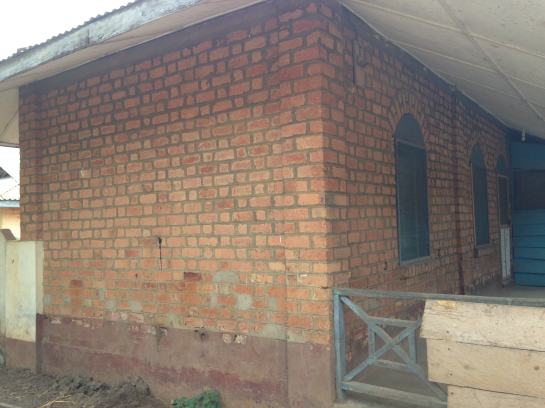
Brick Housing: At Kibi also across the road from the ‘forestry’ house we found an example of a demonstration brick building. This was a semi detached pair of worker quarters set out as a single depth bungalow with a wide verandah and walls one brick thick. The first building retained the balcony format whilst the second had its balcony appropriated to create more space for the larger families who now occupied these buildings.


Experimental Brick Housing in Kibi

Experimental Brick Housing in Kibi

Impregilo Prefabricated Housing
Going to Akosombo Community One  – which was where the elite staff and also the contractor Impregilo had its staff quarters revealed a further rare find.  Built on a higher part of the Community One hill ridge are the original staff quarters for Imregilo staff, we assume these would have been for the Italian foremen and remain in near pristine condition. The original prefabricated lightweight wall-panels can be seen clearly in the neat avenue of houses which looked in some ways like a re-created Italian village scene. A number of the houses had the individually built ‘sit out’ verandah areas with views to the Akosombo landscape and the staff club below.

Impregilo Housing in Akosombo

Prefabricated housing for Italian contractors at Akosombo

View of the Akosombo Dam

View of the Akosombo Dam from Community 1

Today’s domestic architecture in Ghana as in much of West Africa unfortunately seems to have not incorporated much of the ‘environmental design rules’ that these and other residences of this early post independence era were able to employ. The site orientation, use of lightweight materials, utilisation of large areas of operable fenestration, and shading, have all contributed to make these now historic houses exemplars of how domestic buildings could be built to ensure thermal comfort without reliance on today’s ubiquitous air conditioning systems. Surely it is now time to re-evaluate the principles so aptly demonstrated in these houses and use them as a basis for developing a more sustainable response to tropical housing in Africa today.

Notes from James Town, Accra.

Hansen Road, James Town

Hansen Road looking towards the Methodist cathedral

James Town is an old district in Accra running along the coast and associated with the British during the early colonial period – when the Dutch and Danish were also grappling for control of the town. Set behind the Usher Fort are many warehouses, trading posts and residences. A fine array of historical buildings can still be found here, but much of its rich tangible and intangible heritage is at risk through insensitive development, lack of maintenance and the departure of large businesses from the area. Despite this, it remains a vibrant and charming district full of markets, traders and the cultural epicentre that is the James Town Café, recently frequented by Emmanuel Macron during his visit to Accra.

James Town Cafe

James Town Café

Led by the charismatic Allotey Bruce-Konuah we weaved our way through the markets and informal structures that now occupy the gaps and leftover sites, punctuated by a vast collection of colonial-era buildings. Our first stop is a stone obelisk encased within an old market hall. The obelisk was built shortly after 1900 to commemorate the last of the Anglo-Ashanti wars. One of the plaques is in Arabic script, perhaps in recognition of Nigerian-Islamic troops who fought the Ashanti with the British. From here we went to the adjacent market hall. It was used until quite recently – and with some minor repairs could make for a very fine market venue today, perfectly sited on a strong axis and at the centre of the district.

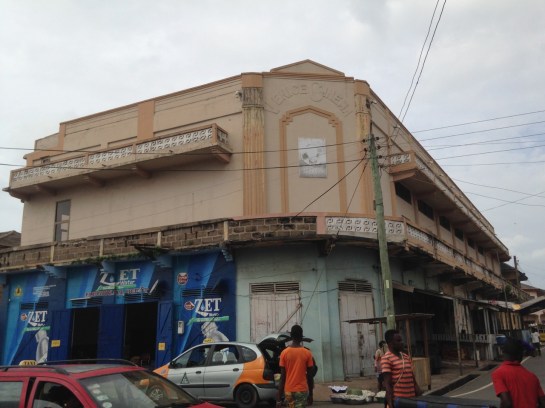
We visited Azumo house, built in 1914 – the original owner’s escapades of shipwrecks and ‘salvaging’ are apparently recorded in the Red Book of West Africa. The quality and number of historical buildings is surprising – a case of preservation by leaving-be. The warehouses of the Compagnie Francaise de L’Afrique Occidentale (based in the Royal Liver Building in Liverpool) occupy a prominent site, and Ellen House built in 1918 boasts a rich history – we will attempt to uncover more.

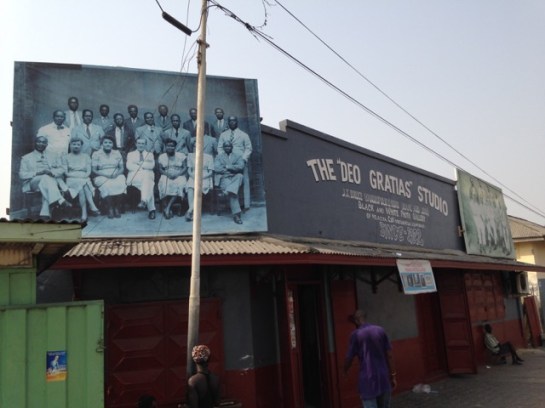
Our trip concluded with a visit to the studio of Deo Gratias. You may remember some of the photos from this studio featuring in The Guardian (and here) not so long ago. It was extraordinary to see these images printed and in large format. Kate Aku Tamakloe, the granddaughter of the studio’s founder, JK Bruce Vanderpuije, and curator of the collection kindly gave us a tour. Kate told us there are many, many more images to scan, some from glass plates. We look forward to seeing more of this important work.

Deo Gratias Studio

Deo Gratias Studio James Town

Notes from Tema, Ghana

We visited Tema, the new port and town built 10km east of Accra in the 1950s and early 1960s. Planned as part of a suite of infrastructure projects including, an aluminium smelter, docklands, and hydroelectric dam, the town was to provide model housing in a series of self-contained neighbourhoods, called ‘Communities’. Each has its own central market area and Community Building surrounded by a series of residential areas. The houses are set around schools and recreation areas, and grouped according to size and occupant income.

We began at Community 1 and explored the market area, complete with extended community centre, before finding some of the distinctive ‘Type iv’ housing. The housing has been extended and in-filled but the original basic form is just about discernable. Other housing had been supplemented by gardens and painted facades. The low-rise flats with central access staircase have been well-maintained and there is a strong sense of pride in the neighbourhood here.

Michael Hirst designed the Type iv housing. He studied at the Architectural Association in the Department of Tropical Architecture before moving out to Ghana (then known as Gold Coast) in the mid 1950s. He worked for the Tema Development Corporation, and lived in the Denys Lasdun designed flats in Tema. We had a good look for these flats and hoped to track them down – but alas, they eluded us….

Community 2 Housing

Community 2 Housing

At Community 2 we saw some grander properties (surely inspired by Maxwell Fry’s work in Chandigarh), as well as a market with vaulted roof and carefully detailed concrete and guttering system. The structure is, however, badly corroded and in need of urgent repair. The traders informed us that the market is likely to be demolished and replaced shortly.

Community 2 Market

We moved on to Tema Manhean, the ‘replacement fishing village’ built to house the Ga People who were displaced with the building of Tema (see our paper for more detail). The settlement wraps around the light house and is made up of a series of compound houses designed by Maxwell Fry and Jane Drew. We found one compound that was built in 1961 (as noted by the date etched into the concrete during construction) and barely modified since. It was a perfect example of just how successful and adaptable the compound typology can be.


SaveSave

Notes from Accra 2018

Escaping the freezing temperatures of the UK we returned to Ghana for our final trip of the British Academy sponsored project. There were a number of buildings on our list still to be visited in Accra and we were eager to explore…

George Padmore Library, Accra

George Padmore Library, Accra

The first stop was the George Padmore Library designed in 1961, and containing a vast collection of Kwame Nkrumah’s personal books and pamphlets. The building is hidden in the Efua Sutherland Children’s Park and forms an excellent example of tropical modernist architecture with carefully detailed finishes, craftsmanship and landscaping. The cooling reflection pool sits beneath the open-tread staircase that weaves its way up into the reading room. There is no air-conditioning here, just the pleasant breeze enticed through the building by the louvres on each side. Who is the architect of this oft-overlooked gem? The Librarian is eager for the facilities to be expanded and developed – we hope they pursue a sensitive solution, and avoid what has happened the library at Sekondi.

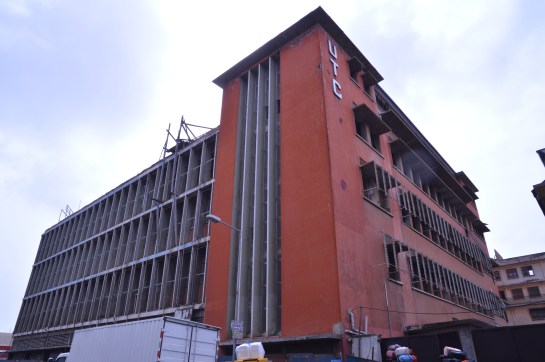
UTC Building

UTC Building

From here we visited the UTC building, a former department store and office block now stripped of its external solar-shades and in the process of demolition. We were lucky to photograph this building, as a few weeks from now it will no longer exist. The building is located in the frantic and exciting market area of town where everything from a tomato to a stadium PA system can be purchased. The market grew up around the train station that brought produce from the north and relayed the imported goods back. Complete with a dainty clocktower and waiting rooms the station structure is made from an imported cast iron kit from either Liverpool or Glasgow. Although there are no trains running any longer the station is as busy ever with squatters and traders making full use of the facilities.

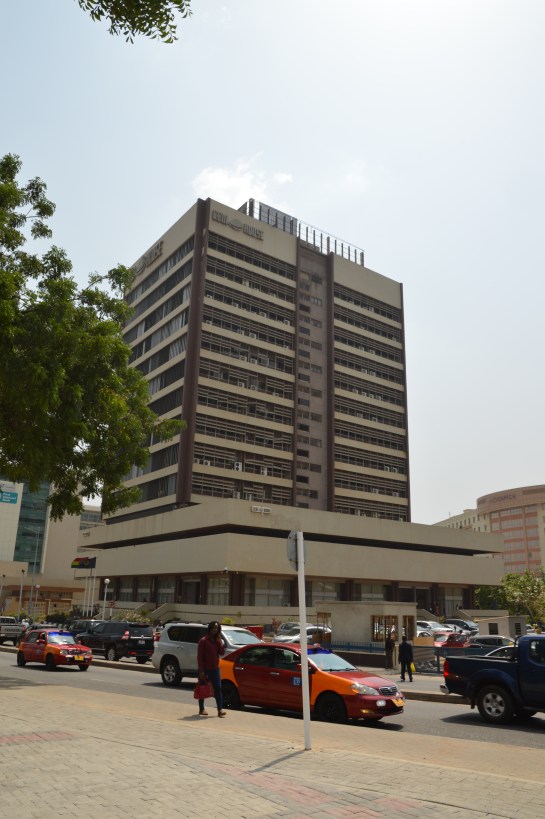
Cedi House

Cedi House

Cedi house, the first podium-base-cum-high-rise to be built in the city in the early 1960s by John Owusu Addo is now, sadly,  looking a little tired, and needs some major investment. Each façade is different to respond to the specific climatic/solar demands. Inside a couple of murals survive and the marble cladding and exposed staircase give a glimpse of the building’s former style.


The Transnational Architecture Group Blog is 5 Today!

It’s five years since our first tentative blog post. Since that day we’ve posted over 200 articles, calls for papers, and general research updates on all things architecturally transnational.

One of our major research interests has of course been the work of Maxwell Fry and Jane Drew, with the publication of the monograph in 2014 and international conference. But that was just the start. Since then we’ve covered Shama Anbrine and Yemi Salami’s PhD work in Pakistan and Nigeria respectively, as well as Cleo Robert’s PhD work in India. Rachel Lee tested and developed our Timescape App in Bangalore and also published a wonderful monograph (with TAG Press) on Otto Koenigsberger. She was also responsible for a major heritage symposium in Dar es Salam. Ola Uduku has been our most prolific ‘commenter’ as well as providing many research updates on our findings in Ghana and organising numerous workshops on the Architecture of Africa. Our current research project has been sponsored by the British Academy and we’re delighted to be collaborating with Rexford Assasie Oppong (KNUST) and Irene Appeaning Addo (Legon University) on this work.  There is going to be a lot more research stemming from this initial project, not least the cataloguing and archiving of the major drawings collection at KNUST, with Łukasz Stanek from Manchester University.

Other forays have taken us to Thailand and the work of Nat Phothiprasat, as well as to Sri Lanka and the plans of Patrick Abercombie.  We’ve posted abstracts and links to many other papers and projects, not least Johan Lagaes and Kathleen James-Chakraborty’s papers. Killian Doherty and Edward Lawrenson’s film on Yekepa promises to be one of the highlights of 2018.

More recent posts have revealed the rich architecture of the Middle East, including Levin’s paper on Ashkelon, William A. Henderson‘s work at Little Aden,  Ben Tosland’s research into Kuwait, Alsalloum’s moving paper on Damascus and Jackson’s paper on the PWD in Iraq. There’s surely a lot more to investigate here.

It’s been great fun, and here’s to the next five years of exciting research, difficult questions, dusty roads and even dustier archives, and of course new discoveries that make everything worthwhile.

We’d like to thank all of the blog contributors (please do continue to send us your updates, research findings and short articles). Thanks also to our committed readers and for all of your kind comments and emails.

Iain Jackson.


It is with great sadness that the AA has learnt of the death of former AA Principal Professor Michael Lloyd (AADipl 1953). The following obituary, written by Svein Erik Svendsen, Hans Skotte and Patrick Wakely is translated from Norwegian by Desmond McNeill and originally published on the AA website.

Architect and multifarious professor Michael Lloyd was buried in Oslo on 16 June 2017.

With him we have lost one of the foremost architecture educators of our time; not just in Norway – his work and influence were global. He was born in England in 1927 and studied at the Architectural Association (AA) in London. Whilst still a student he took part in the post-war reconstruction of Finnmark, Norway, and after graduating, Alvar Aalto arranged work for him in Helsinki. He then practiced in Oslo and taught at the School of Art & Craft where he met Catharine, who became his wife and lifelong companion.

1501857756

In 1959 he was appointed first year master at the AA, in charge of all new students to the school. In 1962 Kwami Nkrumah University of Science & Technology, Kumasi, Ghana, approached the AA for assistance in re-organising and running its faculty of architecture that had been established in 1951, but had become moribund. The AA responded to this and gave the job to Michael Lloyd, who was appointed professor and dean of the faculty in 1963. He immediately appointed several new full-time members of teaching staff, several of whom were drawn from the AA Department of Development and Tropical Studies – later to become the Development Planning Unit (DPU) at University College London, and radically reorganised the curriculum and teaching style of the faculty. Over the following five years, Michael brought a number of interesting short-term visiting professors to the faculty, including Buckminster Fuller, Jane Drew, Keith Critchlow, Paul Oliver and Joseph Rykwert. The faculty gained an internationally acclaimed reputation for its innovation and educational and architectural excellence.
In 1966 he was appointed principal of the AA School of Architecture, where he also initiated new and challenging educational and administrative reforms. These were turbulent times for higher education in the United Kingdom and he left the AA after a few years. He then restored the School of Architecture in Kingston-upon-Hull and joined the DPU where he directed a Master’s degree programme in design teaching methods, as part of which he was instrumental in reforming the faculty of architecture at the University of Costa Rica in San José.

On leaving the DPU in the early 1980s, he assisted local efforts in establishing new schools of architecture in Bergen, Norway, where he remained a professor for several years and in Reykjavik, Iceland. Thereafter he was appointed professor at the Oslo School of Architecture and Design, where he, among other things, conducted a project at Makerere University in Uganda, which eventually encompassed the whole of East Africa.

As a teacher, and as the sympathetic man that he was, his work was based on the idea of “the responsible human being” that one learns through taking responsibility for one’s own professional development, and that one’s skills are a personal social responsibility. As an educator Michael was unorthodox, inspiring and very much present as a teacher. He was inquisitive, courageous, and knowledgeable and had highly respected friends all over the world. His international position remains outstanding. To become principal of the AA School of Architecture, which many regard as the world’s best school of architecture, one must possess very special qualifications. Michael had those. As was said during his funeral, “Michael was a truly good man”.

Image: Michael Lloyd at his home in Spain in November 2016, by Mónica Pacheco, Dip. Arch., MA, Ph.D., Department of Architecture and Urbanism, University Institute of Lisbon

An interesting book and reappraisal of 20thC Modernist architecture by Freddy Gibberd’s grandson has been published by Phaidon http://uk.phaidon.com/store/architecture/ornament-is-crime-9780714874166/  

I was especially pleased to see Kenneth “Winky” Scott’s house in Accra included:

3952

More here: https://www.theguardian.com/artanddesign/gallery/2017/jul/19/modernist-architecture-photography-corbusier-concrete-gibberd-hill

Ola Uduku and colleagues at Edinburgh University hosted an excellent workshop this week on West African Modernism, combining some of the sessions with Docomomo Africa. The result was a very rich series of encounters, exchanges and discussions.

IMG_1676

Ilze Wolff presenting Rex Truform’s factory in Cape Town

Ilze Wolff gave a very poignant paper on Rex Truform, the clothing factory in Cape Town designed by Max Policansky in 1937. Ilze’s investigation goes beyond the built fabric and stylistic qualities of the structure – it considers the workers’ stories and what it was like to be a part of the everyday life of this significant building in the city. Ilze is also publishing her findings and interventions through a series of booklets: see Open House Architecture for more details.

IMG_1674

Shantanu Subramaniam’s presentation on Community Centres and Libraries in Ghana

Shantanu Subramaniam presented his recent fieldwork on the community centres and libraries of Ghana. In addition to architectural surveying and cataloguing Shantanu is also considering the environment performance of these structures and testing their ability to modify climate and interior temperatures.

IMG_1675

Joe Addo’s skype presentation on modern architecture in Accra

Joe Osae-Addo joined us via Skype and shared his film on modern architecture in Accra. The film presented an autobiographical account of Accra and its modern architecture, as seen and experienced by Joe from his childhood onwards. It is a compelling piece that will deliver far more impact in changing ‘hearts and minds’ than reports and conservation legislation.

You can watch the film here: https://stream.liv.ac.uk/s/hav96uun

We also discussed the DOCOMOMO presence in Africa and whether there should be regional groups [such as West Africa, Southern Africa and so on], to generate a more critical mass and greater influence. The reliance on the fiche methodology was also questioned – or at least its limits acknowledged – and we considered the use of ‘narrative’ and social history as a means of generating meaning, significance and connection to these structures beyond the fetishisation of the physical attributes, and tangible qualities.

IMG_1697

Cumbernauld townscape

On the final day we were treated to a site visit to the new town of Cumbernauld, and Stirling University.

The 6th Conference on Infrastructure Development in Africa, has just concluded with a particular focus this year on ‘Building Resilience through African Urban Culture’. Held at KNUST in Kumasi, Ghana the conference welcomed speakers from Nigeria, South Africa and UK, as well as a host of research papers presented from scholars based in Ghana.

Key note speakers (including Prof. Chike Oduoza, Dr Obuks Ejohwomu and Prof. Mugendi M’Rithaa) lucidly presented the varied and many challenges facing African cities today – with particular focus on energy use, digital infrastructure and the internet of every/things.

Prof. M’Rithaa’s presentation included some very striking map visuals, including the image below that shows the true size of Africa relative to other countries – something that Mercator projection of the world fails to reveal. You can just make out on the poor quality photo below the outlines of USA and India. He also spoke very eloquently on how our solutions must be people centred, rather than imposed solutions. Dr Ejohwomu also challenged us with many provocative questions and themes – including a cartoon showing an emaciated cow and a worker abandoning it in pursuit of an obese cattle. His challenge was that we can’t simply walk away from the problem and that Africa needs us to focus on its problems rather than attempting to flee them in the ‘global north’. This message also reinforced by Prof. David Edwards and Dr. Erica Parn in their presentation.

IMG_1313

IMG_1322

I gave a presentation on the rich modern architectural history of Ghana, and the infrastructure of culture that exists here. I focused on a series of building types including education, community centres, and libraries, as well as the town planning and historical development of Kumasi.

IMG_1309

Nearly 50 papers followed on a vast array of topics as well as a striking art installation on the plight of the African Giant Snail’s ecosystem. A new journal was launched ‘Journal of Built Environment (ISSN: 2026-5409) and next year the conference will migrate to Lagos – we look forward to hearing more from this important gathering.

“Founded in 1922, Deo Gratias is the oldest photography studio still in operation in Accra. As the city celebrates 60 years of independence this week, the studio has revealed new photos of life in the 1920s and 1930s”.

Does Achimota School still have such a formidable boxing club?

2464

9789

Empire Day, Accra, 1930

More photos here: https://www.theguardian.com/cities/gallery/2017/mar/07/accra-a-century-ago-ghana-before-independence-in-pictures