Call for Papers: British Architecture in the World
As part of its long-running series Twentieth Century Architecture, the Twentieth Century Society is planning a journal for publication on the relationship between British architecture and other countries of the world, particularly those beyond Europe.
Pansodan Street, Yangon, including Chartered Bank, Palmer & Turner, 1939–41.
The nature of the relationship may take a number of forms, such as British-based practices working overseas, British architects establishing offices in other countries, architects coming to Britain for training before returning home, or more general issues of how the profession in Britain set standards for education and validation elsewhere, in particular through the RIBA. We tend to favour actual buildings as subject matter in Twentieth Century Architecture, but on this occasion the field may be wider, including town planning, cultural responses, climatic adaptation, administrative histories, professional formations, and relationships to the later period of colonialism and its ending. Accounts of the scope of archival resources could be of interest, and we might also include reports on the current state of buildings, including threats and conservation projects.
Jane Drew, housing in Sector-22, Chandigarh, c. 1954.
The scope outlined above is larger than usual for what is a relatively small collection of published pieces – the journal usually contains about ten articles – but it seems preferable not to place limitations until we are aware of what might be available. Recently, research and publication in this area have grown rapidly, and our aim is to bring together articles that complement each other, but with a spread of periods (anything from 1914 to around 2000), styles and locations. The journal will be the sixteenth in the series, and will probably be published in 2023.
In the first instance, please send your ideas by 01 July 2020 in the form of an abstract of up to 300 words, along with a brief CV and list of publications to date, to elain.harwood@HistoricEngland.org.uk, who will also answer any queries. Abstracts will be reviewed by the editorial committee of the journal, drawn from members of the Twentieth Century Society Publications Committee, and selected for full submission. Completed texts will be peer-reviewed.
Following commissioning, delivery would be 1 March 2022, the length of articles should be between 2,000 and 5,000 words, with up to ten images per article. Contributors are expected to provide and pay for images of publishable quality.
Online Symposium: Epidemic Urbanism Reflections on History: 28 May and 29 May 2020
Epidemic illnesses – not only a product of biology, but also social and cultural phenomena – are as old as cities themselves. The recent pandemic of COVID-19 has put into perspective the impact of epidemic illness on urban life and exposed the vulnerabilities of the societies it ravages. So how can epidemics help us understand urban environments? And what insights from the outbreak and experience of and the response to previous urban epidemics might inform our understanding of COVID-19?
Addressing these questions, this online symposium on Thursday 28 and Friday 29 May, 16:00–18:00 BST (11:00–13:00 US EST) will bring together academics from a range of disciplines to present case studies from across the globe demonstrating how cities in particular are not just the primary place of exposure and quarantine, but also the site and instrument of intervention.
Each presentation will tell a story of a city, an outbreak of illness, and the city’s response to the epidemic, addressing notable interventions or actions implemented and their effects. Some will discuss the impact of the epidemic on urbanism, urban design and urban planning. Others consider epidemic influence on architecture, the built environment and the experience of illness.
Presentations will cover a range of illnesses and epidemics, geographies, time periods and urban interventions. The observations on the impact of these epidemics on society and urban life seek to offer insights to understand, critique or complicate the conception of and response to COVID-19 because the symposium ultimately aims to create a space in which to use history as a medium to provide a better understanding of the current crisis and how it might shape our future.
The 7th International Congress on Construction History (7ICCH) will be held in Lisbon, from 12 to 16 July, 2021. As in 6ICCH (Brussels, 2018), the 7ICCH event will adopt a two-step procedure for proposals evaluation:
– First call: a first call for proposals for thematic sessions will be open from 15 April 2020 to 9 May 2020; followed by a
– Second call: a general call for abstracts for the usual open sessions, from 18 May to 28 June 2020.
We are what we build and how we build; thus, the study of Construction History is now more than ever at the centre of current debates as to the shape of a sustainable future for humankind. With the main theme “History of Construction Cultures”, the Congress will provide an opportunity to celebrate and expand our understanding of the ways that everyday building activities have been perceived and experienced in different cultures, times and places.
The general call for abstracts will invite proposals for inclusion in thematic sessions as well as single contributions dealing with a broad range of construction history topics (construction determinants and their relation with design, extraction and processing of materials, site management, works execution processes, knowledge transfer, actors, machines, tools, building legislation, construction – politics, economy and society, etc.). The aim will be to achieve a broad and in-depth assessment of new research in construction history.
The present call, open until 9 May 2020 invites prospective session chairs to suggest topics for thematic sessions. The proposed subjects should contribute to the debate of the latest issues, approaches and questions of research in the field of construction history research, stimulating intercultural and interdisciplinary collaboration and discussion. Proposals should include a description of the theme (max. 400 words), an explanation of the relevance of the theme (max. 400 words) and the CV of the applicant chair demonstrating his/her relevant expertise.
With the support of the Scientific Committee, the Organizing Committee will select up to 12 thematic sessions, limited to one per applicant. Chairs of the thematic sessions are expected to be present at the 7ICCH and give a short introduction to their session. They are, in collaboration with the Scientific Committee, responsible for the selection process of the submitted abstracts and for the editing process of the submitted papers. Four or five papers will be selected for each session.
No more than one paper from the chair’s research team can be selected. The Scientific Committee reserves the right to redirect papers towards other thematic or general sessions. Proposals should be sent to 7icchlisbon@gmail.com until 4 May 2020. Prospective session chairs will be informed on the evaluation of their proposals by the Organizing Committee by 18 May 2020.
Organizing Committee:
Chair – João Mascarenhas Mateus (University of Lisbon) Treasurer – Ana Paula Pires (NOVA University of Lisbon) Sandra M. G. Pinto (NOVA University of Lisbon) Fernanda Rollo (NOVA University of Lisbon)
José Aguiar (University of Lisbon)
Ivo Veiga (University of Lisbon)
Milton Pacheco (Coimbra University)
Manuel Caiado (University of Lisbon)
The Coloniality of Infrastructure: Eurafrican Legacies:
Call for Papers – Conference at the University of Basel, 24-26 June 2020
When Eurafrica emerged in the 1920s as an intellectual and political project to connect Europe with Africa, its goal was to ensure European colonial dominance in a changing world. Key to the proposed continental merger was infrastructure—not surprising at a time when railways, ports, camps, and other large-scale building projects were facilitating the extraction and movement of things for Europe while curtailing the freedom and mobility of Africans on an unprecedented scale. Recent scholarship has emphasized the centrality of Eurafrica and the type of colonialism it mustered in the history of European integration, from the EU’s founding intellectuals to its Cold-War-era realization. But continental infrastructure also played a role in African struggles for independence. Highways, ports, and dams became tools of state-building and even mobilized hopes of Panafrican integration and international solidarity. In practice, however, large-scale infrastructure required technical and financial aid which further entrenched Africa’s asymmetrical relationship to the Global North.
Today, as Africa enters a new age of development increasingly dominated by China, and the EU is in fundamental crisis, is it still possible to speak of a Eurafrican present? From the physical imprint of cities and the configuration of intercontinental airline routes, infrastructure testifies to the enduring legacies of Eurafrica. Infrastructure shapes territories and governs the mobilities within and across them, but also serves to immobilize and externalize bodies and things. The European infrastructure of the Mediterranean border regime, in which African migrants are systematically being detained or left to die, recalls colonial-era policies that valued life and dictated death along racial lines. At the same time, European aid focused on infrastructural development in Africa is increasingly targeted to counter such unwanted migration—without touching the global extraction economies that have roots in European colonial rule and continue to shape African cities and territories today. Because of these specters of Eurafrica, the EU seems structurally incapable to come to terms with its colonial past.
This conference proposes to explore historical continuities in Africa’s relationship with Europe through the lens of infrastructure. What are the infrastructural histories that bind the unequal destinies of people together across continents, and how do these legacies shape contemporary lifeworlds and international relations? How does infrastructural violence shape international relations between Africa and Europe, and how is the legacy of Eurafrica manifested in the spaces of everyday life? To answer these questions, the conference invites scholars from urban studies, history, political science, postcolonial theory, architecture, border and migration studies, and allied fields. We invite contributions that develop new perspectives of our geopolitical and interconnected urban present through its infrastructural pasts. Such studies of material and aesthetics relationships between Africa and Europe can focus on questions of lifeworlds, urban transformation, migration, territory, citizenship, development, or related themes. We are particularly interested in studies that can reveal the differential entanglements between people and places, and locate alternative forms of infrastructure, imaginaries of belonging, ongoing struggles for decolonization, and practices of world-making that decenter colonial ways of seeing, feeling, and knowing.
Confirmed Keynote Speakers:
Elizabeth Povinelli (Columbia University)
Siba N’Zatioula Grovogui (Cornell University)
Scientific Committee:
Peo Hansen (Linköping University, Sweden)
Edgar Pieterse (University of Cape Town)
Muriam Haleh Davis (University of California Santa Cruz)
Samia Henni (Cornell University)
Charles Heller (Forensic Oceanography, Geneva)
Anne-Isabelle Richard (University of Leiden)
Bilgin Ayata (University of Basel, Sociology)
Julia Tischler (University of Basel, Centre for African Studies)
Lorena Rizzo (University of Basel, Centre for African Studies)
Madeleine Herren-Oesch (University of Basel, European Global Studies)
Selection of Speakers:
Please submit an abstract of no more than 300 words and a short C.V. by 10 December 2019 to Michelle Killenberger (michelle.killenberger@unibas.ch). Applicants will be notified of acceptance in February 2020. We will cover travel and accommodation expenses for speakers in need of financial assistance.
Conference Organization:
The conference is organized by Kenny Cupers, Urban Studies, Department of Social Science at the University of Basel, in collaboration with Sociology, the Centre for African Studies, and the Institute for European Global Studies, as well as the African Centre for Cities at the University of Cape Town.
Follow-up Conference:
A follow-up conference will take place in collaboration with Prof. Edgar Pieterse at the African Centre for Cities at the University of Cape Town in June 2021. Entitled “Emerging Infrastructural Worlds: Mapping Urban Research in Africa,” this conference will map research approaches to transnational infrastructure projects across Africa and their consequences on the ground.
More information:
This conference is funded by the Swiss National Science Foundation. For more information about the conference and associated research projects, please visit:
Book Review by Robin Hartanto Honggare: “Southeast Asia’s modern architecture: questions of translation, epistemology and power” by Jiat-Hwee Chang and Imran bin Tajudeen, Planning Perspectives.
Livelihoods and culture under threat in Ghana’s historic port of Jamestown
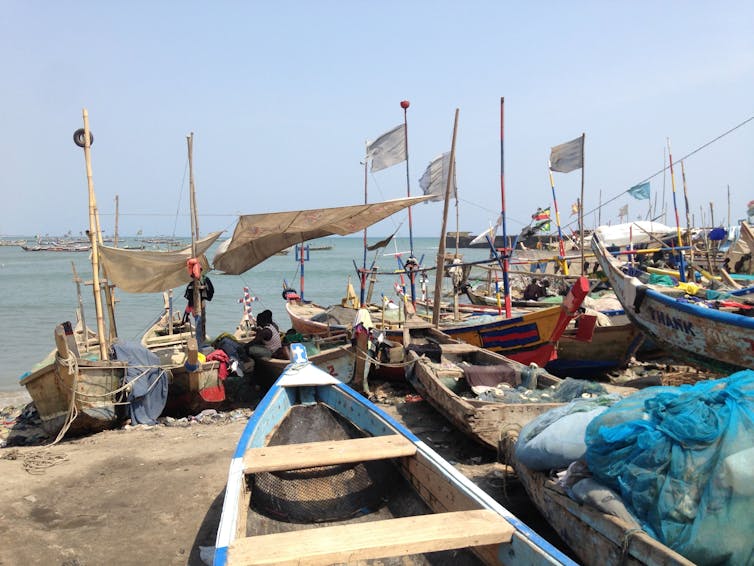
The beachfront of historical Jamestown, Ghana.
Plans are afoot to replace the historic Ghanaian fishing port of Jamestown with a Chinese-backed mechanised factory.
This is a move that will destroy traditional livelihoods, as well as damage the historic built environment. It will drastically change not only the tangible fabric of this historic town, but also impact the fishing methods, market traders and community that’s reliant on the sea.
Since 2011 I have been researching the history of Ghanaian architecture and urbanism, and have been particularly struck by its impressive collection of heritage structures and associated narratives.
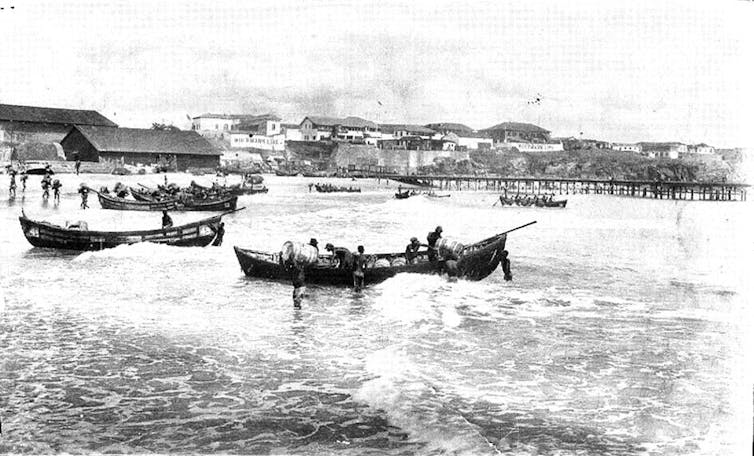
The harbour at Accra’s district of Jamestown was built to provide shelter from the heavy surf that pounds this part of the coast. The breakwater and pier were equipped with railway tracks, gantries and cranes to handle the large produce exports following the cocoa boom of the early 1900s. The wealth created from this trade saw some fine buildings being built. An array of warehouses, stores and villas survive (some very precariously) in Jamestown to this day.
Historical photograph of Jamestown. Courtesy of Wirral Archives
The shallow waters of the harbour utilised smaller surf boats who ferried the goods in and out to the ships anchored in deeper water. The creation of new ports rendered the Jamestown harbour superfluous by the 1950s and it was no longer used for international trade.
While this profoundly affected the livelihoods of the surf boat owners, as well as the economic prosperity of the Jamestown area, it has still remained an active harbour, returning its focus to fishing. New canoes are still built on the beach, nets are made, repaired and dried, and a large, if casual, fishing market trades off the shore.
Although described as a beach, it’s still a working harbour rather than a place for leisure. Businesses, residences, schools, places of worship and bars have all been established on the beach and a large population considers it their home and community. The place has a very different feel to the rest of the city. It has an intimate connection to the sea, dictated by the tides, rituals, songs and danger that accompanies all fishing communities.
It is “informal”, sometimes appears anarchic, and while not suitable in its current format for freight shipping, its potential for commercial development has caught the attention of the municipality and international investors.
New development
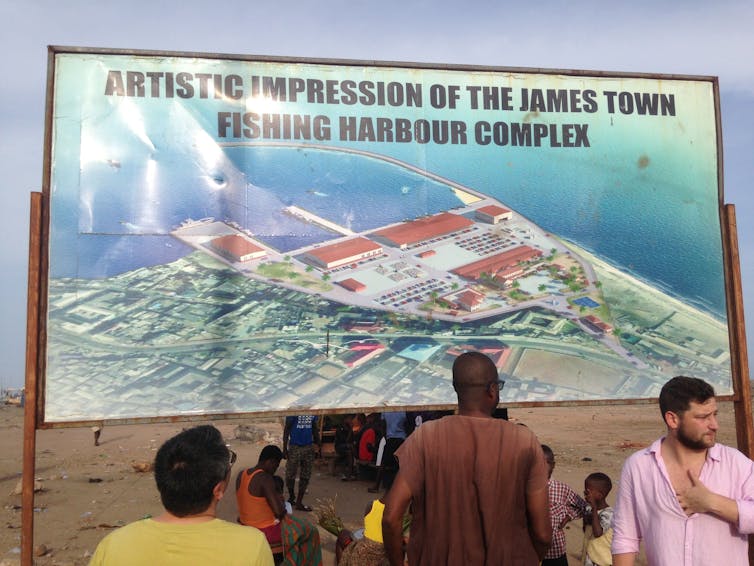
Earlier this year a billboard was suddenly erected on the beach displaying an “artist’s impression” of how the beach is to be developed. It’s a disturbing image in many ways, showing the beach completely cleared of its inhabitants. There’s also a large car park and a series of somewhat bland sheds or factories. There is not one single canoe in sight.
An artist’s impression of the new Jamestown development. Iain Jackson
The proposal (and its backers) see this site as a convenient place to construct a new factory for the mechanised processing of fish. There is nothing inherently wrong with this as an idea. But the current proposal would not only occupy a prime site with historical significance: it would displace a large community along with their heritage, skills and traditions.
There are four main considerations that have not been addressed by the current proposal. And with the beach already being cleared of its residents and traders, time is running short.
Seafront heritage site: A shoreline development with an historic waterfront requires sensitive and appropriate proposals. A failure to deliver this undersells the site’s potential. It is not appropriate for a factory and car park to be placed on this important plot.
It is hard to imagine any other international port city using its most important natural features in this way. The attractive view over the ocean offers lots of possibility for this site. Reducing it to a fish-gutting production line is shortsighted and lacks ambition.
Community discussion and liaison: The settlements and businesses located on the beach are “informal” (like most of Ghana’s economy). But this must not discount or invalidate their contribution to future development. No one is more invested in this place than the current population, part of the minority Gā community, with their own language and traditions, who have lived and traded here for centuries.
Individual fishing boats and their small hauls may not be the most efficient or lucrative methods of extracting the bounty of the sea. But they bring many advantages. The main traders (and controllers) are women affectionately known as “mammies”, who set the prices and manage supply.
This matriarchal system has been largely responsible for ensuring a strong community. Whilst these traders are fiercely competitive, they care for each other and their lives. Memories and stories are inherently bound to this place – the proposed factory would completely undermine and destroy this market and cohesion.
Mechanised production would also result in fewer employment opportunities. The power would be taken from market traders and fewer fishermen would be required.
Fish stock: Environmentally the mechanised processing and trawlers would be disastrous for the fish stock. The existing method marries periods of fallow with festivals, allowing the sea to recuperate and replenish. There is a rhythm to the current fishing method that responds to the seasons and traditions. It is unlikely this approach will be respected by the new process and the factory’s profit driven approach.
Tourist potential: The first place tourists visit when arriving in Ghana is usually Jamestown and the harbour area. Its two former slaving forts and the historic mercantile core of the town, coupled with the array of festivals and events, have so much potential as revenue creators.
They must be treated as rare commodities, not as cheap development plots. If this district is gradually eroded, its natural features, historic charm and engaging community dismissed, then what else is there for visitors to see in Accra?
In the last six months eviction processes have started to clear the beach. This is an earnest plea for this proposal to be rethought – and for this fascinating part of the city to be regenerated in a way that celebrates and respects the history and people of Jamestown.
Thank you to Prof. Ola Uduku of Manchester School of Architecture for reviewing the ‘Sharing Stories from Jamestown’ exhibition. The exhibition has been extended to run until the end of June 2019. Below I’ve uploaded a 360 degree panoramic view – you can ‘click and drag’ the film to have a look around….
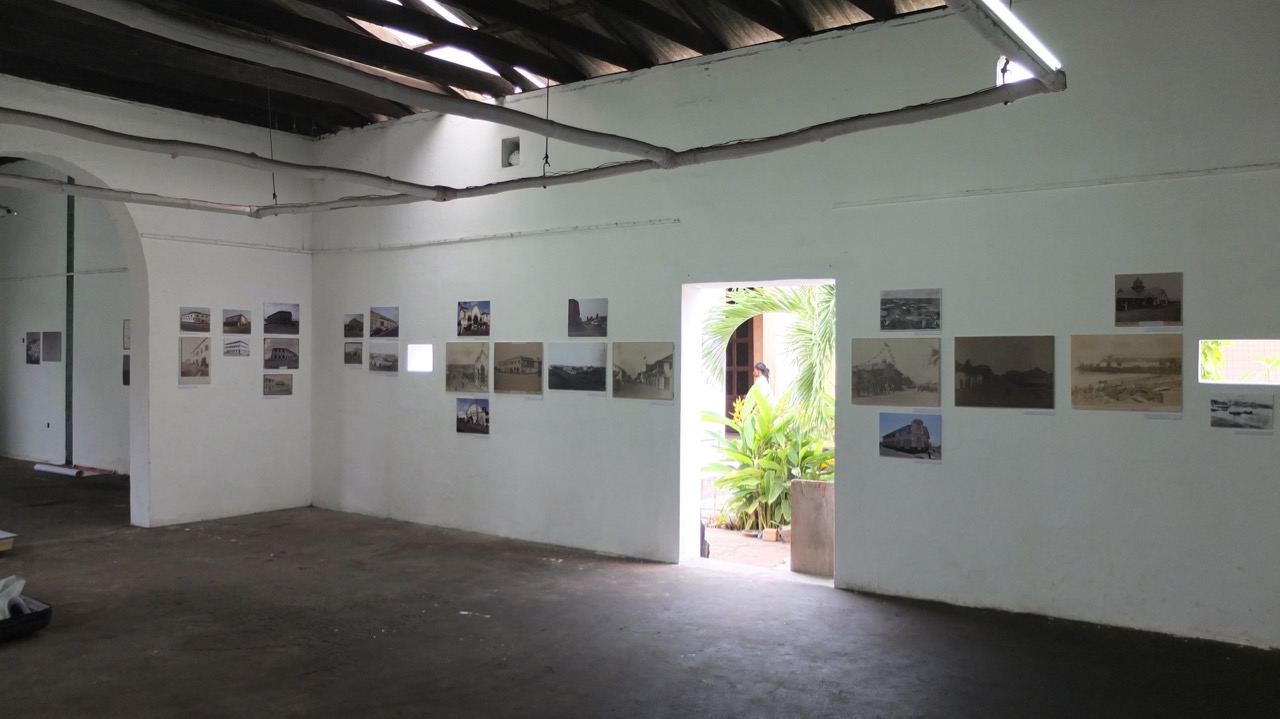
Iain Jackson’s exhibition co-curated by Allotey Konuah-Bruce and Joe Addo opened to great acclaim on Saturday evening at the Jamestown Café, venue, near Ussher Fort. Curiously the café it was confirmed by local elders who attended the opening is accurately in Usshertown; the exhibition launch providing a great forum for these questions to be aired and for detailed discussions to be had.
Historic photographs and maps of ‘old’
Jamestown buildings have been placed next to those which show their age,
condition and use, in ‘contemporary’ Jamestown have been displayed in the lower
gallery of the Jamestown Café, which itself features in the exhibition as Tarquah
house, the dwelling and warehouse of one of Jamestown’s wealthy local
merchants, who had originally had it built. The exhibition represents a true
joint collaboration between Iain Jackson and Allotey Konuah-Bruce who have formed a close and productive working relationship as they have spent the…
This is an excellent opportunity for emerging writers and students. Last year’s gathering produced some excellent work, and this year we will have the exhibition at James Town Cafe as a provocation and stimulus for debate….
We are pleased to announce that we are now accepting applications for the 2019 British Academy – ASAUK funded 2019 African Architecture Writing Workshops. These workshops are offered for postgraduate students looking to develop their academic writing skills in the areas of architecture, urbanism and related disciplines.
This year there are two workshops. The first to be offered will take place in May 2019
FIRST WORKSHOP DETAILS
“Sharing
Stories from Jamestown and the Creation of Mercantile Accra” Writing Workshop
Monday, May 12 – Sunday, May 18, 2019
This workshop explores the colonial
and mercantile architecture of Jamestown, the British settlement area of
colonial Accra and located in Ga Mashie. This writing workshop is linked to the
May 17 exhibition organized by Professor Iain Jackson (University of Liverpool) and Joe Osae-Addo and Allotey Bruce-Konuah (Jamestown Cafe), which will showcase archival and historical images and maps of Accra’s…
(sub) URBAN TROPICALITY: Urban challenges in the tropical zone
International Network of Tropical Architecture (iNTA) Conference at The University of Queensland, Brisbane, Australia, 5 – 8 December 2019
The cities and urban centres of the (sub) tropics are where the greatest challenges facing our collective future can be found. They are where the challenges of global warming, inequality and the migration of people fleeing political unrest or climate change are at their most extreme. The 2019 International Network of Tropical Architecture (iNTA) conference provides a forum to discuss architectural and design solutions for a resilient, smart and just future for urban centres in the tropics.
Founded in Singapore in 2004, the International Network for Tropical Architecture (iNTA) is a networking platform for international researchers and practitioners to collaborate and learn from each other about problems and solutions pertaining to architecture and urban design in the tropical (and sub-tropical) regions and brought together by the shared climatic imperatives and opportunities of these regions. The iNTA permanent secretariat is located at the Department of Architecture, School of Design and Environment at the National University Singapore.
The 2019 iNTA conference is hosted by the School of Architecture at The University of Queensland, located in Brisbane, capital city of the state of Queensland, Australia. Brisbane is proximate to both the fastest growing urban centres in Asia and many Small Island Developing States (SIDS) most at risk from climate change, including Kiribati, Marshall Islands, Federal States of Micronesia, Marshall Islands, Niue and Tuvalu amongst others. Queensland’s most northern extremity, Cape York, sits at the confluence of the Indian and Pacific Oceans, those very same oceans that generate the weather systems that circle the globe and affect the destiny of millions of people.
For those who live in the so-called “global south,” there is a sense of urgency about the challenges arising from rapidly changing climate conditions. Matters are not merely academic, but dynamic and concrete. Before the launch of iNTA, discourse around architecture and urbanism in the tropics was framed by centres of scholarship in Europe and North America. The malingering aftermath of devastating tropical storms such as Maria and Irma (2017) in the Caribbean and Typhoon Haima (2016) in the Philippines challenges such ascendancy. The 2019 iNTA conference in Brisbane brings discourse to a subtropical city at the crossroads of cultures, regions and climate zones. At a time when Australia’s role in the region continues to be questioned, it provides an opportunity to enhance north-south dialogue.
Submission Information & Instructions
Submit abstracts of no more than 300 words in length by email as Word documents to: https://easychair.org/conferences/?conf=inta2019. Please name the email subject ABSTRACT-SURNAME and use this name for your submission file as well.
Abstract deadline: 26 April 2019
Submission of full papers for review: 26 July 2019
Submission of final papers for publication: 18 October 2019
All abstracts will be considered by the conference academic committee; authors will be invited to prepare a full paper (no longer than 4,500 words); authors wishing their papers to be published in conference proceedings should submit their final papers for peer review on or before 26 July 2019. The date for submission of final papers is 18 October 2019. Authors may opt out of publication.
Conference Streams
Tropical Architecture refers to constructed architectural and urban environments relating the climatic and natural conditions of the tropical (and sub- tropical) regions, and interacting with various local specifics of culture, urban fabric and technology. Contributions to the following conference streams are sought.
1. Tropical Urbanism
Stream focussing on challenges to and solutions for enhanced liveability in urban centres of the tropics. Papers might address:
projects or propositions for reversing or healing the degradation and collapse of urban centres under rapid growth;
urban infrastructures at risk: rising sea-levels, increasing storm intensity, expanding torridity and aridity.
urban adaptation responses : design planning policy, governance and codes
urban forms shaped by determinants other than climate alone, such as topography, nature, cultural life.
vegetation in (sub) tropical cities: cultivation in gardens and the peri-urban or neglect in terrain vague.
Stream focussing on individual designs/ architectural, infrastructure, adaptation projects. What is it that makes the contemporary architectural project tropical? Or the tropical project contemporary? Papers might illuminate projects that demonstrate instances of :
building technologies: tropical and subtropical applications including
passive low energy and carbon neutral architecture
climate mitigation strategies
equity in the tropical city
the (sub)tropical tower
contemporary architecture (still) learning from vernacular traditions
reciprocities/dialogue between architecture and tropical environments: between the zeitgeist of a globalized culture and a project’s specific circumstance.
3. Narratives of Disease, Discomfort, Development and Disaster :: Reconsidering Tropical Architecture and Urbanism
The idea of tropical architecture and urbanism initially developed through a particular connection between discourses on disease, spatial practices and optimum architectural typologies, which were believed to circumvent the spread of tropical diseases and to maintain the comfort of the white settler. After the Second World War, the focus shifted from the European settlement of the colonial tropics to the self-development and governance of the world’s tropical regions; a phenomenon necessitated and propelled by post-war decolonization and global regimes of development aid. Accompanying this change was a shift away from the physiological comfort of the colonial settler to a new focus on indigenous cultures, vernacular building traditions, use of local materials, and increasing appreciation for the psychological value of cultural conventions, including superstition and taboo. The aim of this stream is to examine how “triumph” in the tropics was imagined across multiple geographies, by various subjects, through diverse discourses, and at different times and to critically investigate the roles architecture and urban planning played in this process. We particularly welcome papers that offer historical case studies of tropical and subtropical architecture and urbanism examined through one of four lenses:
disease
discomfort
development or disaster.
This stream will be convened by Dr Deborah van der Plaat (The Univerity of Queensland), Dr Vandana Baweja (University of Florida) and Professor Tom Avermaete (ETH Zurich).
4. Historic Urban Landscapes and Tropicality
The Historic Urban Landscape is a new approach recommended by UNESCO that recognises and positions the historic city and its core as a resource for the future and the centre for the urban development process. Papers might address:
operational principles for urban conservation models: respecting values, traditions and environments of different cultural contexts.
historic urban centres and tropical vulnerability
mapping urban heritage values and attributes
planning, design and implementation of development projects in historic urban centres
adaptive use and re-use impacting authenticity and integrity of physical and social fabric in historic urban centres
Small Island Developing States (SIDS) of the Pacific and Caribbean: their vulnerability and resilience
A World History of Architecture, a small but mighty conference organized by Murray Fraser took place at The Bartlett School of Architecture, UCL, November 2-4, 2018. Over two days, and only eight sessions, Fraser was able to curate a cumulative and rigorous series of presentations that tousled with all facets of teaching global architectural history to the undergraduate and graduate audience. The conference focused on the term “global” in two ways. The first was as a geographic lens, a method that leaned towards the increased inclusion of previously ill-studied parts of the world into the architectural survey. The second was an intellectual engagement with the instruction of global architectural history, and an analysis of its growing interdisciplinarity with neighboring fields of study. The aim of these methods of engagement was explicitly to study and inform on the future direction of global architectural history in universities.
The morning session on day one, The Expanded Field, had Mark Jarzombek tangling with the concept of tradition, a theme that can be in one sense totalizing of all that is non-modern, but in another, a useful/clever label used to project value and meaning onto art and architectural objects. The presentation intended to make clear a much needed separation between the term traditional – so often a synonym for the vernacular – and the meaning of global history.
Subsequent sessions were based on the themes of:
Global Domesticity
Colonialism, Post-Colonialism and Beyond
Architectural History and Design Research
Informalities, Identities and Subjectivities
Culture and Architectural History
Architectural History as Pedagogy
Evening sessions focused on a discussion of the architectural object on the first day, and closed with an ambitious debate of the future of architectural education on the second. Throughout, the group of global scholars shared the pedagogical challenges of teaching in architectural history in their home institutions, in hope that together, they could begin to envision a way for the discipline to transcend beyond its seemingly fixed limits. David Leatherbarrow, in his presentation on Architectural History as Pedagogy transformed architectural survey into a study of architectural details, with intense focus on the various elements that compose the architectural object, rather than a rote evaluation of the whole. In this way architectural education takes pause, ensures that the students absorb and evaluate, not just commit the basic facts of architectural history to memory. Students thus are able to engage emotionally with their object of study, connect with the built environment around them, and, most importantly, hone their critical analysis skills.






 Transnational Architecture Group