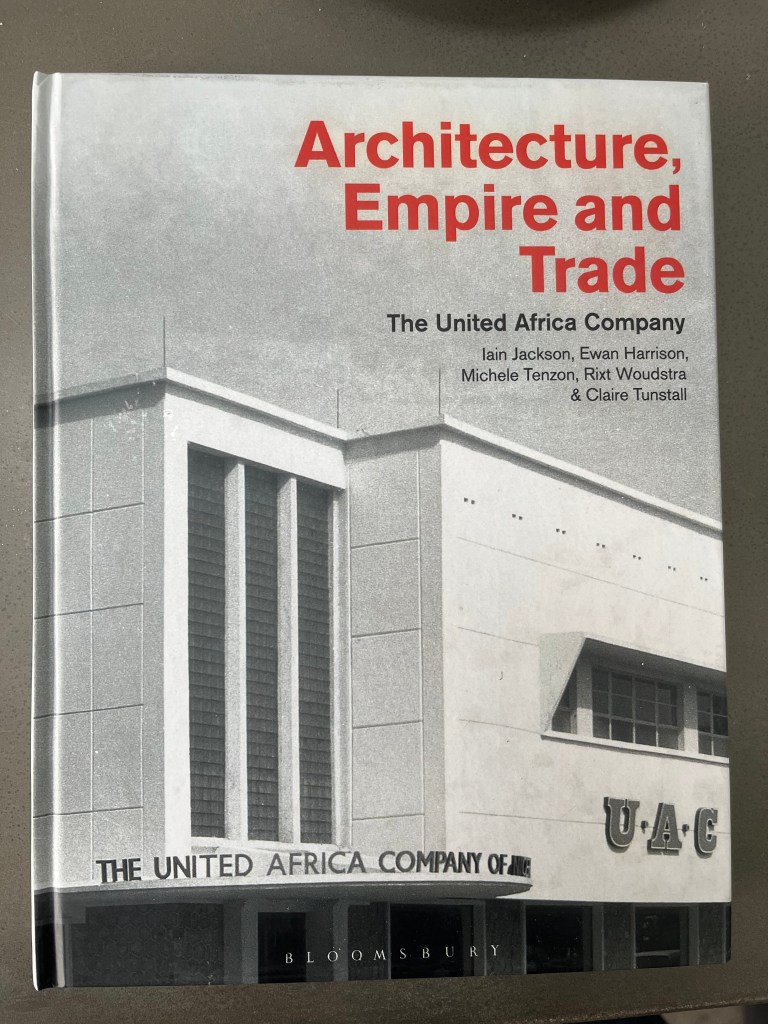
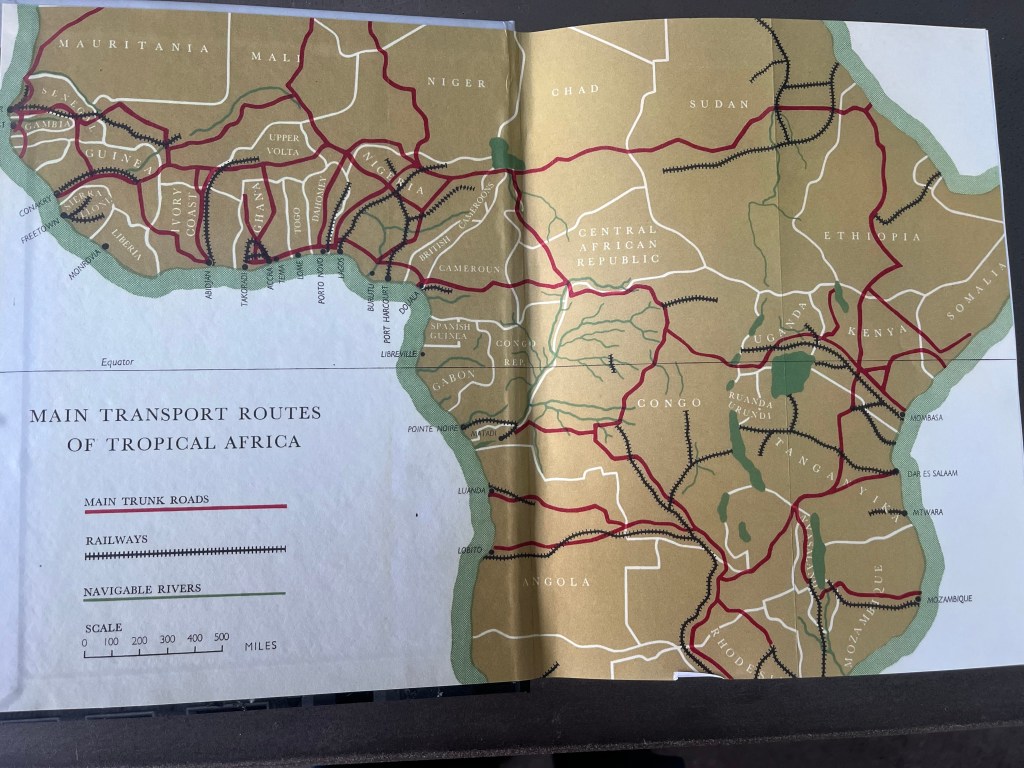
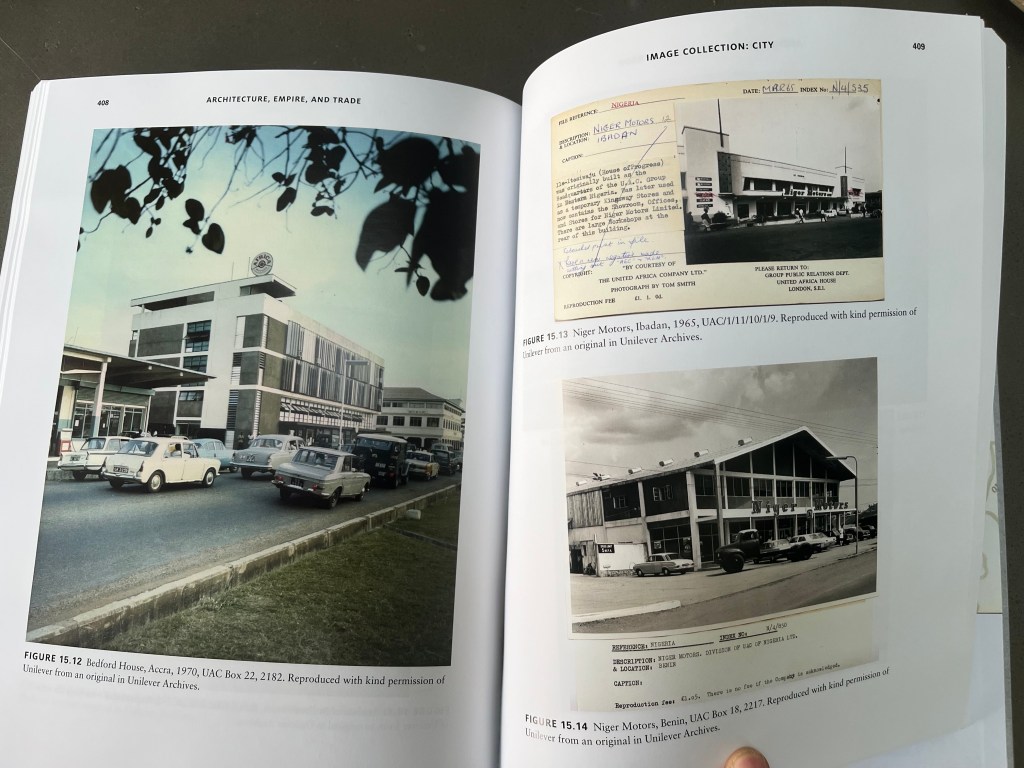
Our monograph Architecture, Empire, and Trade: The United Africa Company has just been published with Bloomsbury. We’re delighted to finally share our findings with you on the architecture of Western and Central Africa. The work begins with an critique of the archive and the UAC collections, before examining the Royal Niger Company, the development of Burutu and Lagos; the Lever’s concessions in Congo, the timber townships of Samreboi and Sapele; real estate and construction, the Kingsway Stores, and much more.
In addition to the main chapters the monograph includes specially commissioned essays from ‘responders’ as well as a series of photographic essays using previously unpublished images from the superb Unilever archives.
Liverpool School of Architecture, at the University of Liverpool and the Program in the History of Science, Medicine, and Technology of the Johns Hopkins University invite proposals for a hybrid symposium to be held in Liverpool from the 17-18 April 2025.
Pathology Labs, Korle Bu Hospital, Accra, c1958
We welcome presentations that explore various settings for health and healing, such as shrines, sacred healing huts, and herbal ‘apothecaries’ and other spaces for indigenous medicine and healing practices; ‘basic’ health care infrastructure incorporating dispensaries, clinics, and hospitals developed for early missionary and colonial medicine; post-independence medical centres. We are also interested in papers examining the use of healthcare ‘vectors’ such as barefoot doctors, travelling midwives and paramedics and their spread of health care practices such as vaccinations, and childhood nutrition programmes in urban and rural areas.
We are interested in the settings for full range of medical specialisms from paediatrics to psychiatry and also more contemporary physical design responses to contemporary pandemics such as Ebola and Covid. Evidence and records of mixtures of indigenous and western healthcare practices in some community settings and the emergence and involvement of teaching hospitals in healthcare planning is also of interest.
Other possible topics include the role of military hospitals, colonial and modern, and contemporary healthcare infrastructure and provisions for displaced persons and refugees. We encourage interdisciplinary approaches–history of medicine, medical anthropology and sociology, oral history, among others.
Our area of interest is the African continent, from the ‘MEANA’ countries of the maghreb, north of the Sahara, to all countries South of the Kalahari and East and West of the Sahara. Health and healing facilities on islands in proximity to main continental mass such as Zanzibar, Mauritius, Fernando Po and Cape Verde are also of unique interest.
We are seeking to publish selected outputs from the symposium in a volume currently under negotiation with the publisher. We welcome abstracts (500 words max) and short CVs (1page) Please also indicate whether you intend to deliver your paper in person or online. For more information please contact Ola Uduku o.uduku@liverpool.ac.uk or Bill Leslie, swleslie@jhu.edu
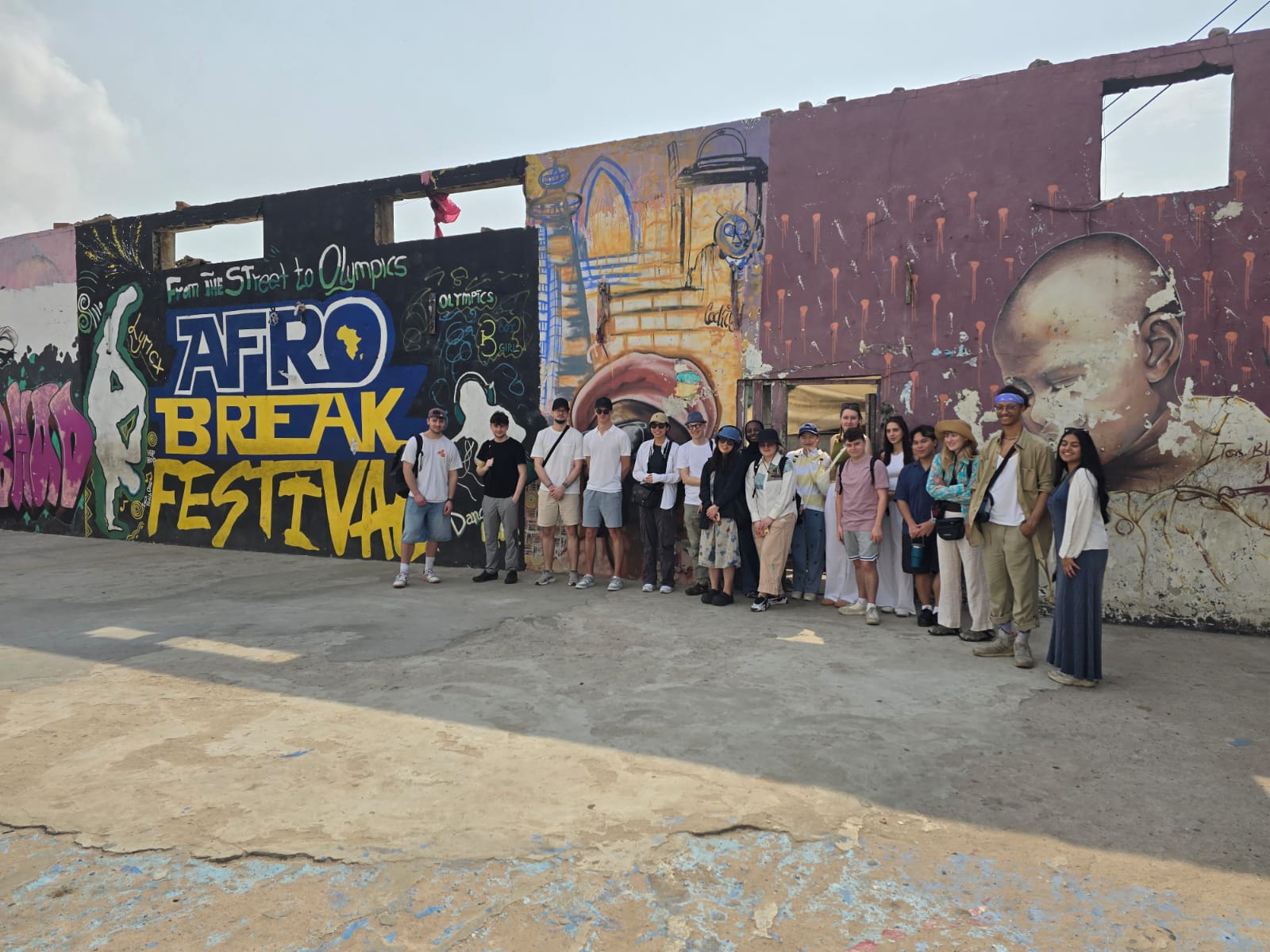
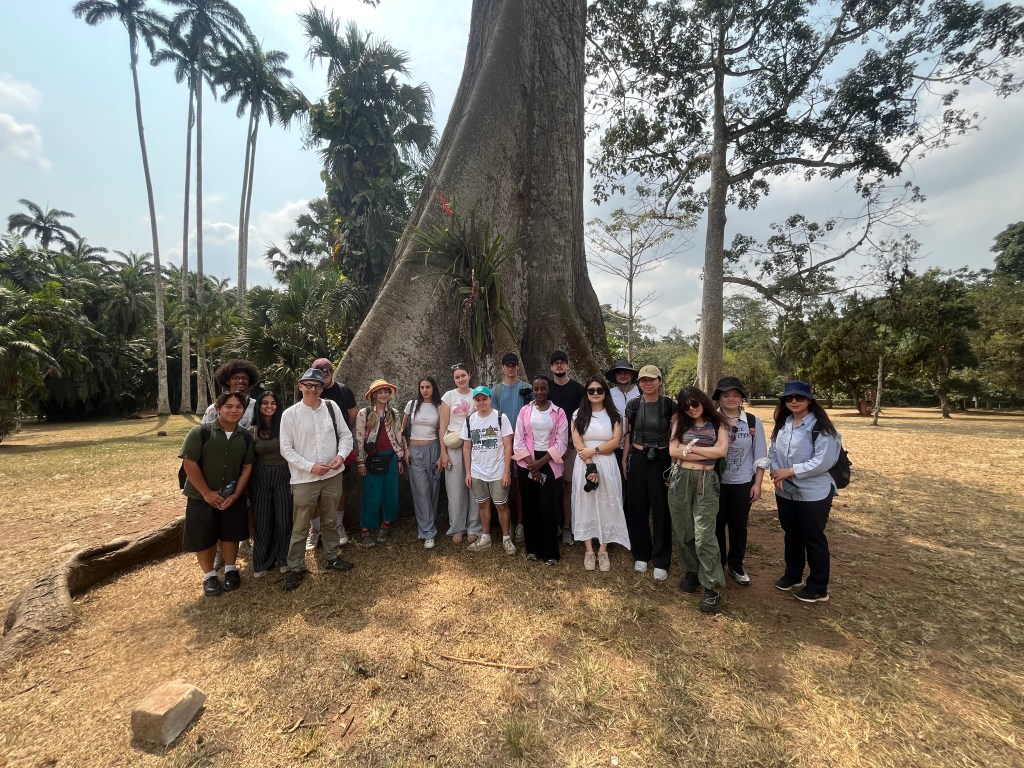
We’ve just returned from a Liverpool School of Architecture BA3 field trip to Ghana. 17 students from the AHUWA studio visited Accra, Kumasi, Cape Coast, and Aburi. We’ll be setting a theoretical design project at the former Kingsway Stores site on Accra’s High Street. Students will be using the site to test climatically appropriate design solutions, naturally cooled interiors, and how a new botanical research station, exhibition, and garden could be reimagined in the historic core of Accra.
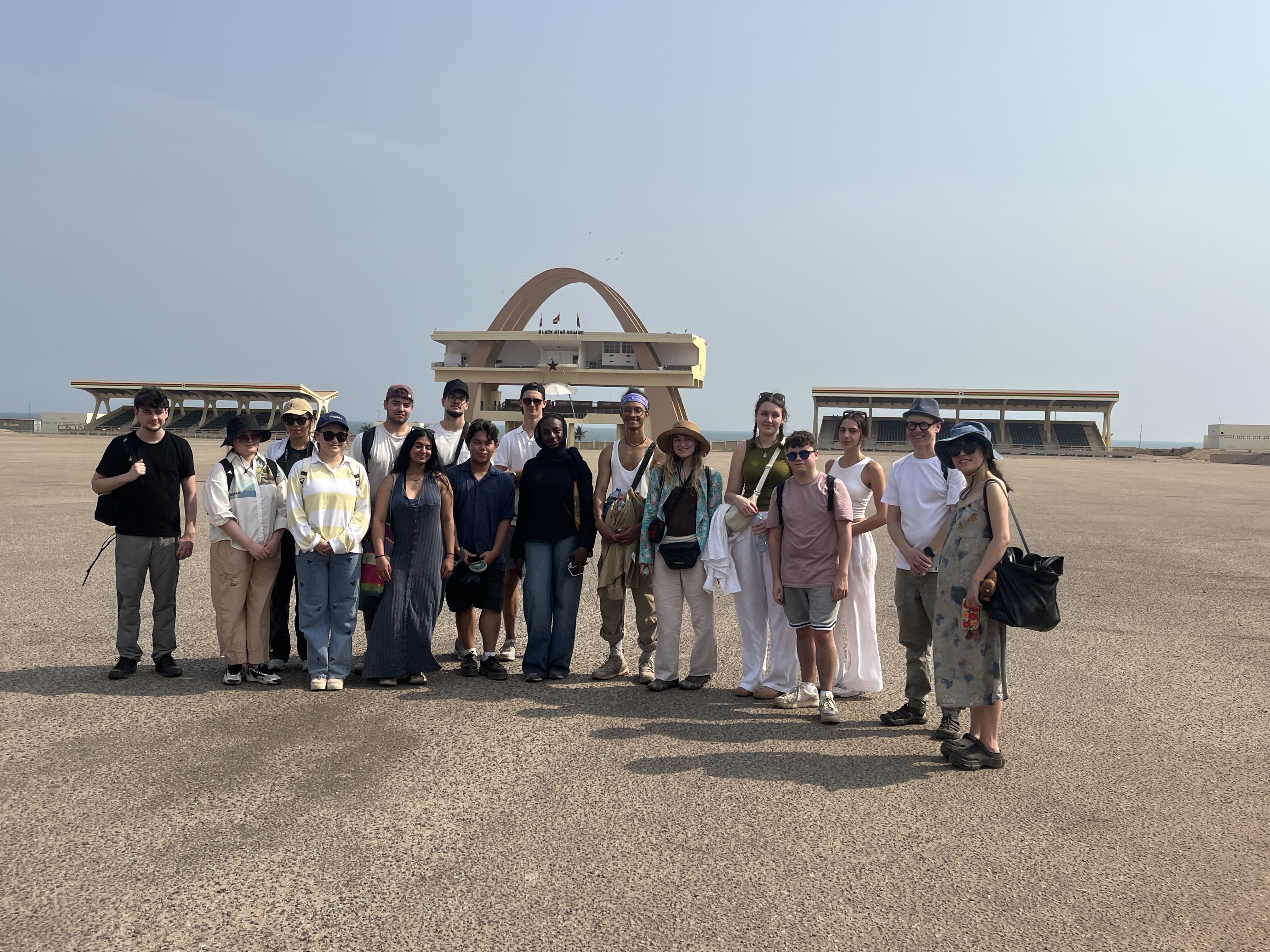
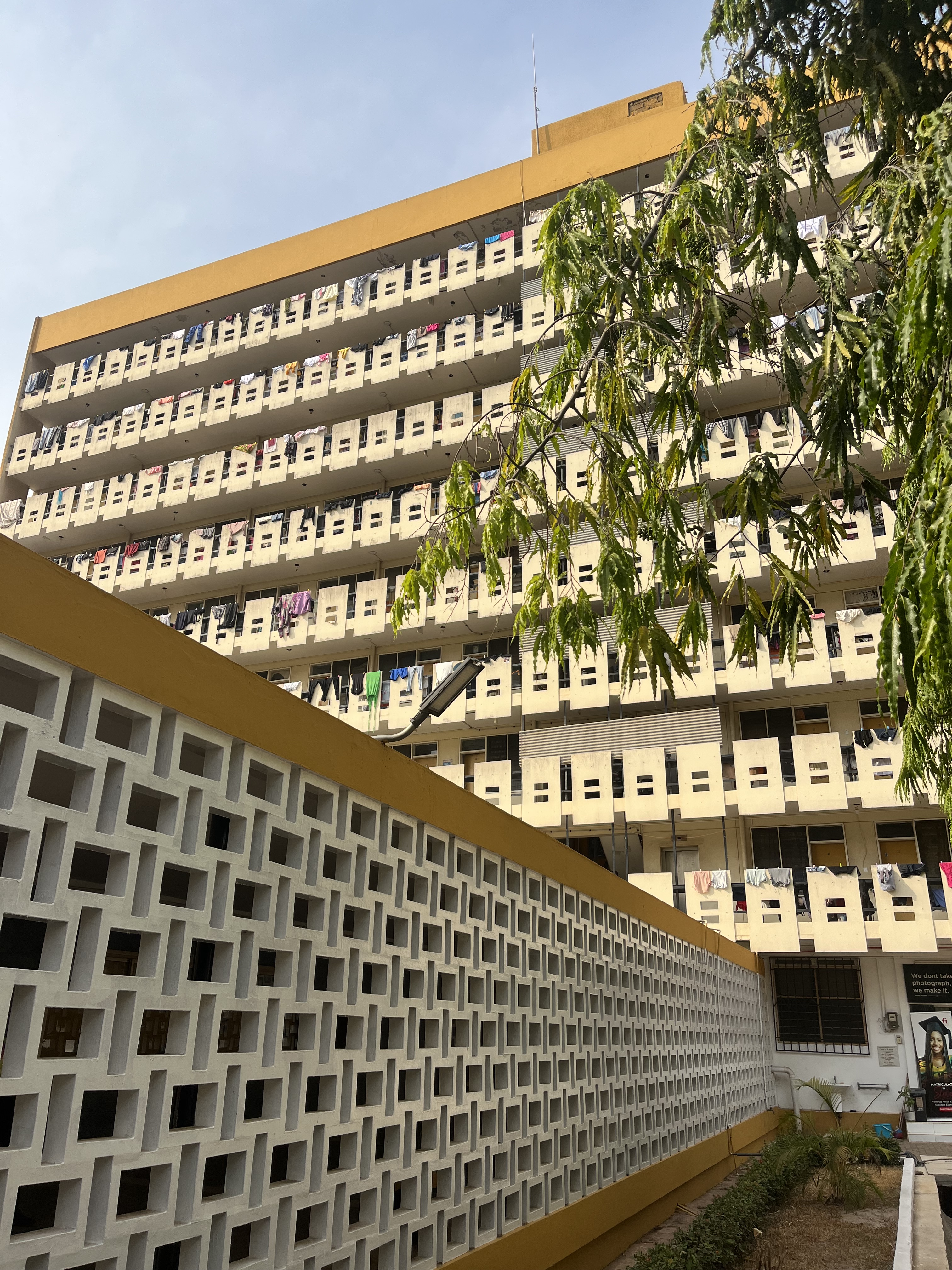
We visited Jamestown, the Padmore Library, Accra Library, Black Star Square and various streets and buildings around central Accra.
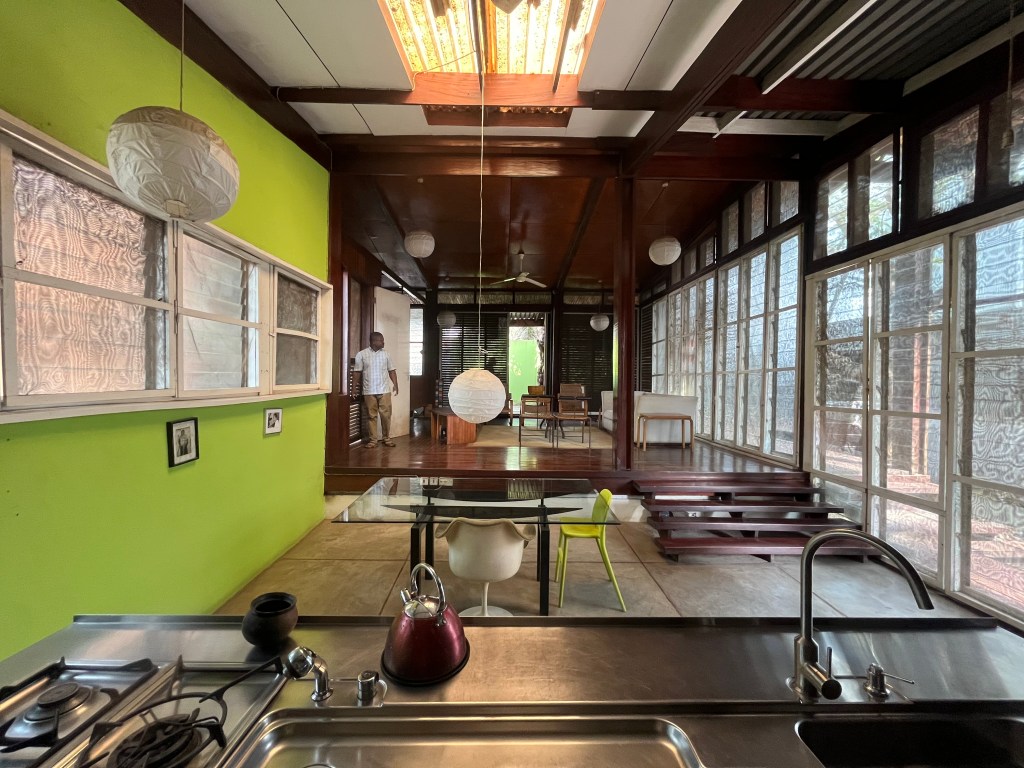
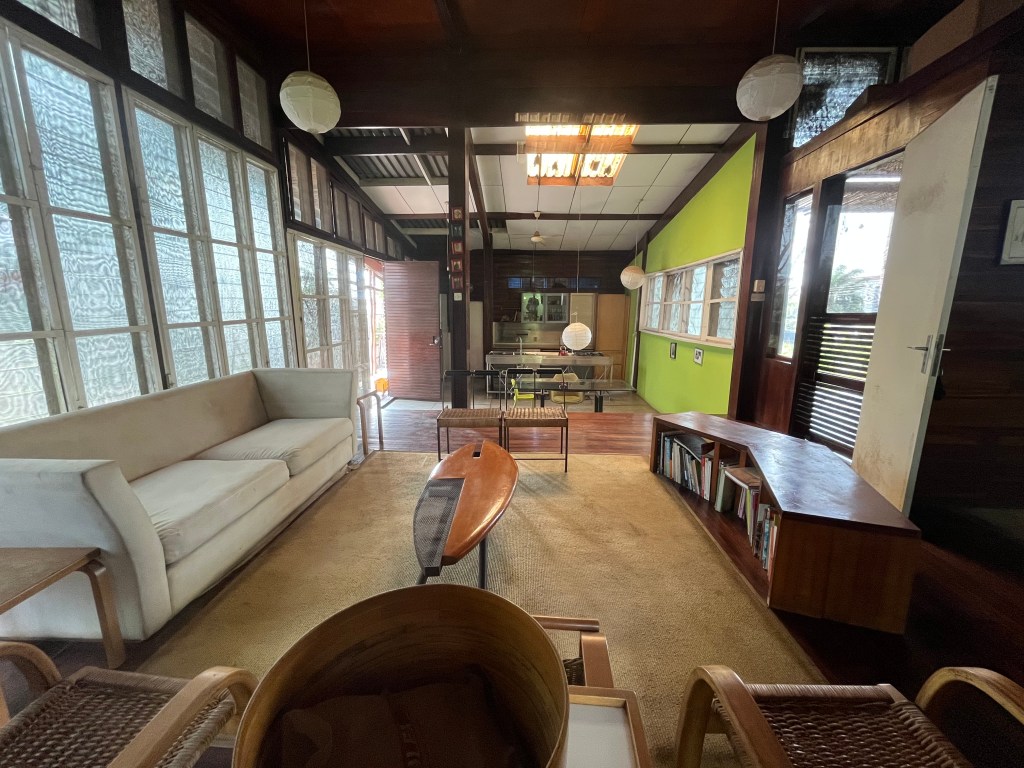
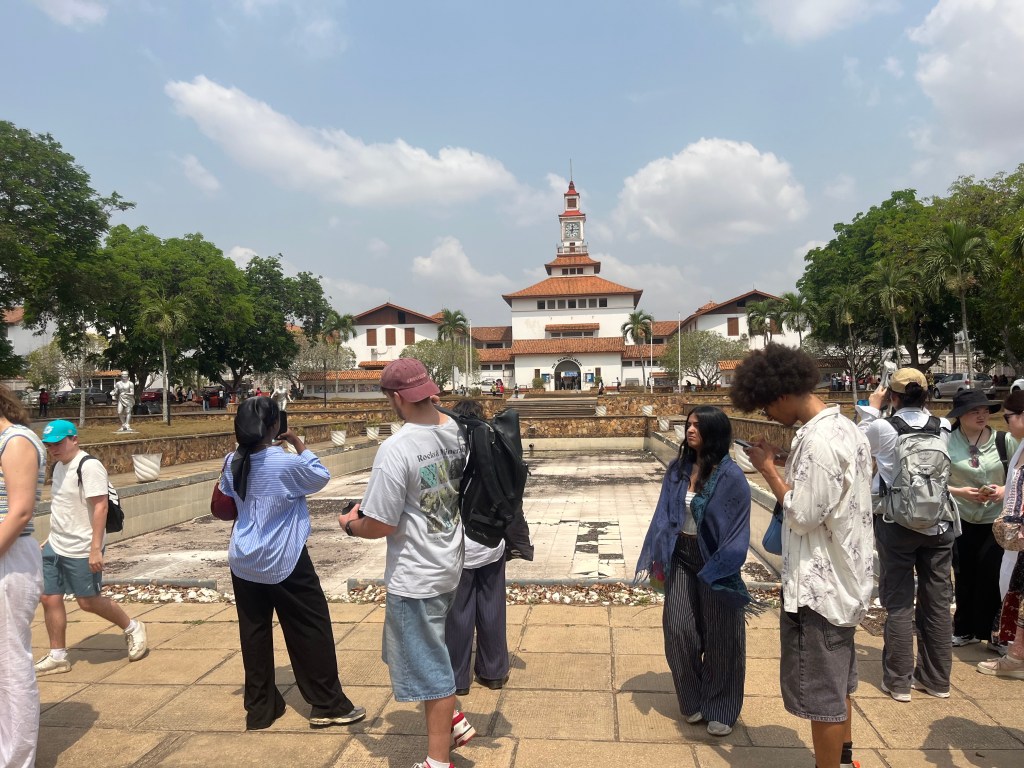
Joe Addo kindly gave us permission to visit his home in Medina, and from there we went to the University of Ghana.
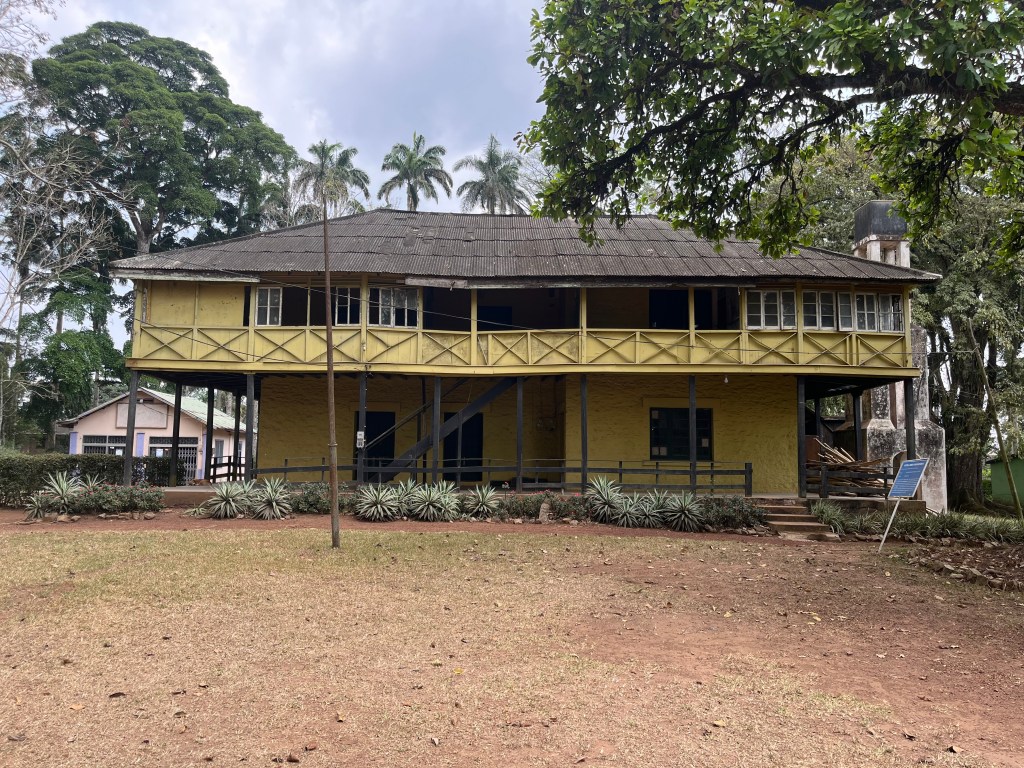
In Kumasi we visited the KNUST campus as well as the Ejisu Besease Shrine – an early 19thC shrine and one of the few surviving Asanti traditional buildings (now all UNESCO heritage sites).
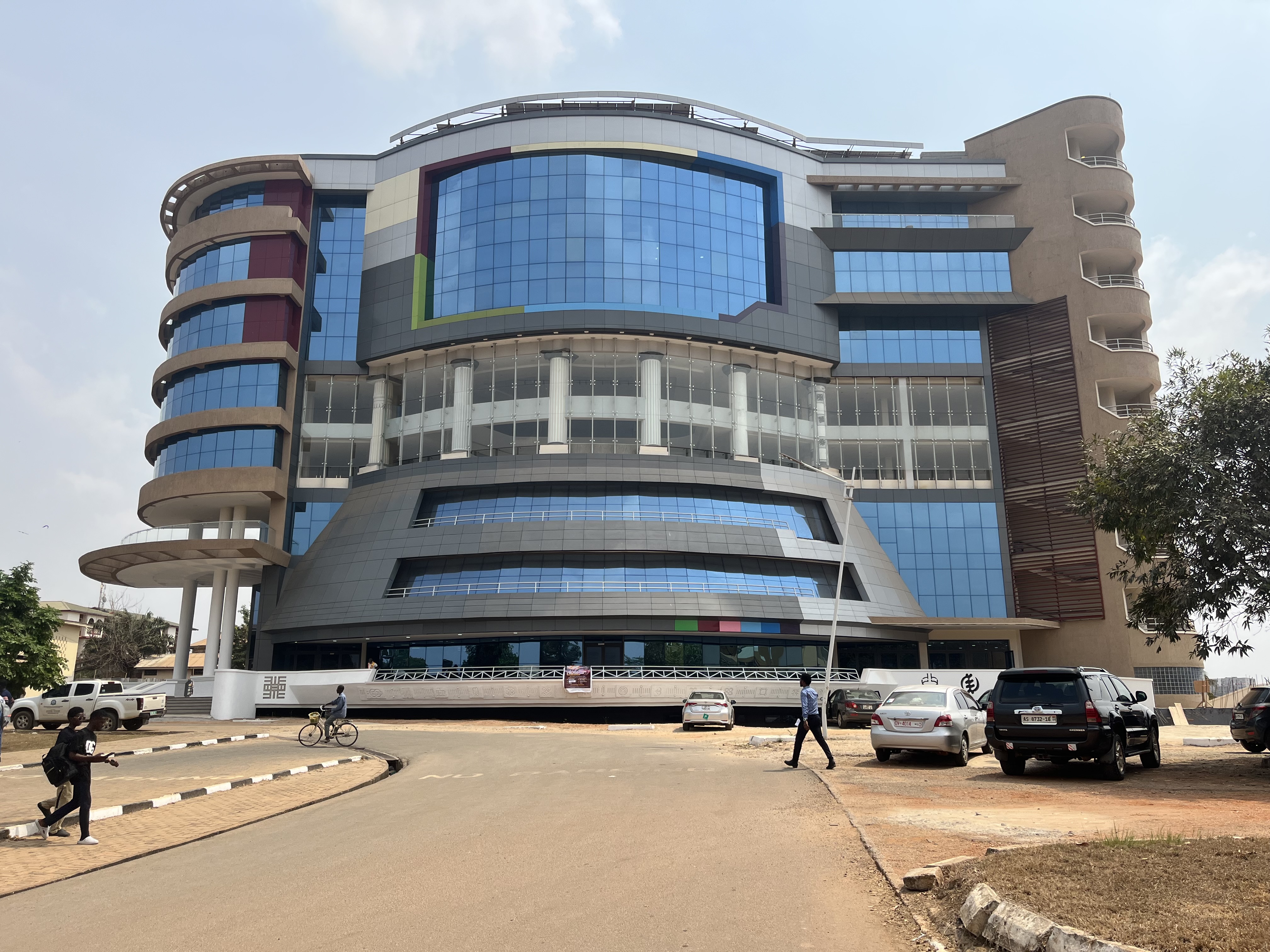
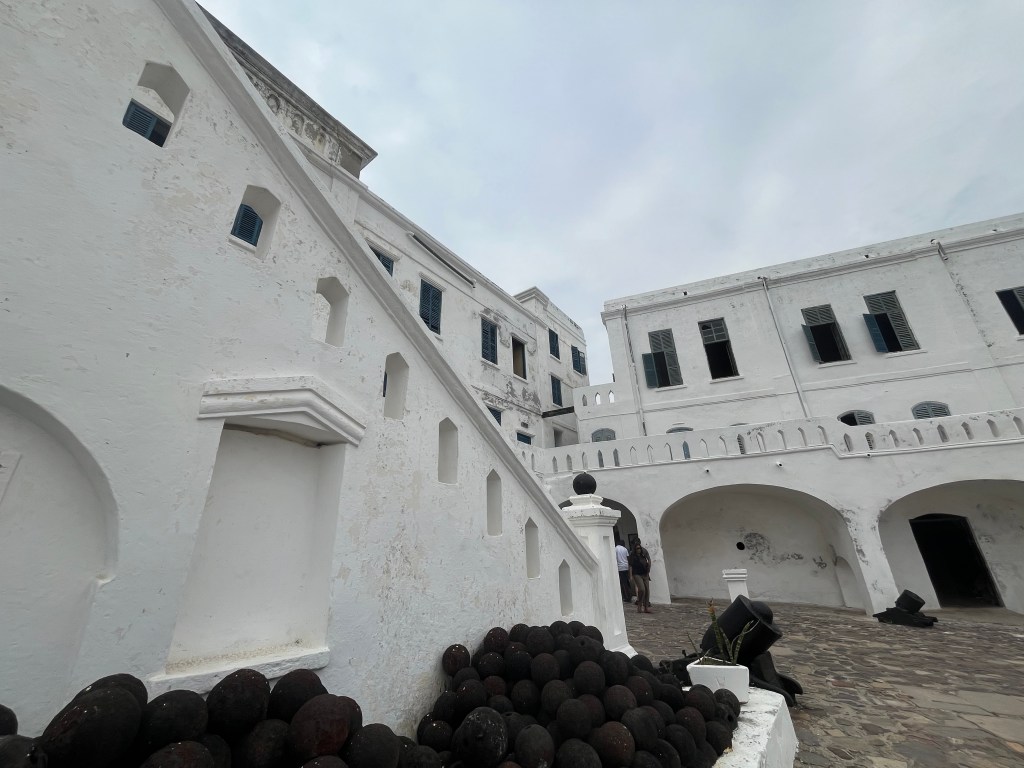
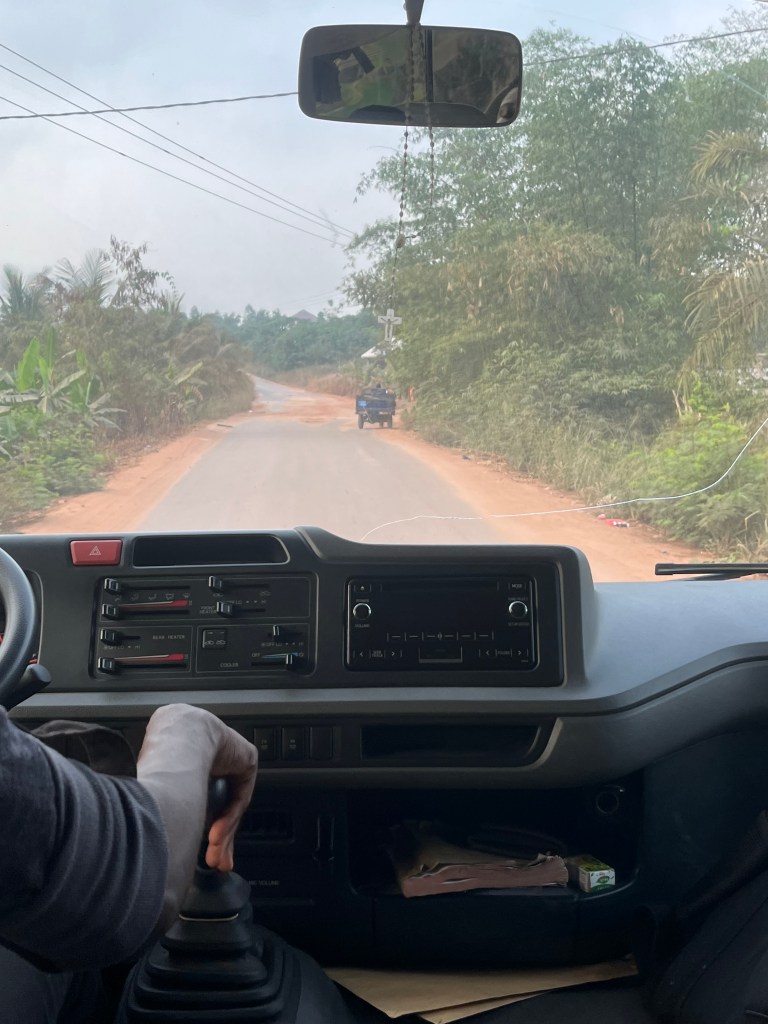
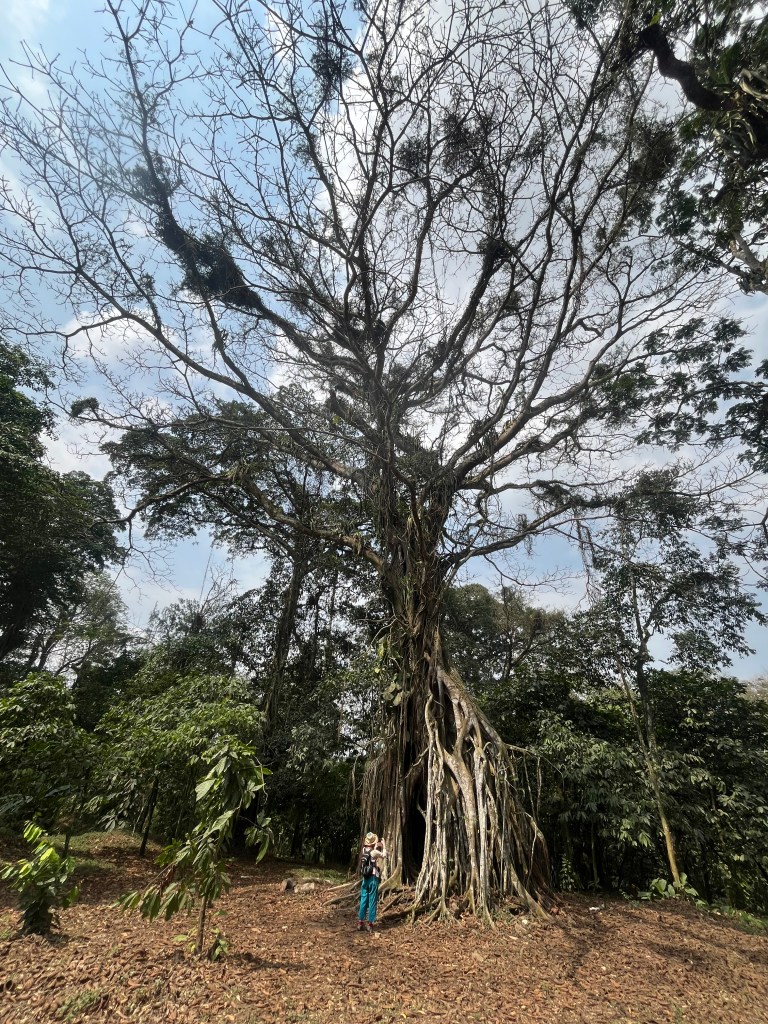
The large new build with the white columns behind the glazing is going to be the new arts and architecture building on campus. It sits at the end of the road axis leading to the library and great hall. It’s not finished yet and we couldn’t visit the interior. From there we went to the Kumasi Cultural Centre to see the Nickson and Borys designed Asanti Regional Library before heading to Adum and central Kumasi. We travelled by bus to from Kumasi to Cape Coast where we visited the Cape Coast castle – with an excellent tour of its disturbing and poignant history. We returned along the coast road back to Accra to continue our buildings visits there and to the Botanical Gardens at Aburi.
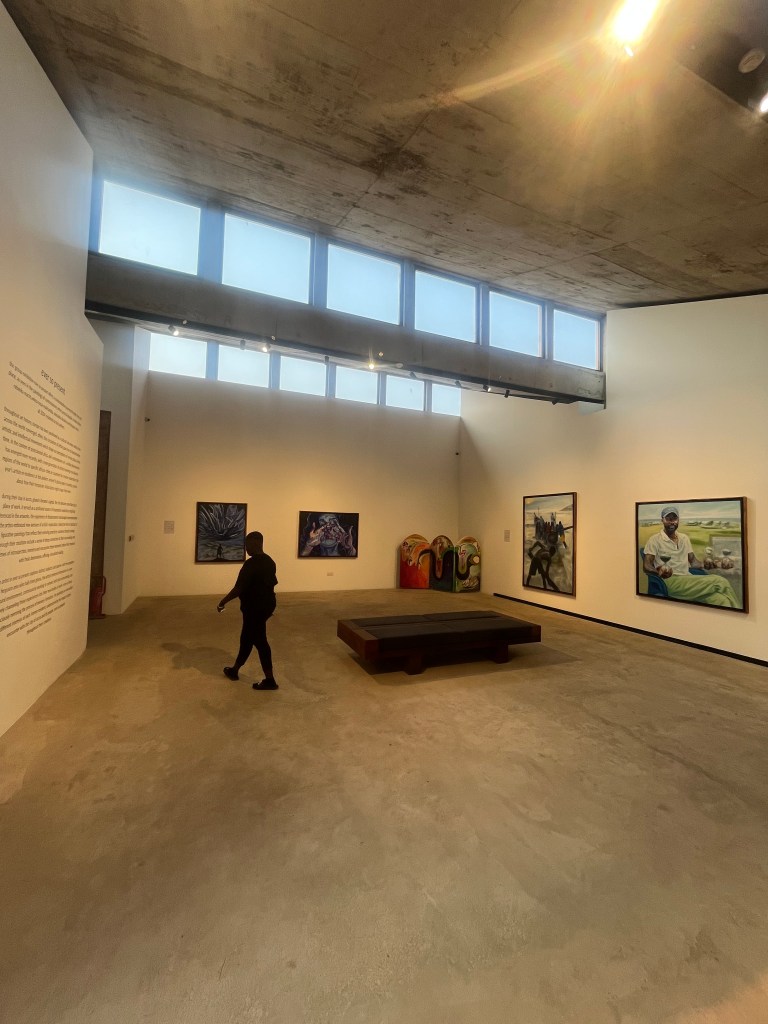
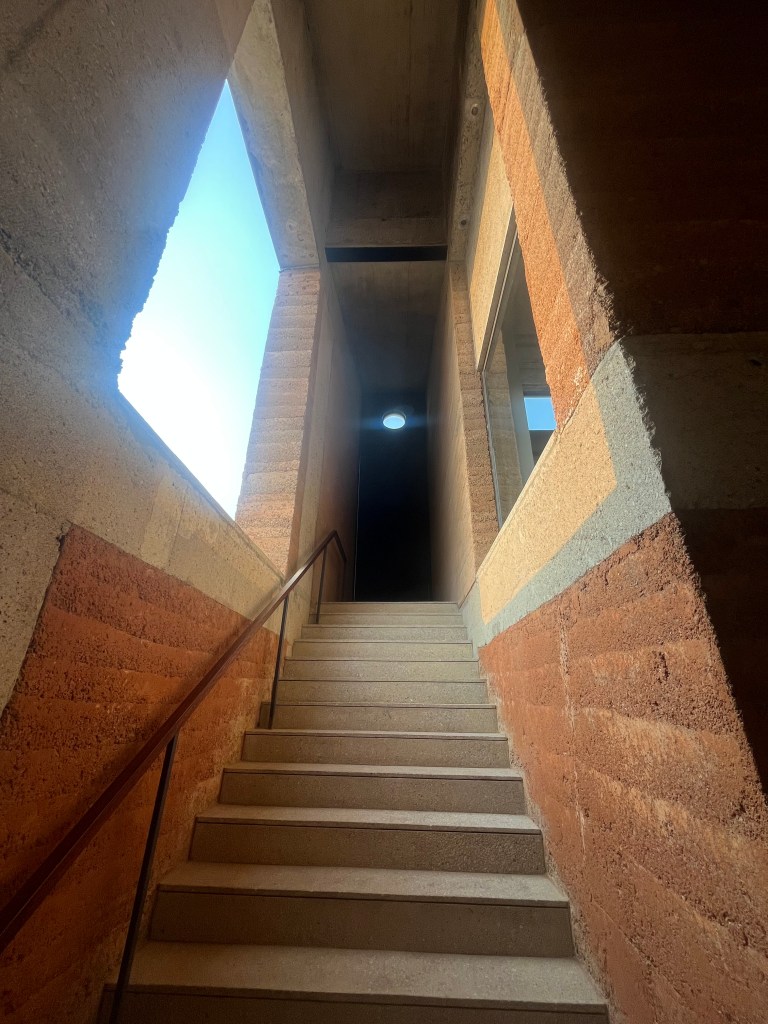
We visited the dot atelier new artist studios and gallery spaces designed by Adjaye Associates too. A 3-storey rammed earth building with concrete frame and distinctive saw-tooth roof above the gallery. The clerestory windows set within the roof are north-facing. The vertical circulation has large openings offering views out over the suburb and allowing the sea-breeze to circulate through the building. A metal flashing detail was being retrofitted below the exposed concrete floor and the pisé – the mud was being eroded at that point and required some additional protection. It’s a fascinating structure and clearly an experimental project that requires fine-tuning and testing.
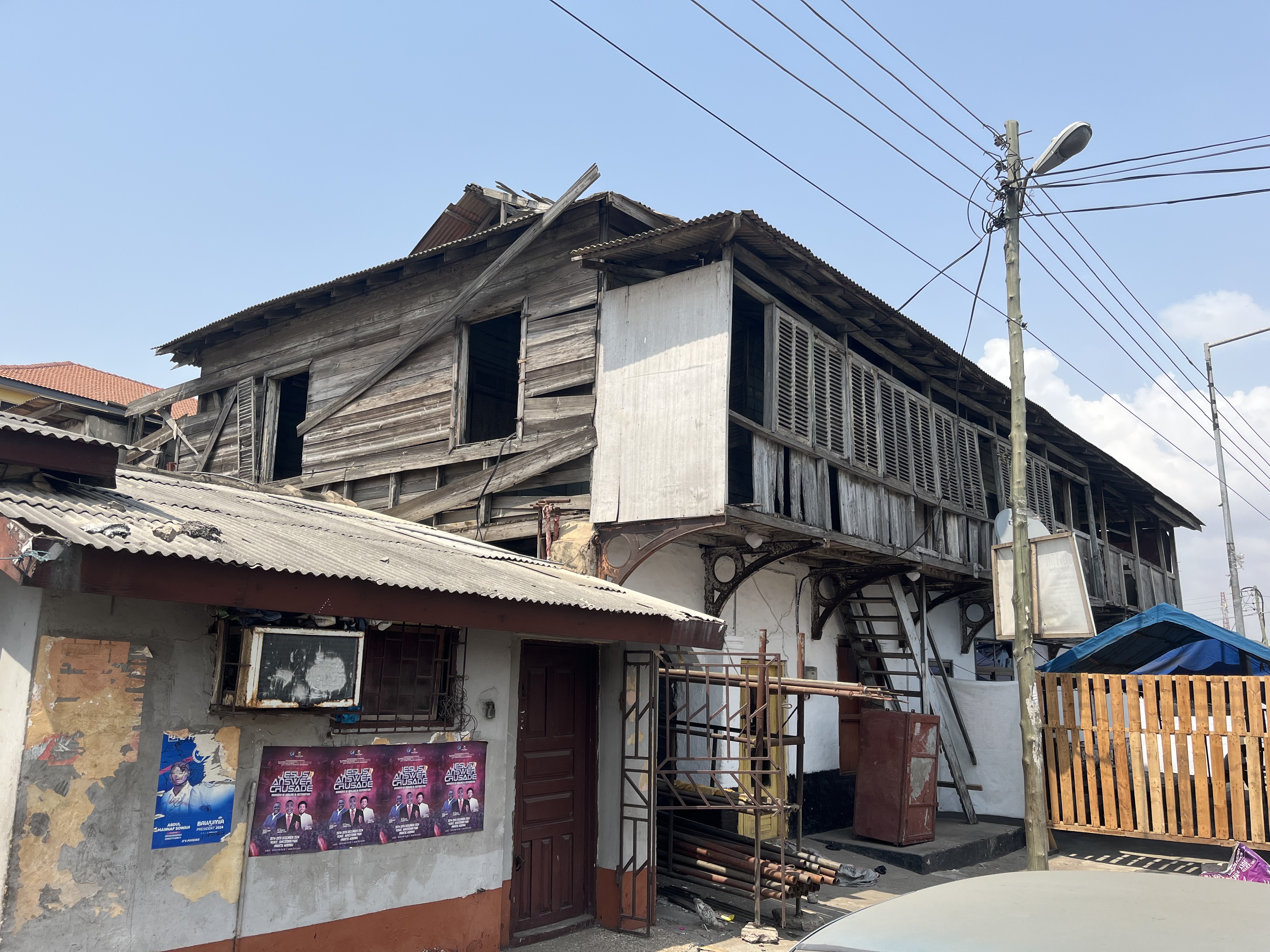
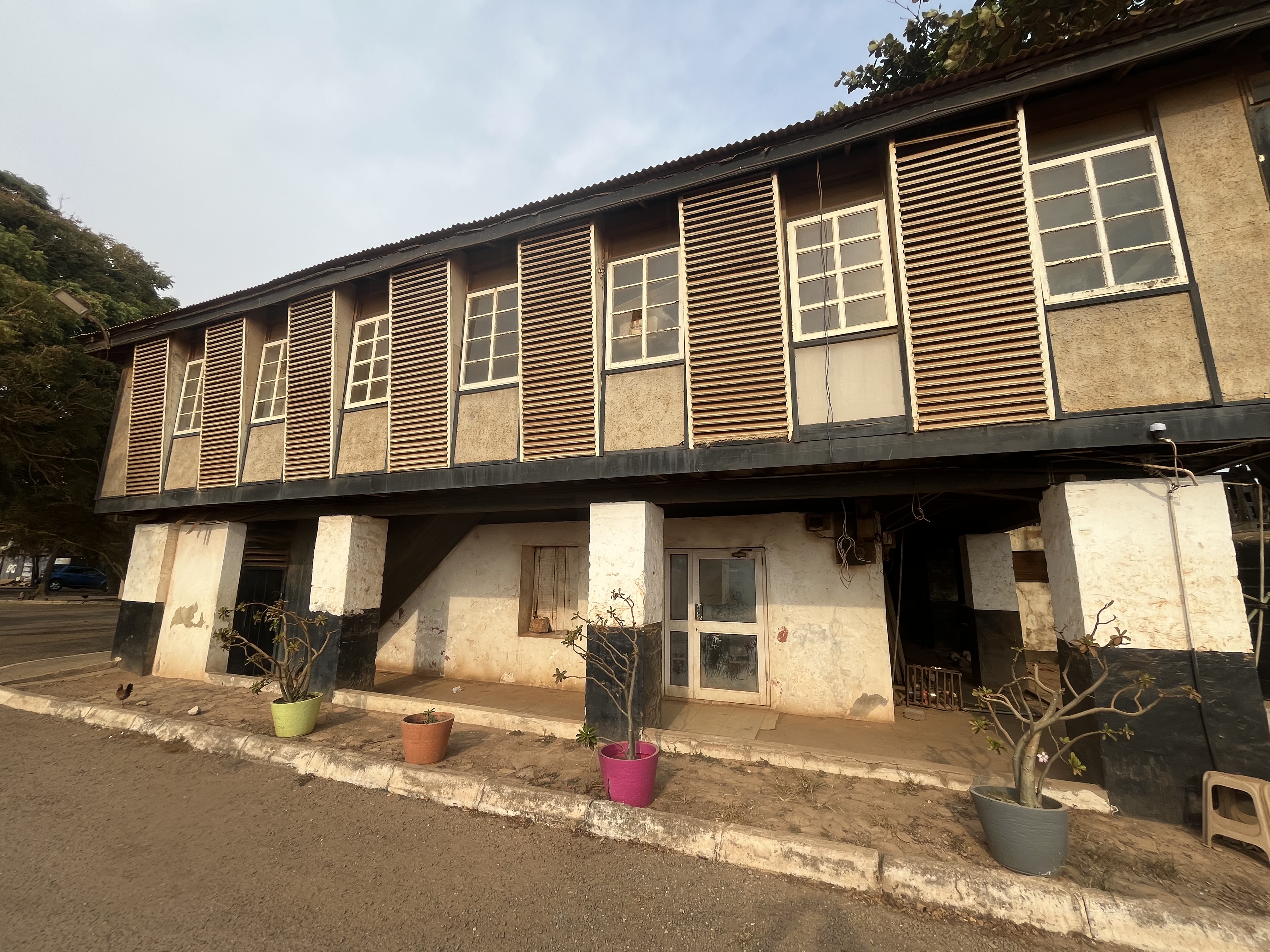
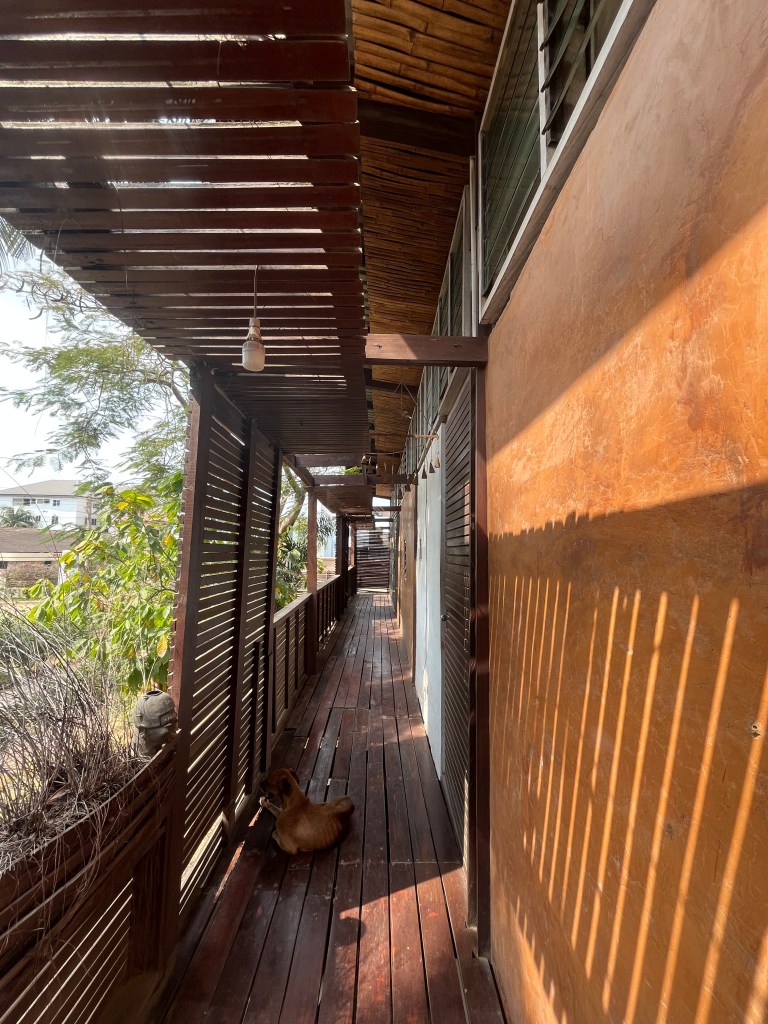
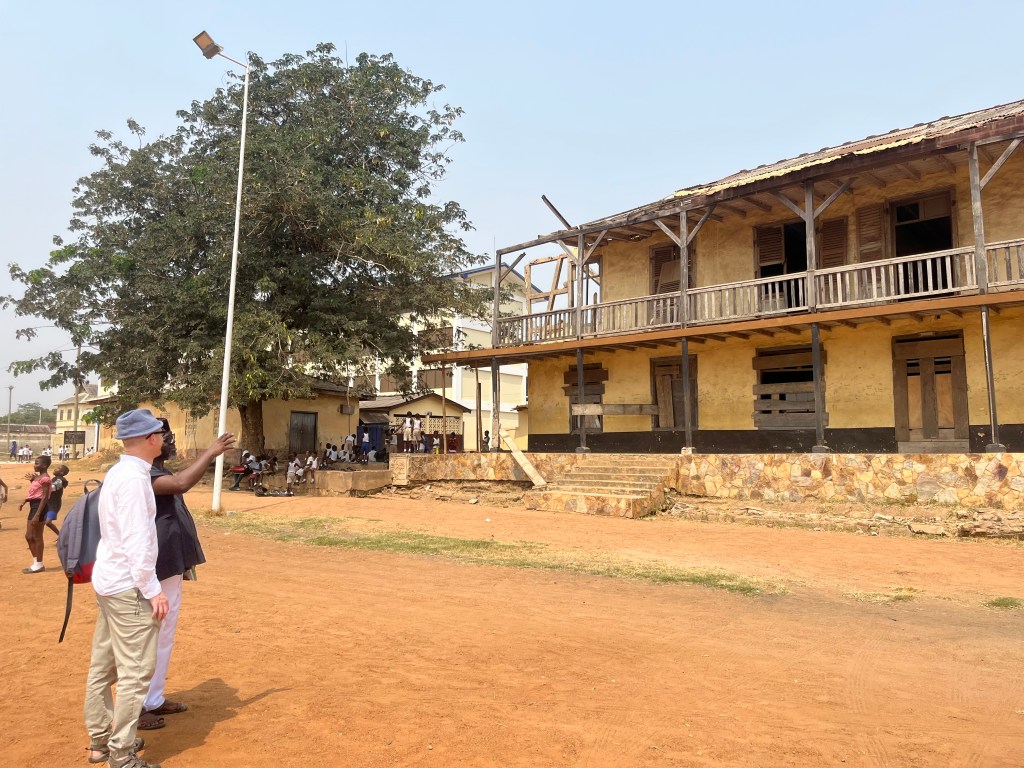
I gave a talk on some of our research and studies of Accra’s heritage structure for the Ghana Institute of Architects and Centre for Architecture and Arts Heritage. Architect David Kojo Derban kindly organised the event – and is pursuing an important mission to preserve, list, and celebrate the heritage structures and spaces within Ghana. David kindly showed us a project he’s been tasked with restoring. It’s the Osu Salem Presbyterian Middle Boys Boarding School – founded by the Basel Mission of Switzerland in 1843. The timber frames, shutters, windows, and verandahs were all pre-fabricated in Germany and then imported. The wattle and daub walls were infilled using local adobe, stones, and plaster. The school is now severely dilapidated and in urgent need of repair. It may not survive the next rain season.
Stanek Ł. Hegemony by Adaptation: Decolonizing Ghana’s Construction Industry. Comparative Studies in Society and History. Published online 2024:1-34. Full paper available here: doi:10.1017/S0010417524000185
Soviet Uzbekistan Today (Through the Republican Press Pages). August. (Tashkent: The Uzbek Society of Friendship and Cultural Relations with Foreign Countries, 1963).
This paper discusses competing visions of the decolonization of Ghana’s economy during the first decade of the country’s independence from Britain (1957–1966), and the agency and horizon of choice available to the Ghanaian decision-makers in charge of implementing these visions. It focuses on Ghana’s construction industry, both as an important part of the national economy and as a condition for Ghana’s broader social and economic development in the context of colonial-era path-dependencies and Cold War competition. By taking the vantage point of mid-level administrators and professionals, the paper shows how they negotiated British and Soviet technological offers of construction materials, machinery, and design. In response to Soviet claims about the adaptability of their construction resources to Ghana’s local conditions, the practice of adaptation became for Ghanaian architects and administrators an opportunity to reflect on the needs, means, and objectives of Ghana’s construction industry, and on broader visions of Ghana’s economic and social development. Beyond the specific focus on the construction industry, this paper conceptualizes the centrality of adaptation in enforcing technological hegemony during the period of decolonization, and discusses African agency beyond the registers of extraction and resistance that have dominated scholarship on the global Cold War.
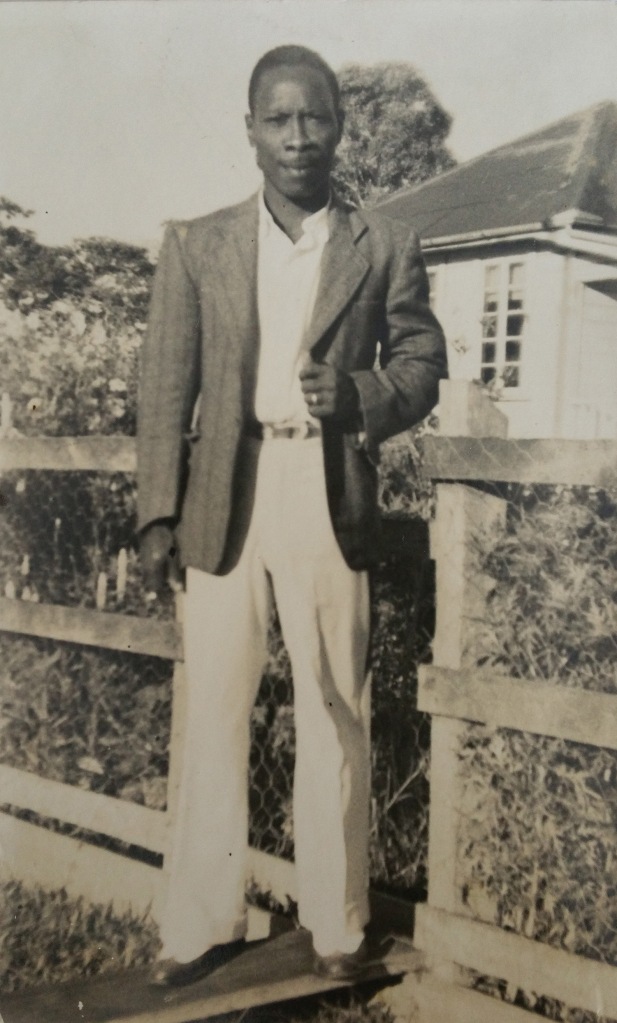
Charles Eric Wilkinson, late 1940s in British Guiana. Source: Michelle Joan Wilkinson.
My grandfather, Charles Eric Wilkinson, was a black architect-builder involved in major government-sponsored building and infrastructure projects in British Guiana from the 1930s to the 1970s. I place Wilkinson’s built work and its surviving archive of bookkeeping ledgers, letters, photographs, and architectural drawings in conversation with material from national archives in Guyana and England, adding oral histories from family members. White architects stationed in British Guiana and the Caribbean reported back to England about the “skilled craftsmen” (carpenters and building contractors) that they observed. Based on family lore and archives, I question the interactions between the supposed foreign “expert” architects and the local builders, seeking to document this period more accurately through architectural work that has remained in the shadows.
Wilkinson’s concrete house in the late 1950s, before he added a concrete fence and bridge from the front yard. Source: Michelle Joan Wilkinson.
The backdrop to my research is the rise of foreign-aided, self-help building schemes in British Guiana in 1954, the same year that Wilkinson endeavored to build a concrete house for his family. British and US architects were involved in British Guiana’s planning and housing development work. Howard Mackey, a Black American professor at Howard University, was on a team contributing to the self-help project. This period of Britain transitioning its so-called dependencies to self-sufficiencies provides an important context for understanding the role that black builders would play in shaping the built environment of the (independent) nation to come.
Gifted buildings are potent mechanisms of geopolitical reshuffling, premised on an uneven power relation between giver and receiver. How do such exchanges shape cities in transition?
Frances Richard: You have been working for several years on ideas of the architectural gift, and have realized this research in a number of projects. To cite a few: an exhibition you’ve co-organized with Damjan Kokalevski called “The Gift: Stories of Generosity and Violence in Architecture” recently opened at the Architectural Museum in Munich. In 2022, you were convener for a conference at the British Academy titled “The Gift of Architecture: Spaces of Global Socialism and Their Afterlives.” And your 2020 monograph Architecture in Global Socialism: Eastern Europe, West Africa, and the Middle East in the Cold War explores issues of international largesse and exchange — what you call “socialist worldmaking.”
Housing project for Libya, designed by Romproiect (Romania), 1980s. The design and construction of buildings such as this were typically subject to barter agreements. [Arhivele Naţionale ale României, f. Romproiect, 7288]
A focus on architectural gift-giving affords new ways of thinking about the worldwide processes triggered by capitalist industrialization and colonial exploitation.
Would you talk about the parameters and findings of this research? What is the architectural gift, as exemplified in what kinds of sites? Why has the inquiry followed the trajectories it has?
Łukasz Stanek: Architectural gift-giving is embedded in a long tradition of imperial and religious donations of buildings. But my collaborators and I have been interested in its relationship to modern urbanism; in how a focus on architectural gift-giving affords new ways of thinking about the worldwide processes triggered by capitalist industrialization and colonial exploitation since the 18th century. In my book, the temporal frame is more restricted: I studied Cold War collaborations — often unequal — between architects, planners, and construction companies from socialist countries in Eastern Europe, and their counterparts in West Africa and the Middle East. The movement of labor, blueprints, and construction materials and technologies across these geographies shaped cities such as Accra, Lagos, Baghdad, Abu Dhabi, Kuwait City, and many others, from the 1950s to the 1980s. Gifted buildings were among the most visible interventions by means of which the Soviet Union, China, and other socialist countries both supported the newly independent countries, and hoped to achieve political leverage and economic gains. To cite a few examples: the National Assembly Building in Conakry, a Chinese gift to Guinea; the Kikwajuni housing district in Zanzibar, an East German gift; or the House of Culture and Youth Theatre Complex in Darkhan, a Soviet gift to Mongolia.
Timothy Latim: Reflections on Kigali writing workshop
Context
I was invited to the one week writing workshop as a guest mentor to discuss with the students of architecture, how photography can be used to support architectural writing and design. The workshop held at the University of Rwanda was in close proximity to three of the buildings being studied and I got a chance to visit and discuss the buildings with the students.
First Impressions
Kigali is coined as the city of a thousand hills. An apt description of it. Standing at any one hill one observes the landscape unfolding, the undulating hills reveal themselves in layers to the observer. While it serves as an incredible sight, the topography is also a major influence in the design and development of Kigali. The varying layers of landscape can as a metaphor to the influence that the city has had over its history. This is apparent in the diversity of essays and research topics presented by the students. A broad reflection would categories these into three main ideas in regards to time. Colonial history, contemporary influence and ambitions of the city.
Historical – Colonial influences.
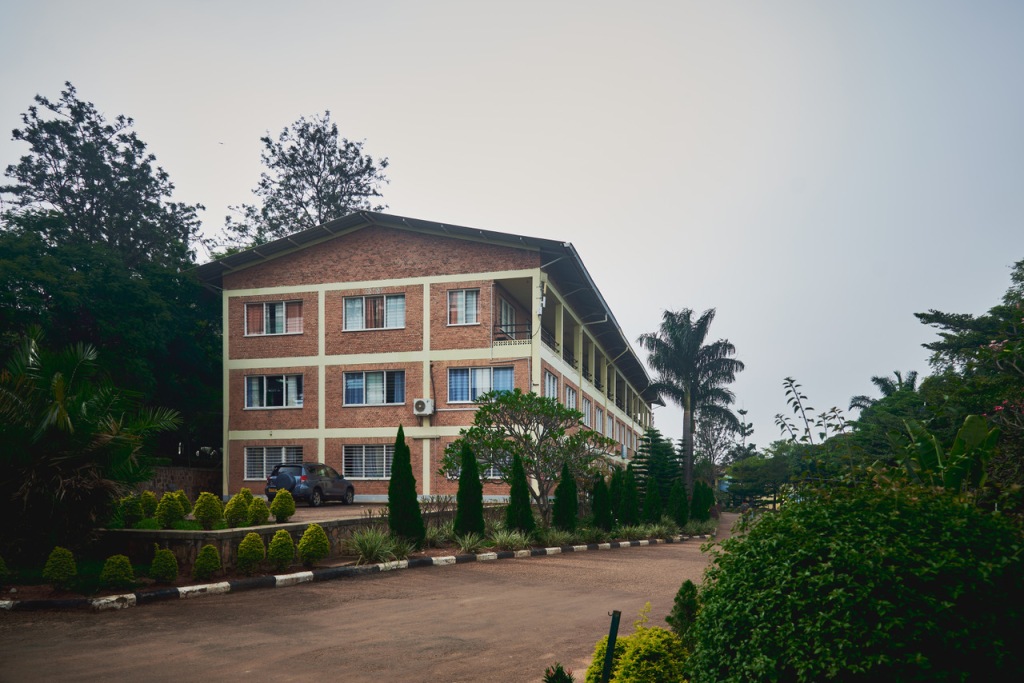
The influence on Rwanda predates the shadow of genocide. Into the realm of both native history and colonial influences. A guided tour and with the student to the Administration Building reveals an interesting dialogue between the architectural influences from the Belgium in the design and construction of the building. These were noted to be the fair faced used of materials in construction. While changes in the dynamics of Rwanda socially and politically influenced the use of the Administration building over time, from the use by military all the way to a university campus. Similar traces of the Belgium influence can be found all around the Univeristy. Which was interesting to being to unravel alongside the students.
Administration block University of Rwanda
Contemporary influences.
Completed in 2014 by Kigali by FBW Group. The Library complex serves an example of a contemporary building. A reflection of the trends and issues currently being resolved by the architecture fraternity. The use of form in the composition of the building. A conscious effort to design the building to be passive in regards to heating and cooling. And the use of locally available materials to clad the building.
Library college of science and technology, University of Rwanda
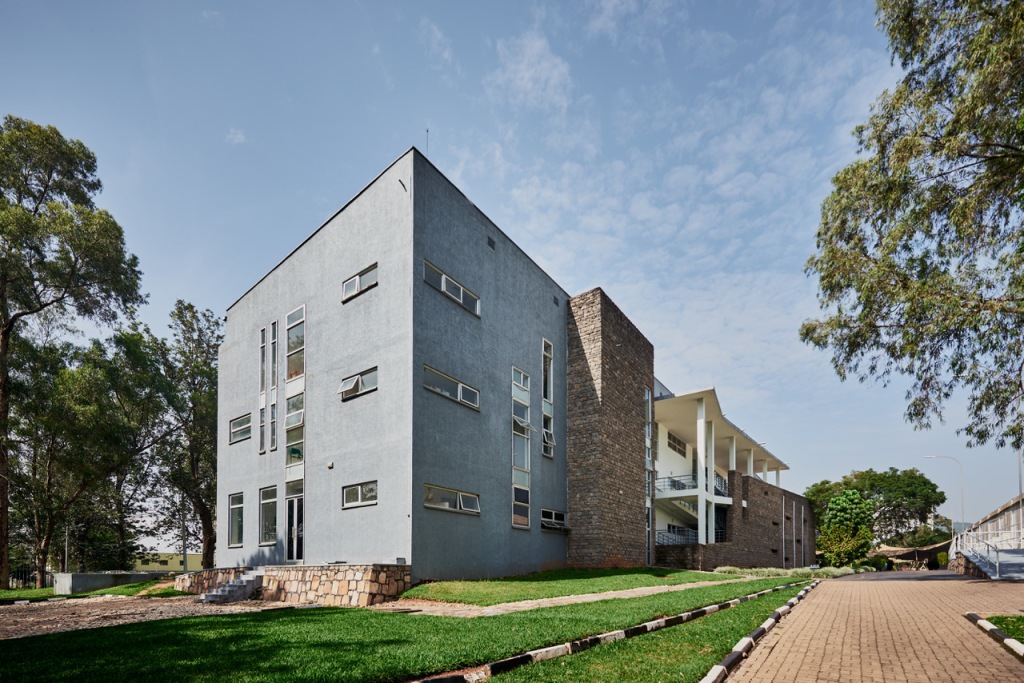
The School of Architecture, serves as an example of the wave of international architects responding to the regional influences on Rwanda. The School has a similar approach to its design. The form is prominent, a metaphorically it can be an interpretation to the hilly landscape. And the use of volcanic stone to clad the exterior of the building.
School of architecture, University of Rwanda
While both these buildings have a very strong relationship between form and programme. The studies done were focused more on the spatial and programmatic response of the architecture. From the space planing to the layout and interpretation of the materials on programme.
Future ambitions.
A walk around the civic Centre in Kigali, draws ones attention to the values being sought after. An egalitarian space, inclusive for all walks of life. And its in this context that Norsken is found, a stone throw away from the civic heart of the city hall. The building reflects on its insides what the civic centre reflects on its outsides. The buildings programmes vary across different fields with low tech to very high tech, future and contemporary issues with possible solutions. A hybrid of activity. Startups and established companies alongside each other.
The student investigations into this building were user-centric. Focus was placed on what layout and design choices were done; so the building created an egalitarian space and facilitated encounters among its users with the hope to encourage cross pollination of ideas in these chance encounters.
Its interesting to see that the same complexities on a country level, can still be found in the rich diversity in a small group of students. The workshop served as a fantastic incubation ground for research topics. Which was witnessed in the ideas presented by the students at the end of the workshop. The duration of the workshop forced the students to narrow down to the core ideas they could investigate. This was made possible perhaps by the daily feedback sessions between the mentors and the students. The mentors placed emphasis on reviewing what was written over what was said. One observation was that there was a some articles whose conclusions were presented without an understanding of the evidence. This was also addressed in the remarks given by the mentors. A suggestion would be to allow them a period of one week after the workshop, to research their topic and review their essay after.
What kind of art is left behind by totalitarian regimes? A new free-to-readbook called Congo Style: From Belgian Art Nouveau to African Independence explores the visual culture, architecture and heritage sites of the country today known as the Democratic Republic of Congo (DRC). It does so by exploring two now-notorious regimes: King Leopold II of Belgium’s Congo Colony (1908-1960) and Mobutu Sese Seko’s totalitarian Zaire, established when he seized power in a military coup in 1965 after five years of political upheaval. We asked artist and visual culture scholar Ruth Sacks five questions about her book.
What did you set out to achieve?
Years ago, while I was in Belgium on an art residency, I became interested in the early modernist art nouveau movement (1890-1914). In architecture and art, this period is part of 20th century modernism, known for a minimal, clean aesthetic that’s influenced by new technologies and the advent of machines. Art nouveau is distinctive because it’s highly decorative, while still using the new building materials of iron and glass.
What interested me was the colonial nature of art nouveau. Art nouveau came with a very strong sense of defining newly formed (or unified) nation states in western Europe. It was the style used at world fairs. These were grand exhibitions showing off western countries’ scientific and cultural achievements, including the acquisition of colonies.
A colonial pavilion in the art nouveau style at the 1897 Brussels world fair in Belgium helped establish one of the names for Belgian art nouveau: “Style Congo”.
The style is distinctive for its curling, plant-like shapes and is a major tourist feature today. The years in which it was implanted in Brussels (about 1890-1905) directly coincided with the brutal Congo regime of Belgium’s King Leopold II.
Travelling to the DRC, I located actual art nouveau buildings from the early colonial period. But it was the state sites of the early Mobutu Sese Seko regime (1965 to 1975) that captured my attention. Like art nouveau, they are steeped in a sense of nationalism and aimed at impressing. For example, the Limete Tower (in use from 1974) on Boulevard Lumumba is a massive monument intended to be a museum celebrating national culture. A tower made up of a huge raw cement tube is topped by an organic floret shaped crown, with a curving walkway leading off from its rounded lower sections.
My experience of the capital city, Kinshasa, made me rethink what cities were and could be. Buildings like Limete Tower that were designed for very different infrastructures (far more ordered, European and US systems) have weathered in fascinating ways that are often related to extremely violent historic events.
I didn’t want to present a conventional study that only analyses the design of the architecture and its functionality. The book attempts to read sites like this within the particularities of their city, its streets, plants and histories.
What did you conclude about the Leopold period?
In Leopold II’s time, the king himself was cast as the villain of the “red rubber regime” in the Congo. The Belgian colonial regime under Leopold II committed atrocities connected to the rubber industry. (The 1897 Congo Pavilion was a pavilion within the Brussels World’s Fair dedicated to displaying how the Congo provided a lucrative and exotic resource to Belgium.)
Movements like the Congo Reform Association (mainly US and British) protested against horrific conditions, including torture and mutilation, that left at least a million Congolese people dead. A great deal of the focus was on Leopold II himself and his greed, which distracted attention away from the greater system of capitalist colonial expansion that was fully endorsed by Euro-American powers.
Famously, Leopold II never set foot in the Congo and neither did the art nouveau designers who fashioned buildings and exhibition pavilions relating to the Congo. I believe this distance from the realities of life in the Congo itself allowed for the fantastical forms that were created in Belgium.
What did you conclude about the Mobutu period?
Mobutu Sese Seko was widely maligned by the Euro-American press. What’s often ignored, to this day, is that he was put in place by Belgium and the US. He was painted as the villain of the African story, fulfilling the ultimate caricature of the African kleptocrat, yet he wouldn’t have come to power without the nature of the colonialism that came before him.
Belgian colonialism followed a logic of extractivism (removing natural resources to export them) that forced the Congolese economy to supply raw materials to the west (especially Belgium), which continues today.
Mobutu is considered corrupt in the Congo today and his military dictatorship was indeed brutal and controlled the Congolese people with fear. However, his commandeering of a cultural blooming in Kinshasa in the late 1960s and early 1970s was important. Instead of dismissing what he built as only the work of a dictator, my book draws out some of the complexity of this time and what it meant to celebrate African craft, art forms and traditional culture.
The process of appropriating Euro-American artistic ideas and architectural styles in order to celebrate Africanness, as an anti-colonial statement, still holds weight today. Many of Mobutu’s towering monuments are considered objects of pride in the city.
How does this live on today?
There is something to be gained from looking at what is left in the wake of tragically violent regimes and how their structures are treated within both their societies and their immediate surroundings. How material culture is made is as important as what is made. Reckoning with monuments and memorials, and considering how these are maintained in the city, can shed often unexpected insights into the ways histories are told.
My hope is that the book remains relevant as a sign there is value in picking apart material remains of regimes that aimed for total control, but never fully achieved it. The associations that build up around public spaces and exhibitions are not necessarily only to do with the circumstances of their making, but how these stories have been filtered over time. They can alienate people but they can also engender pride.
The extractivist attitudes I describe throughout the book, which see the Congo as a resource with bountiful raw natural materials, are still very much present in our day-to-day life. The cobalt in our smartphones, computers and electric cars is mined by labourers working in near slave conditions to feed our need for the latest technology. While Congo Style stays with historical examples in Kinshasa, the built material that follows colonial ecocide is the main topic.
Architectures of Informal Empire in Architectural Theory Review
Recent efforts to understand the pervasiveness of empire and its legacies have done little to reorient and expand the geographic or theoretical focus of scholarship, often downplaying the broad range of political, commercial, and cultural relationships that empire was built upon. Yet imperial ambitions were almost always accompanied by multiple economic and civilisational claims that preceded or did not amount to direct colonisation. Aptly named the “Age of Empire” by Eric Hobsbawm, the nineteenth century witnessed unprecedented travel and exchanges made possible by the advances in technology and industry of the century, that served to advance economic and cultural aims simultaneously. A wide range of private and state actors, including missionaries, merchants, explorers, archaeologists, doctors, nurses, and scientists thus helped expand, articulate, and consolidate both the reach of western “civilisation” as a standard and the petrification of indigenous civilisations as backwards and “other.” Neither have all imperial activities been recognised as such. Some empires, like the United States, engaged in similar processes driven wholly by private actors, without the apparatus of a colonial state, while positioning themselves as “anti-imperial.” And some regions, like the Eastern Mediterranean, while never “formally” colonised—depending on our definition of colonialism—were significantly shaped by “informal” foreign interests. But almost three decades since Mark Crinson introduced the history of informal imperialism into architectural history, such areas remain marginal in studies of colonial architecture and urbanism. In these areas that were the site of informal or inter-imperial contestation, or that were subject to what Ann Laura Stoler calls “affective” security regimes, the projects of private actors often led to extensive economic, material, and spatial configurations whose reverberations continue to be felt, even today. Architecture, as an embodiment of territorial, political, economic, and cultural imaginations, was integral both to these processes and to their contemporary endurance.
This issue seeks to explore the boundaries of what can be considered “colonial” in histories of architecture and urbanism, in the past as in the present. It asks how we can define and describe the architectural and urban projects that accompany imperial ambitions, both formal or informal, and their spatial, material, and cultural imprint on the territories in which they are implemented. How can we meaningfully question the legacies of missionary projects, of infrastructural concessions, or developmental aid, to mention only a few examples, especially when such projects came without a colonial state? What do we learn about the entanglement of architecture and political power if we begin from the buildings and sites around which proto-imperial and para-imperial processes took place, rather than from the study of a single or formal imperial state?
We welcome contributions that explore new theoretical questions and methodological approaches to the study of architectures of informal empire—that foreground the affective power of buildings in the past or present; the entanglements of state and non-state actors in informally colonised regions; instances of intra- or inter-imperial contestation or collaboration, including with local elites; or the broader cultural and/or economic relationships inscribed in space that survive after the dismantling of colonial states. We also encourage empirical contributions that focus on geographies and actors that have remained marginal in the scholarship on colonial architecture and urbanism, that can dislodge the primacy of the single colonial state. By expanding our understanding of the “colonial” in architectural history, we hope to gain new insights into the contemporary and enduring manifestations of empire in the built environment—a necessary starting point for any true attempts at future decolonisation.
A visit to Venice to attend the inaugural AFRAHUAN session at the Teatro Piccolo at the Arsenale as part of the Carnivale Proceedings of the Venice Biennale proved an apt occasion to visit and view Venice in full exhibition and tourist mode.
Venice is indeed a city like no other. No cars, no bicycles, lots of passageways, canals, and tourists. One adjusts to this city of walkers, traders and tourists all jostling for space in alleyways that are literally not wide enough to swing a cat. The green canal water both enticing and goading the unwary walker to come to its banks.
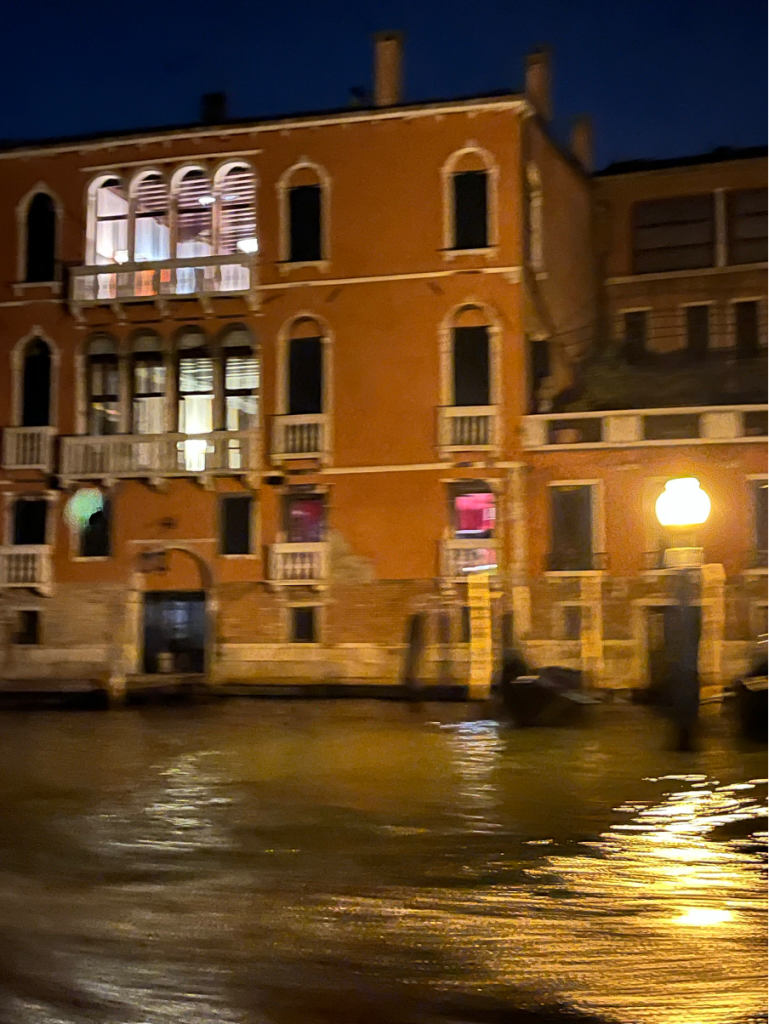
Arsenale Arriving in Venice at night
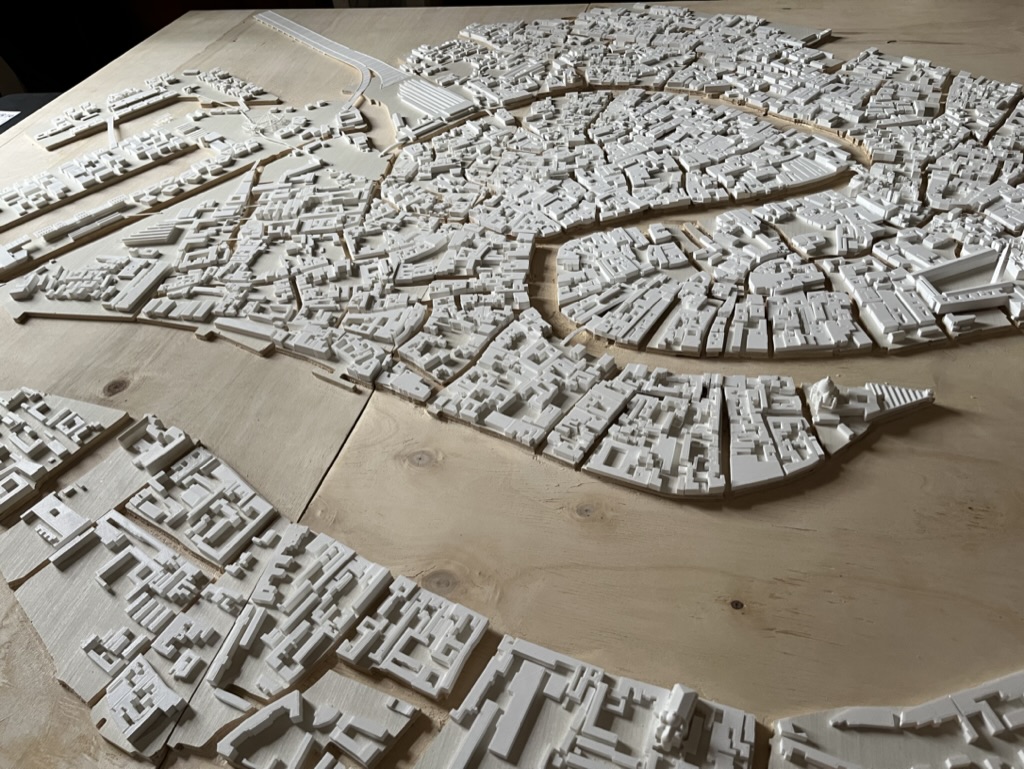
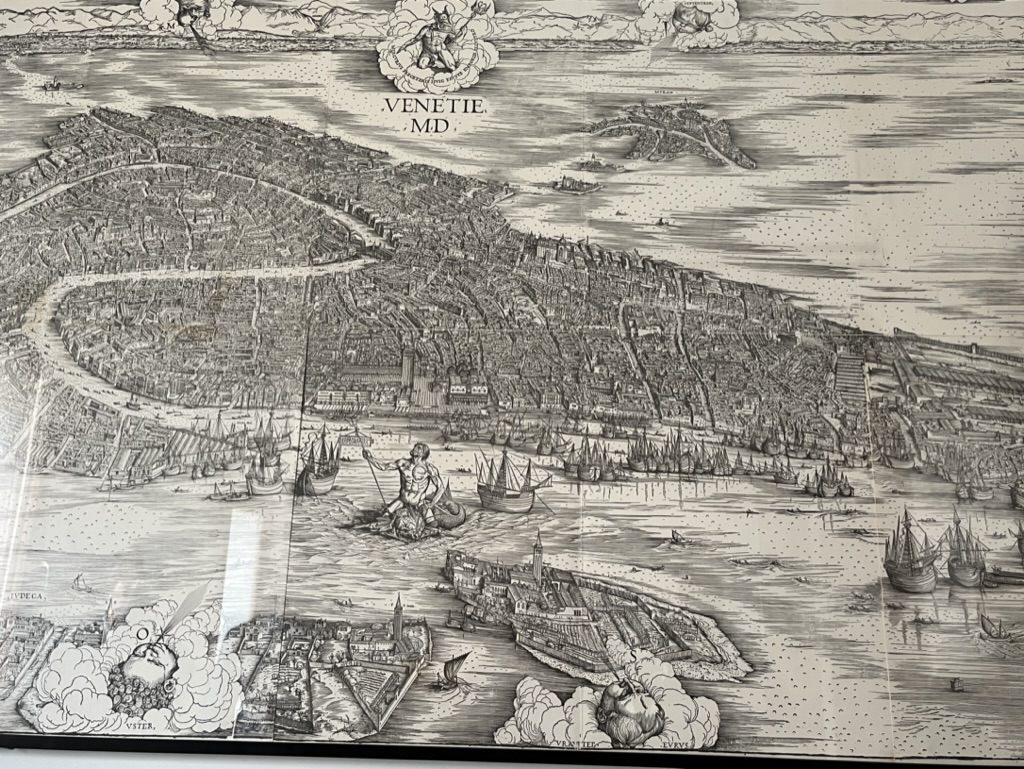
A walk to the Arsenale gave a better viewpoint of the wide vista of Venice as a series of islands with canals as fingers out to the grand canal. The adaptive reuse of various parts of this still living city is clear. The Arsenale itself remains the home of the Italian navy and a museum dedicated to the armed force still exists with the occasional boat dropping by.
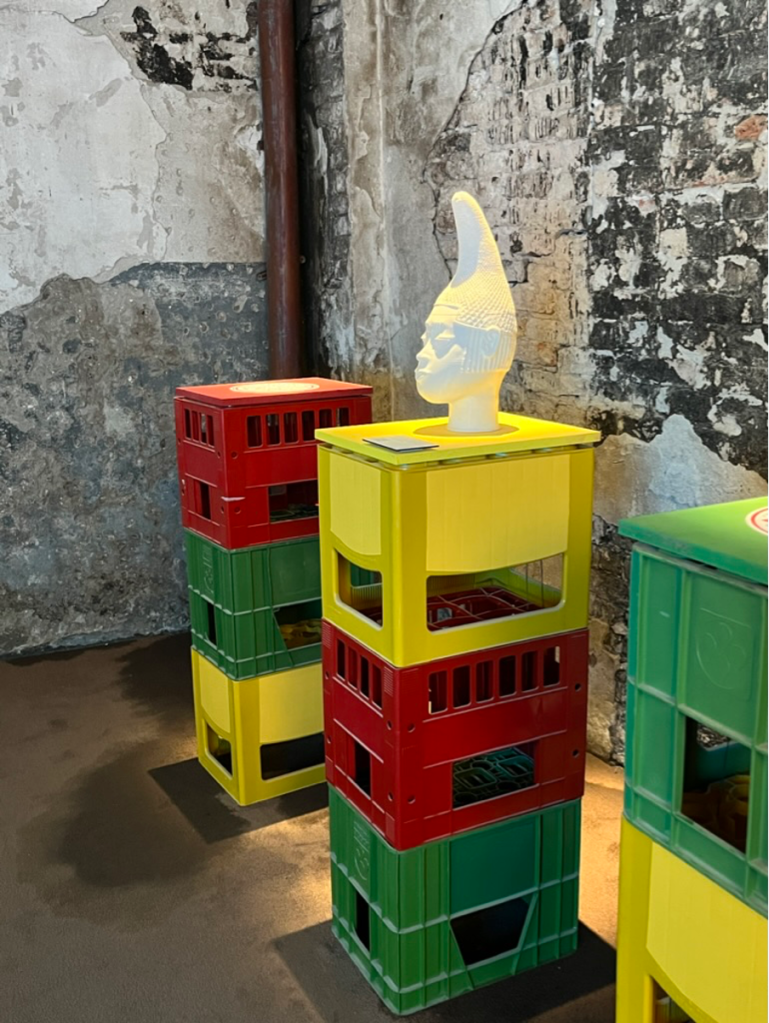
The main part of the old Arsenale building however now has been occupied by the architecture biennale, this year curated by Lesley Lokko and involving your writer and a wide set of architects, writers and artistes with Africa focused research. The ‘carnivale’ exhibition is no mean feat, a work of immense dedication, creativity and focus. The curation is superb and content more than can be taken in at one go. One easily gets immersed in what it offers up with names one knows and has heard of contributing to this rich tapestry of art. Fortunately the accompanying catalogue means one can refer back to installations and events missed or glossed over in the viewing of the exhibition.
AFRAUHN AT THE CARNIVALE…
The African Architectural and Urban History Network (AFRAUHN) had its debut at a session at the Carnivale at the Biennale. Curator Lesley Lokko introduced our session which had two parts, the first involved speakers Ikem Okoye (Delaware, USA), Kuukuwa Manful (Michigan University, USA) and Neal Shasore (London School of Architecture), with Ola Uduku (Liverpool University) chairing, where the session focused on a discussion on the remit of AFRAUHN which is to help encourage and advocate for Architectural Research in Africa, and support new generations of indigenous historians and researchers in Architectural History and urbanism. After Ikem Okoye’s introduction both Kuukuwa and Neal were able to discuss their different approaches to, and hopes for Africa-related Architectural Research.
AFRAUHN Session [Courtesy of Venice Biennale]Lesley Lokko Introducing the AFRAUHN Session [Courtesy of Venice Biennale]
The second session chaired by Huda Tayob (Unversity of Manchester) involved all speakers from the earlier session and also Murray Fraser (University College London). This session was a roundtable where the speakers responded to Huda Tayob’s questions which considered specific issues and challenges to scholarship in African Architectural History and its situatedness within the wider context of global research and challenging normative notions of historical research and scholarship.
AFRAUHN 2nd Session [Courtesy of Venice Bienale]AFRAUHN 2nd Session [Courtesy of Venice Bienale]
The entire session was recorded and will be published by the Venice Architecture Biennale before the end of September 2023. Due to the events related to air traffic control problems in the UK unfortunately several of the invited AFRAUHN team were unable to attend the session, and others arrived late due to flight delays. It is hoped we will be able to include their recorded contributions to the final video output from the session.
IUAV (University of Venice)
On Wednesday, the day after the Carnivale discussion we were fortunate to reconvene at a meeting room at the IUAV (University of Venice), thanks to Dr Jacopo Galli, who has researched into African modernism and was involved in the curation of the exhibition Africa Big Change, in Milan and has worked with Manchester School of Architecture on the analysis of schools in West Africa. IUAV has sites across Venice, and we met at the C’a Tron campus, a Venetian villa owned by the wealthy Tron Family before being gifted to the State. Post meeting tours took us to the Carlo Scarpa-influenced main campus of the IUAV, a repurposed convent which still has parts which are owned by the church. The campus also has a significant architectural library including book volumes and periodicals accessible and in regular use by its students.
IUAV
Unlike the exclusive arrival to the watery city a few days earlier, the trip back to the airport was by airport water taxi, which proved to be a bus trip stopping at many of the archipelago of islands which constitute Venice, including Murano, famous for its glass works and San Michael. Approaching Marco Polo Airport Venice by water seemed a very apt way to leave the city.

































 Transnational Architecture Group