Archive

India

Designing Buildings in 15 Minutes: A day in the life of Otto Koenigsberger, Government Architect to the Govt. of H.H. the Maharaja of Mysore

by Rachel Lee

The following extract is from a private letter written by the architect, planner and educator Otto Koenigsberger (1908-1999) to his family in 1940.  He probably typed it in his small room in the bungalow he shared with the Brinitzer family at 42 Infantry Road, Bangalore, India. Like the Brinitzers, Koenigsberger, a native Berliner with a Jewish background, was in exile.

  1948_Koenigsberger and colleagues at the PWD

Due to a fortuitous family connection, in 1939 Koenigsberger had been contracted to work as an architect in Princely Mysore, a South Indian state with a limited amount of independence from British colonial rule. Thus his boss was not a member of the British Raj, but the ambitious Dewan (Prime Minister) Mirza Ismail, whose favourite pastime was building. In November 1939 Koenigsberger was promoted to Government Architect, the highest position for an architect in the state. As the humorous extract reveals, although his job kept him very busy, it did not prevent Koenigsberger from trying to build up a private practice or enjoying himself in his new home . . .

“I shall give you a short review of one day in the life of the Government Architect to the Govt. of H.H. the Maharaja of Mysore.

My boy appears at 6:30 am in my room in order to wake me up. This has the result that I go on sleeping till quarter to or quarter past seven. Which of the two depends on the situation whether I must go and see the Dewan in his Bungalow or not. He belongs to those immorally hard working people whom I thoroughly dislike and has already one hour of hard work finished when I come to see him at 7:30. The next item is an enormous breakfast at 8 and instruction of my private draughtsman at 8:30 – Yes I have a private draughtsman and ‘secretary’. He is an Angloindian with the nice name Eric J. Crane, is rather shy, not too bright, and of course very unreliable. He comes for three hours in the morning and three in the afternoon and tries hard to learn how to do architectural drawings, so that I may be well armed and prepared when the great wave of private work comes of which I am daydreaming.

If there are no other inspections (on most days there are, my average is about 30 miles a day inside Bangalore only) I go to the office between 9 and 10 in order to have some quiet hours before my six men arrive at 11.

1940_Serum Institute

The morning post brings about 5 to 6 requests for designs per day, say one hospital, one bungalow for an officer, one railway station, one cinema, and a number of smaller tasks and alterations. In addition comes a tray full of files, for all building plans, small or big must go through my hands before they can be sanctioned by Govt. In Europe I would have worked about a week to design a hospital and about another week or fortnight to prepare the drawings. Here the main idea and the sketch must be ready in ten to fifteen minutes and then the assistant or draftsman must prepare the plans within two to four days. Of-course these designs cannot be so well worked out as mine were at home. To keep up at least a certain standard of exactness and efficiency I must permanently go round from one to the other to correct the plans and to tell them what they must do. In the intervals between my wanderings from one drawing board to another I try to attend to my files, to answer letters, and to make a number of sketches and small plans which I can finish myself in less time than it would need to explain to somebody else how to do them.

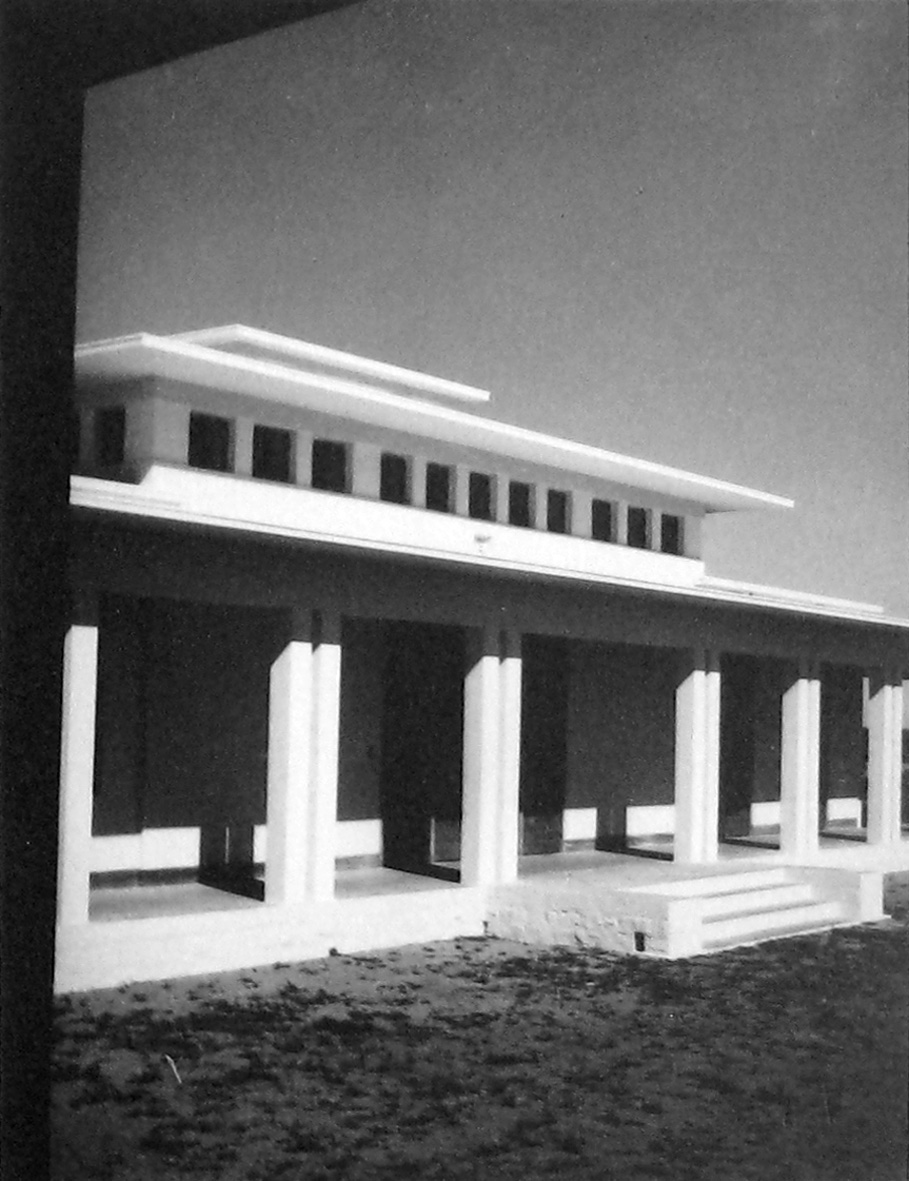
1940_Dispensary Bangalore

At 1:15pm I go home for lunch and for new instructions for my home-draftsman and back to the office at 2 or 2:15. The afternoon is usually filled with visitors who want all sorts of technical instructions or come discussing of new building schemes. Of-course only a very small percentage of our many designs will be built, and if they are it will take at least half a year or a year till they are started. That gives the Dewan who plays the role of ‘Bauherr’ [client] in this game ample time to ask for new schemes and accordingly revised designs.

Usually I am home at 6 in the afternoon. I sit down for a late but very big tea which usually takes about half an hour, not because I eat so much, but because I am just lazy and enjoy my rest. Every second day a Kanareese lesson follows from 6:45 to 8 or 8:15. If there is no lesson this time should be spent with learning what we had the day before, but so far I have always found an excuse not to learn so that the result of a fortnight of lessons with a very good teacher is very poor.          

1939_Municipal Swimming Pool

Dinner is celebrated from 8:30 to 9:30 when we hear the news from England. As it usually is a very good and rich dinner you can imagine that there is not much energy left for letterwriting in the evening.          

This description of my life is unadequate in two points: (1) it sounds boasting and at the same time complaining. But it is certainly not meant to do so. I thoroughly enjoy my work. I only tried to explain that a day of permanent designing is somewhat exhausting. (2) It gives the picture of rather a dull and narrow (English for ‘spiessig’) life. But actually I am meeting interesting new people nearly every day, studying a most interesting country, reading a few good books (for instance the latest Aldous Huxley ‘After many a Summer,’ which I enjoyed very much), seeing a film once in a while and hearing a good deal of Indian and European (gramophone) music.”[1]

Note: Although Koenigsberger’s native language was German, the outbreak of World War II forced him to communicate with his family, who were by then living in the USA and UK, in English – letters in German were censored or confiscated.

 The images are reproduced with the permission of the Koenigsberger family.

Email Contact: rachel.lee@gmx.net


[1] Koenigsberger Papers at the Jewish Museum Berlin: Extract from a letter from Otto Koenigsberger to Kaethe Koenigsberger dated 7 February 1940

PhD Studentship ‘Envisioning the Indian City’ (ETIC)

If you would like to pursue a PhD  at Liverpool University that relates to our understanding of the Indian City, then please consider applying for this studentship (fees only).

Further details about the application process can be found at: http://www.jobs.ac.uk/job/AGJ840/phd-studentship-in-envisioning-the-indian-city-spaces-of-encounter/

The main objectives of ETIC are to examine the following broad areas of inquiry:

(1) how and why the city has functioned as the focus of cross-cultural exchanges in both colonial and post-colonial India;

(2) the nature of the marks that such exchanges have left on the socio-cultural and imaginative identities of the cities in question;

(3) the ways in which they have shaped, and been shaped by, the urban space and the physical fabric of the city in each case; and

(4) the ways in which the nature of such exchanges vary both synchronically, across geographical regions in the same period, and diachronically, across historical periods (sixteenth century till the present).

ETIC involves scholars from English literature, History, Architecture and Modern Languages, with specialisms covering the sixteenth century till the present. The exact PhD topic is open to discussion with potential applicants, but must be related to furthering our understanding of the Indian city. Projects that work across disciplinary boundaries (such as attending to both cultural and spatial/architectural traces of encounter in sixteenth century Goa or twentieth century Pondicherry or Chandigarh, for instance), or those that work across one or more of the selected cities, are especially welcome. Responsibilities will also involve providing some support to the ETIC project, such as helping with meetings, organising reading lists, helping to organise small symposia and gathering source material, uploading data to blog/website.

Applications are invited from students with a good first degree (First, 2:1 or equivalent) or a post-graduate degree in a relevant discipline.

The Doctoral scholarship is available for up to three years full-time study starting on or before September 2013 which will cover the cost of University tuition fees at UK/EU rates, as well as providing tailored early career development training within a thriving intellectual and social community of over 800 researchers and 300 postgraduate researchers.

For more information or to discuss possible research projects further, please contact envisioningtheindiancity@gmail.com.

Indian Connections with the Liverpool School of Architecture

I’m hoping to uncover more connections, exchanges and networks between India and the Liverpool School of Architecture. Please feel free to get in touch if you know of any other Indian Architects and Planners who studied in Liverpool during the early-mid twentieth century, or were directly influenced by Reilly, Budden, Gardner-Medwin, Abercrombie, Holford.This post focuses on three architects who came from India to study at Liverpool; Srinivasarao Harti Lakshminarasappa (BArch in 1921), T. J. Manickham (BArch in 1940) and D. V. R. Rao (BArch in 1950). In all three cases their careers have adopted a tripartite approach of practice, teaching and writing.  In the cases of Manickam and Rao they also worked in the West Indies and Middle East, respectively, with the UN. Gardner-Medwin had taken a similar role in India during the early 1950s. The role of the UN in terms of development/welfare/self-build is an interesting and under-researched component of ‘Tropical Architecture’ in the post WW2 era. Furthermore as demonstrated in these two cases, non-European professionals were advising on planning and architecture matters in other parts of the world, illustrating a shift in power-knowledge relations and a more complex network of exchange than the polar colonizer-colonized model would suggest.

Srinivasarao Harti Lakshminarasappa. Born circa 1885.

Lalit_palace
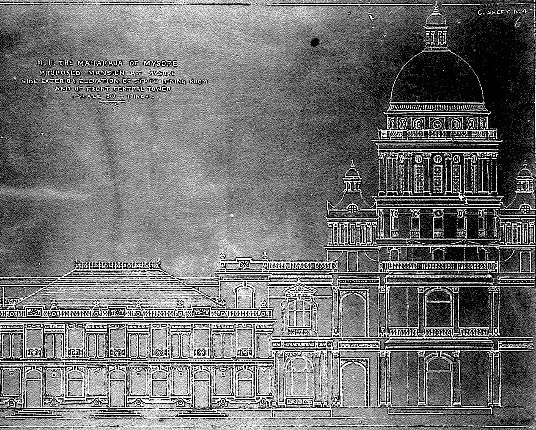
Lalit Mahal Palace, Mysore, circa 1930s

He was the chief architect to the Maharaja of Mysore and worked on the ostentatious Lalit Mahal Palace, completed around 1930, along with  E. W. Fritchley.He also worked on a number of other prestigious projects, including Mysore Town Hall and the Municipal offices, known as the BBMP building (built 1933-36) and was also involved in education as the Principle of the College of Engineering, Bangalore.

T. J. Manickam (1913-1974) Manickam studied at University of Mysore before studying at Liverpool where he completed the BArch degree in 1940 and the Post Graduate Diploma in Civic Design in 1946. He then returned to India, and took up office in the substantial Public Works Department (PWD) before establishing the School of Town & Country Planning in Delhi in 1955.

tjm

T. J. Manickam, circa 1970s.

In conjunction with the ITPI he established the Planning Campus in 1958 and merged with the Architecture department of Delhi polytechnic in 1959 to form the School of Planning and Architecture (SPA). This is a prestigious school and is ranked amongst India’s top architecture schools. Manickam designed a new campus in 1965.
Aware of the importance of disseminating his findings and the reputation of the school, Manickham also founded the journal, Urban and Rural Planning Thought in 1958 (based on the Town Planning Review). He also wrote several articles for Urban & Region al Planning, “Housing Crisis in the east” (1971) for example, and the books New Towns in India, (SPA, 1960), and Housing Crisis in the East, (SPA, 1970)

Furthermore he served as a UN co-ordinator in the West Indies (Trinidad and Tobago) and was a UN Advisor to the Government of Jamaica between 1963-66.

D. V. R. Rao: Prof. Rao has been kind enough to write some of his memories of Liverpool and career highlights and these are included below (email correspondence with Jackson, 2012)

DVR Rao Liverpool University

D.V.R. Rao graduation photograph, Liverpool, 1950

“I am pleased to have had the opportunity to reminisce on my Liverpool days and answer some of the questions posed by Dr Iain Jackson

Why I chose Liverpool– After graduating in civil Engineering from Bangalore University I decided to go to the UK for further studies under the Tata scholarship. Prof Manickam and Mr Lakshminarasappa were both graduates from Liverpool practising in Bangalore at that time. Both spoke highly of the quality of education at the Liverpool School of Architecture which is why I decided on Liverpool and travelled there after the war

Prof Budden –I studied under Prof Budden whom I remember as an excellent teacher and particularly proficient in classic architecture. I graduated from Liverpool university in 1950.There were no other Indian students at the time. Liverpool University was not particularly well known in India except to a small section of post graduate students teachers and academics

Subsequent career– I returned to India in 1950 did a few small assignments and was subsequently appointed to IIT Kharagpur as architect to the campus and assistant professor of the Department of Architecture and Regional Planning. I was fortunate enough to meet Prof Vishwanath Prasad who had earlier worked with Prof Abercrombie, planner of Greater London and Prof Matthews of Clyde valley Regional development. I was promoted to Professor and Head of department of Architecture

In 1963 I took over as officiating director of the SPA, Delhi during the absence of Prof Manickam who was away on a 3 year foreign assignment [Ed – on the UN mission to West Indies].  On Prof Manickam’s return I continued in the SPA as Professor and Head of Department of housing studies  as I had developed a keen interest in social housing which had become a serious issue.  I initiated research into the sociological and economic aspects of massive social housing programmes for disadvantaged people. This drew the attention of UN organizations who were conducting similar studies in other developing countries

Following the sad and untimely passing away of Professor Manickam I took over as director of the school.I developed a strong research centre on rural housing and construction of demonstration houses to help improve the quality of houses in rural areas. Meanwhile I had also worked towards getting the School elevated to the status of a deemed university

In 1977 I was invited by the United Nations to serve as technical advisor in Town and Regional planning in Saudi Arabia . I worked mainly in Riyadh and other Emirates for 9 years from 1977 to 1986 .During this time our team (comprised of a number of international architects and planning consultants) undertook planning and development of major cities alongside a national spatial strategy for equitable distribution of the population. This became the basis for all further and future development in Saudi Arabia.

I retired in 1986 and returned to India. Since then I have been associated with a few consultancy groups.In recent years I have withdrawn from any active participation on grounds of advancing age and deteriorating health”.

I would like to express my thanks to Prof. Rao and his family for helping with this research and for providing the photograph above.