Archive

North Africa

Spaces for Health and Healing in Africa

Symposium 16 – 17 April 

Liverpool School of Architecture 

Liverpool School of Architecture, at the University of Liverpool and the Program in the History of Science, Medicine, and Technology of the Johns Hopkins University invite proposals for a hybrid symposium to be held in Liverpool from the 17-18 April 2025.  

Pathology Labs, Korle Bu Hospital, Accra, c1958

We welcome presentations that explore various settings for health and healing, such as shrines, sacred healing huts, and herbal ‘apothecaries’ and other spaces for indigenous medicine and healing practices; ‘basic’ health care infrastructure incorporating dispensaries, clinics, and hospitals  developed for early missionary and colonial medicine; post-independence medical centres. We are also interested in papers examining the use of healthcare ‘vectors’ such as barefoot doctors, travelling midwives and paramedics and their spread of health care practices such as vaccinations, and childhood nutrition programmes in urban and rural areas. 

We are interested in the settings for full range of medical specialisms from paediatrics to psychiatry and also more contemporary physical design responses to contemporary pandemics such as Ebola and Covid. Evidence and records of mixtures of indigenous and western healthcare practices in some community settings and the emergence and involvement of teaching hospitals in healthcare planning is also of interest.  

Other possible topics include the role of military hospitals, colonial and modern, and contemporary healthcare infrastructure and provisions for displaced persons and refugees.  We encourage interdisciplinary approaches–history of medicine, medical anthropology and sociology, oral history, among others. 

Our area of interest is the African continent, from the ‘MEANA’ countries of the maghreb, north of the Sahara, to all countries South of the Kalahari and East and West of the Sahara. Health and healing facilities on islands in proximity to main continental mass such as Zanzibar, Mauritius, Fernando Po and Cape Verde are also of unique interest. 

We are seeking to publish selected outputs from the symposium in a volume currently under negotiation with the publisher. We welcome abstracts (500 words max) and short CVs (1page) Please also indicate whether you intend to deliver your paper in person or online. For more information please contact  Ola Uduku o.uduku@liverpool.ac.uk or Bill Leslie, swleslie@jhu.edu

Call for participation
Journée d’étude sur l’architecture et l’urbanisme au Maroc après l’indépendance (1956-1986)
20th February 2024, Centre Jacques Berque, Rabat
Deadline (french or english): 30th September 2023

The newly established Réseau de recherche sur l’histoire de l’architecture au Maroc – RHAM (rham.hypotheses.org) launches a call for participation to the Symposium: ‘L’architecture et l’urbanisme au Maroc après l’indépendance (1956-1986). Trajectoires d’acteurs et circulations de savoirs’.

Cette journée d’étude se concentre sur une période spécifique de l’histoire du Maroc : les trois décennies qui ont suivi l’indépendance du Maroc, de 1956 à 1986. Cette période, qui demeure encore largement sous-explorée au regard de la littérature produite sur la période coloniale, suscite désormais un intérêt croissant. Fort de ce constat, la première journée d’étude du RHAM vise à faire se croiser et se rencontrer ces différentes manières d’aborder l’histoire de l’architecture, du paysage, de l’urbanisme et de l’aménagement du territoire au lendemain de l’indépendance, en mettant en évidence des matériaux de recherche inédits

For more info, see the call for participation here.

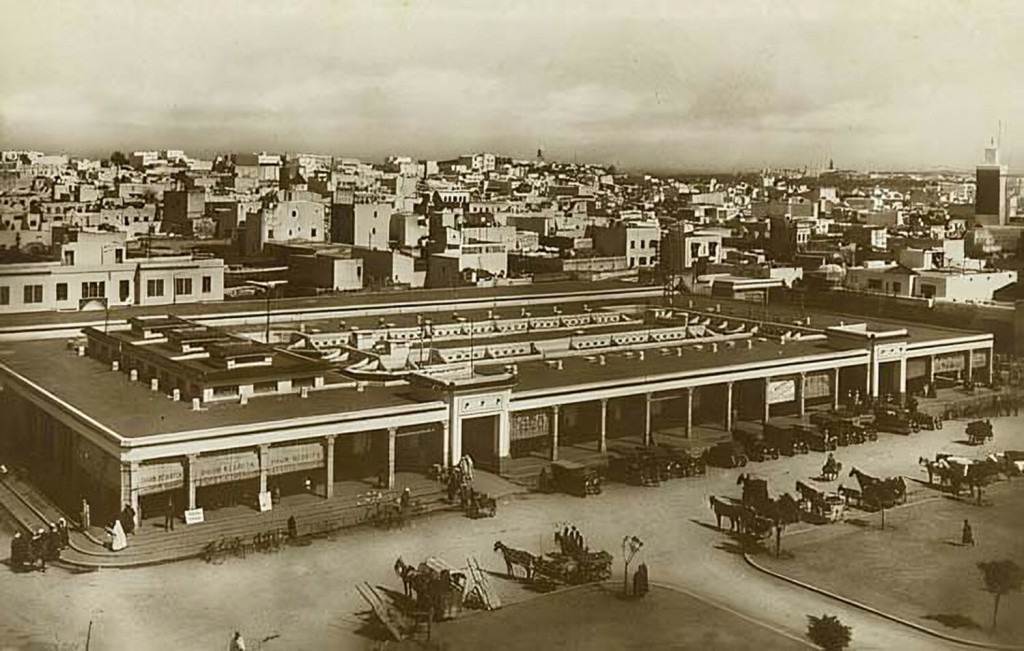
Central Market Rabat. Source: Postcard, 1925 (Author’s collection).

Rim Yassine Kassab writes:

In 1925, the Central Market of Rabat was built at the outskirt of the medina (the old city) by French Colonial powers (1912-1956). Despite being the only element displayed in colonial maps of the medina, and one of Rabat’s current landmarks, the history of the market is still unknown. Drawing on the National Moroccan archives and on colonial postcards, the article explores the historical and urban significance of the Central Market for Rabat colonial and postcolonial history. It argues that the market constitutes a unique architectural and urban case for Rabat as it both challenged and reinforced the colonial agenda. Planning principles like the policy of association, the ‘image of the city’ and the ‘dual city’ were not only defied by the market, but also by the demolition of the part of the wall in front of it. This revealed the inconsistencies and lack of homogeneity of the colonial approach. Moreover, without the wall, the medina became penetrable by the ‘Ville Nouvelle‘ (New Town). Engaging with the Central Market is significant for the history of colonial planning, but also for today’s Rabat identity construction, inscribed in 2012 in the UNESCO World Heritage Sites and elected cultural capital in 2022.

Read the full article in Planning Perspectives , Open Access: https://www.tandfonline.com/doi/full/10.1080/02665433.2022.2130964