Archive

Tropical Architecture

Good bye Kumasi, Accra, Ghana….

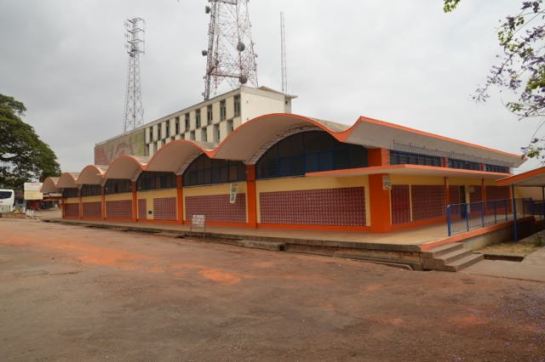
We revisited the Manhyia Palace archives and made notes on the relevant documents to be consulted before dashing off to board the local propeller plane back to Accra. Gazing at the dusty spread of Kumasi – we wondered whether the current airport terminal was adjacent to the original Norman and Dawburn small airport project designed in the 1950s? Suggestions of an earlier architectural history seemed to be revealed in the present day profiles of the domestic airport buildings viewed as we taxied down the empty runway for takeoff.

IMG_0144

‘Tropical Modernism’ on the 10GHC note, The Bank of Ghana in Accra

Accra was in the grips of a major traffic jam, cooler and drier than Kumasi, it proved overbearingly hot to spend more than half an hour getting from the airport to Jamestown to see the exhibition of the Delft-Accra, urban transformation collaboration project we visited on our arrival in Ghana. We met a transformed space and were given a tour by curator and ArchiAfrika member Joe Addo. Joe also spoke of his further plans for the activation of various parts of the Jamestown neighbourhood. A further visit to the National Museum offices, and another slow trip on Accra’s congested highway to the international airport concluded the trip, with Ghana’s independence day holidays over the weekend we weren’t the only ones heading out of town.

Our project continues; the Ghanaian team (Prof. Rexford Assasie Oppong and Irene Appeaning Addo) will begin planning their research trip to the UK in the autumn, and we have considerable sources to continue consulting in the meantime.


Notes from Kumasi Part 3

At the KNUST campus the library and Great Hall complex work very well within their elevated landscape setting. The Gerlach and Gillies-Reyburn’s muscular grey abstract ‘kente’ cloth brutalist hall and library extension is arranged in a ‘quad’. The complex overlooks the campus, facing a formal axis that leads to the administrative and teaching blocks. The composition is completed on its south flank by an architectural gem, which we discovered is the original KNUST library block. Is this James Cubitt’s riposte to Fry and Drew’s Ibadan Library?

DSC_0246

DSC_0276

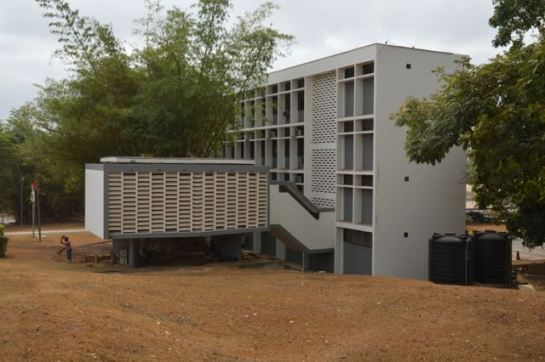
The Old Library Block

The ‘old’ KNUST library presents an essay in tropical architectural design. Still sitting on its cast, fluted piloti this four storey structure employs screen walling, operable louver windows, and shading devices to both demonstrate and celebrate the possibilities of creating a successful architectural resolution to the needs of passive design. Its forlorn main entrance, clad in travertine, and superseded by the Gerlach and Gillies-Reyburn entrance to the East, shows the quality of materials employed in specific areas of its design.


DSC_0101

Administration Offices and Meeting Room

Inside, much of the Library building seems frozen in time. Reading carrels lie empty whilst the daylight filled reading spaces, with custom built, empty journal shelves have few readers, and ageing academic book collections. The e-resource room however has been kitted out with desktop computers and seems to be the most used student space in the building. A second “IT” floor was being planned, and the new desktop computers were just being commissioned, in spaces flooded with artificial light, closed to the exterior with floor to ceiling fabric curtains – only this space in the building needed fans for cooling. Meanwhile the offices at the top floor with their no longer used spiral staircase took one to another world of naturally cross ventilated office space, and custom designed insect screens – demonstrating that climate responsive design in the tropics still works. One hopes its on-going transformation doesn’t forget this idea.

Notes from Kumasi

Leaving Accra we departed for Kumasi– there was a change of pace in this dusty Ashanti city. Flying in, the low-rise collection of housing and settlements spreads across the horizon. The city has a hotter, inland climate, but the KNUST campus has this relieved somewhat by its lush mature vegetation. A visit to the recently restored KNUST Staff Club and walk around the campus to the ‘central area’, gave a good feel, and introduction to KNUST.

DSC_0939

KNUST Senior Staff Club House, designed by Cubitt

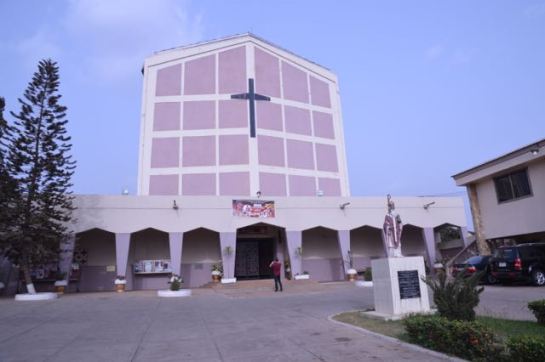
The following day united us with more visiting staff from University of Edinburgh and we set off on an extended excursion to various buildings in Kumasi city. Fry and Drew’s Prempeh College and Opoku Ware schools, are visited first and present us with a first hand view of this couples’ best exemplars of institutional tropical modernism. Visits followed to Nickson’s Anglican Cathedral, a towering structure, with less external architectural sophistication than F+D’s educational oeuvres, but provided interiors that successfully captured the spirit of high Anglicanism in its light-filled interior.

DSC_0997

Anglican Cathedral, Kumasi, designed by R. Nickson from 1950

A dusk-tinted view of the campus concluded the day’s visitations, its welcome calm was a good antidote to the ‘busy-ness’ of the town. The buildings at the ‘Tech’, as it is colloquially called, sat sedately in their lush tropical setting, showing off Scott and Cubitt’s earliest university campus in Africa.

The historic ‘central’ administrative area of Kumasi formed the focus of the next day. The post office and Ghana electricity building suggest they are examples of late ‘PWD’ post war architecture, whilst the historic memorial to the West Africa Frontier Force, soldiers who fell in WW1 in Abbysinia (Ethiopia) and Burma (Myamaar) give us pause for remembrance. Walking up towards the military museum we find that although it is closed, we can still pay officially for a visit and take the chance. More than an hour later, we are overwhelmed with the sheer military-related history this deceptively small former garrison fort contained. As a colleague commented, “this gave [me] the context” to this city.

DSC_0024

Kumasi GPO, designed by PWD?

Visits to the Asawasi and Fanti Town districts, the latter adjoining the Cathedral area, gave good examples of early housing layouts in Kumasi designs by known planners in some cases. At Fanti Town we inadvertently came across the’ coffin district’, and attempted a stop at the Bantana district of the town to photograph circular hut housing we had identified the day before. The military museum guide had confirmed that these historic huts still provided accommodation for the army. As the garrison was still camped at the site we could not investigate this much further.

Notes from Accra Part 2

Our journey continued with visits to Tessano ‘East’ which had a few remnants of the original site and service planned estate, best exemplified by the police station and a few administrative blocks, which often defined the colonial housing plan layout. A visit to the University of Ghana, at Legon followed. Designed in the late 1940s by Harrison Barnes and Hubbard, the leafy campus sits upon on a hill, high above Central Accra. The campus architecture has a curious oriental aesthetic which defines the its identity, with a number of significant buildings including the Balme Library and the Main Hall. In the African Studies department we joined our British Academy project associate, Dr Irene Appeaning Addo, for a very productive meeting.

DSC_0905

Tisano East Police Quarters


DSC_0917

The Grand Hall and Tower at Legon University, Accra

A trip to the Korle Gonno Housing Estate followed, using then new drained highway over the Korle Bu inlet and past the University of Ghana Hospital. The Korle Gonno Estate demonstrated a very early example of decant housing as from conversations with an older resident of the estate it was found out that many of the original residents had been moved from the Jamestown area of Accra to Korle Gonnu, a few miles down the coast. The estate was more intact than Tessano, with a number of the original buildings still evident.

DSC_0928

Korle Gono Housing Estate: regulated street patterns and services

Korle-gono

Korle-Gono Model, c.1920? Photograph held in the National Archives, Kew, UK.

A walk around the “Ringway” estate ,where we resided took us to the “Osu” layout and a road which had a pair of suspected James Cubitt-designed residences . A second visit just before departure from Accra confirmed this, although their external facades had been significantly altered. The pair of residences are now in use by the diplomatic corps.

Notes from Accra

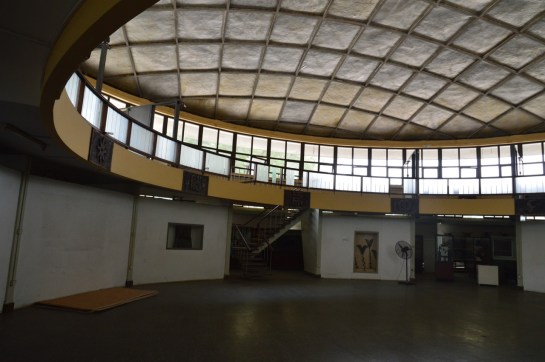
Iain Jackson and Ola Uduku have spent the last two days in Accra catching up with 20th century architecture, and meeting with contacts as part of the British Academy funded ‘From Colonial Gold Coast to Tropical Ghana’ architecture project. Tuesday 23rd February was spent visiting the Ghana National Museum complex, the gem in the crown being Denys Lasdun’s prefabricated dome shaped museum, currently closed for refurbishment. The imagination and vision of the building were still clearly there in our viewing of the stripped down structure ready for conservation.

DSC_0820.jpg

Our next stop took us to Nickson and Borys’ Children’s library building nearer to Central Accra. This had been sympathetically restored, and again was a great demonstration exemplar of ‘West African Modern’ and the developmental vision of the departing colonial government to establish libraries that were open to all citizens. The upper area remained devoid of activity but had potential to be a great multipurpose programme space.

DSC_0801.jpg

Children’s Library

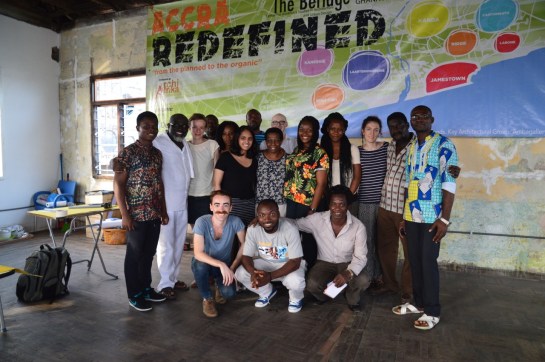
The final visit of the day was to Joe Osae-Addo’s Archi-Africa – TuDelft Berlage Architecture school studio, in Accra’s Jamestown neighbourhood, on the urban fabric of everyday life in Accra. The impromptu crit we were invited to take part in was an enjoyable experience and the schemes were full of promise.

DSC_0832.jpg

TU Delft and Archi-Africa in the newly converted Jamestown Studio

Day two involved visits to Jamestown – as a walking visit this time to take in early 20th century colonial PWD, and also warehouse architecture in the neighbourhood. A visit to Adabraka also yielded a few examples of early PWD worker housing, which was followed by an afternoon visit to Achimota School, which conveyed the height of the colonial education project with architectural symbolism and style. A few later additions to the campus by Nickson and Borys and other’s also fitted well into the College’s narrative of colonial imperialism and privilege. The final visit for the day was to Scott House, which lived up to its deified tropical modernism status, whilst the Western Tessano neighbourhood had transformed into an upper class gated area, that unexpectedly gave us a glimpse of an earlier [likely Cubitt?] designed semi detached housing unit, currently undergoing a further 21st century upgrade..

DSC_0863.jpg

One of the few surviving examples of its type in Adabraka

We will be moving onto Kumasi on Friday and will update from there early next week.

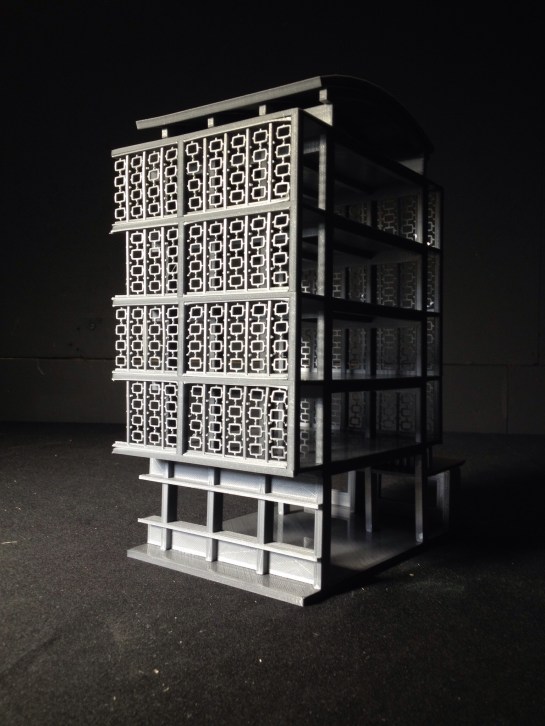
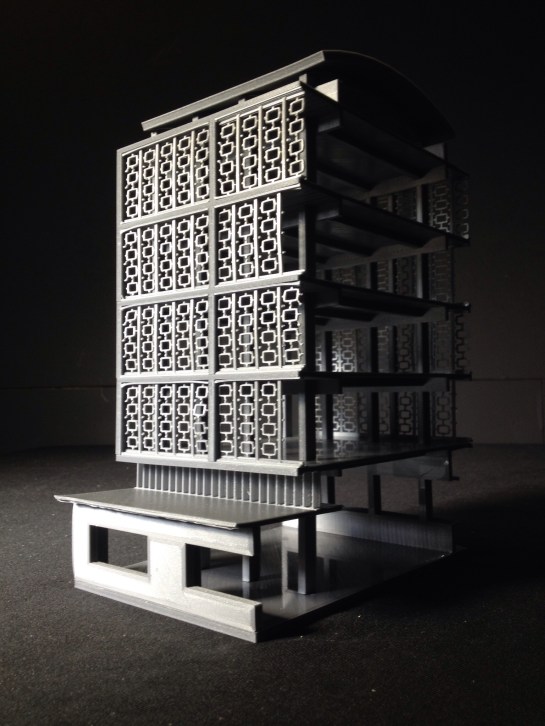
3D Printed Model of Kenneth Dike Library

We’ve been playing with a couple of 3D printers [Makerbot and Ultimaker] and testing how they might be used to create a small collection of models to supplement our History of Architecture lectures.

image

In the age of ‘Stream Capture’ and recorded lectures including a small exhibition of key case study models in the lecture theatre will hopefully entice the students to attend the live event and will also form an opportunity to further explore light, scale and the qualities of buildings that are not as easily expressed through photographs and orthographic drawings.

image

Our first test case used a computer model of the Kenneth Dike Library, Ibadan [designed by Fry and Drew] expertly produced by Jacopo Galli and generously shared with us. The model doesn’t show the entire buiding but a key section enabing the interior to be viewed. The ambition is a for an online library of models that can be downloaded and then printed as and when they are required by faculty and students.


image

The 20th Century Urbanism and Landscape in Africa conference recently held at the Edinburgh School of Landscape Architecture (ESALA), University of Edinburgh. It took place from 7 to 8 October, and focused on the subtheme of ‘Research Challenges and opportunities’.

The first day of the conference was dedicated to presentations by the four Key Note speakers, who were Dr Rexford Oppong of KNUST Ghana, Prof Luc Verpoest of KU Leuven, Prof Johan Lagae of Ghent University and Dr Iain Jackson of University of Liverpool. Although their presentations all brought the conference’s key theme of ‘Research Challenges and Opportunities’ to the fore, their various approaches and contexts had provided more divergent and interesting perspectives to the discussion.

The areas of interest covered by the four speakers ranged from Dr Oppong’s  “Challenges and Opportunities of Conservation Research and Documentation on the Urbanist and landscape heritage of KNUST”, to Prof Verpoest “Mind the gap: from historiography to [urban] preservation. The African case” and Dr Jackson’s “Research Challenges and opportunities in West Africa”. Prof Johan Lagae also presented a talk on the challenges of his on-going research on urbanism in Congo.

Picture2

Cover picture for Dr Jackson’s “Research Challenges and Opportunities in West Africa”

In Dr Oppong’s talk, he presents the KNUST as a campus set, and much preserved in the Modernist architectural theme of the 1950s. However, the current state of its architectural drawings archives as highlighted in his presentation, need urgent conservation and documenting for posterity. He therefore gives insights into his current research in this regard, and the challenges of the project. One main challenge he sights is in getting the current University and secondary school students (who also played a part in the survey) to recognise the input of indigenous Ghanaian Architects in the building designs.

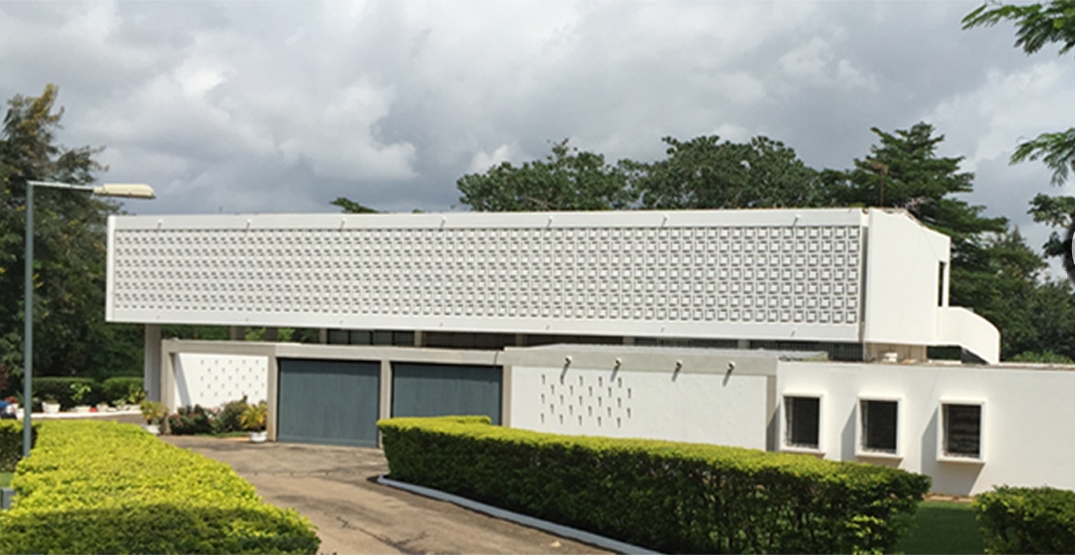
vc lodge

The Vice-Chancellor’s Lodge, KNUST Ghana

The challenges of conservation and documentation raised by Dr Oppong, was a theme which ran through the other presentations. However, in Prof Verpoest’s talk, he suggests that further strands of investigations are needed to be explored on the subject. Rather than being limited to buildings and famous architectural pieces he argues, researching conservation, preservation and documentation should look at the wider picture of processes, institutions, mechanisms and historical context. In essence, it should go beyond the built object as an individual subject of analysis. He therefore discusses this in the light of recent projects by Docomomo, where research is being done to go beyond individual building conservation to urban building conservation. He also explains how the organization is seeking to have regional linkages in selected African countries.

Picture2

An image of Africa’s changing society as illustrated in Prof Verpoest’s presentation

Prof Verpoest’s  suggestion of research into urban, rather then individual building conservation, preservation and documentation in Africa and globally, is also seen to form the crux of work done by the third key note speaker – Prof Johan Lagae. In his current research in Congo, Prof Lagae looks at various types of infrastructure – Missionary, Railroad and Hospitals, but all within the wider urban form context and everyday living. He also looked at the Post Belgian period in Congo around 1965, and raises the issue of building production and technology – but again questions “where were the Congolese in all these?” On the challenge faced in his research, he stated practical issues of language, electricity, relating with local chiefs etc. He also notes the fantastic data and drawings present in the archives, but which unfortunately lacks infrastructure.

Picture5

Picture of King Leopold II of Belgium in an archival administrative document on the Congo

Prof Lagae’s question on the contribution of natives, and poor archival infrastructure are two issues which Dr Jackson’s also raises in his presentation on Research Challenges in West Africa. With regard to the native contribution, he suggest that urgent work is required on the works of native architects in particular. While supporting the need for improved archival infrastructure in West Africa, however, Dr Jackson also makes a case for more fieldwork participation – arguing that “We have to get our hands dirty and explore…to create new photographs and records of the buildings”. He also suggest that further to such fieldwork exercises, the adoption of new technologies, like Drones and GPS need be encouraged to produce astonishing results. As seen in Professors Verpoest and Lagae talk, Dr Jackson was also of the Opinion that Architectural history needs to move beyond the conservation and preservation of important buildings. He argues rather, that research in this area become more inclusive of the intangible and the ephemeral, and sample user experiences and opinions. His talk raises several other questions on research challenges in West- Africa, including the theoretical base, further studies into Village plans and the PWD, art works and murals, architectural teaching etc. A most significant point he however raises, is on the need for collaborative research, rather than the lone-wolf and fear of plagiarism approach.

photo (1)

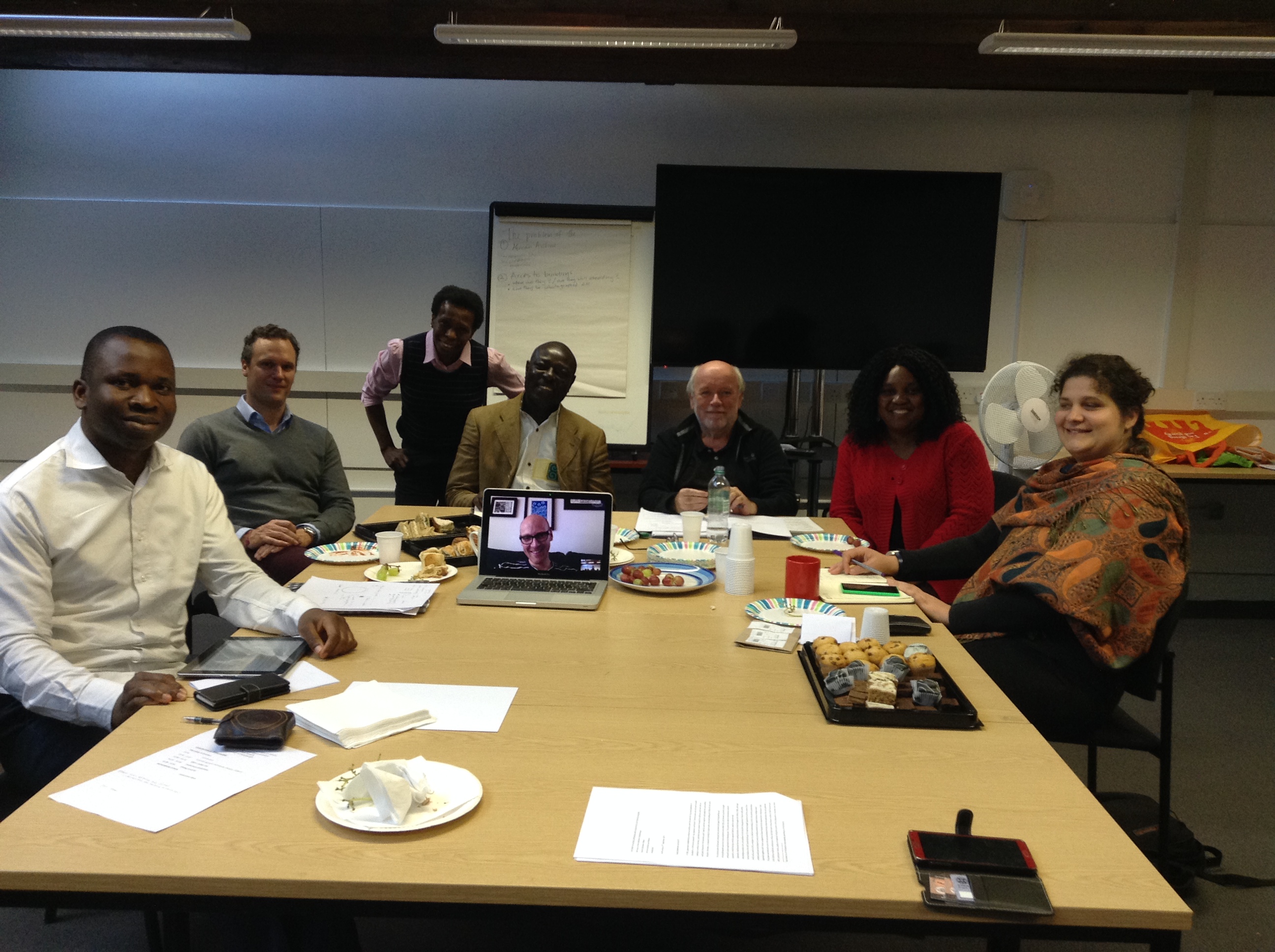
Delegates at the 20 Century Urbanism and Landscape in Africa Conference on 8 Oct 2015; Left to right are Meshack, Dr Alex Brymer, Dr Ola Uduku, Dr Rexford Oppong, Dr Iain Jackson (on Skype), Professor Verpoest, Yemi Salami, Dr Ruxandra

Scheduled for the second day of the conference were two presentations to be given by Yemi Salami and Anthony Folkers. Anthony Folkers was not in attendance at the conference but had his paper presented by Dr Uduku The paper was titled “The Spirit of George Lippsmeier and His Institute for tropical Building”. Yemi, had only recently submitted her PhD and is awaiting her viva to take place. She gave a talk on the challenges of undertaking a doctoral research in Nigeria, and her paper was titled: “Challenges of Conducting a Doctoral Research in Nigeria: Reflections from my PhD work on “the Architecture of the Public Works Department in Nigeria, c1900-1960”. Here she discussed challenges ranging from very slow bureaucratic processes, to ill equipped archives and security and insurgency issues, as some of the hindrances she faced during her research. The symposium then held at the end of Yemi’s presentation, with Dr Jackson joining the debate via Skype.


Conserving West African Modernism Workshop and Conference Report

KNUST Kumasi, 2 – 18th July 2015

From the 2nd to 18th July 2015 Ola Uduku spent time at the Kwame Nkrumah University of Science and Technology (KNUST), Kumasi Ghana, working with Dr Rexford Assasie Oppong, to set up and run the inaugural “Conserving West African Modernism” workshop culminating in an international conference held from the 13th – 14th July at KNUST.

There were a number of objectives for the project; firstly the visit provided an initial attempt to explore the possibilities of Edinburgh University’s Scottish Centre for Conservation Studies, (SCCS) and Architecture School becoming involved in research collaboration activities centred on the Modernist heritage of the KNUST campus both in terms of architectural history and also international- tropical conservation practice. Also included in this collaboration was the Liverpool University School of Architecture, (LSA) which has research expertise and archival material on the work of Maxwell Fry and Jane Drew who were involved in the development of Kumasi and Ghana’s post-WW2 architectural heritage.

DSC_0463

Second, the project sought to make an initial assessment of the modernist heritage site and buildings at KNUST with a view to using these as a basis for documentation, to support the application for Ghana to become a member of the international modernism conservation organisation Docomomo International. This also included a public outreach element in which the project engaged with local university school children in a campus buildings tour and questionnaire session to raise awareness and interest in the buildings on the KNUST campus.

Third, the project sought to explore the possibilities of having the SCCS at Edinburgh University support the development of an MSc. Course in conservation and also contributions to architectural history teaching, initially via online courses, using available media technology at both institutions. In connection with this, linkages to architectural history teaching at the Liverpool School of Architecture and its future research-links with Ghana were also examined.
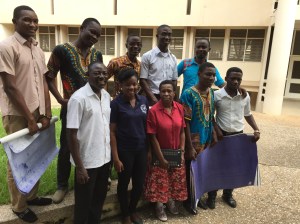
PG_KNUST2

Also at public and international outreach level, work was undertaken with Junior high school students to raise awareness about the modernist architectural legacy on the Kumasi campus, via a series of tours, discussions and ‘snap-voting’ on buildings judged ‘best’ by the pupils. At the international level the project enlisted PG architecture students to work on listing key campus buildings, using the Docomomo, (the international organisation for conserving modernist buildings and landscapes), fiche listing template. This is with a view to working with KNUST staff and students towards compiling material required to apply for Ghana’s membership of Docomomo in the next biennial conference in 2016.
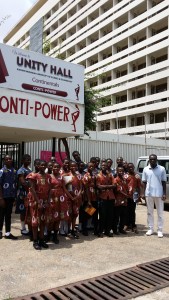
GROUP_UNITY

The project culminated with a well-attended two-day conference at KNUST, where keynote speeches were given by; KNUST Professor emeritus H. Wellington, and Professor Miles Glendinning, Director SCCS, University of Edinburgh. Teams of Junior High School and KNUST Architecture PG students also gave presentations, showing the work they had done during the preceding week’s ‘KNUST Modernism’ workshops.

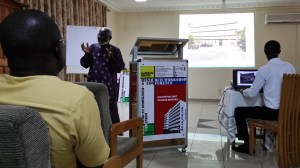
miles_rex_me Prof_Wellington

Providently the conference also heard the views and reminiscences of Profs Wellington, Owuso Addo, and Arc. J Larbi, all eminent Ghanaian architects and educators, who had been historically involved with the development of the campus, since its inception in the mid 1950s to the 1990s, who attended the workshop. Representatives from the Ghana Institute of Architects, the Lands and Survey office at KNUST, associated faculty staff from the College of Architecture, Arts, and Planning, and from the ArchiAfrika organisation, were also in attendance.

The various workshops and final conference was made possible by funding and in–kind support received from a number of bodies including: The African Studies Association UK, ArchiAfrika, The University of Edinburgh, The University of Liverpool and KNUST.

The Communique below was issued at the conclusion of the conference:

Conserving West African Modernism and Urbanism Research Workshop and Conference Communiqué

 At the inaugural workshop / conference, ‘Conserving West African Modernism and Urbanism’, held at KNUST, Kumasi, Ghana on 13-14 July 2015 – an event which involved staff and student participants from the KNUST Junior High School, KNUST Architecture postgraduates, and which was attended by a range of national and international invitees including the Ghanaian architectural luminaries Prof. J. Owusu-Addo, Prof. H. N. A. Wellington, and Arc. S. O. Larbi, along with Prof. Miles Glendinning from the University of Edinburgh, Scotland – it was agreed to pursue the following specific objectives:

  • To continue with the primary objective of the project in supporting and developing an appreciation and culture of conservation in West Africa, in collaboration with DOCOMOMO International – commencing with the task of researching and conserving the heritage modernist movement campus layout and buildings at KNUST, Kumasi, and pursuing the establishment of a Ghanaian national chapter of DOCOMOMO;
  • To work to develop collaborative research links related to KNUST’s building history, with the Edinburgh School of Architecture and Landscape Architecture (University of Edinburgh) and the Liverpool School of Architecture (University of Liverpool), with expected joint academic research outputs.
  • To explore the possibilities of developing a Department of Architecture -KNUST Masters programme in history/ conservation studies with support and collaboration from the Scottish Centre for Conservation Studies (SCCS) at the University of Edinburgh, and the Liverpool School of Architecture (LSA);
  • To seek funding to develop a West African Modernism Archival Project, (WAMAP) which would have the Department of Architecture, KNUST as its centre. Its objective will be to create a digital archive of KNUST’s extant material records of its historical development, comprising plans, models, and oral histories contributed by surviving actors involved in the founding and development of the campus. This project would aim ultimately to evolve into an international centre and nexus for modernist building research in West Africa.

In this communiqué we also acknowledge the desirability of developing full links with cognate research and academic bodies within Ghana, including the Institute of African Studies and the Department of Archaeology and Heritage Studies, at the University of Ghana, Legon, together with other associated educational and professional institutions, including the Ghana Museums and Monuments Board, the Ghana National Archives, the Ghana Institute of Architects, and ArchiAfrika.

  15th July 2015
Dr Rexford Assasie Oppong Dr Ola Uduku
Department of Architecture,

Kwame Nkrumah University of Science and Technology, Kumasi, Ghana

Edinburgh School of Architecture and Landscape Architecture,

University of Edinburgh, Scotland

*** Further news, Iain Jackson, Rexford Assasie Oppong and Ola Uduku will be collaborating on a British Academy Funded International Partnership and Mobility Grant “Architecture and planning in the Tropics; from Imperial Gold Coast to Tropical Ghana“,  starting in November 2015. ***

Current Research: Tropicality at the Architectural Association

1425394707

The research project takes form of a two week workshop which is open to students as well as the general public. Our agenda is nomadic but we aim to study the tropical dwelling through architectural stories about home, culture and place.

Initially we are planning a 3 year agenda with a specific focus on one country per year, starting with Costa Rica, Vietnam and India.

During the two week field trips, we will visit the homes of people from all walks of life, talking to them about their experiences in the architecture they inhabit, and exploring that same architecture as a character.

At each home we will make a short film as a narrative composition of images (form, space, light, colour, materiality) and sound (voice, story, city, nature). The films will become a unique and perceptive form of architectural construct.

For more information please visit:

http://www.aaschool.ac.uk/STUDY/VISITING/costarica

http://tropicality.aaschool.ac.uk/

West African Modernism & Urbanism Research Conference and Workshop, 13-14 July 2015, KNUST, Kumasi, Ghana

You are invited to a workshop and conference which will focus on developing the conservation of modernist buildings and urban landscapes in West Africa.

This development strategy will be tackled at two levels. Firstly, at urban and edifice level, through the development of the KNUST Architecture Department as a Centre for public engagement with, and professional expertise in, contemporary urban conservation training and research; in West Africa, this discipline is currently not taught at institutional level, despite the existence of a network of architecture and planning schools, and architectural institutes for whom this would be beneficial.

Secondly, with support from DOCOMOMO International’s African group and Urbanism-landscape specialist committee, the workshop will develop a physical archive of modernist buildings in West Africa, using digital technology to scan and record building photographs and plans of the postwar modernist era. The data will be made available both to researchers linked to the proposed urban conservation training project, and, equally importantly, to the local public, as a visual resource of contemporary West African Modernist history.

The workshop will feature outreach presentations from junior secondary school pupils and talks from the eminent keynote speakers and research associates involved in the workshop and archive programme.

Keynote Speakers: Prof. Miles Glendinning [University of Edinburgh] and Prof. H. N. A. Wellington [Emeritus and Former Head of KNUST].

Kumasi_Conference_poster

We acknowledge the support of this event by the Universities of Edinburgh, and of Liverpool, and by the Royal Africa Society.

For more details on the event please contact Dr. Rexford Assasie Oppong [assasie2003@yahoo.co.uk] / Dr. Ola Uduku [o.uduku@ed.ac.uk] for more details.