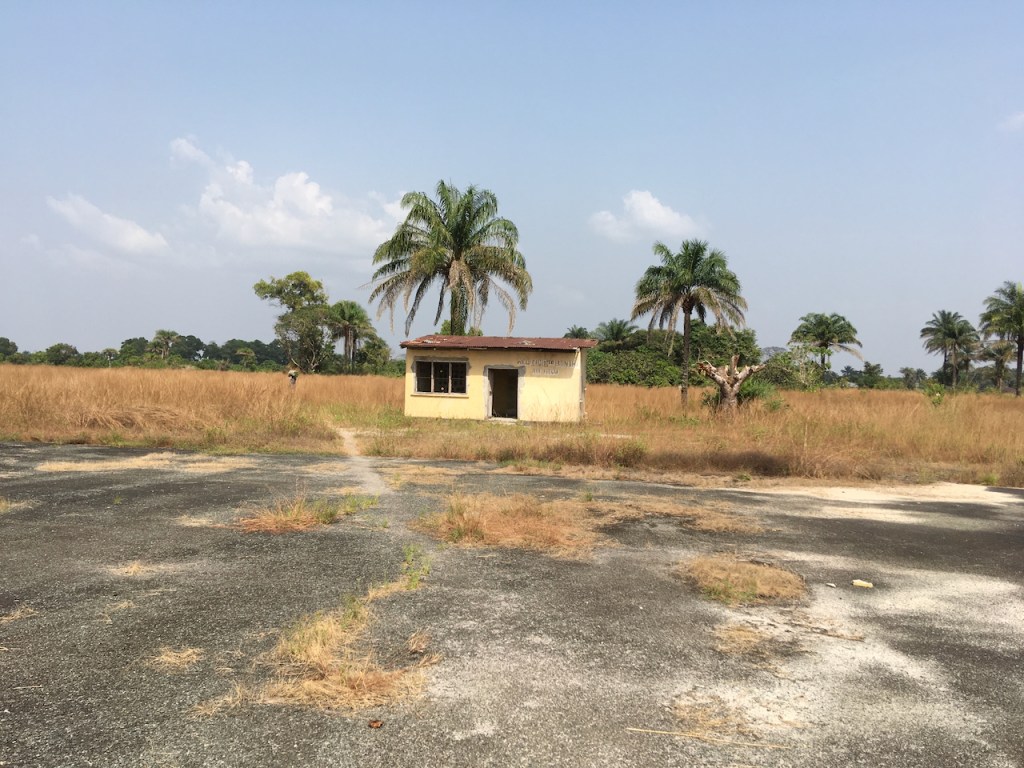
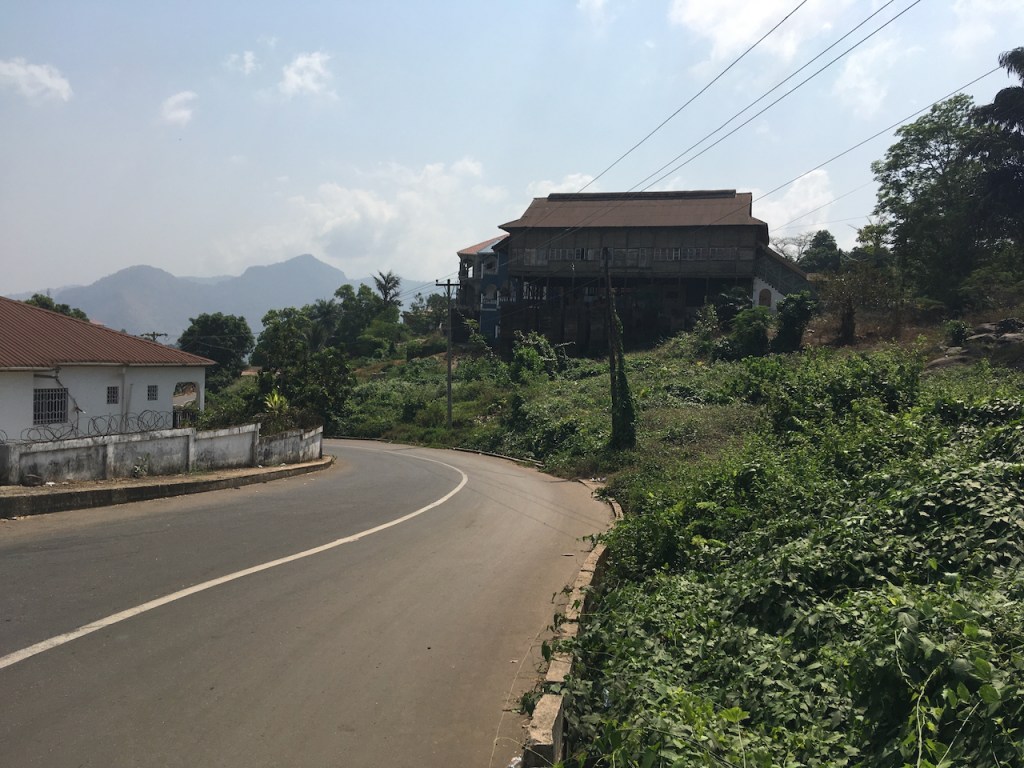
On an escarpment, 250m above the city of Freetown, is the small settlement of Hill Station. This was an exclusive resort built for the British colonial administrators and staff between 1902 and 1904. Modelled on the Indian hill stations (such as Simla) and the sanatorium at Aburi, Ghana, it aimed to provide cooler, more healthier abodes for the Colonists. Ronald Ross’s recent discoveries on mosquitoes and malaria also prompted the move away from the city, and the increasing desire for racially segregated housing and cordon sanitaires.
Bungalow at Hill Station
The houses were exported as kits from the UK ready to be assembled and clad on site. Hefty concrete bases are topped with steel frames that provide living accommodation at first floor level . Access is via a perpendicular staircase leading to a verandah. The raised bungalows catch the breeze and offer far reaching views over the forest, city, and ocean below. A club offered the only source of entertainment for the residents of this leafy, isolated, community.
Covered staircase entrance
How to access the Hill Station was solved by building a narrow gauge railway line from the city. It operated to suit the office hours of the government officials, and ran from 1904 until 1929 when it was replaced by road and bus service. Each day the officials would commute into town and return at the end of the day to their verandah’s and billiards at the Club House. It was an elaborate and hugely expensive experiment that benefited just a few dozen individuals. To build and maintain a railway through this challenging terrain was an immense task.
New build on left with origin Hill Station residence on rightView from Hill station over FreetownHill StationOne of the surviving 12 original Hill Station houses – with modifications to base
Today, just 12 of the original 24 two-storey houses survive, still occupied by civil servants and their families (and still without a piped water supply). Many of the houses are being modified and extended, and the large plots split-up and sold to facilitate new development.
As part of our project to research the architecture of the United Africa Company (UAC) we’re visiting Freetown in Sierra Leone.
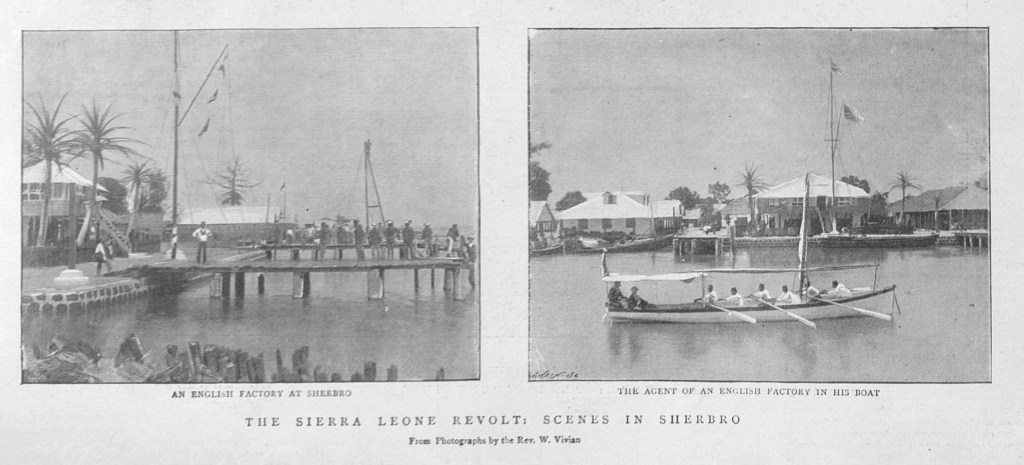
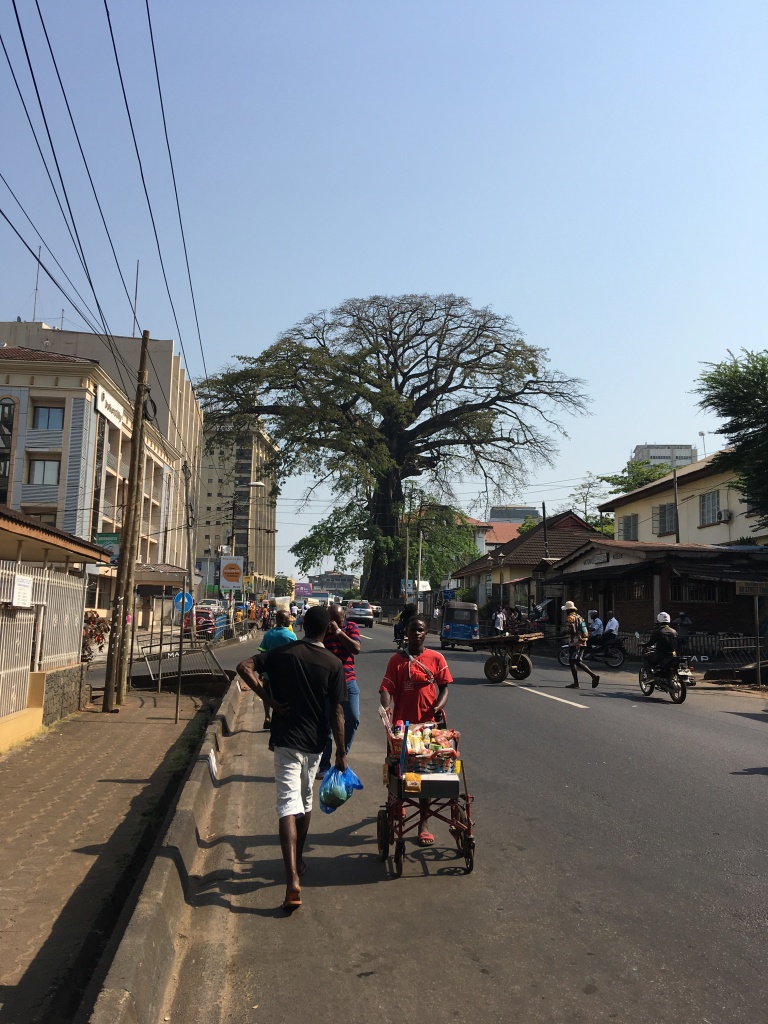
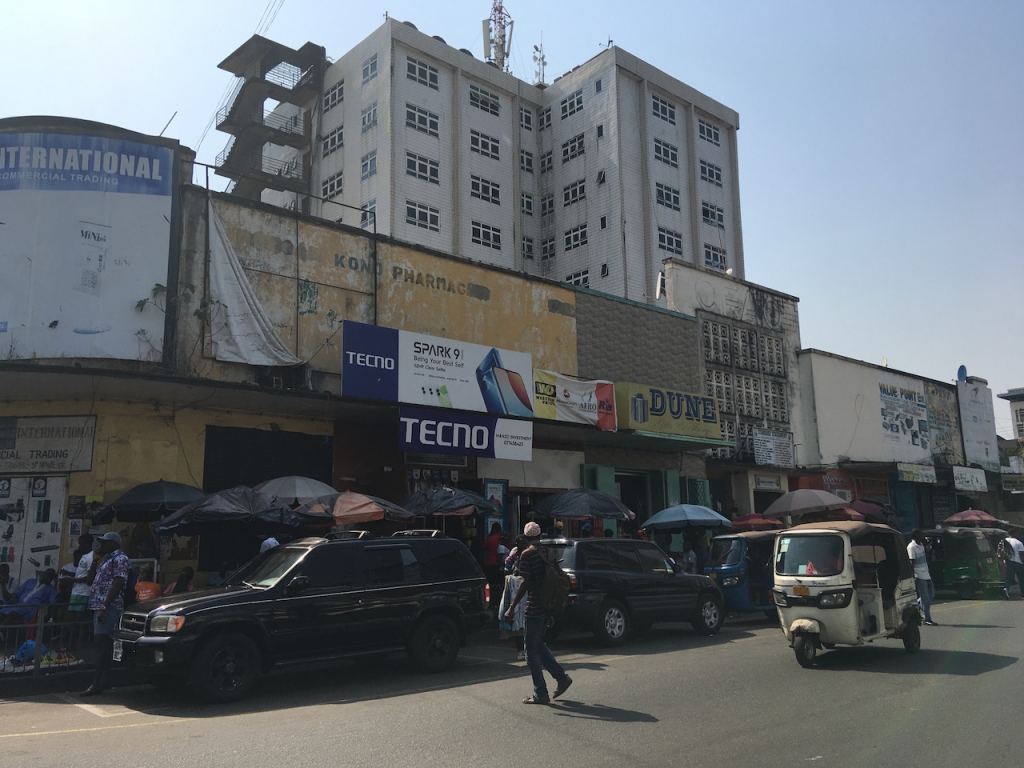
We spent the first day looking around the commercial business area wrapped around the giant cotton tree. The city grid was set out by the Sierra Leone Company surveyors in the 1790s and its wide streets and blocks are largely intact. Interspersed among the commercial properties are churches, houses, and schools, some dating back to the 19th Century.
The Cotton Tree, central Freetown
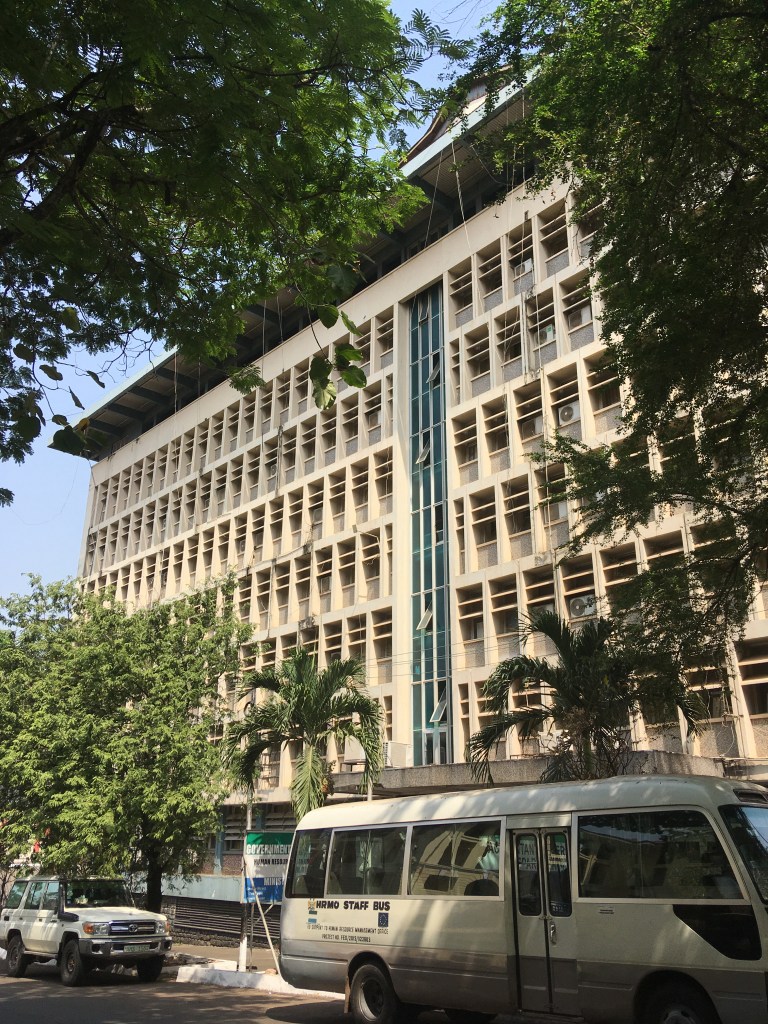
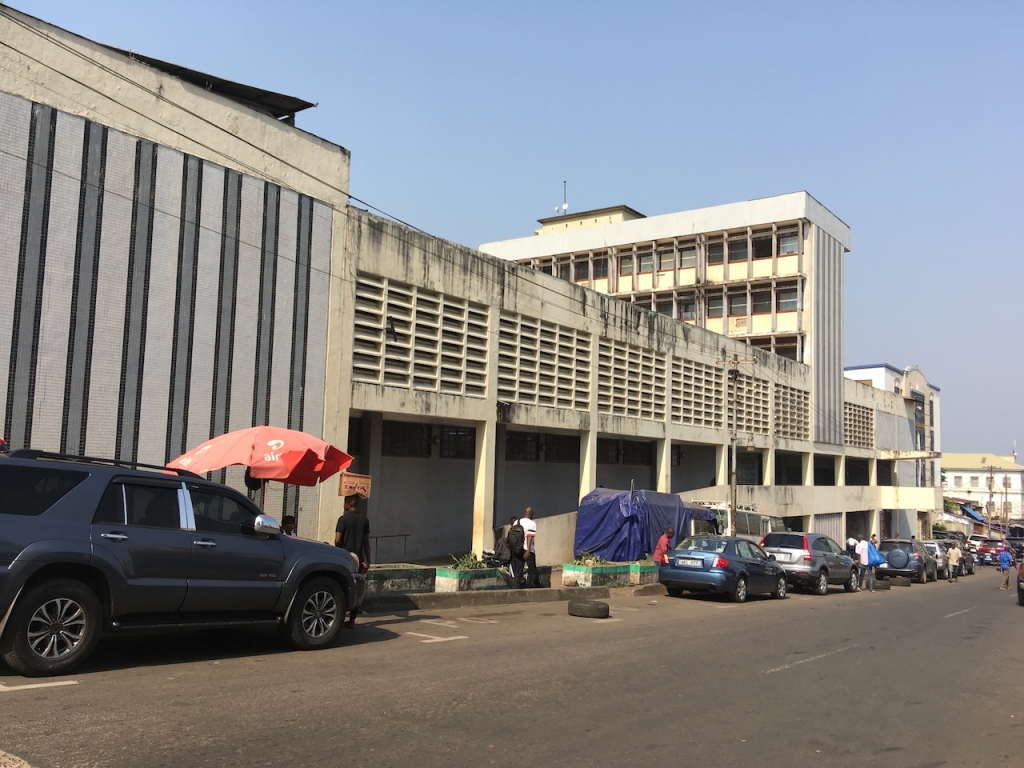
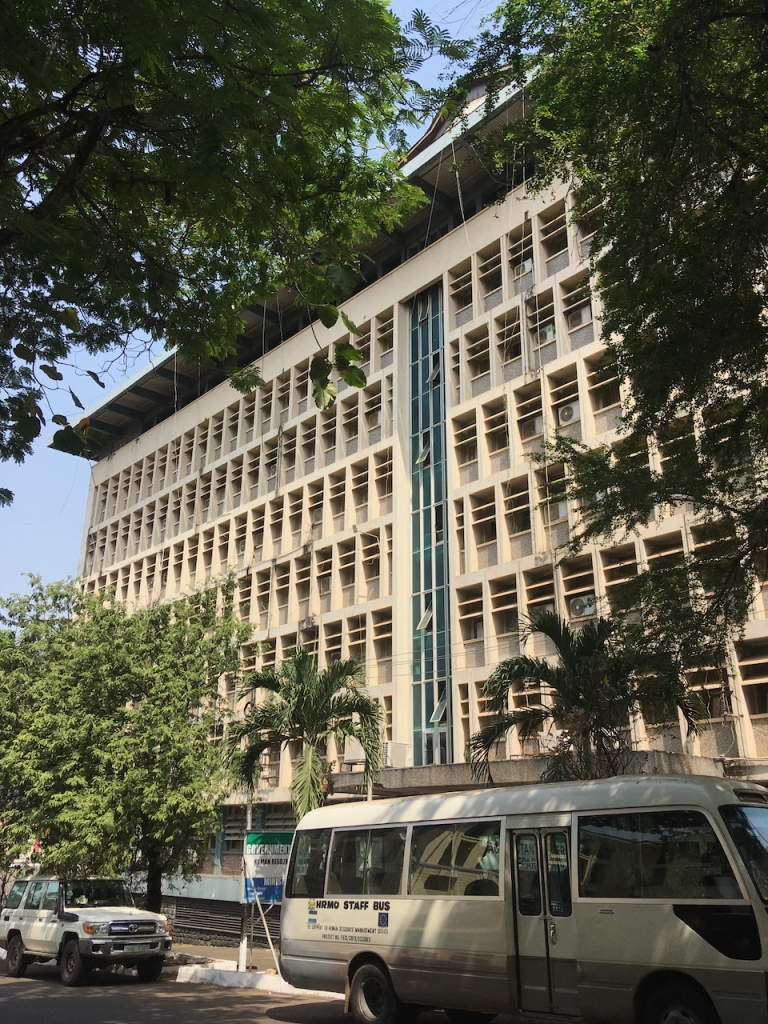
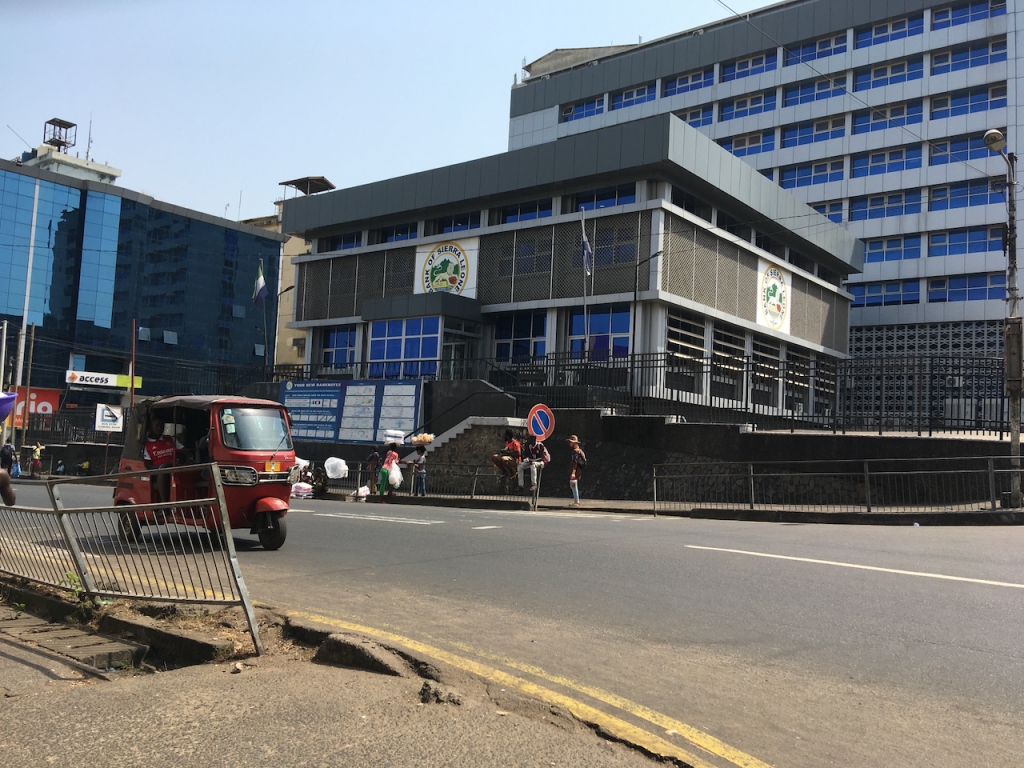
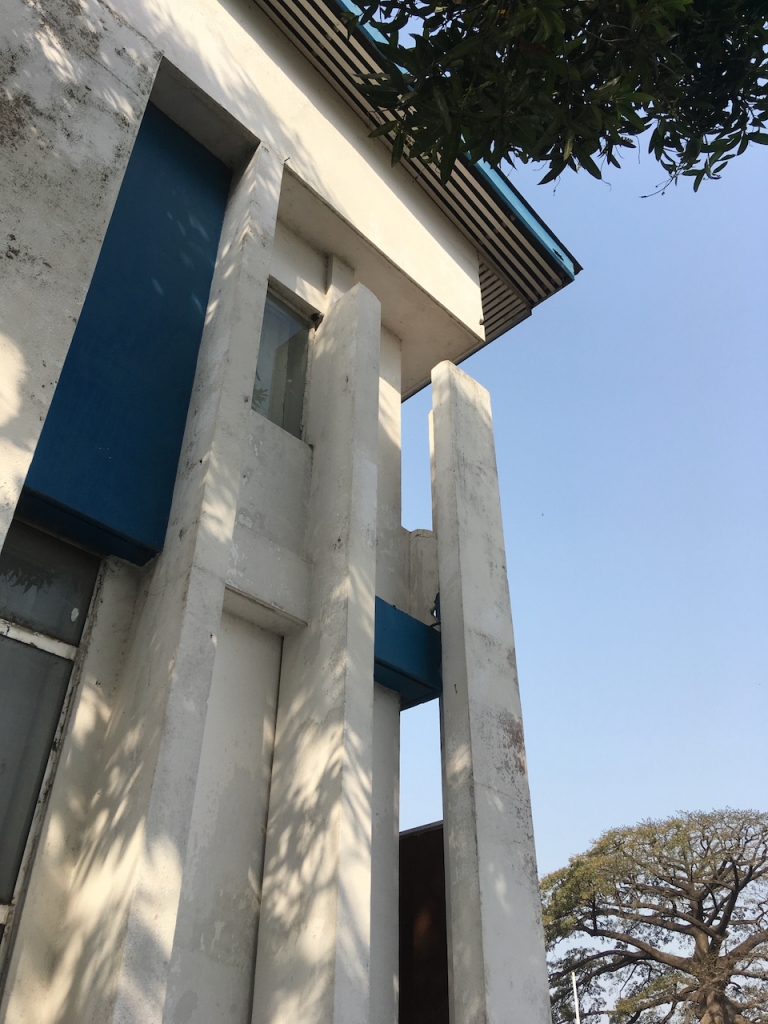
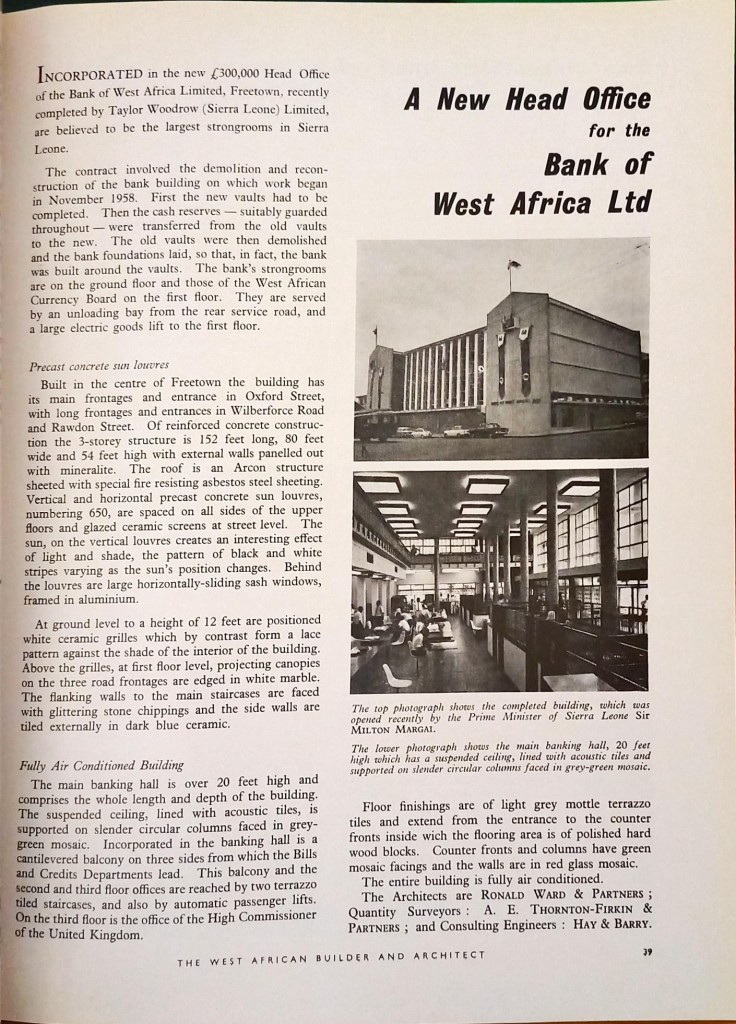
Adjacent to the Cotton Tree are the municipal offices, post office and former telephone exchange, and the major bank branches. Nickson and Borys designed a major branch for Barclays DCO and Ronald Ward for British Bank of West Africa (more on these by Ewan Harrison shortly). The Sierra Leone Central Bank is also located here – now refurbished and with its concrete mural sadly covered over with signage (designed by Ministry of Works in 1964).
GPO and Telephone Exchange, Nickson and BorysMunicipal Offices, Nickson and BorysBank of British West Africa, Ronald WardBank of Sierra Leone, Ministry of WorksBarclays DCO Bank, Nickson and Borys
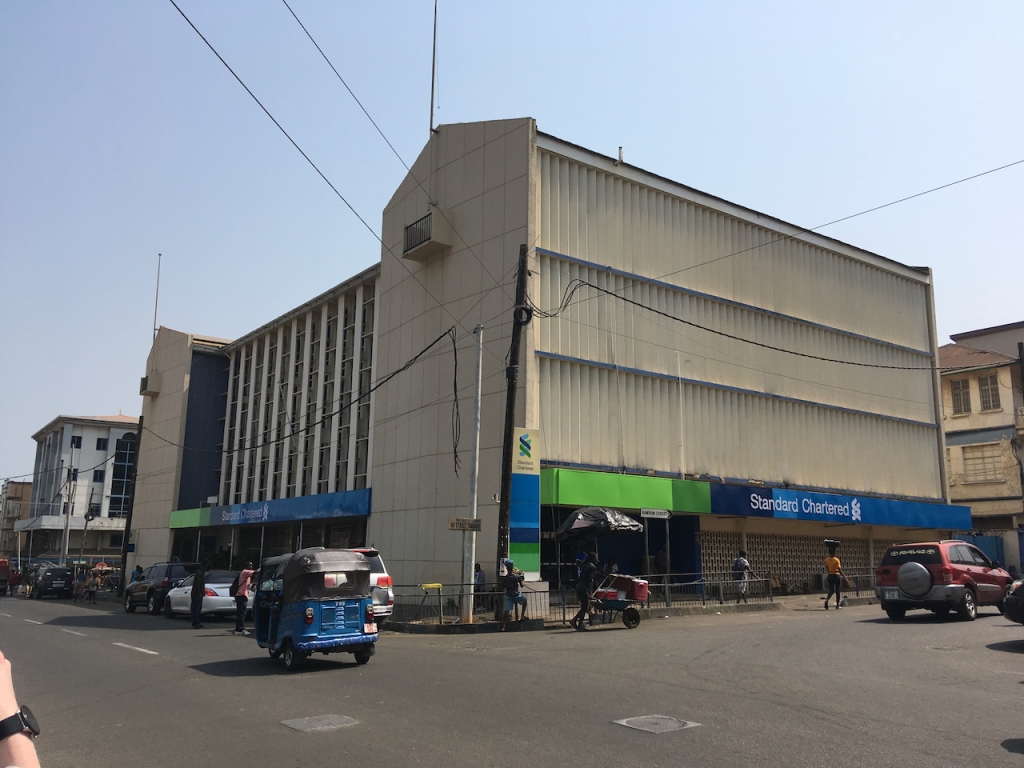
Further downhill, towards the old railway station and harbour, are the major merchant stores and retailers.
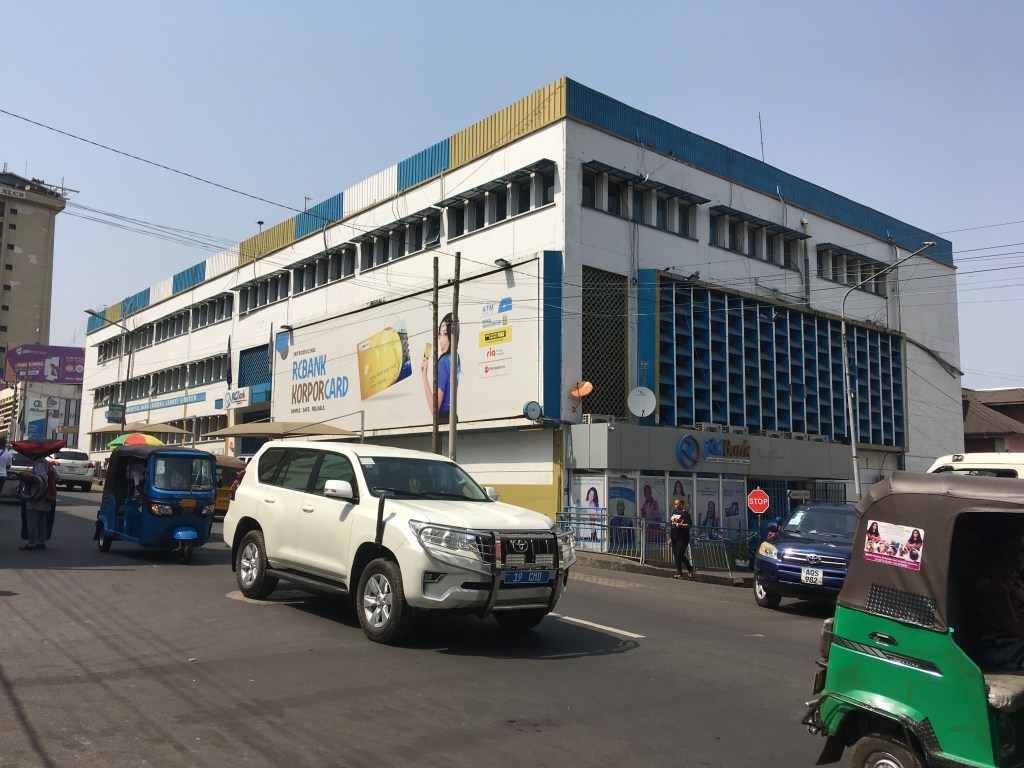
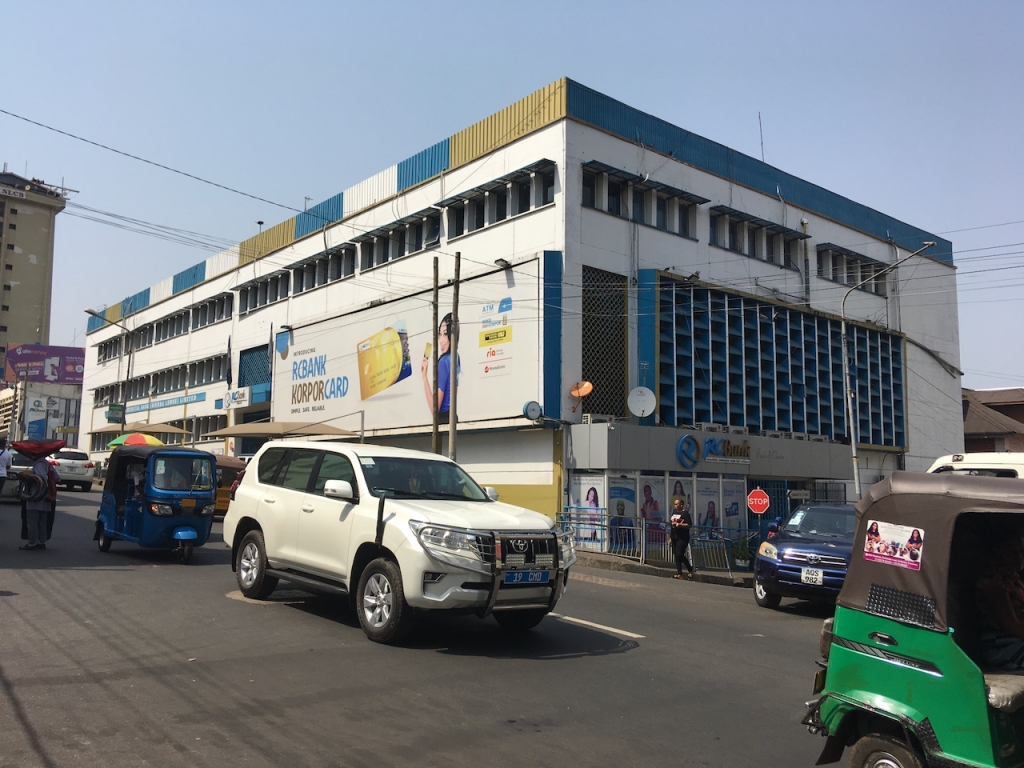
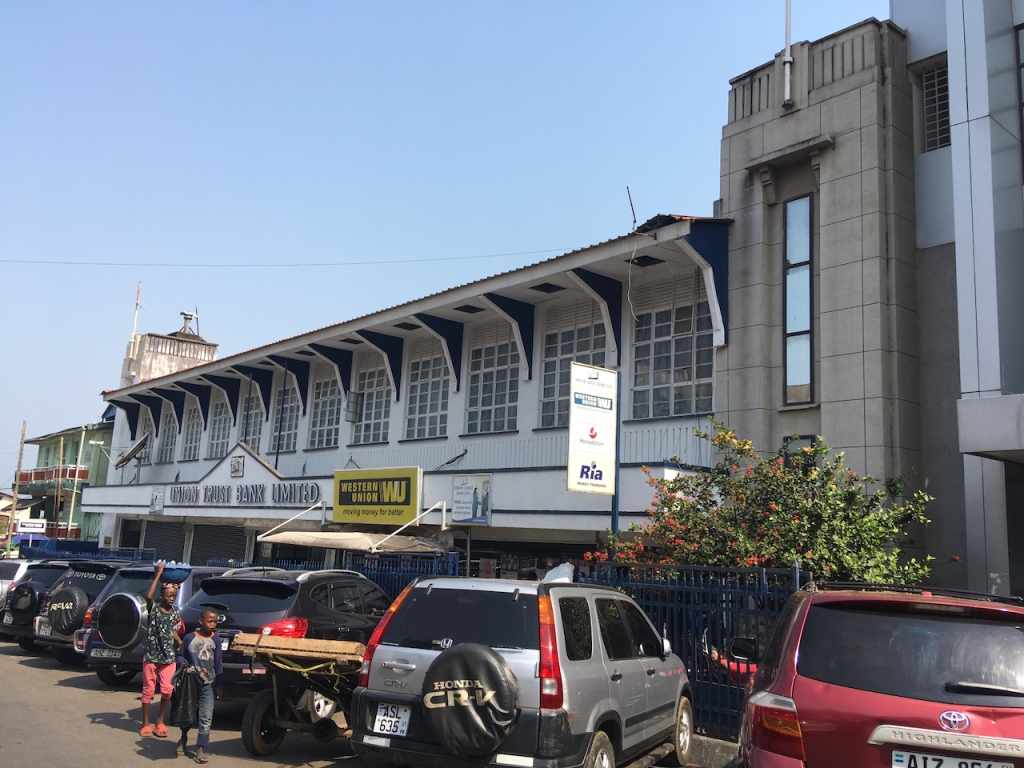
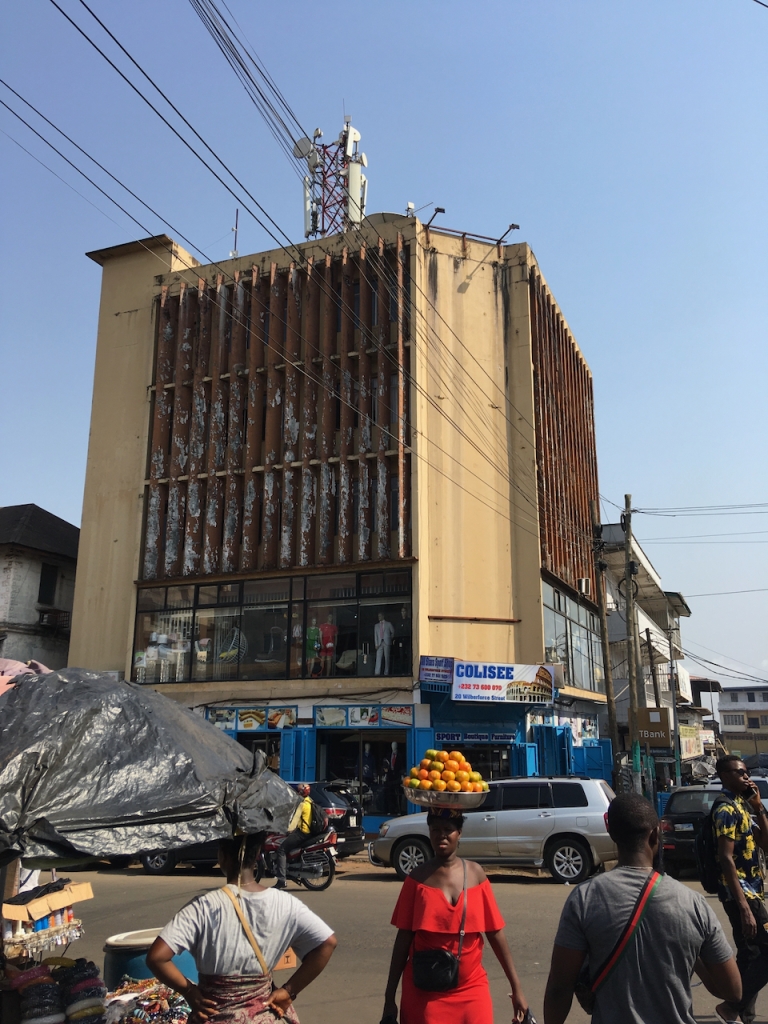
We visited the old Kingsway Stores – now a bank – but still with its deco-inspired flourishes at each end of the facade. The CFAO is still clearly recognisable, and several other stores display strong characteristics of GB Ollivant and Leventis properties we’ve seen elsewhere in Western Africa.
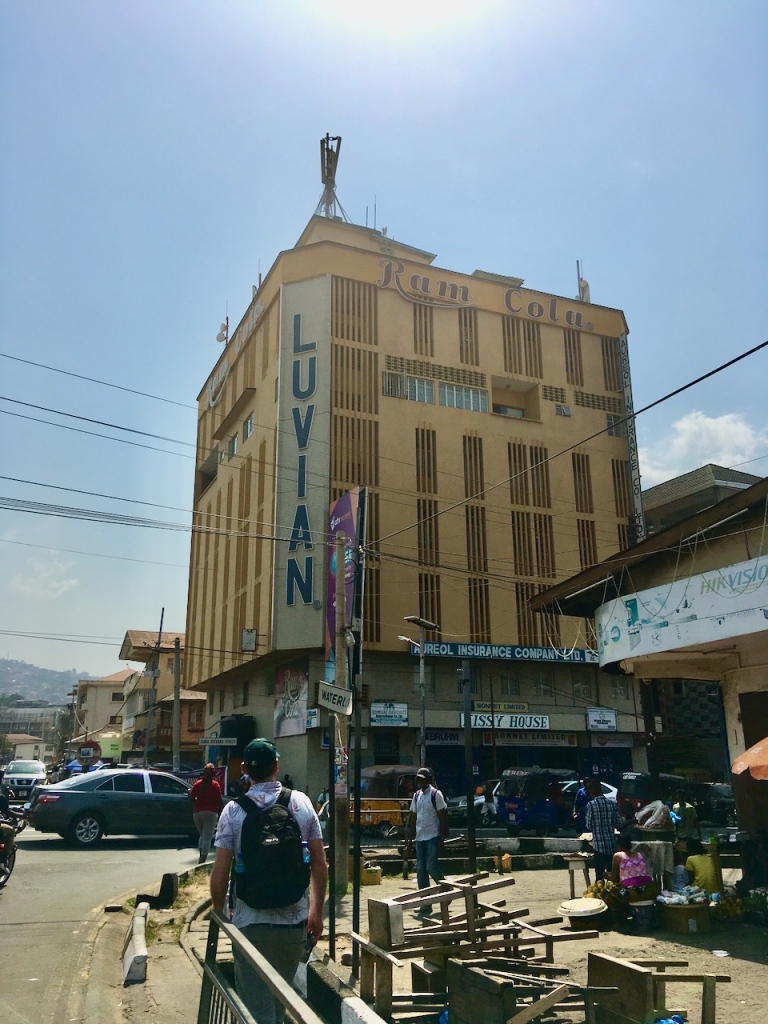
Former Kingsway Department StoreRetail: architect unknownLuvian Building, architect unknownFormer CFAO Building
Heading further eastwards beyond the older city grid is ‘PZ Roundabout’ named after trading company Patterson Zochonis. Here the formality of the central business area gives way to more lively street markets and less formal city planning.
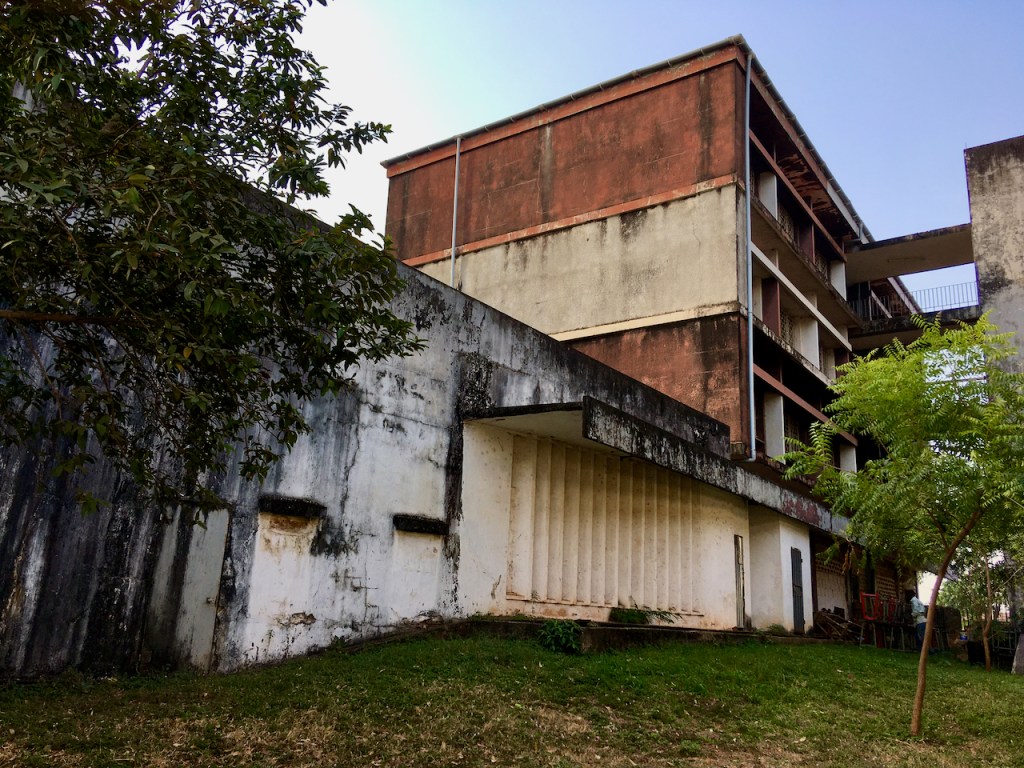
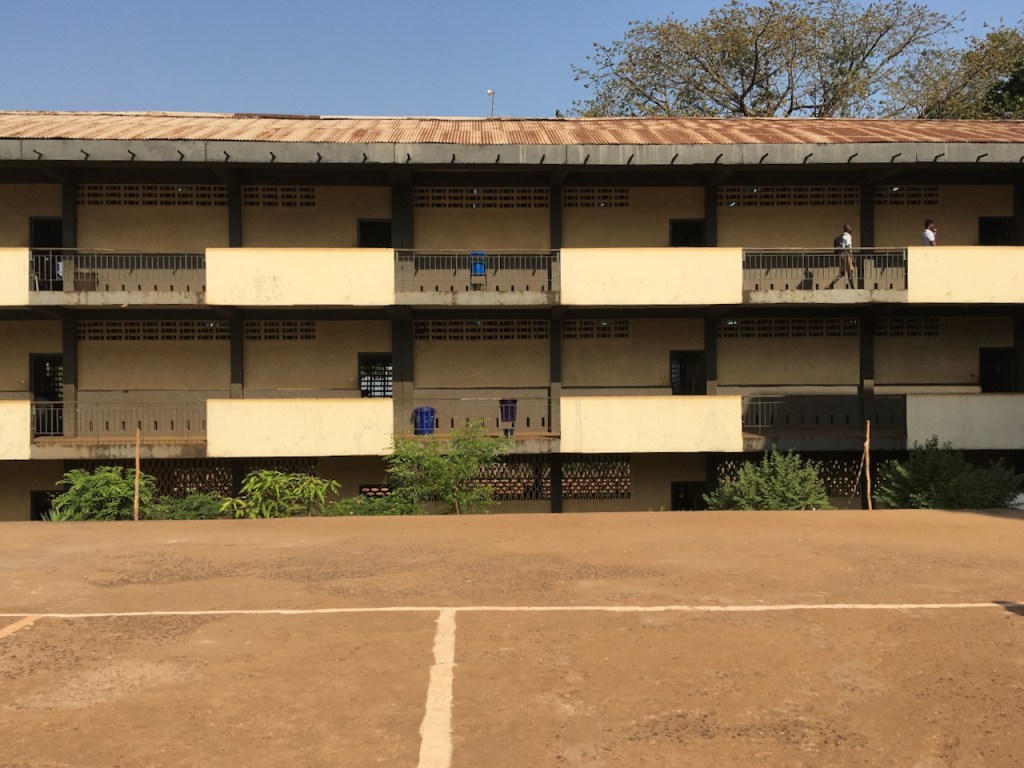
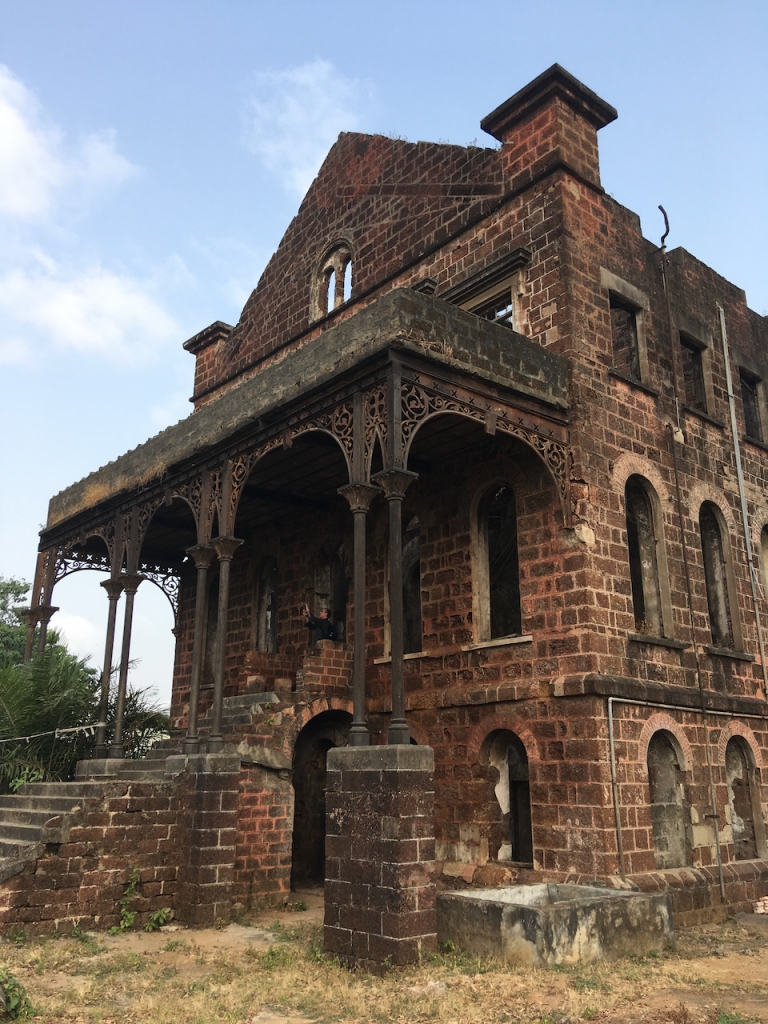
Further along Fourah Bay Road is the old Fourah Bay College building. The College was founded in 1827 in association with Durham University and was the first western style educational establishment in West Africa. It was mainly focused on missionary training. The delicate front verandah is formed with steel members bolted together and the ruinous state of the building has further exposed the steel structure inside. The beams were made by Glengarnock Iron and Steel Co in Ayrshire, Scotland and shipped out to Sierra Leone during the construction of the college building in the 1840s.
Old Fourah Bay College, founded in 1827, with construction starting in 1845, work supervised by Rev Edward Jones.
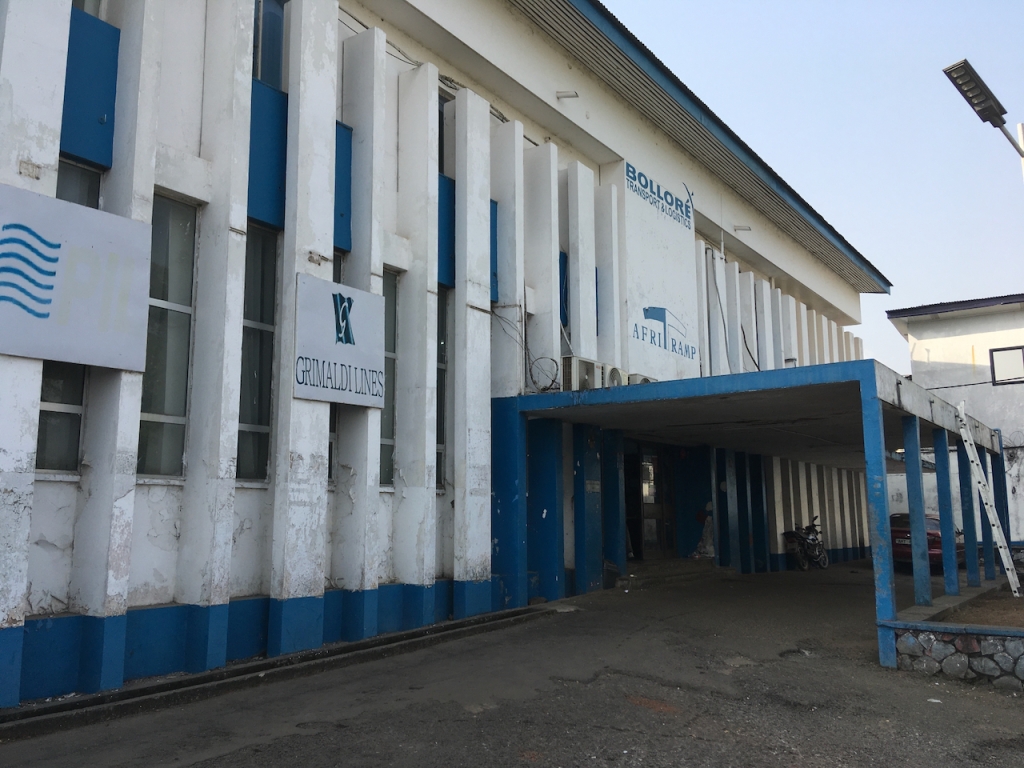
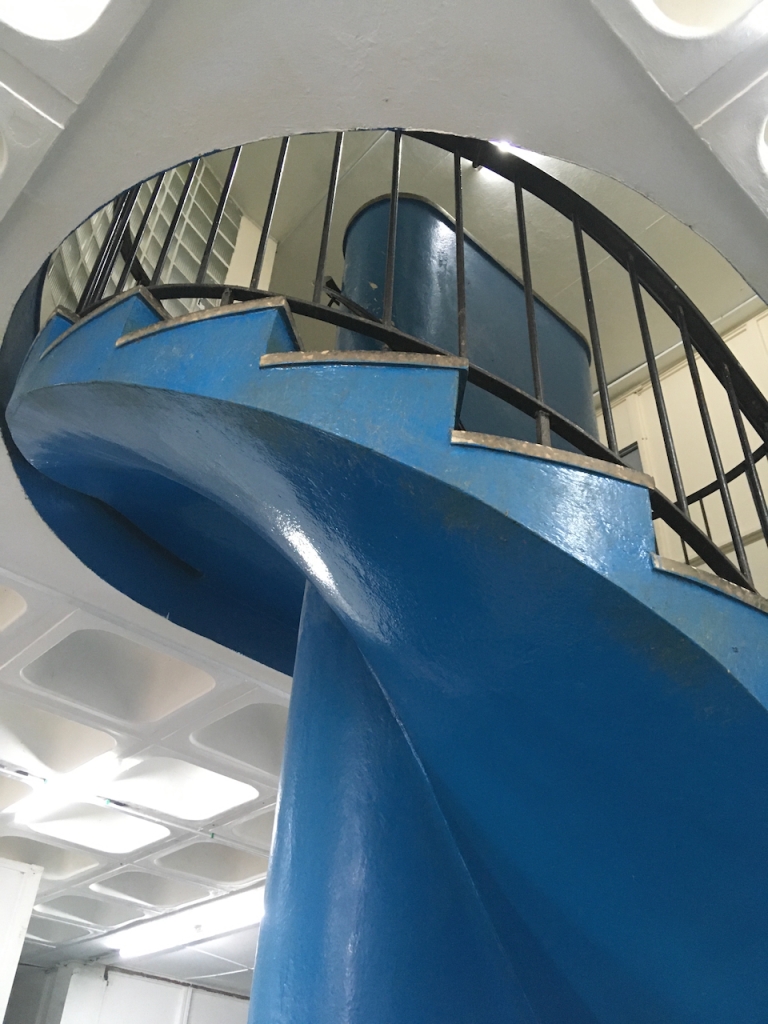
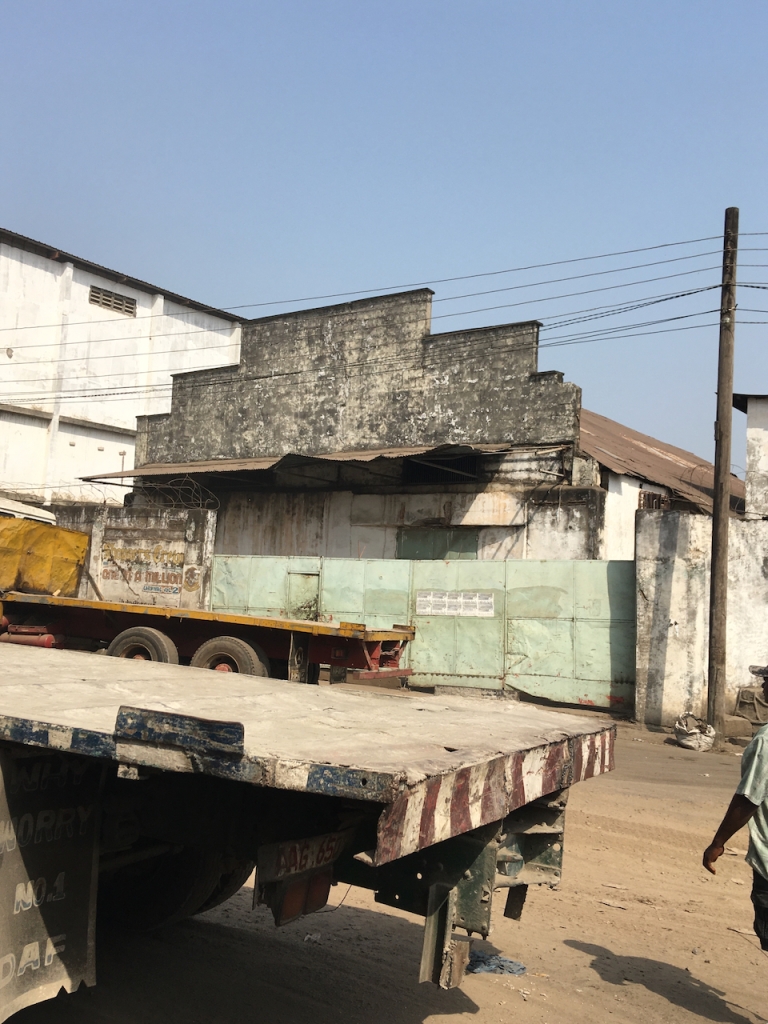
The college is located just a short distance from the sea, and what is now the busy port of Cline Town. Here the major shipping company Elder Dempster had their offices. They commissioned James Cubitt to design their premises in 1958. Cubitt also designed the Elder Dempster tower in Lagos, Nigeria, but rather than a dramatic tower overlooking the marina, here there is a more restrained horizontal solution with projecting concrete brise soleil and a porte-cochรจre. Inside the booking hall is a dramatic spiral staircase that wraps around what resembles a ship’s funnel. Warehouses and storage sheds dominate the area, including the former UAC stores opposite the National Railway Museum.
Former Elder Dempster Offices, James CubittInside Elder Dempster: waffle ceiling and spiral staircasedetail of the exteriorUAC warehouse Cline Town
There’s an impressive collection of architecture in this historic port city. In the UAC archive there are extensive photographic albums from 1915 through the 1960s documenting many of the streets and buildings we visited. Our task now is to identify more of these structures, and to research the history that resulted in their commissioning, design, and wider significance.
We have recently established a new research centre, based at the Liverpool School of Architecture calledย Architecture, Heritage, and Urbanism, in West Africaย (AHUWA): https://ahuwa.org/ Weโre hosting a launch event and would be honoured if you could join us on Tuesday 13th December, 3-5pm at theย Arts Library, 19-23 Abercromby Square, Liverpool Universityย for tea and cake. ย Friends and colleagues from all of the North-Westโs major collections, repositories, and archives with material on West Africa have been invited, and weโre excited to share ideas and build up new networks across the region and beyond.
If you could registerย hereย weโd appreciate it, and look forward to seeing you on the 13th. Weโll have an informal presentation at 3:30pm โ please do come along and stay as long as youโre able. Weโll be onย Zoom too from 3:30-4:00pmย if youโd like to join us virtually for the presentation.ย
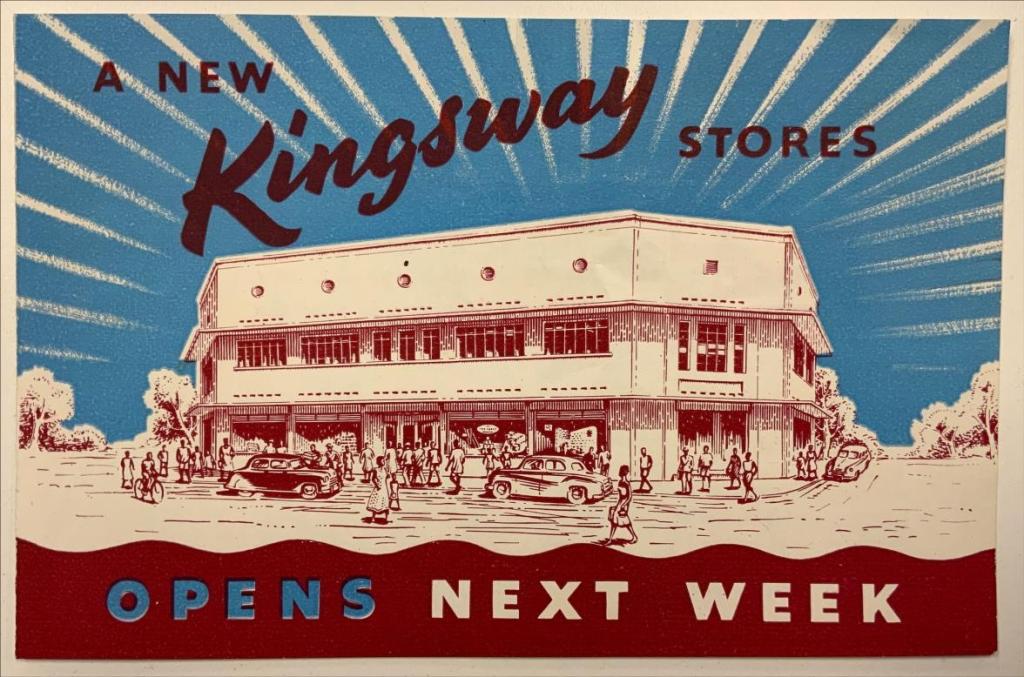
Kingsway, Sekondi Advertisement Picture courtesy of Unilever Archives
Kingsway Stores was the most exclusive retail chain in colonial British West Africa. Established by a British import-export firm, Miller Brothers, the chainโs first two department stores opened in Accra and Kumasi in 1915-1920 and were explicitly modelled on Harrods and Selfridges. Named for the boulevard in Londonโs Holborn, where Millers was headquartered in a stodgily baroque office building, the Kingsway Stores sold imported food, clothing and home wear to a primarily British expatriate clientele. By 1929, a series of mergers and takeovers saw Miller Brothers absorbed into Unileverโs vast African subsidiary, the United Africa Company, which is currently the subject of a collaborative research project led by the University of Liverpool and Unilever Archives, and funded by the Leverhulme Trust.ย
Kingsway Stores, Sekondi, 2022 Image: Iain Jackson
The Kingsway chain grew under the United Africa Co.โs ownership and by the early 1950s, Kingsway stores tradedย in each of the British West African capitals, Accra, Lagos, Freetown, Banjul, and in many of the larger towns and cities across the region: Kumasi, Cape Coast, Sekondi, and Tamale in the Ghana, and in Jos and Kaduna in Nigeria.ย Like many of these stores, the Sekondi store was designed by the Unilever In-House Architects and Engineering Department, headed by James Lomax-Simpson.ย A graduate of the University of Liverpool School of Architecture, Lomax-Simpson designed numerous buildings for Unilever, including housing at the famous company town, Port Sunlight. The designs that his team produced for United Africa Co. offices, warehouses and retail stores across West Africa tended towards the mildly moderne, with some slight modifications for local climatic conditions through the use of canopies and verandas to provide shading from the sun and allow for the higher loads of rainwater run-off required during the rainy season. The Sekondi Kingsway store is a paradigmatic example of this work.ย
Party at Kingsway Store in Bathurst/Banjul, Gambia, held in 1953. Picture courtesy of Unilever Archives.
The growth of the Kingsway chain in the interwar years reflected the expansion of British expatriate technicians, civil servants and businessmen during a period known as โthe second colonial occupation.โ Increased investment in development projects, ultimately designed to maximise the flow of cocoa and precious metals from West Africa and thus boost Britainโs dollar reserves, saw not only an increase in British expatriate staff working in late colonial West Africa, but also their increasing embourgeoisement. The growth of the chain also reflected, and, indeed, facilitated, changes in the gender balance of British communities in West Africa. British women were originally discouraged from settling in the region, but by the 1940s the availability of malaria prophylaxis and yellow fever vaccines saw increasing numbers of women taking positions within colonial administrations, and wives joining their husbands on tours of duty across the region. As Laura Ann Stoler notes, the presence of European women โaccentuated the refinements of privilege and the etiquettes of racial differenceโฆ women put new demands on the white communities to tighten their ranks, clarify their boundaries and mark out their social space.โ Racially segregated bungalow reservations proliferated across โBritishโ West Africa in this period. Within these reservations, โEuropeannessโ was performed through a constant round of dinner parties, drinks parties, tennis parties, through the consumption of imported tinned and preserved food, through patterns of dress and home decoration. Kingsway stores, which emphasised that โorders were delivered direct to bungalows,โ supplied all the goods required for this memetic of bourgeoise English life.ย
By the mid-1950s, as political decolonisation neared in West Africa and both civil services and expatriate companies increasingly โAfricanisedโ their staff, the Kingsway Stores faced the loss of its primary customer base. Perhaps paradoxically, the company management combatted this through a programme of expansion. Boldly modernist new stores, designed by the British commercial architectural firm TP Bennett & Partners, were opened in Accra, in the Lagos suburbs, in Ibadan and Port Harcourt in Nigeria. At the same time, didactic marketing campaigns โ exhibitions, product demonstrations, fashion shows โ were instrumentalised to sell a vision of modern, and, indeed, modernist, domesticity to an elite African clientele. An Ideal Homes Exhibition, sponsored by the British Design Council and held at the Lagos Kingsway Store in 1962, for example, offered advice on โsuch subjects as how to create harmony with simple furnishings and the tricks of entertaining which make a house-wife into a hostess.โ Kingsway at the end of empire therefore shrewdly manoeuvred itself away from selling โEuropeanness,โ to selling โModernityโ to the emerging, post-colonial, African elite, a shift in mode that sheds light on the entanglements between modernist architecture and design on the one hand, and colonial and neo-colonial profit extraction on the other.ย
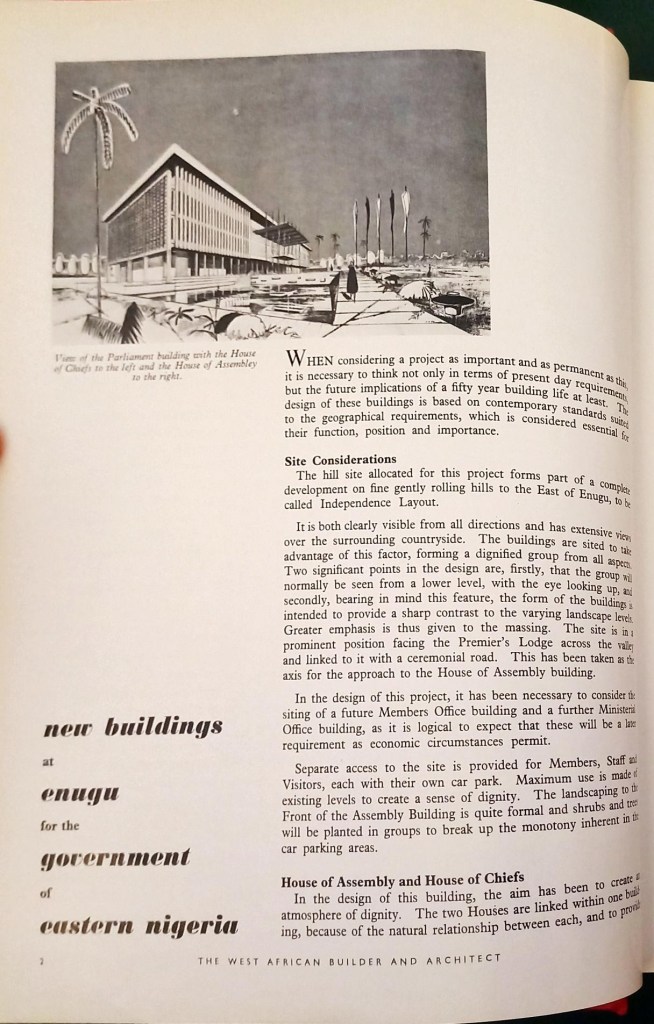
The first architectural journal in West Africa, The West African Builder and Architect (WABA) was published in 8 volumes between 1961 and 1968, and covered the field of architecture and building in the region. Nation-building programmes had started in newly independent West African nations by the early 1960s. These projects were centred on large-scale infrastructure projects for national development, which sparked a boom in design and construction. In contrast to earlierโฏarchitectureโฏjournals on colonial Africa that wereโฏpublishedโฏforโฏaโฏmetropolitan readership,i WABA wasโฏfoundedโฏbyโฏand forโฏprofessionals based in WestโฏAfricanโฏcountries to share information on practice in the developing industry and encourage cooperation among practitioners. iiย
The journal began with an editorial panel of British architects: Kennett Scott in Ghana, and Anthony Halliday and Robin Atkinson of Fry & Drew and Partners in Nigeria.iiiโฏโฏOluwole Olumuyiwa,โฏoneโฏofโฏtheโฏfew Nigerianโฏarchitectsโฏwhoโฏstudiedโฏabroadโฏandโฏestablished practices upon their return,โฏwasโฏtheโฏonlyโฏWestโฏAfricanโฏonโฏtheโฏpanel. Among the WABA’s target audience was the modest number of engineering and architecture students studying in West Africa. It aspired to equip them with valuable information regarding their future careers that were specific to their environment.โฏย
Published articles included news on new projects finished in Ghana, Nigeria, Liberia, and Sierra Leone as well as articles by skilled professionals discussing contemporary design and building methods in West Africa. Regular publication features included technical reviews of new products, updates on developmentโฏwork in the countries covered, and advertising placements.
Atโฏthatโฏtime,โฏBritishโฏpracticesโฏoperatingโฏsinceโฏtheโฏ1940sโฏdominatedโฏtheโฏarchitecture field in the region.โฏ Theyโฏcompletedโฏlateโฏcolonialโฏbuildings usingโฏtropical modernistโฏdesigns. This group of foreign architecturalโฏfirms,โฏincluding James Cubittโฏ& Partners, KennettโฏScott Associates,โฏArchitectsโ Co-Partnership,โฏFry,โฏ Drewโฏ&โฏPartners,โฏetc.,โฏ producedโฏa significant numberโฏofโฏthe newโฏstructures publishedโฏinโฏtheโฏ WABAโฏjournal.โฏThe projectsโฏofโฏthe generalโฏcontractor, TaylorโฏWoodrow andโฏthe engineeringโฏconsultant,โฏOve Arup &โฏPartnersโฏwereโฏalsoโฏlisted. Buildings for government organisations, corporations, and residences,โฏconstitutedโฏtheโฏbulkโฏofโฏtheโฏreportedโฏprojects. Facilities for telecommunications, transportโฏandโฏhealthcareโฏwereโฏalso mentioned.โฏย
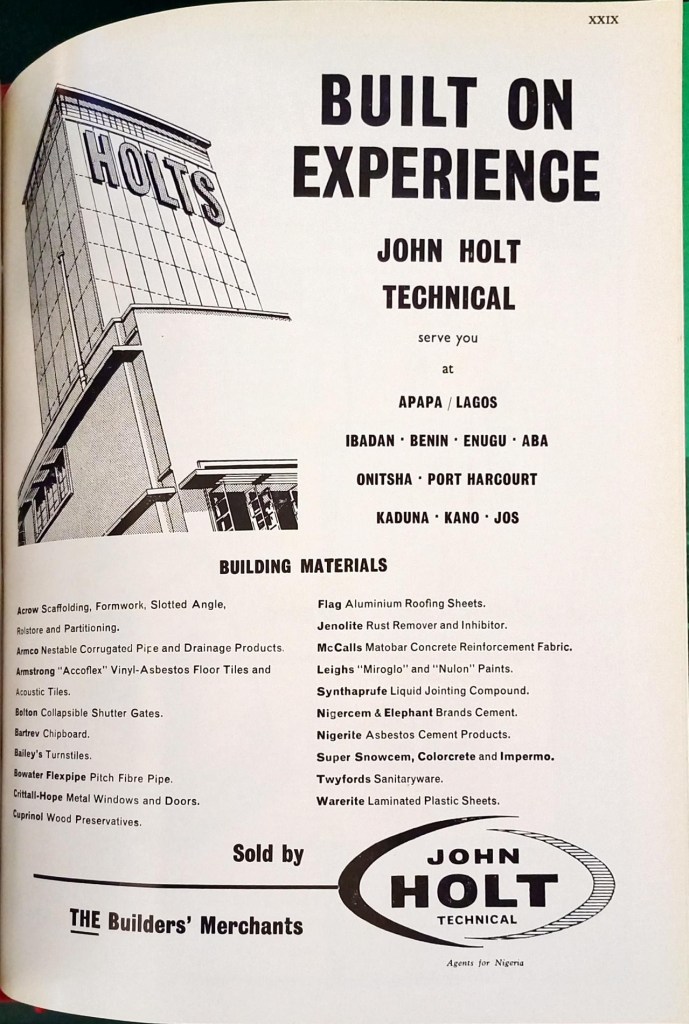
The WABA journal served as a reference for the purchase and sale of building supplies and services through advert placements, advertisers index and buyersโ guides. Advertisements in volumes 1 and 2 of the journal reflect the state of the construction industry in the early 1960s independent West Africa. As the regionโs manufacturing industry was in its cradle, building supplies and equipment were primarily imported and distributed by West African-based agents. Most of the distributors’ advertisements in the journal were from multinational corporations that were at the forefront of trade in colonial West Africa such as United Africa Company, GBO (G.B. Ollivant) and CFAO (CompagnieโฏFranรงaiseโฏde l’AfriqueโฏOccidentale). GBO Building Department for example was a former subsidiary of British merchant GB Ollivant and had been operating in Nigeria since the late 19th century. Vivian, Younger & Bond Ltd and John Holt Technical were among more well-known suppliers with numerous locations throughout West Africa.ย
By constructing new facilities and forming partnerships with public and private organisations, foreign manufacturers also expanded their presence in West Africa. In their various local factories, International Paints (West Africa) Ltd., Dorman Long (Ghana) Ltd., and Nigerite (in Nigeria) produced paint, steel, and asbestos sheets respectively. The headlines of these corporations’ advertisements in WABA highlighted the launch of new plants and their support of the local economy. Additionally, advertisements for locally produced goods included the clause “made in Ghana” or “made in Nigeria.”. There was a minimal presence of indigenous manufacturing companies. NIGERCEM-Nigeriaโs first locally owned cement factory was the only producer to include this feat in its advertisement.
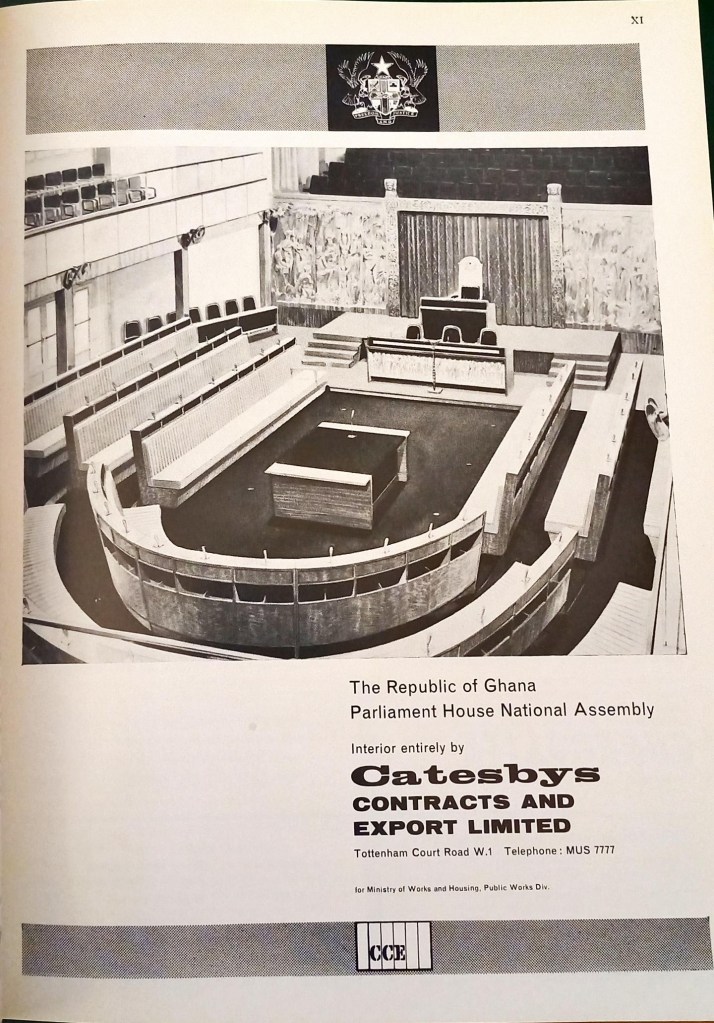
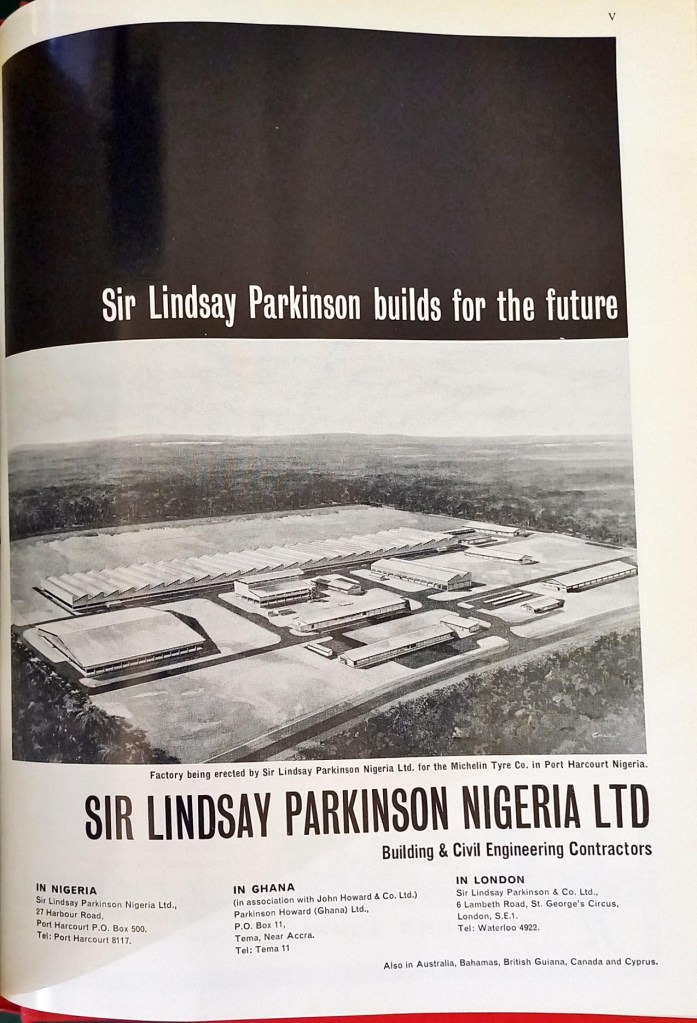
Some organizations used their advertisements to highlight their importance and reputation in the sector. Advertisements for general contractors and subcontractors were designed to appear as portfolios of completed and continuing projects. The advertisement pages for the metal component company Henry Hope & Sons Ltd always showed an image of a brand-new building fittedโฏwith their curtainwalls and/or sun breakers.โฏ This was displayed alongside a brief overview of the building including its location and architect’s name.
The journal adverts reflected companiesโ recognition of their role in nation-building. Multinational corporations boasted of their delight and pride in partaking in the โprogressโ and โgrowthโ of the economy and the future of new countries. Was this marketing approach merely chosen to appeal to the development-oriented nature of the new market, or was it implemented to emulate previous advertisements by foreign businesses (like UAC) in response to criticism of neo-colonialism? ivย ย
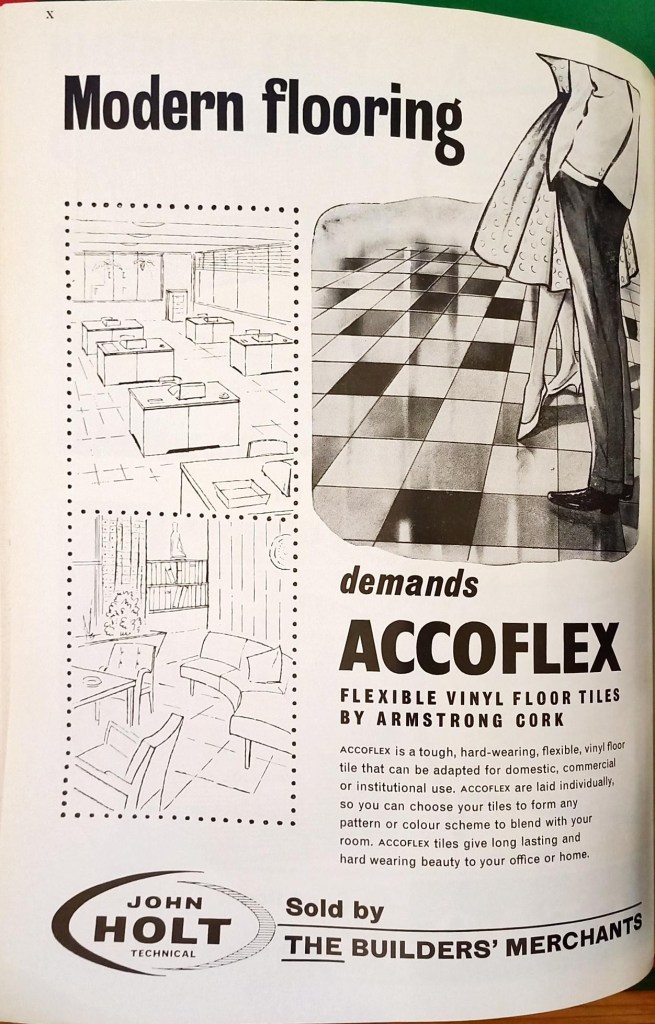
Companies targeted their advertisements not only at professionals but also at citizens in West Africa. These advertisements directed at building occupants first appeared in the 1962 issues and frequently alluded to modernity. Adverts for flooring, sanitary fittings, and appliances included large texts with phrases like “gracefully modern” and “modern living.” This contrasted with building supplies adverts-directed at professionals-which hardlyโฏreferenced modern living. The late colonial era’s โafricanizationโ programmes aided the growth of the middle class by giving priority to the education and employment of Africans by public and private sector organisations. Likewise, housing initiatives launched by government agencies like the Ghana Housing Corporation and the Nigerian LEDB (Lagos Executive Development Board) in the 1950s attracted this demographic. They were characterised by their higher economic and educational status, as well as a household lifestyle distinct from the traditional communal family structure.v Was the reference to a modern lifestyle a marketing strategy to attract the West African middle class who had adopted a western-oriented lifestyle?
The WABA journal provides an account of the building sectorโs development in independent West Africa. The journal advertising demonstrated how companies promoted their products to appeal to both individual and national ideals of growth while navigating the shifting socio-political landscape.
i See Hannah le Roux and Ola Uduku, โThe Media and the Modern Movement in Nigeria and the Gold Coastโ, NKA (Brooklyn, N.Y.), 2004.19 (2004), 46โ49.
ii โIntroductionโ, The West African Builder and Architect, 1:1 (1961), 1.
iii In 1961, the Nigerian office of Fry, Drew and Partners became Fry, Drew, Atkinson Architects Nigeria under the leadership of Robin Atkinson. โNigeria Developmentsโ, The West African Builder and Architect, 1.4 (1961), 108.
iv Bianca Murillo, โโThe Devil We Knowโ: Gold Coast Consumers, Local Employees, and the United Africa Company, 1940โ1960โ, Enterprise & Society, 12.2 (2011), 317โ55
v Daniel Immerwahr, โThe Politics of Architecture and Urbanism in Postcolonial Lagos, 1960-1986โ, Journal of African Cultural Studies, 19.2 (2007), 165โ86 (p.175)
Inรชs Nunes is a PhD student at University of Coimbra, Portugal and is investigating, “The Social Within the Tropical: Jane Drew and Minnette de Silva designing an inclusive modernism in the tropics”. Here’s an update on a recent visit to the RIBA archive.
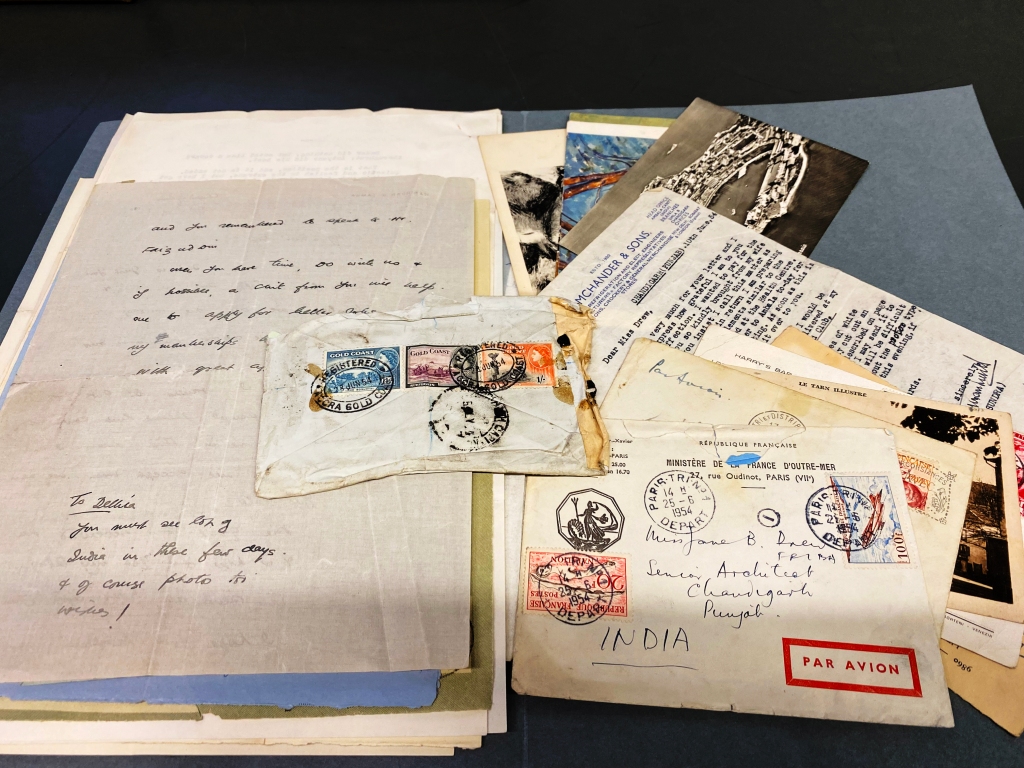
โMy dearest, darling Janeโ: unfolding Fry and Drew Papers
In a conversational tone, Maxwell Fry addresses Jane Drew from the โremoteโ mid-1940s Accra. โDarling Maxโ, she replicates. Their correspondence, a lively itinerary from West Africa, India, Iran, or Mauritius, belongs to a treasure chest named Fry and Drew Papers. It is accessible, along with unrivaled archival material, in the RIBA Architecture Study Rooms of theย Victoria & Albert Museumย (London).
Love notes handwritten on hotel letterheads, diaries displaying candid reflections about life, and memoirs manuscripted on paper bags are entangled with professional-wise material. Included are lectures and articles revealing narratives about architecture, extraordinarily illustrated with colourful drawings or sharp pencil sketches. Both are complemented by miscellaneous data: postcards, press cuttings, administrative files, address booksโฆ The characters gain life in every opened box. Their voices echo through calligraphies, signatures, ideas.
In its uniqueness, Fry and Drew Papers are an overwhelming resource regarding the life and work of both architects and an efficient record of the dynamic of their global scope partnership. Even so, it excels. Flexible and embracing enough to accommodate diverse interests and aims, unpublished personal letters, diaries, and autobiographies provide captivating details to any enthusiast โ for instance,ย Fryโs diary was only made accessible in 2021.ย Furthermore, the archive is a source of knowledge about British historiography and significant architectural thematics: the MARS Group, the Modern Movement, Tropical Architecture, and Chandigarh are noteworthy.
Overall, the research was a privilege and the expectations were exceeded. My deep gratitude to Dr. Shireen Mahdavi for supporting this endeavour. The wealth of these primary sources allows an experience that couldnโt have been more rewarding. By immersing in Fry and Drewโs universe, how inspiring becomes their lifetime of respect and companionship, the robustness of their practice, and the profound vow to โproduce towns and housing that will be loved, lived in and cared forโ (Drew, F&D/27/2).
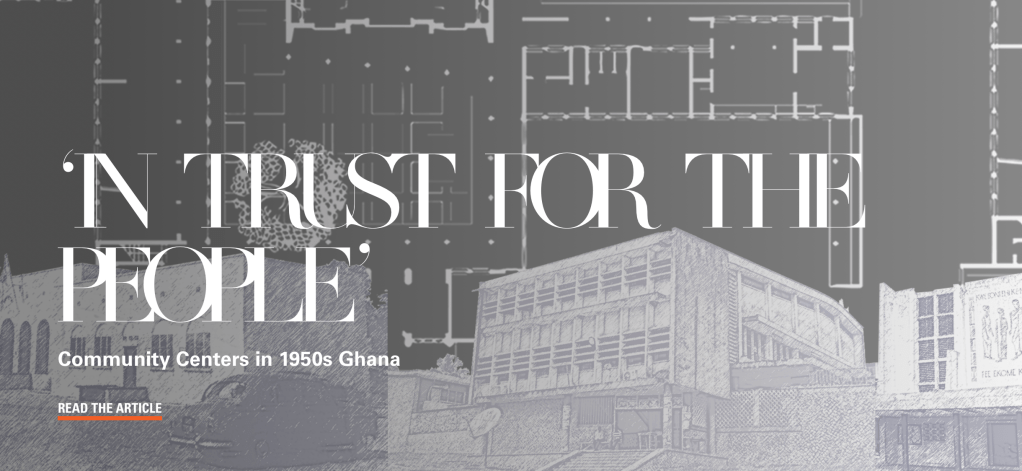
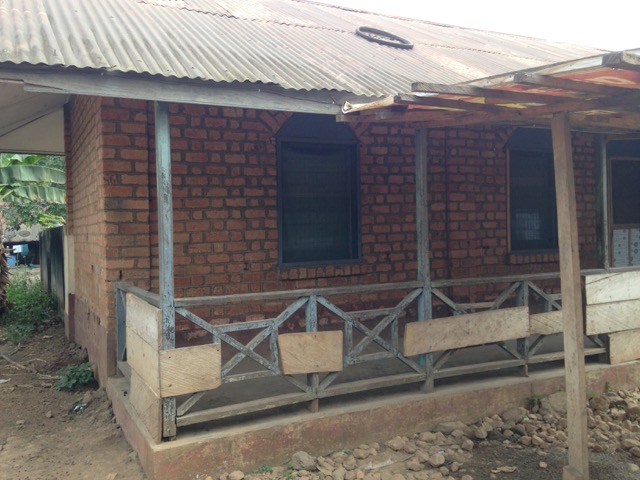
Have a look at the latest article from Design233 on Community Centers in Ghana, including the Accra Community Centre (paid for by the UAC) and Tarkwa Community Center (paid for by the Manganese Mining Company) – both designed by Fry and Drew. In addition to these modernist works the more formal and classically inspired centre at Kyebi is discussed – this centre is more of a mystery… We know it was funded by the Consolidated African Selection Trust (CAST)- but who designed it, and why did CAST commission such a lavish project?
Accra Community Center PlanTarkwa Community Center articleKyebi Community Center
Jubilee House, Accra, Ghana.ย Source: Julia Gallagher, March 2019
This article examines recent attempts to create specifically African forms of modernist political architecture that draw on โtraditionalโ or โpre-colonialโ aesthetic forms and ideas. Taking examples of three prestigious structures โ the presidential palace in Ghana, the parliament in Malawi and the Northern Cape regional parliament in South Africa โ the article shows how vernacular ideas have been incorporated into state-of-the-art political architecture, producing new or explicitly โAfricanโ forms of modernism. It explores how such buildings, which draw on โinvented traditionsโ, are used alongside conventional, monolithic representations of the state to produce โinvented modernismsโ that both uphold and question the African state as a project of modernity.
The George Padmore Library: A Potential Attribution
Text by Dr Ewan Harrison
George Padmore Library in Accra ,Ghana
The George Padmore Library in Accra is a dynamic composition. Its principal block houses a fan-shaped reading room that extends from an apsidal end wall. This is raised up on pilotis, and is entered via a delicately wrought cantilevered staircase that itself springs from a fan-shaped expanse of terrazzo floating above a reflective pool. Externally, the facades are defined by horizontals of louvred glazing which allow for free air circulation, keeping the reading room at a comfortable temperature, and a strongly modelled canopy with sculpturally expressed rain water outflows. The building was established by the first president of the republic of Ghana, Kwame Nkrumah, in memory of the pan-Africanist writer, journalist and activist George Padmore. Padmore, who was born in Trinidiad, Nkrumah during the 5th Pan Africanist Conference, held in Manchester in 1945, and on Ghanaโs independence, Padmore moved to Ghana to work for Nkrumahโs government as a diplomatic adviser. Sometime following Padmoreโs death, Nkrumahโs government built the library in his memory, to house Padmoreโs archive and a growing African studies library collection. The Library continues to function as Ghanaโs primary deposit library to this day.
Reflecting Pool and staircase of George Padmore Library
Before visiting, I had assumed that the building was likely designed by Nickson & Borys. Responsible for the design of both the Accra Central Library complex and the nearby Ghana National Archives building in the late 1950s, the practice might have seemed the natural fit for a commission to design a bespoke library in Accra at this date. However, on visiting the George Padmore Memorial Library, after having recently spent time in both of Nickson & Borys libraries in the city, the manifest differences in both spatial planning and design between those and the George Padmore Memorial Library became clear. Whilst both the Accra Central Library and the National Library are simple, cubic buildings, the architect of the George Padmore seems to have rejected the rectilinear in their handling of the main reading room. The Nickson & Borys buildings use brise-soliel and pierced concrete walls to dissolve the wall plane: creating lightweight buildings. In contrast, the George Padmore is a heavier, starker, more sculptural composition: much of its drama comes from strongly modelled canopies and sculptural concrete rainwater outflows, and its main facades feature long planes of unbroken concrete.
Curved gable and reflecting pool of George Padmore Library
This points to another possible attribution, a design by Max Bond Jnr (1935-2009). The scion of a prominent African-American family, Bond studied architecture at the Harvard School of Design before working at Le Corbusierโs Paris atelier (1958-61) and the New York practice Pedersen and Tiley (1961-64). Bond believed that African-American culture should โhark back to Africa,โ[1] and thus in 1963 wrote to Nkrumah asking for a job. By 1964 Bond was established in Accra as an employee of the Ghana National Contracting Corporation, the stateโs contractor, working on designs for buildings at the government complex at Flagstaff House. Two of the precepts he outlined as central to his practice in Ghana were a โresponsiveness to climate,โ and โmodern buildings for new institutions.โ[2] Bondโs most famous commission for the GNCC, the design of a public library at Bolgatanga, in the countryโs arid northern region, strongly evidences these concerns. The Bolgatanga library project, which features four discrete volumes โ two library reading rooms, a lecture hall and an administration block โ under a free-standing roof designed to maximise cooling air circulation throughout the complex, is very different in its massing to the George Padmore Memorial Library. But there is something in Bondโs heavy roof at the Bolgatanga Library, in his handling of the oval wall of the Lecture Hall, and the sculptural treatment of the rainwater goods which show clear affinities with the George Padmore Memorial Library. And there are reasons beyond the stylistic to suggest Bondโs authorship of the building. Padmoreโs intellectual project, and, it can be argued, much of Kwame Nkrumahโs political one, resolved around drawing attention to the shared heritage and struggles of Africans and the African diaspora throughout the Atlantic world. In this context, a design by an African-American architect, resident in Ghana, might have seemed especially suitable.
Neither the Accra Town Planning archives, the papers of the Ghana Library Board or the archive of the Padmore Memorial Library itself shed much light on the buildingโs authorship, although a letter in the National Archives of Accra politely rebuffing an offer from Nickson & Borys to fund a memorial plaque to Padmore is certainly suggestive that the buildingโs patrons didnโt think a practice headed by European emigres a suitable one to design a memorial to a titan of Pan-Africanism (dated 1961, this letter makes no mention of the project for the Library, suggesting that it predates the libraryโs construction). Questions remain, however. The Bolgatanga Library was extensively published, if the Padmore is by Bond, why wouldnโt he have seen that it too received attention in architectural publications? Why wouldnโt he accord it a central place in his Ghanian oeuvre? Was this perhaps a collaborative job, an awkward collaboration with one of the expatriate architectural practices that Nkrumah wished to side-line, practices like Nickson & Borys? Or with Eastern European or Yugoslavian architects employed by the GNCC? The last might be the most likely, given Ghanaโs political culture in the early 1960s, and Padmoreโs own long, if increasingly fractious, association with the Communist Party. Conclusive answer may well lie in the collections of the Avery Library at Columbia, which holds Max Bond Jnrโs archives, or in the private papers of Kwame Nkrumah. For now, a tentative attribution will have to suffice.
George Padmore Library Interior: Photo Iain Jackson
[1] J, Max Bond Jnr and the Approproation of Modernism in a Library Design in Ghana
[2] J, Max Bond Jnr and the Approproation of Modernism in a Library Design in Ghana
Arriving in the dead of the night there was not much to see at Lilongwe Airport. The trip to the city was a long, quiet drive on a single lane road with not much to indicate what the city would deliver. Hotel check in suggested this might be a ghost destination in a ghost town with large edifices and pretensions of grandeur.
Later on at 7am in the morninig however, the city began its reveal. My hotel room at the Umodzi-President hotel set in the grounds of the lush green Umodzi Park gave the perfect vantage point of the modernist icon the Malawi Reserve Bank building (c. 1964 but who designed it? – apparently an exact copy of a building in South Africa), and also a view out to the Mausoleum to Malawiโs first president Kamuzu Hastings Banda.
The Malawi parliament Complex also got a detailed view from my Umodzi vantage point. More curious was the conference complex which forms part of the Umodzi Hotel โ Park setting, and I suspect this might have been or is the setting for presidential and other political rallying in days gone by. Post-covid it seemed an empty stage set for a drama yet to unfold.
The field research trip that brought me to the city began in earnest later on that morning, not before a after a hotel room battle with climate and media control as both remote devices had only Chinese ideographic character instructions to follow. The Umodzi Hotel Park and facilities had been built through a Chinese arrangementโฆ
Malawi National stadiumMalawi National stadium
So the trip began in earnest, a visit to the first point of call meant a drive past the Malawi National stadium complex, a gift of the Chinese Government, certainly worthy of international architectural merit. Close by a gated community also developed during the stadiumโs construction and now a high-end housing estate.
Villas in Lilongwe: High value housing
Lilongwe owes its masterplan to the dark days of apartheid and its layout is credited to South African planners who projected the segregation of residence by race and buffer zones to what had become Malawiโs capital city. The hard trace of this layout very much structures 21st century Lilongwe. Poorer Malawian and increasingly trans-African communities live the farthest out to the city centre whilst former European only (now mainly elite African) residents and Asian communities live the closest to the city centre.
Local housing in Lilongwe despite sharing distance issues from the CBD, is certainly different from West Africa. โFormalโ housing uses much more burnt clay brick than in West Africa, locally made bricks are used for the majority of housing with โcrittal hopeโ-style windows predominating glazing options. Corrugated Iron, and formed aluminium roofing as in West Africa predominate with an absence of asbestos or other cement fibre sheeting types. Building crafts and trades also seem particularly well established on the ground, might this be because as a landlocked country all importation is expensive and local labour is more valued. The other thought might be that the โgripโ of South Africaโs emphasis on non academic โtechnical/serviceโ education for non-whites has led to a better skilled and trained local technical workforce.
Low Cost Housing
Transportation-wise also sustainable transport gurus might be in seventh heaven, the humble bicycle seemed the main form of transportation in many neighbourhoods with a locally welded handlebar for passengers to use. A range of second-hand imports also could be seen gracing the streets. Faster and more efficient than cars and cheaper than motorbikes given the exhorbitant cost of fuel.
bicycle transportationbicycle transportation
Great efforts were being made by Lilongwe local government and at national level to deliver services to all communities. Sanitation and water projects abounded. Contracts had interestingly been given to several international contractors including in a case we came across a water hydrant project for poorer neighbourhoods, run by a Chinese contracting firm.
Water Hydrant Installation.
This seems to be in keeping with the Chinese involvement in the development of the Lilongwe highways projects and future interchange. Not to be outdone there has also been investment by the Japanese in the Lilongwe International Airport upgrading and expansion project, with some interesting architectural results.
Viewing Lilongwe in a day was going to be a hard call, letโs say that it is certainly a green city and one that seemed genuinely peaceful and friendly. Its key problems seem to stem on a poor transportation system, predicated on the apartheid zoned settlement city which means that there remains very little interconnectivity to neighbourhoods and a non-existent prioritised public transport system to the city centre where unsurprisingly all the jobs remain located.
Mosque in Lilongwe
Foreign investment in the infrastructure and buildings in Lilongwe is truly international it is quite clear to see. If this was a former British colonial city, the trappings thereof are rapidly disappearing. Aid seems to come in many forms and many directions, the โGlobal Eastโ certainly being emergent. This investment seems now to be getting โgroundedโ in infrastructure projects including a housing estate for the Chinese in Lilongwe close to the Presidential palace and the Chinese Embassy, a symbol of Sino-African friendship.
But to end as I began, my last stop was again to view the Malawian investment bank, a night time shot didnโt fail to impress. 1970s African modernism at its best.