Archive

Tropical Architecture

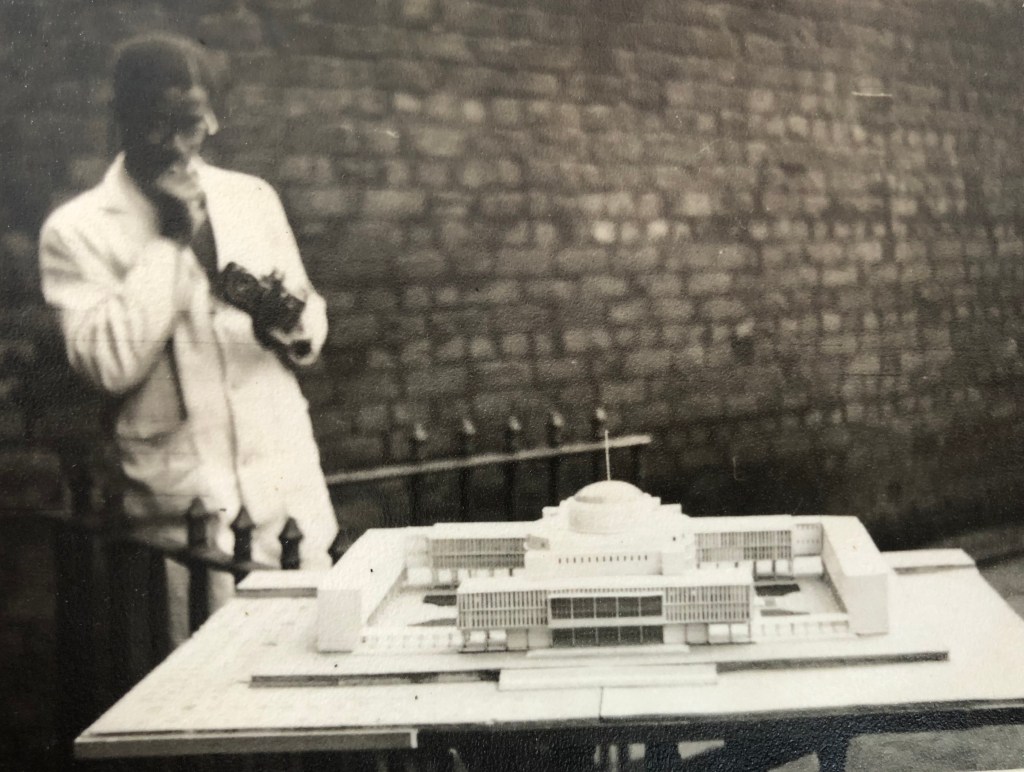
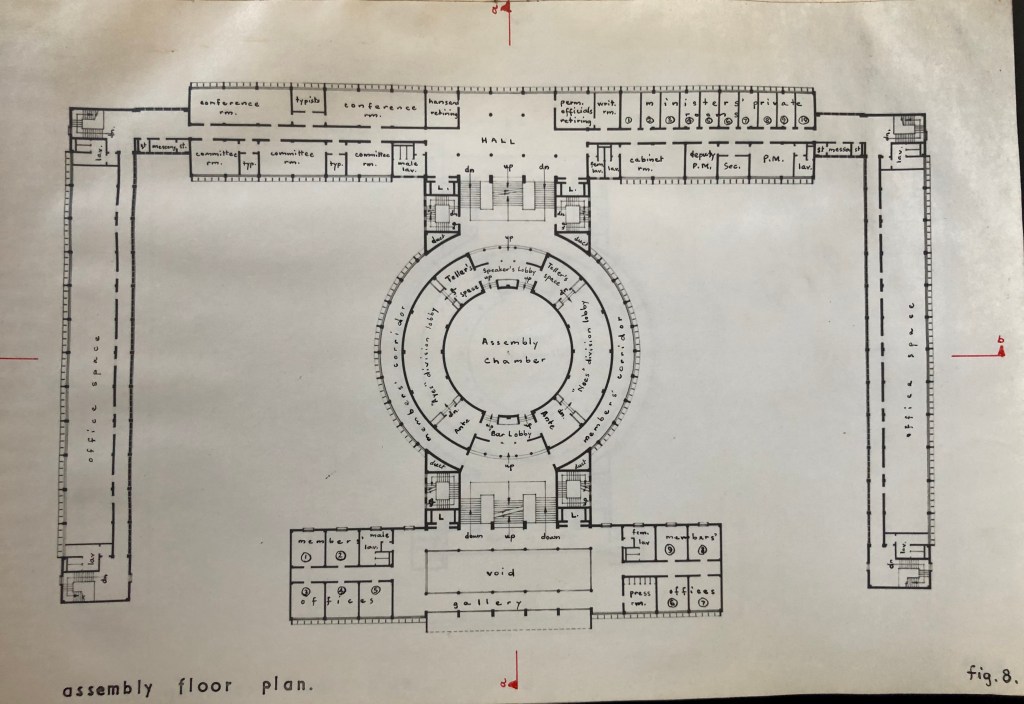
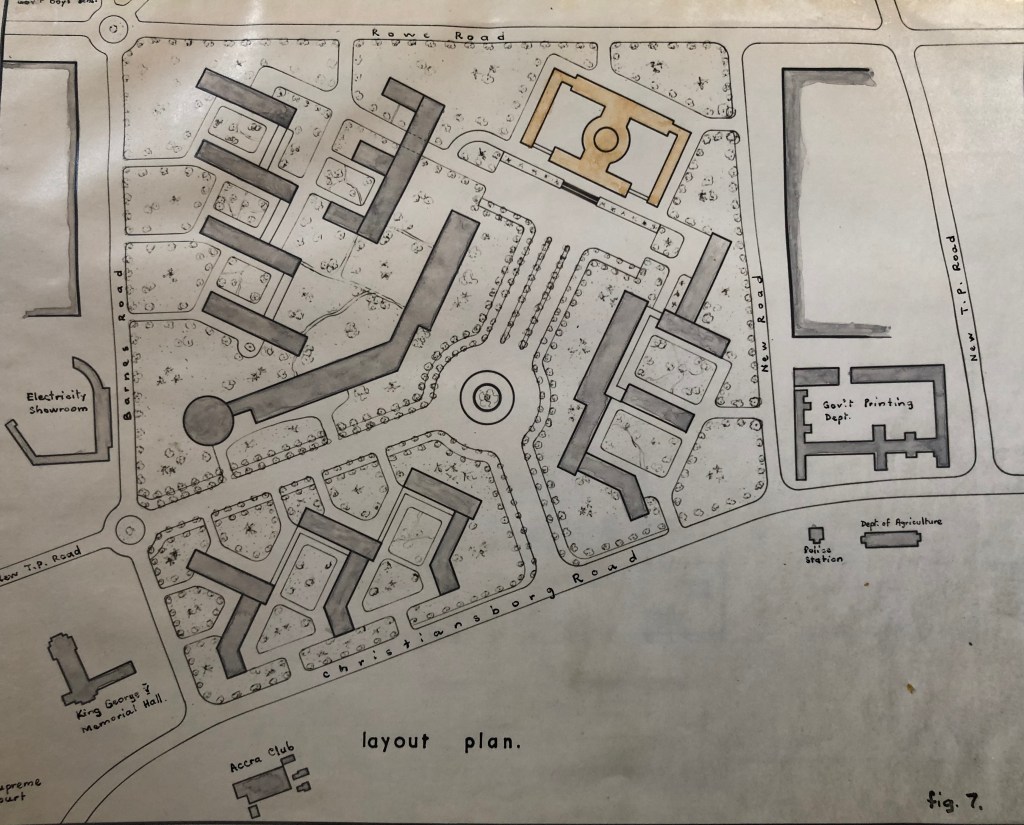
Have a look at https://www.design233.com/articles/from-buckman-to-turkson for my article on some lesser known Ghanaian architects, including John Buckman and Peter Nathaniel Kwegyir Turkson. I uncovered Turkson’s architecture thesis project in the University of Liverpool archives and discuss his plans for a new Parliament Assembly building in Accra.

Peter Turkson in Liverpool with his architectural model for a new parliament building in Accra, 1954.

Turkson wanted a design that was ‘classic in character and at the same time distinctly modern in feeling and detail…[exhibiting] the spirit of modern times’. 

Proposal for the Accra Assembly building, by Peter Turkson, 1954

Turkson’s solution proposed using a ‘sandcrete’ (laterite soil mixed with cement) block wall along with a brise-soleil frame of fixed vertical and horizontal fins. Topping the structure and reflecting the chamber below was a reinforced concrete dome clad in copper, whilst some of the walls would be clad with faience finish. The plan was symmetrical forming two courtyards with a central drum for the debating chamber and library above. 

Site plan showing the proposed location of the new Assembly on Accra’s Barnes Road and Christianborg Road.

Name: Adefolatomiwa Toye

PhD Research Title and Summary: Development and National Identity: Tropical Modernism in Post-Independence Nigerian Universities 

The aftermath of the Second World War brought a shift in the policies of the British Empire towards the infrastructural development of colonies in West Africa. Massive projects ranging from transportation to healthcare and including education went underway in Nigeria, the largest colony in West Africa. Various commissions from the 1940s and nationalist agitations eventually led to the establishment of the first university in West Africa in 1947- the University of Ibadan, Nigeria. Colonial architects such as Maxwell Fry and Jane Drew, who specialised in modernist designs for the tropics, were hired for this and other major projects. 

Ibadan University

With the country’s independence from colonial rule in the foresights in the late 1950’s, a new desire for a unified national identity arose. This aimed to erase dividing ethnic lines and create a collective identity in the culturally heterogeneous new nation. Infrastructural projects were commissioned, ranging from public buildings to higher education institutions. These projects designed and built following the tropical modernist architecture of the colonial were used in developing a new built environment for Nigeria. I am interested in examining the tropical modernist architecture of Nigerian higher education projects in the 1960s and their role in the country’s development and representing the national identity for the newly independent Nigeria.

Ibadan University

Aims and Objectives:

-examine the position of higher education projects in creating a new sense of identity and nation building

-explore the first universities established in post-independent Nigeria within the social and political context of the 1960s

-highlight the roles of Nigerian actors who championed, designed, and built higher education projects

-compare tropical modernist style of higher educational buildings before independence and post-independence

What did you do before the PhD Research?

I recently completed my master’s degree in Environmental Design at the University of Lagos, Nigeria where I also obtained my undergraduate degree in Architecture. I also worked part-time at A3: Archives of African Architecture, an organization based in Lagos that documents architecture of practices in the country and promotes documentation of endangered built environments in Africa.

Why did you pursue a PhD, and what made you choose the University of Liverpool?

I first made a choice to purse a PhD in the third year of my undergraduate degree. Research satisfied my curiosity and I found it interesting and fulfilling to investigate the unknown and/or under researched areas in architecture (that I could relate to) and share it to the public. I think I also had enough time to weigh the pros and cons and honestly question my reasons and be certain for my interest in undertaking a PhD.

I chose the University of Liverpool for a few reasons. The research area was of great interest to me. I was surrounded by tropical architecture in the University of Lagos and studied some of the buildings only as case studies for studio projects. It was exciting to do a PhD on this topic that didn’t study these buildings in isolation but within the wider context of the period they were designed and built. 

The programme also provided me with the opportunity to gain experience outside academia at the National Archives in London which caught my interest. I was also confident in the calibre of my supervisors and the wealth of experience they had in their fields. It also helped that Liverpool is a coastal city with beaches and waterfront views just like Lagos.

What have you found the most fun part of the PhD, and the most challenging?

I am at the beginning of my PhD, and I find learning more about my research area interesting. There is something new to learn everyday and that alone excites me. 

I think the most challenging part for me is managing the scale of my research. It is still a new experience and managing my project myself is still very unfamiliar. 

Post-PhD? Any ideas of what you’d like to do next?

I do not yet have a clear path post-PhD but I am sure my programme will enable me try new opportunities within and outside academia. I think this will help me make a more informed choice.

Any advice for others interested in doing a PhD?

It is particularly important to like what you want to research. When it becomes challenging, it helps to know that you are working on something that you chose and genuinely enjoy. 

You also don’t have to be very excellent in research, although experience in research helps. A PhD is a learning process, and it gets better.

In the UAC archive amongst the Public Relations files is ‘Nigeria Magazine‘. From within the mat brown cardboard of the archive box springs a collection of beautifully designed and printed set of publications. The magazine was a Government sponsored venture, published by the Cultural Division of the Ministry of Information in Lagos. It was issued quarterly from around 1937 until the mid-1980s “for everyone interested in the country and its peoples”. The focus of the editorial was varied and wide ranging, covering topics across the arts, history, architecture, literature, and culture in Nigeria. There was a strong commitment and celebration of ‘local’ art, as well as extensive articles on planning, housing, and architecture from across the ages. The contributing authors were often experts and highly regarded scholars. Ulli Beier was a frequent writer, and the quality and tone of the editorial was consciously accomplished, supplemented by some striking images and high quality graphics.

Covers of Nigeria Magazine from the 1960s, held in UAC archive

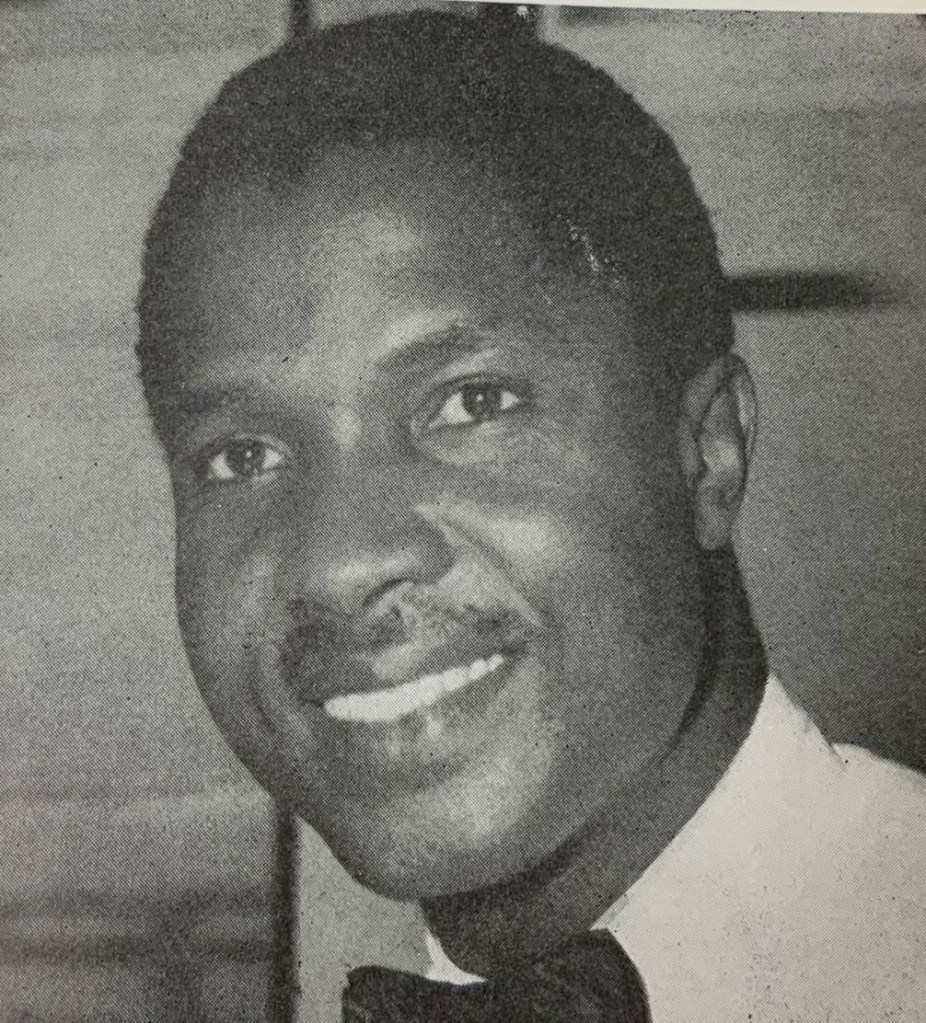
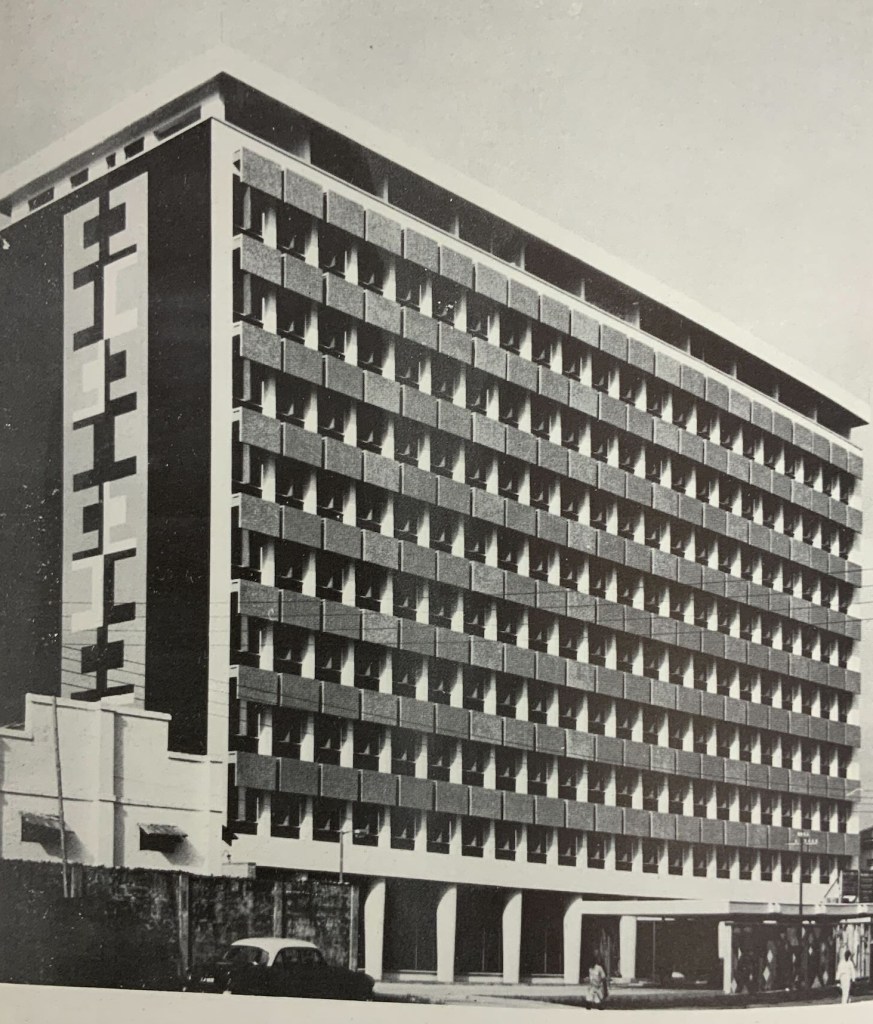
Articles were published on the history of cities, including “Ibadan, Black Metropolis” in 1961, relishing in the city’s longevity and traditions, as well as welcoming its position as a new centre for finance and media (see Design Group’s Finance building below). Other sections included biographies on key personalities, such as June 1966 with its feature on architect Alex Ifeanyichikwu Ekwueme (1932-2017).

Ekwueme studied at Washington University on a Fullbright Scholarship in 1952, and went onto to work at Nickson and Partners in London (is this Nickson and Boris?) before setting up a firm in Nigeria that grew to 16 offices. He designed the United Christian College at Apapa, Universal Insurance Building Enugu, and the Administration Building for the Nigerian Petroleum Refinery Company, amongst others. Ekwueme’s architectural career ended when he was elected Vice-President of Nigeria in 1979.

Architect and Vice-President of Nigeria, Alex Ifeanyichikwu Ekwueme (1932-2017), from Nigeria Magazine, June 1966.

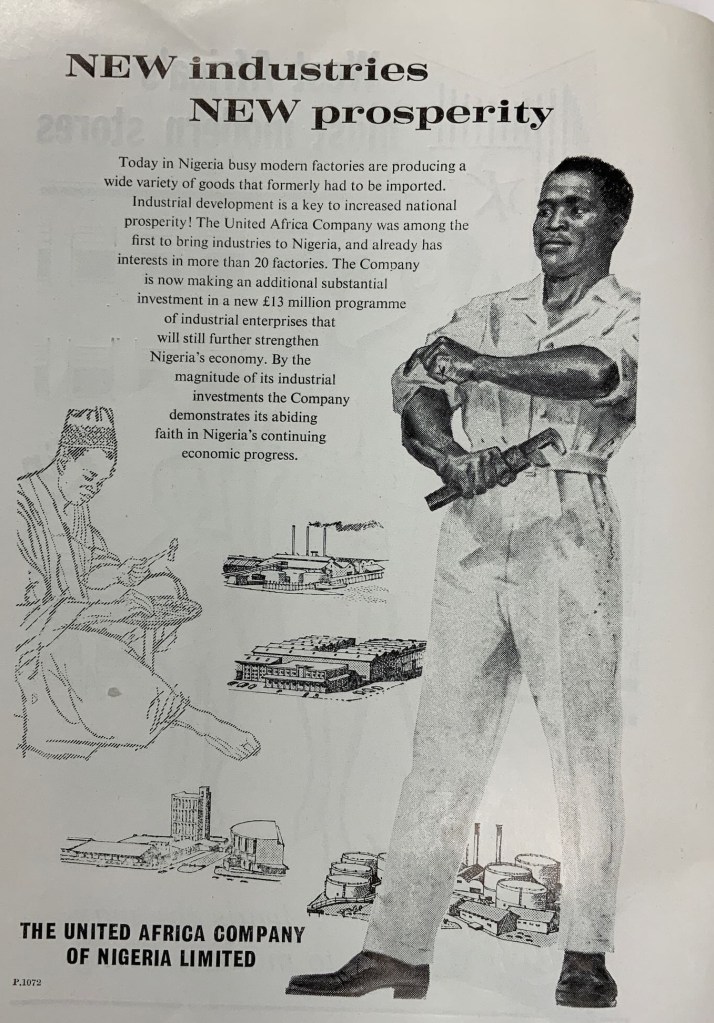
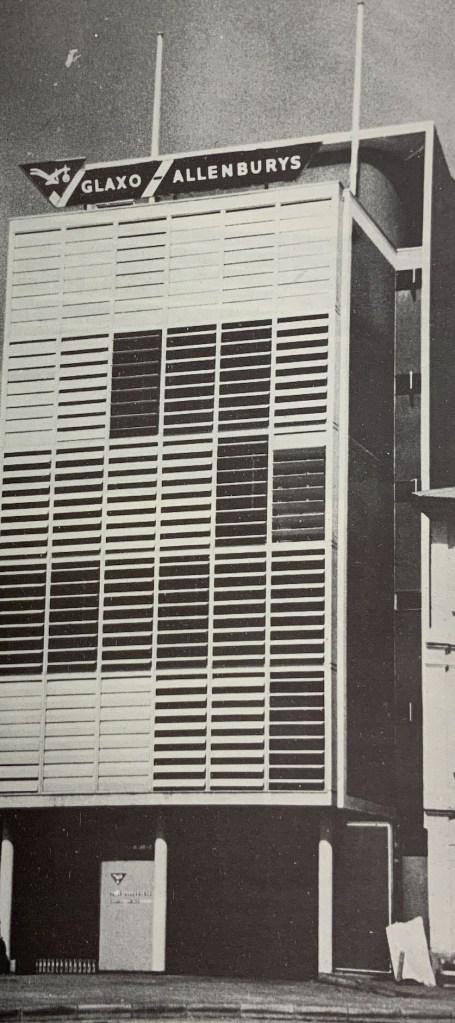
Whilst there was a lofty desire to promote local art, culture, and history, other articles appear to focus on trade and industry, presenting what are effectively op-eds or public relations pieces as historical accounts. In 1960 there was a special report on The Niger River Transport Company and Burutu, “Nigeria’s Timber Industry” featured in December 1962, focusing on the work and settlements of the African Timber and Plywood company – both subsidiary companies of of United Africa Company (UAC). Again, the Company features in various other articles, such as “The UAC in Nigeria’s economic growth” in December 1965. It’s a thorough and detailed account, going to some length to stress how the company is ‘inseparable’ from Nigeria’s economic growth. The article was also eager to stress the restructuring of the company and how it now operated as a series of smaller locally managed entities ‘to encourage the growth of industry and trade in local Nigerian hands’.

It seems that the magazine had a mandate beyond art and culture, and sought to shape opinion (particularly in the emerging and educated middle classes) on business and trade matters. The seductive and authoritative format of the journal gave these opinions validity, and allowed a particular and curated message to be carefully presented. The advertisements within the journal also reinforced these messages and narratives of progress through industry.

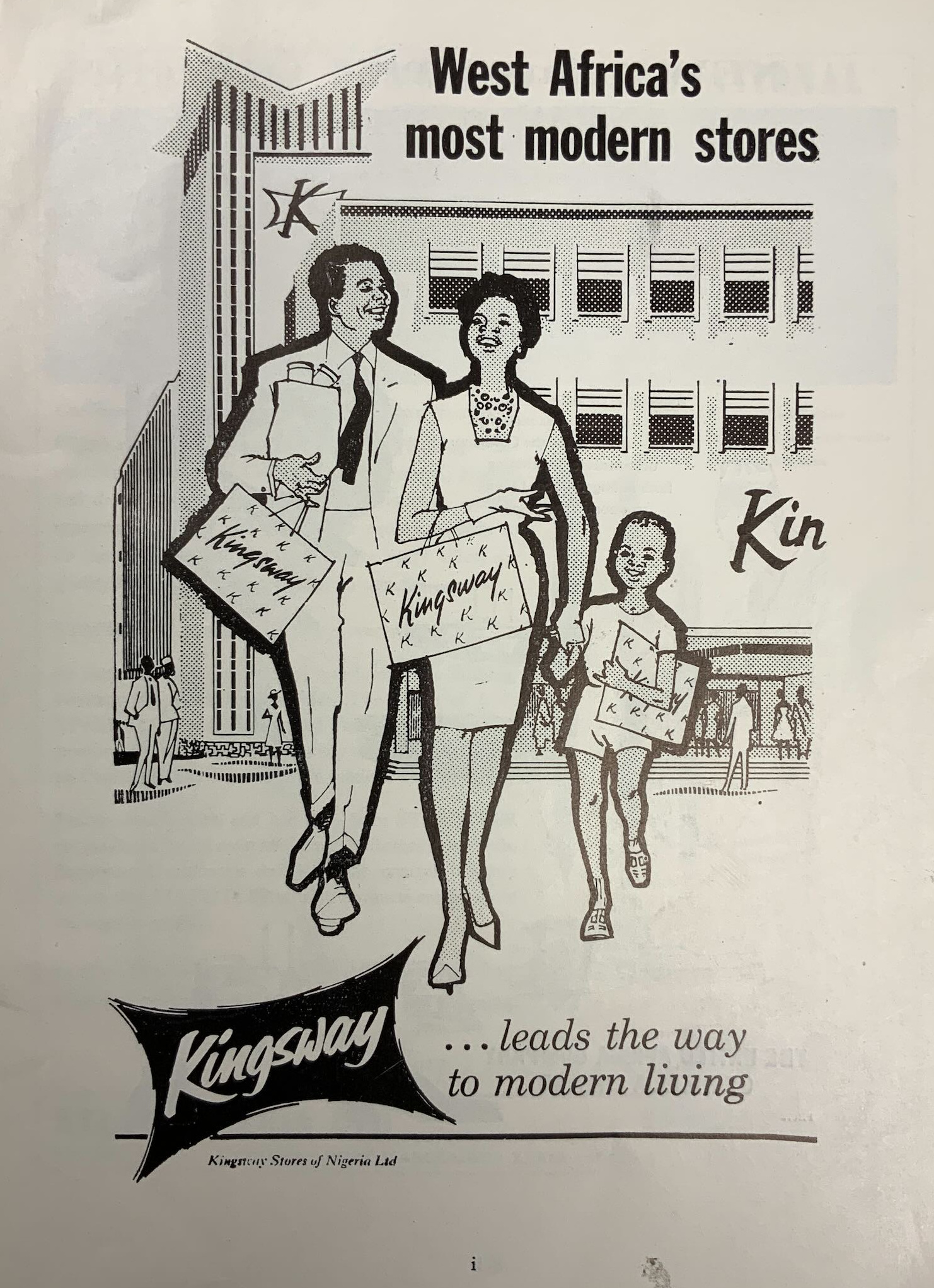
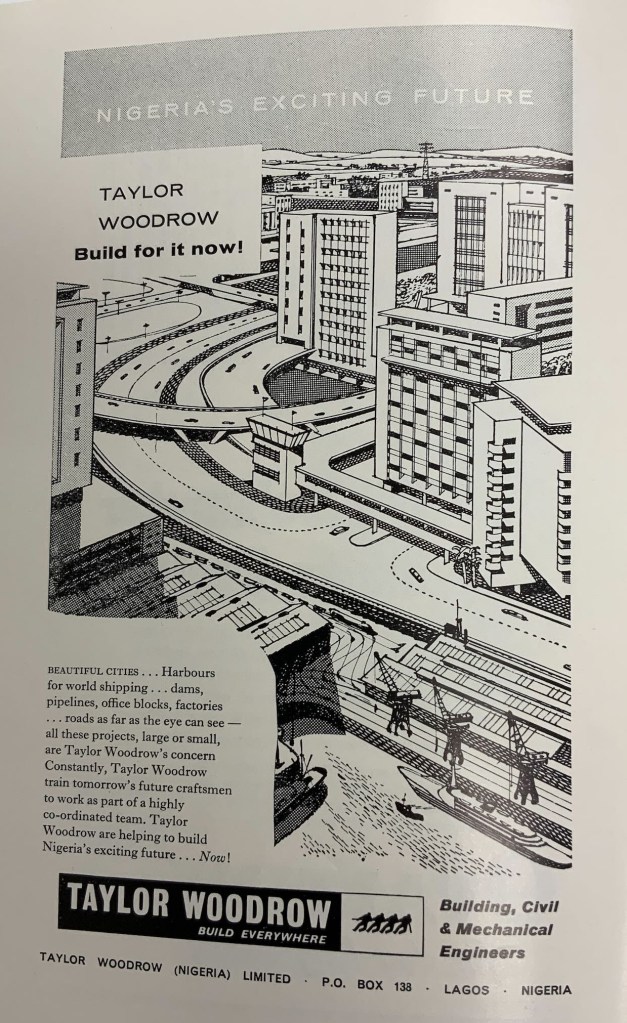
At the same time, ‘traditional’ and ‘local’ practices were celebrated and discussed. There is something disarming in this technique. An ahistorical image was usually shown on the front cover, often a decontextualised figure in traditional dress sometimes playing an instrument – followed on the inner leaf by an advertisement for the latest fashions from Kingsway department store. The advertisers tended to belong to, or were in partnership with, the UAC group (e.g. Taylor Woodrow, Guinness, Kingsway Stores), and it seems likely their extensive patronage held some sway over the editorial content. The adverts were not geared towards selling specific products, but were there simply to bolster public opinion and shift attitudes towards modernity, progress, and societal advancement alongside a romanticised nationalist sense of history and culture.

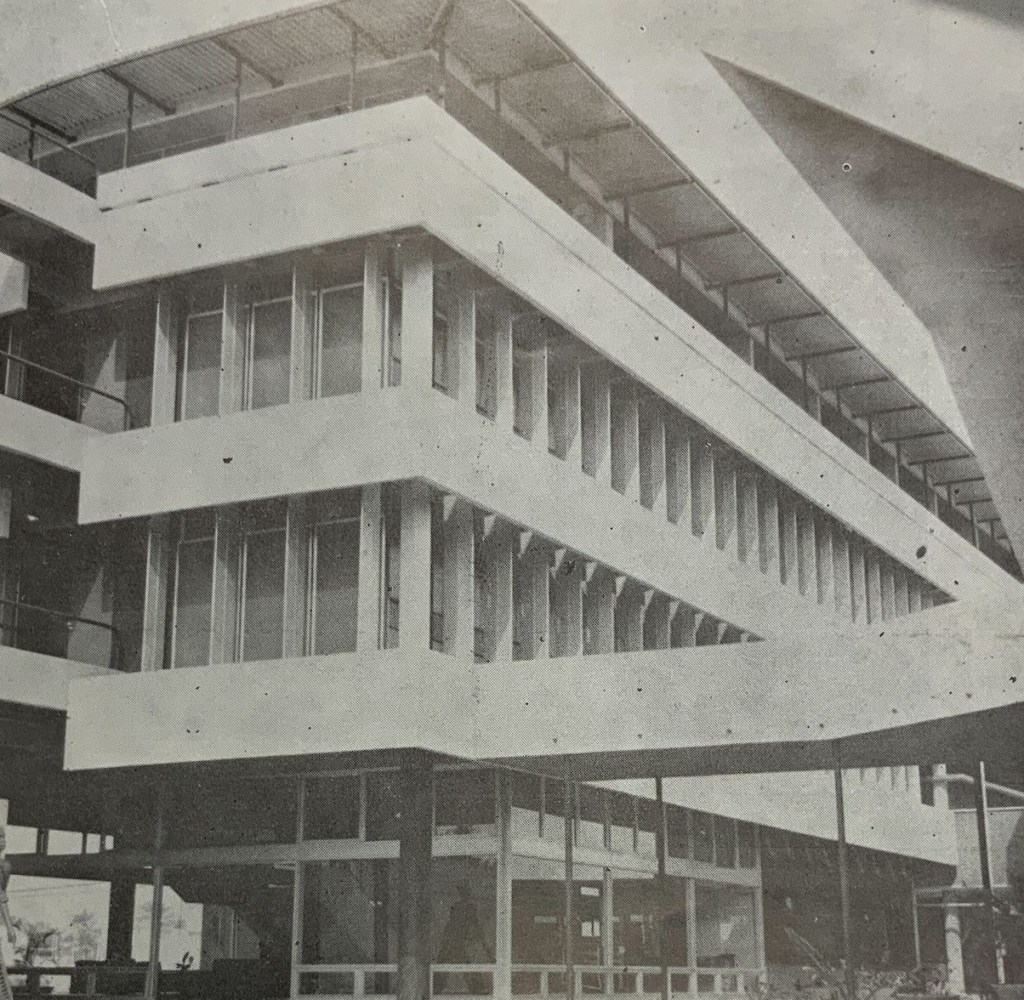
The articles on architecture were also propagandist and concerned with presenting Nigeria as a place of rapid progress and impatient ambition. Again, the UAC story is followed with interest, and their newly proposed offices in Lagos (by Watkins and Gray) demonstrates the Company’s commitment to ongoing business in the newly independent country, and also the shift in its focus from import/export to real estate and property development.

Artist impression of the UAC’s Niger House in Lagos. Designed by Watkins Gray and Partners.

John Godwin, wrote an article entitled, “Architecture in Nigeria” in December 1966. It’s a potted history that starts with the regional building types, local materials, and climatic responses before moving onto the impact of corrugated iron sheeting (pan) and its limitations. Godwin sets out this story to demonstrate the sudden change in scale, building types, and growth of the construction industry in West Africa post-1945,

“Tower cranes were on the scene in 1955 and by 1961 two twenty-five-storey buildings had been completed in Ibadan and Lagos built by Italian firms who thirty years earlier were struggling with their labour force to build small houses”

Whilst acknowledging this rapid growth and exciting possibilities, he also goes on to caution that more ‘research’ is required, greater collaboration should exist between architects, and that building components and materials were still being imported at prohibitive costs. Overly extravagant “prestige building” was also targeted whilst low-cost housing problems remained unresolved. Whilst the claims and hopes for air-conditioning now seem somewhat out-dated, his desire for a civic pride and community spirit, tree planting, and care of the environment is pertinent and all the more urgent. Godwin’s approach was to propose an “architecture of ventilators and sun breakers”, a lexicon that he viewed as, “increasingly identifiable as West African.”

Offices and Flats in Kaduna, designed by Godwin and Hopwood, 1964

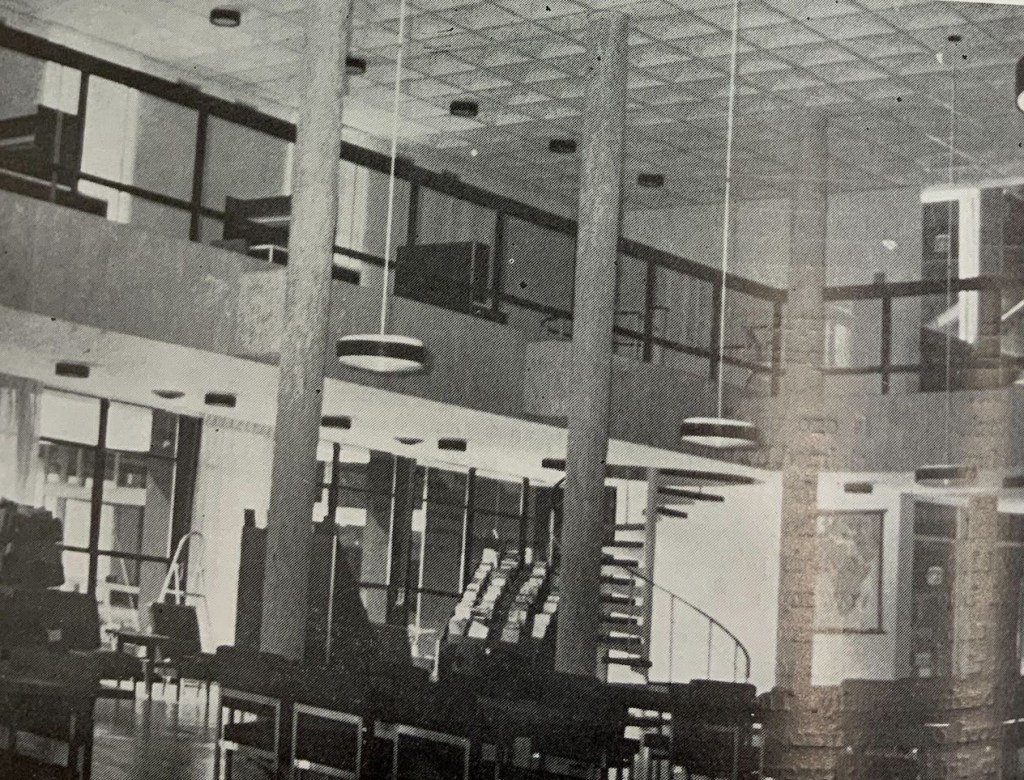
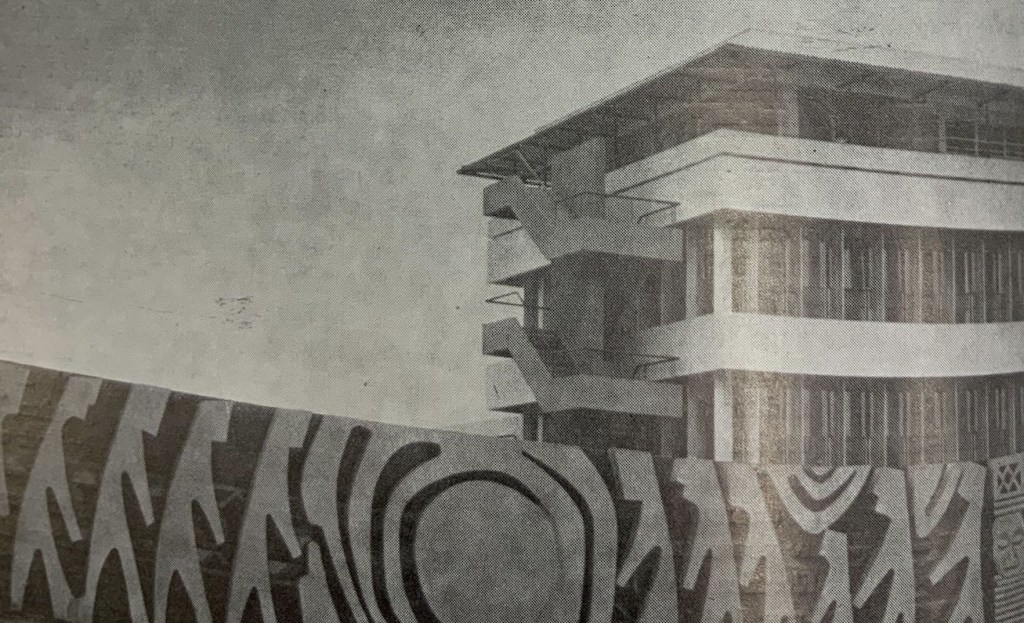
Contributing to this West African style was the Design Group’s “Nigerian Institute of International Affairs” (located on Lagos’s Kofo Abayomi Street). It was discussed at length by Alan Vaughan-Richards in the March/May 1968 edition of the magazine, where he particularly admired the sculptural mural, ‘The Art of Understanding” by Erhabor Emokpae in tooled concrete that revealed the granite aggregate. Inside the Institute are further sculptural elements, including a bronze figure representing Knowledge by Ben Enwonwu and positioned hovering above an evaporation pool. The interior includes some grand double-height spaces, dramatic cantilevered spiral staircases and travertine marble cladding (donated by the Italian contractor). At the rear of the plot there is an octagonal conference room with a dramatic star-shaped roof (still visible on Google maps).

The Institute was to promote peace and progress (the internal conflict taking place in Nigeria at that time was not mentioned), and was to operate as a centre for learning, research, and debate on global affairs.

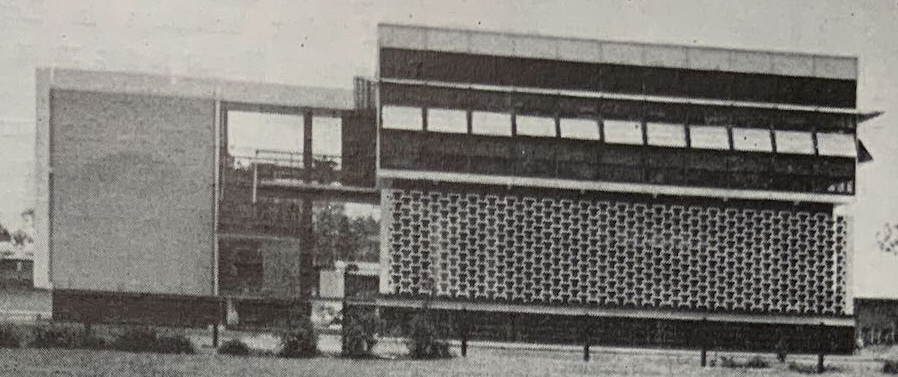
June 1962 edition included an article on “Contemporary Nigerian Architecture” by D. J. Vickery, the former Head of Department at Singapore Polytechnic (did he then go on to work in Nigeria?). This is an exceptional article covering some of the latest construction in Nigeria, and Lagos in particular. As a gazetteer of the latest building work – including the work from recently qualified Nigerian architects – it formed one of the most detailed architectural surveys of the country. Although the crude categorisation of the works under three types; ‘Climate’, ‘Traditional Spirit’, and ‘Skyline’ is somewhat limited, it gets the message across, and more importantly illustrates what the Independence Boom meant to the towns and cities across Nigeria.

In addition to the speculative offices, headquarters and banking halls there was an impressive array of schools and libraries (many designed by James Cubitt who had also designed similar works in Sekondi and Koforidua, Ghana), but the focus here was undoubtedly on real estate and speculative construction.

Nigeria magazine illustrates how UAC and other global companies shifted their approach and emphasis during the early Independence period. UAC was presenting its suite of businesses as nationalist, pro-development, and key partners in the country’s future. They rapidly placed an emphasis on real estate, finance, and industrial development, whilst curating a sophisticated advertisement and public relations campaign, through an arts and culture journal, to bolster their local credentials and legitimacy in the history of Nigeria.

Shared Heritage Africa: Call for Applications: Digital Fellowships March-September 2022: https://sha.architectuul.com

We are pleased to announce an open call for 6 Digital Fellowships, to be awarded to students and young professionals in architecture related fields or with demonstrable interest in architecture, who are based in Ghana, Uganda or Nigeria.

Shared Heritage Africa: Rediscovering Masterpieces

The documentation and investigation of buildings can tell us a lot about how politics works, and a lot about the nature of the relationship between state and society – a concern of all partner organisations. The project focuses on the rediscovery of post-war modern buildings from the 1950-1970s. These fall in the period of independence from colonial rule, here from the United Kingdom (Ghana 1957, Nigeria 1960 and Uganda 1962), and have a great educational and socio-political significance. One focus of our discussions with the respective universities, which were founded by the majority during this period of independence and for which new campuses were usually built, among others:

  • Kwame Nkrumah University of Science and Technology (KNUST), Kumasi, Ghana (1952/1961),
  • University of Lagos (UNILAG), Lagos, Nigeria (1962),
  • University of Nigeria (UNN) (formerly Nigeria College of Arts Science and Technology), Nsukka, Nigeria,(1950s),
  • Busitema University (formerly National College of Agricultural Mechanisation), Busitema, Uganda (1968),
  • Kyambogo University (formerly Uganda Polytechnic), Kampala, Uganda (1958).Digital Fellowship ProgramThe 6 month long digital fellowship program involves participants working on documentation, investigation and representation of those post-war modernist buildings from the 1950-1970s in Ghana, Nigeria and Uganda. The fellowship program focuses on development of written and visual material on those buildings through scientific writing, photography and digital publishing using different media (text, photo, film and internet).The fellows will be involved in online tutoring and in-person activities undertaken over the period. They will contribute to the online platform Architectuul and the new digest/Blog “Shared Heritage Africa”, allowing for exchange with the professional actors and society, locally and globally. The results shall be presented and discussed at the 17th International DOCOMOMO Conference (IDC) in Valencia (Spain) in September 2022. Each fellow will receive a travel grant for joining the conference.

  • EligibilityPlease note the following conditions for participation:
    • –  Students and young professionals in architecture related fields or with demonstrable interest inarchitecture and other related disciplines, such as: Architecture, Urban Design, History, Social Science,Journalism, Urban Studies, Creative Writing, are eligible to participate.
    • –  If they are based in Ghana, Uganda or Nigeria.
    • –  Strong written communication skills and/or photography and/or digital publishing skills are required.
    • –  Previous experience conducting and communicating ideas or research publicly (blogs, articles,dissertations) is desirable.

Full Details and Application Form: https://sha.architectuul.com

Online Modernist University Campus Architecture Writing Workshop: A Ghana-Nigeria-UK collaboration

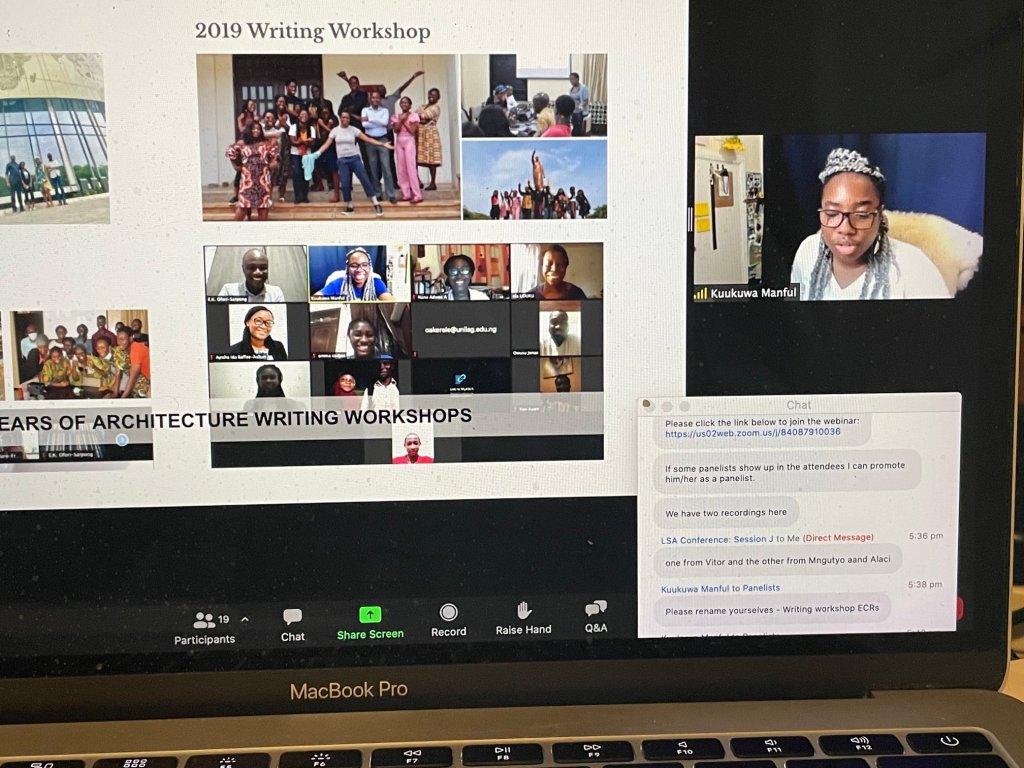
The third iteration of the African Architecture Writing Workshop has involved multi-disciplinary teams of young students and Early Career Researchers (ECRs) from Universities in both Ghana and Nigeria in developing a series short written articles focused on personal views of university campus buildings in Ghana and Nigeria. The ECRs worked directly with the young students as mentors to encourage and develop their writing style. 

The ECRs have also been tasked with compiling and editing student work to create a series of gazette entries for the Modernist University Campus Buildings in West Africa project.  Aside from the written component the ECRs and students have also taken a set of photographs which will form the basis for a future planned photography workshop to be run in association with the International Documentation of Modern Buildings and Landscapes, (Docomomo) team Germany.

The British Academy-funded workshop took place over two weeks starting at the University of Ghana, Legon led by Co-I Dr Irene Appeaning Addo, with support from ECRs Kuukuwa Manful, Emmanuel Ofori-Sarpong, Dr Ayisha Baffoe-Eshun, and Yaw Asare; as well as guest mentor Dr Joseph Oduro-Frimpong. There was a guest lecture from Professor Lesley Lokko. Students from Kwame Nkrumah University of Science and Technology, University of Ghana, and Central University College took part in the workshop. Arc Ruth Anne Richardson, Arc Tony Asare, Dr Edem Adotey, and Professor Iain Jackson reviewed the students’ final written pieces that were focused on three buildings on the University of Ghana Campus; Commonwealth, Volta and Legon Halls. 

After a hand over day the Nigeria team’s workshop was led by Co-I Dr Nnezi Uduma-Olugu, and involved three institutions, the University of Lagos, University of Jos and the University of Nigeria, Enugu Campus. Each institution had a number of ECRs who worked at mentoring the interdisciplinary group of students who had enrolled at each of the workshops. As with the Ghana workshop a number of guest speakers including Prof Bogdana Prucnal-Ogunsote, (University of Jos) Kofo Adeleke (Legacy-92 organisation Lagos) and Dr Onyekiekwe Ijeoma, Nigeria commission for Museums. For the Nigerian final critical reviews attended by Prof Lukasz Stanek (University of Manchester) and Dr Joseph Oduro-Frimpong (Asheshi University Ghana) the ECRs presented their edited summaries of the student-written work and views on campus buildings in the three cities.

ECRs then presented their workshop experience at the Lagos Studies Association International Online Conference at a roundtable panel on conservation challenges in Africa chaired by Profs Uduku and Lawanson, Manchester School of Architecture, Manchester Metropolitan University, and University of Lagos respectively. 

Whilst students and ECRs met in covid secure ways at their respective campuses all lectures and reviews took place entirely online, with students and ECRs able to work from ethernet-wifi equipped room spaces at the University of Ghana, and all three Nigerian collaborating Universities.  

Currently ECRs are working on the editing and production of the initial phase of the Modernist African University Campus Buildings Gazette, this will be critically reviewed by Prof Miles Glendinning, Docomomo Scotland and Director SCCS University of Edinburgh. Watch this space…      

Crucibles, Vectors, Catalysts: Envisioning The Modern City 2nd March Part 1

https://www.liverpool.ac.uk/architecture/events/filmarchive/

Here are the recordings from the Crucibles, Vectors, Catalysts: Envisioning The Modern City, event from 2nd and 9th March 2021. Thank you to all of our excellent speakers, and for the interesting questions and discussions.

PROGRAMME: Session 1: Crucibles, 15:00-16:30 (UTC) Building the Modern City: Expressions of Identity, Change and Power, Moderated by Iain Jackson

This panel will explore state-sponsored programmes, planned cities and masterplans in cities such as Lagos, Tehran and Baghdad. It will examine architecture as expressions of nationalism and nationalist political agendas as well as its relationship to big business, corporations and mercantile ventures.

Speakers:
  • Talinn Grigor (University of California, Davis)
    • Building a (Cosmopolitan) Modern Iran
  • Ola Uduku (Manchester School of Architecture)
    • Lagos International Metropolis: A city’s adventure in tropical architecture as an expression of dynamic modernism and growth in the mid 20th century
  • Lukasz Stanek (University of Manchester)
    • Rupture, Transition and Continuity in Baghdad’s Master Plans: From Minoprio to Miastoprojekt
Session 2: Vectors, 17:00-18:30 (UTC) Connecting the Modern City: Networks, Alliances and Knowledge Production; Moderated by Clara Kim

This panel will explore the practice of modern architecture through colonial-postcolonial networks and geopolitical alliances. It will explore cities in Mozambique within the context of other Lusophone countries, post-Partition East & West Pakistan, as well as the dissemination of knowledge and technical expertise through pedagogy.

Speakers:
  • Ana Tostões (University of Lisbon)
    • Correspondences, Transfers and Memory: Maputo’s “Age of Concrete”
  • Farhan Karim (University of Kansas)
    • Archaeology of the Future: Constantinos Doxiaidis in East and West Pakistan
  • Patrick Zamarian (University of Liverpool)
    • Global Perspectives and Private Concerns: The AA’s Department of Tropical Architecture
TUESDAY 9 MARCH Session 3: Catalysts, 15:00-16:30
  • Fragments of the Modern City: Memories, Echoes and Whispers Moderated by Osei Bonsu

This panel will explore the collaborations, connections and entanglements that developed between art and architecture during a dynamic period of building in Morocco, India and Iraq. It will examine the legacy and afterlives of these projects through the investigation of under-recognised figures and narratives in art and architecture.

Speakers:

  • Lahbib el Moumni & Imad Dahmani (founders of MAMMA, Mémoire des Architectes Modernes Marocain)
    • Initiatives toward saving modern heritage of Morocco
  • Ram Rahman (Photographer/Curator)
    • Building Modern Delhi, The Nehruvian Post-Independence Renaissance
  • Amin Alsaden (Independent Scholar)
    • Syntheses Across Disciplines: Rifat Chadirji and Art-Architecture Liaisons in Modern Baghdad

This event was organised by Hyundai Tate Research Centre: Transnational and Liverpool School of Architecture.

Explore modern cities and architectural production in the blurred era of the independence and postcolonial period

Join us for three sessions which will bring together scholars, researchers and curators to explore architectural production in the blurred era of independence to the post-colonial period of the mid-20th century, focussing on cities in Africa, Middle East and South Asia. 

Register here: https://www.eventbrite.co.uk/e/crucibles-vectors-catalysts-envisioning-the-modern-city-tickets-138966892717

Whether driven by socialist agendas (Nehruvian in India and Nkrumah in Ghana), monarchies (Pahlavis in Iran and Hashemite in Iraq), quasi colonial protectorates, or pan-continental aspirations, architecture (and especially Modernism) was a key apparatus for nation-building, for re-imagining identities and a means to project and invent a new image of the future. The seminar seeks to explore the use of architecture as both physical infrastructure and symbolic expression, as well as its vulnerability to the vicissitudes of changing politics and policies of the times.

The role of cities as crucibles, vectors and catalysts for developing new expressions of identity, change and power is key. Cities in this period saw the emergence of schools of thought, dynasties and collaborations were formed, networks and ideas were shared and publications were disseminated. While the desire of a newly independent nation was often to consolidate a single national collective identity, it was through the urban centres that strands of coherent, yet often multiple identities were formed. The role of figures such as Rifat Chadirji, Mohamed Makiya, Jane Drew and Maxwell Fry were important as they often operated within multiple cities and cross-cultural contexts that spanned the colonial to postcolonial divide. 

These urban centres were either newly built, or they were remade and reimagined through city infrastructure, government buildings, universities, cultural institutions and national monuments. Architecture schools, state sponsored projects and external agencies feed into the discussion and warrant further exploration. The seminar explores the transnational connections, diverse political agendas and complex allegiances which informed architectural development in this period. 

Seminar convenors:

  • Iain Jackson, Professor of Architecture and Research Director, Liverpool School of Architecture
  • Clara Kim, The Daskalopoulos Senior Curator, International Art, Tate Modern
  • Nabila Abdel Nabi, Curator, International Art, Tate Modern

PROGRAMME
TUESDAY 2 MARCH

Session 1: Crucibles, 15:00-16:30 (UTC)

  • Building the Modern City: Expressions of Identity, Change and Power
    • Moderated by Iain Jackson

This panel will explore state-sponsored programmes, planned cities and masterplans in cities such as Lagos, Tehran and Baghdad. It will examine architecture as expressions of nationalism and nationalist political agendas as well as its relationship to big business, corporations and mercantile ventures.

Speakers:

  • Talinn Grigor (University of California, Davis)
    • Building a (Cosmopolitan) Modern Iran
  • Ola Uduku (Manchester School of Architecture)
    • Lagos International Metropolis: A city’s adventure in tropical architecture as an expression of dynamic modernism and growth in the mid 20th century
  • Lukasz Stanek (University of Manchester)
    • Rupture, Transition and Continuity in Baghdad’s Master Plans: From Minoprio to Miastoprojekt

Session 2: Vectors, 17:00-18:30 (UTC)

  • Connecting the Modern City: Networks, Alliances and Knowledge Production
    • Moderated by Clara Kim

This panel will explore the practice of modern architecture through colonial-postcolonial networks and geopolitical alliances. It will explore cities in Mozambique within the context of other Lusophone countries, post-Partition East & West Pakistan, as well as the dissemination of knowledge and technical expertise through pedagogy.

Speakers:

  • Ana Tostões (University of Lisbon)
    • Correspondences, Transfers and Memory: Maputo’s “Age of Concrete”
  • Fahran Karim (University of Kansas)
    • Archaeology of the Future: Constantinos Doxiaidis in East and West Pakistan
  • Patrick Zamarian (University of Liverpool)
    • Global Perspectives and Private Concerns: The AA’s Department of Tropical Architecture

TUESDAY 9 MARCH

Session 3: Catalysts, 15:00-16:30 (UTC)

  • Fragments of the Modern City: Memories, Echoes and Whispers
    • Moderated by Nabila Abdel Nabi

This panel will explore the collaborations, connections and entanglements that developed between art and architecture during a dynamic period of building in Morocco, India and Iraq. It will examine the legacy and afterlives of these projects through the investigation of under-recognised figures and narratives in art and architecture.

Speakers:

  • Lahbib el Moumni & Imad Dahmani (founders of MAMMA, Mémoire des Architectes Modernes Marocain)
    • Initiatives toward saving modern heritage of Morocco
  • Ram Rahman (Photographer/Curator)
    • Building Modern Delhi, The Nehruvian Post-Independence Renaissance
  • Amin Alsaden (Independent Scholar)
    • Syntheses Across Disciplines: Rifat Chadirji and Art-Architecture Liaisons in Modern Baghdad

This event is organised by Hyundai Tate Research Centre: Transnational and Liverpool School of Architecture.

Rachel Lee, ‘Engaging the Archival Habitat: Architectural Knowledge and Otto Koenigsberger’s Effects
Comparative Studies of South Asia, Africa and the Middle East (2020) 40 (3): 526–540; https://doi.org/10.1215/1089201X-8747502

Drawing on experiences of researching India’s architectural history, this article explores the affect generated by architectural archives as a source of knowledge. It traces the affective life of the archives and practices of a singular historical figure: Otto Koenigsberger, the chief architect and town planner of the princely state Mysore, the architect of Jamshedpur (a.k.a. Tatanagar, the “Steel City,” India’s first planned industrial town), the first director of housing of the federal government of India, cofounder and director of the Department of Tropical Studies of the Architectural Association in London, and architecture and planning consultant at-large to the United Nations.

Arguing that the affective archive has disruptive historiographical potential, the article posits that it exists fundamentally beyond the architectural object and archival documents themselves, and indeed fully in discourse with its users. The article argues for a more expansive and inclusive understanding of what constitutes an archive, designating the “archival habitat” as a place of active scholarly engagement.