A World History of Architecture, a small but mighty conference organized by Murray Fraser took place at The Bartlett School of Architecture, UCL, November 2-4, 2018. Over two days, and only eight sessions, Fraser was able to curate a cumulative and rigorous series of presentations that tousled with all facets of teaching global architectural history to the undergraduate and graduate audience. The conference focused on the term “global” in two ways. The first was as a geographic lens, a method that leaned towards the increased inclusion of previously ill-studied parts of the world into the architectural survey. The second was an intellectual engagement with the instruction of global architectural history, and an analysis of its growing interdisciplinarity with neighboring fields of study. The aim of these methods of engagement was explicitly to study and inform on the future direction of global architectural history in universities.
The morning session on day one, The Expanded Field, had Mark Jarzombek tangling with the concept of tradition, a theme that can be in one sense totalizing of all that is non-modern, but in another, a useful/clever label used to project value and meaning onto art and architectural objects. The presentation intended to make clear a much needed separation between the term traditional – so often a synonym for the vernacular – and the meaning of global history.
Subsequent sessions were based on the themes of:
Global Domesticity
Colonialism, Post-Colonialism and Beyond
Architectural History and Design Research
Informalities, Identities and Subjectivities
Culture and Architectural History
Architectural History as Pedagogy
Evening sessions focused on a discussion of the architectural object on the first day, and closed with an ambitious debate of the future of architectural education on the second. Throughout, the group of global scholars shared the pedagogical challenges of teaching in architectural history in their home institutions, in hope that together, they could begin to envision a way for the discipline to transcend beyond its seemingly fixed limits. David Leatherbarrow, in his presentation on Architectural History as Pedagogy transformed architectural survey into a study of architectural details, with intense focus on the various elements that compose the architectural object, rather than a rote evaluation of the whole. In this way architectural education takes pause, ensures that the students absorb and evaluate, not just commit the basic facts of architectural history to memory. Students thus are able to engage emotionally with their object of study, connect with the built environment around them, and, most importantly, hone their critical analysis skills.
A World of Architectural History is the 4th annual conference of the Architectural Research in Europe Network Association (ARENA).
The conference aims to critique and celebrate the latest global advances within architectural history over the last few decades, by focusing upon the word ‘global’ in two senses:
Geographically – referring to the increasing inclusion of all parts of the world in more complex and multiple discourses of architectural history
Intellectually – the ongoing expansion of architectural history into other academic subjects, plus the reception of ideas/themes from those subjects
Recognition will be given to a more inclusive approach to architectural history that seeks to incorporate the histories of all countries/regions, and to the significant contributions now being made through interdisciplinary links with other subjects. As such, the conference will represent the forefront of the field internationally and discuss where architectural history ought to head in the future.
Conference presenters will include those from a wide range of subject areas within The Bartlett Faculty of the Built Environment and leading figures in architectural history across the world. Both invited speakers and those selected via an open call will contribute their papers.
Conference themes
Eight thematic areas will be presented over the two days of the conference, with these themes also framing the call for papers:
Jawaharlal Nehru, Otto Koenigsberger, Amrit Kaur and unknown others visit the Housing Factory, 1950. | Courtesy: Koenigsberger family
The refugee crisis that followed the division of India and Pakistan in August 1947 intensified the already dire housing situation in Indian cities. In Delhi, where the population had almost doubled over the previous decade, causing a severe housing shortage, some 500,000 refugees sought shelter. As well as camps outside the city, Delhi’s verandahs, gardens and pavements were filled with displaced people while communal violence raged in the streets.
The “noble mansion of free India where all her children may dwell” that Prime Minister Jawaharlal Nehru envisioned building in his Independence Day speech must have seemed a pipedream to Delhi’s homeless. Nonetheless, the central government committed to developing housing solutions that would provide dignified, sustainable, low-cost shelter to help counter the refugee crisis.
Responsible for leading this project was Otto Koenigsberger, Director of Housing in the Ministry of Health. Koenigsberger, who was born in 1908 in Berlin, Germany, had been working in exile in India since 1939. Unable to continue his work as an architect in Berlin due to Nazi persecution, Koenigsberger – who was of Jewish background – had migrated to Bangalore, where he held the position of Government Architect and Town Planner in the erstwhile princely state of Mysore for nine years.
Otto Koenigsberger at his desk in Delhi, 1950.
In addition to his extensive government work in Mysore, he built up a private practice, working on large-scale urban planning projects such as the Jamshedpur Development Plan for Tata & Sons, or the master plan for Bhubaneswar, the new capital of Orissa. Koenigsberger was also a founding editor of MARG magazine. Before being called to Delhi to work with the central government, Koenigsberger had become a prominent figure in India’s evolving architectural landscape and had established a reputation as a town planner.
Throughout his time in India, he had also displayed enthusiasm and ambition for developing low-cost, prefabricated housing. Arguing that mass production was particularly suited to India because of the “simpler” housing needs of the Indian worker’s family, Koenigsberger designed the Tata House for Jamshedpur.
Tata House, 1945Sri Jayachamarajendra Institute of Indian Medicine, circa 1948Dining Hall, Indian Institute of Science, Bangalore, circa 1946Jamshedpur Development Plan, 1945Tata House, 1945Sri Jayachamarajendra Institute of Indian Medicine, circa 1948
Built on a light steel framework, with walls of precast aerated concrete blocks and a barrel-vault roof of the same material, the component parts could be transported by lorry and assembled on site. In Mysore, too, Koenigsberger was involved in the development of a mass-manufacture housing scheme initiated by Bangalore industrialists and a British engineering firm to meet the severe housing lack in urban areas. Like many other prefab schemes that were initiated in the 1940s, however, these projects remained on the drawing board.
Good idea on paper
It is not surprising that when Koenigsberger was invited to advise the government of India on the chronic housing shortage, he recommended prefabricated housing as a viable solution. From October 1948, as Director of Housing, he began setting up the Hindustan Housing Factory in Delhi, which was to serve the capital city, supplementing rather than replacing the traditional construction of houses and targeting refugee housing needs.
It was a pilot project, initiated with the aim of replication across India’s urban centres. The simple single-storey housing units produced by the factory offered two rooms, rear and front verandahs, a kitchen and a separate bathroom and lavatory accessed via a small rear courtyard. While they could be added to incrementally or combined to make larger units, the real innovation of the houses was the use of large load-bearing aerated-concrete wall panels that were quickly cured by the relatively new process of autoclaving.
Delhi prefab, 1950.
The aerated-concrete panels offered excellent thermal properties and could be produced using local materials. Doors and windows were to be fitted to the panels in the factory so that site work could be reduced to building simple masonry foundations and assembling the ready-made panels.
Government Housing Factory with aerated concrete panels in the foreground, 1950.
Series of crises
What could possibly go wrong? Well, pretty much everything, as it turned out.
ADVERTISEMENT
To begin with, the delivery of prototypes of the houses, which were needed for testing in local conditions and finalising design details, was delayed. Meanwhile, the Ministry of Health took over six months to establish the factory’s management and administration structure, define its constitution, select its committee and hire skilled staff, which postponed the commencement of actual building work.
Apart from that, a dock fire in Liverpool, the sinking of a ship loaded with vital supplies in the Red Sea, the overcrowding of Bombay’s harbour in the summer of 1949 and shortages of special wagons for the transport of heavy machinery from Bombay and Calcutta to Delhi, all hampered progress. It was not until the summer of 1950 that the factory started producing houses, after a backlash in the press and Parliament had already begun.
Departure amidst scandals
To make matters worse, a worrying number of the aerated-concrete panels started breaking during autoclaving, while others developed cracks after erection. The houses were falling apart. Unable to solve the problem, production stopped in December 1950. The scandal that ensued ended Koenigsberger’s career in India. Politicians who had been against the scheme launched an aggressive attack in Parliament, which was intensified in the media and supported by groups that had hoped the project would fail, including the PWD and elements of the construction industry.
Headlines such as “The Full Dope on GOI’s Pre-Fab Racket,” and “Prefab Housing Project A Criminal Waste” coursed through the press. Health Minister Rajkumari Amrit Kaur dismissed Koenigsberger as manager of the housing factory in April 1951 and he subsequently retired from his government duties, returning to Europe bitterly disappointed.
Press clippings on the scandal, 1951.
Koenigsberger, a naturalised Indian citizen, settled in London, where most of his family was living. He continued his work on low-cost housing and urban development in rapidly growing cities but as director of the Department of Tropical Studies at the Architectural Association, Professor of Development Planning at University College London and in his advisory roles for the United Nations, World Bank and various nation states. His book Manual of Tropical Housing and Building, co-authored with TG Ingersoll, Alan Mayhew and SV Szokolay and published in 1974, became ubiquitous in architecture school libraries in South Asia and other “tropical” geographies. He died in London at the age of 90.
Ironically, production of the panels resumed shortly before Koenigsberger’s departure from India. The autoclaving had brought out peculiarities in the local cement that were “nursed” by adding more lime. The Hindustan Housing Factory still exists, albeit under another name: Hindustan Prefab. According to their website, their premises include a Technology Park, where parts of the failed refugee housing are displayed.
British Academy – ASAUK Funded Ghana Architecture Writing Workshop 6–8 July
Apologies for the short notice – but if you’re in Accra this weekend and want an opportunity to improve your writing skills, there are some free places to join an excellent Architectural Writing Workshop.
Architecture in the Age of Mechanical Reproduction: Glasgow School of Art and its Future
Like many people, I was again saddened, shocked, and frankly annoyed to see Charles Rennie Mackintosh’s masterpiece, the Glasgow School of Art, engulfed in smoke and flame for the second time in just four years. It was a radical piece of architecture that helped to shape the development of early 20thC Modernist architecture, and unlike a lot of contemporary and experimental work it was much loved and held a popular appeal.
The charred remains have yet to cool, but a fierce debate has erupted on the future of the building. On the one hand there is an impassioned plea to demolish and rebuild a new structure that would be something of ‘our time’; with any attempts to refabricate the ‘original’ resulting in a ‘replica’, that is, a fake.
Glasgow School of Art, by Charles Rennie Mackintosh
This faction argues that a rebuilt school would be rendered a ‘museum piece’, and that a new school would somehow respond better to the needs of today’s students. For sure, it is a compelling argument and after the shock of the tragic event it shows a fighting spirit and an optimism that all architects possess to create a better future. If an architect were to design a new building today that mimicked, or somehow parodied the ‘Mackintosh style’, then for sure, that would not be the way forward for architecture. But this is not a newly commissioned project, rather it should be a restoration of a dilapidated shell.
“The handle has been replaced several times, and the blade was changed once, but this knife has been in our family for centuries”
Unlike other works of art, such as painting or sculpture, there is a utilitarian, designerly approach in building, and buildings are made of many components, materials and finishes. They can all be replaced or remade. Certain parts of a building inevitably wear-out and have to be replaced; lead flashing is carefully reinserted, roofs are precisely re-laid, window frames rot, and sometimes windows are smashed and replaced. We accept this continual, sensitive remaking and in the case of buildings like the GSA undertake this process with extreme diligence. This is all part of a building’s ability to endure time and survive, and whilst a fire rapidly accelerates this process, it need not be the end. Buildings are never complete, they are always unfinished and being continually remade through the acts of everyday use. They develop patina, tarnishes, stains, and are weathered, changing all buildings for better or for worse. This aging cannot be replicated of course, but it demonstrates that a building is not a pristine artefact, there is a spectrum of aging and renewal.
The surviving GSA structure could be retained and kept in its ruinous state as a kind of memorial to what we once had. Some of the ‘original’ fabric would be retained and fixed to commemorate Mackintosh’s genius. It could become a shrine with a steady pilgrimage of architects’ eager to touch the stone relics with their direct link back to the hand of the Mackintosh. This would surely be the worst type of preservation – for whilst we would have the vestiges of the School there would be no joy, no use, just a sad lament. The surviving stones might enable a façade to be retained, or possibly form a similar condition to that deployed by Basil Spence at Coventry Cathedral, in the aftermath of World War Two. Whilst this might preserve the outer shell, or image, it wouldn’t suffice because the interiors at GSA were so rich and possibly even more important than the building’s skin.
We should not be afraid to remake architecture, because architecture as a concept is detached from its manifestation as a building. There is the idea and its representation often in the form of drawings and physical models, and then there is the physical construct. The physical entity is of course very important, but it is an outworking of an idea. Unlike painting, where the hand of the artist is important (but not essential) architecture is always remote from the act of construction. Architects make drawings that are then interpreted and fabricated by teams of artisans, technicians and craftspeople into the built object. Inevitably there are gaps between the artist’s intentions and the drawings they produce, and then of course there are numerous clefts between the drawings and the constructed piece. Decisions are made ‘on site’ and changes made on the hoof – this is all part of the construction process. In many buildings there is even a devolution of some parts of the design to the craftspeople on site, especially in decorative pieces, or commissioned artworks and sculptures. The core idea remains and is entirely the responsibility (and gift) of the designer, but it is important not to overly fetishize the object as a fixed, pristine artefact.
A burned out Jaguar E-Type can be fully restored, and even enhanced to suit modern environmental standards as the ‘Concept Zero’ illustrates. In no way does this detract from the ‘original’ duplicated model, nor the enjoyment of driving the vehicle. Indeed, there is pleasure and pride to be had from such a restoration. There is certainly room to manoeuvre here in construction and many buildings are sensitively restored and enhanced for modern living and reduced energy use. The drawings produced by Mackintosh (and his wife Margaret) survive and the recent scans and computer models of the building produced in response to Fire no.1 will enable a faithful rebuilding of the GSA. There is no technical reason why this school could not be rebuilt. Other art forms revel in this ability to be remade and enjoyed; music is recorded, plays are performed, artists issue facsimile casts and photographers offer limited edition prints. Walter Benjamin foresaw this in his seminal writing, ‘Art in the age of mechanical reproduction’. I’m not suggesting that multiple GSAs are licensed, but rather the single edition we had is carefully remade in honour of Mackintosh and the city which this building has helped to define and create.
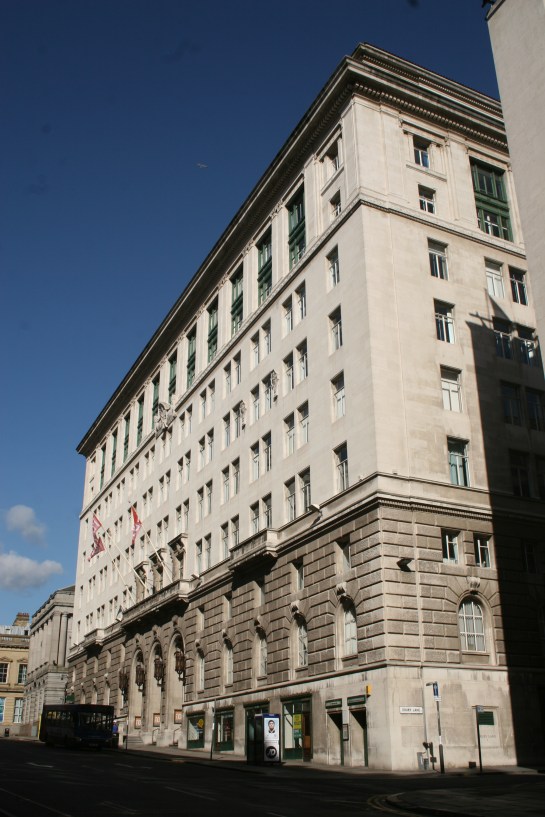
India Buildings by Herbert Rowse
There are claims that a rebuilt School would not be ‘of our time’. Some, like eminent architect Alan Dunlop have claimed that Mackintosh’s would indeed want ‘to see a new school of art fit for the 21stcentury’ – but we can never truly know the wishes of the deceased. Surely the GSA is an excellent didactic tool for today’s students, and in any case it is not very old – it’s a mere blink of an eye in the broader scheme of things. To remake it now would not be a disservice to ‘our time’ but would be a measure of how we value and cherish such works of art. So many buildings have been regrettably erased following fire – to the detriment of our built environment. Gavin Stamp’s publication, Britain’sLost Citiesis a roll call of this approach, whereas when the decision to rebuild has been made the results are rarely questioned. We do not hear claims of, ‘we should have pulled this down and replaced it with something else’. Herbert Rowse’s India Buildings in Liverpool was carefully rebuilt after the effects of incendiary bombs – its authenticity is not questioned because of this; it simply becomes part of the building’s story. Mies van der Rohe’s Barcelona Pavilion was also famously remade and it continues to bring pleasure and delight to all who see it. It is far better to experience this wonderful design than to imagine it’s ‘spirit’ or look at the old photographs. Plus, we live in an age when this is possible – it is ‘of our time’ to replicate and reproduce components and objects that are better than the ‘originals’.
I’ve been spending some time working in and around Accra, and in particular at the Public Records and Archives Department. This archive has undergone major changes in the last five years and is a great place to undertake research with helpful staff and quick responses to queries. Located in a distinctive building with bold concrete brise soleil and a brave concertinaed roof over the entrance space, its interiors rely exclusively on passive ventilation. I was looking mainly at the late colonial records including those of the Public Works Department, sanitation, land, and town planning.
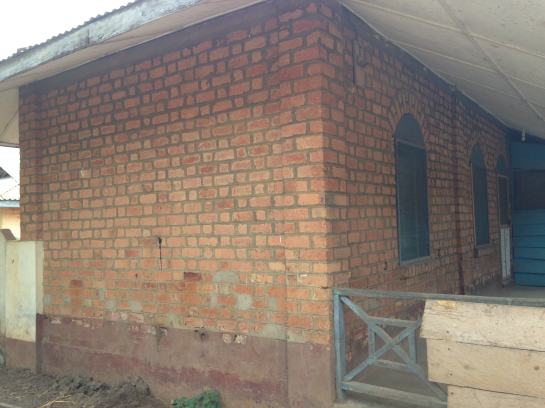
Experimental Swishcrete blocks at Kibi from 1945
Experimental Swishcrete housing at Kibi from 1945. Note the arches above the windows and doors
There were many discoveries and lots to celebrate (and eventually publish), but one particularly interesting find related to a folder called ‘Experimental housing at Kibi’. This gave lots of details on an attempt to build a couple of dwellings in swishcrete (i.e. laterite and concrete mix) blocks in the gold mining town of Kibi, with a view to saving on cement costs and also creating an aesthetic that was more in keeping with the vernacular. It was a particularly exciting find, as we had stumbled across these houses earlier this year, and were taken by their unique construction. The archives revealed that Jane Drew was involved in their design and that she visited the site in early April 1945. It must have formed part of her work on village housing. Although modified and extended the houses still stand and clearly demonstrate the strength of this construction method having survived over 70 years.
Outside of the archives, I managed to finally track down Denys Lasdun’s Paterson Simon’s Office in Accra, 1962 (thanks to the help of their current Managing Director John Traynor). It was formerly a supermarket and toyshop called Farisco.
Paterson Simon Offices designed by Denys Lasdun in 1962, photographed in 2018
Paterson Simon: Farisco Supermarket and toy shop, c. 1962. Many thanks to John Traynor for sharing the postcard.
Paterson Simon Offices designed by Denys Lasdun in 1962, photographed in 2018
Paterson Simon: Farisco Supermarket and toy shop, c. 1962. Many thanks to John Traynor for sharing the postcard.
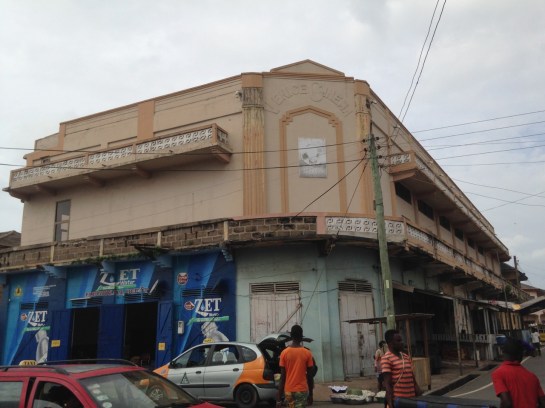
I was hoping to see the Optimist Club in Sekondi, but as suspected, I was too late and the influential African club has been demolished and now replaced with a large youth centre. Fortunately, Nate Plageman did manage to visit the club before it was demolished and you can see his photos here. Despite this loss, it was good to use copies of the early plans of Sekondi from 1900-1920, housed in the UK National Archives, to further explore the town. I was particularly taken by the Venice Cinema located at the edge of the settlement by the lagoon (was this how the cinema got its name?) and the wonderful merchant villas and stores that can still be found in dilapidated abundance throughout the town.
Venice Cinema, Sekondi
Accra continues to seduce with its array of late colonial structures and modernist set pieces. At Korle Bu just west over the lagoon from Jamestown the hospital dominates the landscape. The hospital forms part of the trilogy of projects developed by Gordon Guggisberg in the 1920s (along with Achimota Schooland Takoradi town and docks). The old hospital structures remain, looking almost like they did when built (and similar to the harbour board buildings in Takoradi) – as captured on Africa Through a Lens. The later brutalist addition to the hospital was by Kenneth Scott, looking more restrained and orderly than the edgier and abrupt Effia Nkwanta hospital in Takoradi by Gerlach and Gillies-Reyburn. If you visit Korle Bu hospital continue to walk through the grounds and head out to the staff housing, tennis courts and garden sanctums that lie secretly beyond – it is a hidden, gentile world of privilege that still manages to exist just a couple of miles from the excitement and paucity of Jamestown.
Korle Bu Hospital, Accra photographed shortly after completion, 1928
Call for Papers: COLONIAL AND POSTCOLONIAL LANDSCAPES: Architecture, Cities, Infrastructures
16th – 18th January 2019 | Lisbon | Calouste Gulbenkian Foundation
The infrastructure of the colonial territories obeyed the logic of economic exploitation, territorial domain and commercial dynamics among others that left deep marks in the constructed landscape. The rationales applied to the decisions behind the construction of infrastructures varied according to the historical period, the political model of colonial administration and the international conjuncture.
This congress seeks to bring to the knowledge of the scientific community the dynamics of occupation of colonial territory, especially those involving agents related to architecture and urbanism and its repercussions in the same territories as independent countries.
It is hoped to address issues such as how colonial infrastructure has conditioned the current development models of the new countries or what options taken by colonial administrations have been abandoned or otherwise strengthened after independence.
The congress is part of the ongoing research project entitled “Coast to Coast – Late Portuguese Infrastructural Development in Continental Africa (Angola and Mozambique): Critical and Historical Analysis and Postcolonial Assessment” funded by ‘Fundação para a Ciência e Tecnologia’ (FCT – Foundation for Science and Technology), which has as partner the Calouste Gulbenkian Foundation (FCG).
The aim of this congress is to extend the debate on the repercussions of the decisions taken by the colonial states in the area of territorial infrastructures – in particular through the disciplines of architecture and urbanism – in post-independence development models and the formation of new countries with colonial past
The cartographic and the geopolitical: advocating a new agenda in architectural thinking and research.
Jianfei Zhu; in Architectural Review Quarterly.
Extract
Today, there is an increasing use of terms such as ‘transnational architecture’, ‘architecture beyond Europe’, ‘architecture of China, Japan and Korea’, ‘China in Africa’ and ‘Socialist architecture in Africa’. This signals a change in the basic outlook in thinking and research around architecture towards a problematic concerning geography and geopolitical relations. Michel Foucault, as early as 1967, had already said that ‘history’ was being replaced by ‘geography’, and a historical outlook on an endless timeline was being replaced by a new awareness of a finite world, of a world geography, of things happening ‘here and there’, of space and place, and of a ‘network’ we were all located within (in a speech published later as ‘Of Other Spaces: Principles of Heterotopia’). My contention is that, due to many factors, today more than any other time, a world-historical paradigm in architectural research is being replaced, or at least radically reformed, by a new one that methodologically privileges local and material happenings as horizontally connected to other sites and happenings, in a networked geographic spread: it involves a cartographic perspective that challenges endogenous, national and formalist categories.
Rural networks and planned communities: Doxiadis Associates’ plans for rural settlements in post-independence Zambia
Petros Phokaides; in Journal of Architecture
Abstract
The paper focusses on the planning of rural settlements by the Athens-based firm Doxiadis Associates (DA), a key, even if unrealised, project for Zambia’s nation-building and development efforts in the mid-1960s. In line with post-war discourses of modernisation, DA employed Christaller’s 1933-Central Place Theory and its abstract hexagonal geometrical model to organise different-sized settlements within a single spatial system. By introducing a hierarchical rural network over Zambia, the firm aimed to standardise rural settlement patterns and to formulate a strategy to alleviate rural-urban migration. DA’s top-down, large-scale approach even exceeded the State’s aspirations and the firm’s visions eventually faced two challenges: First, DA’s modernist planning was questioned by the social/ecological considerations as formulated by George Kay’s counterproposal on resettlement policy. Secondly, DA’s ‘urbanising’ visions for rural areas were forestalled by some of the country’s realities, which remained out of the planners’ field of control, and eventually called for more cautious responses to the realities on the ground. By exposing the challenges DA’s rural proposal faced, the paper ultimately contemplates the multiple, and even conflicting reactions towards Zambia’s rural settlement projects, and also adds nuances to the wider histories of rural development in Africa.
On Margins: Feminist Architectural Histories of Migration is the title of the forthcoming fourteenth issue of the peer-reviewed, open access journal ABE, which will be guest-edited by Rachel Lee and Anooradha Iyer Siddiqi
_________
This project works in concert with a growing body of initiatives to write feminist histories of modern architecture through collaborative and intersectional historiographic practices: which redistribute power, co-produce solidarity, and reassess the objects and methods of architectural history. We begin by posing two arguments to architectural historians: first, that the dynamic of a situated and re-situated perspective is foundational to feminist histories of architecture, and second, that feminist historiographical approaches destabilize presumptions of fixity at the heart of the discipline. With the goal of opening the historiography to narratives, perspectives, and practices based on these arguments, we seek histories that employ feminist methods or gather empirical studies of women’s work that emerged from acts and experiences of migration performed individually or collectively—into and out of geographies of control and subjugation, beyond gender or gender framings, across lifeworlds.
In narratives of migrants who were identified with architectural modernism in the most formal sense, and crossed borders in the colonial and postcolonial worlds, we have found repeated instances of a focus on the vernacular, the folkloric, the everyday and the anonymous. A transnational, cosmopolitan mobility oriented figures such as Sybil Moholy-Nagy, Minnette De Silva, Lina Bo Bardi, and Denise Scott-Brown toward proving grounds outside established sociocultural, geographical, and professional territory, in which they generated disciplinary debates on heritage, regionalism, and the banal. In abbreviated form, their migrations turned a lens on culture as architecture. Their practices posited architecture not as exceptional, but as entangled with many other forms of cultural production. We argue that Moholy-Nagy’s grain silo, De Silva’s artisan, Bo Bardi’s Bahia, and Scott-Brown’s Las Vegas each stemmed from the view of a stranger.
In narratives of migrants whose designs, built forms, and constructed environments have not been understood as authored, or of anonymous objects illegible within the frameworks of modern architectural history, we have found instances of empowering links between mobility and architectural forms and practices. The authority embodied by certain migratory works—camps built by refugees, exhibitions curated by exiled artists, urban spaces seized by protestors, radical journals circulated ephemerally—poses a challenge to the discipline’s purported stabilities. We believe this form of challenge is meaningful for architectural history. Writing feminist architectural histories of migration demands seeing the bodies of laborers within the grid of authorship, acknowledging the spatial practices of occupation by activists or prisoners, engaging the obscured work of teachers, researchers, and writers, studying material environments built by migrants, and naming homemakers and others whose designated use of architecture endowed it. Such iterations, which may have lacked signature but not significance, created or unsettled architectural discursivity and enacted forms of power: as predicated upon migration and mobility, or their mirrors, restriction and confinement.
In expounding such histories, we also aim to theorize the spaces within and around which these migrations and mobilities occurred. We posit these spaces as margins. We see margins not in the sense of Derrida’s paradoxical ‘supplement,’ as aiding an original or replacing a lack, but instead as figured zones and often concrete places under continuous negotiation with territories adjacent. A margin may be understood through a variety of spatial and material cognates: periphery, border, fringe, exterior, interior, buffer, surplus, edge… Whether of land or fabric, whether architectural, structural, cultural, (geo)political, environmental or economic, whether obvious or difficult to observe, margins come into view through migration. Thinking with bell hooks, we regard margins as sites of potential and resistance. Their distinct ontologies and emergent epistemologies offer traces of historically meaningful events and architectures, and figure new views of the mundane as well as the exceptional.
In recent literature, we have seen a feminist defamiliarization of architectural histories through readings of a range of theorists. We invite authors to interpret these and intervene with others in thinking on margins and feminist architectural histories of migration. How does Silvia Federici’s work on witchcraft or Simone de Beauvoir’s on cities inform urban history or illuminate issues of spatial restriction? How does nomadism in the writings of Gilles Deleuze or Rosi Braidotti trouble or enable architectural histories of women crossing borders by force or need? How are the subject-solidarities proposed by Judith Butler or Donna Haraway architecturally figured by or within margins? We invite authors to consider these and their own parallel questions through submissions that embed empirically grounded and culturally specific narratives in theoretical considerations of margins. Such a synthesis of migration and margins, we hope, will proffer a set of feminist architectural histories of migration to expand a global architectural historiography, opening it to new theorizations and situated historical perspectives.
Guest editors: Rachel Lee, LMU Munich (Germany), and Anooradha Iyer Siddiqi, Harvard University, Cambridge, MA (United States) Submission deadline: 1st July 2018. Please send your submissions to: abe[at]inha.fr
‘I need 30 minutes to meditate before giving the lecture’ stated Balkrishna Doshi, ‘and a quiet room in which to do so, and, oh, some tea please’.
I’ve always been somewhat taken by this, my first (and only) meeting of Doshi. This was not the request of an architectural tyrant making petty demands, but an essential aligning of thoughts, removal of distraction, and focusing on how he might respond to the audience. It was a process he mirrored in his architectural work – bring forth a determined idea, eliminate any confusion and put the ‘audience’ or the ‘user’ at the centre. Doshi was in Liverpool to give a lecture to coincide with a Le Corbusier exhibition arranged as part of the European Capital of Culture year. The lecture covered parts of his biography such as his time with Le Corbusier in Paris (and surviving on a meagre subsistence) working on the monuments of Chandigarh, as well as his work with Louis Kahn at the Indian Institute of Management in Ahmadabad. Had his career ended there it would have been remarkable but he would go on to make significant advances in both formal and social aspects of architecture.
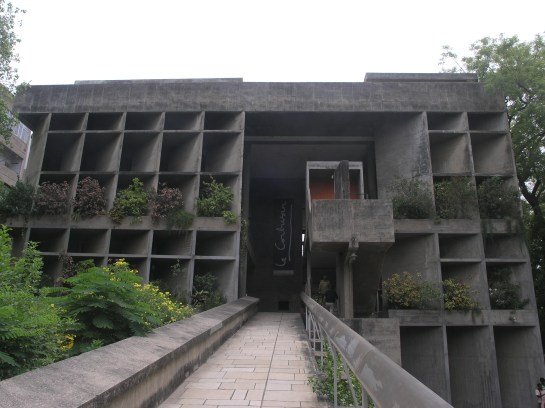
Mill Owners Association Building by Le Corbusier
On 7th March Doshi was awarded the Pritzker Prize, the first Indian to receive the award, and we send our hearty congratulations.
Together with his studio he has designed well over 100 projects in the Gujarati city of Ahmedabad and many more throughout the rest of India. He has chosen to focus on India rather than developing an international portfolio of work, and he has contributed much to low-cost housing provision and town planning.
Sangarth
Ahmadabad, with its wealthy merchant class, has proved an eager patron of architecture and the city is astonishing for its quantity of bold design. They readily embraced Corbusier’s work and he received three commissions in the city. Doshi’s own work emerged out of this context. He wasn’t a mimic or somehow bound by Le Corbusier – on the contrary, he developed his ideas further and pursued the playfulness that is rarely discussed in Corb’s later commissions.
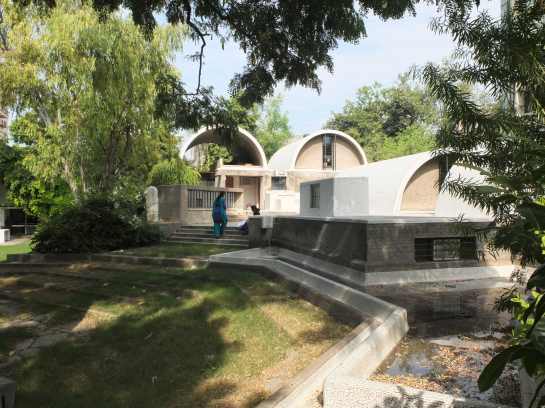
Working out of his self-built studios ‘Sangarth’ for the last 40 years, Doshi created a series of half-round concrete parasols clad with ceramic. These vaulted spaces were quick to construct, eliminate complicated details and components, and offer flexible enclosures that can easily be extended. The vaults offer protection from the intense heat of the Gujarati summer as well as channeling the monsoon rains into a series of pools. The landscaping is equally important with large scale planting, shade trees, and a small amphitheatre carved out of the terrain. The campus is a lesson in how to design with care and beauty whilst minimising materials and maximising spatial impact.
CEPT
Although more sculpted and at a larger scale similar themes were explored at the Centre for Environment, Planning and Technology [CEPT]. Here there is an encouragement of procession and movement through the various structures and landscapes. Gathering spaces open up amongst the strong, yet simple brick masses. The climate here permits few enclosures and the building envelope is perforated and rarely defined. Wandering through the campus exposes the students to the work of others, and one stumbles upon critiques, exhibitions, models being tested, and class discussions. Circulation is no longer a corridor or a staircase. There are elements of Kahn’s IIM, but the CEPT campus is more compact, more urbane and less of a‘set piece’ than IIM – whilst both use the humble brick and deep shadowed reveals to great effect.
Critique at CEPT
There are of course many more projects that we could discuss (see William Curtis or James Steele’s monographs for more on the work), but two that immediately spring to mind are Premabhai Hall (1972) and the Tagore Theatre (1963-65).
Premabhai Theatre
Premabhai was a brave project, situated in the heart of old Ahmadabad’s Badra, a large public square lined with historical works and old city gates. The theatre seems to leap up and cantilever out over the square. It confidently dominates the space, rewarded for its quirky form, and the blank gables acting as a foil to its ornate neighbours.
Tagore Theatre, Vastu Shilpa Foundation 1967
The Tagore Theatre is a rigid frame, folded plate structure, and achieves an impressive 33m span enabling the interior to remain free of columns (as well as containing all of the services). At first sight it appears too much – the scale and lack of surrounding context makes for a foreboding approach. But the delicate folds of the concrete and precision casting seems to soften and give the theatre a more starched-fabric feel upon close contact – plus it’s impossible not to smile at the acoustic clouds that line the interior.
Inside the Tagore Theatre, Vastu Shilpa Foundation, 1967









 Transnational Architecture Group