Archive

Tag Archives: Africa

Conference Report: Colonial and Postcolonial Landscapes: Architecture Cities Infrastructure 16th– 18thJanuary, Calouste Gulbenkian Foundation, Lisbon

Text and Photographs by Ola Uduku, Manchester School of Architecture.

This conference took place at the Gulbenkian institute from Wednesday 16th– Friday 18thJanuary. Its central focus was on having its audience explore research findings and aspects of post-colonial architecture and landscapes specifically from an infrastructure perspective in Africa with a primary focus on the Lusaphone African countries of Mozambique and Angola. Sessions however covered a wide range of topics such as the Chinese involvement in building projects in Africa and how to engage in transnational projects from a postcolonial perspective.

The Gulbenkian Institute, Lisbon

The Gulbenkian Institute, Lisbon

The Gulbenkian Institute was a good setting for the event as Lisbon in winter was best encountered from the urban oasis of the institute in its urban landscape setting. The plenary session on the Wednesday afternoon introduced delegates to the themes of the conference and ended with a lecture given by Helder Pereira, a young Angolan architect who was able to give his perspective on Angolan architectural history and the challenges of architectural practice in contemporary Luanda. He felt particularly exercised with the building industry and landscape in Angola today, but was clear that he was happy to work and contribute his skills to the new Angola in his capacity as a private individual with his own practice.

Helder Pereira at plenary session

Helder Pereira at plenary session

On the first full conference day the opening keynote session was given by Johan Lagae,  (University of Ghent)  who emphasised the need to join up and contextualise the research being done into the PWD archives of Angola, Mozambique and a few other former Portuguese possessions or territories. He focused on the non-completed railway network that would have connected Luanda with Lorenco Marques (now Maputo) and the evolution and execution – successfully or otherwise of other communication projects, and the need to collaboratively examine the histories. A honorary award was also given to the architect Fernao Simoes de Carvalho who had been instrumental to designing a number of buildings and plans in Maputo and across Mozambique.

The parallel sessions which followed covered a number of themes. The author contributed to the session titled “The Transnational Live Project: Critical Reflections on the ethics, politics and pedagogies of collaboration between the global North and the global South”, with Baerbel Muller, (University of Vienna)  the Architects Sans Frontiers representative for Portugal, and one other contributor.

The panel was chaired by John Bennett and Peter Russell, and we concluded that it was possible but difficult to challenge the stereotypical student and institutional engagement and view of the Live project, and that this was an area which needed further exploration but that a radical change to the site project was required. The titles of other parallel sessions in the 1400 – 1600 time slot on day 1 included; Colonial Spatiality in African Sahara Regions, chaired by Samia Henni, and DeConstructing the Right to the City: focusing on Portuguese speaking countries.

In the second parallel session, themes included, Interrupted Utopia: Landscapes of Modern Collective Housing in former European (Socialist) Countries, Spaces in America Current efforts towards a non-Eurocentric theory, projecting Power and further sessions on Planned Violence and Deconstructing the Right to the City. The collective Housing session involved papers describing housing in Yugoslavia and how some of the precast design systems were adapted and designed for socialist countries including Angola due to the cold war connection with the post-colonial political party UNITA, the ensuing independence war meant that only two of these projects were built although countries such as Cuba had more connections to these systems.

We then were taken that to view the colonial archives and an exhibition of the infrastructure in the Belem district of the city, titled “Colonizing Africa”, were we had a drinks reception. Amongst the exhibited PWD photographs of bridges and public housing projects were also busts of Portugal’s unreconstructed neo colonial past.

Paul Jenkins Presentation

The second full day of the conference began with a plenary session, where Paul Jenkins, (Wits University) gave an illuminating lecture on hard and soft infrastructure development focusing in Mozambique. He was able to trace the development of hard infrastructure projects from power supply to railway lines and then focused on road networks. He posited that the hard physical infrastructure need a soft (maintenance, services and planning) infrastructure approach to be successful. By taking a contemporary viewpoint he was able to demonstrate that new development partners, in this case the Chinese, and post revolutionary governments are yet to address the problem of having soft infrastructure packages in pace, to the detriment of current infrastructure being built in postcolonial cities like Maputo, with the Matende bridge and new ring road being case studies to support this theory. Paul pointed out that these projects as in the colonial times benefit investors and middle classes and rarely the masses who often have to ‘pay’ for development.

Tribute Lecture and award made to architect Jose Forjaz

Tribute Lecture and award made to architect Jose Forjaz

The session ended with further summaries of research projects being carried out using the newly catalogued archive sources, and then an honorary citation and award was given to the architect Jose Forjaz for the work he had done for Mozambique from the early revolutionary period to the present day.

The final parallel sessions in the afternoon focused again on a range of themes, including Single and collective housing in a modern laboratory in colonial territories, Infrastructural development in European Portuguese territories in the late colonial period, peripheral infrastructure in late colonial cities, and materiality and mobility in colonial landscapes. I attended the China in African, Latin American and Caribbean territories: examining spatial transformations around diplomacy and economic aid panel. Two papers gave illuminating accounts of the history of Chinese building aid in Africa from the 1960s to the present day. They both concluded that this involvement has now been historic, and despite having its tensions they are set to continue as China’s political relations and economic influence on the continent continues.

The last parallel session had a second panel on materiality and mobility, urban legacies, globalised regionalism, population spatialisation and control, and the panel I attended titled Beyond Colonialism: Afro-Modernist Agents and Tectonics as an expression Cultural Independence. The panel was set up to have younger conference delegates discuss their encounters with post-modern architectural images and landscapes in Europe (Belgium) and in Africa (Mozambique) and how todays tensions of identity and race are encountered by the public. The panel paper givers consensus was that this was still a problem in many European cities, whilst in Africa, the post-colonial city has not changed or adequately dealt with post colonial monuments of the past. Unfortunately there was no time to have the proposed debate about this.

The final panel session was in Portuguese and was unfortunately not translated so only a few of the conference delegates were able to participate in the session. We were told by those who were Portuguese-speaking, that some divisive views were aired relating to whether colonialization in Lusaphone Africa was a success. We did have a successful dinner to conclude the conference.

The conference was very focused, as was to be expected on issues related to Lusaphone Africa, but it did attract a wide range of delegates from as far afield as Brazil, China and Serbia. Its pre-occupation with discussing the material now available from its African colonial archives was welcome although most delegates, as international contributors to panel discussions encouraged the organisers to engage more with universities and researchers in Lusaphone Africa to “make sense” of the archival material now available and also to set up collaborative research projects in the same vein.

The exhibition Lisbon-Baghdad, co-curated by Ricardo Agarez, a conference delegate was also on show at the Gulbenkian Art Gallery during the conference. This showed the Gulbenkian links with modernist architecture and planning in Iraq from the late 1950s to 1960s.


I’ve been spending some time working in and around Accra, and in particular at the Public Records and Archives Department. This archive has undergone major changes in the last five years and is a great place to undertake research with helpful staff and quick responses to queries. Located in a distinctive building with bold concrete brise soleil and a brave concertinaed roof over the entrance space, its interiors rely exclusively on passive ventilation. I was looking mainly at the late colonial records including those of the Public Works Department, sanitation, land, and town planning.

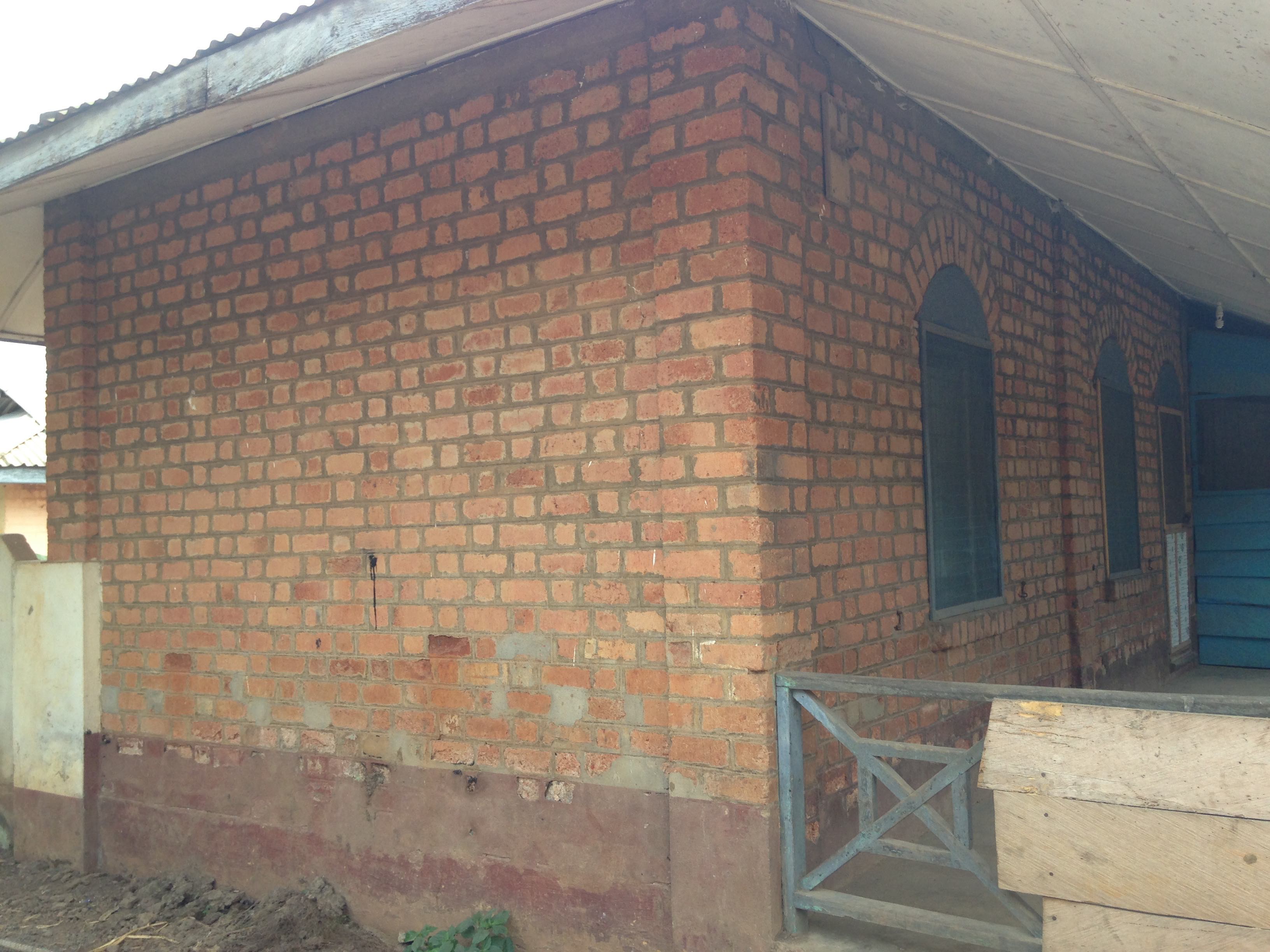
Experimental Swishcrete blocks at Kibi
Experimental Swishcrete blocks at Kibi from 1945
IMG_1003.jpg
Experimental Swishcrete housing at Kibi from 1945. Note the arches above the windows and doors

There were many discoveries and lots to celebrate (and eventually publish), but one particularly interesting find related to a folder called ‘Experimental housing at Kibi’. This gave lots of details on an attempt to build a couple of dwellings in swishcrete (i.e. laterite and concrete mix) blocks in the gold mining town of Kibi, with a view to saving on cement costs and also creating an aesthetic that was more in keeping with the vernacular. It was a particularly exciting find, as we had stumbled across these houses earlier this year, and were taken by their unique construction. The archives revealed that Jane Drew was involved in their design and that she visited the site in early April 1945. It must have formed part of her work on village housing. Although modified and extended the houses still stand and clearly demonstrate the strength of this construction method having survived over 70 years.

Outside of the archives, I managed to finally track down Denys Lasdun’s Paterson Simon’s Office in Accra, 1962 (thanks to the help of their current Managing Director John Traynor). It was formerly a supermarket and toyshop called Farisco.

I was hoping to see the Optimist Club in Sekondi, but as suspected, I was too late and the influential African club has been demolished and now replaced with a large youth centre. Fortunately, Nate Plageman did manage to visit the club before it was demolished and you can see his photos here. Despite this loss, it was good to use copies of the early plans of Sekondi from 1900-1920, housed in the UK National Archives, to further explore the town. I was particularly taken by the Venice Cinema located at the edge of the settlement by the lagoon (was this how the cinema got its name?) and the wonderful merchant villas and stores that can still be found in dilapidated abundance throughout the town.

Venice Cinema, Sekondi

Accra continues to seduce with its array of late colonial structures and modernist set pieces. At Korle Bu just west over the lagoon from Jamestown the hospital dominates the landscape. The hospital forms part of the trilogy of projects developed by Gordon Guggisberg in the 1920s (along with Achimota Schooland Takoradi town and docks). The old hospital structures remain, looking almost like they did when built (and similar to the harbour board buildings in Takoradi) – as captured on Africa Through a Lens. The later brutalist addition to the hospital was by Kenneth Scott, looking more restrained and orderly than the edgier and abrupt Effia Nkwanta hospital in Takoradi by Gerlach and Gillies-Reyburn. If you visit Korle Bu hospital continue to walk through the grounds and head out to the staff housing, tennis courts and garden sanctums that lie secretly beyond – it is a hidden, gentile world of privilege that still manages to exist just a couple of miles from the excitement and paucity of Jamestown.


Korle Bu Hospital, Accra
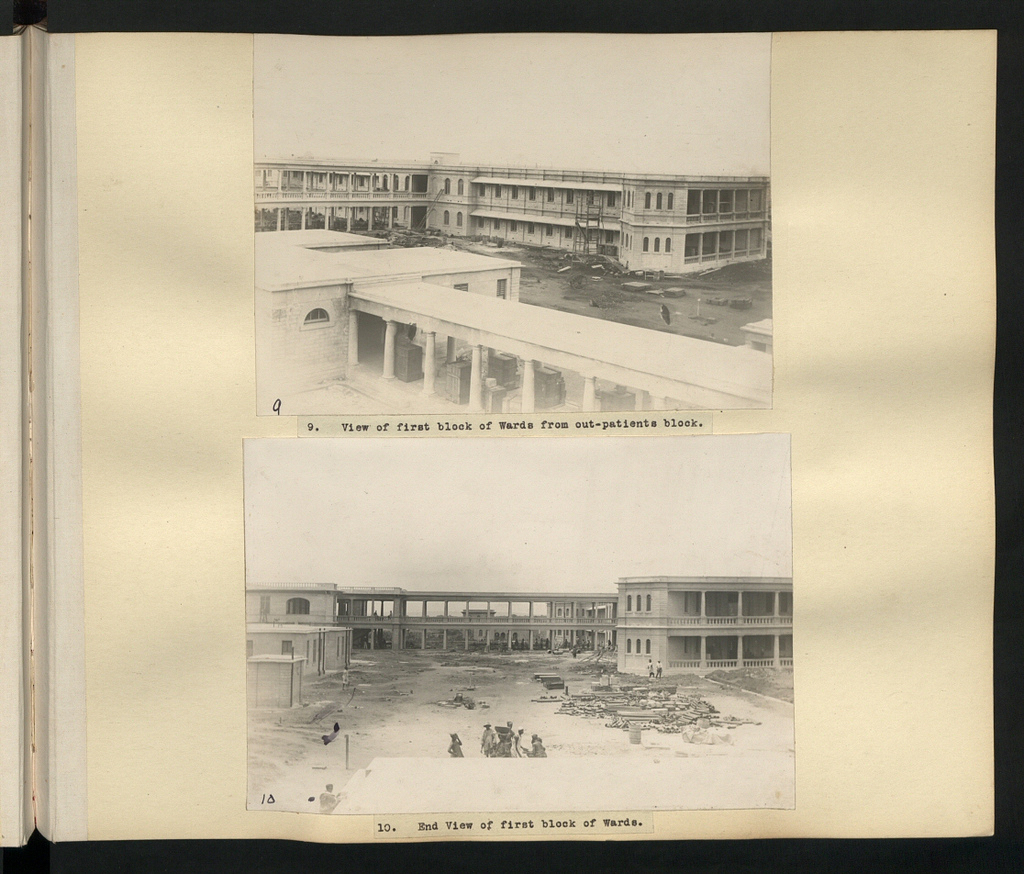
Korle Bu Hospital, Accra photographed shortly after completion, 1928


Two New Buildings in Accra

How are we to build today in Ghana? What is our architectural syntax and how are we to generate form, meaning and qualities that somehow resonate with Ghanaians today? This is of course a difficult question, and not all architecture has to be reflective of the country in which it is built. Indeed, it is very problematic to think of architecture in terms of geo-political territories, especially when the architecture of the West is rarely presented like this. It is unusual to hear of architecture referred to as European, or Luxembourgian for example, but the architectures (and architects) of the global south are frequently labelled according to country or region of origin (Indian, South East Asian, West African for example – see http://blog.nus.edu.sg/seaarc/symposium/), furthermore when ‘modern’ architecture is produced in those countries it is labelled as mimicry, inauthentic, or somehow borrowed, imported, or not belonging.

This is the difficulty architects face when working in places like Ghana. However, architects must take a stance and adopt a position. They should be self-conscious of the designs that they are making, and conceive of a direction, or ambition for their work. There were two recent buildings that we visited in Accra that are attempting to deliver a new response to architecture.
One Airport Square

One Airport Square

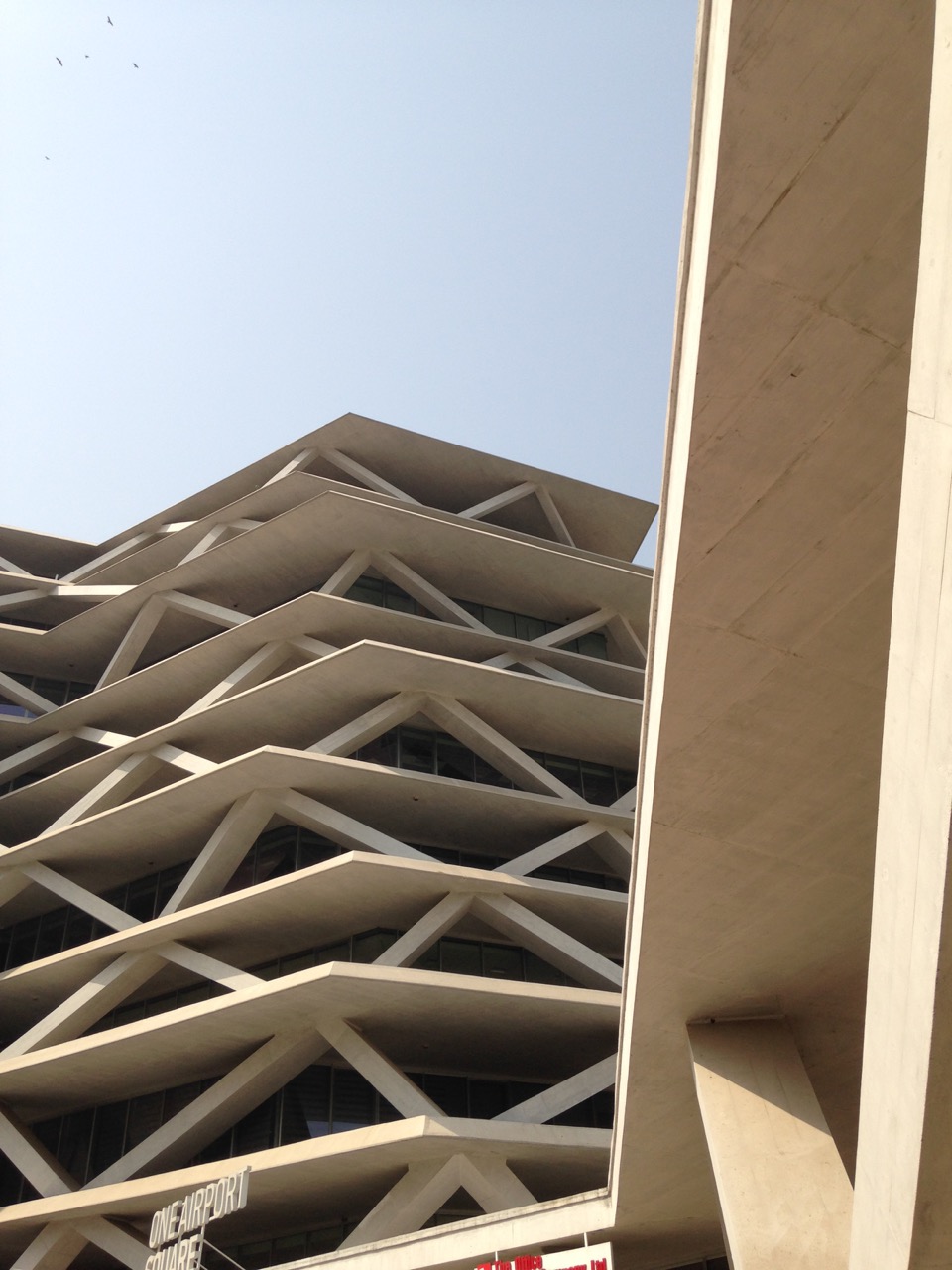
One Airport Square  (designed by Mario Cucinella Architects) has gone for the attention-seeking approach. A complex façade composition made up of diagonally arranged structure with horizontal fins. The fins and ‘columns’ project from the building’s envelope by almost 2m, acting as a vast brise soleil they provide much needed shade, as well as absorbing heat externally whilst reflecting sunlight light into the building.

IMG_0838

Atrium of Airport Square One

Internally there is a large atrium space that holds the circulation as well as bringing light into the deep plan and pulling fresh air through the courtyard. This kind of building works well when set amongst other less adventurous forms. It is also helping to create a new context for that part of Accra, and is distinctive enough to become a reference point and landmark. I just hope it doesn’t become part of a silly form-making game with each bank trying to out-do each other in the quest for the next distinctive shape.

IMG_0840

Ecobank, Accra

Another new building that has just reached completion is the vast Ecobank Headquarters located adjacent to the Efua Sutherland Children’s Park. This provocative building was designed by a consortium of Ghanaian and South African architects (http://arc.co.za/project/ecobank-ghana/), the local and site architects being Mobius, lead by KNUST graduate Augustus Richardson. A lightweight metal brise soleil is used to protect the glass façade where the sun strikes, and a perforated metal jali screen offers solar protection at the lower levels, as well as being used to depict a map of the world, and a larger drawing of Africa.

DSC_0549

Augustus Richardson with the model of Ecobank

At ground level the building is clad with limestone firmly rooting it into the earth and forming tactile surfaces. The two forms reflect the public banking space, and the private offices of the bank HQ. The bank is orientated on an axis leading towards the concrete obelisk in Africa Liberation Square, and there is a real declaration of optimism in this building. Mobius are an exciting firm to follow, and Richardson kindly took us on a tour of the bank, giving behind the scenes access. The quality of the finish is exceptional and build quality excellent. Richardson clearly cares about architecture and his city; there is a charged excitement in the way he talks about design (see http://www.design233.com/oldhtml/works/augustus_richardson_the_bridge_mobius.html for more on this).

But what of the building envelope? Is it an appropriate response to design an almost entirely glazed building in Accra?

In 1957 Anthony Chitty gave the opening address to the new school of architecture at KNUST and posed this question,

‘Is a regional architecture, a truly African style, possible for West Africa; for Ghana in Particular? I believe the answer to this question is “yes” : not only possible but desirable, something to be striven for.’

In many ways the Ecobank is the perfect response to the clients wishes – they wanted a modern, international office space to reflect their brand, and clearly Ghanaian architects and engineers can deliver this type of work as well as anyone, but, if we are to be critical, are we guilty of what Chitty spoke about 60 years ago when he demanded,

‘Not just a pallid and mediocre edition of the international style, not just the half considered European solution trotted out to make do here, but a real and living architectural answer to your own local problems, social, technical and political, drawing the maximum from such origins as do exist here, a true Ghana aesthetic.’

I don’t think the Ecobank is at all mediocre, or half-considered, and Chitty was over-playing the Ghana aesthetic idea in light of the nationalist tendencies from the time-  but there must be an approach that can make the architecture of this region specific to this place. Other large projects are rapidly springing up (and unlike the Ecobank) they parade the hackneyed multi-coloured cladding approach that is tormenting every city, whereas Ecobank is clearly searching for something more.

The difficulty is how to scale-up ‘tropical’ design. Tropical architecture stems from the bungalow, barracks, and hospitals – it works well for small-scale low-rise buildings, as the Children’s Library, George Padmore, KNUST Senior Staff Club House demonstrate – it wants to be a ground hugging solution set within leafy gardens and evaporation pools.

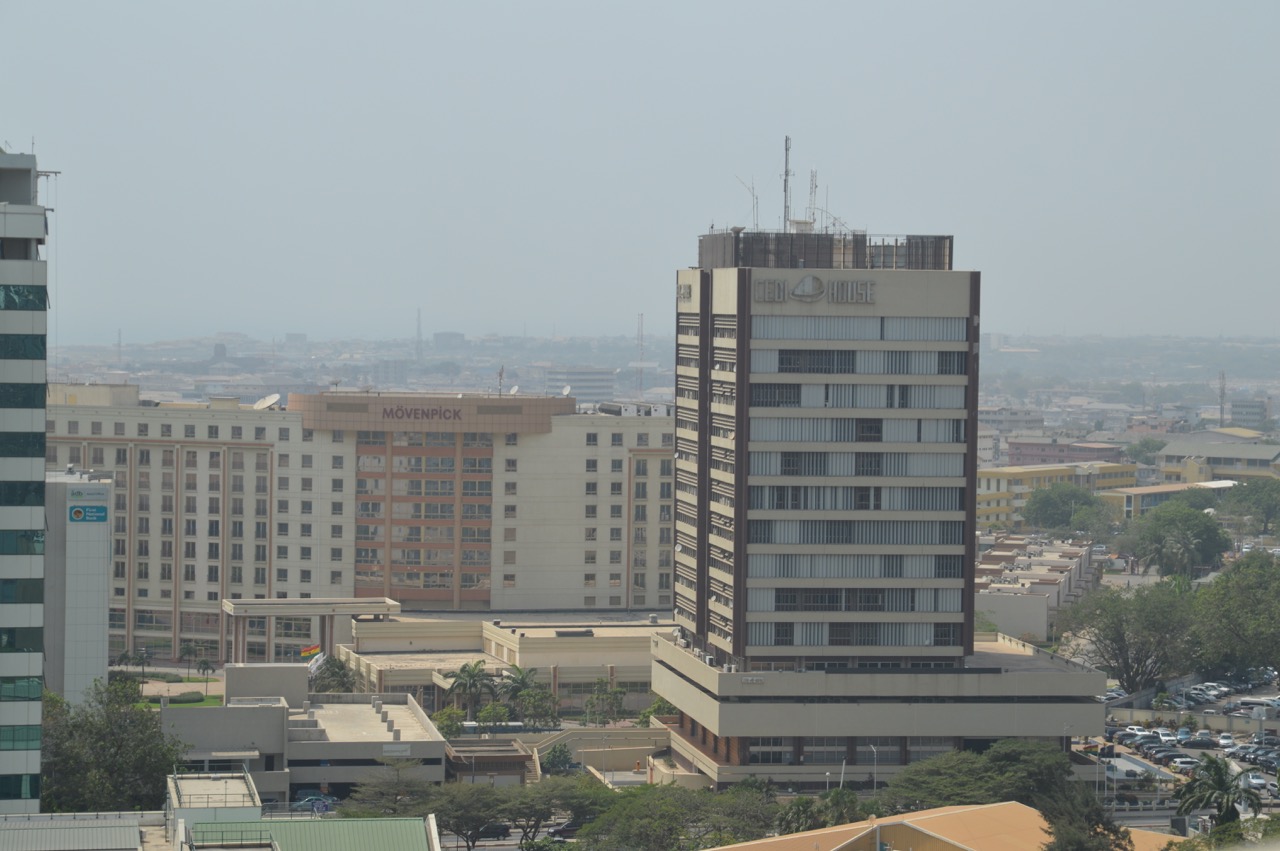
A bank today however cannot rely on loggias and verandahs, and rising land values and the ability of buildings to generate substantial rental incomes stimulates the high-rise approach.  This was something that Fry and Drew encountered in West Africa. They worked for the Co-op Bank in Nigeria and placed louvres on the facades of multistory buildings, a technique also used by John Addo at Cedi House in Accra. The library at Ibadan presents another alternative – with its delicate screen and effectively double-façade-cum-circulation zone. Fry found the façade too ‘lace-like’ and pursued something more strapping and formal in later works, such as the library at Girls College in Chandigarh’s Sector-11.
DSC_0553

Cedi House viewed from Ecobank roof garden

Fry also set himself the challenge of using a glazed façade in a hot climate, again in Chandigarh. At the Government Printing Press he used glass on the north facing façade only, and included adjustable louvres on the interior to reduce glare. The south facing façade was protected by the walkways and an external aluminium louvre system based on the traditional jalousie reduces solar gain.

There is perhaps just the germ of historical precedent in the two recent Accra buildings – and both reveal a confidence in the city, as well as an ambition to test this type of architecture. The next step will be to put some data-loggers into these buildings and to see how they perform. Their critics might be pleasantly surprised.


New Research: Prof. Robert Home, ‘From cantonments to townships: Lugard’s influence upon British colonial urban governance in Africa’ in Planning Perspectives, Pages 1-22 | Published online: 20 Aug 2017

http://www.tandfonline.com/doi/full/10.1080/02665433.2017.1359103

Abstract: The cantonment has been a neglected topic of planning history, yet is significant for urban landscapes and governance in both India and Africa. Drawing upon scholarship in critical comparative legal geography, path dependency and Foucault’s genealogical method, the article explores the transfer of laws and regulations for urban governance by networks of knowledge and actors, tracing a line of descent from rules for cantonments in British India, through Lugard’s Nigerian period, and his indirect rule policy to townships and local government ordinances. The influence of Lugard’s Political Memoranda and Dual Mandate books is evidenced through the work of various senior officials moving between colonies, specifically South Africa, Kenya, and Northern Rhodesia.

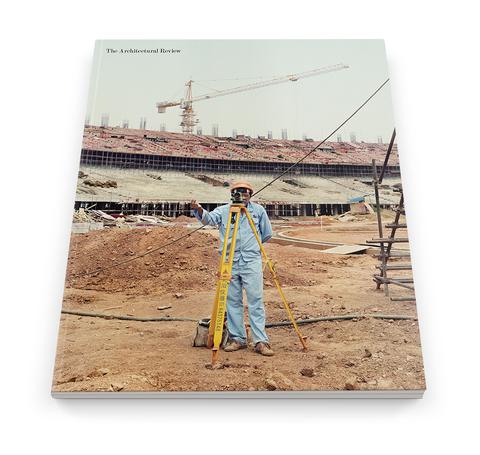
Architectural Review: May 2017 on Africa

AfricaShopify_large

‘Africa’ has become a lazy substitute for any number of ideas from the political to the social, cultural, historical and economic. In this issue, we reject the stereotypes and, from refugee camps to Art Deco housing; starchitects to wooden skyscrapers, counter the notion of Africa as a place to be influenced.

Lesley Lokko challenges the development-aid-charity paradigm that confines Africa, treating it as separate from the forces shaping architectural culture globally, while Tomá Berlanda looks at the challenge of reversing the social engineering engrained in the architecture and urban design of Apartheid towns.

In a new Notopia Edition, Manuel Herz challenges established ideas of permanent and temporary in his study of the refugee camps in the Western Sahara, presenting them as newly found cities with the ability to question the notion of the nation state and the citizen.

We look at projects from Djibouti to Joburg, including designworkshop:sa’s renovation of an Art Deco apartment block, an extension to a piecemeal 1950’s hospital in Vredenburg by Wolff Architects and Urko Sanchez’s SOS Children’s Village.

Typology asks whether the skyscraper is a logical extrusion of land values or an anti-urban monster, while Outrage bemoans the lack of coordinated policy required for housing reform in many burgeoning African cities, the diversity of which is explored by David Adjaye in a presentation of his personal research.

Finally, in the wake of Francis Kéré’s winning design for the 2017 Serpentine pavilion, Andres Lepik looks back on the German-trained African architect’s works and the dialogue they have generated between the global North and South.

See more at: https://www.architectural-review.com/magazine-shop/latest-issue-may-2017-on-africa/10019285.article and David Adjaye’s article at: https://www.architectural-review.com/rethink/david-adjaye-urban-africa/10019650.article?blocktitle=Adjaye-Urban-Africa&contentID=18684

DADAAB IS A PLACE ON EARTH

Architecture in the Twilight of the World’s Largest Refugee Camp

April 18, 2017, 6:00-8:00 P.M., 20 Cooper Square, 2nd Floor, New York University

http://gallatin.nyu.edu/utilities/events/2017/04/DadaabIsAPlaceOnEarth.html

African Cities Week

This moderated discussion concerns architecture and emergency urbanism in history, focusing on the constructed environment of the UNHCR-administered refugee camp complex at Dadaab, Kenya, near the border with Somalia. Paradoxical for its scale and ephemerality together, the Dadaab complex at once approaches and resists being “urban,” on the one hand, and a “camp,” on the other. Established in 1991 to shelter thirty thousand refugees, the Dadaab complex expanded over the course of a quarter century to five settlements with a compound headquartering a centralized structure of humanitarian agencies. According to unofficial counts, it currently houses one half million refugees and asylum seekers, along with humanitarian aid workers in residence. In early 2016, citing security threats, the government of Kenya announced that it would close the complex prior to the next general election, and dismantled the Department of Refugee Affairs as a decisive measure. Through a detailed discussion on design, use, aesthetics, and affect at the Dadaab site, we hope to study the social and political lived realities of an environment constructed to be liminal.

Dadaab-1

Introduction by Anooradha Iyer Siddiqi

Discussion with Samar Al-Bulushi, Alishine Osman, Ben Rawlence, Anooradha Iyer Siddiqi

Moderated by Rosalind Fredericks

Remarks by AbdouMaliq Simone

Organized by Anooradha Iyer Siddiqi, with Rachel Stern. For more information and teaching materials related to this event, please see: http://gallatin.nyu.edu/utilities/events/2017/04/DadaabIsAPlaceOnEarth.html

CALL for PAPERS

II International Conference on ‘African Urban Planning’

Date:

7 – 8 September 2017

Location:

University of Lisbon, Portugal

african-urban-planning

Organization:

Institute of Geography and Spatial Planning, University of Lisbon & International Planning History Society (IPHS)

Conference Website:

https://sites.google.com/site/cpcup2017conference/

Conference e-mail:

urbanplanningafrica2017@gmail.com

Important dates:

– Submission deadline for abstracts: 31 January 2017

– Notification of abstract acceptance: 15 March 2017

– Registration and payment: 1 – 15 April 2017

Flyer: aup-2017-lisbon_conference-flyer

Call for Papers: Revisiting African Modernism at docomomo 14th International Conference 

6-9 Sep 2016,  Calouste Gulbenkian Foundation,  Lisboa,  Portugal

docomomo International is now accepting abstracts for the 14th International docomomo Conference that will take place in Calouste Gulbenkian Foundation, Lisbon, Portugal, September 6–9, 2016. Please submit abstracts no later than October 18, 2015 (12 pm GMT), for one of the 29 thematic sessions listed here.

One session that will be of specific interest to TAG followers is the ‘Revisiting African Modernism’ session…

“Africa’s history of architectural modernism and modernist landscapes is no longer unknown or obscure.  This session seeks to build on that established foundation by asking contributors to explore the potential contribution of the buildings and infrastructure of this era (c. 1945 – 1970s) to our understanding and engagement with Africa today. Does their original programme make them adaptable for 21st century contemporary urbanism? Are there specific case studies or examples of buildings and landscapes that demonstrate positively (or negatively) adaptive re-use possibilities or experience?

Past docomomo sessions on Africa have (arguably rightly) been occupied with debating Africa’s involvement in docomomo, as both a subject and a participatory region. This session recognizes the increasing inclusion of African nations; South Africa, Egypt, Ghana (proposed) into the docomomo “family”. It also acknowledges contributions from African and Africa-focused researchers in a number of past docomomo publications.

This panel session seeks to expand these contributions into a contemporary discourse, devoted to the investigation of the methods, and means, by which Africa’s modernist past can contribute more than just historical research to the Africans and Africa-focused researchers of the 21st century. We are particularly interested in contributions that consider built “ensembles” within urbanist contexts in African communities or cities, such as university campuses, housing masterplans, and industrial complexes/towns. “

Session Chairs: Ola Uduku, University of Edinburgh, Scotland; Miles Glendinning, University of Edinburgh, Scotland.

Bubonic plague, colonial ideologies, and urban planning policies: Dakar, Lagos, and Kumasi, by Liora Bigon, in Planning PerspectivesDOI:10.1080/02665433.2015.1064779

The Third Plague Pandemic originated in Southwest China in the mid-nineteenth century, reached Africa’s shores around 1900, and spread globally for about a century. This article examines three plague loci in colonial Senegal (Dakar, 1914), Nigeria (Lagos, 1924), and the Gold Coast (today’s Ghana; Kumasi, 1924). A tripartite comparative analysis is made of French and British doctrines of colonial rule, colonial urban planning policies, and anti-plague practices. While some common features are demonstrated in the policies and practices of the colonizing forces such as the implementation of rigorous measures and embracing segregationist solutions, divergent features can also be distinguished. These relate to the methods of implementation of planning and anti-plague policies, in accordance with colonial ideology (assimilation, direct and indirect rule); and to the very nature of autochthonous communities, responses, and levels of agitation. Our both comparative and more nuanced site-related view is also based on a large collection of archival and secondary materials from multilateral channels.

The full article may be viewed here: http://www.tandfonline.com/doi/abs/10.1080/02665433.2015.1064779