Archive

Tag Archives: Africa

‘The Influence of Fry and Drew’ Conference, Abstract 14

’Yemi Salami, ‘Fry and Drew’s Influence on Colonial Public Works Architecture in Nigeria’

This study examines the influence of Maxwell Fry and Jane Drew on the architecture of Nigeria’s Colonial Public Works Department (PWD).  Mostly referred to as Fry and Drew, literature provides accounts of their coming to work in West Africa as architects and professional advisors during the mid-twentieth century. They are also deemed to have pioneered alongside other private architects of the time, the climate responsive design that has come to be known as ‘tropical architecture’.

The literature equally provides a glimpse into operations by the Public works Department (PWD). The department had largely produced the country’s earlier colonial buildings, as well as a good number of its mid-twentieth century buildings. The period therefore experienced a blend of designs by the new private architects and by the PWD. But did the designs of the new entrant private architects generate an impact on colonial building? How did the PWD build before this time? Did it have a design tradition by which it operated? Was this tradition affected by the new influences, particularly from Fry and Drew?

To answer these questions, the study will examine two Fry and Drew buildings and their application of tropical design principles. It will then explore two building types done by the PWD – a courthouse and a post office. For each building type, the study will examine its design in the earlier colonial years, as well as during the tropical architecture trend.  Changes arising in the new design will then be identified and discussed, particularly those most likely based on fry and drew influences. The purpose therefore, is not only to establish if Fry and Drew influenced PWD designs, but to also know what features they had influenced.

..  

Yemi Salami is a PhD student at the Liverpool School of Architecture, University of Liverpool. Her research investigates British colonial architecture in Nigeria between 1900 and 1960. Specifically, the research aims to understand the colonial administration’s Public Works Department (PWD), and the architecture which it produced within the period of study. Yemi held a faculty position at Olabisi Onabanjo University Ago-Iwoye, Nigeria, before enrolling for her PhD in November 2011.

‘The Influence of Fry and Drew’ Conference, Abstract 13

Jorge Figueira and Bruno Gil, ‘Dry and Humid and Everywhere: The work of Amâncio (Pancho) Guedes in Mozambique’

In the seminal Tropical Architecture in the dry and humid zones, published in 1964 by Maxwell Fry and Jane Drew, the work of Amâncio Guedes (“Pancho” Guedes, Lisbon, 1925), in Mozambique, appears recurrently as an example of the themes aimed by the authors. The relationship between Pancho’s work and the concerns of Fry and Drew is umbilical, even if the Portuguese architect is more corrosive and incendiary than pedagogical.

Our presentation aims to contextualize and problematize the works of Pancho Guedes referenced by Fry and Drew, as part of his vast production between the early 1950’s and 1975, an itinerary that ends with the decolonization process of the “Portuguese Africa” ​​in 1974. Pancho’s work refers to the condition of Portugal as a colonial power blasted by a great artistic, experimental, “climatological” voracity, which Fry and Drew capture in Tropical Architecture…, demonstrating a particular geo-culture within the colonial process in Africa. Accordingly, we sustain that the general invocation of the post-colonialism – “can the subaltern speak?” – finds in Pancho Guedes a particular resonance. Pancho is a colonizer colonized by modern architecture, from which he is always in a desire/rejection process. All his work is envisioned, in the manner of Team 10 and beyond Team 10, and certainly under the influence of the theses by Fry and Drew, to mourn the more dogmatic aspects of modern architecture, showing affection towards the locality, using techniques and styles that aim to adapt or lacerate the modern canon towards the local. The archaic, primitive and vernacular recurrently appear in his work, more in the manner of an “automatic writing” than an analytical mode. The high point of this trip is the publication that he imagines of 1001 portas do caniço (doors from the slums of Lourenço Marques/Maputo), photographed relentlessly in very beautiful slides.

..

Jorge Figueira graduated in Architecture at the University of Porto, 1992. PhD Degree at the University of Coimbra, 2009, with a thesis entitled The Perfect Periphery. Post-modernity in Portuguese Architecture, 1960-1980. Director and Assistant Professor at the University of Coimbra’s Department of Architecture. Researcher at the Social Studies Centre (University of Coimbra). Professor at the PhD Programme in the Faculty of Architecture of University of Porto. Coordinator at the University of Coimbra of the Red PHI Patrimonio Historico-Cultural Iberoamericano. Curator of international exhibitions such as “Álvaro Siza. Modern Redux”, Instituto Tomie Ohtake, Sao Paulo, Brazil, 2008. Editor of Álvaro Siza. Modern Redux, Hatje Cantz (Berlin). Author of several books on contemporary architecture, including O Arquitecto Azul, Coimbra University Press, 2010. Has published texts in Arquitectura Viva, Casabella and A+U and has a column on architectural criticism in Público newspaper.

Bruno Gil graduated in Architecture at the University of Coimbra, Portugal, 2005. Following the graduation thesis entitled “Architecture School, Today” he continues research in that subject. Currently, he is developing his PhD at the Centre for Social Studies and at the Department of Architecture of the University of Coimbra, with a grant from the Foundation for Science and Technology, Portugal. His thesis focuses on issues related to the practice of architectural research, identifying disciplinary specificities, research cultures, topics and methods. He is a contributor at the University of Coimbra to the Red PHI Patrimonio Historico-Cultural Iberoamericano. He has participated in diverse international conferences and workshops, published texts in architecture magazines and was co-founder of the NU magazine and its director between 2003 and 2004.

Workshop and Roundtable discussion: 28th November 2013 Liverpool School of Architecture.

This workshop is concerned with the architecture, design and planning proposals developed by architects/planners from Poland during the mid-late twentieth century. In particular it seeks to address how people and ideas have migrated beyond national borders and with what effect. Without the networks of empire and trade that aided so many British and Western European architects to practice around the world in the twentieth century, how and why did so many Polish architects obtain commissions beyond the immediate reach of Eastern Europe?

One answer to the above question was the placing of a Polish School of architecture within the Liverpool school during World War Two. In 1942 the British Council approached the university with the proposal that was part of a broader plan that saw other academic disciplines placed in other UK universities, such as a veterinary school at Edinburgh.

The Polish School of architecture was inaugurated by the Prime Minister of Poland and Commander-in-Chief, General Wladyslaw Sikorski in November 1942 – although the school had actually been in operation from June 1941. Staff and students worked on theoretical schemes such as for the rebuilding of a specified Polish village, along with designs for hospitals, blocks of flats, factories, town halls and the like. Professor Budden commenting on the Polish School’s tenure in Liverpool noted that although ‘the work…is in the mainstream of contemporary architectural thought and practice, it is yet distinctively expressive and national in character. The forms employed are in the main familiar, but they are given an unmistakably Polish inflection – and the result is the more interesting and vigorous for that…’

What was this inflection that Budden observed and can we begin to discern a specific Polish approach to twentieth century architecture and planning?

The Polish School is but one of the many networks, vectors and agencies that facilitated the export of Polish architecture and architects. What other modes of migration were pursued? What happened after the Polish School and where did its graduates go on to practice?

These are the most basic questions that we hope to discuss and address, but suggestions, other case studies and individual biographies are very welcome.

Papers and work-in-progress are most welcome. 20 minute papers followed by 20 minutes discussion. For further information or to submit abstracts of 200 words please email Iain Jackson ijackson@liv.ac.uk  or Peter Richmond richdrp@hotmail.co.uk.  Deadline for abstracts is 14th October 2013.

Village Housing in the Tropics: With Special Reference to West Africa

The seminal book on Tropical Architecture by Jane Drew and Maxwell Fry has been republished by Routledge 66 years after its first edition was bravely produced by Lund Humpries.

villagehousing

The slender volume loaded with Fry’s cartoons and sketches became an instant hit, with its engaging insights and empirical findings.  It was not aimed at the specialist or technician, rather the generalist and interested reader looking for quick tips to solve familiar problems. The book gives pragmatic advice on the siting of villages, housing orientation and matters relating to sanitation and health. Although the content was far from novel or radical, it presented previously dry and mundane material in a manner that was easy to understand, and encouraged greater attention to be given to the everyday housing problems of West Africa.

The book was used by Fry and Drew as a promotional tool,  they included a copy along with their CV’s when applying to be considered for the University of Ibadan project and it almost certainly influenced their consideration for Chandigarh. It set them apart from others working in tropical regions,  and with its emphasis on village housing firmly aligned them with the Colonial Office’s desire to promote ‘Development and Welfare’.

It almost goes without saying, but the publication was a product of its time and formed part of the colonial enterprise. Within the front and back endpapers of the book a map of the world is coloured to highlight Britain’s Colonial territories, highlighting where the book’s advice could be dispensed and treating all ‘tropical’ territories as one and the same irrespective of their specific contexts and climatic variations.

Available to purchase here: Village Housing in the Tropics: With Special Reference to West Africa (Studies in International Planning History)

‘changing my situation’

Here’s another excerpt from an interview with Jean-Philippe Vassal, carried out in 2006 as part of a research project funded by the Franco-British Union of Architects. Vassal talks more about the references to ‘far-away’ places within their architecture and the influence of Africa…
13.5.14 LV Bordeaux

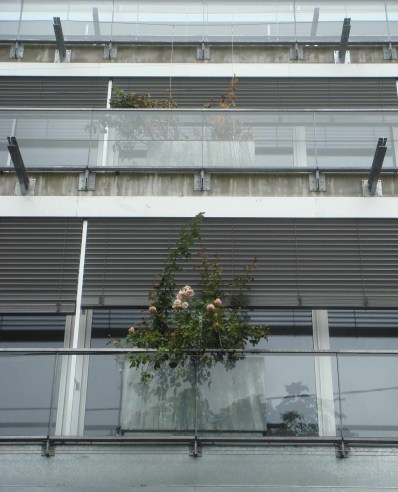
Management Sciences University Building, Bordeaux. Lacaton & Vassal, completed 2006.             Roses climb up and across a grid of wires to create a facade of flowers.

JH            Because the Union encourages relations between the French and British in terms of architecture it is perhaps pertinent to ask whether you consider your work to be typically French in any way?

JPV         Perhaps there is a part, yes, but I don’t know… What I do know is that I have travelled quite a lot, I have lived in Africa and I am very curious of different things. I like changing my situation, to see new things and sometimes I am frightened by the fact that architecture could fix you somewhere. Each time I have the possibility of creating a new project somewhere else or the possibility in my work to take something from a different place – like flowers, like Turkish tiles [at the Architekturzentrum cafe in Vienna] – to make this connection with another country, to escape. Very often, with flowers.

JH           Like your University building in Grenoble, for example?

JPV         Yes, where we use tropical flowers. We have also just finished a big building in Bordeaux with roses as a background. We have 700 climbing rose trees with beautiful flowers and yes, to find something that creates distance from the architecture, from materiality.

JH           Do you think this comes from [your] living in Morocco? I’ve read that Casablanca is a city where French [culture] and the West meets with Islamic culture…

JPV         Yes, this confrontation occurs. In Casablanca you have a lot of incredible, modern architecture of the 1950s, the ’70s – really beautiful buildings and at the same time you have the medina, you have this mix. It is very interesting and there is a sort of… old and new things touch, there are different styles very close to each other.

In the 2G book [Lacaton and Vassal by Ilka and Andreas Ruby] there is an image of a nomadic school in the Sahara. There is nothing around the school, it is just a hut and we don’t know where the parents of the children are, but we imagine the children travelling long distances to arrive at the school. It is, I don’t know, a structure of 80 metres square, about 1.5 or 1.6 metres high – not very tall – and made of branches in the sand. So when it is really hot and bright outside, inside the hut it is dark and cool. The plants allow strips of light in and you enter this place to go to school. There are twenty school children, 6 or 7 years old, sitting in the sand all looking in one direction at a TV screen with a programme on – no teacher, you don’t need a teacher, just a TV. There are batteries and the TV which are linked to a solar panel on the roof and it is in the middle of the desert! And for me, it’s really the embodiment of modernity: architecture and modernity are precisely this. This mix of situation, place and these elements create – very efficiently, but also with a lot of poetry – this story.

JH           Does this place exist now?

JPV         Yes, it exists. Maybe for three years and then the wind blows it down and they just build another… And the children, you can go in and they don’t care, they just focus on the TV screen and the programme they are watching.

JH         And so they learn maths and science through TV.

JPV       Yes. For me, this is precisely architecture because here in Europe you could not imagine this happening. I like to imagine this cross fertilisation of things. Here you say no, I cannot employ straw as a roofing material, I cannot have a TV if there is no window… You can adapt very traditional things with more modern things; it is very easy.

A.E.S. Alcock and the planning of Asawasi, Kumasi

As part of our research into the architecture and planning in West Africa we have uncovered some important work undertaken by Alfred Edward Savige (“Bunny”) Alcock. He worked as  Town Engineer in Kumasi, 1936-45, and then as Gold Coast Town Planning Advisor from 1945-56. Whilst working in Kumasi, Alcock was a pioneer in developing self-build villages. He set up small scale production lines where the villagers could produce ‘swishcrete’ blocks, prefabricated roof trusses and various sanitation devices such as latrines and communal laundries.

DSCF0073

This work was all carefully documented by Alcock and his hand-made photo album survives in the National Archives, London.  Maxwell Fry and Jane Drew worked with Alcock on this ‘experimental village’ (they were credited in Alcocks album) and went on to plan the larger second phase of the development, known as Asawasi. Fry described how the project grew, ‘from being a little experiment has become a big scheme spawning all over the hillside.’

Alawasi_plan

The plan above shows the complete development arranged into ten compounds (housing groups). The area coloured pink was the original village planned by Alcock with the remaining areas designed by Fry and Drew. Alcock proposed a terraced (row) housing approach to create ‘interior’ courtyards, or ‘open compounds’. Alcock described it as a ‘ a repetitive pattern of garden and service compounds alternating… this pattern is adapted to curving contours in the main estate.’ There was a low-tech thrifty approach to the development as Alcock describes,

‘door and window furniture was made from scrap iron by blacksmiths. It was stronger and cheaper than imported furniture.’ In the kitchen a hood and flue were provided by using ‘old tar drums covering all four fire places shared by eight tennants’
Fry and Drew’s Village Housing in the Tropics is indebted to this early development. Alcock proudly noted that his designs could exceed the current building regulations and reduce costs. The big idea was for the government to supply the materials (and technical knowledge) with the villagers providing the labour. It was a system that became very popular throughout West Africa, although it was not always a fair and equitable solution.

DSCF0075

Alcock took over from Fry as the Town Planning Advisor in Accra and was instrumental in the initial planning of Kwame Nkrumah’s Volta River project, new port and town Tema. He (along with Helga Richards) published his findings in a series of ‘How to’ building guides. Although less commercially successful than Fry and Drew’s acclaimed Village Housing in the Tropics manual, Alcock’s books were far more pragmatic and explanatory. There is also an element of humour in his books. How to Plan your Village for example is all about an educated villager returning to his old village and helping them to restore it – the character is named ‘Kwame’  – an overt reference to Nkrumah and a metaphor for the radical changes he was proposing.

howtovillage

Exports Only?

Export Architecture. To the casual reader, this phrase may come across as almost self-explanatory, devoid of any further need for clarification. Export, most will reason, literarily connotes the transfer of a product from its source of production to a foreign or external recipient, usually in exchange for a fee, charge or emolument. As for Architecture, the reader might almost think, well, we all know what architecture is! Caution is however advised, as such perceived ‘knowledge’ on architecture could often be very superficial.

In spite of the lack of complexity to the reasoning described above, it does provide a basic insight to export as a means of product transfer. The ‘Product’ here, is however largely limited to a perception of manufactured (or material) goods, but which exportation clearly transcends. Culture, lifestyle, language, and fashion among other things, are immaterial endeavours also exported across borders. Architecture, possibly rated material in terms of the physical building components it employs, and immaterial with regards to construction methods, building forms and functional requirements – has been exported all through history by explorers, adventurers, and new settlers.

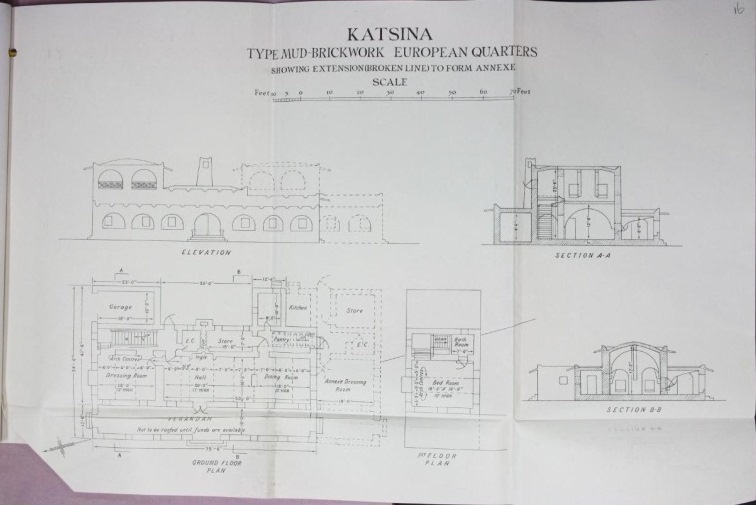
Lagos European Quarters

The architecture established in Nigeria during the British colonial era could well be assumed a classic example of export architecture, with features that reflected architectural traits from the heart of empire and were alien to the prevailing indigenous buildings of the time. It may however constitute a very hasty and almost erroneous judgement to assume that all British colonial buildings were export products. Could there perhaps, have been instances where indigenous architectural style and features were adapted, or even wholly copied in colonial building?

Writing on the building works carried out by European builders in Nigeria, Arthur M. Foyle in a 1951 The Builder Journal, had noted the character of early houses for government staff in Nigeria. He observed that while they were built of timber in the south, in the north and in the more inaccessible areas, staff housing were usually constructed of local materials and often by local labour using traditional methods of construction.

Image

Hausa Built form, Northern Nigeria

This ‘Type Mud brick European quarters’ designed by Nigeria’s colonial Public Works Department presented here, was sourced from a 1933 technical paper of the department, and rightly corroborates Foyle’s observation. The European quarters’ adapted features may perhaps, be better understood if analyzed on surviving Hausa built form models of Northern Nigeria. Although its plan retains a European model with a garage, hall, pantry, store and dressing room on the ground floor, and features a bedroom and bathroom upstairs, the quarters design largely adapts local form and materials to accommodate the colonial lifestyle.

Image

1933 Drawing of European Quarters at Katsina

Mad dogs and Englishmen

Following up Yemi’s post on the RWAFF, I noticed the uniforms of the African soldiers and reflected on how this apparently insignificant peculiarity has been a sign of the different methods with which Europeans confronted with Africa. The uniforms of colonial military force in Africa are a clear sign of the development of climate-adaptive sensibility, they played a major role in the history of Tropical Medicine that I see as the cultural base of Tropical Architecture. Noël Coward in 1931, while travelling from Hanoi to Saigon, wrote the famous lyrics “Only mad dogs and Englishmen go out in the midday sun“. It’s amazing to see how the idea that tropical climate was unhealthy and dangerous was so deeply rooted in the European culture to even generate popular folk songs.

The solar topee (shown below) that “the simple creatures hope he will impale on a tree” was the most famous symbol of how scientific knowledge could help the Western man cope with the dangerous tropical climate. Yet we must avoid tracing the history of Tropical Medicine as the simple linear progression of reason over superstition. Even if significant progress were made, they did not sweep away the suspicion that climate itself was a biological harm for Europeans. In 1930s Nigeria one cadet refused to wear the hat until he got a letter from the government saying that if he become ill from not wearing the hat he would have to go back home and end is career. It is easy to imagine how the whole life of colonialists in early decades of XXth century were influenced by the concerns on tropical climate. The idea that black and whites needed different treatments opened up to the idea that they were biologically different which easily ended up in racial theories.

Towards a genealogy of tropical architecture: Historical fragmen

However the systemic approach to climate that many studies of Tropical Medicine show, one for all the monumental work by Aldo Castellani and Albert Chalmers, posed the basis for the development of studies on climate that were strongly influential on Maxwell Fry and Jane Drew’s work. It is perhaps possible to trace a history of the relation with climate that links together solar topees, military barracks and bungalows all the way to the tropical modernism. A history that will be able to recognize the debt that Fry and Drew had with previous experiences in Africa even in disciplines not immediately linked to architecture.

Nigerian Public Works Department Troop Quarters, designed for the Royal West African Frontier Force

While recently going through archival materials on Nigeria’s colonial Public Works Department, I came across a troop quarters design for the RWAFF. The abbreviation sounded familiar, but I could not readily remember what it stood for and had to do a google search for further insight.  Results returned from the search brought it all flooding back to my memory; RWAFF is the abbreviation for Royal West African Frontier Force. To gain an initial casual understanding about the force, I took a quick look at Wikipedia and was able to obtain this excerpt – “The West African Frontier Force (WAFF) was a multi-battalion field force, formed by the British Colonial Office in 1900 to garrison the West African colonies of Nigeria, Gold Coast, Sierra Leone and Gambia. In 1928 it received royal patronage, becoming the Royal West African Frontier Force (RWAFF).”

13.3.6 GeorgeV

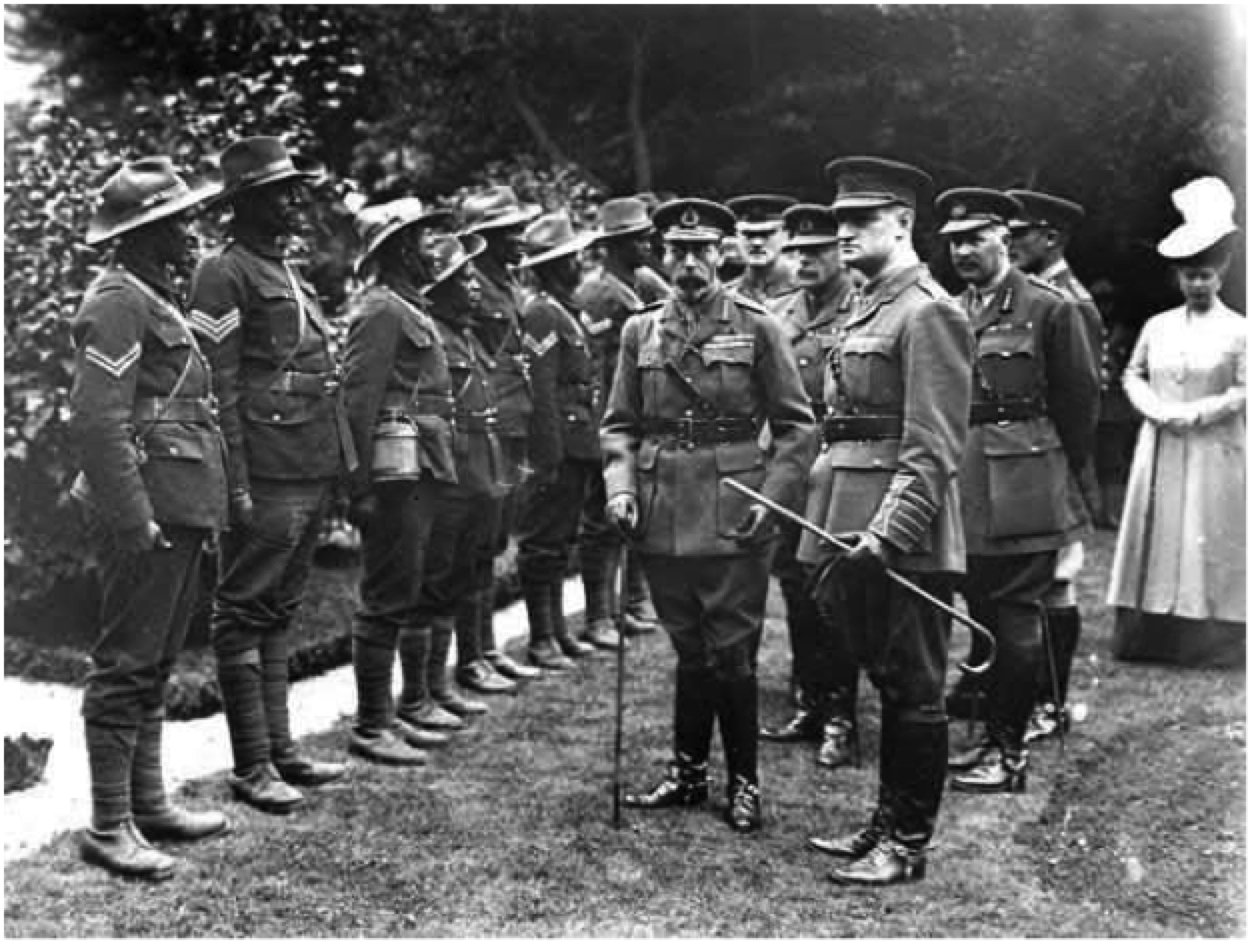
Soldiers on Parade for Visit by King George V and Queen Mary.

In a 1952 paper entitled “The story of the Royal West African Frontier Force”, published by the Royal United Service Institution journal, Brigadier F.A.S Clarke (DSO) however attempts to give a more scholarly account of the origins, services and numerical composition of the Force. In telling the RWAFF story, he sums up his account of its activities with this assertion: “though the force habitually wore a scarlet suave jacket, fez, and cummerbund on ceremonial parades, it has never been merely a ‘picturesque constabulary’ as some would now have us believe”. He gives instances of laborious and painstaking operations,expeditions and invasions conducted by RWAFF units in their bid to capture enemy territory. More importantly, he provides the organizational structure of the force, as well as its numerical composition. According to him, the force consisted of a Headquarters Company, a Raffle Company, platoons and battalions.  He equally notes that the total strength of a 1938 WAFF battalion, apart from British personnel, was 591 African troops and 219 carriers (those who bore the WAFF’s heavy loads of ammunition and supplies), with Nigeria providing the major quota.

13.3.6 Troops

RWAFF troops boarding a military plane.

The availability of such data might suggest a basis on which P.W.D architects developed accommodation schedules for RWAFF troop quarters designs. One of these designs was what I had sourced from my archival search, and is presented below:

13.3.6 Quarters

Drawing of RWAFF Quarters by the Nigeria PWD.

The troop quarters consisted of a ten-room block with an external measurement of 108’3”. It was fronted by an open veranda, and surrounded by an open drain which conveyed waste water to a surface disposal system. Each room had an internal measurement of 18’6” by 10’0”, and was accessed through a doorway from the open veranda. Although each room had a rear window, the space between the top of the door and the wall plate was also fitted with an expanded metal ventilator. This enabled cross ventilation and adequate air flow within each room. The roofing favoured a deep gable design to facilitate rain water run-off during the frequent tropical rain storms.

Research Seminar Presentation

Wednesday 13th February was the PhD research seminar day at the Liverpool School of Architecture. I gave a 15 minute presentation on the recent progress of my research. My research had started out by examining the development of Nigeria’s architectural profession during the mid-twentieth century. Findings made in the course of the research, however, revealed an outstanding level of architectural output by the country’s colonial Public Works Department (PWD), yet to be the subject of any known research.

This translates into an apparent gap in the studies done on Nigeria’s architectural history as a whole, and its British colonial architectural history in particular. My research’s new line of investigation is therefore centred on British colonial public works architecture in Nigeria, with the aim of bridging this gap in literature. In a bid to provide a fuller understanding of the department’s output as well, the research’s focus of investigation now covers the period from 1900 to 1960.

As my presentation discussed, one issue raised from literature is that private sector architecture tended to blaze new trails and to produce more innovative designs than the PWD. I therefore employed these images from the West African Builder and the Architects’ Journal to analyse this argument.

13.2.18 Lagos

13.2.18 Lagos2

The first is the 1959 General Post Office, Lagos, designed under the supervision of Charles Stevenson, PWD Senior Architect.  The other image is the 1960 Nigerian Port Authority Headquarters, also in Lagos, designed by W.H. Watkins Gray & Partners. With both buildings featuring a similar modernist approach to their designs at that time, the ‘less innovative’ view to public works designs may need to be further questioned.