Archive

Tag Archives: architecture

Research Student Seminar

Today some nice images from a forthcoming presentation by Shama Anbrine on the Lahore Model Town, to be held at the Liverpool School of Architecture on 13th February 2013. Please do get in touch if you are interested in attending the seminar.

13.1.25 collage

Top left: Mosque in ‘A’ Block

Top right: Hindu Temple in ‘D’ Block

Centre: Inscription on the original foundation stone

Bottom left: ‘A’ Class house

Bottom right: House of Hafeez Jullundhry National Poet of Pakistan before refurbishment.

Photographs © Shama Anbrine, apart from bottom right image. Thanks to Jawad Ahmed Tahir and Muhammad Saad Khan, project architects for the refurbishment of Hafeez Jullundhry’s house, for supplying the image prior to recent work.

University of Ibadan, Nigeria

In August of last year, some of the Transnational Architecture Group visited one of Fry and Drew’s best-known projects in West Africa – Nigeria’s first university, the University of Ibadan (1947-60).

Fry and Drew planned the campus, situated on a site of five square miles of farm and forest land, and designed many of the associated residential and teaching buildings. The campus is approached from a tree-lined avenue leading directly to a central tower, administrative offices and lecture hall. From this administrative centre, residential colleges and teaching buildings are laid out roughly east-west to take advantage of the south-west breeze.

Speaking of building in West Africa, Maxwell Fry summarises their straightforward but considered approach, which is shown so well at Ibadan University:

‘We were fated to make a new architecture out of our love for the place and our obedience to nature, and to make it with cement and steel, asbestos sheets, wood above the termite line, glass, paint and some stone later, and not much else’.
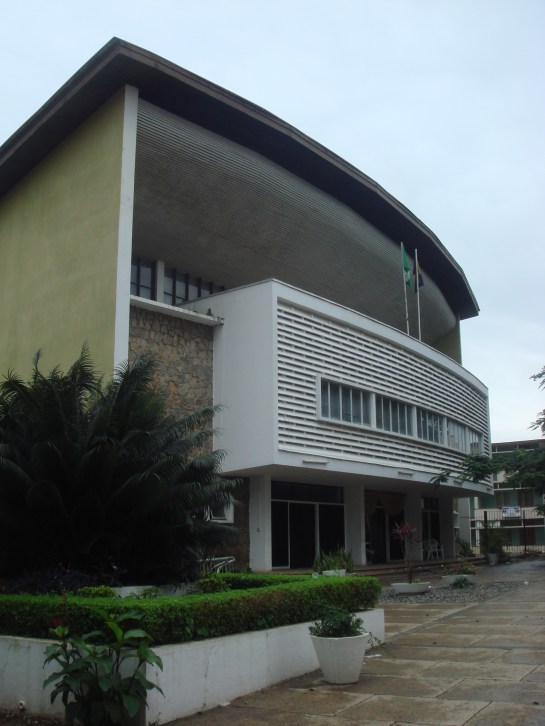
DSC08401

Fry’s words are demonstrated in their design for the central lecture hall, above. Trenchard Hall is constructed of a reinforced concrete frame infilled with concrete block and local stone. The ceiling sweeps up from the stage, over the internal balcony, and finishes at eaves level to the main elevation (shown above). Timber is used freely to the hall’s interior and adds warmth to the concrete columns.

Thanks to the Office of International Programmes, who made us very welcome and showed us around the university.

Map of Fry & Drew Projects

Over the course of our research we have plotted the built and unbuilt projects of the Fry and Drew partnership on an online map, with astonishing results. Although known for their work in West Africa and India, the geographical spread of the partnership’s work is considerable. Projects span Europe, Africa and Asia, tracing a line from The Gambia in the west to Singapore and Malaysia in the east.

The map gives a clear indication of Fry and Drew’s knowledge of Tropical Architecture, which they presented in a series of pioneering books: Village Housing in the Tropics (1947, with Harry L. Ford); Tropical Architecture in the Humid Zone (1956); Tropical Architecture in the Dry and Humid Zones (1964). These publications remain an important source of information – highlighted recently by Routledge’s decision to republish Village Housing in the Tropics later this year (with a new introduction by Iain Jackson).

13.1.21 VHT Sketch

Survey sketch for a new town plan, taken from Village Housing in the Tropics.

The online map is a work in progress and concentrates on work abroad, so not all UK projects are currently shown. If you have any comments or know of any other projects that might be added, please contact us: jholland@liv.ac.uk

Veterinary Building, Liverpool University

The importance of the Fry and Drew research project has been demonstrably underlined with the recent demolition of Maxwell Fry’s School of Veterinary Science (1955-60) at the University of Liverpool. There’s something particularly ironic about the Vet School being situated just a few hundred yards from our offices at the Liverpool School of Architecture – where Fry was a student in the 1920s – or maybe it’s just depressing!

Anyway, over the course of a week last October, it was demolished to make way for new student residences. Here it is, in two pictures: the construction and demolition, just over fifty years later (sigh).

13.1.18 DH Vet

© Sheffield Hallam University. Duncan Horne Collection, c. 1960.

13.1.18 Vet bldg

© Jessica Holland. 24 October 2012.

During the same period Fry also designed the university’s Civil Engineering building. Like the Vet School, it’s a great example of his humanist take on post-war modernism – combining textured and colourful materials, and artwork inside and out, to give a building ‘soul’ (in Fry’s words).

For further reading on these commissions, and for more images of both buildings, see: Iain Jackson, ‘Post-War Modernism: Maxwell Fry’s buildings at the University of Liverpool’, The Journal of Architecture, vol. 16, no. 5, pp. 675-702. Available here.

Locating the Model Village

The location of the site was crucial for the success of the proposed co-operative Model Town. Like the English garden suburb from which it took inspiration, the site was to be located close enough to the city so that the middle-class residents might easily commute to work, yet maintain a distance to avoid the congestion and pollution of Lahore. Accordingly, the designer Khem Chand proposed a distance of six or seven miles from the city.

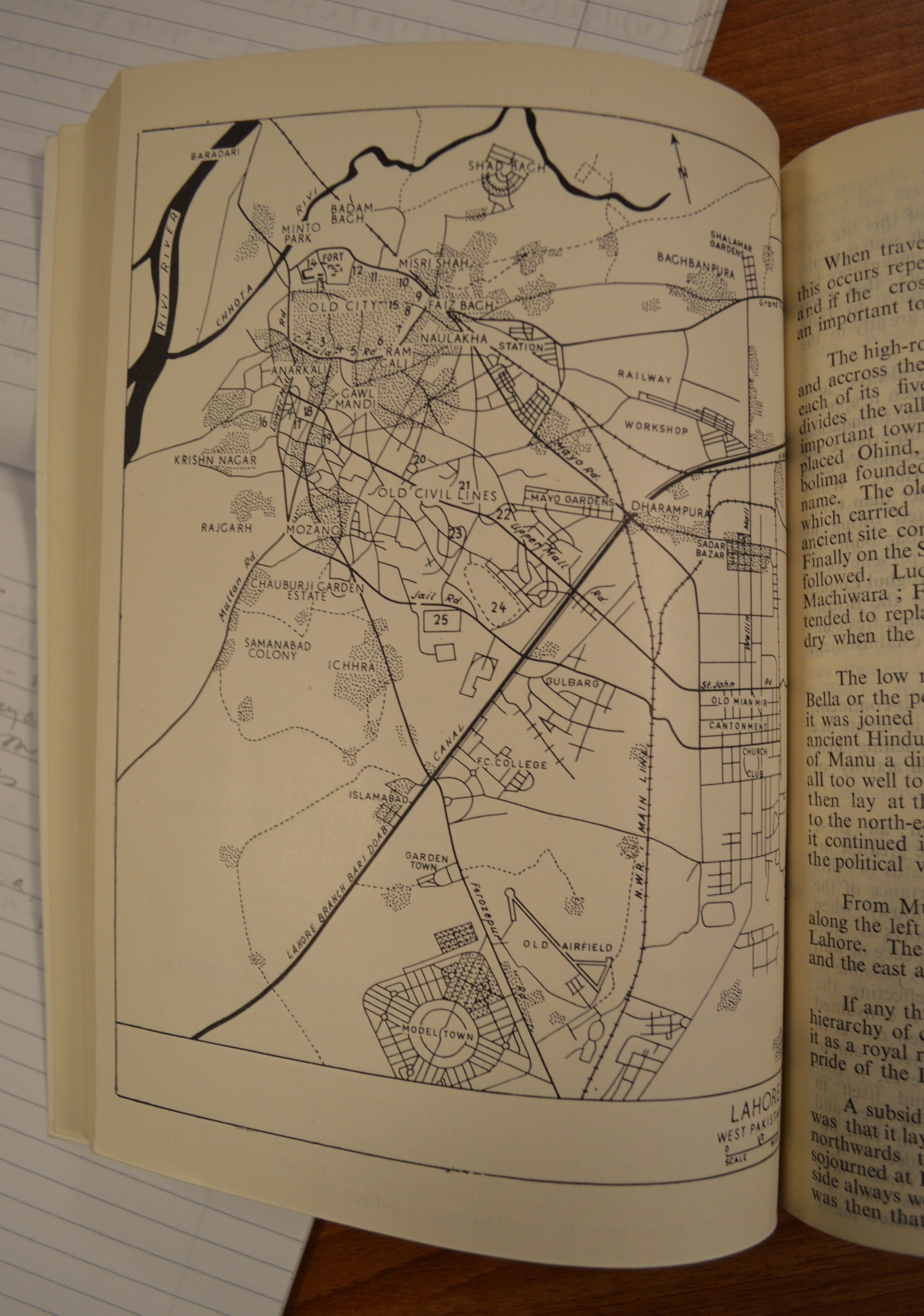
The site finally selected was part of Rakh Kotlakhpat, a rich forest plantation of mulberry and shisham trees, south-east of Lahore adjacent to the Ferozepore Road. It was at an accessible distance from Lahore, located just 1½ miles from the nearest railway station and 5½ miles from the Lahore District Courts, where many of the residents worked. As the following image shows, the Model Town was planned with a low density to provide a serene and healthy environment. According to Government sanitary reports of 1919–20, the locality was the healthiest in the Punjab.

13.1.16 SA Plan

This plan is taken from Towns and Villages of Pakistan, A Study by Grenfell Rudduck (July 1961), a publication from the papers of the British town-planner and architect William Holford (1907–75), held at the Liverpool University Archives & Special Collections.

Graham Bligh on Pilkington Brothers’ Headquarters

Following on from the last post on Fry and Drew’s staff, here’s an excerpt from a recent interview with the Australian architect Graham Bligh, an employee at Fry, Drew & Partners around the same time as Duncan Horne.

Bligh describes his time working on the headquarters for the glassmakers Pilkington Brothers at St. Helens, Lancashire, designed and built from 1955 to 1965. Designed by Maxwell Fry, the project was run by Staff Architect, Peter Bond. As Bligh recalls:

‘I became entirely focused on the canteen building which is next to the lake … I particularly remember doing a detail of the building wall … coming up to the lake with the waterproofing going down … I had a detail which worked but it wasn’t aesthetically suitable, you know, things didn’t really line up and Peter chews my ear about that. But I said, “But Peter, it’s all under the water!” He says, “I don’t care where it is!” … It’s the integrity of the quality of dimensioning and the detail.’

13.1.14 PB Canteen

South façade of the Canteen, Pilkington Brothers’ Headquarters, St. Helens, c. 1965. © Pilkington Brothers

John Macarthur, Robert Riddel and Janina Gosseye interviewed Bligh in connection with the Architectural Practice in Postwar Queensland (1945-75) oral histories project. Visit the project’s website for further interviews with Graham Bligh and other Queensland-based architects.

Do you know these men?!

We are currently compiling a list of architectural and administrative staff employed by the various incarnations of the Fry and Drew partnership, from their pre-marriage work of the 1930s right through to the 1970s. The aim is to include a database in the forthcoming publication.

 13.1.10 GP office

© Sheffield Hallam University. Duncan Horne Collection, c. 1960.

This image is taken from architect Duncan Horne’s collection of photographs held at Sheffield Hallam University and available to view from their excellent online catalogue, Shimmer.

Horne trained at Liverpool School of Architecture and then worked for Fry and Drew at their offices at 63 Gloucester Place in London. His photograph neatly shows what life was like as a Fry and Drew staff architect around 1960, sat at a drawing board with pipe in hand. The smart chap, far left, is Duncan Horne, according to the Shimmer catalogue – can anyone confirm this?

Fry and Drew had lived and worked at the Georgian terrace since the 1940s, which became an open house for the artistic community at the time. As another former employee Trevor Dannatt commented recently at a docomomo-uk lecture, ‘the Fry’s ran a very hospitable house […] it was a place of great ferment.’

We would be very pleased to hear from anyone who worked for Fry and Drew, or knows of any former employees. Leave a comment or contact us at: jholland@liv.ac.uk

E. Maxwell Fry and Jane B. Drew: Modernism, Collaboration and the Tropics.

Iain Jackson and Jessica Holland are currently working on a Leverhulme-funded research project investigating Fry and Drew’s lengthy architectural careers and the wider cultural significance of their work, from the 1920s to the 1970s. The documentation of their work will highlight their significant collaborations with other architects and artists, including Le Corbusier, Walter Gropius, Denys Lasdun, Victor Pasmore, Henry Moore and Barbara Hepworth.

Fry and Drew were pioneers in what is now known as ‘Tropical Architecture’, due to their post-war buildings throughout Africa, from The Gambia to Mauritius, and across Asia, from Iran to Singapore. The project focuses particularly on their extensive work in Ghana, Nigeria and India.

In the UK, Fry and Drew’s often overlooked later projects (1950-70) will also be investigated. While their contemporaries – such as the Smithsons, James Stirling and Denys Lasdun – embraced the changing interpretations of modernism, Fry in particular stuck to the restrained, polite forms that he had promoted in his late ‘thirties work. An examination of Fry and Drew’s increasingly divergent architectural aesthetic will conclude the study.

The project continues through 2013. The findings will be presented in the first monograph of Fry and Drew’s work, published by Ashgate in 2014.