Archive

Tag Archives: Colonialism

The Central Garden at Model Town

The most ambitious idea in the plan of Model Town was the Central Garden, which as proposed was nothing short of the reminiscence of a hill station resort. The focus of this garden was a central hill 50 feet high on top of which a reservoir for the supply of drinking water to the town was to be located assuming that by doing so the reservoir would remain comparatively cool. The hill was to be covered with evergreen plants and flowers. Winding paths would lead to the top of the hill where a promenade was proposed round the reservoir, with four pavilions providing for shade and shelter and thus be a delightful place in hot summer evenings where it would be possible to get breath of cool fresh air. A few springs from the hill would water the plants and as well as provide water for a ‘couple of’ gold fish pools.

The proposition did not end here, as a cave restaurant was also proposed inside the hill by providing ‘a few rooms’ which were to be well-lit and well-ventilated and constructed of reinforced concrete construction. Round the hill, a 100 feet wide and 4 to 5 feet deep lake was proposed for fishing and boating but ‘not enough for a man to drown in’. Surrounding the lake were proposed lawn flanked by a flower garden. The lawns and gardens were to be watered from the Bambawali-Ravi-Bedian Canal through a lake by means of syphon tubes which were to help in keeping the water in the fishing and boating lake in motion.

from Civil and Military Gazette Lahore

Mad dogs and Englishmen

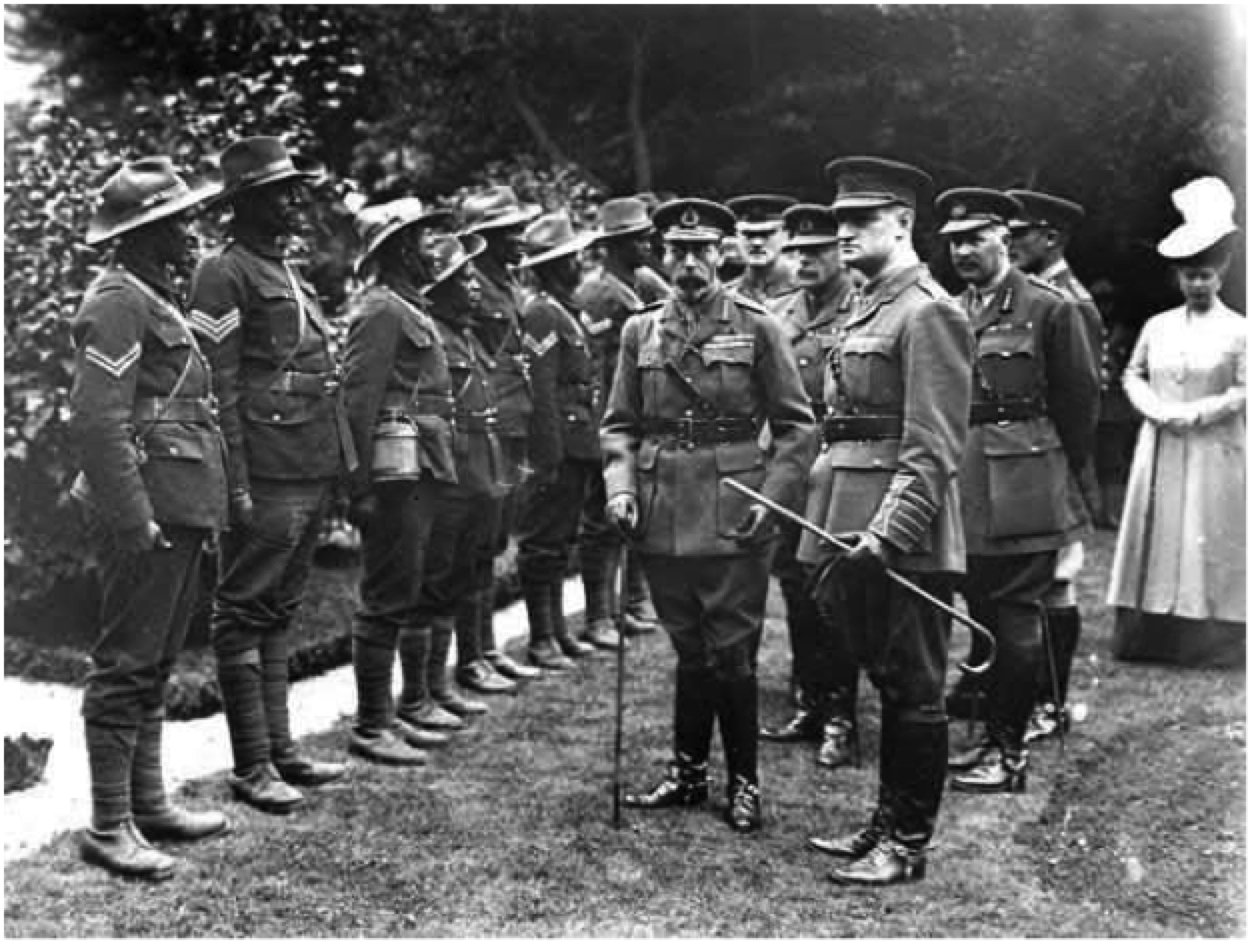
Following up Yemi’s post on the RWAFF, I noticed the uniforms of the African soldiers and reflected on how this apparently insignificant peculiarity has been a sign of the different methods with which Europeans confronted with Africa. The uniforms of colonial military force in Africa are a clear sign of the development of climate-adaptive sensibility, they played a major role in the history of Tropical Medicine that I see as the cultural base of Tropical Architecture. Noël Coward in 1931, while travelling from Hanoi to Saigon, wrote the famous lyrics “Only mad dogs and Englishmen go out in the midday sun“. It’s amazing to see how the idea that tropical climate was unhealthy and dangerous was so deeply rooted in the European culture to even generate popular folk songs.

The solar topee (shown below) that “the simple creatures hope he will impale on a tree” was the most famous symbol of how scientific knowledge could help the Western man cope with the dangerous tropical climate. Yet we must avoid tracing the history of Tropical Medicine as the simple linear progression of reason over superstition. Even if significant progress were made, they did not sweep away the suspicion that climate itself was a biological harm for Europeans. In 1930s Nigeria one cadet refused to wear the hat until he got a letter from the government saying that if he become ill from not wearing the hat he would have to go back home and end is career. It is easy to imagine how the whole life of colonialists in early decades of XXth century were influenced by the concerns on tropical climate. The idea that black and whites needed different treatments opened up to the idea that they were biologically different which easily ended up in racial theories.

Towards a genealogy of tropical architecture: Historical fragmen

However the systemic approach to climate that many studies of Tropical Medicine show, one for all the monumental work by Aldo Castellani and Albert Chalmers, posed the basis for the development of studies on climate that were strongly influential on Maxwell Fry and Jane Drew’s work. It is perhaps possible to trace a history of the relation with climate that links together solar topees, military barracks and bungalows all the way to the tropical modernism. A history that will be able to recognize the debt that Fry and Drew had with previous experiences in Africa even in disciplines not immediately linked to architecture.

Nigerian Public Works Department Troop Quarters, designed for the Royal West African Frontier Force

While recently going through archival materials on Nigeria’s colonial Public Works Department, I came across a troop quarters design for the RWAFF. The abbreviation sounded familiar, but I could not readily remember what it stood for and had to do a google search for further insight.  Results returned from the search brought it all flooding back to my memory; RWAFF is the abbreviation for Royal West African Frontier Force. To gain an initial casual understanding about the force, I took a quick look at Wikipedia and was able to obtain this excerpt – “The West African Frontier Force (WAFF) was a multi-battalion field force, formed by the British Colonial Office in 1900 to garrison the West African colonies of Nigeria, Gold Coast, Sierra Leone and Gambia. In 1928 it received royal patronage, becoming the Royal West African Frontier Force (RWAFF).”

13.3.6 GeorgeV

Soldiers on Parade for Visit by King George V and Queen Mary.

In a 1952 paper entitled “The story of the Royal West African Frontier Force”, published by the Royal United Service Institution journal, Brigadier F.A.S Clarke (DSO) however attempts to give a more scholarly account of the origins, services and numerical composition of the Force. In telling the RWAFF story, he sums up his account of its activities with this assertion: “though the force habitually wore a scarlet suave jacket, fez, and cummerbund on ceremonial parades, it has never been merely a ‘picturesque constabulary’ as some would now have us believe”. He gives instances of laborious and painstaking operations,expeditions and invasions conducted by RWAFF units in their bid to capture enemy territory. More importantly, he provides the organizational structure of the force, as well as its numerical composition. According to him, the force consisted of a Headquarters Company, a Raffle Company, platoons and battalions.  He equally notes that the total strength of a 1938 WAFF battalion, apart from British personnel, was 591 African troops and 219 carriers (those who bore the WAFF’s heavy loads of ammunition and supplies), with Nigeria providing the major quota.
13.3.6 Troops

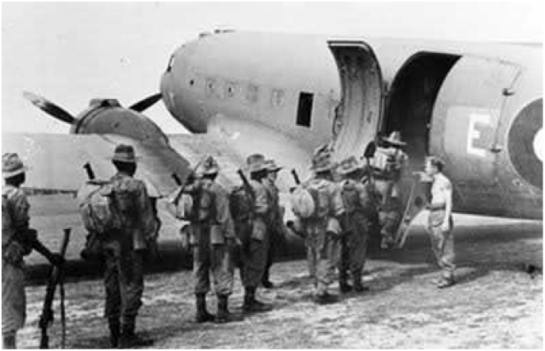
RWAFF troops boarding a military plane.

The availability of such data might suggest a basis on which P.W.D architects developed accommodation schedules for RWAFF troop quarters designs. One of these designs was what I had sourced from my archival search, and is presented below:

13.3.6 Quarters

Drawing of RWAFF Quarters by the Nigeria PWD.

The troop quarters consisted of a ten-room block with an external measurement of 108’3”. It was fronted by an open veranda, and surrounded by an open drain which conveyed waste water to a surface disposal system. Each room had an internal measurement of 18’6” by 10’0”, and was accessed through a doorway from the open veranda. Although each room had a rear window, the space between the top of the door and the wall plate was also fitted with an expanded metal ventilator. This enabled cross ventilation and adequate air flow within each room. The roofing favoured a deep gable design to facilitate rain water run-off during the frequent tropical rain storms.

BP Headquarters, Lagos, Nigeria

On 1st October 1960, Nigeria gained independence from Great Britain. Jane Drew was in Lagos during this historic period and she wrote home to Maxwell Fry of the carnival atmosphere in the capital: ‘Lagos is electric with excitement.’

Drew was in town to attend the opening of the headquarters for British Petroleum in Lagos, designed by Fry, Drew & Partners. The office block is one of several lucrative projects designed by Fry and Drew for British companies in West Africa – others include the Co-operative Bank, just a few streets away from the BP building, and the Leventis Store in Accra.

13.2.11 BP HQ

Now African Petroleum House, the roof terrace has since been filled in to provide an extra floor of office space and the louvres have been altered – no doubt following the introduction or upgrading of the air conditioning. For images of the building shortly after its opening, see the RIBA online photograph collection.

Mfantsipim School, Cape Coast, Ghana

In 1947, Maxwell Fry and Jane Drew were commissioned to build a series of schools and teacher training colleges, primarily in the former British colony of the Gold Coast. The architects used the project as an opportunity to apply European ideals of modernism to a new environment, and their pioneering architectural approach was promoted as the realisation of a new era of mutual interest for Britain and the Gold Coast. Representative of newly-released resources from the Colonial and Welfare Development Fund, Fry and Drew’s educational buildings embodied the move toward colonial devolution.

At Cape Coast, Fry and Drew worked on three projects (more on these soon), including a series of extensions for Mfantsipim School. The first secondary school in the Gold Coast, Mfantsipim School was established in 1876 as part of the Methodist mission. Phase one of building works comprised a series of staff houses and a water tower, followed by a second phase of dormitory blocks, shown below.

13.2.8 mfant dorm

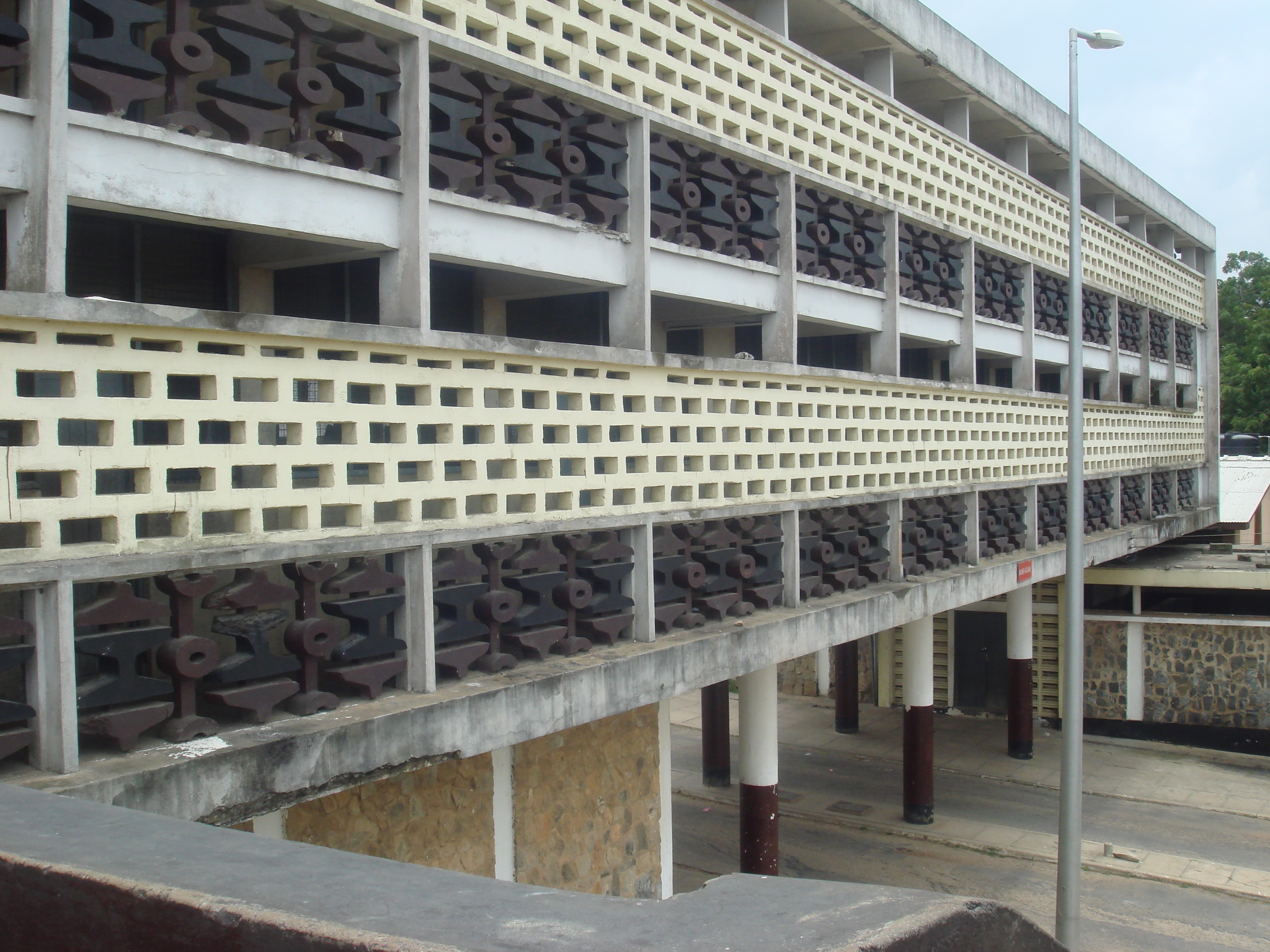
This block forms a gateway to the site. The driveway passes under the building and up to the main, hill-top campus. The ground floor bathroom block sits at right-angles to the dormitories above. The perforated balustrade evidently provided scant shading to the south elevation as further brise-soleil have since been added:

13.2.8 mfantdorm

For further discussion of Fry and Drew’s work in West Africa see the excellent: Mark Crinson, Modern Architecture and the End of Empire (Ashgate, 2003).

A pictorial archive of Mfantsipim School, from which the first image is taken, is available here. The second image was taken during a TAG visit in September 2012, © Jessica Holland.

British Colonial Architecture in Nigeria, 1900-60.

Yemi Salami’s study explores British colonial architecture in pre-independent Nigeria. Beginning at the turn of the twentieth century and culminating in the year of independence, the investigation traces a significant period of transformation in the country’s history. Notably, it explores the rise of its colonial style buildings, which had come to cater for emerging uses in government, commerce, healthcare, transportation and other contemporary uses of the time.

Previous studies showcase a rich presence of these buildings in pre-independent Nigeria, particularly with reference to the climate responsive “tropical architecture” of the mid-twentieth century. The architectural careers of a few notable professionals are likewise widely explored. However, were these projects and professionals the only modern influences to Nigerian architecture at the time? Who were the other architects and what were they designing? Furthermore, what forms of colonial buildings existed before the mid-twentieth century climate responsive trend?

The aim of this PhD research, therefore, is to obtain a more accurate understanding of the events and circumstances which shaped colonial architectural forms and practice in pre-1960 Nigeria. It will employ a qualitative historical research strategy, by sourcing and investigating materials from previous literature, archival records and existing projects from the period.

Colonial Films Unit at Ibadan University

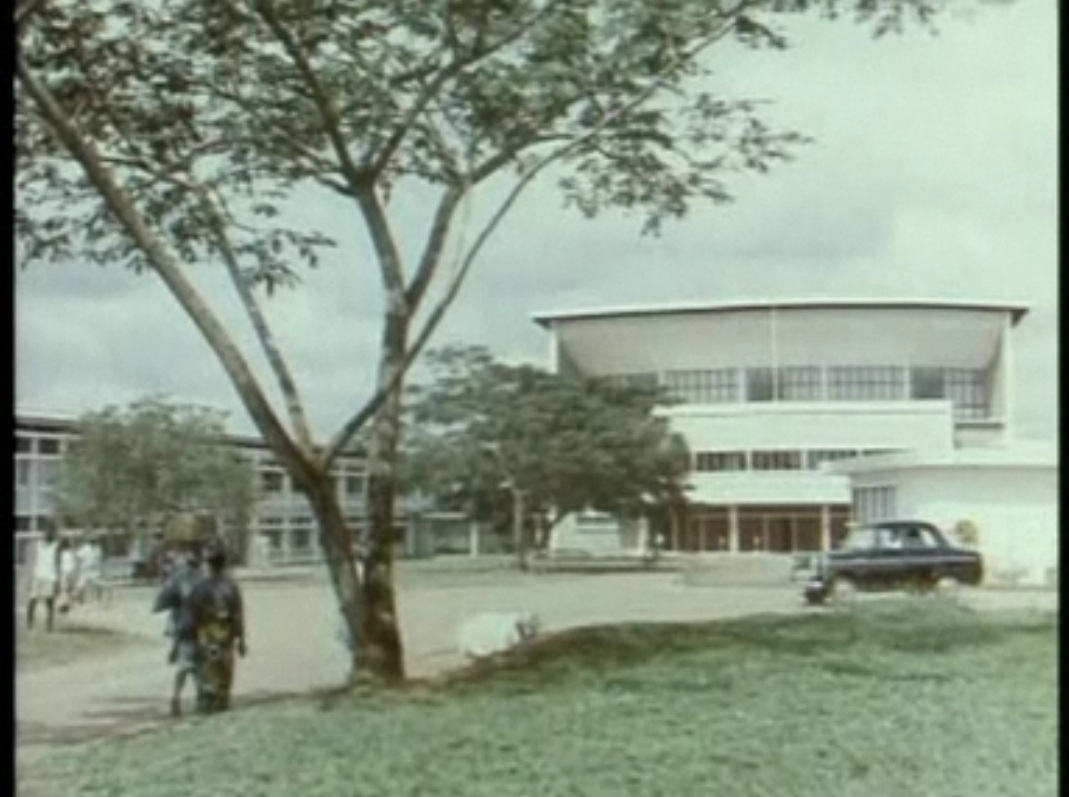
Following on from last week’s post on Ibadan University, here’s a still of Trenchard Hall taken from the 1958 film “Three Roads to Tomorrow”. It tells the story of three students from different parts of Nigeria making their way to university for the first time. Sponsored by BP, the film was made by Greenpark Productions to illustrate the way that ‘modern transport and oil power have changed the lives of all Nigeria’, says the narrator.

13.1.30 ui

The image shows the administrative block to the left of Trenchard Hall and the single-storey bookshop to the right, all designed by Fry and Drew as part of the first phase of development at the university.

The film is available to watch online at the excellent Colonial Film website, a research project intended to ‘allow both colonizers and colonized to understand better the truths of Empire’. The website brings together information on over 6000 films depicting life in Britain and its former colonies, including a fascinating collection of 150 films to view online – such as “Mr English at Home” (1940) and “Farmer Brown Learns Good Dairying” (1951).

A shining example of progress in colonial Nigeria, Ibadan University was the subject of several films, from the early stages of clearing, surveying and planning to the opening ceremony in 1954. Jane Drew featured in early footage; she wrote home to Maxwell Fry of being filmed on-site with the university’s first principal, Kenneth Mellanby:

‘This morning the colonial film unit took films of Mellanby, Jack Hoskins and I talking – a bit bogus but they want a full record’.

Indeed. Read about the Colonial Film Unit here.

Religious Buildings at the Lahore Model Town

13.1.28 collage

Left: Gurudwara (Sikh temple) B Block, Centre: Mandir (Hindu temple) D Block, Right: Mosque A Block. All photographs © Shama Anbrine.

The model town was not just an urban morphological experiment, but a unique social experiment as well. In a time when all the major sections of Indian population were thinking of freedom and possible independent states based on religious majorities in different areas, a small segment of people from all these sections were willing to live together in an ideal co-operative garden town. Therefore, during planning of the Model town, eight identical sites were reserved for religious buildings with one in each residential block. However only three of these were actually built: Sikh and Hindu temples and a Mosque.

The temples were abandoned in 1947 due to mass exodus of Sikhs and Hindus (who formed the majority of the population) after independence of Pakistan. The Sikh temple is now being used as a residence while the Hindu temple is now part of a girl’s primary school. The interior of the Sikh temple has been radically altered by the residents, and many portions of Hindu temple have been demolished or are in ruins. The Mosque, on the other hand, is quite well maintained and well preserved in its original condition, the only alteration being the introduction of modern electrical equipment.

Research Student Seminar

Today some nice images from a forthcoming presentation by Shama Anbrine on the Lahore Model Town, to be held at the Liverpool School of Architecture on 13th February 2013. Please do get in touch if you are interested in attending the seminar.

13.1.25 collage

Top left: Mosque in ‘A’ Block

Top right: Hindu Temple in ‘D’ Block

Centre: Inscription on the original foundation stone

Bottom left: ‘A’ Class house

Bottom right: House of Hafeez Jullundhry National Poet of Pakistan before refurbishment.

Photographs © Shama Anbrine, apart from bottom right image. Thanks to Jawad Ahmed Tahir and Muhammad Saad Khan, project architects for the refurbishment of Hafeez Jullundhry’s house, for supplying the image prior to recent work.

Locating the Model Village

The location of the site was crucial for the success of the proposed co-operative Model Town. Like the English garden suburb from which it took inspiration, the site was to be located close enough to the city so that the middle-class residents might easily commute to work, yet maintain a distance to avoid the congestion and pollution of Lahore. Accordingly, the designer Khem Chand proposed a distance of six or seven miles from the city.

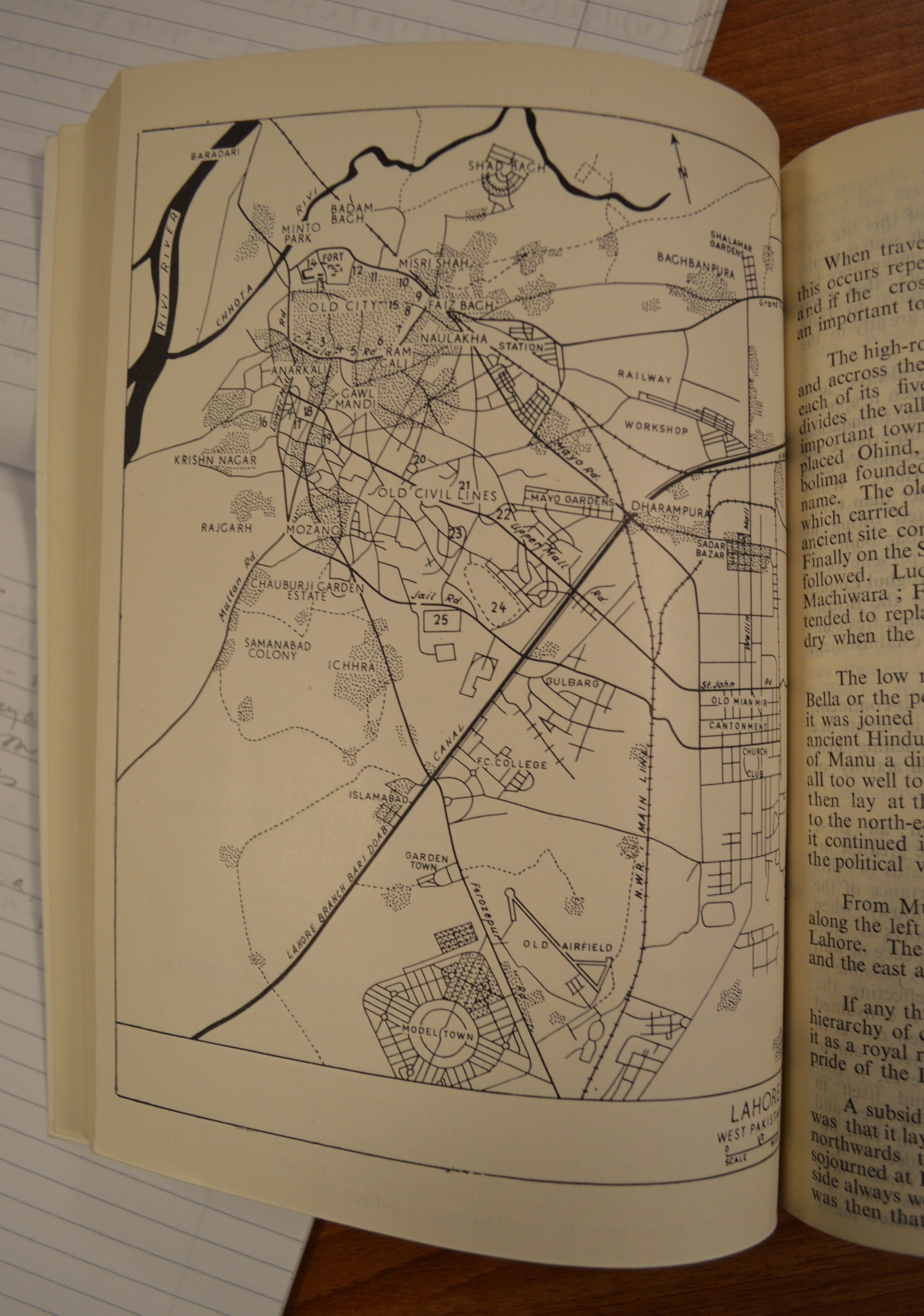
The site finally selected was part of Rakh Kotlakhpat, a rich forest plantation of mulberry and shisham trees, south-east of Lahore adjacent to the Ferozepore Road. It was at an accessible distance from Lahore, located just 1½ miles from the nearest railway station and 5½ miles from the Lahore District Courts, where many of the residents worked. As the following image shows, the Model Town was planned with a low density to provide a serene and healthy environment. According to Government sanitary reports of 1919–20, the locality was the healthiest in the Punjab.

13.1.16 SA Plan

This plan is taken from Towns and Villages of Pakistan, A Study by Grenfell Rudduck (July 1961), a publication from the papers of the British town-planner and architect William Holford (1907–75), held at the Liverpool University Archives & Special Collections.