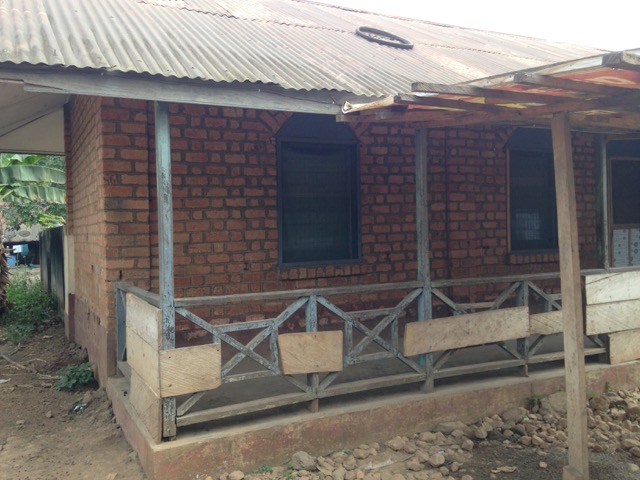
The two major projects under construction in the city that we reported on in 2022 – Cathedral and Marine Drive have both stalled, and both projects are now under-review and reassessment – leaving behind faded hoardings and large vacant sites. At least the Community Centre and Ghana Club have some reprieve.
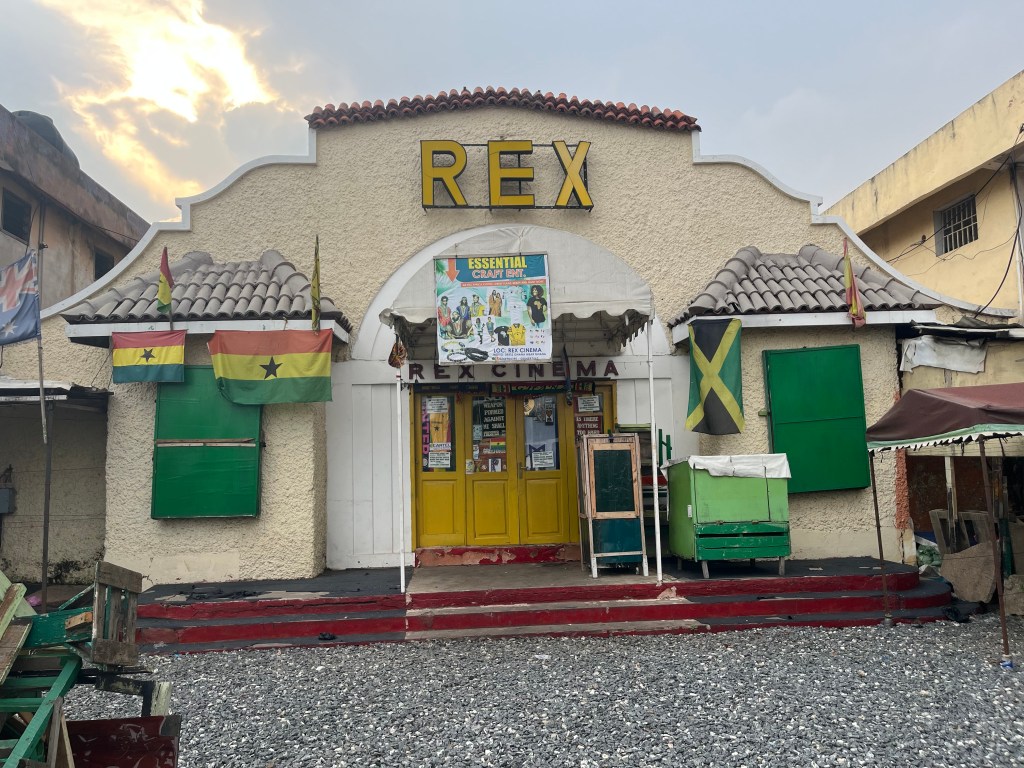
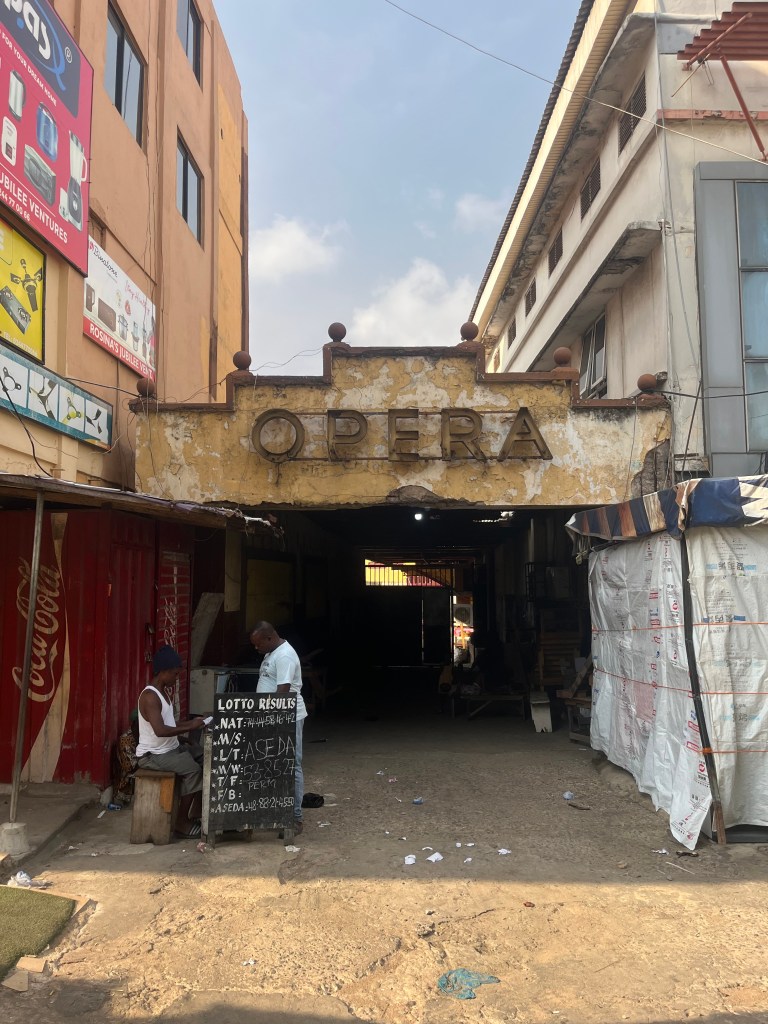
I also visited the Rex Cinema and Opera Cinema – both still looking excellent with their small scale intriguing entrance portals hiding their vast open-air screening areas.
The July-August 2025 edition of the Architectural Review has published an extended 9-page feature article written by Lois Quartey and Julia Gallagher on the Accra Community Centre, Ghana. The building designed by Maxwell Fry and Jane Drew, with Theo Crosby as the lead assistant, opened in 1951 and quickly became an important educational, cultural, and social hub in the city. It was paid for by the United Africa Company in an attempt to foster local support after its ‘Swanmill’ HQ was looted and burned following the 1948 Accra riots. TAG provided some drawings and photographs that accompany the article.
The primary thrust of the piece is to raise awareness of this significant historic structure – especially how it was used in the independence campaigns and beyond – and to stress just how vulnerable this building is. Currently being used as a mere store and at risk from the Marine Drive development plan – the article expands on what we covered here https://transnationalarchitecture.group/2022/06/22/accras-renaissance-fishing-harbour-marine-drive-and-a-new-cathedral/ back in 2022.
It’s a deceptively simple and even ordinary building at first sight – but after spending time exploring it’s two interconnected courtyards and assembly hall it quickly begins to feel at home, climatically comfortable, and a nice place to be. It’s also a significant structure because of its design pedigree and especially because of its political significance – so many important speeches, gatherings, and events took place here in the advent to independence and beyond. It’s also home to one of the largest installations by leading artist Kofi Antubam – that alone should secure its future. Our model that replicates one made by Fry and Drew featured in the recent V&A Tropical Modernism exhibition too.
If foreign and leading agencies such as the V&A museum and Architectural Review are prepared to give this seemingly humble building exposure, critique, and cause for preservation – surely the case can be made to restore this heritage structure and to weave it into the wider Marine Drive masterplan. Champions of Ghanaian culture https://www.design233.com/articles/in-trust-for-the-people are behind saving these works and raising awareness, but much more needs to be done.
To deliberately allow a ‘managed decline’ and slow demolition is a tragic waste and short sighted view of the building’s rich political history.
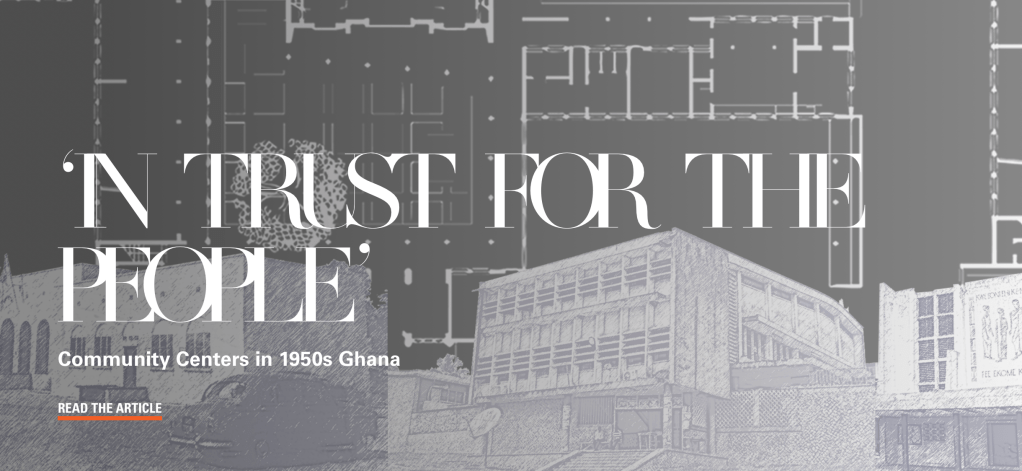
Have a look at the latest article from Design233 on Community Centers in Ghana, including the Accra Community Centre (paid for by the UAC) and Tarkwa Community Center (paid for by the Manganese Mining Company) – both designed by Fry and Drew. In addition to these modernist works the more formal and classically inspired centre at Kyebi is discussed – this centre is more of a mystery… We know it was funded by the Consolidated African Selection Trust (CAST)- but who designed it, and why did CAST commission such a lavish project?
Accra Community Center PlanTarkwa Community Center articleKyebi Community Center
Returning to Accra after a 30 month break, I was expecting there to be changes, but not on the scale I witnessed. Three major projects have commenced – the new cathedral; the Marine Drive project; and the new fishing harbour. When completed they will have a drastic impact on the city and how it is experienced. Marine Drive, in particular, promises some spectacular changes to the much neglected and large sea front. For a port city Accra has never really utilised its enviable position overlooking the sea with its refreshing breeze, until now. The scale of the Marine Drive project is vast and incorporates the set design piece of Independence Square as its focal point.
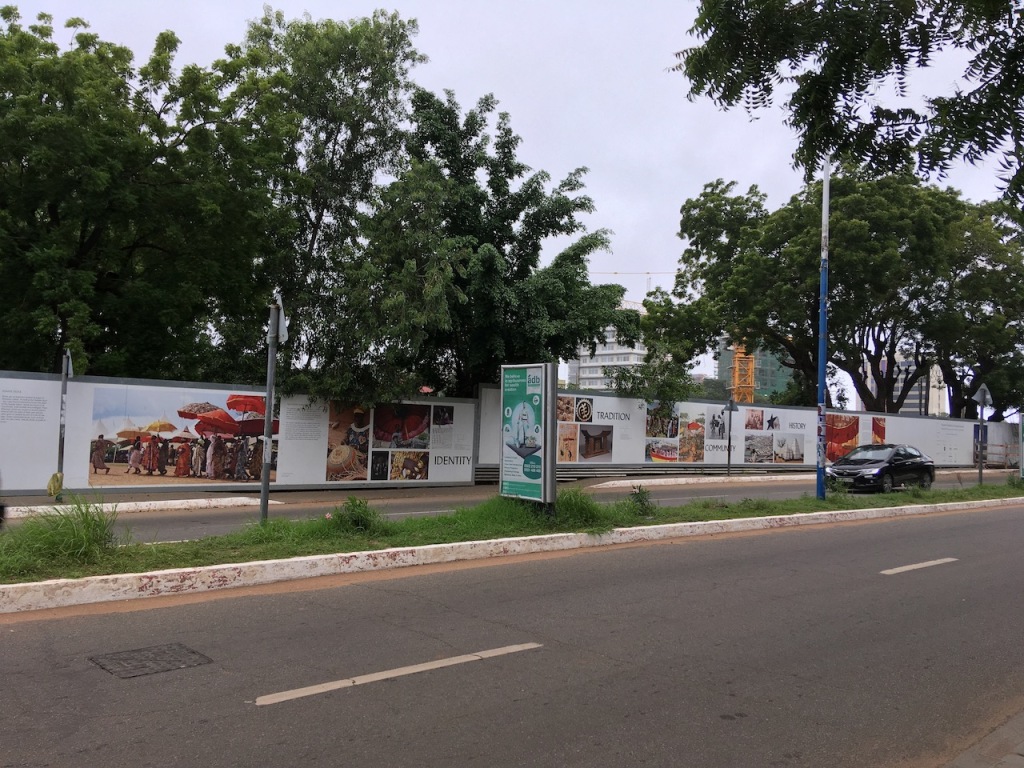
The New HarbourMarine Drive SiteHoardings around the new Cathedral
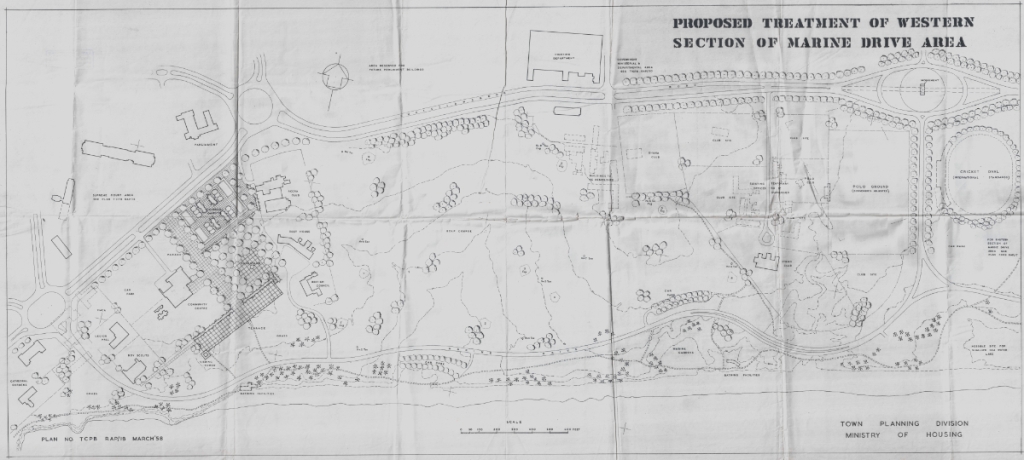
The project for Marine Drive initially commenced back in 1958 with Geoffrey Jellicoe as lead designer, and various other projects have been mooted since. Jellicoe’s proposal centred around the Community Centre, and also utilised the cricket stadium and polo pitch on the current site of Black Star Square, as well as a golf course and series of club houses.
1958 plan for Marine Drive: source PRAAD
After so many other false starts it looks like Marine Drive is finally going to happen this time, with Sir David Adjaye as the lead architect. Whereas Jellicoe’s design was mainly concerned with providing sport facilities to the Colonial residents, the new proposal includes provision for other leisure facilities including beach bars, shopping, a promenade, and a series of residential and commercial towers. Sir David’s practice is also designing the new Accra cathedral and initial ground works have also commenced, with the site hoarded off and clad with architectural renderings explaining the project’s concept.
A rendering of the new Marine Drive project: towers around Black Star Square.Current view of Black Star Square
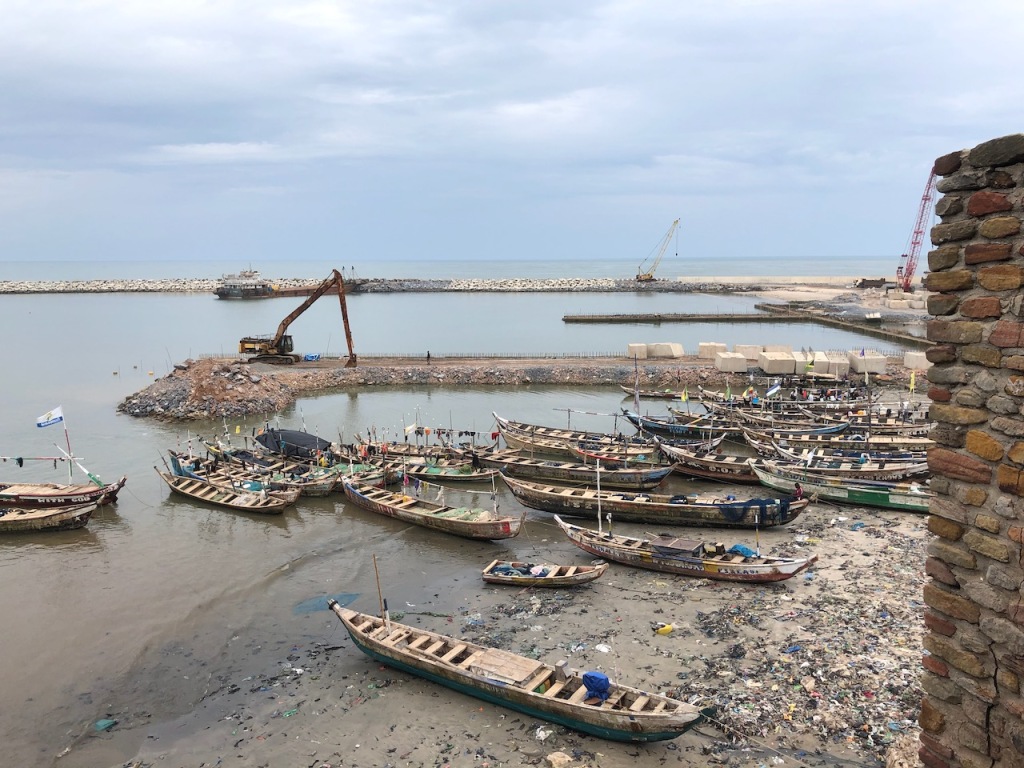
The fishing harbour project has resulted in an extension of the old breakwater wall along with some major engineering works linking the shore to the harbour, as shown above.
It’s impressive that the city is conducting works of this scale, ambition, and vision. We’ll continue to record the developments here and to document the changes.
We also revisited the classic modernist constellation of the law court, library, and community centre. Whilst the library is still in use the community centre is not, other than as a store. It’s looking particularly tired, and the building fabric is beginning to deteriorate. Its future is uncertain, and as it sits within the Marine Drive development area discussed above it isn’t clear what, if any, it’s role will be. Even the beautiful Ghana Club is potentially at risk from the new development. It’s been mooted that the club might have to be physically moved to a new site. It’s not an impossible solution as the upper level is a timber structure with louvred facades. It could be jacked up and rolled to a new location, but equally it’s also disappointing that these older structures were not incorporated and woven into the new plans.
Community Centre / Store?Abandoned Christmas decorations in the Community CentreThe Ghana Club – potentially at risk of demolition / being moved elsewhere?
We visited Tema, the new port and town built 10km east of Accra in the 1950s and early 1960s. Planned as part of a suite of infrastructure projects including, an aluminium smelter, docklands, and hydroelectric dam, the town was to provide model housing in a series of self-contained neighbourhoods, called ‘Communities’. Each has its own central market area and Community Building surrounded by a series of residential areas. The houses are set around schools and recreation areas, and grouped according to size and occupant income.
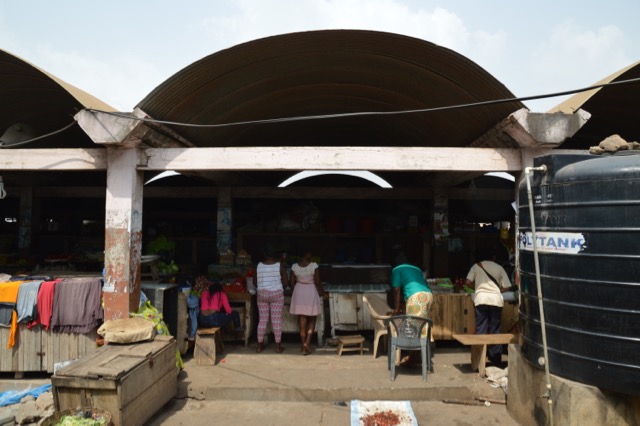
Market within Community 1
Community Centre and Market Area in Community 1
Community 1 Housing and Garden
Community 1 low-rise flats
We began at Community 1 and explored the market area, complete with extended community centre, before finding some of the distinctive ‘Type iv’ housing. The housing has been extended and in-filled but the original basic form is just about discernable. Other housing had been supplemented by gardens and painted facades. The low-rise flats with central access staircase have been well-maintained and there is a strong sense of pride in the neighbourhood here.
Type iv Housing shortly after completion in late 1950s. Courtesy of Michael Hirst
Type iv Housing in 2018
Michael Hirst designed the Type iv housing. He studied at the Architectural Association in the Department of Tropical Architecture before moving out to Ghana (then known as Gold Coast) in the mid 1950s. He worked for the Tema Development Corporation, and lived in the Denys Lasdun designed flats in Tema. We had a good look for these flats and hoped to track them down – but alas, they eluded us….
Community 2 Housing
At Community 2 we saw some grander properties (surely inspired by Maxwell Fry’s work in Chandigarh), as well as a market with vaulted roof and carefully detailed concrete and guttering system. The structure is, however, badly corroded and in need of urgent repair. The traders informed us that the market is likely to be demolished and replaced shortly.
We moved on to Tema Manhean, the ‘replacement fishing village’ built to house the Ga People who were displaced with the building of Tema (see our paper for more detail). The settlement wraps around the light house and is made up of a series of compound houses designed by Maxwell Fry and Jane Drew. We found one compound that was built in 1961 (as noted by the date etched into the concrete during construction) and barely modified since. It was a perfect example of just how successful and adaptable the compound typology can be.
Ola Uduku and colleagues at Edinburgh University hosted an excellent workshop this week on West African Modernism, combining some of the sessions with Docomomo Africa. The result was a very rich series of encounters, exchanges and discussions.
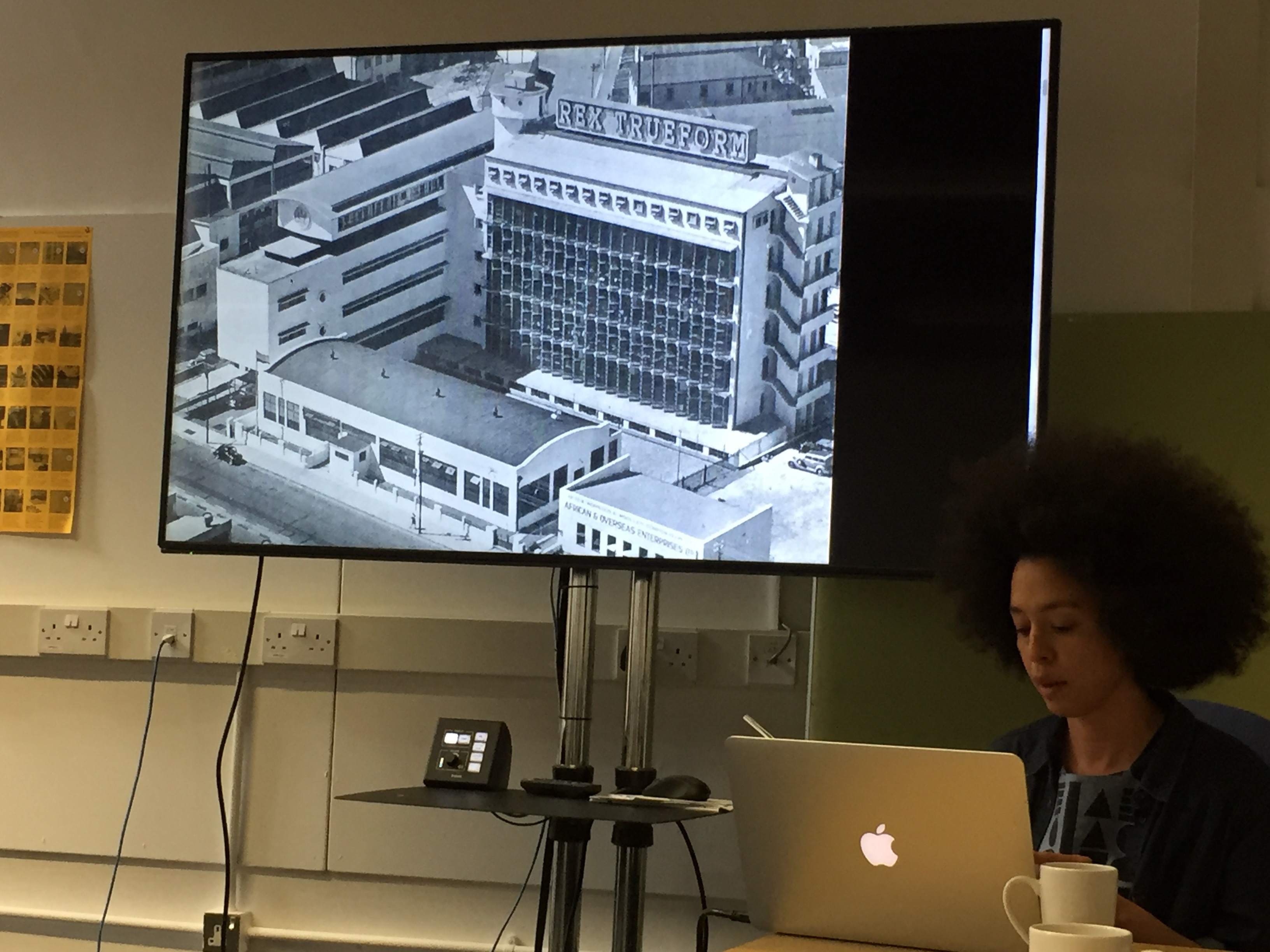
Ilze Wolff presenting Rex Truform’s factory in Cape Town
Ilze Wolff gave a very poignant paper on Rex Truform, the clothing factory in Cape Town designed by Max Policansky in 1937. Ilze’s investigation goes beyond the built fabric and stylistic qualities of the structure – it considers the workers’ stories and what it was like to be a part of the everyday life of this significant building in the city. Ilze is also publishing her findings and interventions through a series of booklets: see Open House Architecture for more details.
Shantanu Subramaniam’s presentation on Community Centres and Libraries in Ghana
Shantanu Subramaniam presented his recent fieldwork on the community centres and libraries of Ghana. In addition to architectural surveying and cataloguing Shantanu is also considering the environment performance of these structures and testing their ability to modify climate and interior temperatures.
Joe Addo’s skype presentation on modern architecture in Accra
Joe Osae-Addo joined us via Skype and shared his film on modern architecture in Accra. The film presented an autobiographical account of Accra and its modern architecture, as seen and experienced by Joe from his childhood onwards. It is a compelling piece that will deliver far more impact in changing ‘hearts and minds’ than reports and conservation legislation.
We also discussed the DOCOMOMO presence in Africa and whether there should be regional groups [such as West Africa, Southern Africa and so on], to generate a more critical mass and greater influence. The reliance on the fiche methodology was also questioned – or at least its limits acknowledged – and we considered the use of ‘narrative’ and social history as a means of generating meaning, significance and connection to these structures beyond the fetishisation of the physical attributes, and tangible qualities.
Cumbernauld townscape
On the final day we were treated to a site visit to the new town of Cumbernauld, and Stirling University.











 Transnational Architecture Group