Archive

Tag Archives: development

From the 1950s to the late 1980s, the politics and economies of foreign aid — instigated by both the ‘capitalist West’ as well as the ‘communist East’ — gave rise to a whole infrastructure destined to assist the progress of ‘developing countries’ on their ‘path to development’. The various North-South exchanges that took place in the name of ‘development’ have left a deep imprint on the geopolitical landscape of postcolonial Africa, Asia, and Latin America.
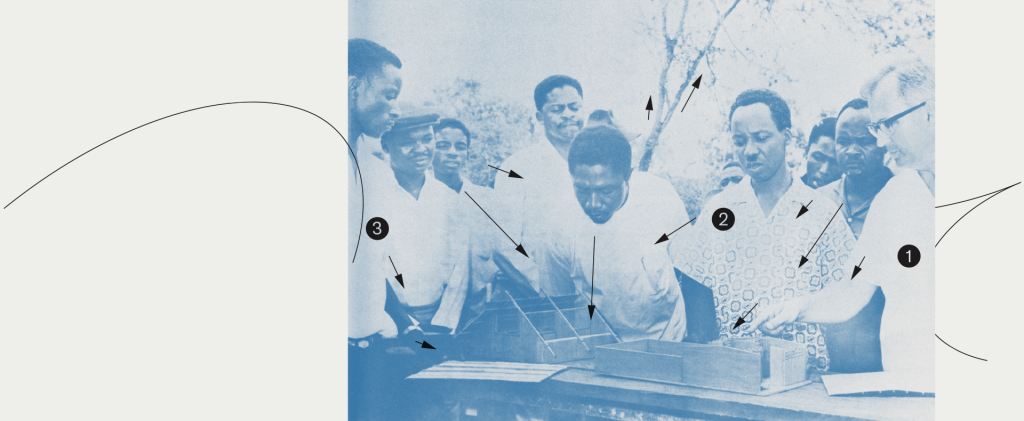
(1) Bertil Melin, the Swedish director of the Nordic Tanganyika Project in Kibaha, showing a model of low-cost housing to (2) President Julius Nyerere, c. 1963-64. To the far left, (3) Mr. Dennis, the carpenter who made the models, co-designed the housing project, and “test-lived“ in the first constructed house with his family. From Torvald Åkesson, ‘Education – In Marble Halls or Under Trees. Low-Cost Houses in East Africa, Especially Ethiopia and Tanzania’, compiled self-published report, c. 1965, Stockholm. Collection KTH Library.

Largely instituted through bilateral relations between individual states, these ‘aid’ initiatives involved not only financial and material resources but also various forms of knowledge and expertise; as such, the modalities of this global, foreign aid-funded infrastructure boosted the creation and reinforcement of all sorts of institutional actors to efficiently exchange knowledge — largely through training courses, educational programs and/or research projects. In the light of widespread rural migration and intensive, rapid urbanization processes, expertise on the built environment was a particularly salient form of knowledge to the aims of foreign aid. Hence, architecture, urbanism and planning were no strangers to an emerging foreign aid-funded knowledge economy — a context in which the production and circulation of knowledge were intimately tied to the political-economic value attributed to them by foreign aid diplomacy.

How did architectural knowledge figure in foreign aid-sourced international relations, and what frameworks were set in place to efficiently exchange that knowledge?

For this two-day symposium, we seek scholarly work that critically analyzes, contextualizes, or theorizes the establishment and functioning of such institutional actors, training courses, educational programs, research centers, and other infrastructures for knowledge exchange that emerged under the aegis of development and targeted ‘Third World’ clients. We welcome a wide range of methodological and creative perspectives as well as less empirical (but well-informed) theoretical approaches that interpret this phenomenon from a postcolonial or decolonizing perspective. We also encourage contributions that scrutinize the intersections of these histories with discussions of gender, race, religion and nationalism.

More information and Register here: https://www.architectureforeignaid.arch.kth.se

The 6th Conference on Infrastructure Development in Africa, has just concluded with a particular focus this year on ‘Building Resilience through African Urban Culture’. Held at KNUST in Kumasi, Ghana the conference welcomed speakers from Nigeria, South Africa and UK, as well as a host of research papers presented from scholars based in Ghana.

Key note speakers (including Prof. Chike Oduoza, Dr Obuks Ejohwomu and Prof. Mugendi M’Rithaa) lucidly presented the varied and many challenges facing African cities today – with particular focus on energy use, digital infrastructure and the internet of every/things.

Prof. M’Rithaa’s presentation included some very striking map visuals, including the image below that shows the true size of Africa relative to other countries – something that Mercator projection of the world fails to reveal. You can just make out on the poor quality photo below the outlines of USA and India. He also spoke very eloquently on how our solutions must be people centred, rather than imposed solutions. Dr Ejohwomu also challenged us with many provocative questions and themes – including a cartoon showing an emaciated cow and a worker abandoning it in pursuit of an obese cattle. His challenge was that we can’t simply walk away from the problem and that Africa needs us to focus on its problems rather than attempting to flee them in the ‘global north’. This message also reinforced by Prof. David Edwards and Dr. Erica Parn in their presentation.

IMG_1313

IMG_1322

I gave a presentation on the rich modern architectural history of Ghana, and the infrastructure of culture that exists here. I focused on a series of building types including education, community centres, and libraries, as well as the town planning and historical development of Kumasi.

IMG_1309

Nearly 50 papers followed on a vast array of topics as well as a striking art installation on the plight of the African Giant Snail’s ecosystem. A new journal was launched ‘Journal of Built Environment (ISSN: 2026-5409) and next year the conference will migrate to Lagos – we look forward to hearing more from this important gathering.