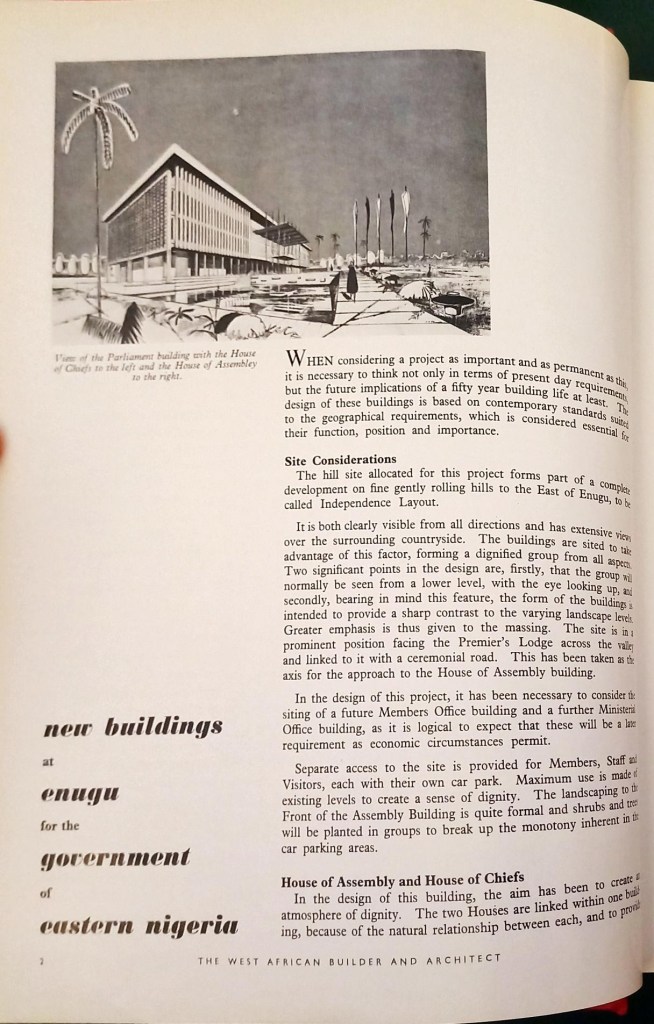
The 1951 victory for Kwame Nkrumah’s Convention People’sParty resulted in some major shifts in the procurement of new infrastructure and housing. For the electorate, housing was one of the most important issues and Nkrumah’s government was quick to recognize this potency.
His plan, announced in 1952, was to build a new port city, complete with innovative and improved housing at the highest standards. Located only 18 miles from the centre of Accra, the new city of Tema would demonstrate Nkrumah’s commitment to industrial development and that Ghana was at the centre of a pan-African vision.
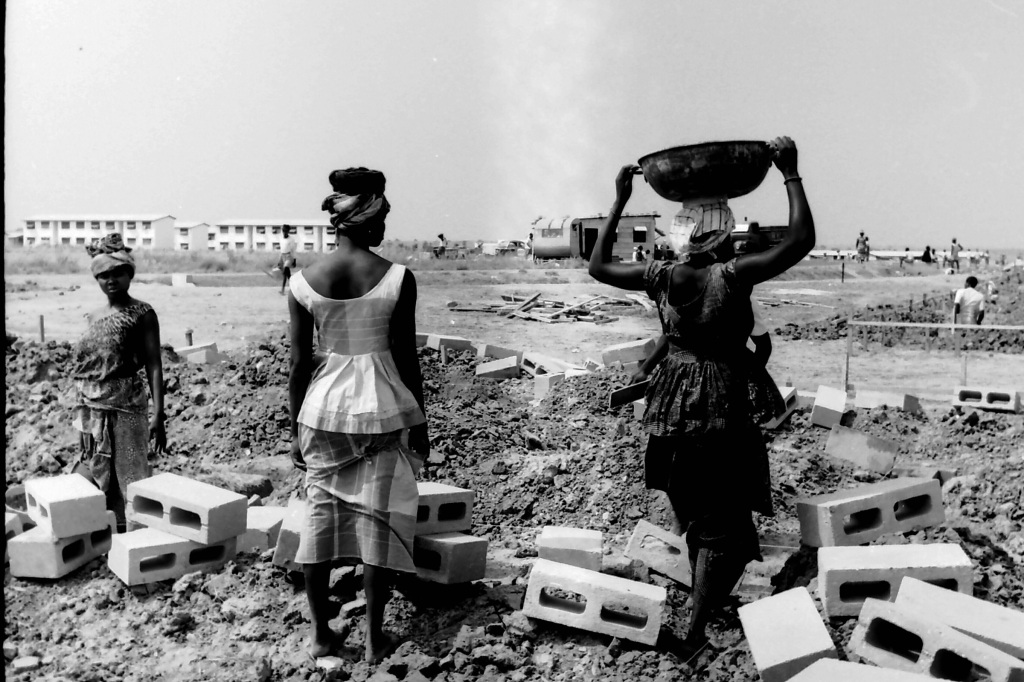
Tema under construction: female labour force transporting blocks and cement
Tema was part of a wider industrialization project that included a new aluminum smelting plant and hydroelectric power station on the Volta River. It was a major project involving international financial backing and set out the major ambition Nkrumah had for the nation during the advent of independence. For such a major project, very little is known about the first team of architects and planners responsible for the execution and delivery.
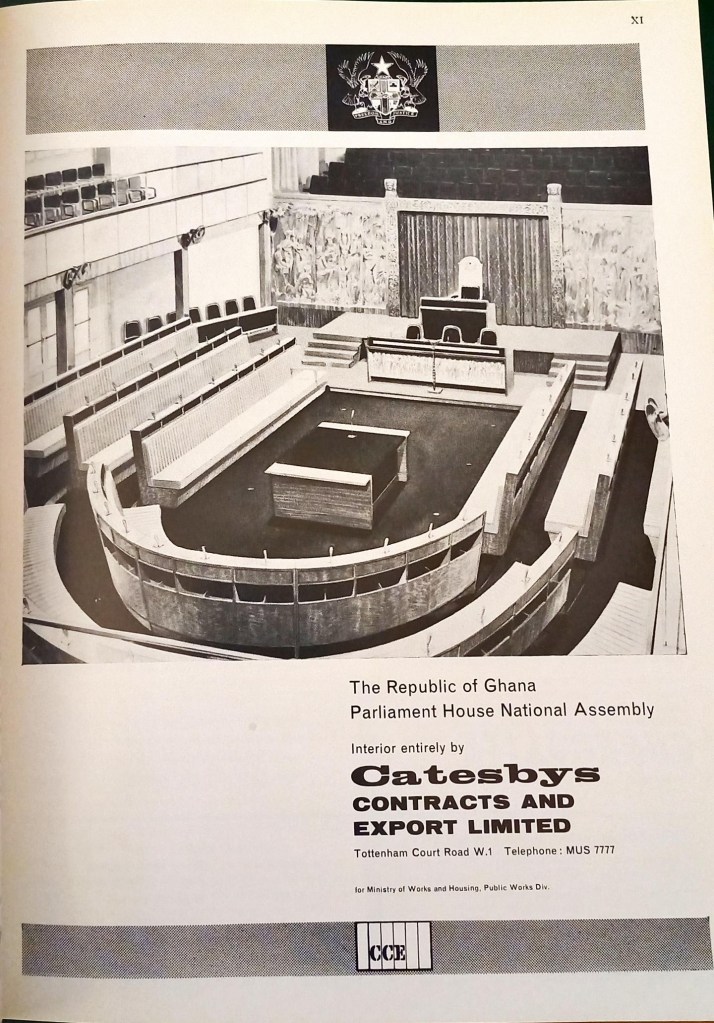
Have a look at https://www.design233.com/articles/from-buckman-to-turkson for my article on some lesser known Ghanaian architects, including John Buckman and Peter Nathaniel Kwegyir Turkson. I uncovered Turkson’s architecture thesis project in the University of Liverpool archives and discuss his plans for a new Parliament Assembly building in Accra.
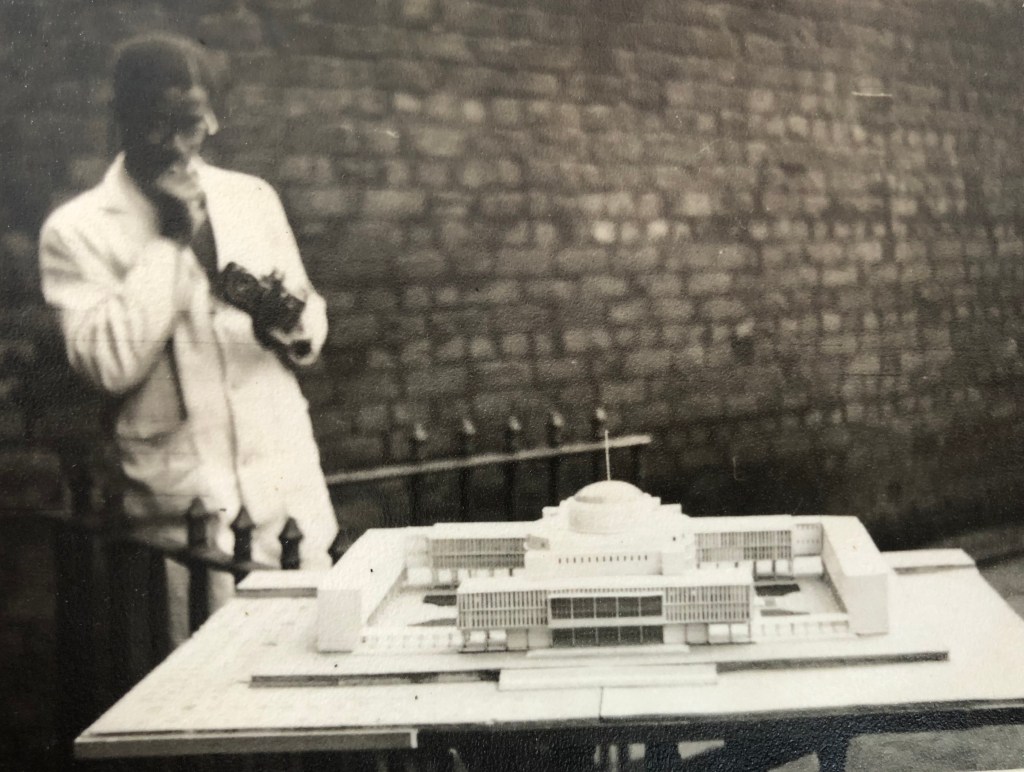
Peter Turkson in Liverpool with his architectural model for a new parliament building in Accra, 1954.
Turkson wanted a design that was ‘classic in character and at the same time distinctly modern in feeling and detail…[exhibiting] the spirit of modern times’.
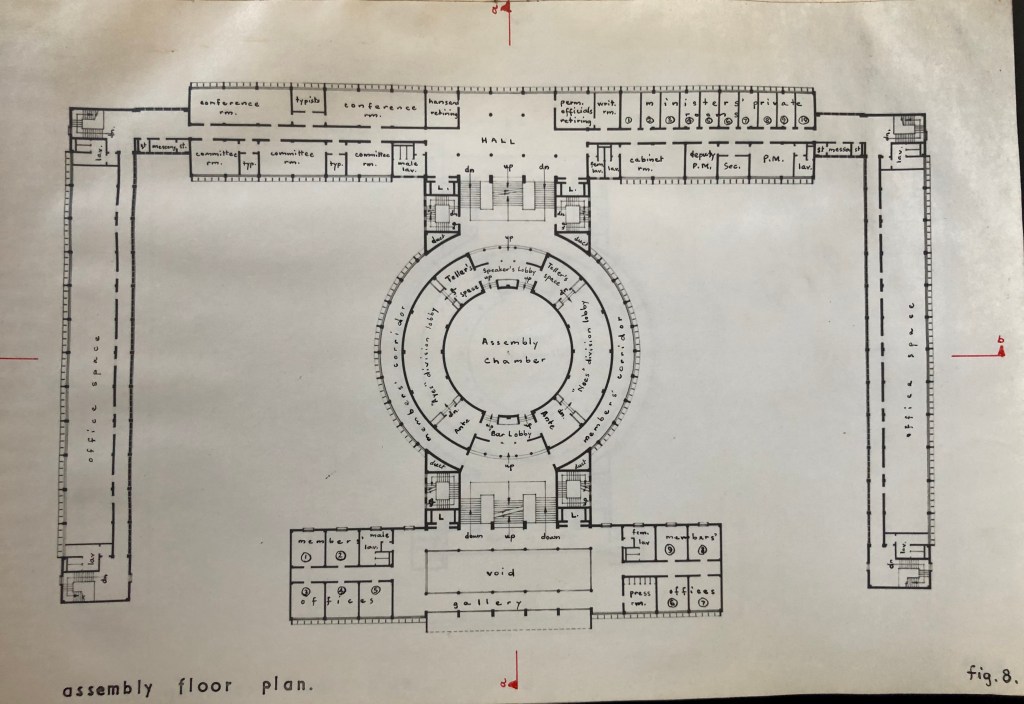
Proposal for the Accra Assembly building, by Peter Turkson, 1954
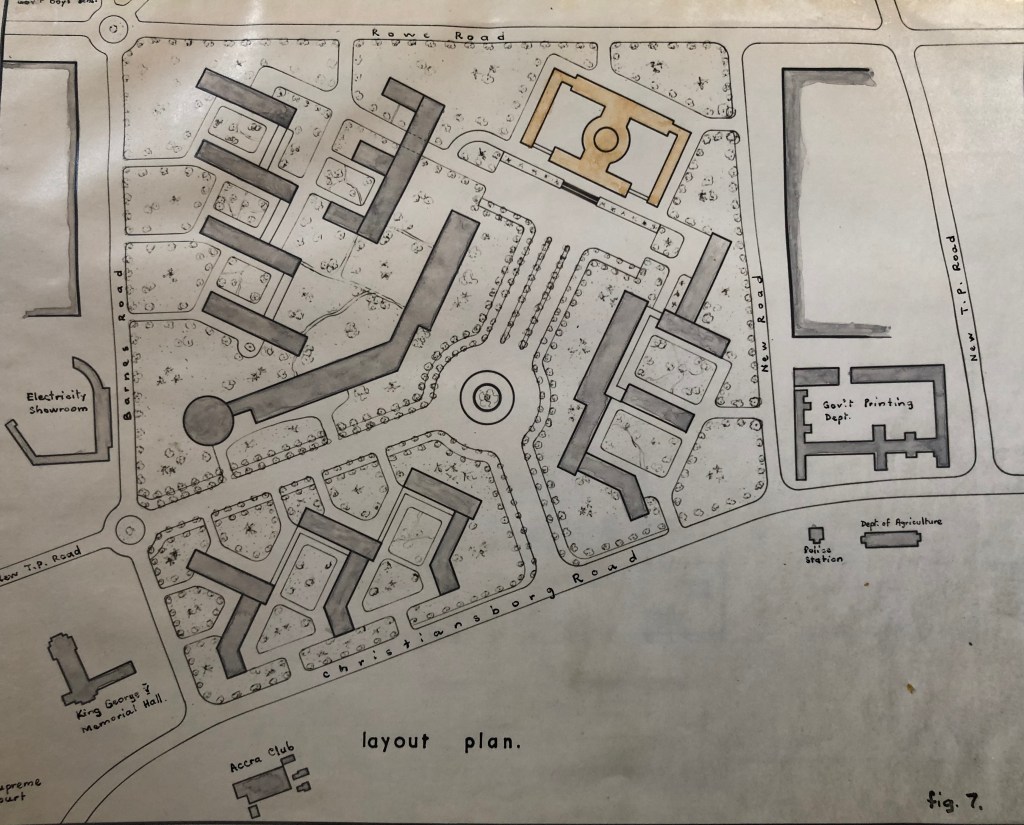
Turkson’s solution proposed using a ‘sandcrete’ (laterite soil mixed with cement) block wall along with a brise-soleil frame of fixed vertical and horizontal fins. Topping the structure and reflecting the chamber below was a reinforced concrete dome clad in copper, whilst some of the walls would be clad with faience finish. The plan was symmetrical forming two courtyards with a central drum for the debating chamber and library above.
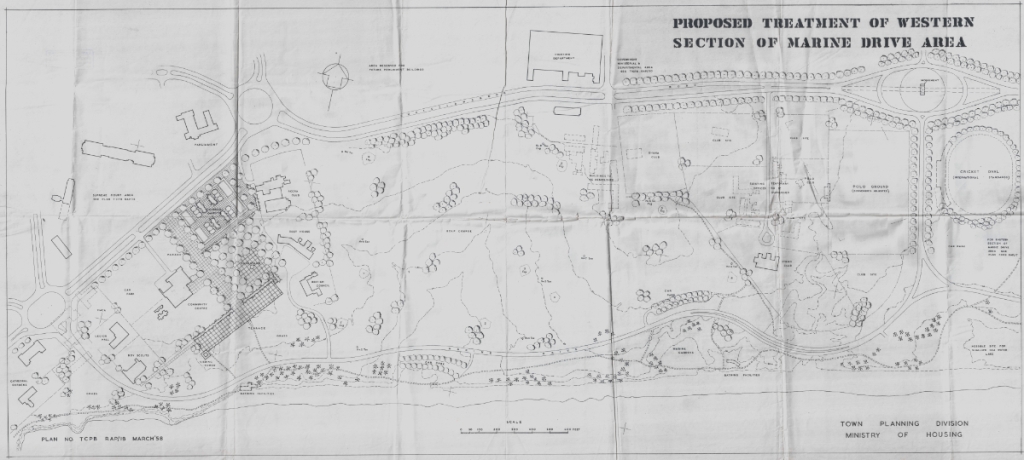
Site plan showing the proposed location of the new Assembly on Accra’s Barnes Road and Christianborg Road.
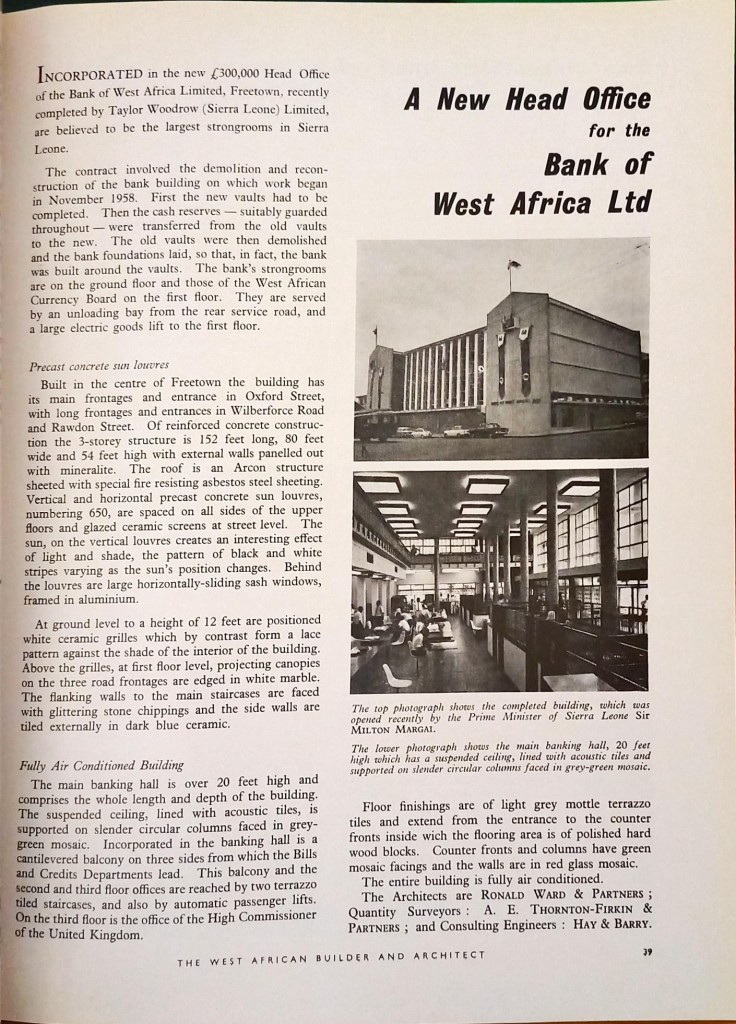
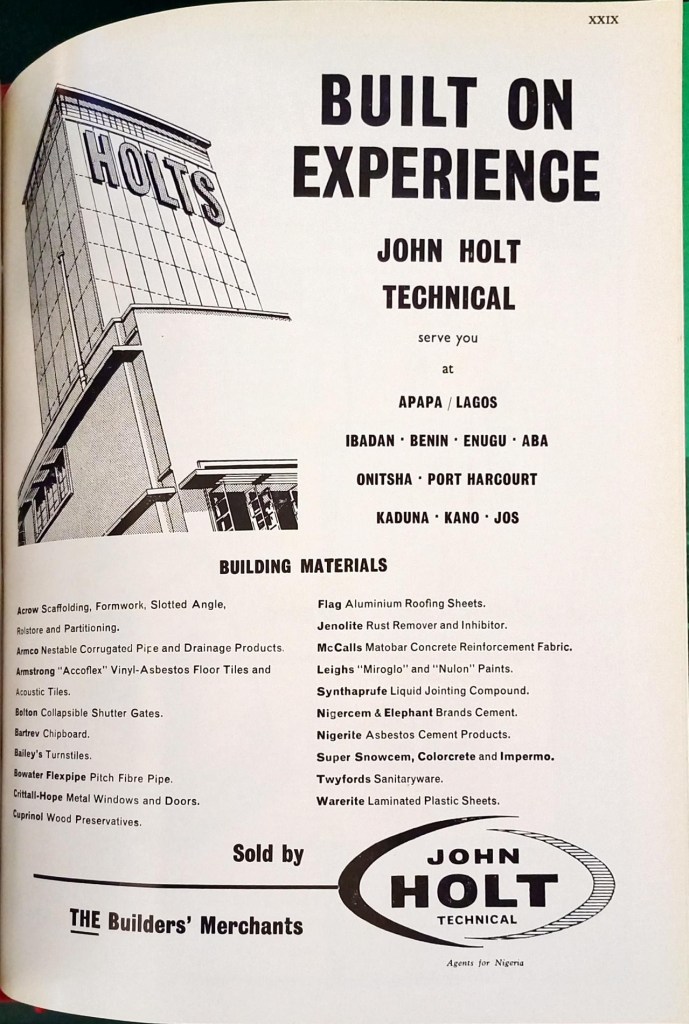
For the past months, we have been exploring the vast United Africa Company (UAC) archive held at Unilever in Port Sunlight. The archive documents decades of commercial activity in West Africa, which left a significant imprint on the built and natural environment. The UAC extracted raw materials such as palm oil and timber, but also exported finished goods such as cars, building materials, and refrigerators. The UAC also sold British products in its department stores across Ghana, Nigeria, and Sierra Leone. Meanwhile, it operated its own shipping line, named Palm Line, that ferried goods between the UK and West Africa. We have come across a variety of different materials, ranging from maps documenting the company’s palm oil plantations in the Congo and architectural drawings showing the modern Kingsway stores in Lagos and Freetown, to detailed notes related to the design of the UAC’s port, Burutu, in the Niger Delta.
Tropical hardwood at Sapele, NigeriaAfrican Timber and Plywood Concessions in Ghana, ca. 1955
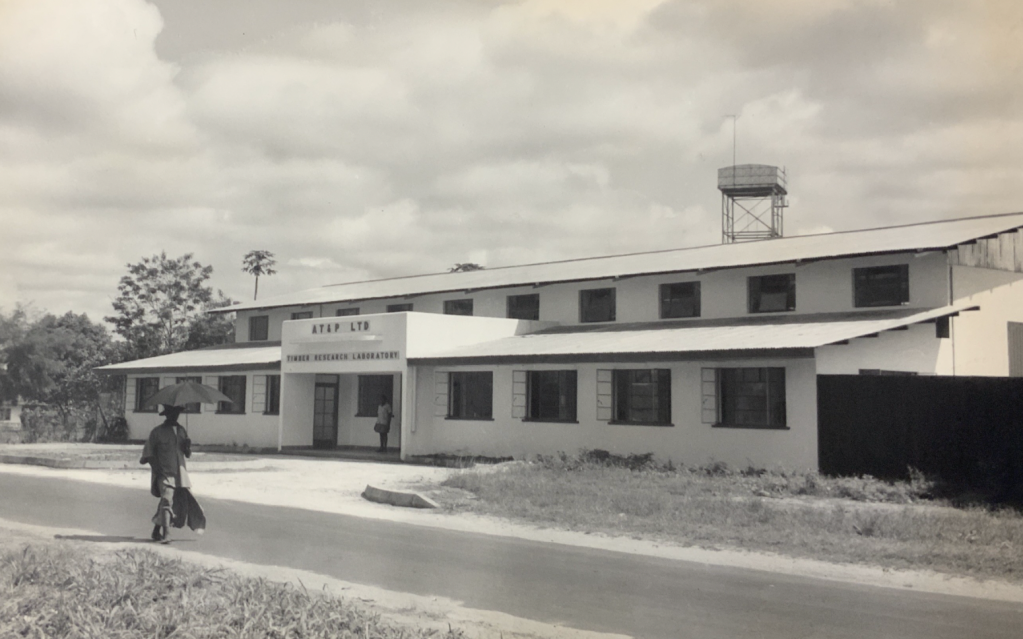
One aspect of the UAC I have been focusing on these past months is the company’s timber operations in Ghana and Nigeria. In the early twentieth century, the UAC founded the African Timber Company (later the African Timber and Plywood Company), located in Sapele, Nigeria. Through a range of concession agreements with local chiefs, they managed to consolidate vast areas of territory around Sapele from which they extracted a wide range of different tropical hardwoods for export to the UK. At the same time, the company began operating in Ghana (then still the Gold Coast), in Samreboi, a hundred miles inland from the port of Takoradi. After World War II, they also built a plywood factory in Sapele—the first of its kind in this area and described as ‘the largest industrial plant in West Africa’—and began producing plywood at a large scale. Using photographs and written documentation, I have begun to explore the construction of these two company towns and their wider infrastructure. While the factories and processing plants were built using prefabricated steel sheds made by Arcon (also responsible for prefabricated houses in the UK during the postwar period), the bungalows for the company’s British employees can be described as traditional. Later, a Timber Research Laboratory was added, as well as showrooms, and several local facilities such as a (plywood) cinema and clubhouse. Through felling hundreds of thousands of logs every year, the company irrevocably left an imprint on these two areas in Ghana and Nigeria and had a devastating impact on the natural environment.
The plywood factory in Sapele, NigeriaSapele, Nigeria, in the 1950sThe Timber Research Laboratory at Sapele, Nigeria
What is interesting is how the work of the African Timber and Plywood Company aligns with the British government’s focus on ‘empire timber’, or the push to use timber in Britain from different parts of the empire for furniture as well as architecture and interior design. While the government attempted to promote empire timber through a variety of exhibitions in the first decades of the twentieth century, the UAC archive reveals how widespread the use of tropical hardwood and plywood produced in Sapele and Samreboi was during the postwar period. Often marketed as giving ‘a feeling of warmth’, it was used for modern furniture made by the Conran Design Group, doors, window frames, and outside paneling for a variety of council housing, but also as interior decoration and flooring in buildings such as the Commonwealth Institute in London and the Commonwealth Royal Pool in Edinburgh. The former headquarters of the UAC in London, United Africa House at Blackfriars, is another case in point: the building’s interior functioned as a display of tropical timber, ranging from mahogany to African walnut and Sapele hardwood—all produced by the company.
Modular furniture designed by the Conran Design Group, made of African walnutDifferent types of tropical hardwood used for the interior of United Africa House, London, 1960s
Another fascinating aspect is the shift to production for the local, West African market in the 1960s and ‘70s, after Independence. Aside from furniture, one innovation was ATP Systems Building, a prefabricated building system using tropical hardwood and plywood. The company promoted this as an affordable, quick, and flexible way to build without requiring much technical knowledge. Documents I found in the archive point out that ATP Systems Building was widely deployed in, for example, Warri, a rapidly growing oil town in Nigeria, to build houses, offices, and schools.
The ATP Showroom in Benin City, Nigeria (originally built for the Lagos Trade Fair of 1962)An ATP employee selling an ATP Systems Building bungalow in Nigeria, ca. 1970
Overall, the archive of the African Timber and Plywood company demonstrates, once again, how (modern) architectural construction in Britain was shaped by colonialism and, conversely, how British companies continued to impact design in the former colonies after independence. Many questions, however, are still unanswered. How, for example, was the work of the timber companies related to the colonial government’s efforts to promote empire timber from Nigeria? How should we understand the widespread use of (colonial) timber in postwar Britain? What prompted the shift to focus on the Nigerian market after Independence? How successful was ATP Systems Building? Over the coming months, we will continue to explore these issues.
This colour footage includes shots of the Great Hall, Kumasi; Methodist Church, Winneba; extensions to Effia Nkwanta Hospital, Secondi, and various others designed by Gerlach and Gillies-Reyburn Architects.
Online Modernist University Campus Architecture Writing Workshop: A Ghana-Nigeria-UK collaboration
The third iteration of the African Architecture Writing Workshop has involved multi-disciplinary teams of young students and Early Career Researchers (ECRs) from Universities in both Ghana and Nigeria in developing a series short written articles focused on personal views of university campus buildings in Ghana and Nigeria. The ECRs worked directly with the young students as mentors to encourage and develop their writing style.
The ECRs have also been tasked with compiling and editing student work to create a series of gazette entries for the Modernist University Campus Buildings in West Africa project. Aside from the written component the ECRs and students have also taken a set of photographs which will form the basis for a future planned photography workshop to be run in association with the International Documentation of Modern Buildings and Landscapes, (Docomomo) team Germany.
The British Academy-funded workshop took place over two weeks starting at the University of Ghana, Legon led by Co-I Dr Irene Appeaning Addo, with support from ECRs Kuukuwa Manful, Emmanuel Ofori-Sarpong, Dr Ayisha Baffoe-Eshun, and Yaw Asare; as well as guest mentor Dr Joseph Oduro-Frimpong. There was a guest lecture from Professor Lesley Lokko. Students from Kwame Nkrumah University of Science and Technology, University of Ghana, and Central University College took part in the workshop. Arc Ruth Anne Richardson, Arc Tony Asare, Dr Edem Adotey, and Professor Iain Jackson reviewed the students’ final written pieces that were focused on three buildings on the University of Ghana Campus; Commonwealth, Volta and Legon Halls.
After a hand over day the Nigeria team’s workshop was led by Co-I Dr Nnezi Uduma-Olugu, and involved three institutions, the University of Lagos, University of Jos and the University of Nigeria, Enugu Campus. Each institution had a number of ECRs who worked at mentoring the interdisciplinary group of students who had enrolled at each of the workshops. As with the Ghana workshop a number of guest speakers including Prof Bogdana Prucnal-Ogunsote, (University of Jos) Kofo Adeleke (Legacy-92 organisation Lagos) and Dr Onyekiekwe Ijeoma, Nigeria commission for Museums. For the Nigerian final critical reviews attended by Prof Lukasz Stanek (University of Manchester) and Dr Joseph Oduro-Frimpong (Asheshi University Ghana) the ECRs presented their edited summaries of the student-written work and views on campus buildings in the three cities.
ECRs then presented their workshop experience at the Lagos Studies Association International Online Conference at a roundtable panel on conservation challenges in Africa chaired by Profs Uduku and Lawanson, Manchester School of Architecture, Manchester Metropolitan University, and University of Lagos respectively.
Whilst students and ECRs met in covid secure ways at their respective campuses all lectures and reviews took place entirely online, with students and ECRs able to work from ethernet-wifi equipped room spaces at the University of Ghana, and all three Nigerian collaborating Universities.
Currently ECRs are working on the editing and production of the initial phase of the Modernist African University Campus Buildings Gazette, this will be critically reviewed by Prof Miles Glendinning, Docomomo Scotland and Director SCCS University of Edinburgh. Watch this space…
This film documents work songs of a fishing community in Ghana, the West-African roots of the work-song tradition shown in the films “Afro American Worksongs in a Texas Prison” and “Gandy Dancers”. The film shows the community singing as it pulls fish nets onto the shore and men on boats in heavy surf singing to pace their rowing. It was shot 40 miles northeast of Accra, Ghana, January 7th or 8th, 1964.
The film material is part of the Seeger collection at the Library of Congress.
The University of Liverpool and The National Archives are pleased to announce the availability of a fully funded collaborative doctoral studentship, under the Arts and Humanities Research Council (AHRC) Collaborative Doctoral Partnership (CDP) scheme.
Using The National Archives extensive collections the project will investigate how the West African ‘built environment’ has been shaped to respond to various political, economic, and welfare demands and ambitions. The particular timeframe will cover the transition from colonial rule into independence period. After tracking these broader notions across ‘British West Africa’, the project will pursue a narrower focus on one of the four former British colonies.
How were ideas of ‘self’, identity, freedom, and so on, expressed through new construction and town planning? How did former colonisers, and other foreign groups attempt to shape and influence these developments in the ‘post-colonial’ period. How were notions of identity, nation, and ‘new beginnings’ expressed by the postcolonial nations?
The aim of the project is to investigate how political ideas, and notions surrounding identity, nationhood, and statecraft are expressed or manifest through the built environment.
Infrastructure, prestige projects, and grand architectural schemes are often used to infer power, or suggest modernity, development, and progress. Equally, more (seemingly) mundane developments, such as housing, can be as revealing in terms of power structures and wider ambition. In a problematic and contested political situation these types of projects become highly charged and significant expressions of a nation’s collective (and often contested) identity. This is even more meaningful in a colonial context, and architecture, town planning and infrastructure, in part, become symbolic expressions of the colonial power.
The objective of this project is to examine these notions within the West African context over a period of time that spans the late colonial era and early post-colonial period. This was a particularly volatile moment, charged with excitement and optimism, and a desire to somehow ‘start again’ and rebuild a new nation with a new vision. Architecture and planning would shift from being expressions of colonial dominance and subjugation to being expressions of nationalism, hope, and modernisation.
It is sometimes tempting to see the event of Independence as an abrupt and sudden moment. The clock strikes twelve and everything suddenly changes – and whilst this is true, it is also oversimplifying a complex event that is, to some degree, still being played-out today. There is also a sense of inertia in the built environment and existing city plans, methods of development, and networks of expertise stubbornly persist and outlast political dynasties.
The desire for the newly independent nations to express their hard-fought freedom through physical, often large-scale triumphant (sometimes infrastructure) projects was met with the former colonial power’s aspiration to continue offering technical assistance, expertise, and trade. It resulted in a complex blend of nationalism, reimagining/reinventing identity and Pan-African ambition, further mixed with the additional influences of ‘non-aligned’ socialist assistance and US, World Bank, and UN concerns.
The independence of these nations was not an abrupt severance from the former colonial power, but a feathered, gradual transition coupled with intense global interest eager to retain or cultivate influence and trade advantage.
It makes for a fascinating narrative that reveals the shift from overt imperialism, to one of post-WW2 ‘technical assistance’, ‘development’, and fiscal packages from an array of competing agencies and organisations, met with a desire to express African modernisation, liberation, and success.
Start date 1st October 2021
Applications due 25th May 2021
Interviews planned for 22nd June 2021
For any enquiries please contact: Professor Iain Jackson on: ijackson@liv.ac.uk
How to Apply: To apply for this studentship, please send the following documents to artsrecruit@liverpool.ac.uk:
Full Curriculum Vitae (CV)
Cover Letter expressing motivation for applying and pursuing a PhD on this topic.
Project Plan: This is your chance to set out how you would like to design and plan the research project and should not exceed 1000 words. Please produce a Project Plan that includes the following headings:
Proposed project outline and suggested research questions
Proposed Methodology
The National Archives / other archival sources to be consulted
Selected Bibliography.
The project can be undertaken on a full-time or part-time basis.
CDP doctoral training grants fund full-time studentships for 45 months (3.75 years) or part-time equivalent. The studentship has the possibility of being extended for an additional 3 months to provide professional development opportunities, or up to 3 months of funding may be used to pay for the costs the student might incur in taking up professional development opportunities.
The student is eligible to claim additional travel and research related expenses (worth up to £1000 per year for four years) during the course of the project, courtesy of The National Archives.
· We want to encourage the widest range of potential students to study for a CDP studentship and are committed to welcoming students from different backgrounds to apply. We particularly welcome applications from Black, Asian, Minority Ethnic backgrounds as they are currently underrepresented at this level in this area.
· Applicants should have an undergraduate degree in subjects allied to the Built Environment/Architecture/History/Cultural Geography.
· A Masters level qualification is desirable but not essential. Applicants may be able to demonstrate equivalent experience in a professional setting (e.g. producing and researching written reports, public outreach and liason, working with collections and archives).
· Experience of working in West Africa is desirable but not essential.
· Applicants must be able to demonstrate an interest in the archives sector and potential and enthusiasm for developing skills more widely in related areas.
· As a collaborative award, students will be expected to spend time at both the University and The National Archives.
This is a joint project with AHRC Collaborative Doctoral Partnership programme. The external partner is the National Archive, Kew. See View Website The award pays full maintenance for all students, both home and international students. The National Minimum Doctoral Stipend for 2021/22 is £15,609, plus an allowance of £1000 per year and a CDP maintenance payment of £550 per year.
Mojca Smode Cvitanovic, ‘New Paper: Tracing the Non-Aligned Architecture: Environments of Technical Cooperation and the Work of Croatian Architects in Kumasi, Ghana (1961-1970)’ Histories of Postwar Architecture, 3(6), 34-67. Full paper available here: DOI: https://doi.org/10.6092/issn.2611-0075/10450
Unity Hall, KNUST, designed by Miro Marasović and John Owusu Addo, 1968.
Focusing on the work of a group of Croatian i.e. Yugoslav architects in Ghana, the paper explains the nature of technical cooperation as a model of temporary international contract work in relation to the specificities of the environment built consequently. It focuses on the engagement of Miro Marasović as the head of the Kwame Nkrumah University of Science and Technology Development Office from 1961 to 1964. As its contextual framework, the paper addresses bilateral technical cooperation as a form of international communication and exchange, the practices of the Non-Aligned Movement, and the interrelations of the pre- and post-independence generation of modern architecture in Africa.
Infrastructure between Statehood and Selfhood: The Trans-African Highway
Kenny Cupers, Prita Meier
Journal of the Society of Architectural Historians, Vol. 79 No. 1, March 2020; (pp. 61-81) DOI: 10.1525/jsah.2020.79.1.61
Focusing on the 1960s–70s project to build a trans-African highway network, Infrastructure between Statehood and Selfhood: The Trans-African Highway argues for the need to develop a more dialectical understanding of the relationship between people and infrastructure than current architectural and urban scholarship affords. As Kenny Cupers and Prita Meier describe, African leaders imagined infrastructure as a vehicle of Pan-African freedom, unity, and development, but the construction of the Trans-African Highway relied on expertise and funding from former colonial overlords. Based on archival research, visual analysis, and ethnographic fieldwork in Kenya, this article examines the highway’s imaginaries of decolonization to show how infrastructure was both the business of statehood and a means of selfhood.
Map of the Trans-African Highway project, late 1970s (Rolf Hofmeier, “Die Transafrikastraßen: Stand der Planung und Realisierung,” Africa Spectrum 14, no. 1 [1979], 35).
From the automobile and the tarmac road to the aesthetics and practices of mobility these fostered, infrastructure was a vehicle for the production of subjectivity in postindependence Kenya. This new selfhood, future oriented and on the move, was both victim and agent of commodification.