Archive

Tag Archives: gold coast

Notes from Tema, Ghana

We visited Tema, the new port and town built 10km east of Accra in the 1950s and early 1960s. Planned as part of a suite of infrastructure projects including, an aluminium smelter, docklands, and hydroelectric dam, the town was to provide model housing in a series of self-contained neighbourhoods, called ‘Communities’. Each has its own central market area and Community Building surrounded by a series of residential areas. The houses are set around schools and recreation areas, and grouped according to size and occupant income.

We began at Community 1 and explored the market area, complete with extended community centre, before finding some of the distinctive ‘Type iv’ housing. The housing has been extended and in-filled but the original basic form is just about discernable. Other housing had been supplemented by gardens and painted facades. The low-rise flats with central access staircase have been well-maintained and there is a strong sense of pride in the neighbourhood here.

Michael Hirst designed the Type iv housing. He studied at the Architectural Association in the Department of Tropical Architecture before moving out to Ghana (then known as Gold Coast) in the mid 1950s. He worked for the Tema Development Corporation, and lived in the Denys Lasdun designed flats in Tema. We had a good look for these flats and hoped to track them down – but alas, they eluded us….

Community 2 Housing

Community 2 Housing

At Community 2 we saw some grander properties (surely inspired by Maxwell Fry’s work in Chandigarh), as well as a market with vaulted roof and carefully detailed concrete and guttering system. The structure is, however, badly corroded and in need of urgent repair. The traders informed us that the market is likely to be demolished and replaced shortly.

Community 2 Market

We moved on to Tema Manhean, the ‘replacement fishing village’ built to house the Ga People who were displaced with the building of Tema (see our paper for more detail). The settlement wraps around the light house and is made up of a series of compound houses designed by Maxwell Fry and Jane Drew. We found one compound that was built in 1961 (as noted by the date etched into the concrete during construction) and barely modified since. It was a perfect example of just how successful and adaptable the compound typology can be.


SaveSave

Field Work: Axim and Dixcove

Heading west from Takoradi along the coast-road towards Côte d’Ivoire there are a number of fishing towns and natural harbours, such as Axim and Dixcote.

img_0697

Dixcove Harbour

IMG_0692.jpg

Fishing Boats at Dixcove

Axim was a major port during the early 20thC, exporting £250,000 worth of goods in 1913, and the mail boat from Liverpool (as well as ships from the US, Germany and Belgium) called every 10-15 days before heading on to Sekondi. Before the British occupied the Fort at Axim (Fort St. Anthony) it was held built by the Portuguese in 1515 and then captured by the Dutch from 1642. The Fort was conceded to Britain, along with the other Dutch forts east of Elmina on the 6th April 1872.

A European hospital was established in the town in 1901, and the British Bank of West Africa opened a branch, having traded in Accra from 1897. There are still some colonial buildings to be found, and a photograph of the District Commissioner’s bungalow (c.1914) is held in the UK National Archives.

axim-bungalow

Type B Public Works Department Bungalow in Axim

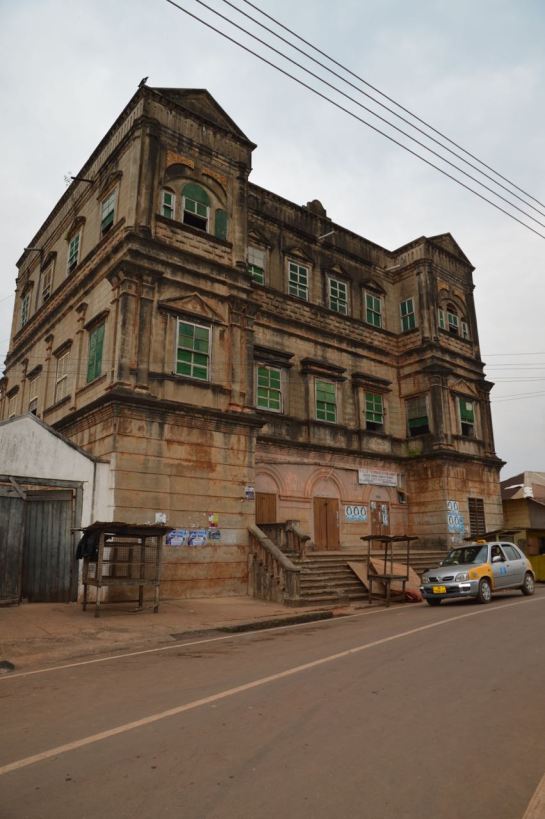
Besides the Fort, the Quandahor Building dominates the town from its elevated position. The building (according to some sources) was built in the 1920s, but with what purpose and by whom?

dsc_0426

Quandahor Building in Axim

Nearby Dixcove also has its fort (macabrely named Fort Metal Cross after the slave branding iron used there) and the town still retains its thriving fishing industry. The fortress was constructed from 1683 by the Royal African Company and continues to resemble the 1806 print below. Needless to say, it is a harrowing structure, and a surviving relic of what must be one of the lowest points of British history.  By 1868 the Fort was under Dutch control, before being returned to the British just four years later. It was made a World Heritage Site in 1979 and has recently been inhabited by an Englishman intent on refurbishing the place.

phpthumb_generated_thumbnailjpg-2

1806 Print depicting Dixcove

DSC_0414.jpg

Dixcove Fortress

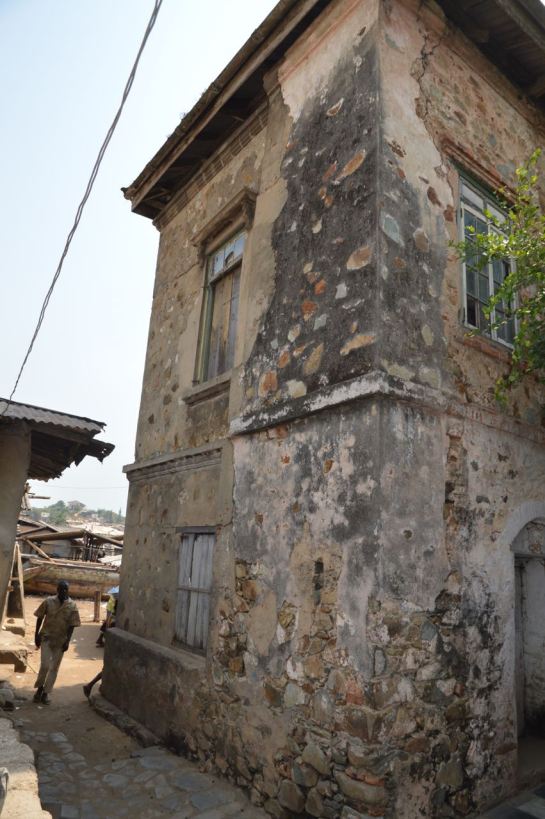
It was only in 1911 that a Customs Warehouse was completed and a market shed was erected in the Dixcove – is the image below the customs warehouse? A few other Colonial period buildings survive and we will endeavour to find out more about this fascinating place.

dsc_0423

The Customs Warehouse in Dixcove?

A.E.S. Alcock and the planning of Asawasi, Kumasi

As part of our research into the architecture and planning in West Africa we have uncovered some important work undertaken by Alfred Edward Savige (“Bunny”) Alcock. He worked as  Town Engineer in Kumasi, 1936-45, and then as Gold Coast Town Planning Advisor from 1945-56. Whilst working in Kumasi, Alcock was a pioneer in developing self-build villages. He set up small scale production lines where the villagers could produce ‘swishcrete’ blocks, prefabricated roof trusses and various sanitation devices such as latrines and communal laundries.

DSCF0073

This work was all carefully documented by Alcock and his hand-made photo album survives in the National Archives, London.  Maxwell Fry and Jane Drew worked with Alcock on this ‘experimental village’ (they were credited in Alcocks album) and went on to plan the larger second phase of the development, known as Asawasi. Fry described how the project grew, ‘from being a little experiment has become a big scheme spawning all over the hillside.’

Alawasi_plan

The plan above shows the complete development arranged into ten compounds (housing groups). The area coloured pink was the original village planned by Alcock with the remaining areas designed by Fry and Drew. Alcock proposed a terraced (row) housing approach to create ‘interior’ courtyards, or ‘open compounds’. Alcock described it as a ‘ a repetitive pattern of garden and service compounds alternating… this pattern is adapted to curving contours in the main estate.’ There was a low-tech thrifty approach to the development as Alcock describes,

‘door and window furniture was made from scrap iron by blacksmiths. It was stronger and cheaper than imported furniture.’ In the kitchen a hood and flue were provided by using ‘old tar drums covering all four fire places shared by eight tennants’
Fry and Drew’s Village Housing in the Tropics is indebted to this early development. Alcock proudly noted that his designs could exceed the current building regulations and reduce costs. The big idea was for the government to supply the materials (and technical knowledge) with the villagers providing the labour. It was a system that became very popular throughout West Africa, although it was not always a fair and equitable solution.

DSCF0075

Alcock took over from Fry as the Town Planning Advisor in Accra and was instrumental in the initial planning of Kwame Nkrumah’s Volta River project, new port and town Tema. He (along with Helga Richards) published his findings in a series of ‘How to’ building guides. Although less commercially successful than Fry and Drew’s acclaimed Village Housing in the Tropics manual, Alcock’s books were far more pragmatic and explanatory. There is also an element of humour in his books. How to Plan your Village for example is all about an educated villager returning to his old village and helping them to restore it – the character is named ‘Kwame’  – an overt reference to Nkrumah and a metaphor for the radical changes he was proposing.

howtovillage