Eager to secure the provision of raw materials at low cost to its flourishing soap factories in Liverpool, Lever Brothers and the United Africa Company (UAC) acquired land concessions from colonial states across the oil palm belt in West Africa. Beginning from the early 1910s, subsidiaries such as the Huilieries du Congo Belge (HCB, later Huilever and Plantations du Congo), and Pamol, established oil palm plantations in today’s DR Congo, Congo-Brazzaville, Nigeria, Ghana and Sierra Leone.
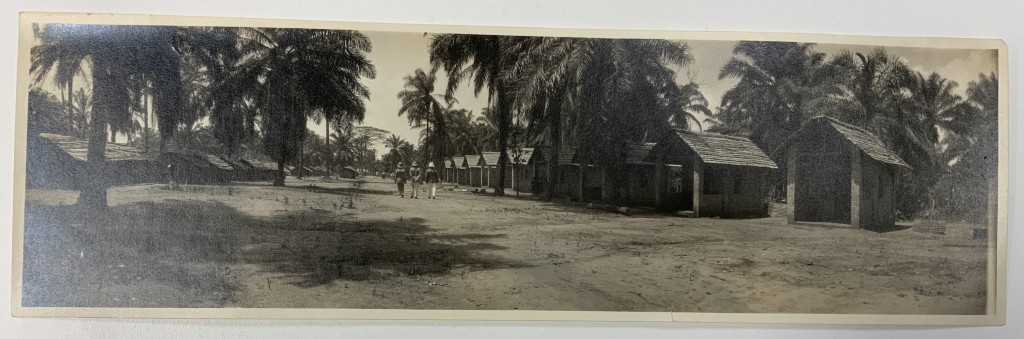
Plantation workers holding a bunch of fruit of Elaeis Guineensis (African oil palm). Oil is derived from fruit’s outer layer and cracked kernel. The photo was taken near the Alberta plantation in the Belgian Congo, probably in the 1930s or 1940s.Agronomists selected oil palm varieties to maximise the quantity of oil and facilitate the cracking of the kernels.Plan of a plantation on the Benin river in Nigeria showing the subdivision of the planted area in square sectors; the location of the oil mill and wharfs where palm oil was extracted and loaded on boats; and the area where worker houses were built.
Historians such as Jules Marchal lengthily detailed the brutality of Lever Brother’s exploitation especially in the Belgian Congo, the forced resettlement of local population, and the violent repression of “uncooperative workers”. However, this attitude uneasily coexisted with a paternalistic, but probably genuine, hope that plantations would bring “progress and civilisation”. Such hope – Benoit Henriet argues – was compromised by the overriding need to turn a profit but it requires to be analysed beyond oversimplifying narratives of predatory capitalism.
Our initial exploration of the rich UAC archival collection revealed that plantations had been the locus of a wide array of experiments combining agronomic knowledge with political, economic, social, and cultural tools. The plans and photos of worker houses and communal facilities, and the numerous written exchanges on the social aspects of work organisation and the daily life of workers in the plantation shows that architecture played a relevant role in giving tangible form to the company’s largely unfulfilled ambitions to widespread social development.
Diorama showing two HCB oil palm plantations presented at the Ghent Universal and International Exhibition in 1913.“Model houses” for workers in the Brabanta plantation, Belgian Congo.Native dwelling quarters in an unidentified Huilever plantation.Views of worker houses and public facilities in Leverville, Belgian Congo.
While the construction of villages for plantation workers such as Leverville offers the occasion for a critical reflection on the role of architecture in private colonial exploitation, other documents from the UAC archives suggest that plantations had been the testing ground for innovative spatial planning models. Indeed, over the course of the 20th century, changes in plantation management and spatial structure overlapped with the evolution of ideas on social engineering and rural development.
In the 1930s and 1940s for example – as Jonathan Robins highlights – in response to the well grounded critiques on the social and environmental sustainability of plantations in West Africa, UAC proposed plans for a reformulation of plantation organisational system. The model they proposed would later influence policy recommendations given by international organisations such as the World Bank to developing countries across the globe. The experimental plantation model, the Nucleus Estate-Smallholder (NES) model, claimed to combine the virtues of the plantation system of management with the “social attractions” of peasant agriculture. This farming system entailed a spatial structure in which a nucleus, composed of a plantation established on a land concession and managed by UAC, is surrounded by further plantation sectors operated by smallholders.
The extent to which this and other models were successful in improving the living condition of local farmers or rather were functional smokescreens for the perpetuation of colonial or neo-colonial extractivism remains an highly debated topic. Certainly, plantations remains, both at the architectural and territorial scale, a fascinating subject which we will continue to explore in the following months and an opportunity to explore the multiple intersections between development ideologies, colonial and post colonial histories, and architectural and planning knowledges.
–
Henriet, B. (2021) Colonial impotence: virtue and violence in a Congolese Concession (1911-1940), De Gruyter Oldenburg.
Robins, J.E. (2021) Oil palm: a global history, University of North Carolina Press.
Marchal, J. (2008) Lord Leverhulme’s ghosts, Verso. First published in French as (2001) Travail force’ pour l’huile de palme de Lord Leverhulme: l’histoire du Congo 1910-1945, vol.3, Paula Bellings.
Name: Heather Lynn McGrath Alcock PhD Research Title: Beyond the Village: The Global Value of Port Sunlight
Dissertation Supervisors: Professor Iain Jackson, Dr Ataa Alsalloum and Dr Cheryl Hudson
Research Question: Does Port Sunlight village express Outstanding Universal Value and if so, what material and intangible aspects of the site express its influential, unique, and exemplary character?
Aim: The aim of my research is to define the heritage values of Port Sunlight village in a comparative global context.
Figure 1: Mapping global planned worker villages. Sites are mapped by latitude and longitude and key characteristics are recorded for each site, including dates for development, designer, industry, and heritage site management indicators such as statutory protections.
Objectives:
Identify, map, and analyse the transmission of ideas and images for Port Sunlight village and two similar sites Bournville and New Earswick from 1889-1939.
Complete desk-based research to identify, map and briefly describe global planned worker settlements, garden suburbs, and Garden Cities.
Compare transmission of ideas and images research against the development of planned worker settlements, garden suburbs and Garden Cities research to identify and describe possible connections and influences.
Undertake case studies for more in-depth comparative analysis, including archival research, field work and interviews with stakeholders.
Analyse findings to determine if there is a correlation between the transmission of images and ideas and the development of planned worker villages. If so, would it be possible to identify the primary influence? Were direct or indirect forms of transmission most prevalent? What methods were most effective or enduring? Lastly, is it possible to directly trace Port Sunlight’s influence?
Define Port Sunlight’s heritage values within UNESCO’s framework for world heritage site inscription.
Figure 2: The model worker village at Port Sunlight was both a highly local and ‘tied’ manufacturing community and a global phenomenon. Foreign visitors toured the site regularly and Lever Brothers had a global business operation by 1900. This 1901 quote from the Crown Prince of Siam featured in the opening pages of the 1905 “Souvenir of Port Sunlight” by Lever Brothers Limited. (Held by Port Sunlight Museum, Collection Reference S13 1905)
Background to Port Sunlight
Port Sunlight is a planned worker village created by industrialist William Lever (1851-1925) for the workers in his soap manufacturing company Lever Brothers, which later became global manufacturing corporation Unilever, plc. Port Sunlight holds a unique place in the history of British town and country planning, where two significant traditions meet: picturesque town and country planning and improved housing and amenities for working class people”.1
Construction of the Lever Brothers’ works started in 1888 and the first houses were occupied by 1889. By 1891, Lever Brothers had built their first community facility, Gladstone Hall and they were publishing visitor ‘guidebooks’ to promote the works and village.
By the start of the first world war, the village had a wide range of facilities, including two schools, cottage hospital, an open-air swimming bath, 3000-seat auditorium, gymnasium, library, savings bank, social clubs, shops, church, tennis and bowling lawns, football pitch and pub. The houses and facilities were set in a generous landscape with passive green spaces, designed landscapes and allotments.
Figure 3: Plan of Port Sunlight as it was in 1938 by historian Michael Shippobottom in consultation with Edward Hubbard. The plan, reproduced in Hubbard and Shippobottom’s A Guide to Port Sunlight Village (3rd Edition, Page 34, Figure 32) illustrates the village at its first Jubilee.
Port Sunlight village became a conservation area in 1978 and includes over 900 Grade II-listed buildings within 130 acres of parkland and gardens.
Research Justification
Port Sunlight faces many challenges, articulated in a suite of evidence-based strategic documents developed from 2018-2021 by Port Sunlight Village Trust (PSVT), the independent charity charged with the care and promotion of the village.2 PSVT, working in partnership with key stakeholders, plans to undertake significant projects and to advance key business objectives to address these challenges and to ensure the long-term sustainability, accessibility and inclusivity of the site.3 The research will support PSVT, village stakeholders, academics and practitioners to better understand the global value and significance of the site and to make more informed decisions about its future.
Research Methodology
My work will be informed by extensive archival research, case studies and oral histories, and my professional experience and understanding of heritage values (including current dialogue challenging the processes for identification and management of heritage sites), but it will also engage with the theoretical, contextual and historiographic approaches of others who have studied the design, development, transformation and impact of planned worker villages from multiple disciplines.
Figure 4: Bridge Street and Park Road terraces houses in Port Sunlight by Douglas and Fordham, 1893. Digital version from the Drawn Together collection under Creative Commons CC-BY-NC-ND. Original drawing held by Unilever, plc.
What did I do before the PhD Research?
As a British-American citizen and a mature student, I enjoyed twenty years in built heritage practice in the USA and UK. My academic degrees in Cultural Anthropology and Historic Preservation from the University of Pennsylvania led to private heritage consultancy in New York City. There I worked for Building Conservation Associates, Inc. on many aspects of built heritage practice across the country. In New York, I developed a practical approach for the creative adaptation and conservation of listed buildings for tax credit projects, which resulted in the regeneration of at-risk heritage sites. Research underpinned my practice, including heritage policies for the United Nations Headquarters in New York and a serial listing for the New Canaan Moderns.
Before starting my PhD at Liverpool, I served as the Heritage Conservation Officer for PSVT, where I had the opportunity to draft one of England’s first Local Listed Building Consent Orders, to design and implement a conditions and integrity survey of the 923 listed houses in the village, co-authored the Conservation Management Plan (2018) and managed Drawn Together, a Lottery-funded partnership project to digitise original drawings for Port Sunlight. It was through my work for PSVT and direct engagement with village residents that I developed an appreciation for my research site and its stakeholders.
Why did you pursue a PhD and what made you choose the University of Liverpool?
Since immigrating to the UK in 2009, I had felt the pull towards further education, particularly in a British context. I found time during the disrupted life of the pandemic to apply for both a PhD and research funding. The Society of Architectural Historians of Great Britain (SAHGB) awarded me their Graham Child Scholarship, so the question of funding was very happily and gratefully resolved. My choice of university was straight forward. I was well-acquainted with the School of Architecture, the excellent reputation of its researchers, its facilities, and resources. Both the Architecture and Planning departments had ties to Port Sunlight and the archives hold significant collections for the transmission of ideas research. I had met both Ataa and Iain through my work at Port Sunlight and felt they would make an ideal team to supervise my cross-disciplinary dissertation. Everything fell into place!
What are your first impressions of life as a PhD researcher and what do you think you will do after you have finished?
I am perhaps one of the most grateful and fortunate people in Wirral as I am being paid to learn, think, and write about Port Sunlight. Working with Ataa and Iain has been incredibly rewarding as their global expertise and experiences in architecture, history and heritage connect and complement my own experiences and practice. Our differences make for lively and enjoyable discussions, and I always go away feeling a bit daunted but inspired.
However, there is no denying the dramatic change of pace and the different daily rhythms I experienced when I became a PhD researcher. In my professional life, there were meetings, colleagues, volunteers, emails, public engagement, and strategic considerations. In short, there were people. Now, my world is quiet and contemplative (when my children are at school). My ‘to do’ list is long and exciting, but undeniably solo. I rather like working with a team and know that once my dissertation is finished, I will welcome back the noisy collaborative world of heritage practice and possibly the even noisier world of teaching.




 Transnational Architecture Group