Archive

Tag Archives: tropical

Two New Buildings in Accra

How are we to build today in Ghana? What is our architectural syntax and how are we to generate form, meaning and qualities that somehow resonate with Ghanaians today? This is of course a difficult question, and not all architecture has to be reflective of the country in which it is built. Indeed, it is very problematic to think of architecture in terms of geo-political territories, especially when the architecture of the West is rarely presented like this. It is unusual to hear of architecture referred to as European, or Luxembourgian for example, but the architectures (and architects) of the global south are frequently labelled according to country or region of origin (Indian, South East Asian, West African for example – see http://blog.nus.edu.sg/seaarc/symposium/), furthermore when ‘modern’ architecture is produced in those countries it is labelled as mimicry, inauthentic, or somehow borrowed, imported, or not belonging.

This is the difficulty architects face when working in places like Ghana. However, architects must take a stance and adopt a position. They should be self-conscious of the designs that they are making, and conceive of a direction, or ambition for their work. There were two recent buildings that we visited in Accra that are attempting to deliver a new response to architecture.
One Airport Square

One Airport Square

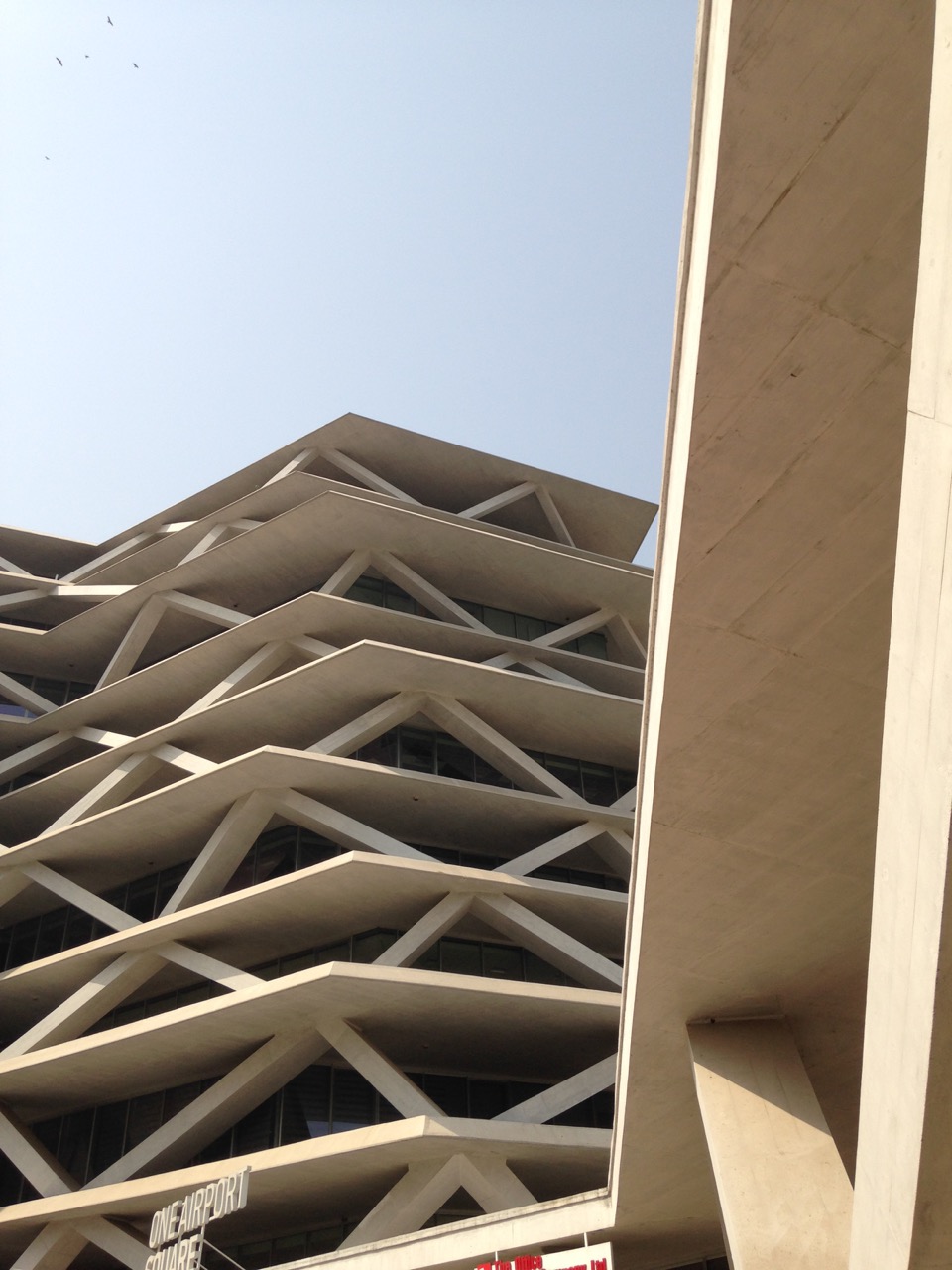
One Airport Square  (designed by Mario Cucinella Architects) has gone for the attention-seeking approach. A complex façade composition made up of diagonally arranged structure with horizontal fins. The fins and ‘columns’ project from the building’s envelope by almost 2m, acting as a vast brise soleil they provide much needed shade, as well as absorbing heat externally whilst reflecting sunlight light into the building.

IMG_0838

Atrium of Airport Square One

Internally there is a large atrium space that holds the circulation as well as bringing light into the deep plan and pulling fresh air through the courtyard. This kind of building works well when set amongst other less adventurous forms. It is also helping to create a new context for that part of Accra, and is distinctive enough to become a reference point and landmark. I just hope it doesn’t become part of a silly form-making game with each bank trying to out-do each other in the quest for the next distinctive shape.

IMG_0840

Ecobank, Accra

Another new building that has just reached completion is the vast Ecobank Headquarters located adjacent to the Efua Sutherland Children’s Park. This provocative building was designed by a consortium of Ghanaian and South African architects (http://arc.co.za/project/ecobank-ghana/), the local and site architects being Mobius, lead by KNUST graduate Augustus Richardson. A lightweight metal brise soleil is used to protect the glass façade where the sun strikes, and a perforated metal jali screen offers solar protection at the lower levels, as well as being used to depict a map of the world, and a larger drawing of Africa.

DSC_0549

Augustus Richardson with the model of Ecobank

At ground level the building is clad with limestone firmly rooting it into the earth and forming tactile surfaces. The two forms reflect the public banking space, and the private offices of the bank HQ. The bank is orientated on an axis leading towards the concrete obelisk in Africa Liberation Square, and there is a real declaration of optimism in this building. Mobius are an exciting firm to follow, and Richardson kindly took us on a tour of the bank, giving behind the scenes access. The quality of the finish is exceptional and build quality excellent. Richardson clearly cares about architecture and his city; there is a charged excitement in the way he talks about design (see http://www.design233.com/oldhtml/works/augustus_richardson_the_bridge_mobius.html for more on this).

But what of the building envelope? Is it an appropriate response to design an almost entirely glazed building in Accra?

In 1957 Anthony Chitty gave the opening address to the new school of architecture at KNUST and posed this question,

‘Is a regional architecture, a truly African style, possible for West Africa; for Ghana in Particular? I believe the answer to this question is “yes” : not only possible but desirable, something to be striven for.’

In many ways the Ecobank is the perfect response to the clients wishes – they wanted a modern, international office space to reflect their brand, and clearly Ghanaian architects and engineers can deliver this type of work as well as anyone, but, if we are to be critical, are we guilty of what Chitty spoke about 60 years ago when he demanded,

‘Not just a pallid and mediocre edition of the international style, not just the half considered European solution trotted out to make do here, but a real and living architectural answer to your own local problems, social, technical and political, drawing the maximum from such origins as do exist here, a true Ghana aesthetic.’

I don’t think the Ecobank is at all mediocre, or half-considered, and Chitty was over-playing the Ghana aesthetic idea in light of the nationalist tendencies from the time-  but there must be an approach that can make the architecture of this region specific to this place. Other large projects are rapidly springing up (and unlike the Ecobank) they parade the hackneyed multi-coloured cladding approach that is tormenting every city, whereas Ecobank is clearly searching for something more.

The difficulty is how to scale-up ‘tropical’ design. Tropical architecture stems from the bungalow, barracks, and hospitals – it works well for small-scale low-rise buildings, as the Children’s Library, George Padmore, KNUST Senior Staff Club House demonstrate – it wants to be a ground hugging solution set within leafy gardens and evaporation pools.

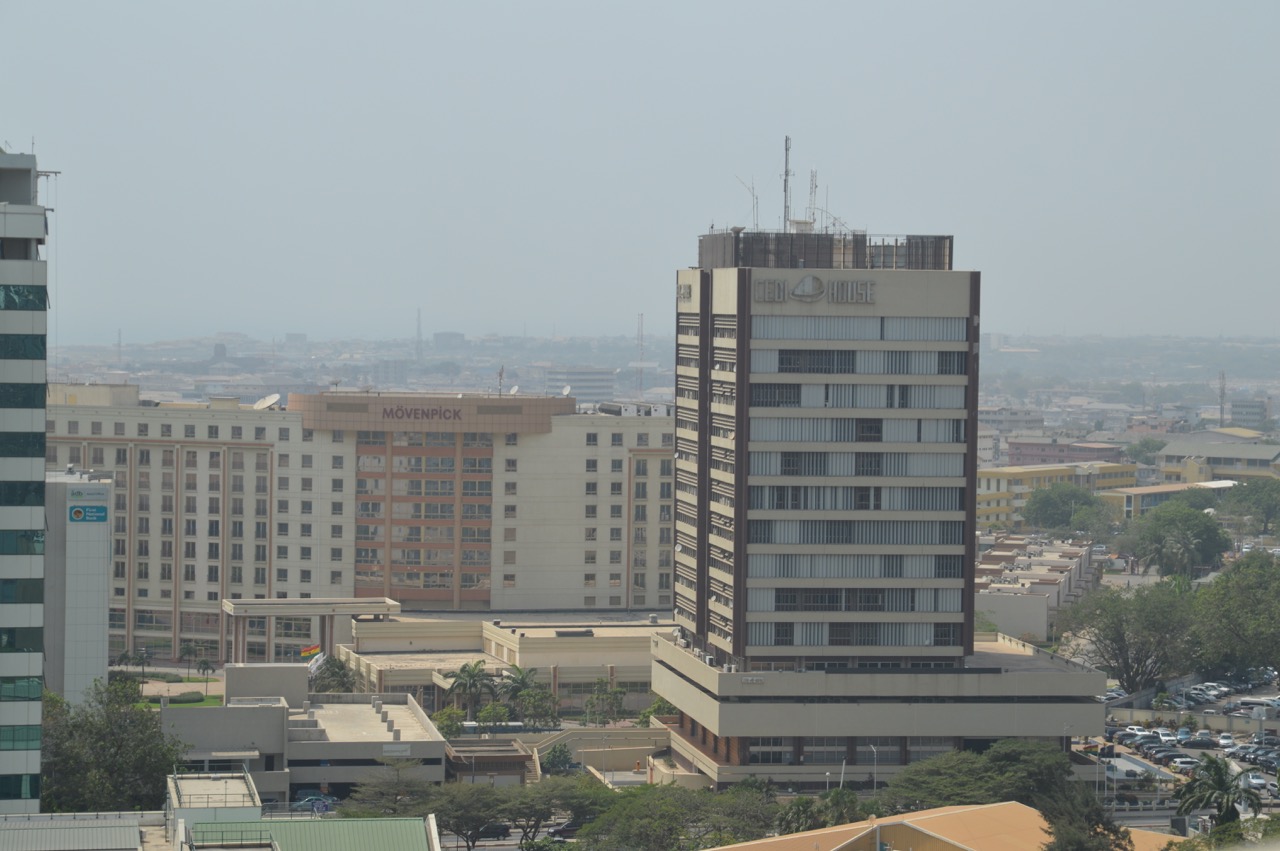
A bank today however cannot rely on loggias and verandahs, and rising land values and the ability of buildings to generate substantial rental incomes stimulates the high-rise approach.  This was something that Fry and Drew encountered in West Africa. They worked for the Co-op Bank in Nigeria and placed louvres on the facades of multistory buildings, a technique also used by John Addo at Cedi House in Accra. The library at Ibadan presents another alternative – with its delicate screen and effectively double-façade-cum-circulation zone. Fry found the façade too ‘lace-like’ and pursued something more strapping and formal in later works, such as the library at Girls College in Chandigarh’s Sector-11.
DSC_0553

Cedi House viewed from Ecobank roof garden

Fry also set himself the challenge of using a glazed façade in a hot climate, again in Chandigarh. At the Government Printing Press he used glass on the north facing façade only, and included adjustable louvres on the interior to reduce glare. The south facing façade was protected by the walkways and an external aluminium louvre system based on the traditional jalousie reduces solar gain.

There is perhaps just the germ of historical precedent in the two recent Accra buildings – and both reveal a confidence in the city, as well as an ambition to test this type of architecture. The next step will be to put some data-loggers into these buildings and to see how they perform. Their critics might be pleasantly surprised.
 

The Transnational Architecture Group Blog is 5 Today!

It’s five years since our first tentative blog post. Since that day we’ve posted over 200 articles, calls for papers, and general research updates on all things architecturally transnational.

One of our major research interests has of course been the work of Maxwell Fry and Jane Drew, with the publication of the monograph in 2014 and international conference. But that was just the start. Since then we’ve covered Shama Anbrine and Yemi Salami’s PhD work in Pakistan and Nigeria respectively, as well as Cleo Robert’s PhD work in India. Rachel Lee tested and developed our Timescape App in Bangalore and also published a wonderful monograph (with TAG Press) on Otto Koenigsberger. She was also responsible for a major heritage symposium in Dar es Salam. Ola Uduku has been our most prolific ‘commenter’ as well as providing many research updates on our findings in Ghana and organising numerous workshops on the Architecture of Africa. Our current research project has been sponsored by the British Academy and we’re delighted to be collaborating with Rexford Assasie Oppong (KNUST) and Irene Appeaning Addo (Legon University) on this work.  There is going to be a lot more research stemming from this initial project, not least the cataloguing and archiving of the major drawings collection at KNUST, with Łukasz Stanek from Manchester University.

Other forays have taken us to Thailand and the work of Nat Phothiprasat, as well as to Sri Lanka and the plans of Patrick Abercombie.  We’ve posted abstracts and links to many other papers and projects, not least Johan Lagaes and Kathleen James-Chakraborty’s papers. Killian Doherty and Edward Lawrenson’s film on Yekepa promises to be one of the highlights of 2018.

More recent posts have revealed the rich architecture of the Middle East, including Levin’s paper on Ashkelon, William A. Henderson‘s work at Little Aden,  Ben Tosland’s research into Kuwait, Alsalloum’s moving paper on Damascus and Jackson’s paper on the PWD in Iraq. There’s surely a lot more to investigate here.

It’s been great fun, and here’s to the next five years of exciting research, difficult questions, dusty roads and even dustier archives, and of course new discoveries that make everything worthwhile.

We’d like to thank all of the blog contributors (please do continue to send us your updates, research findings and short articles). Thanks also to our committed readers and for all of your kind comments and emails.

Iain Jackson.


Lou Moon:   Viewing tropical materials, renewable technologies and local community engagement at a coastal resort.  

Ola Uduku Writes:

Climate responsive, tropical architecture using locally sourced materials remains a rarity in West Africa, therefore setting foot at the remote coastal Lou Moon resort was a revelation. At first glance this seemed like yet another ‘safari-architecture’ beach resort on the Ghanaian coastline [20 minutes drive from Axim]. The first view of a dining area with non-local thatch roofing initially suggesting a copy of an aesthetically pleasing safari ‘hang out’ for expatriates and daring local tourists willing to get to this off-the-beaten-track location.

img_0710

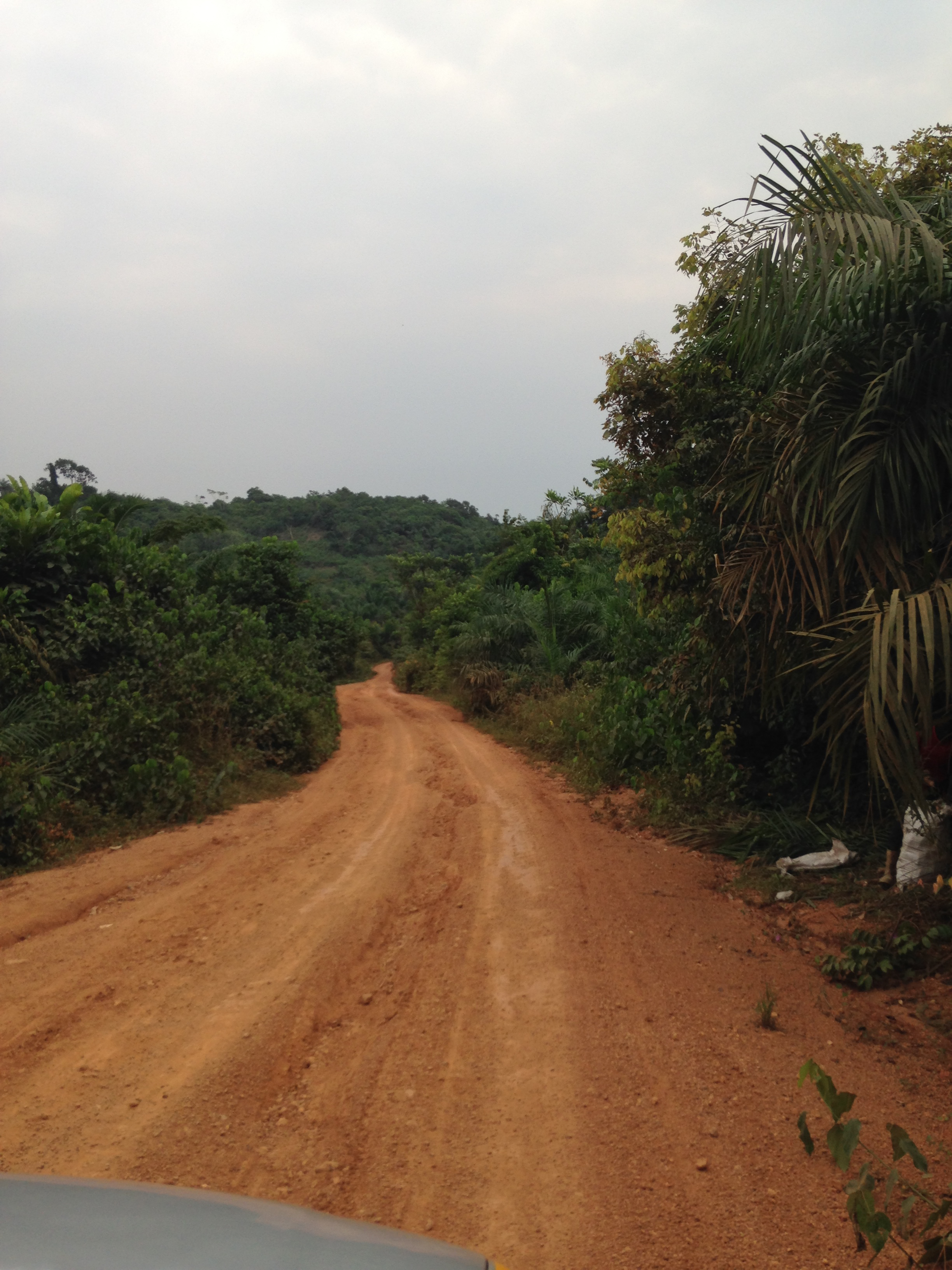
“Are we nearly there yet?” The track to Lou Moon

On closer inspection and conversation with Lou Moon’s designer and owner Paul Ramlot, it was explained to us that the roofing is not indigenous to Ghana’s coastal communities but was indeed an import from the middle to northern part of Ghana. He had worked with northern Ghanaian thatchers and local craftsmen to ensure the construction of a watertight roof covering. He explained that this had been achieved successfully, and the only problems that had been encountered since it had been completed were with with local bats and grass cutters, that from time to time nest and forage in the thatch. Catching them was tricky  – but sonic deterrents were now being successfully used.

img_0719

Architect and owner of Lou Moon, Paul Ramlot with Ola Uduku

After a good lunch from an impressive menu boasting  European – Ghanaian ‘gastro’ cuisine and the option of good French wine (which we declined) we were shown more of the resort. The owner had worked hard to tame the land jutting out to the sea and create a number of secluded chalets, using locally sourced building materials and oriented to allow local ventilation and lighting. Whilst specialist bath fittings were imported, 90 % of the materials were sourced locally and the owner worked  with local craftsmen to develop the accommodation at the resort. This was a textbook demonstration on what is possible but has rarely been achieved in contemporary West Africa.

By working with local craftsmen, and employing local staff at the resort he had also both given employment opportunities in a part of Ghana where there are few such opportunities available. He also had a working arrangement with the ‘chief’ and ultimate owner of the land on which the Lou Moon Resort has been built. A share of the profits is paid to the chief and his community.

Resort chalets had solar photovoltaics incorporated into their design, and wireless communication, and electricity were freely available along with a large satellite dish in clear view. Interestingly on arrival we noted a number of vehicles with diplomatic number plates, possibly the remoteness of the location had in the past made it the perfect retreat, one wonders whether this remains so appealing, now that it is hooked up to the world via its telecommunications systems. Judging by the resident clientele at the resort in the January off peak season this didn’t seem to be the case.

We left musing that it took a Belgian expatriate to rediscover local materials and encourage local design talent in this remote part of Ghana. His design model had been so successful that he was in conversation with local elites to develop a similar resort on private land to reap these benefits. What was his most serious problem we asked him? He responded that it was the noise from the local community at funerals and other festivals…

We hope that a cordial arrangement can be agreed to secure the serenity of this snapshot of tropical architectural paradise. We made ‘design attribution’ peace with the non-local indigenous thatch roofing, we saw no vermin, enjoyed the shade and couldn’t fault its aesthetic contribution to what had been a truly revealing ‘Lou Moon’ experience.

Notes from Accra

Iain Jackson and Ola Uduku have spent the last two days in Accra catching up with 20th century architecture, and meeting with contacts as part of the British Academy funded ‘From Colonial Gold Coast to Tropical Ghana’ architecture project. Tuesday 23rd February was spent visiting the Ghana National Museum complex, the gem in the crown being Denys Lasdun’s prefabricated dome shaped museum, currently closed for refurbishment. The imagination and vision of the building were still clearly there in our viewing of the stripped down structure ready for conservation.

DSC_0820.jpg

Our next stop took us to Nickson and Borys’ Children’s library building nearer to Central Accra. This had been sympathetically restored, and again was a great demonstration exemplar of ‘West African Modern’ and the developmental vision of the departing colonial government to establish libraries that were open to all citizens. The upper area remained devoid of activity but had potential to be a great multipurpose programme space.

DSC_0801.jpg

Children’s Library

The final visit of the day was to Joe Osae-Addo’s Archi-Africa – TuDelft Berlage Architecture school studio, in Accra’s Jamestown neighbourhood, on the urban fabric of everyday life in Accra. The impromptu crit we were invited to take part in was an enjoyable experience and the schemes were full of promise.

DSC_0832.jpg

TU Delft and Archi-Africa in the newly converted Jamestown Studio

Day two involved visits to Jamestown – as a walking visit this time to take in early 20th century colonial PWD, and also warehouse architecture in the neighbourhood. A visit to Adabraka also yielded a few examples of early PWD worker housing, which was followed by an afternoon visit to Achimota School, which conveyed the height of the colonial education project with architectural symbolism and style. A few later additions to the campus by Nickson and Borys and other’s also fitted well into the College’s narrative of colonial imperialism and privilege. The final visit for the day was to Scott House, which lived up to its deified tropical modernism status, whilst the Western Tessano neighbourhood had transformed into an upper class gated area, that unexpectedly gave us a glimpse of an earlier [likely Cubitt?] designed semi detached housing unit, currently undergoing a further 21st century upgrade..

DSC_0863.jpg

One of the few surviving examples of its type in Adabraka

We will be moving onto Kumasi on Friday and will update from there early next week.

3D Printed Model of Kenneth Dike Library

We’ve been playing with a couple of 3D printers [Makerbot and Ultimaker] and testing how they might be used to create a small collection of models to supplement our History of Architecture lectures.

image

In the age of ‘Stream Capture’ and recorded lectures including a small exhibition of key case study models in the lecture theatre will hopefully entice the students to attend the live event and will also form an opportunity to further explore light, scale and the qualities of buildings that are not as easily expressed through photographs and orthographic drawings.

image

Our first test case used a computer model of the Kenneth Dike Library, Ibadan [designed by Fry and Drew] expertly produced by Jacopo Galli and generously shared with us. The model doesn’t show the entire buiding but a key section enabing the interior to be viewed. The ambition is a for an online library of models that can be downloaded and then printed as and when they are required by faculty and students.


image

Conserving West African Modernism Workshop and Conference Report

KNUST Kumasi, 2 – 18th July 2015

From the 2nd to 18th July 2015 Ola Uduku spent time at the Kwame Nkrumah University of Science and Technology (KNUST), Kumasi Ghana, working with Dr Rexford Assasie Oppong, to set up and run the inaugural “Conserving West African Modernism” workshop culminating in an international conference held from the 13th – 14th July at KNUST.

There were a number of objectives for the project; firstly the visit provided an initial attempt to explore the possibilities of Edinburgh University’s Scottish Centre for Conservation Studies, (SCCS) and Architecture School becoming involved in research collaboration activities centred on the Modernist heritage of the KNUST campus both in terms of architectural history and also international- tropical conservation practice. Also included in this collaboration was the Liverpool University School of Architecture, (LSA) which has research expertise and archival material on the work of Maxwell Fry and Jane Drew who were involved in the development of Kumasi and Ghana’s post-WW2 architectural heritage.

DSC_0463

Second, the project sought to make an initial assessment of the modernist heritage site and buildings at KNUST with a view to using these as a basis for documentation, to support the application for Ghana to become a member of the international modernism conservation organisation Docomomo International. This also included a public outreach element in which the project engaged with local university school children in a campus buildings tour and questionnaire session to raise awareness and interest in the buildings on the KNUST campus.

Third, the project sought to explore the possibilities of having the SCCS at Edinburgh University support the development of an MSc. Course in conservation and also contributions to architectural history teaching, initially via online courses, using available media technology at both institutions. In connection with this, linkages to architectural history teaching at the Liverpool School of Architecture and its future research-links with Ghana were also examined.

PG_KNUST2

Also at public and international outreach level, work was undertaken with Junior high school students to raise awareness about the modernist architectural legacy on the Kumasi campus, via a series of tours, discussions and ‘snap-voting’ on buildings judged ‘best’ by the pupils. At the international level the project enlisted PG architecture students to work on listing key campus buildings, using the Docomomo, (the international organisation for conserving modernist buildings and landscapes), fiche listing template. This is with a view to working with KNUST staff and students towards compiling material required to apply for Ghana’s membership of Docomomo in the next biennial conference in 2016.

GROUP_UNITY

The project culminated with a well-attended two-day conference at KNUST, where keynote speeches were given by; KNUST Professor emeritus H. Wellington, and Professor Miles Glendinning, Director SCCS, University of Edinburgh. Teams of Junior High School and KNUST Architecture PG students also gave presentations, showing the work they had done during the preceding week’s ‘KNUST Modernism’ workshops.

miles_rex_me Prof_Wellington

Providently the conference also heard the views and reminiscences of Profs Wellington, Owuso Addo, and Arc. J Larbi, all eminent Ghanaian architects and educators, who had been historically involved with the development of the campus, since its inception in the mid 1950s to the 1990s, who attended the workshop. Representatives from the Ghana Institute of Architects, the Lands and Survey office at KNUST, associated faculty staff from the College of Architecture, Arts, and Planning, and from the ArchiAfrika organisation, were also in attendance.

The various workshops and final conference was made possible by funding and in–kind support received from a number of bodies including: The African Studies Association UK, ArchiAfrika, The University of Edinburgh, The University of Liverpool and KNUST.

The Communique below was issued at the conclusion of the conference:

Conserving West African Modernism and Urbanism Research Workshop and Conference Communiqué

 At the inaugural workshop / conference, ‘Conserving West African Modernism and Urbanism’, held at KNUST, Kumasi, Ghana on 13-14 July 2015 – an event which involved staff and student participants from the KNUST Junior High School, KNUST Architecture postgraduates, and which was attended by a range of national and international invitees including the Ghanaian architectural luminaries Prof. J. Owusu-Addo, Prof. H. N. A. Wellington, and Arc. S. O. Larbi, along with Prof. Miles Glendinning from the University of Edinburgh, Scotland – it was agreed to pursue the following specific objectives:

  • To continue with the primary objective of the project in supporting and developing an appreciation and culture of conservation in West Africa, in collaboration with DOCOMOMO International – commencing with the task of researching and conserving the heritage modernist movement campus layout and buildings at KNUST, Kumasi, and pursuing the establishment of a Ghanaian national chapter of DOCOMOMO;
  • To work to develop collaborative research links related to KNUST’s building history, with the Edinburgh School of Architecture and Landscape Architecture (University of Edinburgh) and the Liverpool School of Architecture (University of Liverpool), with expected joint academic research outputs.
  • To explore the possibilities of developing a Department of Architecture -KNUST Masters programme in history/ conservation studies with support and collaboration from the Scottish Centre for Conservation Studies (SCCS) at the University of Edinburgh, and the Liverpool School of Architecture (LSA);
  • To seek funding to develop a West African Modernism Archival Project, (WAMAP) which would have the Department of Architecture, KNUST as its centre. Its objective will be to create a digital archive of KNUST’s extant material records of its historical development, comprising plans, models, and oral histories contributed by surviving actors involved in the founding and development of the campus. This project would aim ultimately to evolve into an international centre and nexus for modernist building research in West Africa.

In this communiqué we also acknowledge the desirability of developing full links with cognate research and academic bodies within Ghana, including the Institute of African Studies and the Department of Archaeology and Heritage Studies, at the University of Ghana, Legon, together with other associated educational and professional institutions, including the Ghana Museums and Monuments Board, the Ghana National Archives, the Ghana Institute of Architects, and ArchiAfrika.

  15th July 2015
Dr Rexford Assasie Oppong Dr Ola Uduku
Department of Architecture,

Kwame Nkrumah University of Science and Technology, Kumasi, Ghana

Edinburgh School of Architecture and Landscape Architecture,

University of Edinburgh, Scotland

*** Further news, Iain Jackson, Rexford Assasie Oppong and Ola Uduku will be collaborating on a British Academy Funded International Partnership and Mobility Grant “Architecture and planning in the Tropics; from Imperial Gold Coast to Tropical Ghana“,  starting in November 2015. ***

Sri Lanka, Oliver Weerasinghe and Patrick Abercrombie

I’ve been interested in the work of Patrick Abercrombie for some time now. His 1943 London County Plan (developed with John Forshaw) was a war-time best seller and is filled with wonderful drawings and coloured plans that I enjoy looking at, and I frequently cycle past the white rendered late Georgian house in Oxton that he used to live in. This is a quick post to show some of the material I’ve uncovered to date.

Abercrombie

Figure 1 Patrick Abercrombie

In addition to developing several plans for UK cities, he also produced a plan for Dublin, but far less known is the work he did in Sri Lanka in the 1940s and 1950s. It is this work that I’m currently (and very slowly/intermittently) researching. He prepared a a regional plan for Colombo in 1948 working with a local architect Oliver Weerasinghe (Government Town Planner, b?-1980), as well as editing the town planning policy for the city. In their report they noted,

‘The re-planning and re-construction of the slum areas of Colombo and the obsolete parts of the built-up areas of the city to meet present day requirements is also a regional planning problem of first importance. The adoption of lower housing densities and greater recreational open space in these re-planning schemes will leave an “overflow” population which will have to go outside the existing built-up areas.’

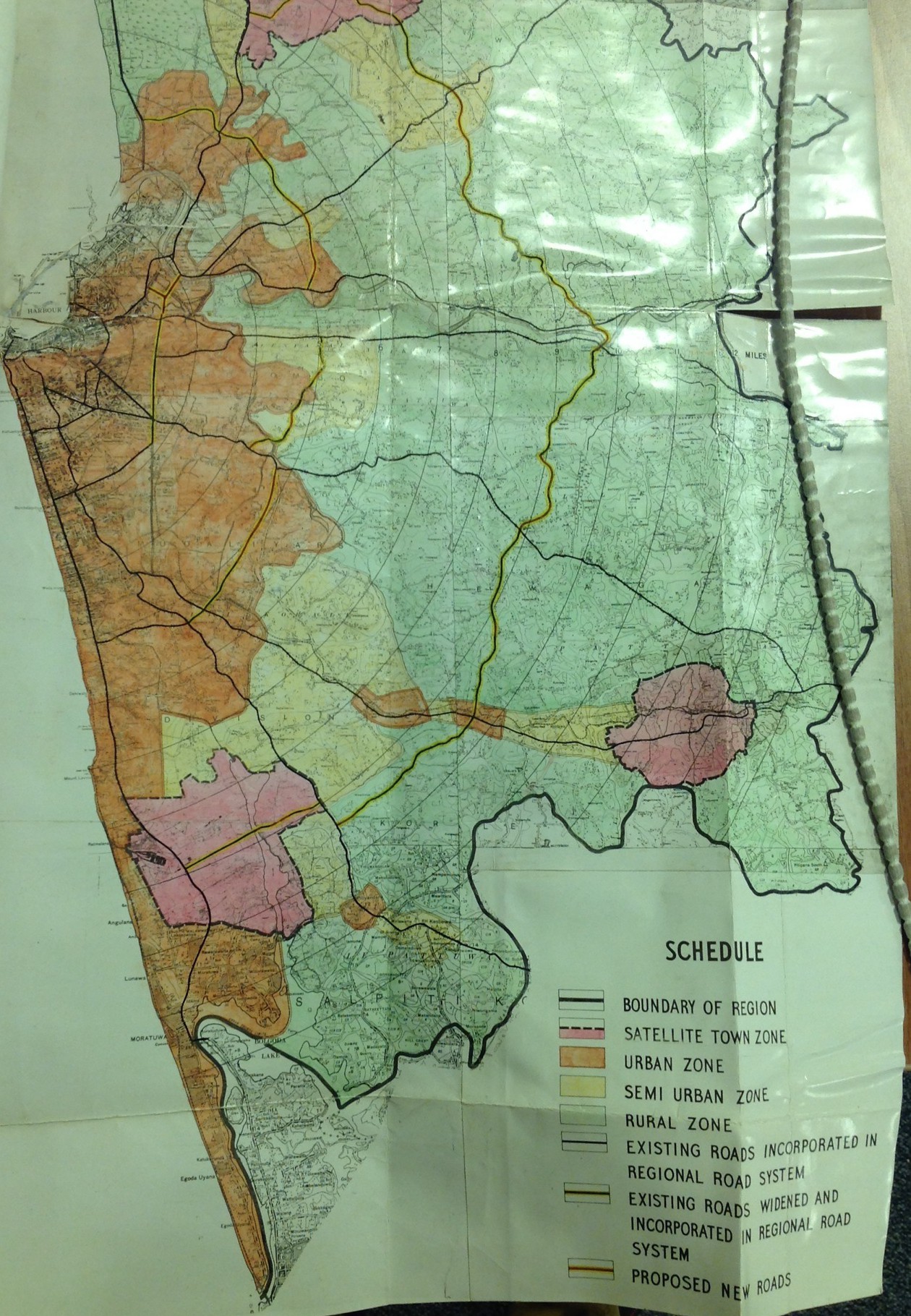
To accommodate the ‘overflow’ population they proposed to build three towns at Ratmalana, Homagama and Ragama. Each town, located around 10 miles from the centre of Colombo and linked together via a ring-road was each to accommodate around 40,000 residents.

I’ve found the broad planning proposal they proposed for Colombo, along with some photographs of the three settlements prior to their development.

IMG_0625

Figure 2 Colombo Regional Development Plan: New towns coloured in magenta.

IMG_0639

Figure 3 Ratmalana New Town, as existing.

IMG_0633

Figure 4 Homagama New Town, Hospital prior to development

Weerasinghe and Abercrombie also worked on the Anuradhapura preservation scheme together, developing a plan in 1942 that was subsequently developed post-war with a view to preserving the ancient temples and monuments as well as developing new housing proposals for the town.

IMG_0622

Figure 5 Proposed plan for Anuradhapura

Weerasinghe was one of the first qualified engineers in Sri Lanka. He studied at Cambridge, and later as one of Abercrombie’s Civic Design students at Liverpool (which explains their subsequent collaboration). After practicing as Government Planner he served as Sri Lanka’s Ambassador to the United States in the 1960s before returning to his planning roots as an Inter-Regional Advisor in Urban Development of the United Nations (1971-1973), working in the Middle East, Africa and the Caribbean. From 1974 he continued as a UN development consultant.

IMG_0583

Figure 6 Oliver Weerasinghe

International Conference
Crossing boundaries: Rethinking European architecture beyond Europe
Palermo, 13-16 April 2014

The International network “European Architecture beyond Europe: Sharing Research and Knowledge on Dissemination Processes, Historical Data and Material Legacy (19th-20th centuries)”, chaired by Mercedes Volait and Johan Lagae, and supported by EC funding through the COST Action IS0904 (2010-2014), is holding its final conference in Palermo (Rettorato dell’Università degli Studi di Palermo,  Palazzo Chiaramonte Steri ), 13-16 April, 2014.

 The conference includes a general session presenting the achievements and future prospects of the network, and the following panels:

–        Session 1. Methods and methodologies: Writing the histories of European imperial/colonial architecture, chaired by Alex Bremner (Edinburgh School of Architecture and Landscape Architecture) and JoAnne Mancini (National University of Ireland Maynooth)

–        Session 2. Architectures of exile: Visions and re-Visions of the global modern in the age of the refugee, chaired by Regina Göckede (Brandenburgische Technische Universitaet, Cottbus) and Rachel Lee (Technische Universität Berlin)

–        Session 3. Looking eastward, building identities: The architecture of European diplomacy beyond the Mediterranean in the age of Empire chaired by Paolo Girardelli (Boğaziçi University) and Mercedes Volait (CNRS/INHA)

–        Session 4. Transnational studies and cultural transfers, chaired by Kathleen James-Chakraborty (University College Dublin)

–        Session 5. Architecture as development aid. Actors, networks and mechanisms in the design of institutional buildings in the postcolonial global South, chaired by Kim De Raedt (University of Ghent’s Faculty of Engineering & Architecture) & Tom Avermaete (Delft University of Technology)

–        Session 6. Examining Tropical Architecture: in different international contexts,  chaired by Ola Uduku (Edinburgh School of Architecture and Landscape Architecture) and Iain Jackson (The Liverpool School of Architecture)

The keynote speech will be delivered by Dr. Sibel Zandi-Sayek, The College of William and Mary,
Williamsburg, Virginia, USA, Remapping the Geographies of Industrial Enterprise: Ottoman-British Networks and the Architectural Canon

An invited lecture will be delivered by Dr. Lukasz Stanek, Manchester Architecture Research Centre, School of Environment & Development, University of Manchester, UK, Architects from Socialist Countries in Ghana (1957-1967): Architecture and Mondialization 

The official launch of the new dedicated electronic journal, ABE – European Architecture beyond Europe, will take place at the conference.


For the detailed program of the conference, check www.architecturebeyond.eu


Call for Papers: Crossing boundaries: Rethinking European architecture beyond Europe

13-17 April 2014 Palermo

The International network “European Architecture beyond Europe: : Sharing Research and Knowledge on Dissemination Processes, Historical Data and Material Legacy (19th-20th centuries)”, chaired by Mercedes Volait and Johan Lagae, and supported by EC funding through the COST Action IS0904, is opening calls for papers for its final Conference to take place on 13-17 April 2014 at Palermo (Italy).

The conference will have the 6 following sessions:

Transnational studies and cultural transfers” (chaired by Kathleen James-Chakraborty).

Methods and methodologies: Writing the histories of European imperial/colonial architecture” (chaired by Alex Bremner and JoAnne Mancini). 

“Looking eastward, building identities. The architecture of European diplomacy beyond the Mediterranean in the age of Empire” (chaired by Paolo Girardelli and Mercedes Volait).

Tropical architecture” (chaired by Ola Uduku and Iain Jackson).

Architectures of exile: Visions and re-visions of the global modern in the age of the refugee” (chaired by Regina Göckede and Rachel Lee).

Architecture as development aid: Modernization, technical assistance and the design of institutions” (chaired by Tom Avermaete and Kim de Raedt).

The deadline for proposing a paper (300-word abstract) is 1 December 2013. Submissions to the chairs of the sessions should be accompanied by a short biographical note (max. 150 words). Acceptance decisions will be communicated by mid-December. Please note that invited speakers are expected to submit their complete paper by 15 March, 2014, to be circulated among the conference’s participants. Speakers based in countries participating in the Action (refer to the website http://www.architecturebeyond.eu for the complete list) will be able to claim reimbursement of their expenses. A few grants will be available for speakers based in other countries. For further information, please contact the sessions’ chairs or write to is0904@inha.fr.

Transnational studies and cultural transfers

Chaired by Kathleen James-Chakraborty (University College Dublin)

European architects have worked beyond Europe since the time of the Crusades.  Many architectural historians have documented these practices. In recent years particular attention has been paid to architects who emigrated to escape authoritarian regimes and who are widely credited with having brought modernism with them.  Most of this literature, however, floats independently of social science scholarship on transnationalism, and much of it focuses on the movement of forms and theories, rather than on how people structure their own identity in relationship to their experiences of other places and cultures.  Moreover, relatively little of this writing engages the role of the client, although the role of local building cultures is beginning to receive the attention it deserves.  And finally, very little of it is comparative.  What is the difference between Genoese settlements on the Black Sea, for instance, and Portuguese ones on the African coast?

This session seeks papers that rectify this situation. Particularly welcome are contributions that consider current anthropological investigations of transnationalism and theories of cultural transfer and their applicability to architectural history. What can architectural historians learn from methodologies developed largely to analyze more portable forms of artifacts, not to mention ideas?  Also desired are papers that seek to conceptualize the ways in which transnational architectural practice has changed across time.  What, for instance, distinguishes the German architects that came to the United States following 1933 from those who emigrated after 1848?  Papers might also examine the problem of determining what role biographical experience plays in the designs of any architect.   This is particularly important in the case of a profession that is profoundly collaborative, engaging clients, builders, and users as well as designers.  Other questions that might be addressed include what motivates clients to hire architects from other countries and how do these architects operate once they have such commissions.  Are they employed because of technical or stylistic expertise gained abroad, or are other factors at work?  What types of information and ideas travel with them, and under what circumstances are what local conditions taken into account?

Kathleen James-Chakraborty kathleen.JamesChakraborty@ucd.ie

Methods and methodologies: Writing the histories of European imperial/colonial architecture

Chaired by Alex Bremner (Edinburgh School of Architecture and Landscape Architecture) and JoAnne Mancini (National University of Ireland Maynooth)

This session seeks to explore and debate the ways in which we write (and have written) the history of ‘European architecture abroad’, particularly in the context of European imperial expansion. For some thirty years now the study of European imperial and colonial architecture has largely been refracted through the theoretical lens of post-structuralism—mainly appropriated from philosophy, literary  and cultural studies—in the form of the ‘Orientalist’ critique of Edward Said and other forms of Foucauldian discourse analysis, nominally referred to as ‘post-colonial theory’. As powerful and seductive as these modes of analysis may be, and as useful in their opening new ways of seeing and interpreting forms of cultural production such as architecture, they have become formulaic, predictable, and even orthodox. They have also received trenchant and sustained criticism from the wider scholarly community in historical studies (especially outside art and architecture circles) for their inherent limitations.

This leaves us with the question of where the study of European imperial and colonial architecture might turn next.  On the whole, other scholarly and cognate traditions, such as early modern and modern European history, have developed more diverse and wide-ranging approaches to the study of empire and culture, adapting insights from geography, environmental studies, anthropology, and other disciplines; and have devoted significant attention to integral concepts such as networks and agency. Although not necessarily opposed to discourse analysis, these scholarly frameworks—including regional approaches (‘Atlantic’, ‘Pacific’, ‘Indian Ocean’, and ‘World/Global’ histories), network theory, and ‘connected’ histories—provide new and very different insights than those provided by post-colonial theory.  However, just as architectural historians have not fully engaged with scholars in these fields, early modern historians have also been somewhat reluctant to engage fully with architecture and the built environment as agents and repositories of social practice and social change.

Can, indeed should, architectural history engage more with these alternative scholarly traditions and modes of analysis? What can we learn from them, and how might we apply them?  How might architectural historians interact more productively with colleagues in history and historical social science disciplines to encourage more architecturally-informed analysis in those fields?  Or, ought post-colonial theory remain the key concept and frame of reference that underpins our study of the colonial built environment?  This session welcomes papers that address any aspects of these key questions, either by dealing specifically with methodological approaches that enhance, progress, and/or transform our understanding of European imperial and colonial architecture, or by exploring case studies that allow for these methodological concerns to be elaborated in specific contexts. Put simply: where are we, where are we going, and where do we want to be as scholars of the colonial built environment.

Alex Bremner alex.bremner@ed.ac.uk & JoAnne Mancini JoAnne.Mancini@nuim.ie

Looking eastward, building identities: The architecture of European diplomacy beyond the Mediterranean in the age of Empire

Chaired by Paolo Girardelli (Boğaziçi University) and Mercedes Volait (CNRS/INHA)

Embassies are, by definition, representative institutions, but the share of their architectural shelters in this signifying function is a complex and still understudied issue. By transferring a fragment of the nation beyond its frontiers, embassies, consulates and other officially “foreign” architectures engage in a complex cultural dynamic of encounter, estrangement or integration. Symbolic, identitarian and political meanings may be variously inscribed in their architectural fabric; balances in social topography may be altered – all the more when
such buildings were constructed or adapted by European powers in countries with a remarkable degree of geographical/cultural distance. The stylistic heterogeneity resulting from the interactions and constraints inherent to diplomacy is all the more bewildering in such cases.

This session is meant to develop a critical and comparative reflection on a rather neglected aspect of architectural and urban history that informs the global spread of European forms and aesthetics through an unusual lens. It proposes to do so by concentrating on the geography that lies East of the Mediterranean and on places and structures located outside the direct colonial confrontation. We are interested in contributions looking at buildings related not only to the main Western European players, but indeed to Eastern and Central European agency. Empirical as well as conceptual and theoretical research on European diplomatic structures in the Ottoman, Persian and non-colonial Asian geography, as well as in peripheral cities of the Russian empire, can be presented and discussed in this session.

We invite papers assessing the ways in which European diplomacy, international relations, and changing power balances shaped important parts of the built environment outside Europe, in a space/time framework characterized by expanding European penetration eastward and corresponding roughly to the long 19th century and beyond. We are particularly interested in contributions that address the architectural embodiment of encounters and representational strategies within innovative frameworks, exploring new ground beyond the conventional critique of Orientalism. Preeminence will be given to proposals reflecting on the appropriate methods and sources for this kind of trans-national investigation, and addressing the history of diplomatic buildings as a constant reworking of images, styles, spaces and political messages, affecting each other in unpredictable ways.

Paolo Girardelli girardel@boun.edu.tr & Mercedes Volait mercedes.volait@inha.fr

Tropical architecture

Chaired by Ola Uduku (Edinburgh School of Architecture and Landscape Architecture) and Iain Jackson (The Liverpool School of Architecture)

‘Tropical Architecture’, used as a term here to define a particular strain of construction that seeks to address the hot, humid, and dry climes found between the Tropics of Cancer and Capricorn, is inextricably connected with the colonial endeavours of Europe. Traditional scholarship has sought to historicise the canon and to look to early encounters between travellers, missionaries, military engineers and local populations. This seems like a sensible mode of enquiry from which to begin. Participants are encouraged to present research papers that have examined how ideas have travelled, been interpreted and eventually built, with particular interest on the indigenous perspective. We are also however seeking papers that take us beyond the archive; thus in addition to examining records of the indigenous contribution to tropical architecture, what of those forced to live in tropical dwellings, or to occupy schools, courts, and other such buildings? How did they modify or enhance the tropical capabilities of the buildings they occupied and what recorded or pictorial evidence do we have that shows what they thought of their surroundings? Finally, and importantly we are interested in the domestic setting; what constituted the ‘everyday’ what were the female, (and possibly youth) perspectives, on life in these new tropical dwellings. Also how was environmental comfort and hygiene, evaluated by local residents, as compared with the plans and expectations of the tropical research establishments in the home countries?

Tropical Architecture is a blunt, but useful term. Can we begin to draw out some revealing tributaries? The architecture of Port Cities and ‘sailor towns’, will inevitably vary to that of the hinterland, hill station, administrative centre or desert. What about the island, archipelago, peninsula, and mainland as specific places of exchange, encounter, settlement and isolation- can we begin in a more concerted manner to consider the architecture of these territories and conditions whilst thinking about the tropical? The architecture of trade, railways, stations, warehouses, dock walls and shipping offices all need further investigation.

Tropical architecture ‘at the edges’ is also pertinent; beyond the cosmic boundaries imposed by Cancer and Capricorn, what happens at the edges of the tropical – the subtropics and other such regions that form the imagined boundary. Is the architecture of these almost-tropical places of note, and how does it borrow or contribute to the broader debates. Other boundaries seem to exist at The Americas and Caribbean; they have not featured to the same extent as other geographic areas in recent scholarship. Is there a reason for this? Is the architecture of Rudolph and Polevizky in Florida, or Ossipoff in Hawai’i, or Kurchan and Hardoy in Buenos Aires not the right type of tropical architecture, or is there simply less to say about these, often glamorous, projects or places?

Biography is a contested historiographical method, but can we look more closely at the indigenous architects who have contributed to this canon often working alongside European architects, or should we accept that they should retain their anonymity in light of our concerns about biographical narratives? Equally should we continue to explore the life stories of Europeans who worked in the tropics? Should we be placing them more carefully within a broader narrative? Or indeed when does biography become hagiography – to what purpose and for what audience is it really meant.

Colonies within colonies, or neighbouring territories may offer new insights. For example, was the French Indian colony of Pondicherry culturally isolated from its surroundings, or can were discern ‘knowledge transfers’ and modes of exchange? How did the French differ in their approach to tropical design to the British, or Portuguese in Goa, for example? Taking this premise to its other extreme, what characterises early Indian labour settlements in Durban, or Chinese settlement in areas like San Francisco on America’s Western Seaboard, or West Indian/returnee African settlements in Sierra Leone, Liberia and other countries on the West African coast.

Ola Uduku o.uduku@ed.ac.uk and Iain Jackson Iain.Jackson@liverpool.ac.uk

Architectures of exile: Visions and re-Visions of the global modern in the age of the refugee

Chaired by Regina Göckede (BTU Cottbus) and Rachel Lee (TU Berlin)

The emergence of what is today known as international architecture is to a large extent related to the global impact of exiled European architects, who, scattered throughout the world, contributed decisively to its theoretical debates, institutional formations and built manifestations from the early 1920s onwards.

The historiography of exiled modern architecture has long focused on cases of purportedly successful and unidirectional cultural transfer as represented in the master narratives of prominent US immigrants such as Walter Gropius and Mies van der Rohe. The dominant focus on individual biographies and histories of linear stylistic innovations has all too often overlooked the importance of discrepant discursive contexts (material and non-material alike), marginal geographical destinations, the effects of critical self-reflection, as well as the numerous tragedies of loss, disruption and failure under the conditions of forced dislocation. In the last two decades, there have been, however, several important studies that have contributed to a much more complex understanding and significantly extended knowledge (temporal as well as geographical) of the fragmented dynamics of architects’ and urban planners’ exilic dislocations (including re-migrations and transmigrations) and modern architecture and planning. In addition, new approaches from the fields of post-colonial and cultural studies have stimulated the emergence of conceptually de-centered and ideologically de-nationalized perspectives.

This session focuses on the intersection of exile and architectural practice as a historical phenomenon in an increasingly globalizing world. It seeks to re-examine both the exilic histories of our architectural present and the concept of exile as an analytical tool for interpretively grasping the so-called globalization of modern architecture.

We invite contributions by historians of architecture and art history as well as by scholars from related fields such as literary studies, anthropology, human geography and political history. Papers can address the many individual lives and works of 19th and 20th century exiled European architects with a view to their role in the transformation of international architecture, trace (discursive) modes of production and reception (including non-European resistance to Western cultural hegemony), test specific (historical) experiences for links with and relevance to current, or possibly earlier, exilic modes of planning and building, or investigate the research field’s historiographical overlaps and collusions with related interpretive paradigms like diasporic, (trans-)migrant, (post-)colonial, transnational, cosmopolitan, global, or international architecture. We are particularly interested in comparative perspectives and theoretical-methodological approaches that consider temporal/geographical variants, discrepant political-ideological conditions, and institutional and personal networks. We also invite papers that explore exilic careers of non-European architects within Europe or analyse the architecture produced, commissioned or inhabited by exiles who were not architects.

Regina Göckede goeckede@tu-cottbus.de & Rachel Lee rachel.lee@gmx.net

Architecture as development aid. Actors, networks and mechanisms in the design of institutional buildings in the postcolonial global South.

Chaired by Kim De Raedt (University of Ghent’s Faculty of Engineering & Architecture) & Tom Avermaete (Delft University of Technology)

This session deals with the theoretical and practical architecture expertise which emerged through development aid in the ‘global South’ after decolonisation. By looking specifically at development aid organisations, the aim is to unravel mechanisms of architecture and knowledge production specific to the postcolonial context, characterized by shifting political and economic conditions as a result of the Cold War. Through a particular focus on the design of institutional buildings (schools, universities, hospitals, etcetera), the session seeks to produce a mapping of postcolonial networks of expert(ise)s which substituted former métropole-colony relations.

Questions that could be addressed by the papers are: How did a specific type of ‘global expert’ arise through development aid? What was the role and position of such architect-experts within the highly institutionalized aid bodies they worked for, and to what extent could they operate autonomously within those organisations? What kind of architectural discourse was implicitly or explicitly constructed by development aid bodies? How did this lead to a particular approach to the design of institutional buildings? What was the role of African players in the production of those buildings?

Ultimately the session seeks to understand the specificity of the architecture production realized through development aid, and recognize the particularity of the role of the ‘architect-expert’ within aid organisations. This will allow identifying the continuities and shifts in discourse, mechanisms and architectural language with respect to the production of institutional buildings in the late colonial period, while also tentatively putting the increasing globalisation of the architecture practice today into a historical perspective.

Kim De Raedt kim.deraedt@ugent.be & Tom Avermaete T.L.P.Avermaete@tudelft.nl