Crucibles, Vectors, Catalysts: Envisioning the Modern City
Hosted online across two days in March 2021, the Hyundai Tate Research Centre: Transnational and Liverpool School of Architecture’s “Crucibles, Vectors, Catalysts: Envisioning the Modern City” seminar investigated 20th century identities for postcolonial and post-independence cityscapes in Africa, South Asia and the Middle East.
Convened by Iain Jackson, Professor at the Liverpool School of Architecture, Clara Kim, the Daskalopoulos Senior Curator for International Art at Tate Modern and Nabila Abdel Nabi, Curator for International Art at Tate Modern; the seminar explored stories from these ‘highly charged moment[s] in the history of city making or shaping’.[1]
The seminar specifically positions cities as incubators for the generation of national identity and for ‘Modernity’. However, were individual cities sufficient for such grand objectives, or were they more isolated and fragmented sites for local, yet innovative gestures? Presenters demonstrated examples where both centralised urban contexts (including major urban planning initiatives and more piecemeal developments) and wider networks proved valuable in creating or indeed reasserting national and regional identities.
The destructive process of creating mid-century urban environments defined many global contexts. Whether in response to the need for new national identities in postcolonial contexts, reconstruction and housing following the devastating effects of war and a baby boom or strategies to address perceived ‘blight’ and urban flight, urban renewal, with its top-down, Bauhausian, car-focused, and federally funded backbone epitomised Modernity.
Some cities benefitted from a relatively early reconsideration of the blank slate approach to city planning. Lukasz Stanek described how Miastoprojekt, a Krakow-based state planning office of designers envisioned the future of post-revolutionary Baghdad through their experiences with reconstructing historic Warsaw after the Second World War.[2]
Using architectural and design services as a politically and financially motivated form of state aid during the Cold War, the Miastoprojekt plans rejected key aspects of Baghdad’s first modern city plan, including the demolition of the city’s Ottoman era historic and vernacular architecture, and tripling the size of the city at a local level without consideration for expansion through regional developments.[3]
Miastroprojekt’s legacy continued beyond the Baghdad planning commissions through design work and education with Polish and Czechoslovakian architects teaching Polish perspectives of Modernism in Iraqi universities. By the 1990s, with the fall of communism, Polish designers reversed Miastroprojekt’s strategy and were thinking Warsaw through Baghdad to revitalise their cities.
Big plans were not constrained to single urban environments. Fahran Karim’s ‘archaeology of the future’ presentation explored the role of a foreign designer in creating Pakistani nationalism; Greek architect and planner Constantinos Doxiaidis. Karim asks, “How do you represent a country without a past. Fractured geographically into East and West wings… 1000 miles of India between it?”[4]
Doxiaidis preferred stark Modernism, justified through statistical analysis and designed without classical Islamic aesthetic details. He utilised plan forms, practical details and building types that he believed (or presented) to be essentially Islamic.[5] Doxiaidis planned refugee settlements and Islamabad to include ’gossip squares’, souks, Dochala huts and central mosques.
Despite conducting ethnographic fieldwork and survey (aerial photography), Doxiaidis imported his understanding of Islamic community planning and architecture from his research in the middle east and projected the needs and traditions of widely dispersed refugees on narrow local contexts. Unsurprisingly, the communities adapted or removed many of Doxiaidis’ design features or simply did not use the spaces created for them, preferring to adapt their homes or build vernacular sites suited to their cultural preferences instead. While in practice, many of these adaptations and rejections were practical, Doxiadis’ technical expertise and foreign perspective failed to deliver built environments that suited and sustained the needs and preferences of Pakistan’s new citizens.[6]
Considering what was happening between East and West Pakistan, Ram Rahman shared a richly illustrated and personal view of the cultural and political context for his father Habib Rahman’s contributions to the ‘Nehruvian post-independence renaissance of Delhi.’
Habib Rahman, a young MIT-trained Bauhausian architect, was recruited by Nehru to work in Delhi, where he organised an international low-cost housing exhibition in 1954, including plans and a model for his own design for low-cost housing. Rahman’s house design was reproduced across India 100,000’s of times to address a critical housing shortage.
Rahman was a prolific designer and his work, including the World Health Organisation headquarters building of 1963 (demolished) and later designs for three monumental tombs epitomised Indian modernity.
Professional training and architectural education were key vectors for transnational exchange and development in postcolonial contexts. However, as Patrick Zamarian described in his presentation, the development of the Department of Tropical Architecture (DTA) at the Architectural Association (AA) in London was related as much to the independent administrative structure of the AA and its struggling economic position in the 1950’s as it was to meeting the challenges of Modern design in foreign contexts.
Zamarian recognised the problematic and homogenizing term ‘Tropical Architecture’ and then described the global networks of designers, patrons and educators who delivered training for a generation of British and international students, with a curriculum based on technological solutions for climatic design and a Modern design aesthetic that disregarded local aesthetic and cultural traditions.[7]
When the department visited Ghana, “these ideas for Tropical Architecture fell apart. [The curriculum] shifted from a generic science-based approach to a local and sensitive one, focused increasingly on housing, planning and eventually sustainable development.”[8]
Ola Uduku’s exploration of Modernist Lagos focused on the cumulative impacts of the DTA trained architects, engineers and Italian contractors who contributed to the rapid development of the marina district for independent Nigeria’s first capital city.[9] Although Lagos benefitted from major infrastructure improvements, the architecture described in Uduku’s presentation was piecemeal and demonstrated the evolution and intensification of development for the district from colonial centre to financial district.
Examples include Maxwell Fry and Jane Drew’s Co-operative Bank Lagos (1959) and the Architects Co-Partnership’s Bristol Hotel.[10] A Lagos building that encapsulated the international design collaborations for the time is the James Cubbitt and Partners’ Elder Dempster Lines building (1961), which introduced sleek modern lines, natural cross-ventilation, engineering innovations (pile foundations) contributed by Ove Arup and a distinctive funnel-shaped top structure alongside a notable collection of Nigerian artworks in the lobby. Nigerian designs for the time include Oluwole Olumuyiwa’s Crusader House (1955) and elegant villas outside Lagos by Obi Obembe Associates.
In other contexts, a national approach to recreating identity was accomplished through the redevelopment of pilgrimage networks and tourist destinations, including hotels and museums.
Talinn Grigor introduced the Society for National Heritage (SNH) and the role of the Shah’r in asserting the hegemony of the ruling class and Iranian elite (and recreating national identity) through the demolition and reconstruction of over 40 historic mausoleums to encourage secular and cultural tourism.[11] Examples include the mausoleums of Ferdawsi (1934) in Tus and Hafiz (1938) in Shiraz. Grigor argues that these new Modern mausoleums were integral to the creation of an aspirational middle-class culture in Iran, becoming a network for national tourism that remains today.
The Shah’r and the tremendous wealth generated by the Iranian oil industry funded the design and construction of avant-garde Modern environments and later more traditionally inspired art and architectural contexts, culminating in the uniquely Iranian expression of modernism inspired by traditional wind towers for the Tehran Museum of Contemporary Art (Kamran Diba, 1977).[12]
Lahbib el Moumni and Imad Dahmani’s presentation on post-independence Moroccan architecture included a second example of state-sponsored activities to promote tourism with Modern architecture. This was developed through hotels constructed outside urban centres in the country’s dramatic landscapes. Examples of exquisite and richly contextual forms from architects Abdeslem Faraoui and Patrice de Mazieres include the Hotel Les Gorges du Dadès (1974) and Hotel at Taliouine (1971-72) were shared, both to demonstrate the value of these sites and to explore the challenges of engaging communities with their recent past. [13]
The expressive and contextual Modernism of Morocco was certainly not isolated for post-colonial contexts. Amin Alsaden’s presentation demonstrates how urban renewal programmes in Baghdad in the 1950s created a sense of cultural and heritage loss, which predicated a culturally specific interpretation of Modern art and architecture for the city. He focused particularly on the work of architect Rifat Chadirji who merged globalism and regionalism in his designs.[14]
Alsaden described Rifat’s earliest buildings as somewhat derivative but noted that through the 1960’s his designs evolved to incorporate traditional shapes and plan forms, marrying social needs to social forms, and incorporating the narrow round arch form, in both elevation and plan.
Anna Tostoes’ presentation on the work of Amâncio (Pancho) Guedes in Mozambican cities clearly demonstrates how the architect’s designs coupled global technical, aesthetic, and cultural movements for the time with traditional and vernacular forms to create unique buildings for Maputo which continue to engage with local communities, including the Saipal Bakery (1954), Smiling Lion Building (1954-55) and the Abreu Santos and Rocha Building (1953-56).[15]
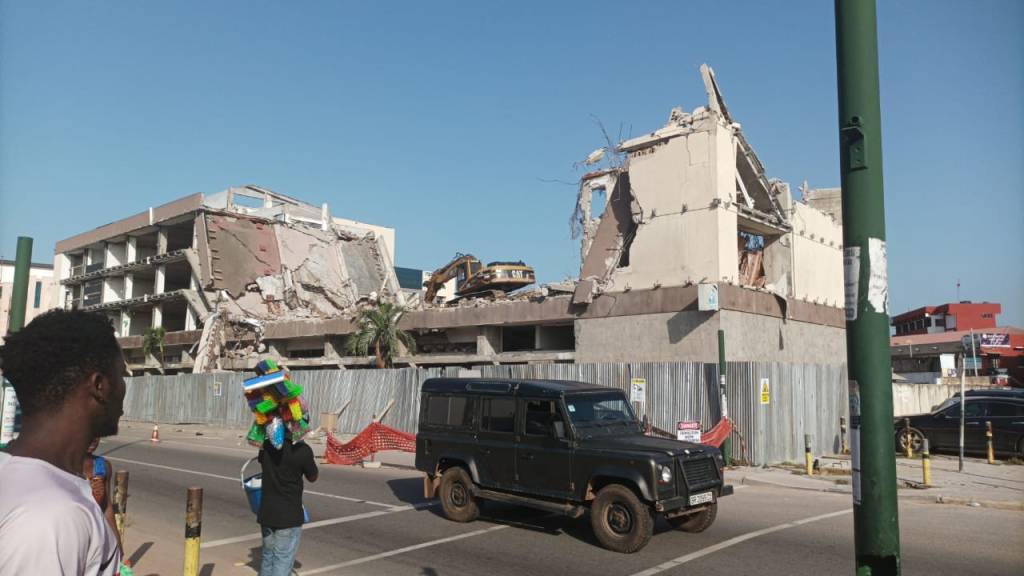
These Guedes landmarks remain relevant to 21st century contexts, but many other postcolonial buildings have been heavily altered or demolished. In my experience as a built heritage professional, architecture of the recent past, whether in postcolonial contexts, Europe, or the Americas is especially vulnerable to inappropriate alterations and loss.
Coupled with the experimental, academic, inefficient and sometimes foreign or dehumanising aspects of mid-century Modern architecture and urban renewal, it can be difficult ‘to love’ and costly to restore for sustainable 21st century purposes. Outside losses from the traumatic impact of military conflict or political maneuvering, it comes as no surprise that the architecture that has sustained and remains relevant to local communities is the architecture that originally engaged with its local context and traditions.
These landmark buildings need champions like Mémoire des Architectes Modernes Marocain’s (MAMMA) and DoCoMoMo to promote their value against ever greater development pressures. “Crucibles, Vectors and Catalysts” moved the discussion forward, but there are clearly collaborative opportunities for research and advocacy to be progressed.
Heather McGrath Alcock is PhD researcher at University of Liverpool’s School of Architecture studying the global development of planned company towns. Heather returned to academia after twenty years as a built heritage practitioner based in New York City and later London and the Wirral. Heather had the opportunity to work on landmarks of the Modern movement, including the United Nations Headquarters in Manhattan, a thematic survey of mid-century modern houses in New Canaan, Connecticut started by “the Harvard Five”, and the former Pan American Building at 200 Park Avenue, Manhattan.
References
Daechsel, Markus. 2011. ‘Seeing like an expert, failing like a state? Interpreting the fate of a satellite town in early post-colonial Pakistan.’ in Marcel Maussen, Veit Bader and Annelies Moors (eds.), Colonial and Post-Colonial Governance of Islam (Amsterdam University Press).
Talinn, Grigor. 2004. ‘Recultivating “Good Taste”: The Early Pahlavi Modernists and Their Society for National Heritage’, Iranian Studies, 37: 17-45.
Uduku, Ola. 2006. ‘Modernist architecture and ‘the tropical’ in West Africa: The tropical architecture movement in West Africa, 1948–1970’, Habitat International, 30: 396-411.
[1] Jackson, Ian. “Introductory remarks for Crucibles session” from “Crucibles, Vectors, Catalysts: Envisioning the Modern City”. Online. 2nd March 2021.
[2] In his presentation, “Rupture, Transition and Continuity in Baghdad’s Master Plans: From Minoprio to Miastoprojekt” on 2nd March 2021, Stanek noted that the Iraqi coup which toppled the monarchy in 1958 instigated a new era of collaboration with Eastern European architects and planners; networks established to “compete with and confront Western European and American hegemony to establish a new independent Iraq through its capital city Baghdad.”
[3] Baghdad’s first modern city plan was completed in 1956 by the British architect and town planner Sir Charles Anthony Minoprio, Hugh Spencley and Peter Macfarlane for the country’s Western aligned Hashemite monarchy.
[4] Karim, Fahran. “Archaeology of the Future: Constantinos Doxiaidis in East and West Pakistan”, from Crucibles, Vectors, Catalysts: Envisioning the Modern City seminar, Session 2, Vectors; 2nd March 2021.
[5] Ibid. According to Fahran Karim, Doxiaidis’ patron Ayub Khan “subscribed to a social theory of development but weakened democracy to validate his authoritarian rule because he felt that the poor, uneducated [masses] couldn’t participate in democracy.”
[6] According to Markus Daechsel in his 2011 contribution ‘Seeing Like an Expert, Failing Like a State?
Interpreting the Fate of a Satellite Town in Early Post-Colonial Pakistan’, in Colonial and Post-Colonial Governance of Islam, ed. by Marcel Maussen, Veit Bader and Annelies Moors (Amsterdam University Press, 2011), p 159-160, there were many problems associated with the rapid and uneven development of the refugee settlements (lack of basic services (running water, electricity, sewers) and infrastructure (storm sewers), unfinished civil engineering works and the relatively poor refugee communities could not afford rents for the shop spaces, so were not used.
[7] Including Michael Pattrick, Director of the AA in the 1950’s who saw the new department as a way to improve the Association’s finances and academic standing, to Maxwell Fry who supervised the first few years of the department and then culminating in Otto H. Königsberger’s (1908 – 1999) leadership. From Zamarian, Patrick. “Global Perspectives and Private Concerns: The AA’s Department of Tropical Architecture”, from Crucibles, Vectors, Catalysts: Envisioning the Modern City. Online. 2nd March 2021.
[8] Ibid.
[9] Lagos was the original capital city for independent Nigeria. However, it is now the capital of Lagos State since the Nigerian capital city moved to Abuja in 1991.
[10] Ola Uduku, ‘Modernist Architecture and ‘the Tropical’ in West Africa: The Tropical Architecture Movement in West Africa, 1948–1970’, Habitat International, 30 (2006), 399.
[11] In ‘Recultivating “Good Taste”: The Early Pahlavi Modernists and Their Society for National Heritage’, Iranian Studies (2004), Talinn Grigor noted that “For the modernists, therefore, the control over the physical and conceptual “heritage” enabled them to erase the immediate past to construct the “progressive” future. Destruction of building-as-representation [traditional sites of religious pilgrimage] proved central to the construction of the pending utopian future. Architecture was imperative to the success of the [Society for National Heritage] SNH’s modernizing agenda.”
[12] The Museum opened months before the revolution started which saw the monarchy overthrown and exiled from the country.
[13] While more ancient histories and built heritage are preserved and underpin 21st century cultural identity in Morocco, the architecture of the mid-twentieth century has been over-looked, inappropriately altered or destroyed. Mémoire des Architectes Modernes Marocain (MAMMA) was created in 2016 by young architects concerned with the loss of these sites.
[14] Alsaden noted in his 9th March 2021 presentation “Syntheses Across Disciplines: Rifat Chadirji and Art-Architecture Liaisons in Modern Baghdad” for Crucibles, Vectors and Catalysts: Envisioning the Modern City, Chadirji was part of the elite bohemian culture of Baghdad, which included artists and architects who were educated in Europe and America. Against the backdrop of political turmoil, they created a vibrant, creative society that embraced Modernism ‘as an act of rebellion against the legacy of British architects who had used Neo-classical designs with orientalist tropes’.
[15] Tostoes, Ana. “Correspondences, Transfers and Memory: Maputo’s ’Age of Concrete’”, from Crucible, Vectors, Catalysts: Envisioning the Modern City seminar, Session 2, Vectors; 2nd March 2021.

















 Transnational Architecture Group