Archive

Author Archives: jacksoniain

The Architecture of Edwin Maxwell Fry and Jane Drew:

We’re delighted to announce that our Fry and Drew book is to be published in paperback format in a few days time. This should make it a little more affordable and hopefully accessible to a broader audience in West Africa and India…

9781409451983

https://www.routledge.com/The-Architecture-of-Edwin-Maxwell-Fry-and-Jane-Drew-Twentieth-Century/Jackson-Holland/p/book/9781409451983


Architect-entrepreneurs in post-independence Pune (India)

Sarah Melsens, Priyanka Mangaonkar-Vaiude, Yashoda Joshi
Department of Architectural Engineering, Vrije Universiteit Brussel (VUB), BelgiumDepartment of Architecture, BRICK school of Architecture, Pune, India

Abstract

With the purpose of expanding the built infrastructure in their colonial empire the British imparted technical training to Indians since the mid nineteenth century. These construction related courses initially focussed on assistant, supervisory and executive tasks but evolved into the training of civil engineers. Half a century later, in 1913, a handful of British architects in Bombay took the initiative to develop an existing drafting school for architectural assistants into India’s first school of architecture. Through such schools, and the gradual employment of Indians at higher ranks in Indo-British firms or the Public Works Department (PWD), Indian architects and engineers acquired British methods of working and construction. While construction practice during the British Raj (1858-1947) has gained scholarly attention recently, less is known of how construction was practiced after India’s independence in 1947. Analysis of the profiles of professional firms has shown to be a fruitful means of gaining insight in the workings of the construction field. In order to understand how construction practice was carried forward, this paper will therefore study the first Indian architect-entrepreneurs, who established their firms after Independence.

Architecture graduates from JJ School of Art

Architecture Graduates from J. J. School of Art formed the nationwide Indian Institute of Architects in 1929. Top Left: G. B. Mhatre, and Bottom second from Left: C. M. Master with council members of the Indian Institute of Architects, Bombay, 1936-1937

The study is built on data collected from interviews and office archives of three Indian architectural and entrepreneurial offices, which were based in Pune and active in the period 1947-1982. The paper analyses the type of projects these firms were working on, the procedures and organisation of design and construction, and the prevailing construction techniques of the period. As such this contribution will shed light on how, in a post-colonial situation, western models of construction practice were translated into the Indian context.

keywords

Construction practice, architects, post-independence, India, Pune

You may read the rest of this fascinating article here: TNAGblog_architectenterpreneurspune

2016 Grantees for Conserving Modern Architecture Initiative Announced

TAG is delighted that the Getty Foundation has awarded a ‘Keeping it Modern’ heritage grant to the Children’s Library in Accra, Ghana – the first time this prestigious award has been made to a building in Africa. This will fund building research into the material fabric of the library, as well as programme of events to keep the space activated and enjoyed.

The library was designed by Nickson and Borys (see Notes from Accra ) in late 1950s / early 1960s (the building appears in J. M. Richard’s New Buildings of the Commonwealth, 1961) and has already received some sympathetic restoration in more recent times, as well as some less fortunate interventions (such as the aluminium front door).

The latest project will be in safe hands under the leadership of the ArkiAfrica team, http://archiafrika.org/wp-content/uploads/2013/03/march-13-invite.jpg  and we will post updates on the project here.

Getty press release and information on the other awards here: http://blogs.getty.edu/iris/2016-grantees-for-conserving-modern-architecture-initiative-announced/


Oxford University Press will publish ‘Architecture and Urbanism in the British Empire’ on 7th October 2016. Below is a brief synopsis from the publishers website.

9780198713326

Throughout today’s postcolonial world, buildings, monuments, parks, streets, avenues, entire cities even, remain as witness to Britain’s once impressive if troubled imperial past. These structures are a conspicuous and near inescapable reminder of that past, and therefore, the built heritage of Britain’s former colonial empire is a fundamental part of how we negotiate our postcolonial identities, often lying at the heart of social tension and debate over how that identity is best represented.

This volume provides an overview of the architectural and urban transformations that took place across the British Empire between the seventeenth and mid-twentieth centuries. Although much research has been carried out on architecture and urban planning in Britain’s empire in recent decades, no single, comprehensive reference source exists. The essays compiled here remedy this deficiency. With its extensive chronological and regional coverage by leading scholars in the field, this volume will quickly become a seminal text for those who study, teach, and research the relationship between empire and the built environment in the British context. It provides an up-to-date account of past and current historiographical approaches toward the study of British imperial and colonial architecture and urbanism, and will prove equally useful to those who study architecture and urbanism in other European imperial and transnational contexts.

The volume is divided in two main sections. The first section deals with overarching thematic issues, including building typologies, major genres and periods of activity, networks of expertise and the transmission of ideas, the intersection between planning and politics, as well as the architectural impact of empire on Britain itself. The second section builds on the first by discussing these themes in relation to specific geographical regions, teasing out the variations and continuities observable in context, both practical and theoretical.

Table of Contents:

Introduction
Architecture, Urbanism, and British Imperial Studies, G. A. Bremner
PART I: Themes in British Imperial and Colonial Architecture and Urbanism
1: Beginnings: Early Colonial Architecture, Daniel Maudlin
2: Urbanism and Master Planning: Configuring the Colonial City, Robert Home and Anthony D. King
3: Stones of Empire: Monuments, Memorials, and Manifest Authority, G. A. Bremner
4: The Metropolis: Imperial Buildings and Landscapes in Britain, G. A. Bremner
5: Propagating Ideas and Institutions: Religious and Educational Architecture, G. A. Bremner and Louis P. Nelson
6: Imperial Modernism, Mark Crinson
Part II Regional Continuity, Divergence, and Variation in the British World
7: British North America and the West Indies, Harold Kalman and Louis P. Nelson
8: South and Southeast Asia, Preeti Chopra
9: The Australian Colonies, Stuart King and Julie Willis
10: New Zealand and the Pacific, Ian Lochhead and Paul Walker
11: Sub-Saharan Africa, Iain Jackson and Ola Uduku
12: Egypt and Mandatory Palestine and Iraq, Samuel D. Albert

Further details here: https://global.oup.com/academic/product/architecture-and-urbanism-in-the-british-empire-9780198713326?cc=ro&lang=en&# 
cleoroberts's avatarEnvisioning the Indian City

Announcement

Four-year PhD Studentships

Location: University of Westminster

Deadline: 26th August 2016

Two x four-year, full time PhD studentships in the Faculty of Architecture and the Built Environment as part of ERC grant funded project Monsoon Assemblages.

Stipend of £16,000 p.a. and Tuition Fees (Home/EU fees only).

Full article

Two x four-year, full time PhD studentships

Monsoon Assemblages is a five-year long research project funded by the European Research Council (Starting Grant no. 679873) with the ambition of confronting challenges of urban climate change through novel, inter-disciplinary research in three of South Asia’s rapidly growing cities: Chennai, Delhi and Dhaka. It is driven by questions of how these cities might be transformed if no longer thought of as exclusive products of human agency, but as co-designed by the material energies of earth systems.

PhD applications are invited from the spatial design and/or environmental humanities disciplines to engage with these questions. The exact areas of…

View original post 119 more words

An update on the Architecture and cultural heritage between the Ganges and Gibraltar Symposium by Cleo Roberts.

cleoroberts's avatarEnvisioning the Indian City

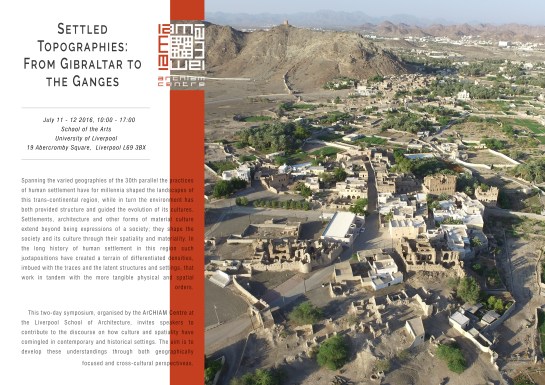
Settled Topographies: From Gibraltar to the Ganges

ArCHIAM Centre Conference

July 11 – 12, 2016

10:00 – 17:00

School of the Arts Library

19 Abercromby Square

Liverpool

Last week the ArCHIAM Centre at Liverpool School of Architecture hosted a two day symposium, ‘Settled Topographies: From Gibraltar to the Ganges’, exploring how culture and spatiality have comingled across this trans-continental region in contemporary and historical settings. As Professor Souymen Bandyopadhyay (Director ArCHIAM) introductory remarks stated, ‘there is a need to reflect on the area’s global interactions to help inform contributions to the present world’.

The opening sessions including papers by Dr Iain Jackson (University of Liverpool), ‘State Building and Nation Creation: British Mandate Architecture and Planning in Iraq’, and Cleo Roberts, ‘The River Ganges: Colonial Calcutta’s Sub-City’, provided a rich insight into how British colonial relationships had sought to harness inherited environments through a combination of infrastructural, and prestige projects, and…

View original post 982 more words

Settled Topographies: From Gibraltar to the Ganges

July 11 – 12, 2016

10:00 – 17:00

School of the Arts Library

19 Abercromby Square, Liverpool
Spanning the varied geographies of the 30th parallel the practices of human settlement have for millennia shaped the landscapes of this trans-continental region, while in turn the environment has both provided structure and guided the evolution of its cultures. Settlements, architecture and other forms of material culture extend beyond being expressions of a society; they shape the society and its culture through their spatiality and materiality. In the long history of human settlement in this region such juxtapositions have created a terrain of differentiated densities, imbued with the traces and the latent structures and settings, that work in tandem with the more tangible physical and spatial orders.

This two-day symposium, organised by the ArCHIAM Centre at the Liverpool School of Architecture, invites speakers and attendants to contribute to the discourse on how culture and spatiality have comingled in contemporary and historical settings. The aim is to develop these understandings through both geographically focused and cross-cultural perspectives.

All welcome to attend and further updates to follow…

2016 UOL_Symposium Flyer.jpg

In between improvisation, compensation and negotiation: a socio-spatial analysis of Kariakoo market (Dar es Salaam) dynamics under British colonial rule (1919–1961), by L Beekmans and J. R. Brennan, published in History of Retailing and Consumption, vol2, issue 1, 2016.

Abstract.

“This article examines the socio-spatial history of the central market of a colonial African city. Colonial policies of racial segregation created obstacles to commerce, which in turn generated a local strategy of improvisational planning to placate various urban actors with a host of often contradictory concessions to ameliorate dislocation. These contradictions of colonial governance played out most visibly in the struggles over Kariakoo market, which became the city’s primary market after its construction in 1923.

DSCF1230

Kariakoo Market, March 2016

By focusing on contests over the spatial ordering of commerce and residence in a multi-racial city ruled by Europeans, commercially dominated by Indians but overwhelmingly populated by Africans, this article demonstrates how the production of certain types of urban space creates unforeseen leverage for local actors, which simultaneously entrenches wider patterns of obstinate racialization despite the ubiquity of planning concessions. Using deeply researched archival evidence as well as a rich secondary literature, the authors argue that the city market best illustrates the racially contradictory impact of the colonial state on an urban landscape.”

Full article available here: http://www.tandfonline.com/eprint/vGx4RCbCui3cBncBNP8h/full 

TAG also included recent posts on Dar es Salam here: A quick tour of Dar es Salam and here: Urban Narratives (Simulizi Mijini) Symposium Report

I’ve recently published a paper in the Journal of Architecture entitled, ‘The architecture of the British Mandate in Iraq: nation-building and state creation’. You can read the full article here [http://dx.doi.org/10.1080/13602365.2016.1179662 ], and the abstract is below…

16_Film001

Watercolour perspective of King Feisal’s Palace, Baghdad, designed by J. M. Wilson, courtesy of Wilson Mason LLP.

This paper seeks to examine and contextualise the architecture and infrastructure projects developed by the British during the occupation of Iraq in the First World War and the Mandate period that immediately followed. Relying heavily on military-political events for its structure and underlying narrative, the paper demonstrates how architecture, planning and ‘development’ were integral to the act of creating the new state and were very much part of the colonisers’ vision to create a nation in their own image. Works were deployed to imbue a sense of collective belonging and national identity through the creation of new town plans, as well as through institutions such as museums and universities. A certain dissonance emerges between the infrastructure and prestige projects, with the latter presenting an imagined and fabricated notion of Iraqi history, blended with a grandiose colonial style imported from India, and designed predominantly by James M. Wilson. The infrastructure projects began with sanitation improvements, road and rail installation, and expansion of the Basra docklands to attract international shipping and for the export of oil. Further building projects undertaken by the Public Works Department included a large number of administrative buildings called serais.

22_Film014

Watercolour perspective of Basra Airport, designed by J. M. Wilson, courtesy of Wilson Mason LLP.

Built at strategic locations, they were deployed as multi-functional centres for justice, taxation and land registration as well as places where local devolved empowerment was instigated. Iraqi architecture from this period has been largely overlooked in the emerging global histories of architecture, yet it offers an important view of the quandaries that faced late British colonial architecture in its attempts to respond to, and reflect changing and hostile political conditions.