Archive

Author Archives: jacksoniain

Building on our Ghana theme I’d like to share an excellent paper recently published by a good friend of the TAG blog, Dr. Lukasz Stanek from Manchester University.

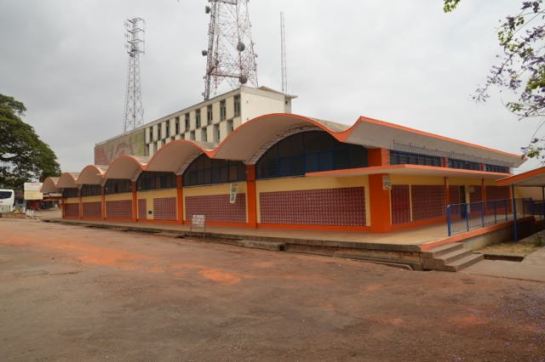
 “When seen from Labadi Road, the buildings of  Accra’s International Trade Fair (ITF) appear among abandoned billboards, scarce trees that offer shade to resting taxi drivers, and tables where coconuts, bottled water, sweets, and telephone cards are sold next to the road.

 The buildings neighbor the La settlement, where streets meander between houses, shops, bars, schools, and shrines,  while on the other sidof Labadi Road, at the seashore, luxurious housing estate is under construction next to upscale hotels that overlook Labadi Beach. Kwame Nkrumah, Ghana’s leader after the country achieved independence (1957), initiated the fair as a prestige project, but it was opened on 1 February 1967 by Joseph Arthur Ankrah the chairman of the National Liberation Council, who led the putsch that toppled Nkrumah in 1966. Once conveying a sense of radical moder-nity, the buildings have suffered from underinvestment and insufficient maintenance, but most of them are still in use, rented for exhibitions that take place every few months, for political rallies, and for religious services.
From 1962 to 1967, the Ghana National Construction Corporation (GNCC), the state office charged with design, construction, and maintenance of governmental buildings and infrastructure in Nkrumah’s Ghana, designed and con-structed the ITF. The designers of the fair were two young architects from socialist Poland, Jacek Chyrosz and Stanisław Rymaszewski, who worked with the Ghanaian Victor (Vic)  Adegbite, the chief architect. Chyrosz and Rymaszewski  were employed by the GNCC on a contract with Polservice, the so-called central agency of foreign trade, which mediated the export of labor from socialist Poland.
Ghana copy

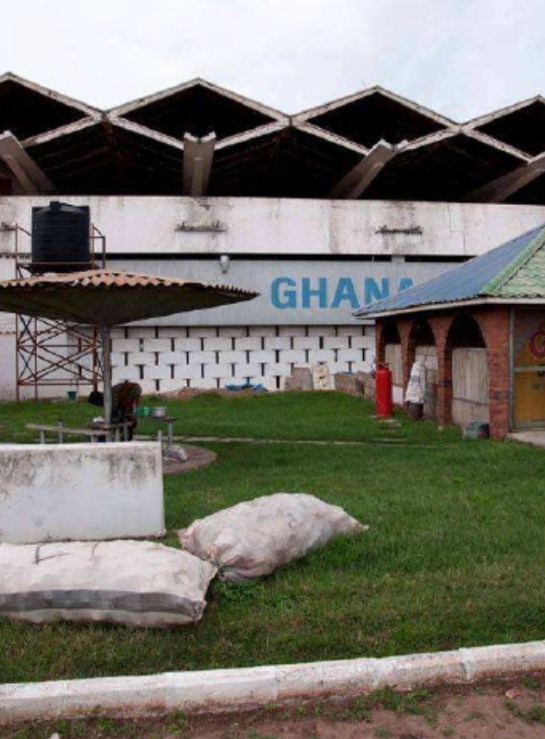
“Made in Ghana Pavilion” 1967, International Trade Fair, designed by Jacek Chyrosz, Stanislaw Rymaszewski and Vic Adegbite


 At the GNCC, they worked together with Ghanaian architects and foreign professionals, many from socialist countries. This collaboration reflected the alliance of Nkrumah’s government with socialist countries, which was demonstrated at the fair by the exhibitions of Czechoslovakia, the German Democratic Republic (GDR), Hungary, and Poland (Figure 3). At the same time, the Ankrah administration used the fair to facilitate Ghana’s reopening toward the West. Hence, the Soviet Union and the People’s Republic of China (PRC), two major allies of Nkrumah, were absent.

 By contrast, the two pavilions not to be overlooked were those of Great Britain, Ghana’s former colonial ruler and its main trade partner, and the United States, which granted Ghana loans for its many infrastructural projects in the 1960s, in particular the Akosombo Dam, financed jointly with the United Kingdom and the World Bank. India was represented as a member of the Commonwealth rather than as a member of the Non-Aligned Movement, since Nkrumah’s attempt to position Ghana among Egypt, India, and Yugoslavia as one of the leading nations of the movement was abandoned after the change of the regime. Collaboration among African countries was particularly favored, not as a way of carrying on Nkrumah’s vision of pan-African union but with a more modest aim, that of the stimulation of trade among African countries. Displays representing African countries were gathered in the round Africa Pavilion at the end of the ramp through which visitors entered the fair, before they moved on to Pavilion A (the “Made in Ghana” pavilion) and the pavilions rented to other countries and Ghanaian state firms.”

Notes from Accra

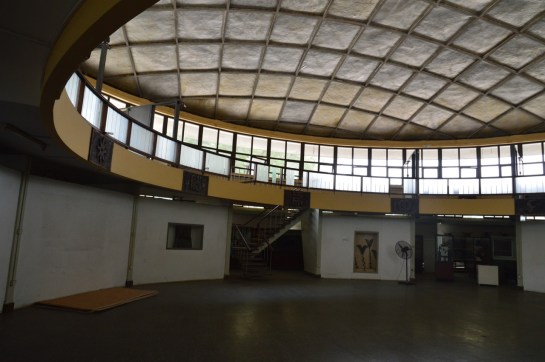
Iain Jackson and Ola Uduku have spent the last two days in Accra catching up with 20th century architecture, and meeting with contacts as part of the British Academy funded ‘From Colonial Gold Coast to Tropical Ghana’ architecture project. Tuesday 23rd February was spent visiting the Ghana National Museum complex, the gem in the crown being Denys Lasdun’s prefabricated dome shaped museum, currently closed for refurbishment. The imagination and vision of the building were still clearly there in our viewing of the stripped down structure ready for conservation.

DSC_0820.jpg

Our next stop took us to Nickson and Borys’ Children’s library building nearer to Central Accra. This had been sympathetically restored, and again was a great demonstration exemplar of ‘West African Modern’ and the developmental vision of the departing colonial government to establish libraries that were open to all citizens. The upper area remained devoid of activity but had potential to be a great multipurpose programme space.

DSC_0801.jpg

Children’s Library

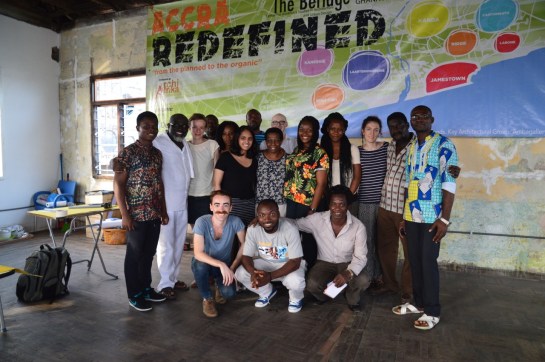
The final visit of the day was to Joe Osae-Addo’s Archi-Africa – TuDelft Berlage Architecture school studio, in Accra’s Jamestown neighbourhood, on the urban fabric of everyday life in Accra. The impromptu crit we were invited to take part in was an enjoyable experience and the schemes were full of promise.

DSC_0832.jpg

TU Delft and Archi-Africa in the newly converted Jamestown Studio

Day two involved visits to Jamestown – as a walking visit this time to take in early 20th century colonial PWD, and also warehouse architecture in the neighbourhood. A visit to Adabraka also yielded a few examples of early PWD worker housing, which was followed by an afternoon visit to Achimota School, which conveyed the height of the colonial education project with architectural symbolism and style. A few later additions to the campus by Nickson and Borys and other’s also fitted well into the College’s narrative of colonial imperialism and privilege. The final visit for the day was to Scott House, which lived up to its deified tropical modernism status, whilst the Western Tessano neighbourhood had transformed into an upper class gated area, that unexpectedly gave us a glimpse of an earlier [likely Cubitt?] designed semi detached housing unit, currently undergoing a further 21st century upgrade..

DSC_0863.jpg

One of the few surviving examples of its type in Adabraka

We will be moving onto Kumasi on Friday and will update from there early next week.


As part of the Envisioning the Indian City project we have been invited to produce a short set of podcasts for the ‘Realise’ series at Liverpool University. Each podcast is devoted to one of the cities we have been researching [Goa, Pondicherry, Kolkata and Chandigarh] for the past few years in collaboration with Jadavpur University in Kolkata.

india-backing

You may listen to us here: https://www.liverpool.ac.uk/realise-podcast/ and read more about the project here: https://eticproject.wordpress.com

This gallery contains 3 photos.

Originally posted on Envisioning the Indian City:
Standing on the Esplanade crossing, looking down Lenin Sarani with the “Tipu Sultan” mosque on our left, Kawshik Aki pressed his shutter. Bringing his camera down from his eyes he looked at the preview, shook his head, took a step to the left and clicked again.Meanwhile I stood…

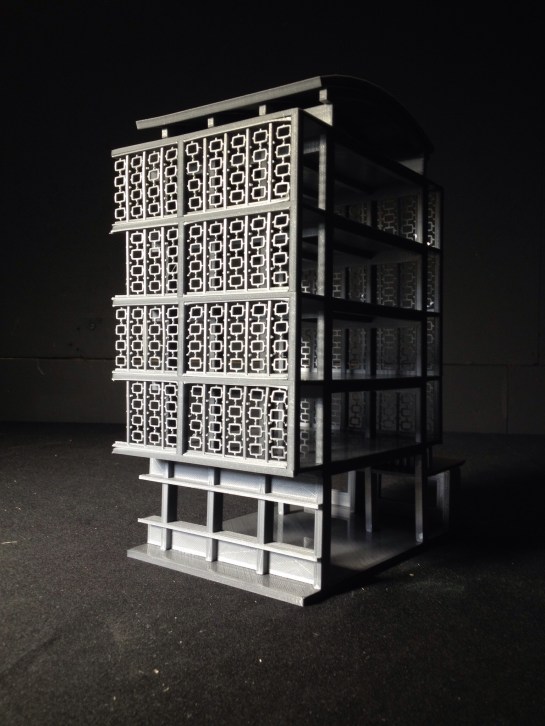
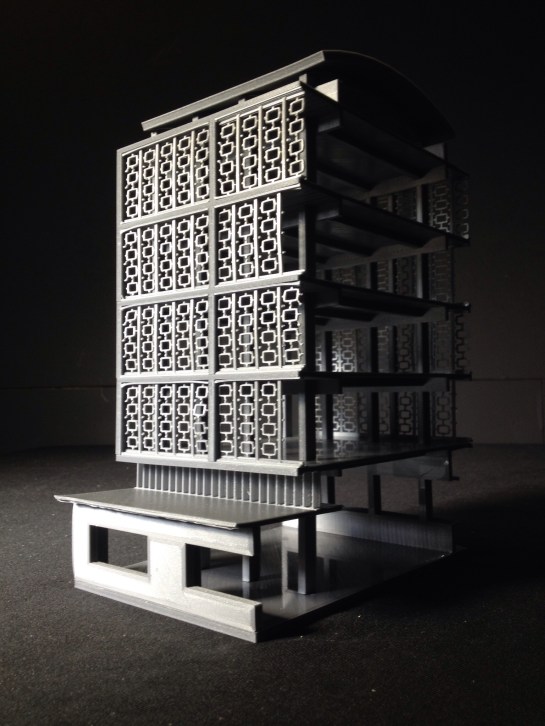
3D Printed Model of Kenneth Dike Library

We’ve been playing with a couple of 3D printers [Makerbot and Ultimaker] and testing how they might be used to create a small collection of models to supplement our History of Architecture lectures.

image

In the age of ‘Stream Capture’ and recorded lectures including a small exhibition of key case study models in the lecture theatre will hopefully entice the students to attend the live event and will also form an opportunity to further explore light, scale and the qualities of buildings that are not as easily expressed through photographs and orthographic drawings.

image

Our first test case used a computer model of the Kenneth Dike Library, Ibadan [designed by Fry and Drew] expertly produced by Jacopo Galli and generously shared with us. The model doesn’t show the entire buiding but a key section enabing the interior to be viewed. The ambition is a for an online library of models that can be downloaded and then printed as and when they are required by faculty and students.


image

Here are some further updates on the Augmented Reality App we developed for Kolkata….

cleoroberts's avatarEnvisioning the Indian City

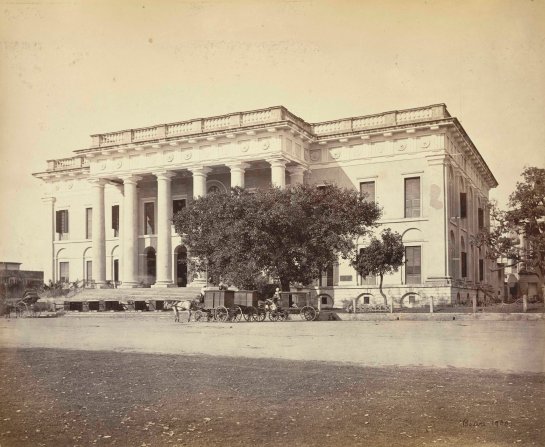
Timescape Kolkata, an augmented reality app developed by the ETIC project, launched earlier this week at the Victoria Memorial Hall. The innovative app allows iOS and Android phone users to experience the antiquated city through photographs produced by Frederick Fiebig, W.G Stretton and Company and the reputable Bourne and Shepherd.

Once Timescape (www.time-scape.org) is downloaded from here, users can explore rare archival images and data about heritage sites in Kolkata. As you walk through the city, views will be ‘augmented’ by a corresponding nineteenth century photograph taken at the exact site. Another click or with a single swipe a host of archival information including sounds and histories will be available.

TimescapeKolkata

The idea germinated following the UGC-UKIERI funded ETIC Liverpool conference held last year. In the School of the Arts library, after negotiating theories of the contemporary city, a series of questions emerged. What if Frederick Fiebig’s handpainted candid Calcutta…

View original post 367 more words

This weekend is the final gathering of the ‘Envisioning the Indian City’ project team in Kolkata, as well as the launch of our Augmented Reality app that overlays historical photographs of Kolkata onto contemporary cartography. If you are in Kolkata please do join us.

Visualizing the City_flyer final-1

Cities are inhabited spaces felt through all our senses, especially those of touch, hearing, smell, and so on. In representation, in imagination, in planning and conceptualization, however, they are above all visualized spaces, appearing before our eyes as seen, remembered, or projected. This one-day symposium will focus on the ways in which cities and city-spaces are experienced through the visual register, though we want to interpret this term as widely as possible to include modes of conceptualizing or laying out city-spaces.

Through a series of presentations from architects, historians, literary scholars and art historians, we wish to bring out multiple ways of seeing the city: as a planned (or not-so-planned) space fitting into a conceptual grid; as a scenic location represented through art or captured in memory; and as a visual experience that feeds into the phantasmagoria of city life. Individual presenters may bring out even more nuanced ways of visualizing the city and historic proto-city sites.

The symposium is the last in a series of international workshops and research seminars under the UGC-UKIERI International Thematic Partnership ‘Envisioning the Indian City: Researching Cross-cultural Exchanges in Colonial and Post-colonial India ’ between the University of Liverpool and Jadavpur University, 2013-15: https://eticproject. wordpress.com. This research project focused on four significant city-sites, Goa, Pondicherry, Kolkata and Chandigarh – the first three originating in distinct colonial encounters (with the Portuguese, the French and the British) and the fourth a creation of the post-colonial Indian state. However, in the course of research, other cities and other ways of understanding or viewing urbanity also came into focus, and our work was immeasurably enriched by the contributions of urban historians and scholars worldwide, as part of an ongoing conversation about cities, space, modernity, and cross-cultural encounters.

In the last phase of the project, our team has been developing the Kolkata layers for the Augmented Reality App through which historic photographs and other archival footage related to existing city-sites can be accessed on one’s mobile phone. This final phase of project research has been enabled by a generous grant from the University of Liverpool and the archival resources of the British Library’s Photographic Collection. We have also been greatly assisted by support from our other non-HEI associates, such as the Victoria Memorial Hall, Kolkata, where the AR App, Timescape Kolkata, will be launched on 28th November at 6 pm, after a panel discussion featuring urban specialists and advisors to the project: Timescape Kolkata: Seeing the Past in the Present.

The day-long symposium on Visualizing the City (Jadavpur University, 10 am – 4.30 pm), however, is not simply a prelude to the launch. It will draw together perspectives from architecture, town planning, history, art, literature and contemporary urban culture to reflect on the major project theme of ‘Envisioning the Indian City’. Our invited speakers are Professors Miki Desai (CEPT Ahmedabad), Snehanshu Mukherji (Architect; Visiting Faculty, SPA Delhi), Swapan Chakravorty (Presidency University), Tapati Guha-Thakurta (CSSSCal), Jonathan Gil Harris (Ashoka University) and Dhir Sarangi (Jawaharlal Nehru University). Entry to the symposium and launch are free and we welcome participation and interaction.

Visualizing the City_flyer final

10 am:

Introductory Remarks and Welcome to Participants: Nandini Das (University of Liverpool) and Supriya Chaudhuri (Jadavpur University), ETIC Project Coordinators

10.15 am – 11.45 am: Session 1: Chair, Nandini Das

Jonathan Gil Harris (Ashoka University): From the Ethiopian Highlands and Baghdad to the Nehr-e-Ambari: How to Build a Transnational Deccan City Dhir Sarangi (Jawaharlal Nehru University): French Visualizations of India through Maps and Drawings from the 18th Century

  1. 45 am – 12 noon: Coffee

12 noon – 1.30 pm: Session 2: Chair, Nilanjana Gupta 

Snehanshu Mukherjee (TEAM/ Visiting Faculty, SPA Delhi): The Vanishing City

Miki Desai (CEPT Ahmedabad): Towns in Transition: a Missing Link in Visualizing the Indian Urbanity: Case Study, Gujarat

1.30 pm – 2.30 pm Lunch

 2.30 pm – 4.00 pm: Session 3: Chair, Supriya Chaudhuri

Tapati Guha-Thakurta (Centre for Studies in Social Sciences, Calcutta): The City in the Archive: Calcutta’s Visual Histories

Swapan Chakravorty (Presidency University): ‘All Its Several Lodgings Composed’: Visualizing Houses of Art for a New Kolkata

All are welcome.

Please join us after the Symposium for the launch of the AR App, Timescape: Kolkata, at Victoria Memorial Hall, 6 pm

New Research: Gyoji Banshoya (1930–1998): a Japanese planner devoted to historic cities in the Middle East and North Africa, published in Planning Perspectives by Kosuke Matsubara

Gyoji Banshoya (1930–1998) was a Japanese urban planner whose life-work was urban planning in the Middle East and North Africa. The purpose of this paper is to provide an overview of his work, which still remains unknown. His early masterpiece, the ‘Square House’, shows how he was influenced by Kiyoshi Seike to apply historic spatial composition to realize width and convertibility in low-cost housing.

Gyoji Banshoya
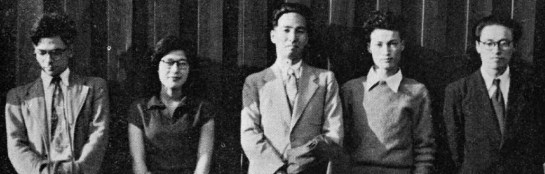
K. Shinohara, M. Yamada, K. Seike, G. Banshoya, and S. Miyasaka. Source: Hayashi, “Seike Kiyoshi to Gendai no Jukyo Design,” 6

Following this, Banshoya studied under the supervision of Gerald Hanning and George Candilis at Ateliers de Baˆtisseurs in Paris, and went to Algiers to engage in the study of ‘evolutionary habitat’. As a United Nations Development Programme (UNDP) expert, he began working with Michel Ecochard in 1962 in Beirut, Damascus, and Aleppo. They were responsible for the elaboration of master plans for these three cities, and that of Damascus still remains as a legally active master plan today. Coupled with the Syrian political struggle since the 1980s, there has been some reaction against their modernist policies. However, the case is made for a detailed examination of Banshoya’s work, and re-evaluation of its legacy for the urban planning history of the Middle East and North Africa.

You may read the full article here: http://www.tandfonline.com/doi/pdf/10.1080/02665433.2015.1073610


EAUH Helsinki 2016

European Association for Urban History 2016 Conference: 

Reinterpreting Cities

24-27 August 2016, Helsinki, Finland


CALL FOR PAPERS

Deadline: 31 October 2015

Session:

M19. Settler Cities: A Useful Concept to Reinterpret Transnational Urban History?

In the opening lines of his massive Replenishing the Earth: The Settler Revolution and the Rise of the Anglo World, 1783-1939, James Bellich presents a challenge to historians eager to reinterpret cities in a transnational framework: do cities like Chicago and Melbourne on opposite sides of the planet share characteristics by virtue of their foundation and political rule by white settlers intent on dwelling permanently upon lands forcibly taken from their indigenous inhabitants?
This panel will explore this question by calling upon scholars to reflect on the concept of “Settler Cities.” What defines such a city? Are their clear boundaries, or does the definition involve a subtle degrees of separation form the broader category of colonial city? Are there broad commonalities in the histories of these cities that merit singling them for scrutiny as a group? Are they best seen as a special subset of colonial cities or is there a way in which they expand or transcend that long-used concept? Are there webs of connections between these cities and between them and the imperial metropoles that make this concept especially useful as a subset of the new subfield of transnational urban history? What if we go beyond Bellich’s focus on the “Anglo World,” and consider Algiers, Elizabethvillle/Lubumbashi, Windhoek, Batavia, Jerusalem, and even Mexico City or Rio de Janeiro in the same universe as Cape Town, Chicago, Vancouver, San Francisco, Belfast, and Sydney? Are there non-western settler cities? Why did the settlers in some cities abandon their project of settlement while others stay, helping to cause some of the most intractable conflicts on earth?
Participants should not only bring their research on individual settler cities to the table, but also contemplate several themes underlying the concept of settler cities: especially dense connections and flows between these cities and between them and metropolitan hubs; the diversity of flows between these cities, including not only people, money, ideas, and urban practices, but also jurisprudential systems, organizational forms, urban economic structures, group identities, and political cultures; especially complex forms of urban politics that includes conflicts between settlers, between settlers and metropolitan governments as well as with indigenous people; real estate practices involving people who plan to invest in urban land for future generations unlike the more transient European populations of non-settler colonial cities; and interventions in urban spatial politics that include especially complex forms of segregation and law-of-conquest authoritarianism.

Keywords:
colonial cities, segregation, settler colonies, transnational urban history, urban politcs

Period:
Modern

Type:
Main session

Session organisers:
Carl Nightingale, University at Buffalo SUNY, United States of America
Vivian Bickford-Smith, University of Cape Town, South-Africa
Johan Lagae, University of Gent, Belgium

EAUH Helsinki 2016

European Association for Urban History 2016 Conference:

Reinterpreting Cities

24-27 August 2016, Helsinki, Finland


CALL FOR PAPERS

Deadline: 31 October 2015

Session:

Women on the Edge: Mobility and Regionalism from the Margins

 Leading Question: How did transnationally mobile female actors engage and shape the development of a regionalism discourse in the fields of architecture and planning in the twentieth century?

From the mid-twentieth century, the expanding discourses on regionalism in a globalizing field of architecture championed and eventually canonized the works of architects such as Charles Correa, Geoffrey Bawa and Muzharul Islam. In addition to working in emerging nation-states, the family backgrounds, educations and client bases of these architects ensured that they were actively involved in powerful transnational networks.

In this session we will investigate the significance of such transnational mobility in the development of the regionalism debate, shifting the focus critically from canonized male actors to “marginal” female actors—opening this term and the actors it may describe as platforms for debate—including architects, planners, patrons, and users, in order to explore the fringes of architectural and planning history. We aim to find a more inclusive angle from which to examine connections between transnational mobility, regionalism and local lived environments, as well as the geopolitical, social and economic events and processes that catalyzed their intersection.

As a factor of globalization that accompanied the modern colonial and postcolonial moments—whether a function of privileged access to international networks or the result of forced migration—transnationalism and an emerging landscape of cosmopolitan sites offered women new proving ground outside established social, cultural, and commercial spheres. We are particularly interested in the modalities of this peculiar confluence of labor, politics, and culture, noting as examples the practices of Jane Drew in West Africa, Catherine Bauer in India, Minnette de Silva in Hong Kong, and Erica Mann in Kenya, which were contoured by transgressions of the borders of colonies and new nations. We also see that the transnationalism of certain female figures—Jacqueline Tyrwhitt, Sibyl Moholy-Nagy, Margaret Michaelis—resulted in their profound discursive engagement in modernist debates on regionalism and vernacular or everyday architecture. By studying village housing in the Gold Coast and anonymous architecture in North America and Europe, establishing cottage industries in rural Kenya, or writing histories on Asian regional architecture, many of these agents operated independently of the expected dialogical frameworks between colony and postcolony.

We seek papers that explore the roles, practices, and networks of transnational female actors from the margins; the reception and transmission of their work; and their imbrication with architecture and urbanism discourses on regionalism and the vernacular in the twentieth century.

Keywords:

gender, global south, mobility, postcolonial, regionalism

Period:

Modern

Type:

Specialist session

Session organisers:

Anooradha Iyer Siddiqi, New York University, USA

Rachel Lee, TU Berlin, Germany

Submission Guidelines:

  • Paper proposals can only be submitted online. Proposals and texts sent by post or email will not be considered. To submit a paper proposal, please create a user account on the abstract system on the EAUH2016 website https://eauh2016.net/.
  • Abstracts of paper proposals should not exceed 300 words.
  • Deadline for paper proposals submission: October 31, 2015
  • Notification of paper acceptance: December 15, 2015