Architecture Tour: Otto Koenigsberger: Building Bangalore in the 1940s
Dr Rachel Lee will be leading a tour of Otto Koenigsberger’s buildings in Bangalore on 3rd September – a rare treat to learn more about Koenigsberger’s work in Mysore state. Dr Lee’s PhD was dedicated to Koenigsberger’s work in India and she is about to publish a monograph on her findings very soon- which we are very much looking forward to and will announce further details here…..
Thursday, 3 September 2015
Tour Start Point: 1:00 p.m. at the Pavilion in M. N. Krishna Rao Park
Tour End Point: 5:00 p.m. at IISc CCS
To register, contact: +919880347794 OR 080-49000812-ext 836 or email: cph@srishti.ac.in
Last day for registration: 1 September 2015.
To view the poster and for more details see: Rachel Lee Walk
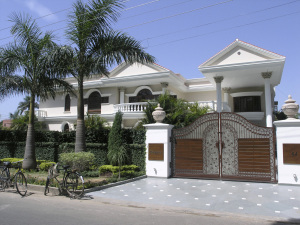
The second day opened with two papers addressing the architectural development and planning of Chandigarh. Iain Jackson (Senior Lecturer, School of Architecture, University of Liverpool) explored the overlooked and quotidian portions of the city in his paper, ‘Chandigarh Dwellings: Ghastly Good Taste or Flamboyant Modernism’. Departing from the over-cited work on the city by Le Corbusier, Pierre Jeanneret, Maxwell Fry and Jane Drew, he detailed his early research into private developments which have avoided similar ossification.
His documentation of these private dwellings showed idiosyncratic modification contra to the city’s founding vision. Discussing this independence from the Government’s arbitration of taste and aesthetic agenda, Jackson proposed a series of classifications including Punjabi Baroque. He stated that this peacock flamboyancy and non-utilitarian adaptation showed Chandigarh remained open, unresolved and signalled the failure of modernist notions of ‘home’.
ENVISIONING THE INDIAN CITY: PEOPLE, PLACES, PLANS
UGC-UKIERI INTERNATIONAL WORKSHOP
HL ROY MEMORIAL AUDITORIUM
MONDAY 17TH AUGUST 2015
The third ETIC international workshop was inaugurated by Professor Sukanta Chaudhuri, Emeritus Professor of English and well-known urban historian. Supriya Chaudhuri (ETIC project lead, Jadavpur) thanked the Centre of Advanced Study, Department of English, Jadavpur University, for hosting the two days and communicated apologies on behalf of Professor Nandini Das (ETIC project lead, University of Liverpool).
Narayani Gupta (Formerly Professor, Department History and Culture, Jamia Millia Islamia) opened the first panel. ‘The Denial of History’ discussed the lost traces of Delhi’s cross-cultural connect throughout its ‘planning’ historiography. Delhi was depicted as an open city, attracting cosmopolitan migration including Armenian and Afghani communities, but Gupta commented on the lack of social historical interest in this multi-layered past. As Delhi gets reported in political terms, using phrases such as Lodi Dehli…
Architectural Theory Review Special Issue Call for Papers: Africa Critical (Vol. 20, No. 3)
Unlike every other populated continent, Africa retains a monolithic description that flattens and abrogates the complexities inherent across its 54 countries. The connotations of the name bear witness to a phantasmatic mobility for which crises have opened various regions to reinvention via mediated spectacle, while also occluding the hegemonies of imperialism and its afterlives. Such transfers, intensified during the violent insurgencies of colonial possession and subsequent ethnic conflicts, has continued into the twenty-first century at an alarmingly rapid pace affecting how and why power is reified among urban centres. Competing ventures, including the fabrication of new infrastructures, unlimited mineral processing and the (de)mobilisation of humanitarian aid all can be read as dynamic indexes of those “networks of concrete becoming” (AbdouMaliq Simone) which quickly eschewed lingering colonial systems in favour of the global. We seek to interrogate how the mapping of environmental impacts and encoding of borders dismantle the “invisible” systems (Filip de Boeck) that once connoted security and development in the post-colony.
This issue invites essays that investigate how displacements such as the phenomena of sovereignty, citizenship, the deployment of health systems, the radicalisation of race and gender, and the manifestations of diaspora are registered in the built environment. More broadly, the issue seeks contributions that reflect on how architecture, art, and landscape confront such divisive forms on the African continent while ensnaring agendas of the everyday.
Africa Critical will attempt to recentre Africa as a source for and mirror of a spatial politics that is rendering a new map of global capital. How can humanistic inquiries begin to move away from the monumental to suggest a holistic yet critical mode to address these incursions? This issue commences with the unmitigated resourcing of Africa throughout history as a platform for staging an alternative reading of global modernity.
Architectural Theory Review, founded at the University of Sydney in 1996 and now in its twentieth year, is the pre-eminent journal of architectural theory in the Australasian region. Published by Taylor & Francis in print and online, the journal is an international forum for generating, exchanging, and reflecting on theory in and of architecture. All texts are subject to a rigorous process of blind peer review.
Have you ever wanted a complete bibliography of books written in French on the topic of India from 1754-1954? If so, this resource is for you. Ian Magedera and team have painstakingly compiled the data and it is now available on-line, with regular updates as new volumes are discovered. Links are also provided to google books and other repositories to the texts making this a very useable and important collection.
Conserving West African Modernism Workshop and Conference Report
KNUST Kumasi, 2 – 18th July 2015
From the 2nd to 18th July 2015 Ola Uduku spent time at the Kwame Nkrumah University of Science and Technology (KNUST), Kumasi Ghana, working with Dr Rexford Assasie Oppong, to set up and run the inaugural “Conserving West African Modernism” workshop culminating in an international conference held from the 13th – 14th July at KNUST.
There were a number of objectives for the project; firstly the visit provided an initial attempt to explore the possibilities of Edinburgh University’s Scottish Centre for Conservation Studies, (SCCS) and Architecture School becoming involved in research collaboration activities centred on the Modernist heritage of the KNUST campus both in terms of architectural history and also international- tropical conservation practice. Also included in this collaboration was the Liverpool University School of Architecture, (LSA) which has research expertise and archival material on the work of Maxwell Fry and Jane Drew who were involved in the development of Kumasi and Ghana’s post-WW2 architectural heritage.
Second, the project sought to make an initial assessment of the modernist heritage site and buildings at KNUST with a view to using these as a basis for documentation, to support the application for Ghana to become a member of the international modernism conservation organisation Docomomo International. This also included a public outreach element in which the project engaged with local university school children in a campus buildings tour and questionnaire session to raise awareness and interest in the buildings on the KNUST campus.
Third, the project sought to explore the possibilities of having the SCCS at Edinburgh University support the development of an MSc. Course in conservation and also contributions to architectural history teaching, initially via online courses, using available media technology at both institutions. In connection with this, linkages to architectural history teaching at the Liverpool School of Architecture and its future research-links with Ghana were also examined.
Also at public and international outreach level, work was undertaken with Junior high school students to raise awareness about the modernist architectural legacy on the Kumasi campus, via a series of tours, discussions and ‘snap-voting’ on buildings judged ‘best’ by the pupils. At the international level the project enlisted PG architecture students to work on listing key campus buildings, using the Docomomo, (the international organisation for conserving modernist buildings and landscapes), fiche listing template. This is with a view to working with KNUST staff and students towards compiling material required to apply for Ghana’s membership of Docomomo in the next biennial conference in 2016.
The project culminated with a well-attended two-day conference at KNUST, where keynote speeches were given by; KNUST Professor emeritus H. Wellington, and Professor Miles Glendinning, Director SCCS, University of Edinburgh. Teams of Junior High School and KNUST Architecture PG students also gave presentations, showing the work they had done during the preceding week’s ‘KNUST Modernism’ workshops.
Providently the conference also heard the views and reminiscences of Profs Wellington, Owuso Addo, and Arc. J Larbi, all eminent Ghanaian architects and educators, who had been historically involved with the development of the campus, since its inception in the mid 1950s to the 1990s, who attended the workshop. Representatives from the Ghana Institute of Architects, the Lands and Survey office at KNUST, associated faculty staff from the College of Architecture, Arts, and Planning, and from the ArchiAfrika organisation, were also in attendance.
The various workshops and final conference was made possible by funding and in–kind support received from a number of bodies including: The African Studies Association UK, ArchiAfrika, The University of Edinburgh, The University of Liverpool and KNUST.
The Communique below was issued at the conclusion of the conference:
Conserving West African Modernism and Urbanism Research Workshop and Conference Communiqué
At the inaugural workshop / conference, ‘Conserving West African Modernism and Urbanism’, held at KNUST, Kumasi, Ghana on 13-14 July 2015 – an event which involved staff and student participants from the KNUST Junior High School, KNUST Architecture postgraduates, and which was attended by a range of national and international invitees including the Ghanaian architectural luminaries Prof. J. Owusu-Addo, Prof. H. N. A. Wellington, and Arc. S. O. Larbi, along with Prof. Miles Glendinning from the University of Edinburgh, Scotland – it was agreed to pursue the following specific objectives:
To continue with the primary objective of the project in supporting and developing an appreciation and culture of conservation in West Africa, in collaboration with DOCOMOMO International – commencing with the task of researching and conserving the heritage modernist movement campus layout and buildings at KNUST, Kumasi, and pursuing the establishment of a Ghanaian national chapter of DOCOMOMO;
To work to develop collaborative research links related to KNUST’s building history, with the Edinburgh School of Architecture and Landscape Architecture (University of Edinburgh) and the Liverpool School of Architecture (University of Liverpool), with expected joint academic research outputs.
To explore the possibilities of developing a Department of Architecture -KNUST Masters programme in history/ conservation studies with support and collaboration from the Scottish Centre for Conservation Studies (SCCS) at the University of Edinburgh, and the Liverpool School of Architecture (LSA);
To seek funding to develop a West African Modernism Archival Project, (WAMAP) which would have the Department of Architecture, KNUST as its centre. Its objective will be to create a digital archive of KNUST’s extant material records of its historical development, comprising plans, models, and oral histories contributed by surviving actors involved in the founding and development of the campus. This project would aim ultimately to evolve into an international centre and nexus for modernist building research in West Africa.
In this communiqué we also acknowledge the desirability of developing full links with cognate research and academic bodies within Ghana, including the Institute of African Studies and the Department of Archaeology and Heritage Studies, at the University of Ghana, Legon, together with other associated educational and professional institutions, including the Ghana Museums and Monuments Board, the Ghana National Archives, the Ghana Institute of Architects, and ArchiAfrika.
15th July 2015
Dr Rexford Assasie Oppong
Dr Ola Uduku
Department of Architecture,
Kwame Nkrumah University of Science and Technology, Kumasi, Ghana
Edinburgh School of Architecture and Landscape Architecture,
University of Edinburgh, Scotland
*** Further news, Iain Jackson, Rexford Assasie Oppong and Ola Uduku will be collaborating on a British Academy Funded International Partnership and Mobility Grant “Architecture and planning in the Tropics; from Imperial Gold Coast to Tropical Ghana“, starting in November 2015. ***
“Zbigniew Dmochowski and the politics of architectural drawing in post-independence Nigeria” by Dr Łukasz Stanek
Dr Dr Łukasz Stanek from Manchester Architecture Research Centre will be presenting an illustrated lecture at the Goethe-Institut in Lagos on Saturday July 25 at 3PM. Dmochowski conducted some extraordinary studies into the architecture of Nigeria, expressing his findings through drawings and scale models.
TAG looks forward to hearing more about this research – updates to follow.
Architecture: how public space in India was refined by Charles Correa and Nek Chand Saini
In a single week this June, the world of architecture lost two artists who celebrated modern India through buildings, landscape, sculpture and gardens. Charles Correa, India’s best known architect, died on June 16 in Mumbai. Nek Chand Saini, the creator of the Rock Garden in Chandigarh, died on June 12. A self-taught artist, he created art work out of junk.
My research in India has taken me to some truly wonderful sites, not least the 16th-century city of Fatehpur Sikri, near Agra, commissioned by Mughal emperor Akbar. Well-designed spaces bring pleasure and even improve health and well-being, rather like a good piece of music.
Like those at Fatehpur Sikri, Correa and Nek Chand simply made structures and spaces that feel “better” than others. Despite hailing from opposite ends of the social spectrum, both reached shared conclusions about what makes a space work. But more than this, through their lives and work, they tell us something of the story of India.
Honouring nature and values
Born in 1930 in the colonial town of Secunderabad, Correa studied architecture at MIT in the US before returning to India in 1954. He immediately set out to develop an architecture that responded to climate, rejecting the US euphoria for air-conditioning. Instead, he sought solutions that would exploit cool breeze and shade.
Courtyard cafe of architect Charles Correa’s Jawahar Kala Kendra in Jaipur, built in 1993. Meena Kadri, CC BY-SA
Correa was also pursuing an architecture that would respond to India’s recent independence. He sought to introduce notions of “Indian-ness” into his proposals. His architecture is not overly concerned with elaborate forms, rather it seeks to create a series of flowing spaces often centred around an “open-to-sky” element. The visitor moves through the buildings blurring divisions between inside and outside, taking in carefully incorporated views.
Art out of waste
Nek Chand, creator of the Rock Garden in Chandigarh Iain Jackson, Author provided
Nek Chand took a less conventional approach. Often referred to as an outsider artist, he received no formal training. Born in 1926 in what is now Pakistan, the son of a farmer, he was forced to flee his home in 1947 as a result of India’s Partition.
In 1951, Nek Chand obtained work at the construction site that was Chandigarh – a new city to replace the loss of Lahore – designed by the modernist architect Le Corbusier. He worked as a road inspector by day. By night, he created a secret sculpture park full of figures made from found objects, broken ceramics and the remnants of the villages demolished to make way for Chandigarh.
Nek Chand’s Rock Garden
He also crafted the landscape to include waterfalls, courtyards and caverns clad in river rocks and broken sanitary ware fittings. Nek Chand’s Rock Garden, a truly wondrous place invoking playful narratives at every turn, now receives thousands of visitors every day.
Space that evokes and engages
Both Correa and Nek Chand were concerned with the notion of promenade, where the visitor is taken on a journey through a series of enclosed spaces, proceeding spaces hidden from view and revealed suddenly to dramatic effect. Both exploit a site’s natural attributes, responding to contours and always incorporating sculpture and artwork.
Both make a subtle reference to the past, often suggestive of village life, not in a sentimental manner but rather as an integral part of the design. Use of devices such as a space to talk and meet with friends, or a spot to sit quietly with strangers to share a view, have a profound effect. The powerful experience of simply walking through a courtyard clad in a careful selection of materials whilst admiring nature, landscape and artwork, cannot be understated.
Both Correa and Nek Chand were deeply affected by India’s Independence and sought to contemplate this event through their work. For Correa, it was a time to rebuild and rethink the nation, to debate what it meant to be both modern and Indian. At the same time, his use of Mughal-inspired red sandstone demonstrates the idea that India’s pre-colonial past was to be celebrated.
As a migrant to the symbol of India’s political ambition, Nek Chand was also well aware of the changes afoot. In his work there is a sense of loss, a longing to remember the past, as well as a childlike desire to recreate mythological scenes from folk tales and epics.
After their deaths, the works of Charles Correa and Nek Chand will remain wonderful tributes to their passion to improve built urban space in modern India. There can’t be many better legacies than the simple fact that we can learn much about space, light, form and beauty from the spatial experience of joy which their creations have given us.
Envisioning the Indian City: People, Places, Plans International Workshop Monday 17th – Tuesday 18th August 2015 Jadavpur University, Kolkata, India
Envisioning the Indian City (ETIC) is a UGC-UKIERI Thematic Partnership Project (2013-15) between the University of Liverpool, UK and Jadavpur University, India. The Project (seehttp://eticproject.wordpress.com/ ) studies Indian cities as crucibles of cross-cultural encounter, with special focus on Goa, Pondicherry, Kolkata, and Chandigarh. Over the past two years, with numerous seminars, research projects, lectures and presentations, and two International Workshops held in Kolkata and Liverpool, the Project has brought together a variety of interdisciplinary approaches to urban studies, cultural history, on-site research, archives, city planning, architecture, the city in art and representation, collective memory and communities in the city.
In the third of our International Workshops, to be held at Jadavpur University on 17-18 August 2015, we welcome presentations on urban encounters and exchanges through individual and…
Current Research: Tropicality at the Architectural Association
The research project takes form of a two week workshop which is open to students as well as the general public. Our agenda is nomadic but we aim to study the tropical dwelling through architectural stories about home, culture and place.
Initially we are planning a 3 year agenda with a specific focus on one country per year, starting with Costa Rica, Vietnam and India.
During the two week field trips, we will visit the homes of people from all walks of life, talking to them about their experiences in the architecture they inhabit, and exploring that same architecture as a character.
At each home we will make a short film as a narrative composition of images (form, space, light, colour, materiality) and sound (voice, story, city, nature). The films will become a unique and perceptive form of architectural construct.



 Transnational Architecture Group
