Escaping the freezing temperatures of the UK we returned to Ghana for our final trip of the British Academy sponsored project. There were a number of buildings on our list still to be visited in Accra and we were eager to explore…
George Padmore Library, Accra
The first stop was the George Padmore Library designed in 1961, and containing a vast collection of Kwame Nkrumah’s personal books and pamphlets. The building is hidden in the Efua Sutherland Children’s Park and forms an excellent example of tropical modernist architecture with carefully detailed finishes, craftsmanship and landscaping. The cooling reflection pool sits beneath the open-tread staircase that weaves its way up into the reading room. There is no air-conditioning here, just the pleasant breeze enticed through the building by the louvres on each side. Who is the architect of this oft-overlooked gem? The Librarian is eager for the facilities to be expanded and developed – we hope they pursue a sensitive solution, and avoid what has happened the library at Sekondi.
UTC Building
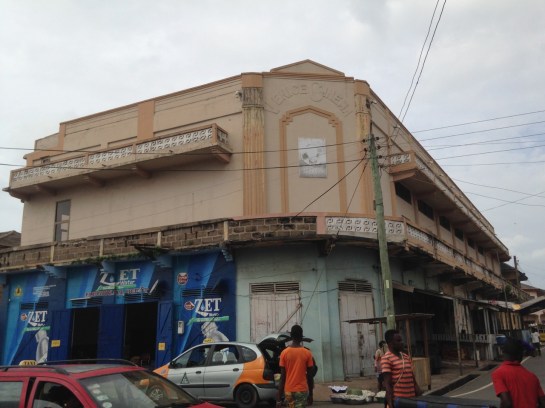
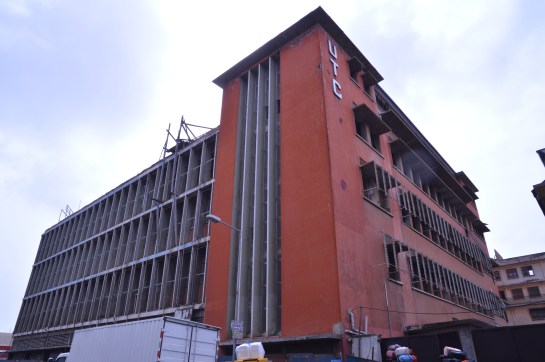
From here we visited the UTC building, a former department store and office block now stripped of its external solar-shades and in the process of demolition. We were lucky to photograph this building, as a few weeks from now it will no longer exist. The building is located in the frantic and exciting market area of town where everything from a tomato to a stadium PA system can be purchased. The market grew up around the train station that brought produce from the north and relayed the imported goods back. Complete with a dainty clocktower and waiting rooms the station structure is made from an imported cast iron kit from either Liverpool or Glasgow. Although there are no trains running any longer the station is as busy ever with squatters and traders making full use of the facilities.
Cedi House
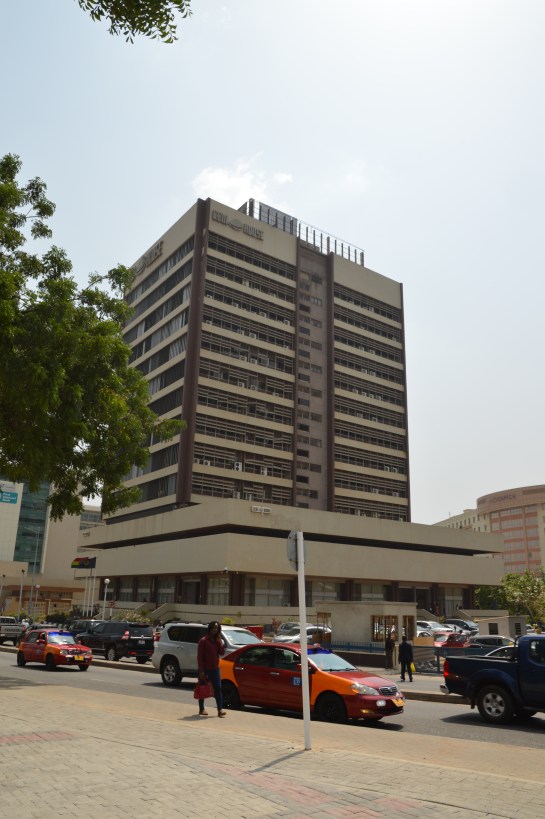
Cedi house, the first podium-base-cum-high-rise to be built in the city in the early 1960s by John Owusu Addo is now, sadly, looking a little tired, and needs some major investment. Each façade is different to respond to the specific climatic/solar demands. Inside a couple of murals survive and the marble cladding and exposed staircase give a glimpse of the building’s former style.
The Transnational Architecture Group Blog is 5 Today!
It’s five years since our first tentative blog post. Since that day we’ve posted over 200 articles, calls for papers, and general research updates on all things architecturally transnational.
One of our major research interests has of course been the work of Maxwell Fry and Jane Drew, with the publication of the monograph in 2014 and international conference. But that was just the start. Since then we’ve covered Shama Anbrine and Yemi Salami’s PhD work in Pakistan and Nigeria respectively, as well as Cleo Robert’s PhD work in India. Rachel Lee tested and developed our Timescape App in Bangalore and also published a wonderful monograph (with TAG Press) on Otto Koenigsberger. She was also responsible for a major heritage symposium in Dar es Salam. Ola Uduku has been our most prolific ‘commenter’ as well as providing many research updates on our findings in Ghana and organising numerous workshops on the Architecture of Africa. Our current research project has been sponsored by the British Academy and we’re delighted to be collaborating with Rexford Assasie Oppong (KNUST) and Irene Appeaning Addo (Legon University) on this work. There is going to be a lot more research stemming from this initial project, not least the cataloguing and archiving of the major drawings collection at KNUST, with Łukasz Stanek from Manchester University.
It’s been great fun, and here’s to the next five years of exciting research, difficult questions, dusty roads and even dustier archives, and of course new discoveries that make everything worthwhile.
We’d like to thank all of the blog contributors (please do continue to send us your updates, research findings and short articles). Thanks also to our committed readers and for all of your kind comments and emails.
Last year architect Killian Doherty and filmmaker Edward Lawrenson visited Yekepa, a remote new-town in Northern Liberia, designed and built by a mining company prospecting for iron-ore in the late 1950s. Yekepa emerged through the West’s investment in the natural resources of a ‘developing’ Africa to become a built symbol of utopian promise, symbolism that voided local inhabitants claims to ancestral lands and their eventual displacement.
Eventually the iron-ore reserves became depleted and Yekepa fell into disrepair, rendered a ghost town haunted by the memories of past prosperity. Now partly repopulated by workers of another mining firm, Yekepa has returned to life, but its fortunes remain dependent on the global market of iron-ore. Having spoken to past and present residents of Yekepa—both in Liberia and in Sweden—they are making a documentary about the town to chronicle its unusual history and uncertain future.
Doherty and Lawrenson’s research film traces, through the neo-colonial architecture and planning of the town, the complex relationship between land, displacement, and the global extractive industries within, and beyond, Sub-Saharan Africa.
Killian will also give a lecture and film screening in the Autumn 2018 at Liverpool School of Architecture – date to be confirmed soon.
Killian Doherty is a qualified architect who has practiced in Sierra Leone, Liberia, and Rwanda. He runs the collaborative practice Architectural Field Office that has a particular interest in sites of conflict and the dissonance of modernity and development in Africa. He has written for Architectural Review, MAS Context, and VOLUMEmagazine on these themes and is currently is undertaking a PhD by Design at the Bartlett School of Architecture.
Edward Lawrenson is a London-based filmmaker whose films have played at a number of festivals, including Sundance, BFI London Film Festival, True/False, Open City; and cinemas, including the Museum of the Moving Image in New York and London’s ICA. His radio documentaries have played on BBC Radio 4. His 2015 documentary Abandoned Goods (codirected with Pia Borg) won the Golden Leopard for Best International Short at the Locarno Film Festival
South African ‘know-how’ and Israeli ‘facts of life’: the planning of Afridar, Ashkelon, 1949–1956, Planning Perspectives by Ayala Levin.
In 1949, in the newly founded state of Israel, South African architects Norman Hanson and Roy Kantorowich planned the city of Ashkelon and, within it, the exclusive neighbourhood unit Afridar. Managed by the South African Jewish Appeal, which initiated and funded the project, Afridar presented a radical exception to Israel’s centralized planning approach during that period.
Figure 6. Arieh Sharon, Plan for Migdal-Gad – Ashkelon, 1951, with added key by the author. Source: Sharon, Arieh. Physical Planning in Israel. Jerusalem: Government Printer, 1951 [in Hebrew].
An early example of a semi-private settlement initiative for an ethnic and class-based enclave reserved for ‘Anglo-Saxon’ Jewish immigrants, it functioned as a ‘model town’ for the immigrant population from the Middle East and North Africa, which was housed by the government in the rest of the city of Ashkelon. Afridar’s enclave reproduced planning practices from South Africa, which had been coloured by race since the 1920s. Despite its exclusive image, it was modelled after progressive experiments in the design of Native Townships. Their main objective of such experiments was to improve the standards of housing of racially discriminated populations yet, in practice, they served as a tool to implement apartheid policies. This paper interrogates this ambivalence of social aspirations and complicity with state segregation practices through examining the translation of apartheid’s planning practices to the Israeli context, and the negotiations and conflicts this translation entailed.
‘The Congo must have a presence on Belgian soil.’ The concept of representation in governmental discourses on the architecture of the Ministry of Colonies in Brussels, 1908–1960
Jens van de Maele and Johan Lagae, The Journal of Architecture, Vol 22, Issue 7, p1178-1201.
While parliament buildings and governor‘s palaces have been studied as embodiments of governmental or colonial power, the architecture of the often more mundane state administrative office buildings has only received scant attention from architectural historians.
The Museum of the Belgian Congo in Tervuren near Brussels, constructed between 1904 and 1910: undated postcard from around 1910 (personal collection of Johan Lagae).
In this article, we seek to demonstrate that political discourses concerning such buildings can nonetheless reveal important conceptions of colonial power. Rather than focusing on how such power was accommodated in and shaped by state-built architecture overseas, this article draws attention to the representational aspects of colonial governance in a mother country through an analysis of various projects proposed for the Belgian Ministry of Colonies (1908–1960). In the 1930s, when it was still housed in an eighteenth-century neoclassical building in Brussels, the Ministry of Colonies was included in a visionary but unsuccessful civil service reform, which was aimed at a modernisation of the Belgian state bureaucracy and its office buildings.
Presentation drawing of the unrealised headquarters project by Ramon and Aerts, 1953 (City Archives of Brussels: Construction permit request no 63042).
After the Second World War, when colonialism became increasingly criticised in international fora, successive Belgian Ministers of Colonies pleaded for the construction of a new, grandiose ministerial complex, which was supposed to symbolise efficiency, modernity, and—above all —the permanence of the colonial undertaking. Even though important steps were taken to realise this complex, the project was outrun by the global decolonisation process, of which the independence of the Belgian Congo (1960) was an inevitable outcome.
It is with great sadness that the AA has learnt of the death of former AA Principal Professor Michael Lloyd (AADipl 1953). The following obituary, written by Svein Erik Svendsen, Hans Skotte and Patrick Wakely is translated from Norwegian by Desmond McNeill and originally published on the AA website.
Architect and multifarious professor Michael Lloyd was buried in Oslo on 16 June 2017.
With him we have lost one of the foremost architecture educators of our time; not just in Norway – his work and influence were global. He was born in England in 1927 and studied at the Architectural Association (AA) in London. Whilst still a student he took part in the post-war reconstruction of Finnmark, Norway, and after graduating, Alvar Aalto arranged work for him in Helsinki. He then practiced in Oslo and taught at the School of Art & Craft where he met Catharine, who became his wife and lifelong companion.
In 1959 he was appointed first year master at the AA, in charge of all new students to the school. In 1962 Kwami Nkrumah University of Science & Technology, Kumasi, Ghana, approached the AA for assistance in re-organising and running its faculty of architecture that had been established in 1951, but had become moribund. The AA responded to this and gave the job to Michael Lloyd, who was appointed professor and dean of the faculty in 1963. He immediately appointed several new full-time members of teaching staff, several of whom were drawn from the AA Department of Development and Tropical Studies – later to become the Development Planning Unit (DPU) at University College London, and radically reorganised the curriculum and teaching style of the faculty. Over the following five years, Michael brought a number of interesting short-term visiting professors to the faculty, including Buckminster Fuller, Jane Drew, Keith Critchlow, Paul Oliver and Joseph Rykwert. The faculty gained an internationally acclaimed reputation for its innovation and educational and architectural excellence.
In 1966 he was appointed principal of the AA School of Architecture, where he also initiated new and challenging educational and administrative reforms. These were turbulent times for higher education in the United Kingdom and he left the AA after a few years. He then restored the School of Architecture in Kingston-upon-Hull and joined the DPU where he directed a Master’s degree programme in design teaching methods, as part of which he was instrumental in reforming the faculty of architecture at the University of Costa Rica in San José.
On leaving the DPU in the early 1980s, he assisted local efforts in establishing new schools of architecture in Bergen, Norway, where he remained a professor for several years and in Reykjavik, Iceland. Thereafter he was appointed professor at the Oslo School of Architecture and Design, where he, among other things, conducted a project at Makerere University in Uganda, which eventually encompassed the whole of East Africa.
As a teacher, and as the sympathetic man that he was, his work was based on the idea of “the responsible human being” that one learns through taking responsibility for one’s own professional development, and that one’s skills are a personal social responsibility. As an educator Michael was unorthodox, inspiring and very much present as a teacher. He was inquisitive, courageous, and knowledgeable and had highly respected friends all over the world. His international position remains outstanding. To become principal of the AA School of Architecture, which many regard as the world’s best school of architecture, one must possess very special qualifications. Michael had those. As was said during his funeral, “Michael was a truly good man”.
Image: Michael Lloyd at his home in Spain in November 2016, by Mónica Pacheco, Dip. Arch., MA, Ph.D., Department of Architecture and Urbanism, University Institute of Lisbon
New Research: Prof. Robert Home, ‘From cantonments to townships: Lugard’s influence upon British colonial urban governance in Africa’ in Planning Perspectives, Pages 1-22 | Published online: 20 Aug 2017
Abstract: The cantonment has been a neglected topic of planning history, yet is significant for urban landscapes and governance in both India and Africa. Drawing upon scholarship in critical comparative legal geography, path dependency and Foucault’s genealogical method, the article explores the transfer of laws and regulations for urban governance by networks of knowledge and actors, tracing a line of descent from rules for cantonments in British India, through Lugard’s Nigerian period, and his indirect rule policy to townships and local government ordinances. The influence of Lugard’s Political Memoranda and Dual Mandate books is evidenced through the work of various senior officials moving between colonies, specifically South Africa, Kenya, and Northern Rhodesia.
Only 1% of houses around the world were designed by architects. Paul Oliver, who has died aged 90, devoted himself to studying the remainder, architecture that was of the people rather than built for them. His books on vernacular architecture ranged from Dunroamin: The Suburban Semi and Its Enemies (1981, with Ian Davis and Ian Bentley) to a three-volume Encyclopedia of Vernacular Architecture of the World (1997), produced with 780 contributors from 80 countries.
An artist by training who became a distinctive commentator on both architectural history and music, especially the blues, he considered himself a generalist, though writing from an architectural background; when pressed, in 1998, he accepted the term “architectural anthropologist”.
His opportunity to develop this perspective came from taking a part-time job as drawing master at the Architectural Association (AA) in London in 1960. When the leading academics Robert Furneaux Jordanand Sir John Summerson both quit, he was left as the principal lecturer in architectural history.
Oliver’s inspiring teaching took two strands. One was the study of modernism, with its emphasis on simplicity, quality and economy. The other was vernacular architecture.
His interest had been aroused when his parents moved to Symondsbury, near Bridport in Dorset, a village with a strong music tradition, a mummer’s play and a close-knit cottage community. Then six articles in the Architectural Review by EA Gutkind, a planner, in 1953 revealed the diversity of traditional building around the world.
The study of vernacular traditions offered ideas on honest construction and functionalism attractive to modern architects, while also contributing to Britain’s emerging conservation movement. An international dimension took hold when in 1964 Oliver was invited to teach at the School of Architecture in Kumasi, Ghana, where his AA colleague John Lloyd was principal. Oliver and his students studied the ways of managing a humid climate and restricted resources, patterns of use and the buildings’ cultural values. His eyes were opened by the housing of the Gurunsi people, compounds with “the formal beauty and logic of pottery”, as he later wrote, which were being swept away for a reservoir and replaced by rows of prefab dwellings that paid no respect to Gurunsi traditions.
Paul Oliver had a lifelong interest in African-American music
The Ghana trip coincided with Bernard Rudofsky’s exhibition Architecture Without Architects at the Museum of Modern Art, New York. Although it was important in popularising vernacular architecture as a subject, Oliver was enraged by its emphasis on the buildings as art objects, which he considered patronising. Working with colleagues from the AA, including students from its small department of tropical architecture, he offered a broader cultural perspective in his book Shelter and Society (1969). Further books on Africa, Greece and symbolism in buildings followed.
His greatest love was perhaps sub-Saharan Africa where, under Islamic and Christian influences, architecture predominates among the visual arts. His contributors were architects and anthropologists, but the disciplines seemed entirely separate; only archaeologists took a holistic view, and Oliver considered their approach to be as valid for the present as the past.
He advised on conservation issues in French towns and villages for the Patrimoine Historique et Artistique de la France. The British Council supported research and teaching in East Africa and India, and he worked for the Overseas Development Administration in Turkey, the Balkans, Central America and Mexico. Some projects focused on the vulnerability of vernacular buildings to earthquakes and floods, and the failures of post-disaster housing that had not taken account of the lessons of older cultures.
Oliver became head of the AA’s graduate school in 1971, but left two years later to lead the art and design department at Dartington College of Arts, at Dartington Hall, Devon. He became an associate head of the architecture school at Oxford Polytechnic (now Oxford Brookes University) in 1978 and founder of the Shelter and Settlements Unit there. His greatest concern was to safeguard traditions in the face of technological change. He believed that the wisdom, skills and satisfaction of human needs embodied in traditional buildings were fundamental to the housing of millions in the 21st century.
In 1987 Oliver took early retirement, though he continued as a visiting professor, so he could devote himself to his research, stimulated by the suggestion of Alyn Shipton, reference editor at the publisher Blackwell, that he produce an encyclopedia of world architecture. His three-volume study was organised by cultures rather than countries, with the first volume explaining general traits, environments, materials and services. Oliver was particularly proud of sections like that for Ethiopia, which was entirely written by local scholars, while gamely taking on himself areas in which no research existed.
A forked post used in vernacular architectural style to support a beam in Taos, New Mexico
Born in Nottingham, Paul grew up in Pinner, north-west London, the son of W Norman Oliver, an architect, and his wife, the former Dorothy Edmunds. His father was keen that Paul should follow him into the profession, but he lacked any talent for mathematics and turned instead to painting.
At the age of 16, Paul entered Harrow Art School, where he met his future wife, Valerie Coxon (they married in 1950), and began a lifelong interest in African-American music. He trained as an art teacher at Goldsmith’s College, London, and in 1949 returned to his old school, the Harrow county school for boys, as art master. There he established a department teaching crafts as well as art, acted as client for a new building, and introduced an African-American music society after the headmaster refused to allow a jazz club. When he left this post for the AA, the drop in his income forced him to write more music reviews.