Archive

Archives

Executive Summary

This report presents findings from a comprehensive survey of 48 archives, collections, and repositories across Northwest England that contain significant West African historical material (1880-1980). We should have an interactive map of the archive locations published here shortly….

Here is a list of the archives consulted and key information for each collection/location/repository:

The research reveals a substantial but under-explored archival landscape that offers exceptional opportunities for advancing historical research into West Africa and its relationship with Northwest England. The collections span diverse themes including colonial administration, trade networks, missionary activities, healthcare, urban development, and cultural exchange, providing rich source material for interdisciplinary research projects.

Research Scope and Methodology

Geographic and Temporal Parameters

The survey focused on historical West African material from former British colonies including Ghana, Gambia, Sierra Leone, and Nigeria, with additional consideration of materials from Congo, Cameroon, Senegal, Mali, and Niger. The temporal scope encompasses the period 1880-1980, capturing the late colonial period through to early post-independence developments.

Thematic Categories

Research materials were categorised across key themes:

  • History and heritage studies
  • Urban design and city planning
  • Public health and medical history
  • Architecture and built environment
  • Trade and commercial networks
  • Religious and missionary activities
  • Colonial administration

Collection Assessment Framework

Each archive was evaluated using a systematic approach that assessed:

  • Type and format of materials (books, photographs, manuscripts, ephemera, artifacts)
  • Primary thematic focus
  • Volume and extent of holdings
  • Accessibility and research potential
  • Relevance rating (1-5 star system that reflected how useful the archive would be to our research interests in the built environment and history)

Key Findings: Archive Landscape and Research Potential

Distribution and Scale

The survey identified 48 archives across Northwest England, primarily concentrated in the Merseyside region but extending to Manchester, Lancaster, and Chester. Seven archives achieved the highest relevance rating (5 stars), each containing over 20 linear metres of diverse West African materials spanning multiple themes and formats.

Material Types and Research Applications

The collections encompass diverse formats offering multiple research approaches:

Documentary Sources:

  • Colonial administrative records
  • Trade and shipping documentation
  • Medical and health records
  • Urban planning documents
  • Personal correspondence and diaries

Visual Materials:

  • Photographs documenting colonial life, urban development, and cultural practices
  • Architectural drawings and city plans
  • Maps and surveys
  • Artistic representations

Material Culture:

  • Artifacts and objects
  • Textiles and decorative arts
  • Ceramics and sculptures
  • Models and architectural elements

Corporate Archives: Exceptional Research Resources

Unilever and United Africa Company Archives: The Unilever archives, particularly the United Africa Company (UAC) collection, represent one of the most comprehensive corporate archives relating to West African economic history. UAC, established in 1929 through the merger of the Royal Niger Company and the African and Eastern Trade Corporation, became the largest trading company in West Africa. The archives contain:

  • Extensive Trading Records: Documentation of palm oil, cocoa, groundnut, and timber trades spanning decades
  • Infrastructure Development: Records of store construction, transport networks, and commercial facilities across West Africa
  • Labour and Employment: Personnel records, training programs, and workforce development initiatives
  • Technology Transfer: Documentation of agricultural techniques, processing methods, and industrial development
  • Local Partnerships: Records of relationships with African traders, suppliers, and business partners
  • Post-Independence Adaptation: Materials documenting corporate strategy during decolonization and nationalist movements

These materials offer unique insights into corporate colonialism, the mechanics of extractive economies, and the complex negotiations between European capital and African societies. The collection provides essential source material for understanding how global commodity chains operated at ground level and their impact on local communities.

Barclays Bank Archive: The Barclays collection contains extensive documentation of banking operations across West Africa, including:

  • Colonial Banking Development: Records of branch establishment, credit systems, and monetary policy
  • Financial Networks: Documentation of money transfers, currency exchange, and international finance
  • Agricultural Finance: Materials on crop financing, seasonal credit, and agricultural development programs
  • Commercial Lending: Records of business loans, trade financing, and commercial development
  • Post-Colonial Banking: Materials documenting the transition to independence and continued financial relationships

The banking records provide crucial insights into how financial systems shaped economic development, facilitated trade networks, and influenced social relations across West Africa. These materials are particularly valuable for understanding the mechanics of colonial extraction and the evolution of financial institutions in post-colonial Africa.

Thematic Strengths for Research Development

Urban Development and Planning: The Archives contain substantial materials on colonial urban development, infrastructure projects, and city planning initiatives. These sources offer opportunities to examine how European urban planning concepts were implemented in West African contexts and their lasting impact on contemporary cities.

Medical and Public Health History: Rich documentation of colonial health initiatives, medical practices, and public health campaigns provides foundation for research into the history of medicine in West Africa, disease management, and the development of healthcare infrastructure.

Commercial and Trade Networks: Extensive shipping, banking, and commercial records illuminate the economic relationships between Northwest England and West Africa, offering insights into trade networks, commodity flows, and economic development patterns. Of particular significance are the Unilever archives (including the United Africa Company records) and the Barclays Bank archive, which contain unparalleled documentation of corporate operations, trading networks, and financial systems that shaped West African economic development throughout the colonial and post-colonial periods.

Religious and Cultural Exchange: Missionary records, religious materials, and cultural documentation provide resources for examining religious transformation, cultural exchange, and the complex dynamics of colonial encounter.

Colonial Administration: Administrative records and governance documents enable research into colonial policy implementation, administrative structures, and the mechanics of imperial control.

Research Opportunities and Applications

Interdisciplinary Research Potential

The diversity of materials supports multiple disciplinary approaches:

Historical Research:

  • Comparative studies of colonial administration across West African territories
  • Economic history of trans-Atlantic trade networks
  • Social history of colonial encounters and cultural exchange

Urban Studies:

  • Evolution of colonial cities and urban planning
  • Infrastructure development and its contemporary implications
  • Architectural history and building practices

Medical History:

  • Development of tropical medicine
  • Public health initiatives and their outcomes
  • Medical knowledge transfer and adaptation

Cultural Studies:

  • Missionary activities and religious transformation
  • Cultural exchange and hybrid practices
  • Art, material culture, and aesthetic transformation

Collaborative Research Framework

The geographic concentration of archives creates opportunities for:

Multi-Archive Projects: Researchers can access complementary materials across institutions, enabling comprehensive studies that draw on diverse source types and perspectives.

Network Building: The established archive network provides foundation for collaborative research initiatives, shared resources, and coordinated access to materials. The University of Liverpool and AHUWA are particularly well-positioned to serve as coordinating institutions/centres for multi-archive research projects, leveraging their expertise in West African studies and established international partnerships.

Digital Humanities Applications: The variety of materials (textual, visual, material) offers opportunities for digital humanities projects, including digitization initiatives, database development, and online exhibitions. The University of Liverpool’s digital humanities infrastructure and AHUWA’s focus on accessibility make this an ideal location for developing innovative digital approaches to archival research.

Strategic Recommendations for Research Development

Institutional Research Capacity: University of Liverpool and AHUWA

University of Liverpool Research Infrastructure: The University of Liverpool is exceptionally well-positioned to capitalise on this rich archival landscape. As a leading institution in historical research with strong connections to West African studies, the university offers:

  • Established Research Expertise: Faculty with specialized knowledge in African history, colonial studies, and economic history
  • Interdisciplinary Capabilities: Departments spanning History, Geography, Politics, Development Studies, and Business that can support multifaceted research approaches
  • Digital Humanities Infrastructure: Technical resources for digitisation projects, database development, and online exhibitions
  • Graduate Research Programs: Capacity for training new researchers in archival methods and West African historical research
  • International Partnerships: Existing relationships with West African universities and research institutions

AHUWA Research Centre: The Architecture, Heritage, and Urbanism in Western Africa (AHUWA) research centre provides a specialized institutional framework for maximising the research potential of these archival collections. AHUWA’s mission and expertise make it ideally suited to:

  • Coordinate Multi-Archive Projects: Develop comprehensive research initiatives that draw on materials from multiple archives
  • Foster Collaborative Research: Facilitate partnerships between UK and West African researchers
  • Support Community Engagement: Connect archival research with contemporary West African communities
  • Promote Policy Relevance: Ensure research contributes to contemporary development and policy discussions
  • Develop Digital Platforms: Create online resources that make archival materials accessible to global researchers

The combination of Liverpool’s institutional resources and AHUWA’s specialised focus creates an unparalleled opportunity for developing the research potential of Northwest England’s West African archives.

Priority Research Areas

1. Comparative Colonial Studies The archives support comparative research across different West African territories, examining variations in colonial policy, administration, and outcomes.

2. Economic History Networks Trade and commercial records enable mapping of economic relationships, commodity flows, and the development of trans-Atlantic commercial networks. The Unilever/UAC and Barclays archives are particularly valuable for examining corporate colonialism, financial systems, and the evolution of global commodity chains. These collections support research into topics such as:

  • The role of European corporations in shaping West African economies
  • Banking and financial networks in colonial and post-colonial Africa
  • Labour relations and industrial development
  • Technology transfer and agricultural modernization
  • Corporate responses to decolonization and African nationalism

3. Urban Development Studies Planning documents and architectural materials provide foundation for examining colonial urban development and its contemporary implications.

4. Medical and Public Health History Healthcare records offer opportunities to examine the development of tropical medicine, public health initiatives, and medical knowledge transfer.

Methodological Approaches

Cross-Archive Analysis: Researchers should develop strategies for working across multiple archives to build comprehensive pictures of historical processes and relationships. The corporate archives (Unilever/UAC and Barclays) can be particularly productive when analysed in conjunction with government records, missionary materials, and local documentation.

Digital Integration: Consider developing digital platforms that integrate materials from multiple archives, enabling new forms of analysis and presentation. The University of Liverpool’s technical capabilities and AHUWA’s research focus provide ideal foundations for such initiatives.

Community Engagement: Explore opportunities for community-based research that connects archival materials with contemporary West African communities in Northwest England. AHUWA’s community engagement expertise and Liverpool’s diverse population create opportunities for participatory research approaches.

Future Research Directions

Emerging Themes

The archive survey suggests several promising research directions:

1. Infrastructure and Development: Examining colonial infrastructure projects and their long-term implications for contemporary development challenges.

2. Knowledge Transfer: Investigating how knowledge, practices, and technologies moved between West Africa and Northwest England.

3. Cultural Networks: Exploring the cultural connections and exchanges that developed through colonial relationships.

4. Corporate Colonialism and Business History: The Unilever/UAC and Barclays archives provide exceptional opportunities for examining the role of European corporations in shaping West African development, including studies of extractive economies, corporate-state relations, and business adaptation to decolonization.

5. Post-Colonial Continuities: Examining how colonial-era relationships evolved in the post-independence period, with particular attention to ongoing corporate and financial connections.

Methodological Innovation

The archives offer opportunities for methodological innovation in:

  • Digital humanities applications
  • Multi-sited archival research
  • Community-based research approaches
  • Interdisciplinary collaboration

Conclusion

The West African archival materials in Northwest England represent a significant and underutilised resource for historical research. The diversity of collections, spanning multiple themes and formats, provides foundation for innovative research projects that can advance understanding of West African history, colonial relationships, and their contemporary implications. The exceptional corporate archives, particularly the Unilever/UAC and Barclays collections, offer unique insights into the mechanics of colonial economies and corporate power in Africa.

The established network of 48 archives, combined with the research capacity of the University of Liverpool and the specialized expertise of AHUWA, offers exceptional opportunities for collaborative research, comparative studies, and interdisciplinary projects. With seven archives containing substantial holdings and many others providing specialized materials, researchers have access to comprehensive source bases for addressing complex historical questions about corporate colonialism, financial systems, and economic development.

The University of Liverpool’s institutional strengths and AHUWA’s focused mission create an ideal environment for developing the research potential of these collections. Their combined expertise in West African studies, digital humanities, and community engagement provides the foundation for innovative methodological approaches and collaborative research initiatives that can significantly advance historical understanding.

Moving forward, the research community should prioritize developing collaborative frameworks that maximise the potential of these collections, with particular attention to the corporate archives that offer unique insights into the mechanics of colonial extraction and economic development. The foundations established through this survey, combined with Liverpool’s institutional capacity and AHUWA’s specialised focus, provide the groundwork for a new generation of research that can significantly advance historical understanding of West Africa and its relationship with Northwest England.

Navigating Archival Fieldwork in Mumbai: Challenges, Opportunities, and Positionality

Excy Hansda E.Hansda@liverpool.ac.uk

A few months ago, I finished my fieldwork for my PhD research in Architectural History. My research investigates the microhistories of the middle-class Indians who moved to the suburbs of Bombay in the early twentieth century and the kind of spaces they lived in. Looking at a postcolonial angle, I am interested in questioning the colonial suburban vision and by highlighting the Indian agency in shaping the suburban urban housing projects, neighbourhoods and their dwellings in late-colonial Bombay. This blog reflects on the challenges and opportunities I encountered while conducting fieldwork in Mumbai. As an Indian PhD scholar based in England, fluent in both English and Hindi, I found that my position brought unique advantages and complications to archival research in Mumbai.

I have prior experience working in archives in both the UK and India. I quickly realized that my background—an Indian architect affiliated with a British academic institution working on a historical subject—often piqued interest in my project. Despite the initial curiosity my profile evoked, I was one of hundreds of Non-Resident Indians (NRI) affiliated with overseas institutions, and this seldom translated into privilege. If anything, being a North Indian, I was seen as a foreigner in Mumbai. Accessing senior bureaucrats in archival institutions and getting information smoothly and efficiently remained particularly difficult.

Finding the Right Archives

I began “getting the data” early in my PhD (February 2023), in parallel with my literature review. I started with the India Office Records at the British Library in London and expanded my search to include collections at the Liverpool School of Hygiene and Tropical Medicine, the School of Oriental and African Studies, the London School of Hygiene and Tropical Medicine, the National Archives at Kew, and others. I investigated diverse sources—Annual Administrative Reports, maps, manuals, and published books. However, due to the hyper-specific focus of my study, initial results were limited.

This led me to change my methodological approach. I revisited the literature and drew on approaches from disciplines such as cultural studies, English literature, and sociology. This led me to explore unofficial sources such as online newspapers, Town Planning Review and the Journal of the Indian Institute of Architects at the Royal Institute of British Architects Archives in London. This helped me expand my knowledge of my subject.

My first fieldwork trip to Mumbai (January 2024) opened a new chapter. I visited the Maharashtra State Archives (MSA) at Elphinstone College, Mumbai, where I discovered files rich in minute detail—memos, petitions, letters, advertisements, maps, municipal debates, and more—everything useful for my research, unlike the colonial records in London, which largely included annual administrative reports and policy documents of the colonial bodies like the Bombay Improvement Trust and the Bombay Development Department, the Mumbai archives revealed the voices and subjectivities of local Indian residents who contested colonial policies and many cases of negotiations, contestations and even micro-scale conflicts which were often absent from official reports.

Missing Records and the State of Archives

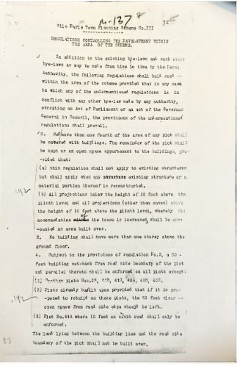
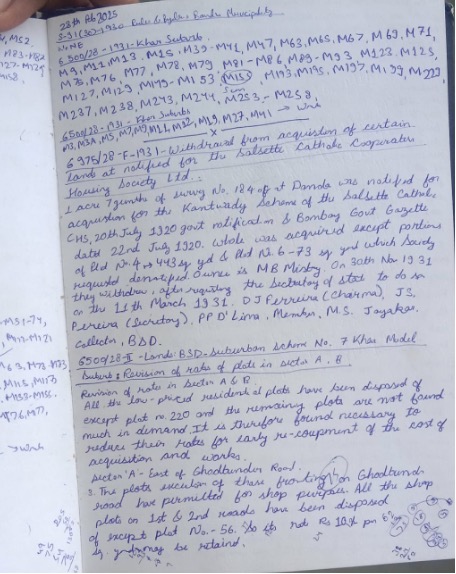
Accessing the archives was not easy. The MSA, one of India’s oldest surviving archives, is poorly maintained and has limited funds. Files are deteriorating, and storage conditions are far from ideal. The reading room is small and dusty, with limited hours—open only five days a week, six hours per day, with an hour-long lunch break. Visitors can request just five files a day. The retrieval process is slow (waiting over two hours is common). Photography is not allowed, and one must request Xerox (Fig 1) or scanned copies, which are payable only in cash. Getting Xeroxes can take 20 days or more; scans may take months. (I am still waiting for the scans that I requested in February) Therefore, I resorted to transcribing the files and making notes (Fig 3 and 4).

Many records are missing. Files before the 1920s are largely uncatalogued and are organized as volumes for entire years for each department of the archives (Revenue, Judicial, PWD, General). Finding specific content means reading through these thick volumes page by page. For post-1920s material, although some cataloguing exists, it’s often incomplete. These are specific files which are numbered, and the numbers correspond to the numbers present in the hefty indices. One has to go through the indices in order to find the files.

Once a file is located, an office peon brings it—after dusting it off (Fig 2). Some are missing completely, and the office peons cannot find them. Others are in fragmented conditions, so they cannot be accessed. While others have missing maps or pages which are crumbling into fragments.

Fig 1: Xerox of a page in a file located at the MSA

Fig 2: A File on Co-operative Housing Society at the MSA

Fig 3 and 4: Transcriptions and Notes I made based on information available in archival documents at the MSA

Finding Sources

A central database for archival material simply does not exist. I relied heavily on human networks: clerks, peons, research assistants, historians, archivists, and fellow researchers. Often, they directed me to smaller archives—usually cramped rooms within municipal offices—where old documents were kept in poor condition and disorganized bulk.

At the MSA in Elphinstone College, I was directed to the Old Customs House in Mumbai. There, I learned they only housed records from Bombay City, so I was redirected to the archives at the Municipal Corporation Office of Bombay Suburban District in Bandra, only to be told that my time period of interest was not covered. Eventually, I was pointed toward ward offices, municipal boards, and local talathi (village record) offices.

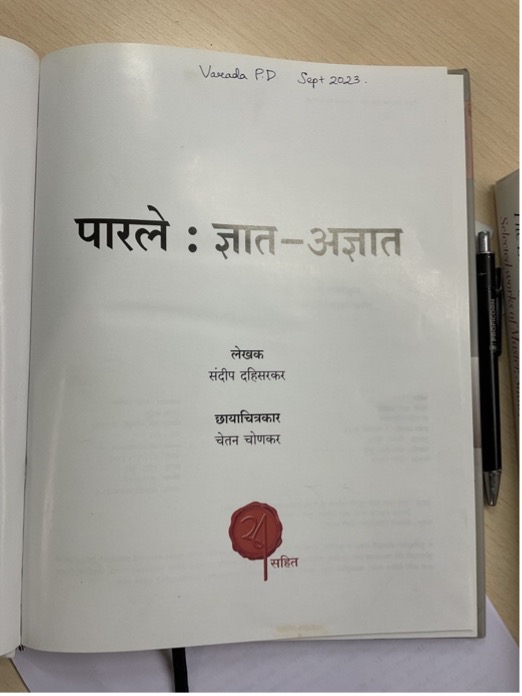
Due to reorganization across the colonial and post-independence eras and the separation of districts and provincial state, records have been scattered. The only way to find them is through local knowledge—gathered from seasoned researchers, administrators, or office staff. Sometimes, I stumbled upon data in unexpected places, such as the Dadar municipal archives or the Art Deco Mumbai Society, which provided helpful secondary sources in English and vernacular languages (Fig 5 and 6).

Fig 5 and 6: Books obtained at the Art Deco Mumbai Trust, Mumbai

The reception of these archives was also varied. Sometimes, the staff was friendly and gave me access to files, right after I showed him my ID card and university letters. In other cases, I was made to wait for half an hour before meeting the upper bureaucrat. Sometimes, I had to follow up several times before they granted me permission to visit their archives. This was the case of Municipal Corporation archives, Mumbai. 

Navigating the Neighbourhoods

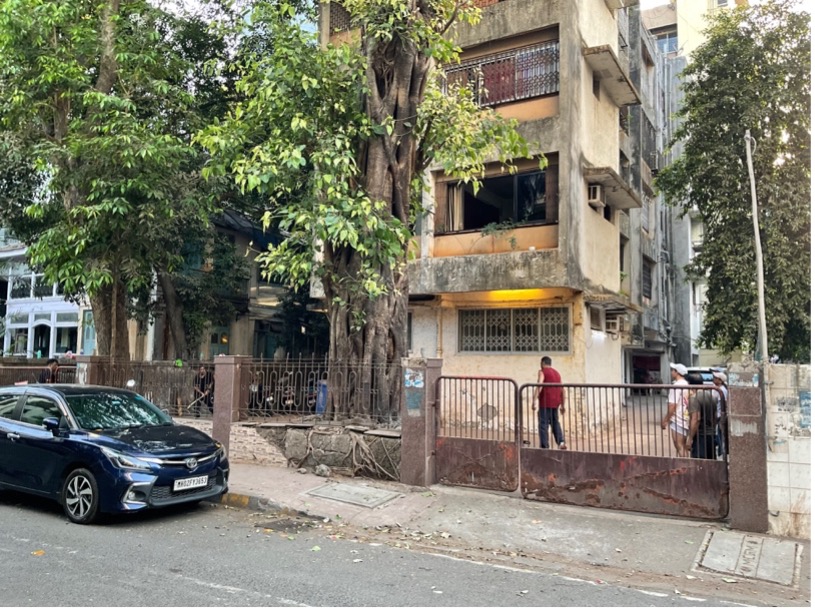
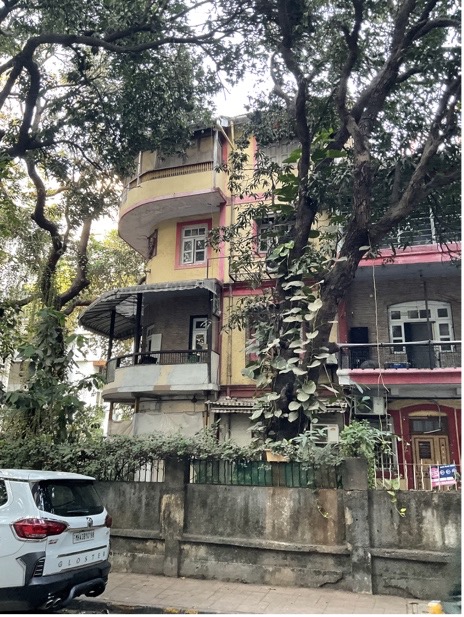
Beyond archives, the buildings themselves served as vital secondary sources. Many twentieth-century buildings had been demolished, redeveloped, or repurposed. Some stood vacant; others had been converted into commercial spaces, with original residents gone.

Identifying buildings from the 1930s–40s required searching for buildings with style, typology and aesthetics matching that of the 20th-century architecture of Bombay. I used secondary literature available on Mumbai, tips from fellow researchers and architects working in Mumbai, detailed reports from the Mumbai Metropolitan Region – Heritage Conservation Society (MMR-HCS), and a database created by Art Deco Mumbai Trust to search buildings. These contained valuable mapping and description of old historic surviving buildings with histories of ownership, years of construction, sketches, photographs, and drawings. I used these for site observations and photographing the exteriors of the building (Fig 7 and 8).

Fig 7 and 8: Walking in the suburban town of Khar, Mumbai as a Method to Collect Data

However, accessing the interior of the buildings was a different challenge. I was often accompanied by a local Marathi-speaking friend to help communicate. His surname “Patil”, which is common in Mumbai, could have helped me start a conversation with the local residents of Mumbai suburbs- so I thought. Residents were tight-lipped, asking questions like “Kahan rehte ho?” (Where do you live?), “Marathi nahi aati kya?” (Don’t you know Marathi?), and “Kya dharam/jaat/surname hai?” (What’s your religion/caste/surname?). These euphemistic inquiries exposed the enduring social divisions of caste, class, and religion—reminding me that while buildings and built fabric might have changed, social fabrics and the mindset of the people are just the same as in the 1930s-40s Bombay.

Language

In the scrutiny of archival works, language skills were sometimes difficult. Language agitation and violence in the name of protecting Marathi culture and identity are common in Mumbai and the provincial state of Maharashtra, where outsiders are forced to speak in Marathi. However, most of the time, people were helpful to me in finding the source materials. The historians in academic and non-academic institutions were proficient in English, Hindi, and Marathi, and they helped me with ideas for my projects. People, especially those working in lower bureaucracy, were able to speak Hindi and directed me to people and places where I could retrieve information.

Logistics of Living in Mumbai

Final Reflections

Someone who works at, for example, the British Library or the Biblioteque Nationale, would not expect this set of challenges. These challenges included obtaining sources of information from beyond the archives, pursuing people to find information, and collecting data in sometimes un-welcoming environments, for which one needs to have a different approach towards them. Being a people’s person and being street-smart helps. Networking and making connections with people make things easier and give you access to a substantial amount of information. Whilst there were complications, it was an enriching experience, making me skilled in finding sources of information, connecting dots, finding and sometimes creating a thread, and keeping backup plans ready. Here, adaptability and patience helped. Having relationships with people has helped me more than having any institutional affiliations, 

Fig 9: The sign board at the local railway station from where I boarded the train to the archives, every morning

Fig 10: The family with their neighbours with whom I lived in Mumbai suburbs

Finally, although having friends-like family in Mumbai and its suburbs made me somewhat familiar with the city, however being a North Indian, miles away from Mumbai, I am sure I might not have noticed a lot of subtleties both inside and outside the archives and sites of inquiry. On the other hand, as a scholar based in England, I found certain information in files, ideas, or simply the way of living striking, which Mumbaikars would have taken for granted. I am indebted to the Patil family and my friends at IIT Powai, where I imposed myself for a significant time period. Also, my colleagues who I knew before and the ones whom I met at the archives helped me point out interesting details, showed me directions during this fieldwork, and accompanied me on several site visits. These certainly positioned me in how I was looking at the sources, the archives, the people, the suburbs and the city.