Archive

Ghana

An Update from Takoradi, Ghana

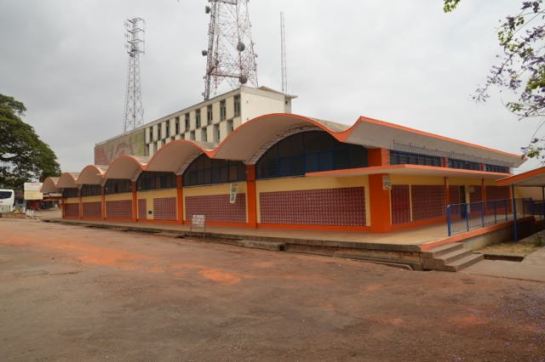
We started at the Takoradi Train Station, completed by 1928 as part of the coastal rail and docklands development. The train lines were initially constructed to transport cash crops, minerals and metals from the northern agricultural and mining districts to the awaiting ships, sheltered in the newly constructed breakwater and deep water harbour. When we visited in 2012 the train station was completely derelict and not in use. Today we found it carefully restored and new tracks laid. The plan is to reuse it for a local transport network. We walked up the hill to the small commercial district made up of international banks and a post and telegrams office. The mishmash of styles reveals the incremental development, as well as the fierce competition between the banks eager to differentiate themselves from the competition.

The former European hospital clock tower up on the hill overlooks the banks and docklands, as well as benefiting from the cooling sea breeze.

We drove to the 1920s part of Takoradi, a major new town extension that was built to accompany the docks development of that time. This portion of the town was primarily for the African population, although it also contains the Lasdun designed Bank of Ghana [built 1957]. Lasdun was also the architect of the National Museum in Accra. The bank was vacant when we visited in 2012, but now it stands in a state of complete dereliction, its fine materials and fixings being stripped from the building. This is a real tragedy. It was once an outstanding building, recorded in the Architecture journals of the day and surely one of Lasdun’s greatest works from this period.

img_0633

Somewhat downbeat, we bid farewell to the bank, and made our way to the rond-point in the middle of the town. The map was deceiving, as this was built as a major market place – our driver told us it was one of the largest markets in West Africa. It had the feel of Kariakoo market  in Dar es Salaam, and also contains a delightful little PWD post office with its signage graphics still intact.

Adjacent to the market is Amanful Village. Laid out in 1922-3 it is a mixed use area of housing and commercial properties. The basic PWD-type houses and layout remained in place, but more wealthy owners had transformed much of the upper part of the estate to suburban housing.

We then went to the Takoradi Technical Institute, shown above (Left, b+w) in the Africa Through a Lens Collection at the UK National Archives. There is a forcefulness to this scheme that takes the familiar two storey gallery access format, and emboldens into more ‘clunky’ yet determined architectural-structural forms.
dsc_0363

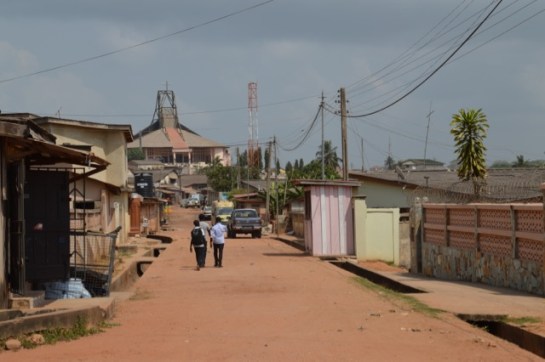
Nearby is the Effiekuma housing and the Effia Nkwanta hospital. The hospital has evolved overtime from a European hospital-cum-sanatorium in the colonial period, to a major health provider today. The careful layering and response to the site contours offers delightful views as well as a most welcome breeze to all the small structures that each have a view of the docks. At the top of the hill is a large brutalist extension that dates from c. late 1960s early 1970s. But who designed it?

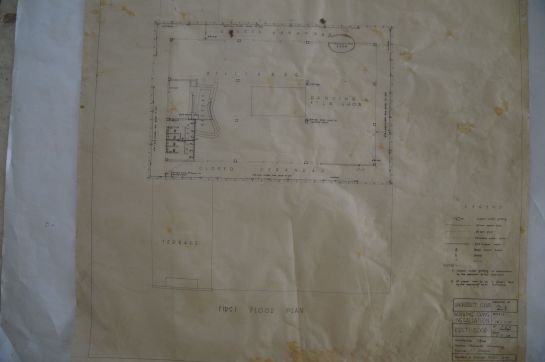
As part of our British Academy Internationalisation and Mobility grant Iain Jackson and Ola Uduku visited Rexford Opong at KNUST in March (we included some brief updates here: Notes from Kumasi and Notes from Kumasi: part 2 and also Notes from Kumasi Part 3). We were fortunate enough to visit the Estate Planning Department and drawing offices and photographed some of the original drawings made of the university estate and buildings. Whilst every effort is being made to carefully preserve these drawings they have been subject to the ravages of time, humidity and vermin attack and many are in a poor state of repair. They are unlikely to survive for much longer.

dsc_0170

Drawing of the First Floor Senior Staff Club House, KNUST

In an attempt to remedy and counter this we are putting together an ‘Archives in Danger’ grant that, if successful, will enable these important artefacts to be digitally scanned/carefully photographed and then carefully preserved and archived for future scholarship.

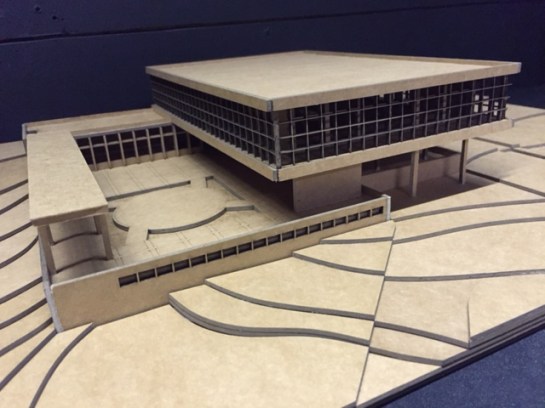
In the meantime we’ve used the photographed drawings to produce a series of new CAD files. Pedro Bittencourt, a student based at Liverpool School of Architecture, has worked dilligently on translating the imperial scales into a metric format and has produced all of the new drawings. He has then used these drawings to construct a beautiful scale model of the Club House, utilising a laser cutter as to form the delicate components.

pedro

Pedro with the completed scale model

We’re hoping to produce additional models of other buildings on campus that can be used in exhibitions and as part of our lecture series.

img_0125img_0126

The Architecture of Edwin Maxwell Fry and Jane Drew:

We’re delighted to announce that our Fry and Drew book is to be published in paperback format in a few days time. This should make it a little more affordable and hopefully accessible to a broader audience in West Africa and India…

9781409451983

https://www.routledge.com/The-Architecture-of-Edwin-Maxwell-Fry-and-Jane-Drew-Twentieth-Century/Jackson-Holland/p/book/9781409451983


2016 Grantees for Conserving Modern Architecture Initiative Announced

TAG is delighted that the Getty Foundation has awarded a ‘Keeping it Modern’ heritage grant to the Children’s Library in Accra, Ghana – the first time this prestigious award has been made to a building in Africa. This will fund building research into the material fabric of the library, as well as programme of events to keep the space activated and enjoyed.

The library was designed by Nickson and Borys (see Notes from Accra ) in late 1950s / early 1960s (the building appears in J. M. Richard’s New Buildings of the Commonwealth, 1961) and has already received some sympathetic restoration in more recent times, as well as some less fortunate interventions (such as the aluminium front door).

The latest project will be in safe hands under the leadership of the ArkiAfrica team, http://archiafrika.org/wp-content/uploads/2013/03/march-13-invite.jpg  and we will post updates on the project here.

Getty press release and information on the other awards here: http://blogs.getty.edu/iris/2016-grantees-for-conserving-modern-architecture-initiative-announced/


Good bye Kumasi, Accra, Ghana….

We revisited the Manhyia Palace archives and made notes on the relevant documents to be consulted before dashing off to board the local propeller plane back to Accra. Gazing at the dusty spread of Kumasi – we wondered whether the current airport terminal was adjacent to the original Norman and Dawburn small airport project designed in the 1950s? Suggestions of an earlier architectural history seemed to be revealed in the present day profiles of the domestic airport buildings viewed as we taxied down the empty runway for takeoff.

IMG_0144

‘Tropical Modernism’ on the 10GHC note, The Bank of Ghana in Accra

Accra was in the grips of a major traffic jam, cooler and drier than Kumasi, it proved overbearingly hot to spend more than half an hour getting from the airport to Jamestown to see the exhibition of the Delft-Accra, urban transformation collaboration project we visited on our arrival in Ghana. We met a transformed space and were given a tour by curator and ArchiAfrika member Joe Addo. Joe also spoke of his further plans for the activation of various parts of the Jamestown neighbourhood. A further visit to the National Museum offices, and another slow trip on Accra’s congested highway to the international airport concluded the trip, with Ghana’s independence day holidays over the weekend we weren’t the only ones heading out of town.

Our project continues; the Ghanaian team (Prof. Rexford Assasie Oppong and Irene Appeaning Addo) will begin planning their research trip to the UK in the autumn, and we have considerable sources to continue consulting in the meantime.


Notes from Kumasi Part 3

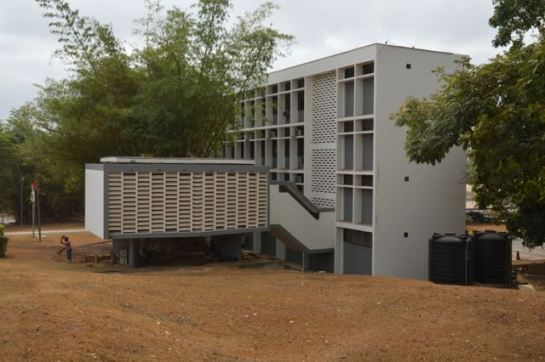
At the KNUST campus the library and Great Hall complex work very well within their elevated landscape setting. The Gerlach and Gillies-Reyburn’s muscular grey abstract ‘kente’ cloth brutalist hall and library extension is arranged in a ‘quad’. The complex overlooks the campus, facing a formal axis that leads to the administrative and teaching blocks. The composition is completed on its south flank by an architectural gem, which we discovered is the original KNUST library block. Is this James Cubitt’s riposte to Fry and Drew’s Ibadan Library?

DSC_0246

DSC_0276

The Old Library Block

The ‘old’ KNUST library presents an essay in tropical architectural design. Still sitting on its cast, fluted piloti this four storey structure employs screen walling, operable louver windows, and shading devices to both demonstrate and celebrate the possibilities of creating a successful architectural resolution to the needs of passive design. Its forlorn main entrance, clad in travertine, and superseded by the Gerlach and Gillies-Reyburn entrance to the East, shows the quality of materials employed in specific areas of its design.


DSC_0101

Administration Offices and Meeting Room

Inside, much of the Library building seems frozen in time. Reading carrels lie empty whilst the daylight filled reading spaces, with custom built, empty journal shelves have few readers, and ageing academic book collections. The e-resource room however has been kitted out with desktop computers and seems to be the most used student space in the building. A second “IT” floor was being planned, and the new desktop computers were just being commissioned, in spaces flooded with artificial light, closed to the exterior with floor to ceiling fabric curtains – only this space in the building needed fans for cooling. Meanwhile the offices at the top floor with their no longer used spiral staircase took one to another world of naturally cross ventilated office space, and custom designed insect screens – demonstrating that climate responsive design in the tropics still works. One hopes its on-going transformation doesn’t forget this idea.

Notes from Kumasi Part 2

The KNUST campus continued to delight as we explored its many building types, landscape and wildlife. The staff housing [over twenty different types], is generally low density bungalows generously positioned along the sweeping roads to the west of the campus. The Vice-Chancellor’s lodge is also set amongst the staff housing, its pierced screen providing shading to the verandah-cum-corridor behind.

DSC_0219

Vice-Chancellor’s Lodge

At Unity Hall, the two high-rise accommodation blocks dominate the arrangement, but they also frame the quadrangle that contains badminton courts, refectory and other social spaces. The space is also commandeered for laundry drying and we observed architecture students surveying the landscaped elements with their drawing boards set up under the shade of the loggia. Just a short walk from Unity is the sports track and Paa Joe Stadium. The seating is set within the raked landscape and the grandstand has a graceful concertinaed concrete roof that reduces in depth as it cantilevers over the seating.

DSC_0229

Unity Hall

We were fortunate enough to view the architectural drawings of these buildings – but sadly, the climate has rendered them in a poor state and plans for digitization must be urgently progressed to preserve this important archive of material.

DSC_0264

Paa Joe Stadium

Off campus we visited the Manhyia Palace built in 1925. Upon returning from exile the Ashantehene Nana Prempeh 1 was offered the building by the British (the former palace having been destroyed in the ‘War of the Golden Stool’ in 1900). The palace is now a museum with some excellent artifacts and collections. The palace grounds also contain the Manhyia archives, managed by the West African Studies department of Legon University. The archives contain records dating back to 1926 including many documents on land development, sanitation, state buildings and town planning. We’re looking forward to seeing what this archive holds – an initial inspection revealed many plans and previously untapped material!

DSC_0221

Manhyia Palace Museum

Notes from Kumasi

Leaving Accra we departed for Kumasi– there was a change of pace in this dusty Ashanti city. Flying in, the low-rise collection of housing and settlements spreads across the horizon. The city has a hotter, inland climate, but the KNUST campus has this relieved somewhat by its lush mature vegetation. A visit to the recently restored KNUST Staff Club and walk around the campus to the ‘central area’, gave a good feel, and introduction to KNUST.

DSC_0939

KNUST Senior Staff Club House, designed by Cubitt

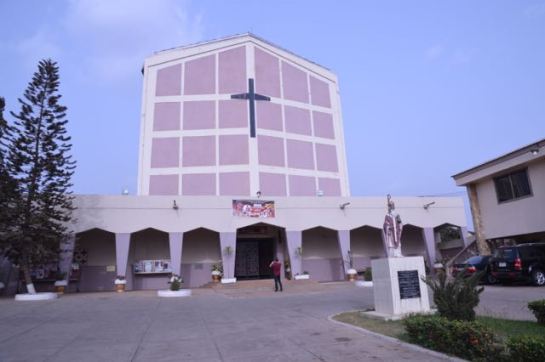
The following day united us with more visiting staff from University of Edinburgh and we set off on an extended excursion to various buildings in Kumasi city. Fry and Drew’s Prempeh College and Opoku Ware schools, are visited first and present us with a first hand view of this couples’ best exemplars of institutional tropical modernism. Visits followed to Nickson’s Anglican Cathedral, a towering structure, with less external architectural sophistication than F+D’s educational oeuvres, but provided interiors that successfully captured the spirit of high Anglicanism in its light-filled interior.

DSC_0997

Anglican Cathedral, Kumasi, designed by R. Nickson from 1950

A dusk-tinted view of the campus concluded the day’s visitations, its welcome calm was a good antidote to the ‘busy-ness’ of the town. The buildings at the ‘Tech’, as it is colloquially called, sat sedately in their lush tropical setting, showing off Scott and Cubitt’s earliest university campus in Africa.

The historic ‘central’ administrative area of Kumasi formed the focus of the next day. The post office and Ghana electricity building suggest they are examples of late ‘PWD’ post war architecture, whilst the historic memorial to the West Africa Frontier Force, soldiers who fell in WW1 in Abbysinia (Ethiopia) and Burma (Myamaar) give us pause for remembrance. Walking up towards the military museum we find that although it is closed, we can still pay officially for a visit and take the chance. More than an hour later, we are overwhelmed with the sheer military-related history this deceptively small former garrison fort contained. As a colleague commented, “this gave [me] the context” to this city.

DSC_0024

Kumasi GPO, designed by PWD?

Visits to the Asawasi and Fanti Town districts, the latter adjoining the Cathedral area, gave good examples of early housing layouts in Kumasi designs by known planners in some cases. At Fanti Town we inadvertently came across the’ coffin district’, and attempted a stop at the Bantana district of the town to photograph circular hut housing we had identified the day before. The military museum guide had confirmed that these historic huts still provided accommodation for the army. As the garrison was still camped at the site we could not investigate this much further.

Notes from Accra Part 2

Our journey continued with visits to Tessano ‘East’ which had a few remnants of the original site and service planned estate, best exemplified by the police station and a few administrative blocks, which often defined the colonial housing plan layout. A visit to the University of Ghana, at Legon followed. Designed in the late 1940s by Harrison Barnes and Hubbard, the leafy campus sits upon on a hill, high above Central Accra. The campus architecture has a curious oriental aesthetic which defines the its identity, with a number of significant buildings including the Balme Library and the Main Hall. In the African Studies department we joined our British Academy project associate, Dr Irene Appeaning Addo, for a very productive meeting.

DSC_0905

Tisano East Police Quarters


DSC_0917

The Grand Hall and Tower at Legon University, Accra

A trip to the Korle Gonno Housing Estate followed, using then new drained highway over the Korle Bu inlet and past the University of Ghana Hospital. The Korle Gonno Estate demonstrated a very early example of decant housing as from conversations with an older resident of the estate it was found out that many of the original residents had been moved from the Jamestown area of Accra to Korle Gonnu, a few miles down the coast. The estate was more intact than Tessano, with a number of the original buildings still evident.

DSC_0928

Korle Gono Housing Estate: regulated street patterns and services

Korle-gono

Korle-Gono Model, c.1920? Photograph held in the National Archives, Kew, UK.

A walk around the “Ringway” estate ,where we resided took us to the “Osu” layout and a road which had a pair of suspected James Cubitt-designed residences . A second visit just before departure from Accra confirmed this, although their external facades had been significantly altered. The pair of residences are now in use by the diplomatic corps.

Building on our Ghana theme I’d like to share an excellent paper recently published by a good friend of the TAG blog, Dr. Lukasz Stanek from Manchester University.

 “When seen from Labadi Road, the buildings of  Accra’s International Trade Fair (ITF) appear among abandoned billboards, scarce trees that offer shade to resting taxi drivers, and tables where coconuts, bottled water, sweets, and telephone cards are sold next to the road.

 The buildings neighbor the La settlement, where streets meander between houses, shops, bars, schools, and shrines,  while on the other sidof Labadi Road, at the seashore, luxurious housing estate is under construction next to upscale hotels that overlook Labadi Beach. Kwame Nkrumah, Ghana’s leader after the country achieved independence (1957), initiated the fair as a prestige project, but it was opened on 1 February 1967 by Joseph Arthur Ankrah the chairman of the National Liberation Council, who led the putsch that toppled Nkrumah in 1966. Once conveying a sense of radical moder-nity, the buildings have suffered from underinvestment and insufficient maintenance, but most of them are still in use, rented for exhibitions that take place every few months, for political rallies, and for religious services.
From 1962 to 1967, the Ghana National Construction Corporation (GNCC), the state office charged with design, construction, and maintenance of governmental buildings and infrastructure in Nkrumah’s Ghana, designed and con-structed the ITF. The designers of the fair were two young architects from socialist Poland, Jacek Chyrosz and Stanisław Rymaszewski, who worked with the Ghanaian Victor (Vic)  Adegbite, the chief architect. Chyrosz and Rymaszewski  were employed by the GNCC on a contract with Polservice, the so-called central agency of foreign trade, which mediated the export of labor from socialist Poland.
Ghana copy

“Made in Ghana Pavilion” 1967, International Trade Fair, designed by Jacek Chyrosz, Stanislaw Rymaszewski and Vic Adegbite


 At the GNCC, they worked together with Ghanaian architects and foreign professionals, many from socialist countries. This collaboration reflected the alliance of Nkrumah’s government with socialist countries, which was demonstrated at the fair by the exhibitions of Czechoslovakia, the German Democratic Republic (GDR), Hungary, and Poland (Figure 3). At the same time, the Ankrah administration used the fair to facilitate Ghana’s reopening toward the West. Hence, the Soviet Union and the People’s Republic of China (PRC), two major allies of Nkrumah, were absent.

 By contrast, the two pavilions not to be overlooked were those of Great Britain, Ghana’s former colonial ruler and its main trade partner, and the United States, which granted Ghana loans for its many infrastructural projects in the 1960s, in particular the Akosombo Dam, financed jointly with the United Kingdom and the World Bank. India was represented as a member of the Commonwealth rather than as a member of the Non-Aligned Movement, since Nkrumah’s attempt to position Ghana among Egypt, India, and Yugoslavia as one of the leading nations of the movement was abandoned after the change of the regime. Collaboration among African countries was particularly favored, not as a way of carrying on Nkrumah’s vision of pan-African union but with a more modest aim, that of the stimulation of trade among African countries. Displays representing African countries were gathered in the round Africa Pavilion at the end of the ramp through which visitors entered the fair, before they moved on to Pavilion A (the “Made in Ghana” pavilion) and the pavilions rented to other countries and Ghanaian state firms.”