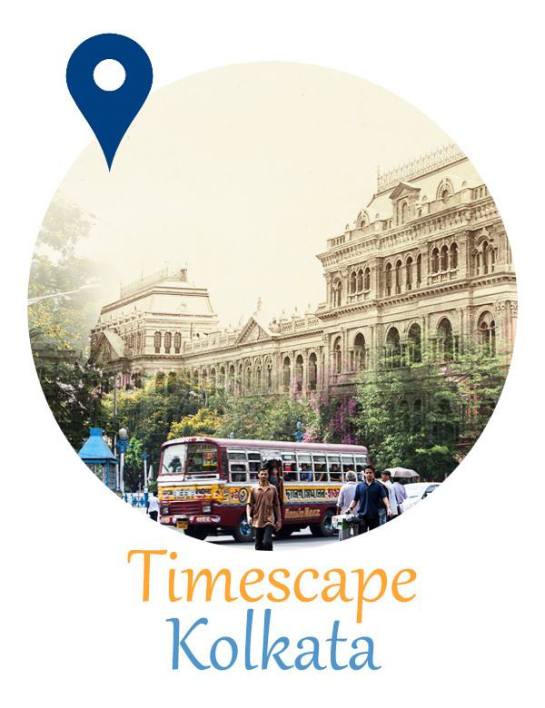
Timescape Kolkata, an augmented reality app developed by the ETIC project, launched earlier this week at the Victoria Memorial Hall. The innovative app allows iOS and Android phone users to experience the antiquated city through photographs produced by Frederick Fiebig, W.G Stretton and Company and the reputable Bourne and Shepherd.
Once Timescape (www.time-scape.org) is downloaded from here, users can explore rare archival images and data about heritage sites in Kolkata. As you walk through the city, views will be ‘augmented’ by a corresponding nineteenth century photograph taken at the exact site. Another click or with a single swipe a host of archival information including sounds and histories will be available.
The idea germinated following the UGC-UKIERI funded ETIC Liverpool conference held last year. In the School of the Arts library, after negotiating theories of the contemporary city, a series of questions emerged. What if Frederick Fiebig’s handpainted candid Calcutta…
This weekend is the final gathering of the ‘Envisioning the Indian City’ project team in Kolkata, as well as the launch of our Augmented Reality app that overlays historical photographs of Kolkata onto contemporary cartography. If you are in Kolkata please do join us.
Cities are inhabited spaces felt through all our senses, especially those of touch, hearing, smell, and so on. In representation, in imagination, in planning and conceptualization, however, they are above all visualized spaces, appearing before our eyes as seen, remembered, or projected. This one-day symposium will focus on the ways in which cities and city-spaces are experienced through the visual register, though we want to interpret this term as widely as possible to include modes of conceptualizing or laying out city-spaces.
Through a series of presentations from architects, historians, literary scholars and art historians, we wish to bring out multiple ways of seeing the city: as a planned (or not-so-planned) space fitting into a conceptual grid; as a scenic location represented through art or captured in memory; and as a visual experience that feeds into the phantasmagoria of city life. Individual presenters may bring out even more nuanced ways of visualizing the city and historic proto-city sites.
The symposium is the last in a series of international workshops and research seminars under the UGC-UKIERI International Thematic Partnership ‘Envisioning the Indian City: Researching Cross-cultural Exchanges in Colonial and Post-colonial India ’ between the University of Liverpool and Jadavpur University, 2013-15: https://eticproject. wordpress.com. This research project focused on four significant city-sites, Goa, Pondicherry, Kolkata and Chandigarh – the first three originating in distinct colonial encounters (with the Portuguese, the French and the British) and the fourth a creation of the post-colonial Indian state. However, in the course of research, other cities and other ways of understanding or viewing urbanity also came into focus, and our work was immeasurably enriched by the contributions of urban historians and scholars worldwide, as part of an ongoing conversation about cities, space, modernity, and cross-cultural encounters.
In the last phase of the project, our team has been developing the Kolkata layers for the Augmented Reality App through which historic photographs and other archival footage related to existing city-sites can be accessed on one’s mobile phone. This final phase of project research has been enabled by a generous grant from the University of Liverpool and the archival resources of the British Library’s Photographic Collection. We have also been greatly assisted by support from our other non-HEI associates, such as the Victoria Memorial Hall, Kolkata, where the AR App, Timescape Kolkata, will be launched on 28th November at 6 pm, after a panel discussion featuring urban specialists and advisors to the project: Timescape Kolkata: Seeing the Past in the Present.
The day-long symposium on Visualizing the City (Jadavpur University, 10 am – 4.30 pm), however, is not simply a prelude to the launch. It will draw together perspectives from architecture, town planning, history, art, literature and contemporary urban culture to reflect on the major project theme of ‘Envisioning the Indian City’. Our invited speakers are Professors Miki Desai (CEPT Ahmedabad), Snehanshu Mukherji (Architect; Visiting Faculty, SPA Delhi), Swapan Chakravorty (Presidency University), Tapati Guha-Thakurta (CSSSCal), Jonathan Gil Harris (Ashoka University) and Dhir Sarangi (Jawaharlal Nehru University). Entry to the symposium and launch are free and we welcome participation and interaction.
Introductory Remarks and Welcome to Participants: Nandini Das (University of Liverpool) and Supriya Chaudhuri (Jadavpur University), ETIC Project Coordinators
10.15 am – 11.45 am: Session 1: Chair, Nandini Das
Jonathan Gil Harris (Ashoka University): From the Ethiopian Highlands and Baghdad to the Nehr-e-Ambari: How to Build a Transnational Deccan City Dhir Sarangi (Jawaharlal Nehru University): French Visualizations of India through Maps and Drawings from the 18th Century
Exhibition: Nek Chand at Pallant House Gallery, Chelmsford, until 25th October
This is a rare chance to see Nek Chand’s work in the UK, and in an external setting which is how the sculptures should be seen. Pallant House Gallery has a large group of sculptures on show courtesy of the Nek Chand Foundation.
I re-visited Nek Chand’s Rock Garden, Chandigarh in August, eager to see how it was being treated and maintained following Nek Chand’s passing in June. I was very concerned that at best it would not be managed properly, and my worst fears were theft and destruction of this unique creation. It was such a relief to see it all looking better than ever. The walkways were clean, litter free and everything was running smoothly. Whilst work seems to have ground to a halt in ‘phase 3’ this may not be a bad thing. Perhaps we now need to think of the garden as being complete and any further changes to be made with utmost care and restraint.
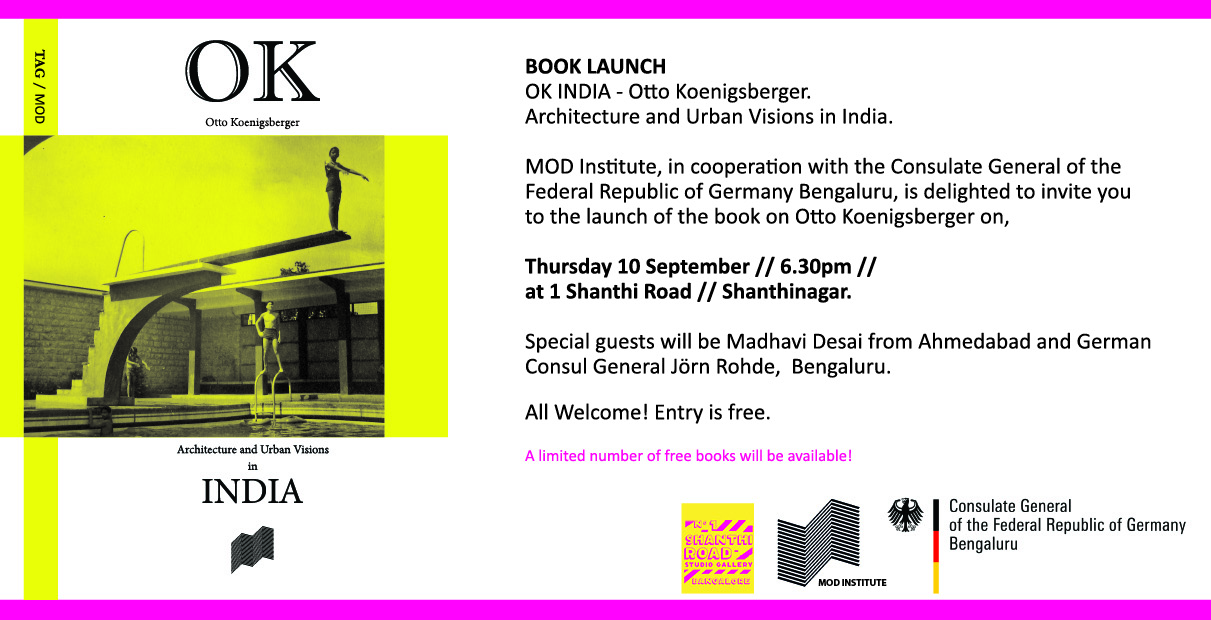
Book Launch OK India – Otto Koenigsberger. Architecture and Urban Visions in India, by Rachel Lee
The much awaited book by Rachel Lee on Otto Koenigsberger is finally with us, and there will be a book launch celebration on 10th September in Bengaluru, see the poster below for more details. We’re delighted that the book has been jointly published by TAG / MOD and we’ll post more details of how you can get a copy in due course…
Architecture Tour: Otto Koenigsberger: Building Bangalore in the 1940s
Dr Rachel Lee will be leading a tour of Otto Koenigsberger’s buildings in Bangalore on 3rd September – a rare treat to learn more about Koenigsberger’s work in Mysore state. Dr Lee’s PhD was dedicated to Koenigsberger’s work in India and she is about to publish a monograph on her findings very soon- which we are very much looking forward to and will announce further details here…..
Thursday, 3 September 2015
Tour Start Point: 1:00 p.m. at the Pavilion in M. N. Krishna Rao Park
Tour End Point: 5:00 p.m. at IISc CCS
To register, contact: +919880347794 OR 080-49000812-ext 836 or email: cph@srishti.ac.in
Last day for registration: 1 September 2015.
To view the poster and for more details see: Rachel Lee Walk
The second day opened with two papers addressing the architectural development and planning of Chandigarh. Iain Jackson (Senior Lecturer, School of Architecture, University of Liverpool) explored the overlooked and quotidian portions of the city in his paper, ‘Chandigarh Dwellings: Ghastly Good Taste or Flamboyant Modernism’. Departing from the over-cited work on the city by Le Corbusier, Pierre Jeanneret, Maxwell Fry and Jane Drew, he detailed his early research into private developments which have avoided similar ossification.
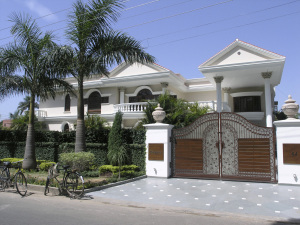
His documentation of these private dwellings showed idiosyncratic modification contra to the city’s founding vision. Discussing this independence from the Government’s arbitration of taste and aesthetic agenda, Jackson proposed a series of classifications including Punjabi Baroque. He stated that this peacock flamboyancy and non-utilitarian adaptation showed Chandigarh remained open, unresolved and signalled the failure of modernist notions of ‘home’.
ENVISIONING THE INDIAN CITY: PEOPLE, PLACES, PLANS
UGC-UKIERI INTERNATIONAL WORKSHOP
HL ROY MEMORIAL AUDITORIUM
MONDAY 17TH AUGUST 2015
The third ETIC international workshop was inaugurated by Professor Sukanta Chaudhuri, Emeritus Professor of English and well-known urban historian. Supriya Chaudhuri (ETIC project lead, Jadavpur) thanked the Centre of Advanced Study, Department of English, Jadavpur University, for hosting the two days and communicated apologies on behalf of Professor Nandini Das (ETIC project lead, University of Liverpool).
Narayani Gupta (Formerly Professor, Department History and Culture, Jamia Millia Islamia) opened the first panel. ‘The Denial of History’ discussed the lost traces of Delhi’s cross-cultural connect throughout its ‘planning’ historiography. Delhi was depicted as an open city, attracting cosmopolitan migration including Armenian and Afghani communities, but Gupta commented on the lack of social historical interest in this multi-layered past. As Delhi gets reported in political terms, using phrases such as Lodi Dehli…
Have you ever wanted a complete bibliography of books written in French on the topic of India from 1754-1954? If so, this resource is for you. Ian Magedera and team have painstakingly compiled the data and it is now available on-line, with regular updates as new volumes are discovered. Links are also provided to google books and other repositories to the texts making this a very useable and important collection.
Architecture: how public space in India was refined by Charles Correa and Nek Chand Saini
In a single week this June, the world of architecture lost two artists who celebrated modern India through buildings, landscape, sculpture and gardens. Charles Correa, India’s best known architect, died on June 16 in Mumbai. Nek Chand Saini, the creator of the Rock Garden in Chandigarh, died on June 12. A self-taught artist, he created art work out of junk.
My research in India has taken me to some truly wonderful sites, not least the 16th-century city of Fatehpur Sikri, near Agra, commissioned by Mughal emperor Akbar. Well-designed spaces bring pleasure and even improve health and well-being, rather like a good piece of music.
Like those at Fatehpur Sikri, Correa and Nek Chand simply made structures and spaces that feel “better” than others. Despite hailing from opposite ends of the social spectrum, both reached shared conclusions about what makes a space work. But more than this, through their lives and work, they tell us something of the story of India.
Honouring nature and values
Born in 1930 in the colonial town of Secunderabad, Correa studied architecture at MIT in the US before returning to India in 1954. He immediately set out to develop an architecture that responded to climate, rejecting the US euphoria for air-conditioning. Instead, he sought solutions that would exploit cool breeze and shade.
Courtyard cafe of architect Charles Correa’s Jawahar Kala Kendra in Jaipur, built in 1993. Meena Kadri, CC BY-SA
Correa was also pursuing an architecture that would respond to India’s recent independence. He sought to introduce notions of “Indian-ness” into his proposals. His architecture is not overly concerned with elaborate forms, rather it seeks to create a series of flowing spaces often centred around an “open-to-sky” element. The visitor moves through the buildings blurring divisions between inside and outside, taking in carefully incorporated views.
Art out of waste
Nek Chand, creator of the Rock Garden in Chandigarh Iain Jackson, Author provided
Nek Chand took a less conventional approach. Often referred to as an outsider artist, he received no formal training. Born in 1926 in what is now Pakistan, the son of a farmer, he was forced to flee his home in 1947 as a result of India’s Partition.
In 1951, Nek Chand obtained work at the construction site that was Chandigarh – a new city to replace the loss of Lahore – designed by the modernist architect Le Corbusier. He worked as a road inspector by day. By night, he created a secret sculpture park full of figures made from found objects, broken ceramics and the remnants of the villages demolished to make way for Chandigarh.
Nek Chand’s Rock Garden
He also crafted the landscape to include waterfalls, courtyards and caverns clad in river rocks and broken sanitary ware fittings. Nek Chand’s Rock Garden, a truly wondrous place invoking playful narratives at every turn, now receives thousands of visitors every day.
Space that evokes and engages
Both Correa and Nek Chand were concerned with the notion of promenade, where the visitor is taken on a journey through a series of enclosed spaces, proceeding spaces hidden from view and revealed suddenly to dramatic effect. Both exploit a site’s natural attributes, responding to contours and always incorporating sculpture and artwork.
Both make a subtle reference to the past, often suggestive of village life, not in a sentimental manner but rather as an integral part of the design. Use of devices such as a space to talk and meet with friends, or a spot to sit quietly with strangers to share a view, have a profound effect. The powerful experience of simply walking through a courtyard clad in a careful selection of materials whilst admiring nature, landscape and artwork, cannot be understated.
Both Correa and Nek Chand were deeply affected by India’s Independence and sought to contemplate this event through their work. For Correa, it was a time to rebuild and rethink the nation, to debate what it meant to be both modern and Indian. At the same time, his use of Mughal-inspired red sandstone demonstrates the idea that India’s pre-colonial past was to be celebrated.
As a migrant to the symbol of India’s political ambition, Nek Chand was also well aware of the changes afoot. In his work there is a sense of loss, a longing to remember the past, as well as a childlike desire to recreate mythological scenes from folk tales and epics.
After their deaths, the works of Charles Correa and Nek Chand will remain wonderful tributes to their passion to improve built urban space in modern India. There can’t be many better legacies than the simple fact that we can learn much about space, light, form and beauty from the spatial experience of joy which their creations have given us.
Envisioning the Indian City: People, Places, Plans International Workshop Monday 17th – Tuesday 18th August 2015 Jadavpur University, Kolkata, India
Envisioning the Indian City (ETIC) is a UGC-UKIERI Thematic Partnership Project (2013-15) between the University of Liverpool, UK and Jadavpur University, India. The Project (seehttp://eticproject.wordpress.com/ ) studies Indian cities as crucibles of cross-cultural encounter, with special focus on Goa, Pondicherry, Kolkata, and Chandigarh. Over the past two years, with numerous seminars, research projects, lectures and presentations, and two International Workshops held in Kolkata and Liverpool, the Project has brought together a variety of interdisciplinary approaches to urban studies, cultural history, on-site research, archives, city planning, architecture, the city in art and representation, collective memory and communities in the city.
In the third of our International Workshops, to be held at Jadavpur University on 17-18 August 2015, we welcome presentations on urban encounters and exchanges through individual and…