Archive

Tropical Architecture

‘Suitable lodgings for students’: modern space, colonial development and decolonization in Nigeria

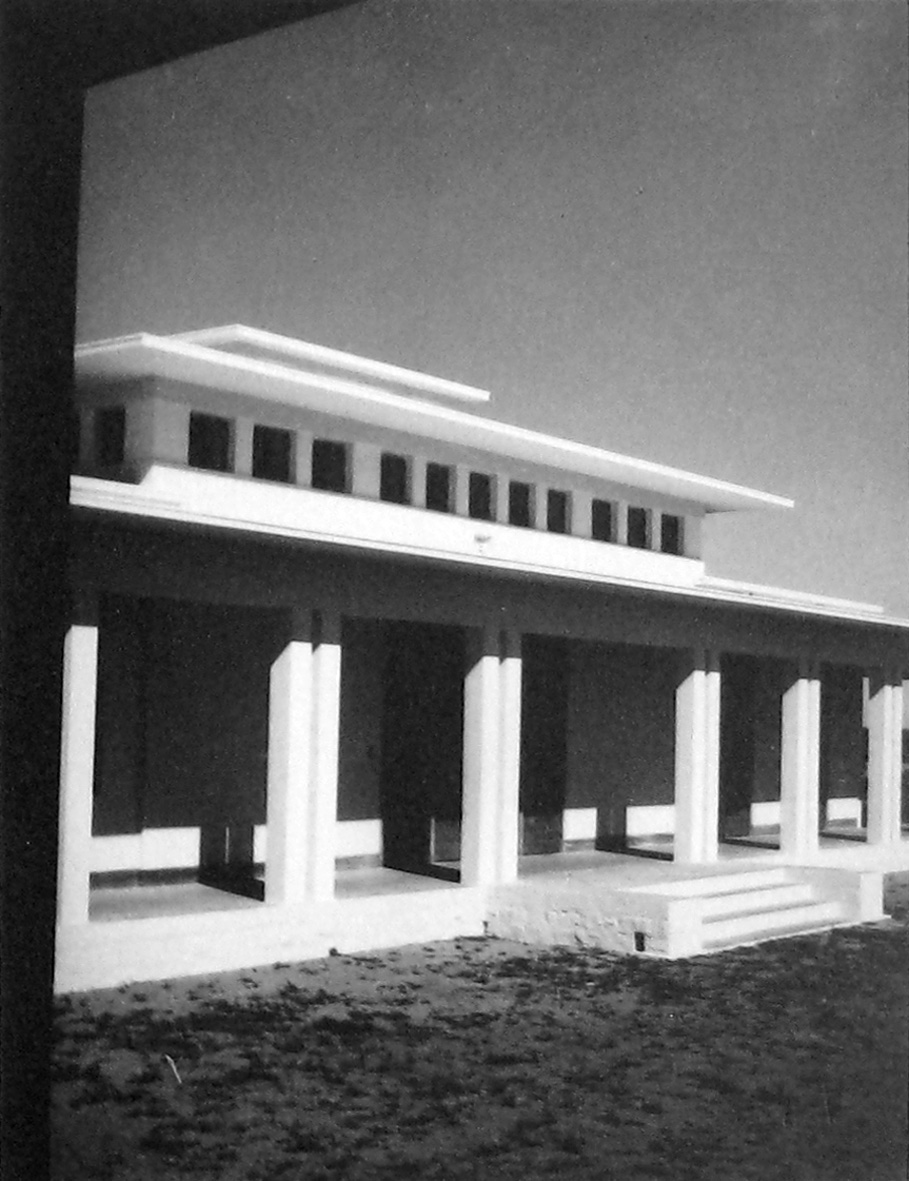
Tim Livsey has recently published his research into Ibadan University in Urban History Journal. The article argues that development and modernity have had spatial manifestations. It considers understandings of modern space in colonial and post-colonial Nigeria through the study of University College Ibadan, the country’s first university institution founded in 1948. It contends that the university was shaped by existing West African conceptions of modern space and university buildings took on new meanings with the shifting politics of decolonization. The article also suggests that colonial development involved a range of groups and forms of knowledge. It seeks to recognize the strength of colonial institutions and cultures but also the limits to and contingencies in late colonial power.

It also has some great archival images of Ibadan University from Cambridge University and SOAS Archives.

http://dx.doi.org/10.1017/S0963926813001065

The planning of late colonial village housing in the tropics: Tema Manhean, Ghana

001

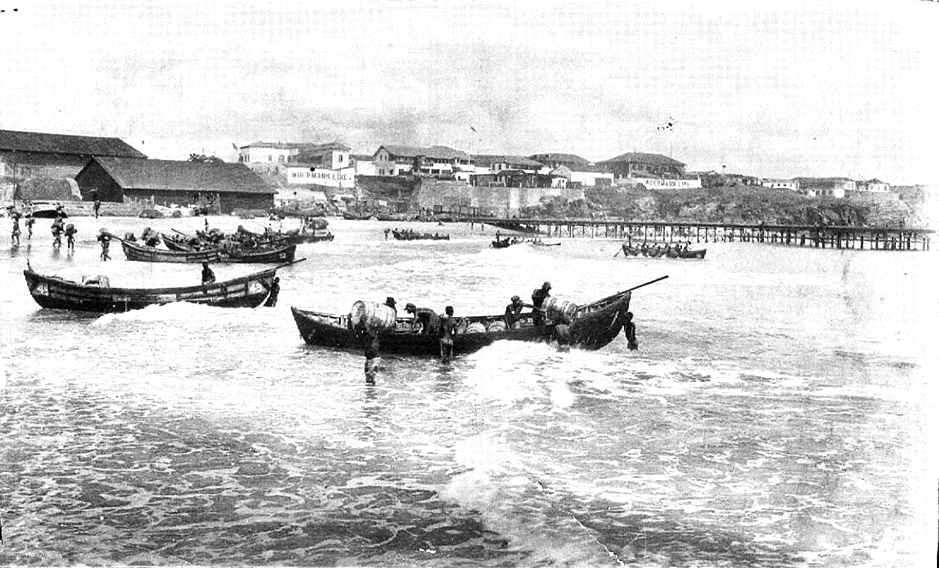
The Surf Boat Harbour at Accra, before the construction of Tema Harbour. Image c. 1920s, courtesy of Wirral Archives

This paper examines the planning, physical development, and housing in Tema New Town, an appendix of the newly created Tema industrial and harbour city, located on the northeastern part of Accra in the Greater Accra Region in Ghana. The city and its appendage were designed and built during the 1950s, as the country was rapidly approaching political independence. Tema, originally an old Ga-fishing village, became a significant part of a much larger and ambitious scheme, known as the Volta River Project proposed as part of Kwame Nkrumah’s domestic policy, embracing multifaceted and multidimensional development projects. These projects were to serve as a symbol of ‘progress’ and were part of Ghana’s desire for modernization as it emerged from a colonial past. The related schemes were largely funded as a result of the British Colonial Development and Welfare Acts, and this paper investigates the implementation of this policy and the effect that it had on physical planning and provision of architectural solutions in Ghana.

007

Maxwell Fry’s sketch of the ‘traditional’ Compound House, from Village Housing in the Tropics

013

One of Fry and Drew’s plans for the fishing village of Tema Manhean, Ghana.

The full paper, published in Planning Perspectives can be read at: http://www.tandfonline.com/eprint/cWc4hRPQWT7yCai5GkjS/full

Jane Drew (1911-1996): An Introduction

We’re delighted that the ICA (Institute of Contemporary Arts) is to hold an exhibition specifically on Jane Drew, especially as she helped to establish that very institution. The exhibition has been curated by Claire Louise Staunton and Laura Guy, who are part of Inheritance Projects. The exhibition opens on 12th February – 23 March 2014. More details on the website below.

Jane_Drew_portrait_web

http://www.ica.org.uk/whats-on/jane-drew-1911-1996-introduction

International Conference
Crossing boundaries: Rethinking European architecture beyond Europe
Palermo, 13-16 April 2014

The International network “European Architecture beyond Europe: Sharing Research and Knowledge on Dissemination Processes, Historical Data and Material Legacy (19th-20th centuries)”, chaired by Mercedes Volait and Johan Lagae, and supported by EC funding through the COST Action IS0904 (2010-2014), is holding its final conference in Palermo (Rettorato dell’Università degli Studi di Palermo,  Palazzo Chiaramonte Steri ), 13-16 April, 2014.

 The conference includes a general session presenting the achievements and future prospects of the network, and the following panels:

–        Session 1. Methods and methodologies: Writing the histories of European imperial/colonial architecture, chaired by Alex Bremner (Edinburgh School of Architecture and Landscape Architecture) and JoAnne Mancini (National University of Ireland Maynooth)

–        Session 2. Architectures of exile: Visions and re-Visions of the global modern in the age of the refugee, chaired by Regina Göckede (Brandenburgische Technische Universitaet, Cottbus) and Rachel Lee (Technische Universität Berlin)

–        Session 3. Looking eastward, building identities: The architecture of European diplomacy beyond the Mediterranean in the age of Empire chaired by Paolo Girardelli (Boğaziçi University) and Mercedes Volait (CNRS/INHA)

–        Session 4. Transnational studies and cultural transfers, chaired by Kathleen James-Chakraborty (University College Dublin)

–        Session 5. Architecture as development aid. Actors, networks and mechanisms in the design of institutional buildings in the postcolonial global South, chaired by Kim De Raedt (University of Ghent’s Faculty of Engineering & Architecture) & Tom Avermaete (Delft University of Technology)

–        Session 6. Examining Tropical Architecture: in different international contexts,  chaired by Ola Uduku (Edinburgh School of Architecture and Landscape Architecture) and Iain Jackson (The Liverpool School of Architecture)

The keynote speech will be delivered by Dr. Sibel Zandi-Sayek, The College of William and Mary,
Williamsburg, Virginia, USA, Remapping the Geographies of Industrial Enterprise: Ottoman-British Networks and the Architectural Canon

An invited lecture will be delivered by Dr. Lukasz Stanek, Manchester Architecture Research Centre, School of Environment & Development, University of Manchester, UK, Architects from Socialist Countries in Ghana (1957-1967): Architecture and Mondialization 

The official launch of the new dedicated electronic journal, ABE – European Architecture beyond Europe, will take place at the conference.


For the detailed program of the conference, check www.architecturebeyond.eu


Chandigarh Exhibitions in Canada and Belgium

There are two exhibitions on the architecture and planning of Chandigarh currently on show – one at the Canadian Centre for Architecture, Montreal, and the other by Archipel at Kortrijk, Belgium.

The CCA exhibition is entitled How architects, experts, politicians, international agencies and citizens negotiate modern planning: Casablanca Chandigarh, and has been curated by Maristella Casciato and Tom Avermaete. It runs until 20th April 2014 and a publication to accompany the exhibition is to be released early 2014. I haven’t seen the CCA exhibition, but its extensive use of Pierre Jeanneret archival material promises to open up new vantage points from which we can view this intriguing city.

The Archipel exhibition has been curated following a visit to Chandigarh by 130 Belgian architects who descended onto the city, and captured not only the architecture but also something of the daily life of the place. Using a series of projectors rather than still photographs, the exhibition is constantly in flux as the large images switch from historical details through to the latest buildings, housing and street scenes. Interviews and films are also broadcast and sound recordings captured in India help to transport a little bit of Chandigarh into Europe. In addition to displaying images and sounds of Chandigarh a side exhibition investigates the relationship between the urbanism of Kortrijk and Chandigarh. An extraordinary collection of material has been gathered as a result of the visit to Chandigarh and I hope it can be collated and published.

Chandigarh continues to provoke, inspire and challenge. It was refreshing not to see the original plan of the city critiqued, nor the hero worship of Le Corbusier; rather the exhibition considered how this great experiment has been adapted, modified and inhabited, and celebrates these interventions.

http://www.cca.qc.ca/en/exhibitions/1984-how-architects-experts-politicians-international-agencies

http://archipelvzw.be/agenda/456


Call for Papers: Crossing boundaries: Rethinking European architecture beyond Europe

13-17 April 2014 Palermo

The International network “European Architecture beyond Europe: : Sharing Research and Knowledge on Dissemination Processes, Historical Data and Material Legacy (19th-20th centuries)”, chaired by Mercedes Volait and Johan Lagae, and supported by EC funding through the COST Action IS0904, is opening calls for papers for its final Conference to take place on 13-17 April 2014 at Palermo (Italy).

The conference will have the 6 following sessions:

Transnational studies and cultural transfers” (chaired by Kathleen James-Chakraborty).

Methods and methodologies: Writing the histories of European imperial/colonial architecture” (chaired by Alex Bremner and JoAnne Mancini). 

“Looking eastward, building identities. The architecture of European diplomacy beyond the Mediterranean in the age of Empire” (chaired by Paolo Girardelli and Mercedes Volait).

Tropical architecture” (chaired by Ola Uduku and Iain Jackson).

Architectures of exile: Visions and re-visions of the global modern in the age of the refugee” (chaired by Regina Göckede and Rachel Lee).

Architecture as development aid: Modernization, technical assistance and the design of institutions” (chaired by Tom Avermaete and Kim de Raedt).

The deadline for proposing a paper (300-word abstract) is 1 December 2013. Submissions to the chairs of the sessions should be accompanied by a short biographical note (max. 150 words). Acceptance decisions will be communicated by mid-December. Please note that invited speakers are expected to submit their complete paper by 15 March, 2014, to be circulated among the conference’s participants. Speakers based in countries participating in the Action (refer to the website http://www.architecturebeyond.eu for the complete list) will be able to claim reimbursement of their expenses. A few grants will be available for speakers based in other countries. For further information, please contact the sessions’ chairs or write to is0904@inha.fr.

Transnational studies and cultural transfers

Chaired by Kathleen James-Chakraborty (University College Dublin)

European architects have worked beyond Europe since the time of the Crusades.  Many architectural historians have documented these practices. In recent years particular attention has been paid to architects who emigrated to escape authoritarian regimes and who are widely credited with having brought modernism with them.  Most of this literature, however, floats independently of social science scholarship on transnationalism, and much of it focuses on the movement of forms and theories, rather than on how people structure their own identity in relationship to their experiences of other places and cultures.  Moreover, relatively little of this writing engages the role of the client, although the role of local building cultures is beginning to receive the attention it deserves.  And finally, very little of it is comparative.  What is the difference between Genoese settlements on the Black Sea, for instance, and Portuguese ones on the African coast?

This session seeks papers that rectify this situation. Particularly welcome are contributions that consider current anthropological investigations of transnationalism and theories of cultural transfer and their applicability to architectural history. What can architectural historians learn from methodologies developed largely to analyze more portable forms of artifacts, not to mention ideas?  Also desired are papers that seek to conceptualize the ways in which transnational architectural practice has changed across time.  What, for instance, distinguishes the German architects that came to the United States following 1933 from those who emigrated after 1848?  Papers might also examine the problem of determining what role biographical experience plays in the designs of any architect.   This is particularly important in the case of a profession that is profoundly collaborative, engaging clients, builders, and users as well as designers.  Other questions that might be addressed include what motivates clients to hire architects from other countries and how do these architects operate once they have such commissions.  Are they employed because of technical or stylistic expertise gained abroad, or are other factors at work?  What types of information and ideas travel with them, and under what circumstances are what local conditions taken into account?

Kathleen James-Chakraborty kathleen.JamesChakraborty@ucd.ie

Methods and methodologies: Writing the histories of European imperial/colonial architecture

Chaired by Alex Bremner (Edinburgh School of Architecture and Landscape Architecture) and JoAnne Mancini (National University of Ireland Maynooth)

This session seeks to explore and debate the ways in which we write (and have written) the history of ‘European architecture abroad’, particularly in the context of European imperial expansion. For some thirty years now the study of European imperial and colonial architecture has largely been refracted through the theoretical lens of post-structuralism—mainly appropriated from philosophy, literary  and cultural studies—in the form of the ‘Orientalist’ critique of Edward Said and other forms of Foucauldian discourse analysis, nominally referred to as ‘post-colonial theory’. As powerful and seductive as these modes of analysis may be, and as useful in their opening new ways of seeing and interpreting forms of cultural production such as architecture, they have become formulaic, predictable, and even orthodox. They have also received trenchant and sustained criticism from the wider scholarly community in historical studies (especially outside art and architecture circles) for their inherent limitations.

This leaves us with the question of where the study of European imperial and colonial architecture might turn next.  On the whole, other scholarly and cognate traditions, such as early modern and modern European history, have developed more diverse and wide-ranging approaches to the study of empire and culture, adapting insights from geography, environmental studies, anthropology, and other disciplines; and have devoted significant attention to integral concepts such as networks and agency. Although not necessarily opposed to discourse analysis, these scholarly frameworks—including regional approaches (‘Atlantic’, ‘Pacific’, ‘Indian Ocean’, and ‘World/Global’ histories), network theory, and ‘connected’ histories—provide new and very different insights than those provided by post-colonial theory.  However, just as architectural historians have not fully engaged with scholars in these fields, early modern historians have also been somewhat reluctant to engage fully with architecture and the built environment as agents and repositories of social practice and social change.

Can, indeed should, architectural history engage more with these alternative scholarly traditions and modes of analysis? What can we learn from them, and how might we apply them?  How might architectural historians interact more productively with colleagues in history and historical social science disciplines to encourage more architecturally-informed analysis in those fields?  Or, ought post-colonial theory remain the key concept and frame of reference that underpins our study of the colonial built environment?  This session welcomes papers that address any aspects of these key questions, either by dealing specifically with methodological approaches that enhance, progress, and/or transform our understanding of European imperial and colonial architecture, or by exploring case studies that allow for these methodological concerns to be elaborated in specific contexts. Put simply: where are we, where are we going, and where do we want to be as scholars of the colonial built environment.

Alex Bremner alex.bremner@ed.ac.uk & JoAnne Mancini JoAnne.Mancini@nuim.ie

Looking eastward, building identities: The architecture of European diplomacy beyond the Mediterranean in the age of Empire

Chaired by Paolo Girardelli (Boğaziçi University) and Mercedes Volait (CNRS/INHA)

Embassies are, by definition, representative institutions, but the share of their architectural shelters in this signifying function is a complex and still understudied issue. By transferring a fragment of the nation beyond its frontiers, embassies, consulates and other officially “foreign” architectures engage in a complex cultural dynamic of encounter, estrangement or integration. Symbolic, identitarian and political meanings may be variously inscribed in their architectural fabric; balances in social topography may be altered – all the more when
such buildings were constructed or adapted by European powers in countries with a remarkable degree of geographical/cultural distance. The stylistic heterogeneity resulting from the interactions and constraints inherent to diplomacy is all the more bewildering in such cases.

This session is meant to develop a critical and comparative reflection on a rather neglected aspect of architectural and urban history that informs the global spread of European forms and aesthetics through an unusual lens. It proposes to do so by concentrating on the geography that lies East of the Mediterranean and on places and structures located outside the direct colonial confrontation. We are interested in contributions looking at buildings related not only to the main Western European players, but indeed to Eastern and Central European agency. Empirical as well as conceptual and theoretical research on European diplomatic structures in the Ottoman, Persian and non-colonial Asian geography, as well as in peripheral cities of the Russian empire, can be presented and discussed in this session.

We invite papers assessing the ways in which European diplomacy, international relations, and changing power balances shaped important parts of the built environment outside Europe, in a space/time framework characterized by expanding European penetration eastward and corresponding roughly to the long 19th century and beyond. We are particularly interested in contributions that address the architectural embodiment of encounters and representational strategies within innovative frameworks, exploring new ground beyond the conventional critique of Orientalism. Preeminence will be given to proposals reflecting on the appropriate methods and sources for this kind of trans-national investigation, and addressing the history of diplomatic buildings as a constant reworking of images, styles, spaces and political messages, affecting each other in unpredictable ways.

Paolo Girardelli girardel@boun.edu.tr & Mercedes Volait mercedes.volait@inha.fr

Tropical architecture

Chaired by Ola Uduku (Edinburgh School of Architecture and Landscape Architecture) and Iain Jackson (The Liverpool School of Architecture)

‘Tropical Architecture’, used as a term here to define a particular strain of construction that seeks to address the hot, humid, and dry climes found between the Tropics of Cancer and Capricorn, is inextricably connected with the colonial endeavours of Europe. Traditional scholarship has sought to historicise the canon and to look to early encounters between travellers, missionaries, military engineers and local populations. This seems like a sensible mode of enquiry from which to begin. Participants are encouraged to present research papers that have examined how ideas have travelled, been interpreted and eventually built, with particular interest on the indigenous perspective. We are also however seeking papers that take us beyond the archive; thus in addition to examining records of the indigenous contribution to tropical architecture, what of those forced to live in tropical dwellings, or to occupy schools, courts, and other such buildings? How did they modify or enhance the tropical capabilities of the buildings they occupied and what recorded or pictorial evidence do we have that shows what they thought of their surroundings? Finally, and importantly we are interested in the domestic setting; what constituted the ‘everyday’ what were the female, (and possibly youth) perspectives, on life in these new tropical dwellings. Also how was environmental comfort and hygiene, evaluated by local residents, as compared with the plans and expectations of the tropical research establishments in the home countries?

Tropical Architecture is a blunt, but useful term. Can we begin to draw out some revealing tributaries? The architecture of Port Cities and ‘sailor towns’, will inevitably vary to that of the hinterland, hill station, administrative centre or desert. What about the island, archipelago, peninsula, and mainland as specific places of exchange, encounter, settlement and isolation- can we begin in a more concerted manner to consider the architecture of these territories and conditions whilst thinking about the tropical? The architecture of trade, railways, stations, warehouses, dock walls and shipping offices all need further investigation.

Tropical architecture ‘at the edges’ is also pertinent; beyond the cosmic boundaries imposed by Cancer and Capricorn, what happens at the edges of the tropical – the subtropics and other such regions that form the imagined boundary. Is the architecture of these almost-tropical places of note, and how does it borrow or contribute to the broader debates. Other boundaries seem to exist at The Americas and Caribbean; they have not featured to the same extent as other geographic areas in recent scholarship. Is there a reason for this? Is the architecture of Rudolph and Polevizky in Florida, or Ossipoff in Hawai’i, or Kurchan and Hardoy in Buenos Aires not the right type of tropical architecture, or is there simply less to say about these, often glamorous, projects or places?

Biography is a contested historiographical method, but can we look more closely at the indigenous architects who have contributed to this canon often working alongside European architects, or should we accept that they should retain their anonymity in light of our concerns about biographical narratives? Equally should we continue to explore the life stories of Europeans who worked in the tropics? Should we be placing them more carefully within a broader narrative? Or indeed when does biography become hagiography – to what purpose and for what audience is it really meant.

Colonies within colonies, or neighbouring territories may offer new insights. For example, was the French Indian colony of Pondicherry culturally isolated from its surroundings, or can were discern ‘knowledge transfers’ and modes of exchange? How did the French differ in their approach to tropical design to the British, or Portuguese in Goa, for example? Taking this premise to its other extreme, what characterises early Indian labour settlements in Durban, or Chinese settlement in areas like San Francisco on America’s Western Seaboard, or West Indian/returnee African settlements in Sierra Leone, Liberia and other countries on the West African coast.

Ola Uduku o.uduku@ed.ac.uk and Iain Jackson Iain.Jackson@liverpool.ac.uk

Architectures of exile: Visions and re-Visions of the global modern in the age of the refugee

Chaired by Regina Göckede (BTU Cottbus) and Rachel Lee (TU Berlin)

The emergence of what is today known as international architecture is to a large extent related to the global impact of exiled European architects, who, scattered throughout the world, contributed decisively to its theoretical debates, institutional formations and built manifestations from the early 1920s onwards.

The historiography of exiled modern architecture has long focused on cases of purportedly successful and unidirectional cultural transfer as represented in the master narratives of prominent US immigrants such as Walter Gropius and Mies van der Rohe. The dominant focus on individual biographies and histories of linear stylistic innovations has all too often overlooked the importance of discrepant discursive contexts (material and non-material alike), marginal geographical destinations, the effects of critical self-reflection, as well as the numerous tragedies of loss, disruption and failure under the conditions of forced dislocation. In the last two decades, there have been, however, several important studies that have contributed to a much more complex understanding and significantly extended knowledge (temporal as well as geographical) of the fragmented dynamics of architects’ and urban planners’ exilic dislocations (including re-migrations and transmigrations) and modern architecture and planning. In addition, new approaches from the fields of post-colonial and cultural studies have stimulated the emergence of conceptually de-centered and ideologically de-nationalized perspectives.

This session focuses on the intersection of exile and architectural practice as a historical phenomenon in an increasingly globalizing world. It seeks to re-examine both the exilic histories of our architectural present and the concept of exile as an analytical tool for interpretively grasping the so-called globalization of modern architecture.

We invite contributions by historians of architecture and art history as well as by scholars from related fields such as literary studies, anthropology, human geography and political history. Papers can address the many individual lives and works of 19th and 20th century exiled European architects with a view to their role in the transformation of international architecture, trace (discursive) modes of production and reception (including non-European resistance to Western cultural hegemony), test specific (historical) experiences for links with and relevance to current, or possibly earlier, exilic modes of planning and building, or investigate the research field’s historiographical overlaps and collusions with related interpretive paradigms like diasporic, (trans-)migrant, (post-)colonial, transnational, cosmopolitan, global, or international architecture. We are particularly interested in comparative perspectives and theoretical-methodological approaches that consider temporal/geographical variants, discrepant political-ideological conditions, and institutional and personal networks. We also invite papers that explore exilic careers of non-European architects within Europe or analyse the architecture produced, commissioned or inhabited by exiles who were not architects.

Regina Göckede goeckede@tu-cottbus.de & Rachel Lee rachel.lee@gmx.net

Architecture as development aid. Actors, networks and mechanisms in the design of institutional buildings in the postcolonial global South.

Chaired by Kim De Raedt (University of Ghent’s Faculty of Engineering & Architecture) & Tom Avermaete (Delft University of Technology)

This session deals with the theoretical and practical architecture expertise which emerged through development aid in the ‘global South’ after decolonisation. By looking specifically at development aid organisations, the aim is to unravel mechanisms of architecture and knowledge production specific to the postcolonial context, characterized by shifting political and economic conditions as a result of the Cold War. Through a particular focus on the design of institutional buildings (schools, universities, hospitals, etcetera), the session seeks to produce a mapping of postcolonial networks of expert(ise)s which substituted former métropole-colony relations.

Questions that could be addressed by the papers are: How did a specific type of ‘global expert’ arise through development aid? What was the role and position of such architect-experts within the highly institutionalized aid bodies they worked for, and to what extent could they operate autonomously within those organisations? What kind of architectural discourse was implicitly or explicitly constructed by development aid bodies? How did this lead to a particular approach to the design of institutional buildings? What was the role of African players in the production of those buildings?

Ultimately the session seeks to understand the specificity of the architecture production realized through development aid, and recognize the particularity of the role of the ‘architect-expert’ within aid organisations. This will allow identifying the continuities and shifts in discourse, mechanisms and architectural language with respect to the production of institutional buildings in the late colonial period, while also tentatively putting the increasing globalisation of the architecture practice today into a historical perspective.

Kim De Raedt kim.deraedt@ugent.be & Tom Avermaete T.L.P.Avermaete@tudelft.nl


Village Housing in the Tropics: With Special Reference to West Africa

The seminal book on Tropical Architecture by Jane Drew and Maxwell Fry has been republished by Routledge 66 years after its first edition was bravely produced by Lund Humpries.

villagehousing

The slender volume loaded with Fry’s cartoons and sketches became an instant hit, with its engaging insights and empirical findings.  It was not aimed at the specialist or technician, rather the generalist and interested reader looking for quick tips to solve familiar problems. The book gives pragmatic advice on the siting of villages, housing orientation and matters relating to sanitation and health. Although the content was far from novel or radical, it presented previously dry and mundane material in a manner that was easy to understand, and encouraged greater attention to be given to the everyday housing problems of West Africa.

The book was used by Fry and Drew as a promotional tool,  they included a copy along with their CV’s when applying to be considered for the University of Ibadan project and it almost certainly influenced their consideration for Chandigarh. It set them apart from others working in tropical regions,  and with its emphasis on village housing firmly aligned them with the Colonial Office’s desire to promote ‘Development and Welfare’.

It almost goes without saying, but the publication was a product of its time and formed part of the colonial enterprise. Within the front and back endpapers of the book a map of the world is coloured to highlight Britain’s Colonial territories, highlighting where the book’s advice could be dispensed and treating all ‘tropical’ territories as one and the same irrespective of their specific contexts and climatic variations.

Available to purchase here: Village Housing in the Tropics: With Special Reference to West Africa (Studies in International Planning History)

Designing Buildings in 15 Minutes: A day in the life of Otto Koenigsberger, Government Architect to the Govt. of H.H. the Maharaja of Mysore

by Rachel Lee

The following extract is from a private letter written by the architect, planner and educator Otto Koenigsberger (1908-1999) to his family in 1940.  He probably typed it in his small room in the bungalow he shared with the Brinitzer family at 42 Infantry Road, Bangalore, India. Like the Brinitzers, Koenigsberger, a native Berliner with a Jewish background, was in exile.

  1948_Koenigsberger and colleagues at the PWD

Due to a fortuitous family connection, in 1939 Koenigsberger had been contracted to work as an architect in Princely Mysore, a South Indian state with a limited amount of independence from British colonial rule. Thus his boss was not a member of the British Raj, but the ambitious Dewan (Prime Minister) Mirza Ismail, whose favourite pastime was building. In November 1939 Koenigsberger was promoted to Government Architect, the highest position for an architect in the state. As the humorous extract reveals, although his job kept him very busy, it did not prevent Koenigsberger from trying to build up a private practice or enjoying himself in his new home . . .

“I shall give you a short review of one day in the life of the Government Architect to the Govt. of H.H. the Maharaja of Mysore.

My boy appears at 6:30 am in my room in order to wake me up. This has the result that I go on sleeping till quarter to or quarter past seven. Which of the two depends on the situation whether I must go and see the Dewan in his Bungalow or not. He belongs to those immorally hard working people whom I thoroughly dislike and has already one hour of hard work finished when I come to see him at 7:30. The next item is an enormous breakfast at 8 and instruction of my private draughtsman at 8:30 – Yes I have a private draughtsman and ‘secretary’. He is an Angloindian with the nice name Eric J. Crane, is rather shy, not too bright, and of course very unreliable. He comes for three hours in the morning and three in the afternoon and tries hard to learn how to do architectural drawings, so that I may be well armed and prepared when the great wave of private work comes of which I am daydreaming.

If there are no other inspections (on most days there are, my average is about 30 miles a day inside Bangalore only) I go to the office between 9 and 10 in order to have some quiet hours before my six men arrive at 11.

1940_Serum Institute

The morning post brings about 5 to 6 requests for designs per day, say one hospital, one bungalow for an officer, one railway station, one cinema, and a number of smaller tasks and alterations. In addition comes a tray full of files, for all building plans, small or big must go through my hands before they can be sanctioned by Govt. In Europe I would have worked about a week to design a hospital and about another week or fortnight to prepare the drawings. Here the main idea and the sketch must be ready in ten to fifteen minutes and then the assistant or draftsman must prepare the plans within two to four days. Of-course these designs cannot be so well worked out as mine were at home. To keep up at least a certain standard of exactness and efficiency I must permanently go round from one to the other to correct the plans and to tell them what they must do. In the intervals between my wanderings from one drawing board to another I try to attend to my files, to answer letters, and to make a number of sketches and small plans which I can finish myself in less time than it would need to explain to somebody else how to do them.

1940_Dispensary Bangalore

At 1:15pm I go home for lunch and for new instructions for my home-draftsman and back to the office at 2 or 2:15. The afternoon is usually filled with visitors who want all sorts of technical instructions or come discussing of new building schemes. Of-course only a very small percentage of our many designs will be built, and if they are it will take at least half a year or a year till they are started. That gives the Dewan who plays the role of ‘Bauherr’ [client] in this game ample time to ask for new schemes and accordingly revised designs.

Usually I am home at 6 in the afternoon. I sit down for a late but very big tea which usually takes about half an hour, not because I eat so much, but because I am just lazy and enjoy my rest. Every second day a Kanareese lesson follows from 6:45 to 8 or 8:15. If there is no lesson this time should be spent with learning what we had the day before, but so far I have always found an excuse not to learn so that the result of a fortnight of lessons with a very good teacher is very poor.          

1939_Municipal Swimming Pool

Dinner is celebrated from 8:30 to 9:30 when we hear the news from England. As it usually is a very good and rich dinner you can imagine that there is not much energy left for letterwriting in the evening.          

This description of my life is unadequate in two points: (1) it sounds boasting and at the same time complaining. But it is certainly not meant to do so. I thoroughly enjoy my work. I only tried to explain that a day of permanent designing is somewhat exhausting. (2) It gives the picture of rather a dull and narrow (English for ‘spiessig’) life. But actually I am meeting interesting new people nearly every day, studying a most interesting country, reading a few good books (for instance the latest Aldous Huxley ‘After many a Summer,’ which I enjoyed very much), seeing a film once in a while and hearing a good deal of Indian and European (gramophone) music.”[1]

Note: Although Koenigsberger’s native language was German, the outbreak of World War II forced him to communicate with his family, who were by then living in the USA and UK, in English – letters in German were censored or confiscated.

 The images are reproduced with the permission of the Koenigsberger family.

Email Contact: rachel.lee@gmx.net


[1] Koenigsberger Papers at the Jewish Museum Berlin: Extract from a letter from Otto Koenigsberger to Kaethe Koenigsberger dated 7 February 1940

The Alan Vaughan Richards Archive Project

Ola Uduku and Hannah Le Roux

13.4.30_AVR House Interior

Alan Vaughan-Richards House Main Living Room Interior, photo for Nigerian Interiors Magazine.

The Alan Vaughan Richards archive project seeks to preserve, record and archive the works of the late British-Nigerian Architect, Alan Vaughan-Richards (1925-89). Its ultimate aim is to make available a digital and physical archive of Vaughan-Richards work to the public. This archive, comprising drawings, artefacts, and texts will be made accessible to the public to view online, or by visiting the renovated Alan Vaughan-Richards house in Ikoyi, Lagos. The Vaughan-Richards House, built by the architect in the 1960’s, is acknowledged as a unique example of West Africa tropical modernist architecture.

The archiving project is being funded by the British Academy with a further University of Edinburgh research grant held by Ola Uduku, at the University of Edinburgh, with Hannah Le Roux, at the University of the Witwatersrand, along with financial and logistical support from the Goethe Institute in Lagos and Remi Vaughan-Richards, Alan’s daughter. In 2012 over 300 drawings and other artefacts were brought from Alan Vaughan Richards’ home office in Lagos to be digitized and preserved for archiving. In September 2012 a short exhibition showing the work completed in digitizing the first batch of artefacts, and documenting Alan Vaughan-Richards’ career and life in Lagos was presented at the Matthew Gallery at the University of Edinburgh. This digital archive is held in the name of the Vaughan-Richards family in Edinburgh. The Alan Vaughan Richards blog was created as part of this process.

At the same time as the exhibition, Candice Keeling from Katholieke Universiteit Leuven documented the condition of the existing house in-situ and created as-built drawings. It is hoped in the future to develop the house as an artists’ residence and the home to a physical archive, accessible by appointment to academics and West African architecture enthusiasts. There are ongoing plans for the renovation and redevelopment of the Vaughan-Richards house in Lagos to enable its transformation into the archive and art residency space planned.

The project throws a number of challenges. The harshness of the tropical climate has contributed to considerable decay of materials such as carpeting and textiles. The cost of restoring the structure and aesthetic of the house requires the transformation of use of part of the property in ways that will sustain the conservation of its elements and intentions. These challenges will be addressed by ongoing design and research. On a broader note this project is hoped to generate interest in conservation in West Africa, where many other modernist buildings are in need of maintenance, conservation and reappraisal of use.

The archival work, residency proposals and related information on the Vaughan-Richards family form the material for an exhibition proposed to coincide with the ArchiAfrika conference in Lagos in December 2013.

The project welcomes participation from with researchers and modernist conservation practioners in West Africa, as well as anyone who has further information on the architecture and other work of Alan Vaughan Richards, as a partner in the  Architects’ Co-Partnership and later as an architect in Lagos.

Contact email:  o.uduku@ed.ac.uk and hannah.leroux@wits.ac.za

..

Permission to publish all images on the blog for educational purposes, has been granted on behalf of the Vaughan-Richards Estate, by his daughter, Remi Vaughan-Richards, a film director, whose feature films and documentaries throw a sharp lens onto contemporary Africa.

A.E.S. Alcock and the planning of Asawasi, Kumasi

As part of our research into the architecture and planning in West Africa we have uncovered some important work undertaken by Alfred Edward Savige (“Bunny”) Alcock. He worked as  Town Engineer in Kumasi, 1936-45, and then as Gold Coast Town Planning Advisor from 1945-56. Whilst working in Kumasi, Alcock was a pioneer in developing self-build villages. He set up small scale production lines where the villagers could produce ‘swishcrete’ blocks, prefabricated roof trusses and various sanitation devices such as latrines and communal laundries.

DSCF0073

This work was all carefully documented by Alcock and his hand-made photo album survives in the National Archives, London.  Maxwell Fry and Jane Drew worked with Alcock on this ‘experimental village’ (they were credited in Alcocks album) and went on to plan the larger second phase of the development, known as Asawasi. Fry described how the project grew, ‘from being a little experiment has become a big scheme spawning all over the hillside.’

Alawasi_plan

The plan above shows the complete development arranged into ten compounds (housing groups). The area coloured pink was the original village planned by Alcock with the remaining areas designed by Fry and Drew. Alcock proposed a terraced (row) housing approach to create ‘interior’ courtyards, or ‘open compounds’. Alcock described it as a ‘ a repetitive pattern of garden and service compounds alternating… this pattern is adapted to curving contours in the main estate.’ There was a low-tech thrifty approach to the development as Alcock describes,

‘door and window furniture was made from scrap iron by blacksmiths. It was stronger and cheaper than imported furniture.’ In the kitchen a hood and flue were provided by using ‘old tar drums covering all four fire places shared by eight tennants’
Fry and Drew’s Village Housing in the Tropics is indebted to this early development. Alcock proudly noted that his designs could exceed the current building regulations and reduce costs. The big idea was for the government to supply the materials (and technical knowledge) with the villagers providing the labour. It was a system that became very popular throughout West Africa, although it was not always a fair and equitable solution.

DSCF0075

Alcock took over from Fry as the Town Planning Advisor in Accra and was instrumental in the initial planning of Kwame Nkrumah’s Volta River project, new port and town Tema. He (along with Helga Richards) published his findings in a series of ‘How to’ building guides. Although less commercially successful than Fry and Drew’s acclaimed Village Housing in the Tropics manual, Alcock’s books were far more pragmatic and explanatory. There is also an element of humour in his books. How to Plan your Village for example is all about an educated villager returning to his old village and helping them to restore it – the character is named ‘Kwame’  – an overt reference to Nkrumah and a metaphor for the radical changes he was proposing.

howtovillage