Conference Call for Papers: The Design, Planning and Politics of How and Where we Live
Place: University of the West of England (UWE), Bristol, UK Dates: 25-26 January 2018 Organisers: Department of Architecture, UWE, with AMPS. In collaboration with the Public Health Film Society and World Health Organisation Collaborating Centre at UWE.
The conference welcomes delegates to present in-person, via Skype or pre-recorded video which will be uploaded to the AMPS YouTube channel.
This major international conference considers the sustainability and healthiness of the places we live in – from our houses to our cities. Inspired by the origin of the public health movement in the issues of urban housing, it seeks an interdisciplinary debate on the quality of life in the built environment. It welcomes health professionals, sociologists, community activists, architects, planners, urban designers, and more.
From a health perspective, it continues the work of AMPS over the past three years on public health. From a housing perspective it continues AMPS engagement with the Housing – Critical Futures research programme. In its concern with the ‘politics of housing and health’ it continues collaborations with sociologists and community researchers. From a design point of view, it brings together the work of architects and spatial designers from various disciplines concerned with a better quality living environment affecting wellbeing, health and social sustainability.
Publications:
There will be a conference proceedings publication with its own ISSN.
There are several other publications:
1. A Special Issues of the Architecture_MPS journal
2. Amps Book Series with UCL Press
3. Amps Book Series with Libri Publishing
4. Amps Book Series with Vernon Press
Other Partners:
The event is coordinated by the UK non-profit research organisation AMPS as part of its engagement with the UN Habitat University Initiative. It is part of a series being organised by an international consortium of universities and publishers including: The University of Derby, La Universidad de Sevilla, University of Cyprus, Swinburne University Australia, London South Bank University Liverpool and John Moores University, UCL Press and Libri Publishing.
We included an article on these structures exactly one year ago today – and were still hopeful that the Indian Government would see sense and agree to retain these important pieces of architecture. Alas, they made a terrible decision and sent in the wrecking ball.
There was no real justification for this act of cultural vandalism. It is a disgraceful destruction of modern heritage, not to mention the environmental waste.
Next month the AHRC and Indian Council for Historical Research will be sponsoring a workshop on ‘Cultural Heritage and Rapid Urbanisation in India‘ in Delhi. Its too late for the Maidan but let’s hope the workshop can provoke some much needed change.
The 6th Conference on Infrastructure Development in Africa, has just concluded with a particular focus this year on ‘Building Resilience through African Urban Culture’. Held at KNUST in Kumasi, Ghana the conference welcomed speakers from Nigeria, South Africa and UK, as well as a host of research papers presented from scholars based in Ghana.
Key note speakers (including Prof. Chike Oduoza, Dr Obuks Ejohwomu and Prof. Mugendi M’Rithaa) lucidly presented the varied and many challenges facing African cities today – with particular focus on energy use, digital infrastructure and the internet of every/things.
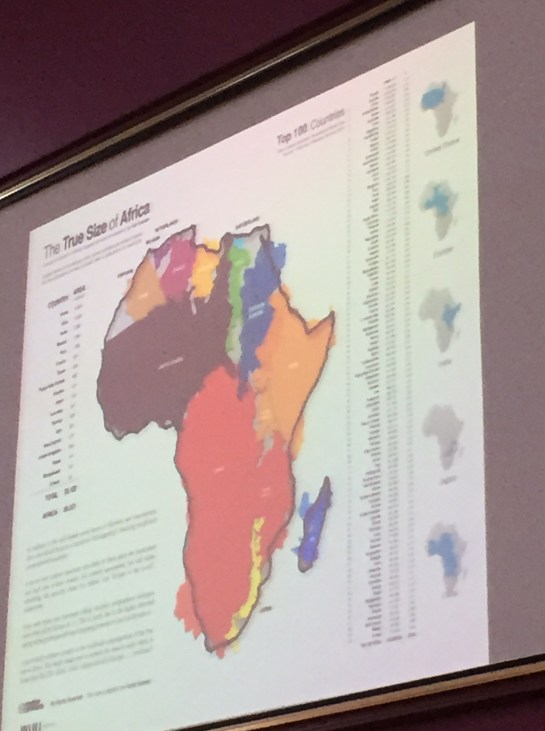
Prof. M’Rithaa’s presentation included some very striking map visuals, including the image below that shows the true size of Africa relative to other countries – something that Mercator projection of the world fails to reveal. You can just make out on the poor quality photo below the outlines of USA and India. He also spoke very eloquently on how our solutions must be people centred, rather than imposed solutions. Dr Ejohwomu also challenged us with many provocative questions and themes – including a cartoon showing an emaciated cow and a worker abandoning it in pursuit of an obese cattle. His challenge was that we can’t simply walk away from the problem and that Africa needs us to focus on its problems rather than attempting to flee them in the ‘global north’. This message also reinforced by Prof. David Edwards and Dr. Erica Parn in their presentation.
I gave a presentation on the rich modern architectural history of Ghana, and the infrastructure of culture that exists here. I focused on a series of building types including education, community centres, and libraries, as well as the town planning and historical development of Kumasi.
Nearly 50 papers followed on a vast array of topics as well as a striking art installation on the plight of the African Giant Snail’s ecosystem. A new journal was launched ‘Journal of Built Environment (ISSN: 2026-5409) and next year the conference will migrate to Lagos – we look forward to hearing more from this important gathering.
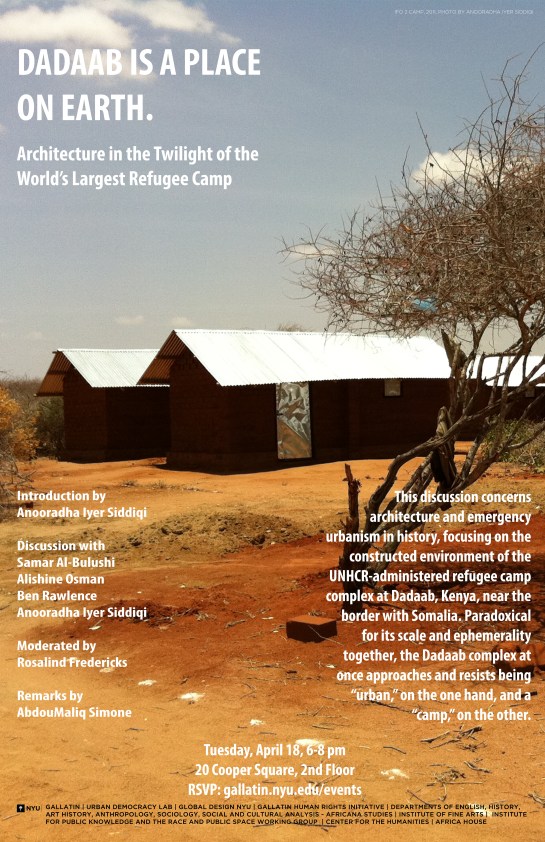
This moderated discussion concerns architecture and emergency urbanism in history, focusing on the constructed environment of the UNHCR-administered refugee camp complex at Dadaab, Kenya, near the border with Somalia. Paradoxical for its scale and ephemerality together, the Dadaab complex at once approaches and resists being “urban,” on the one hand, and a “camp,” on the other. Established in 1991 to shelter thirty thousand refugees, the Dadaab complex expanded over the course of a quarter century to five settlements with a compound headquartering a centralized structure of humanitarian agencies. According to unofficial counts, it currently houses one half million refugees and asylum seekers, along with humanitarian aid workers in residence. In early 2016, citing security threats, the government of Kenya announced that it would close the complex prior to the next general election, and dismantled the Department of Refugee Affairs as a decisive measure. Through a detailed discussion on design, use, aesthetics, and affect at the Dadaab site, we hope to study the social and political lived realities of an environment constructed to be liminal.
Introduction by Anooradha Iyer Siddiqi
Discussion with Samar Al-Bulushi, Alishine Osman, Ben Rawlence, Anooradha Iyer Siddiqi
Job @ METROMOD, Relocating Modernism: Global Metropolises, Modern Art and Exile, an ERC funded project at the Institute for Art History of the LMU Munich
Job: Research Associate / Postdoc Domain: History of Modern Art Location: Institute for Art History, School of Arts, Zentnerstr. 31, D-80798 Munich, Germany Assignment: September 2017 or as soon as possible Salary Range: 13 TV-L Hours: Full Time Duration: 3 years, with the option of up to additional 20 months (until 5/2022) Deadline for application: 1 May 2017
LMU Munich is recognized as one of Europe’s premier academic and research institutions. The university is situated at the heart of Munich.
Job Description Applications are sought for a Research Associate/Postdoc (Wissenschaftlicher Mitarbeiter/in) on the new European Research Council funded project “METROMOD: Relocating Modernism: Global Metropolises, Modern Art and Exile” led by Professor Dr. Burcu Dogramaci and based at the LMU Institute for Art History. Applications from the disciplines of art history, architectural history, urban history, planning history or related research fields are welcome.
We are offering one three-year post-doctoral position starting in September 2017 at the earliest. After a positive evaluation the contract can be extended for up to 20 months (until May 2022 maximum).
The Project Breaking new ground, METROMOD proposes a rewriting of modern art history as a history of global interconnections, spurred by migration movements and rooted in cities. Revising the historiography of modern art, which still continues to be dominated by the hegemonic and normative narratives of (Western) European Modernism and ignores the significance of exile movements, METROMOD conceptualizes art history as a result of interrelations and negotiations in global contact zones, unstable flows, transformations and crises. The conceptual triangle of modernism, migration and the metropolis forms the foundation of an innovative comparative, interdisciplinary methodology. In its analysis, METROMOD focuses on the first half of the 20th century. During this era the modern movement emerged as a paradigm in art and architecture, and rapid urbanization took place globally; thousands of persecuted European modern artists fled their homes, re-establishing their practices in metropolises across the world. Reflecting both the geographical extent of these exile movements and their local urban impact METROMOD examines 6 key migrant destinations—the global cities of Buenos Aires, New York, London, Istanbul, Mumbai (formerly Bombay) and Shanghai—following three main objectives: 1. to explore transformations in urban topographies, identifying artistic contact zones and places of transcultural art production; 2. to investigate networks of exiled and local artists as well as collaborative projects and exhibitions; and 3. to analyse art publications and discourse generated in centres of exile. Digital mapping will locate sites of artistic migration in the cities and demonstrate linkages between transforming metropolises and flows of people and objects around the world.
Prerequisites You have a PhD in art history, architectural history, urban history, planning history or related disciplines. You have a background in the history of modern art, photography, architecture or urbanism. You have a special interest in exile studies and history, and you have special language abilities in Spanish or Mandarin. You will be fluent in English and have a working knowledge of German. You will be expected to pursue independent work related to the themes of METROMOD focusing on the objectives of the project (see description above). You will conduct a postdoc project about the exiled/migrated artist community (1900-1950), art institutions, artworks and the urban landscape of Buenos Aires or Shanghai. Research experience in Argentina or China is expected.
The successful candidate is expected to work as part of a team based at the LMU Munich and to conduct fieldwork and/or archive visits for the case studies. You are expected to publish the results of your research within the publication programme of the project. You will be expected to be involved in planning and running collaborative project group activities (project meetings, workshops and conferences) as well as in the administrative work associated with the project. Experience with administration and coordination is desirable as well as an interest in archival research and/or the implementation of digital mapping tools connected with the project.
Working space, working tools and a travel budget will be provided. Applications from disabled researchers will be considered with priority under equal conditions. We welcome applications from female candidates. This is a full-time position. The possibility of part-time and flexible working hours will be considered.
How to apply Please send the following application materials as a single PDF-document to burcu.dogramaci@lmu.de (please specify METROMOD in your email subject line):
1. Short cover letter (max. 300 words) 2. Short CV (2 pages )plus list of publications 3. A description of your proposed research topic relating to the stated objectives of the METROMOD project (max 1000 words, excluding bibliography) 4. A writing sample (e.g. one chapter of your latest book or an article in a peer-reviewed journal). The writing sample should reflect your current research interests. It does not need to have been already accepted for publication and should preferably be no longer than 5000 words 5. Names and contact details of at least two referees.
Applications received by 1 May 2017 will receive full consideration. Review of the applications will continue until suitable candidates are found. Shortlisted candidates will be invited for interviews in May/June. Informal enquiries may be made to Prof. Dr. Burcu Dogramaci.
Contact Person: Prof. Dr. Burcu Dogramaci METROMOD, Relocating Modernism: Global Metropolises, Modern Art and Exile (ERC) Ludwig-Maximilians-Universität München Institut für Kunstgeschichte Zentnerstraße 31 80798 München E-Mail: burcu.dogramaci@lmu.de
As a Syrian architect, my enjoyment is complete when I wander through the districts of Old Damascus. I used to walk with my daughter and tell her stories about each significant place we passed. In Old Damascus – one of the longest inhabited cities in the world – 5,000 years of history come alive. The tight network of traditional streets are complemented by stunning architectural masterpieces, such as the ancient Umayyad Mosque (completed in 715AD), the Roman Temple of Jupiter and the Byzantine arches.
Al Asruniyeh souk was our favourite destination on special occasions. Al Asruniyeh is a commercial neighbourhood located between the Citadel of Damascus and the Great Mosque of the Umayyads, inside the walls of the ancient city. The souks of Damascus are a part of the daily life – bustling marketplaces where political, social and cultural differences are forgotten.
Yet since the start of the armed conflict in Syria six years ago, much has changed in my home town. Although the city remains relatively safe compared to other parts of Syria, many have fled, lives and livelihoods have been lost and treasured cultural heritage has been destroyed.
In April 2016, a fire raged through Al-Asruniyeh. For the local community, losing part of Old Damascus is like misplacing part of their own soul, their memory and identity.
Yet history has shown that despite attempts to destroy Damascus, it has always risen from the ashes, stronger and brighter, powered by the local community. Time and time again, the Damascenes have proven adept at rebuilding their lives and their city in the wake of disaster.
Rising from ashes
For example, in 1860 when Syria was under occupation by the Ottoman empire, the quarter of Bab Tuma in the north-east of the city was ransacked. Over 3,500 houses, churches and monasteries were comprehensively looted and set ablaze. Hundreds of people were killed and thousands were displaced.
The district was rebuilt between 1863 and 1880, by local builders who returned after the clash. Elements of the old Bab Tuma were preserved by using traditional materials to create similar urban forms. Yet innovative features were also added. Builders used new decorative techniques, and added open windows to the façades as a reflection of “new” social needs, opening them up to the street outside.
Again, on October 18, 1925, the city was bombed by the French army in an attempt to quell a revolution against French rule. As a result, the western district – known at that time as Sidi Amoud – was mostly destroyed. Several traditional masterpieces were burned or damaged, and hundreds of lives were lost.
The destruction after the French attack, with the minarets of the Umayyan mosque on the horizon. Wikimedia Commons
The district was remodelled in 1926 by the French, this time according to modern European characteristics. The local community, who had no voice in this reconstruction, changed the district’s name into Al-Hariqah – which means “fire” in Arabic – to commemorate the terrible event. This rebuilt area has a peculiar character. The orthogonal road network and the heights of the buildings differ from the organic urban fabric of Old Damascus, and the new structures do little to reflect what was lost.
Rebuilding Al Asruniyeh
Today, Damascenes are once again confronted with the task of rebuilding – and this time, they control the outcome. Yet the loss of Al-Asruniyeh raises critical questions about what should rise in its place.
The history of Damascus shows that when ruins are rebuilt by the local community, the new layer is imbued with the soul of the city. Rather than covering the city’s history up, the new buildings become a part of it. For that reason, community input is needed now more than ever before.
The heritage of Syria has been a source of pride and dignity for the Syrians, despite differences in religion and political opinion. Their built heritage has been always a source of shared memory and history, as we all enjoy its authentic and aesthetic character. Old Damascus, with all its souks, khans and districts, embodies Syrians’ cultural, social, educational and economic values.
Because of this, safeguarding the architectural characteristics of the old city should be a cornerstone of the reconstruction process. City authorities must develop a plan to manage Old Damascus’ urban heritage, in a way that upholds its social and cultural integrity.
What’s more, rebuilding the Al Asruniyeh souk presents an opportunity for reconciliation. Although the armed conflict continues, Syria has been enduring it with dignity and pride. Starting the reconstruction now is vital, to encourage Syrians to return and participate in rebuilding their country, spreading a feeling of safety, ownership and pride in the city once more.
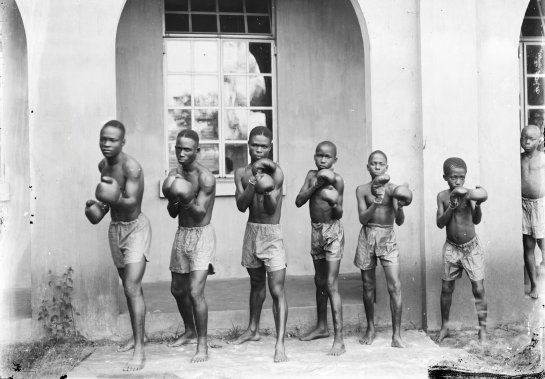
“Founded in 1922, Deo Gratias is the oldest photography studio still in operation in Accra. As the city celebrates 60 years of independence this week, the studio has revealed new photos of life in the 1920s and 1930s”.
Does Achimota School still have such a formidable boxing club?
The two-day Urban Heritage Activism conference will focus on heritage ‘from below’–urban history as it is lived, represented and transformed by local communities in diverse geographies and cultural contexts. Speakers from grassroots movements, academic and cultural institutions will address political ramifications and power struggles related to heritage and introduce the failures and solutions of various activism projects, especially in postcolonial contexts. Contributors will debate contemporary tensions and future strategies for interventions through a roundtable discussion at the end of each day.
In addition to the stimulating conference programme, the Simulizi Mijini / Urban Narratives exhibition Juxtaposing Narratives: Dar es Salaam and Berlin will open at 8pm on Friday 17 March with a cooking performance, live music and a DJ. Walking tours and film screenings will round off the programme of events.
Speakers and moderators: Erica Abreu, Jully Acuna, Yaşar Adanali, Awami Art Collective, Comfort Badaru, Diane Barbé, Shraddha Bhatawadekar, Vittoria Capresi, Jerome Chou , Rebecca Corey, Gabi Dolff-Bonekämper, Matthias Einhoff, Anne-Katrin Fenk, Zinovia Foka, Susanne Förster, Benjamin Häger, Maj Horn, Anooradha Iyer Siddiqi, Sehr Jalil, Leila Javanmardi, Claudia Jürgens, Georg Krajewsky, Rachel Lee, Farah Makki, Sarita Mamseri, Srdjan Mandić, Mansion, Avehi Menon, Philipp Misselwitz, Monika Motylinska, Rishika Mukhopadhyay, Laura Murray, Marcelo Murta, Naira Mushtaq, Cord Pagenstecher, Luise Rellensmann, Ana Luisa Ribeiro, Juliane Richter, Gözde Şarlak, Jona Schwerer, Annika Seifert, Gülsah Stapel, Samaila Suleiman and Mike Terry
Artists: Rehema Chachage, Cloud Chatanda, Tellervo Kalleinen and Oliver Kochta-Kalleinen, KUNSTrePUBLIK and Jan van Esch, Umesh Maddanahalli, Michelle Monareng, Patrick Mudekereza, Paul Ndunguru, Nadin Reschke, and Alex Römer
Call for Sessions: 6th International Congress on Construction History
The 6th International Congress on Construction History (6ICCH) will be organised in Brussels, from July 9 to July 13, 2018. For the first time, thematic sessions as well as the usual open sessions will be organised. Therefore, a two-step procedure is adopted: the call for thematic sessions is launched first, followed by the general call for abstracts. The general call for abstracts will invite contributions for the special thematic sessions as well
as contributions dealing with a broad range of construction history topics (typology, the action of building, knowledge transfer, process and actors, materials, services, etc.). With this combination, the organisers aim at both a broad and an in-depth assessment of new research in construction history. The present call invites prospective session chairs to suggest topics for the thematic sessions. Their aim is to highlight explicitly the latest themes, approaches and directions in construction history research, and to foster
transnational and interdisciplinary collaboration and discussion on burning issues. Proposals should include a description of the theme (max. 400 words), a motivation of the relevance of the theme (max. 400 words) and a CV of the applicant chair demonstrating his/her relevant expertise. The organising committee will select up to 12 thematic sessions, limited to one per applicant.
Chairs of the thematic sessions are expected to be present at the 6ICCH and give a short introduction to their session. They are, in collaboration with the scientific committee, responsible for the selection process of the submitted abstracts and for the editing process of the submitted papers. For each session 4 to 5 papers will be selected. No more than one paper of the chair’s research team can be selected. The scientific committee reserves for itself the right to redirect papers towards other thematic or open sessions.
Proposals should be sent to info@6icch.org by April 1 2017. Session chairs will be informed about the selection of their proposal by the organising committee by May 1 2017.
important deadlines
Call for sessions: March 1, 2017
Submit sessions: April 1, 2017
Call for abstracts: May 1, 2017
Submit abstracts: June 15, 2017
Submit papers: December 1, 2017
organising committee
KU Leuven (Krista De Jonge)
Universiteit Antwerpen (Michael de Bouw)
Université Catholique de Louvain (Patricia Radelet-de Grave, Denis Zastavni)
Université Libre de Bruxelles (Rika Devos, Bernard Espion)
Vrije Universiteit Brussel (Inge Bertels, Stephanie Van de Voorde, Ine Wouters)
The Road Less Traveled is the overarching title given to a yearlong series of exhibitions programmed at the Kohler Arts Center to celebrate its 50th Birthday Anniversary – including a major exhibition on Indian artist and visionary environment creator, Nek Chand. The Arts Center has the largest collection of Nek Chand sculptures outside of the Rock Garden in Chandigarh – and they’ve put 200 sculptures on show in an extraordinary exhibition.
Curator Karen Patterson was looking for a more collaborative and creative approach to curating the shows and selected a responder for each exhibition to bring new and unique insights to the work and the final shows.
Karen asked me to send her a few ideas on how Nek Chand’s sculptures might be presented and exhibited. We met in Liverpool and discussed a range of concepts, including developing a virtual reality film of the Rock Garden [something I’m really eager to do]. We spoke about the experiential, almost cinematic nature of the Rock Garden – and how it is arranged as a series of distinct ‘outside rooms’ or events. Moving through the space and watching the sculptures being ‘revealed’, hidden, and glimpsed through this process is crucial in Nek Chand’s work.
Sculptures by Nek Chand
Sculptures by Nek Chand
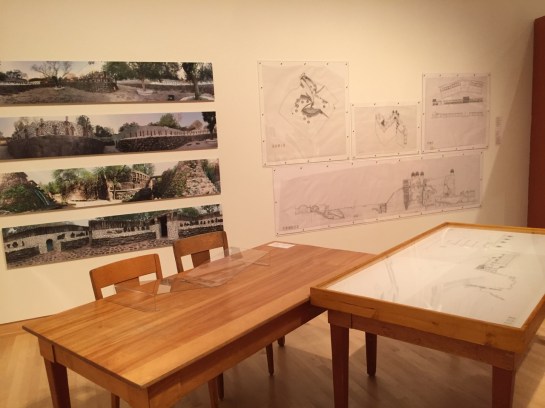
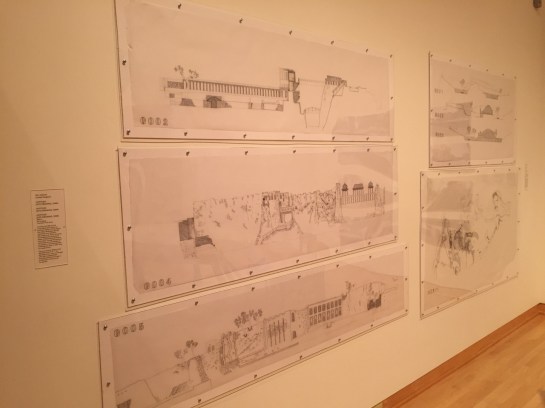
It was also a decade since I completed my PhD research – and I felt it was a good time to revisit my measured drawings and catalogue of the Rock Garden. Karen agreed to exhibit my survey work and I got the catalogue reprinted at A3 size and its 250+ pages hard bound. I really enjoyed ‘re-discovering’ my old work. The survey drawings had been kept rolled up in a plastic tube for ten years, and I carefully extracted the coil of drawings, not knowing in what condition they might be in. Thankfully, they were exactly as I’d left them- tattered at the edges, full of rips, holes and dog-eared corners. I sent them off to the Arts Center, hoping they wouldn’t get lost in the post…
The catalogues of Nek Chand’s work
I arrived at the Arts Centre a few days before the official opening, having seen the CAD drawings of the proposed show, produced by the exhibition designer and co-curator Amy Chaloupka. There’s always a disconnect between an architectural drawing and what it represents – and this was no exception. The scale of the exhibition is vast – and the amount of work required to produce, install and prepare the ‘terrain’ is incredible. One really gets a sense of what it is like to be in the Rock Garden – without there being any sense of pastiche or mimicry. The sculptures are arranged according to type on a series of terraced podiums that sweep through the space, compressing the visitor into a narrow gorge-like passage where the sculptures are densely arranged facing into the walkway. This approach puts the sculptures at eye level and really enables a dialogue to emerge between the viewer and the figures. As well as the concrete sculptures there is a collection of the cloth works – an often overlooked component of Nek Chand’s work – they are again arranged as a group and tightly gathered so that they read as an ensemble of works that need to be walked around, and examined.
An early Nek Chand sculptures, c.1960
Coloured ceramics suggests early edition, but facial features are much later – is it a re-work?
Clinker hair, and brick-dust pigment gives the pinky-brown hue to the skin
In addition to Nek Chand’s sculptures there is an archway reminiscent of the Phase-3 part of the Rock Garden. Contained within this segment of the exhibition are four panoramic photographs, the catalogue and the survey drawings.
Installing the Drawings…
Panoramic photos and drawings. The catalogue sits on the perspex stand.