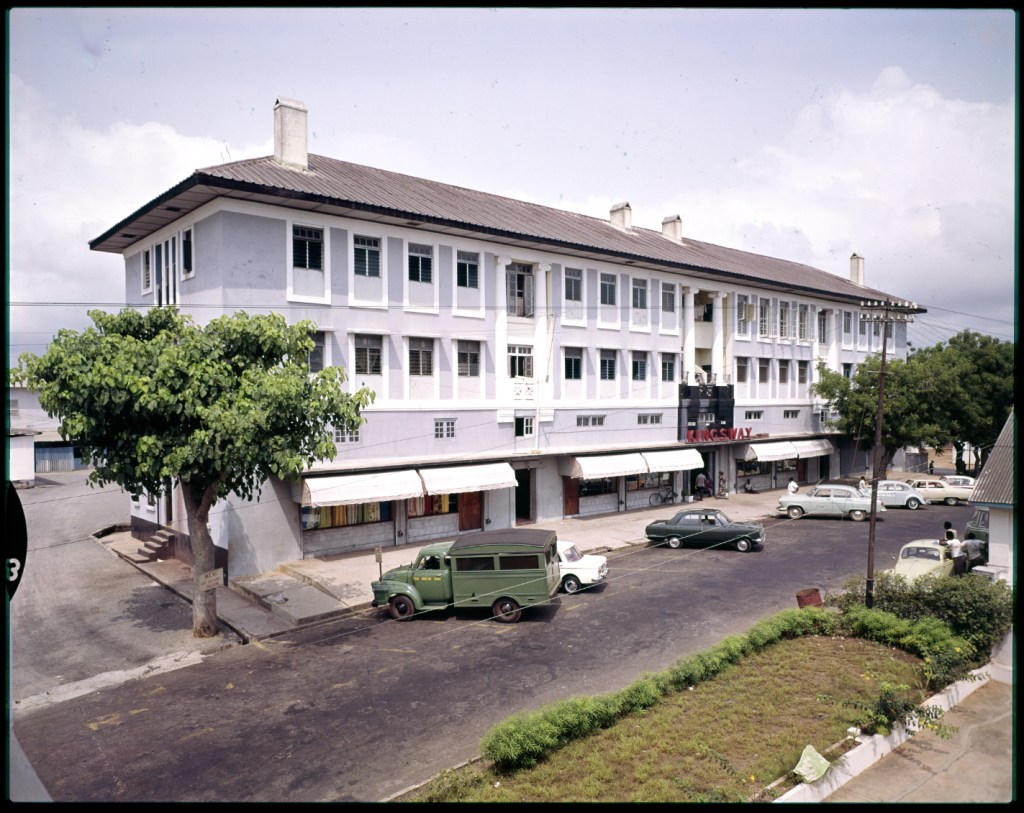
When I was scanning the images for the Kingsway Stores exhibition and recent article, I came across the Takoradi Kingsway in a colour slide. It wasn’t a building I was familiar with and hadn’t seen any other references to it within the wider UAC archive. The design is also different to the other branches – it doesn’t seem to fit with the earlier Millers (old Accra) or F&A Swanzy (Kumasi) stores – nor with the James Lomax-Simpson designs found at neighbouring Sekondi and Cape Coast. The branch at Sekondi complicates things further – why would there be a Kingsway at both Sekondi and Takoradi when they’re so physically close together? The Takoradi branch is also a substantial structure – far larger than might be expected for a town of this scale. Perhaps it was used as a warehouse or depot for the wider enterprise, receiving the imported goods from the neighbouring port that had opened in the 1920s, or was it used as a regional office and retail outlet for the UAC (or one of its predecessors) when the new town and port was set out? The archives include some replanning and refurbishment plans from the 1960s but nothing on the structure’s history and design. The neo-classical facade with ionic columns in antis is also unusual – contrasting with the more moderne 1930s turrets and cantilevered canopies.
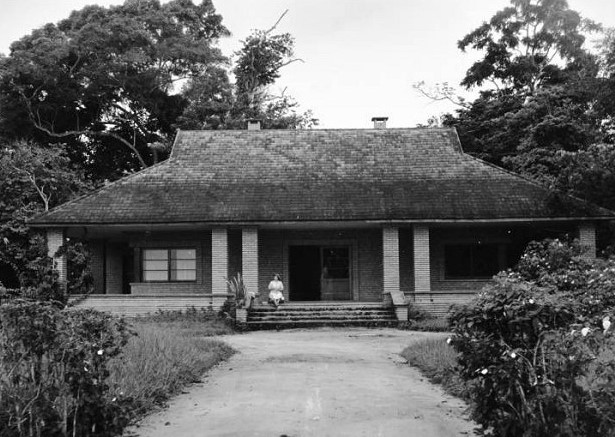
Kingsway Takoradi, Ghana: reproduced from an original in the Unilever Archive UAC/1/11/10/1/10, 1958.
I began to look at the maps of Takoradi to try to locate the structure, but couldn’t find anything on this scale – it was only when I reviewed my photos of the town that I found a contemporary image. The building is still standing and largely unaltered. It’s located amongst the other large European trading properties that were built around the customs house, train station and post office. There’s also shipping offices for Palm Line and Elder Dempster, along with a Barclays bank within this commercial cluster.
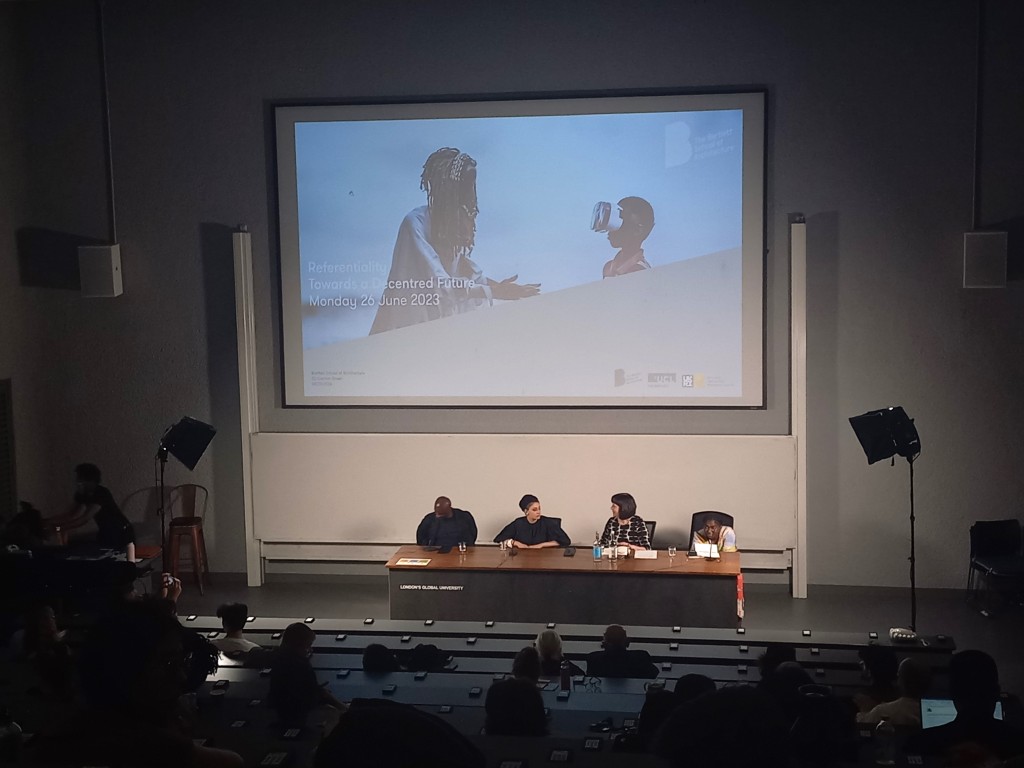
The event interrogated approaches that challenged the mainstream colonial, nationalist and social-cultural frameworks in architecture, art and heritage management scholarship and practice. It included discussions, talks and activities with a diverse range of speakers whose creative production explore approaches free from referential relationship with inequitable power structures.
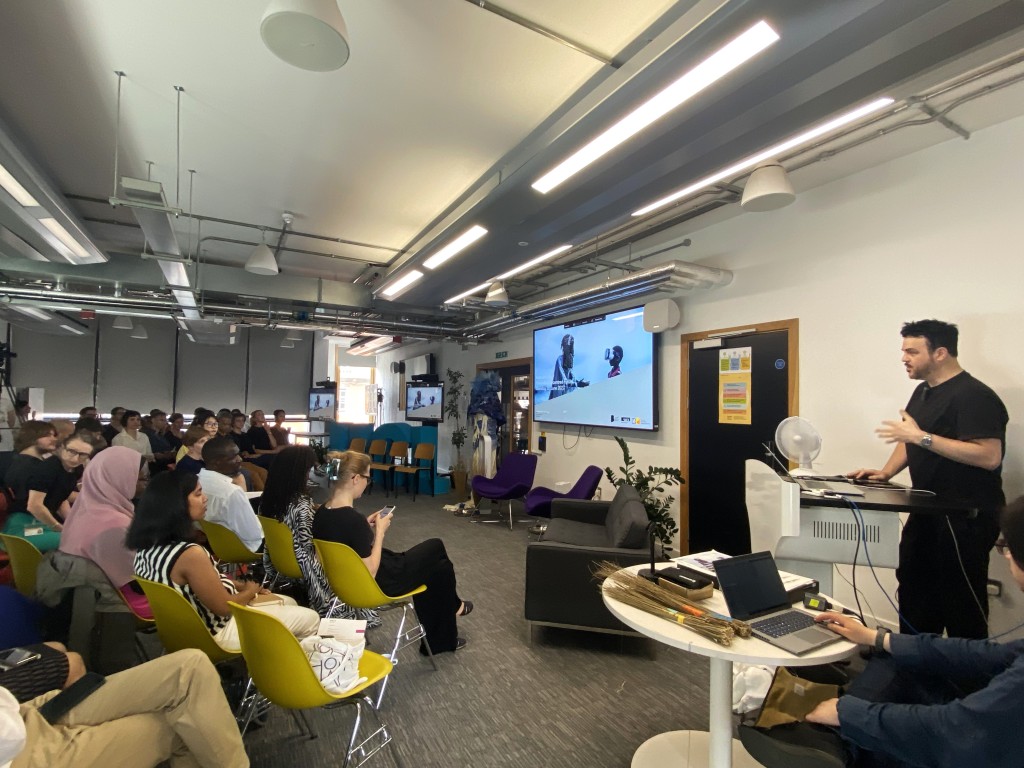
A research conversation moderated by Edward Denison, Ievgenia Gubkina, Emily Mann and Shahid Vawda comprised speakers from multidisciplinary fields of research and practice with case studies from Africa, Asia and Europe. The speakers included Leverhulme Early Career Research Fellow, Dr. Alistair Cartwright and PhD researcher, Adefola Toye – both from Liverpool School of Architecture. Each speaker discussed the limitations they encounter when engaging mainstream sources for scholarship and research-in-practice which erases the agency of populations under study. Furthermore, they shared how they addressed this using participatory action research, public engagement, multidisciplinary methods and utilising crowdsourced open-access archives.
1. Image 1 by Edward Denison
2. Alistair Cartwright Presenting, by Edward Denison
The session concluded with talks from African heritage organizations, including the Direction du Patrimoine Culturel du Sénégal, Swahilipot Hub, and the University of Cape Town. They discussed existing and future initiatives for sustainable and inclusive heritage management on the continent. These included exhibitions, training workshops, public engagement tailored to different age groups and professions, and collaboration with local and global heritage partners.
Afterwards, a student-centered lunchtime activity with architect Sumayya Vally and BSA design tutor Jhono Bennett, explored referentiality in architectural research and practice through co-production and drawings based on the participants insights and experiences.
Image 3 by Adefola Toye
The remainder of the event was spent in conversations with notable speakers in the fields of architecture, art and curatorial practice.
Nana Ocran, founder and Editor of the People’s Stories Project, hosted discussions with multidisciplinary artists Christopher Samuel and Valerie Asiimwe Amani. They explained how their creative works use archives materials to create awareness about the underrepresentation of people with disabilities and colonial subjects.
Performers Peter Brathwaite and Kenneth Olumuyiwa Tharp examine ‘Rediscovering Black Portraiture’s use of domestic material culture to reimagine the historical image of black subjects as well as professional engagement with diverse art and culture foundations in the UK.
The Transnational Architecture Group is 10 year’s old this year. Thank you for supporting the blog and to all of our excellent contributors over the years for enriching the content and generously sharing their work. We’d also like to thank the communities in the places in which we work, the archivists and librarians for making material available to us and sharing their expertise, our respective institutions for supporting our research, and to the research funders who make travel, time, and resources available to us.
The blog started as a means to share our work-in-progress ideas and to promote events – and that is still at the core of what we do. We continue to add updates from our ventures into the archives, travel reports, and to share interesting events and innovative papers. These small reports and updates have compounded into something of a large resource and repository, and we’re delighted so many people have been able to make good use of (and to correct and expand upon) our work and attempts at writing these histories.
To celebrate the 10 year anniversary we held a small gathering at the Liverpool School of Architecture on Wednesday 8th March, curated and organised by Dr Alistair Cartwright. Our speakers were all PhD students, post-doctoral researchers, and research associates at the school. You may watch the proceedings here:
The speakers and titles of the presentations are below, with timings if you’d like to skip to a particular talk:
Rixt Woudstra, “Sapele and Samreboi: Building Company Towns in British West Africa” 5:25
Excy Hansda, “Indigenous Modernities in the Twentieth Century Architecture of Bombay” 20:00
Adefola Toye, “Tropical Modernism in Nigeria’s First Universities: Accessing Sources Beyond the Archives.” 37:00
Ewan Harrison, “Planning for Post/Neo Coloniality: the Paramount Hotel in Freetown” 1:11
Iain Jackson, “Erhabor Emokae and the curious case of the UAC Mural: tropical modernism and decorative arts” 1:31
Daneel Starr, “How and why has the vernacular architecture and intangible cultural heritage of the Akha people changed in the face of globalization: Using the village of A Lu Lao Zhai, Xishuangbanna (sipsongpanna) China, as a case study.” 1:50
Paul Robinson, “Freetown, the UAC and urban design” 2:20
Alistair Cartwright, “Ecologies of Vulnerability: Post-Cyclone Reconstruction in Mauritius, c. 1945” 2:35
We also heard an excellent paper from Razan Simbawa, “The Effects of Demolish-based Urban Regeneration on Displaced Residents in Jeddah, Saudi Arabia” – which cannot be shared on the video recording at the moment.
Thank you again to all of the speakers for their wonderful talks, presentations, and work-in-progress. There was such variety and richness in the topics and methods, and at the same time numerous connections and cross-overs between the work.
Please do get in touch if you’d like to know more, or to share your work on the blog.
An annotated diary of my visit to the Democratic Republic of Congo: a brief stop in Kinshasa before flying to Kisangani and then, following the Congo River, a preliminary exploration of one the regions where the Huileries du Congo Belge – HCB had established its oil palm plantations.
This trip would have not been possible without the help of >>Istituto per la Bioeconomia – CNR and Forets (Formation et Recherche dans le Tshopo) – >>Cifor (Centre for International Forestry Research).
May 2022
Kinshasa — Me and Ottaviano landed in Kinshasa on a Monday morning. I had never crossed the Equator before.
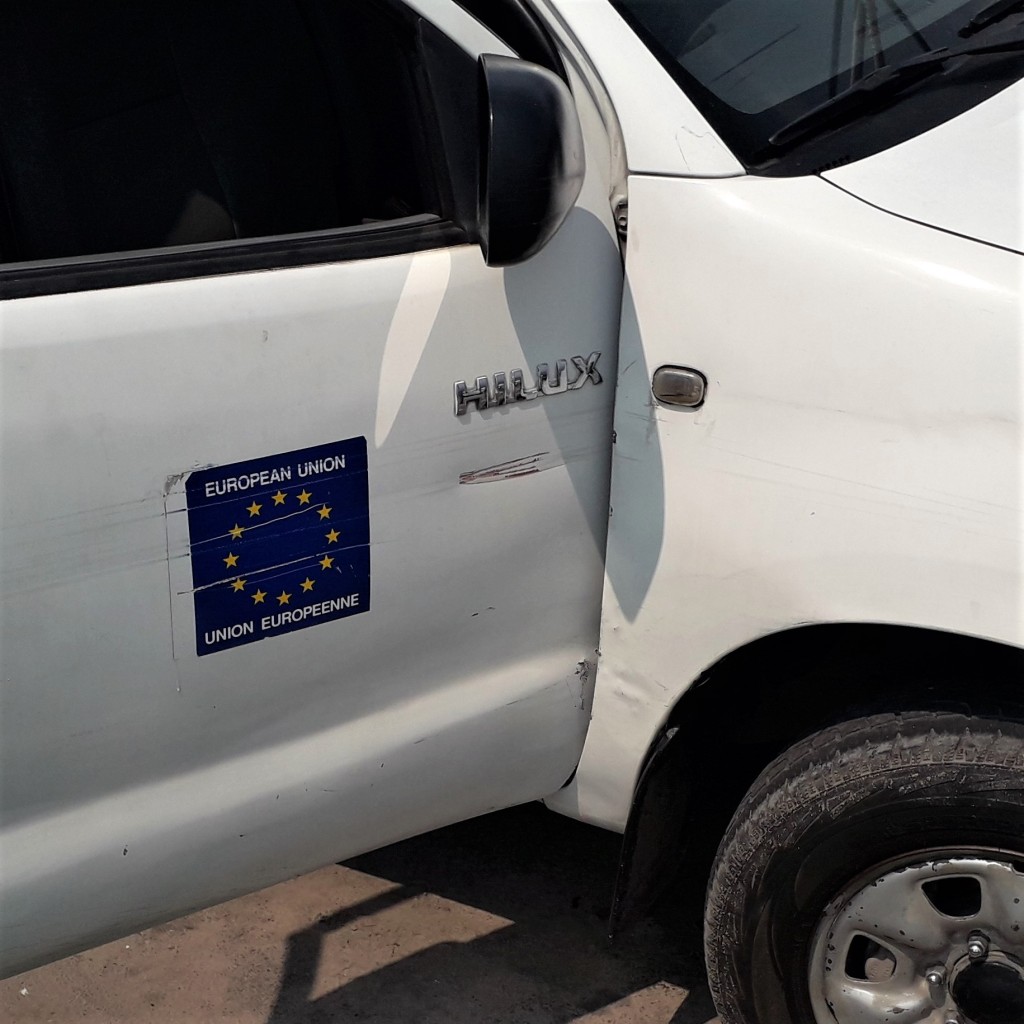
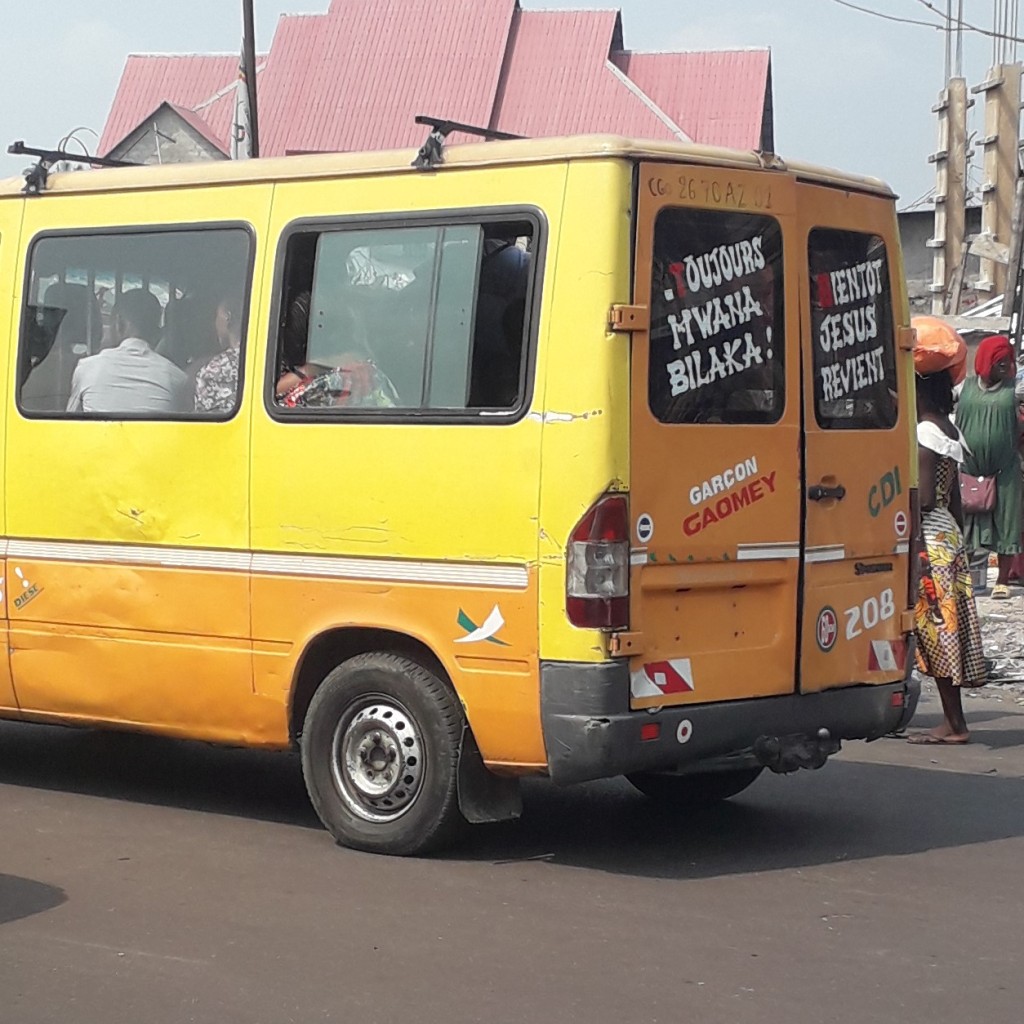
Papa Victor is waiting for us outside on a white Toyota jeep with a EU flag on the door and dents and scratches on all sides. A description that would fit most of the vehicles I travelled in during this trip and, as I came to discover, a stereotype for Westerners in this country. Victor is a tall, pleasant man who talk and laugh quietly even when we plunge into the suffocating traffic of Kinshasa. The 25 kilometers between the airport and my hotel in Gombe are an endless sequence of taxis, yellow Wokswagen vans running with the doors open to bring some air to the passengers squeezed inside, a multitude of weva moto-taxis, and trucks covered in sticky black dust.
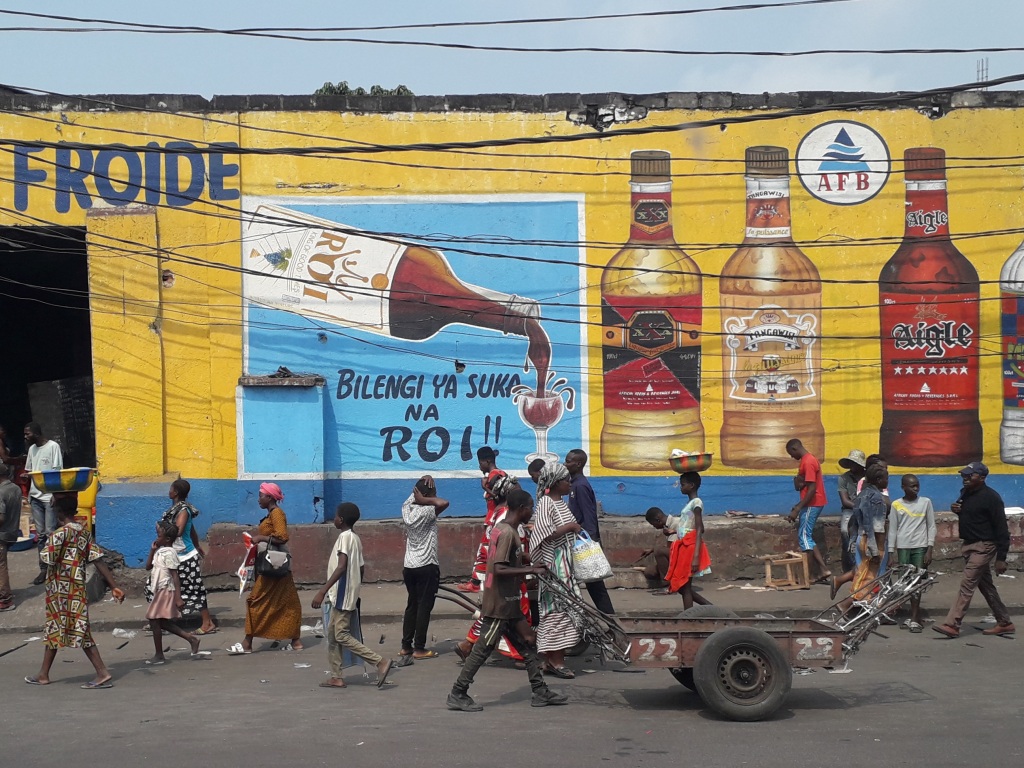
The two days in Kinshasa are chaotic. We meet with some people and don’t see much. I watch street scenes, buildings, and billboards passing by from the window of Victor’s car.
During the last night in the city, I meet my old friends and former colleagues Raphael, Paul, and Pietro – who became a real Kinois in the meanwhile. From the hall of my overpriced hotel Raphael, tells me with his usually sharp irony: “Il faut que tu sors de cette Leopoldville”. And so we drive away, leaving Gombe behind us. Paul, who has a thing for infrastructures, gives us a lecture from behind the wheel of his car while we cross the city. Boulevard du 30 Juin, which originally connected the two Stanley’s times settlements of Kintambo Ngaliema and Nshasha, and later became the first of the large avenues of the colonial capital [>>Kinshasa Then and Now]. Avenue des Huileries, pointing to the area formerly occupied by the Huileries du Congo Belge, now hosting its successor Marsavco.. And then, Matonge, the neighborhooud that everyone here calls the musical capital of the DRC. After having lived for years few hundred meters from Matonge (Brussels) – a product of Congolese diaspora in Belgium – I finally get to see its original counterpart.
It’s early in the morning when we leave again for the airport but the city is well awake.
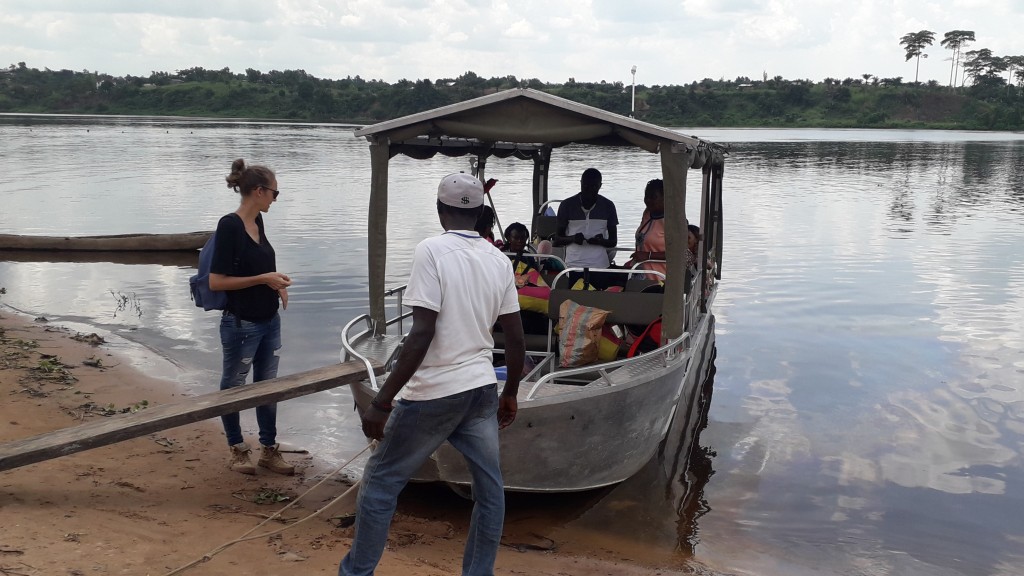
Congo River — After landing in Kisangani we are brought directly to the dock on the Tshopo river. The beach, as docks are locally called borrowing the word from English, is just a sandy stretch where dugout canoes and boats come ashore. We get on board of the canot rapide that Cifor made available for us and, following the Tshopo and Lindi rivers, we finally reach the Congo. Few kilometres upriver, the Wagenia/Boyoma falls, a one-hundred kilometres long sequence of cataracts, make the river impossible to navigate. After the falls, the Congo begins its ‘quiet’ descent of the 1,700 navigable kilometers dividing the place where we are navigating now from Kinshasa’s Pool Malebo before rushing again, through impressive rapids, up to Matadi and to the Ocean.
From this moment on, this broad, magnificient river, with its banks covered in thick vegetation, becomes the silent protagonist of the travel.
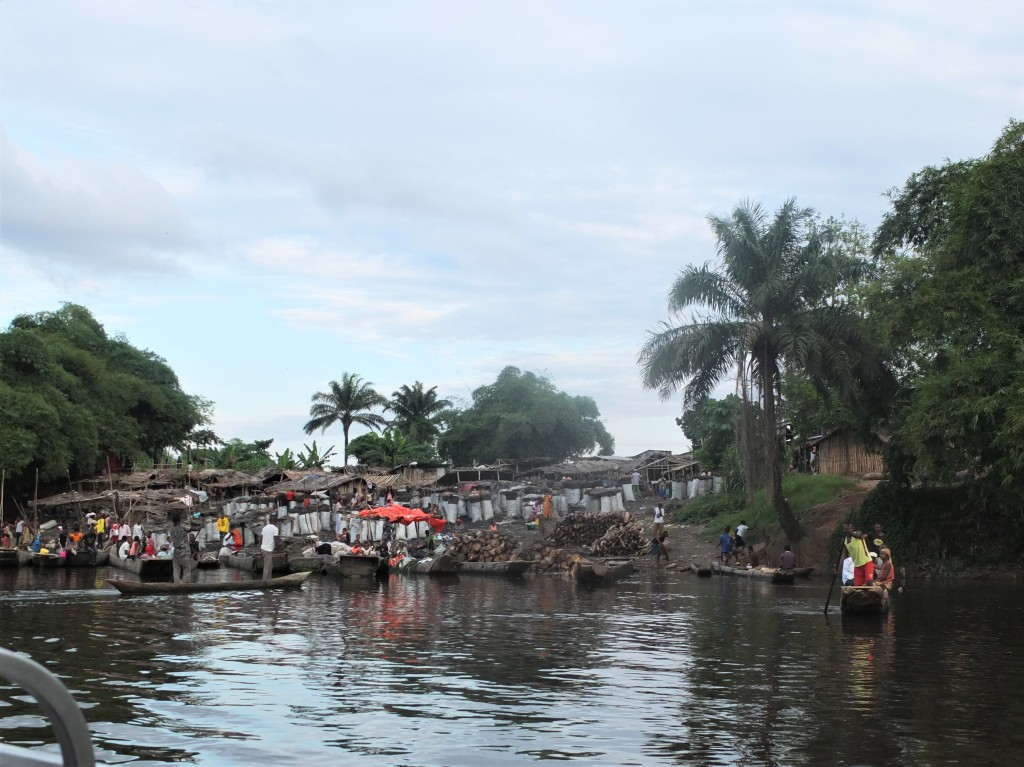
Moving along the river coast, the canot go past busy docks where pirogues – simple boats built by carving a single tree trunk and manouvred by one or two rowers – carry large, white sacks of coal to sell. Apart from our boat and the infrequent barges, the river is populated by these small crafts and by the noisy baleinières (‘whaler’), a wooden boat used for goods transport. Besides being painfully slow, the two half-sunken relics I could spot along the way, testify the scarce reliabilty of these bizarrely named boats.
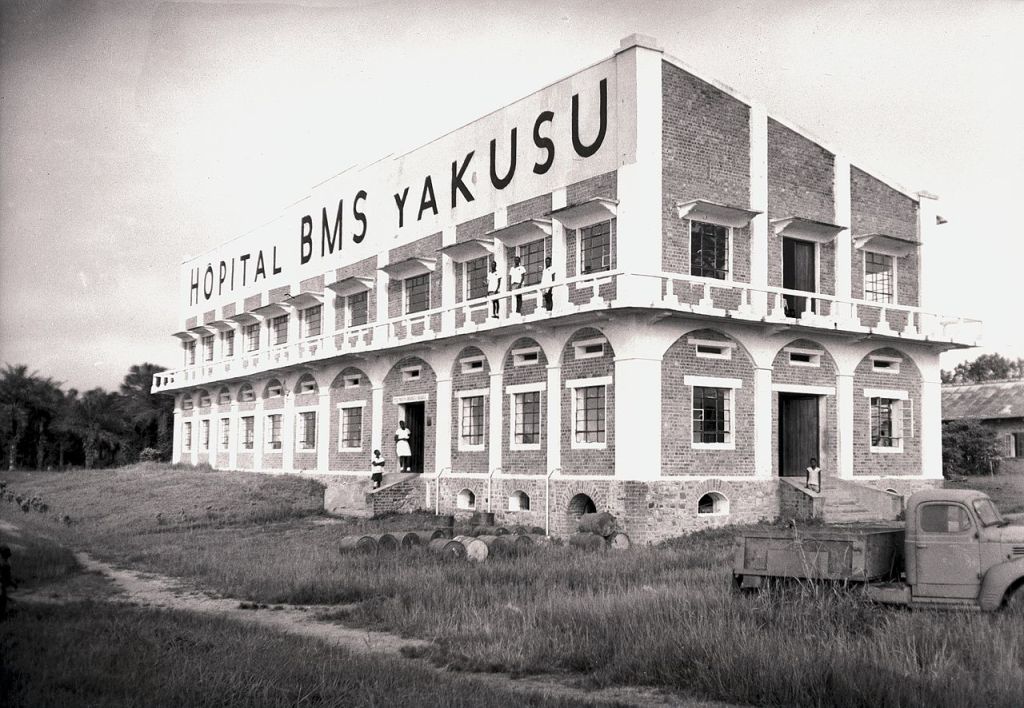
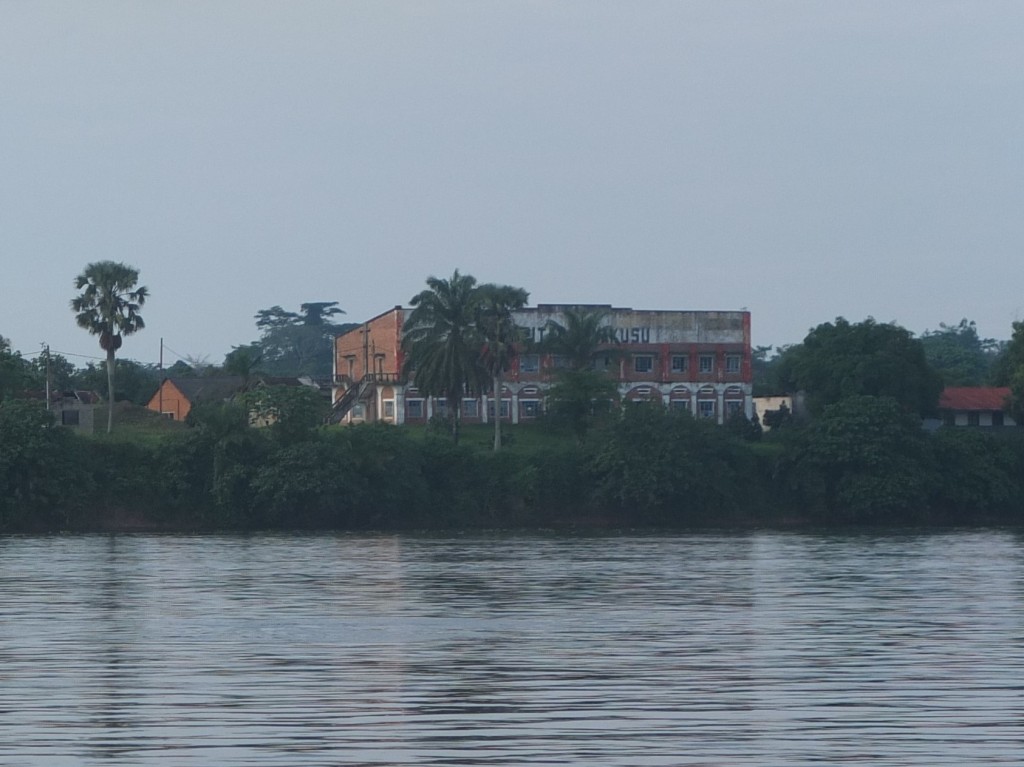
From the canot, on the right bank, flanked by colonial villas, I spot the prominent facade of the Yakusu hospital, a now run-down gem of the Baptist Missionary Society in the Belgian Congo and an important institution for the educational and medical history of the country [Nancy Rose Hunt,>>Colonial lexicon: of birth ritual, medicalization, and mobility in the Congo].
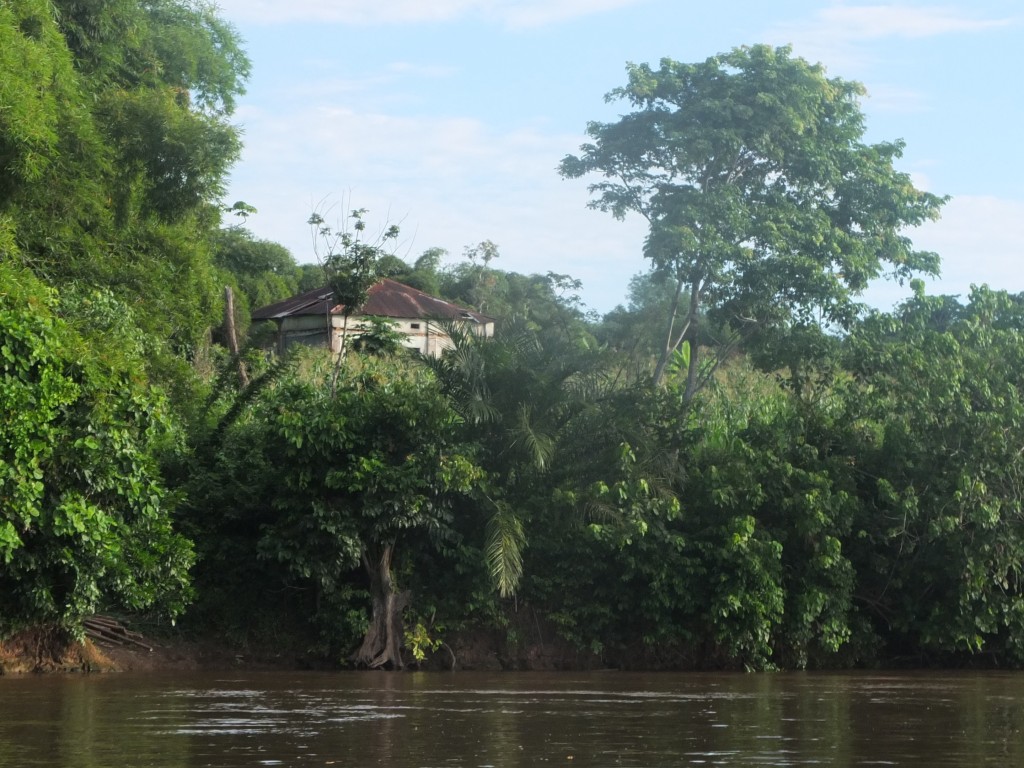
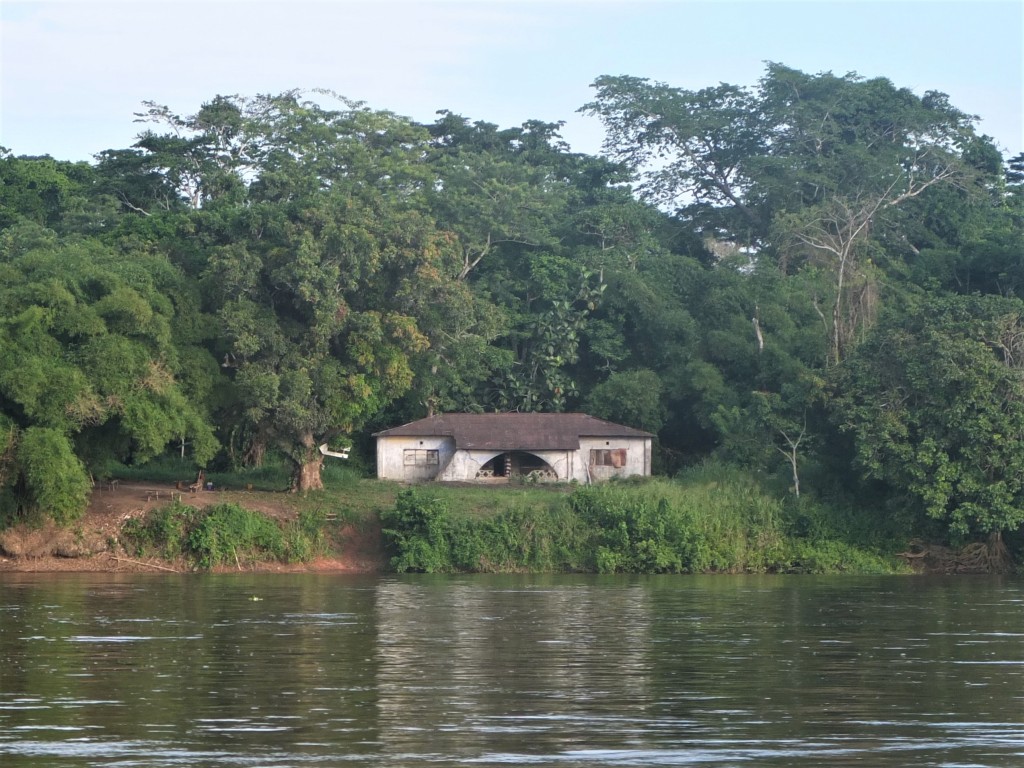
Further down the river, the Belgika, a private island owned by the heirs of a high-rank military chief under Mobutu dictatorship. Our boat speeds close to the coast; the waves agitate the fishermen’s pirogues moving under the branches of leaning trees. The shape of old buildings with porches facing the river vanishes rapidly behind the vegetation. >>During the colonial time, the island was a coffee and rubber plantation owned by the Comptoir Colonial Belgika. The company realised barracks for the workers and villas for the European technicians and now, half a century after it abrupty left the island, those buildings are occupied by the few hundred people still living on the island or are left in disrepair.
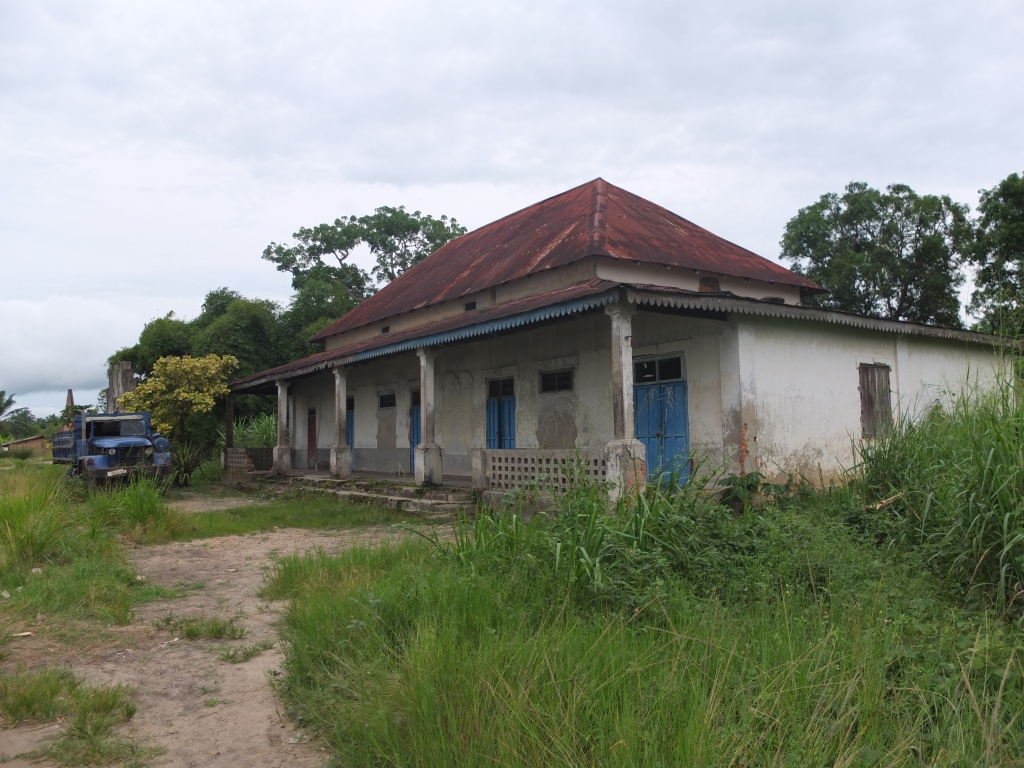
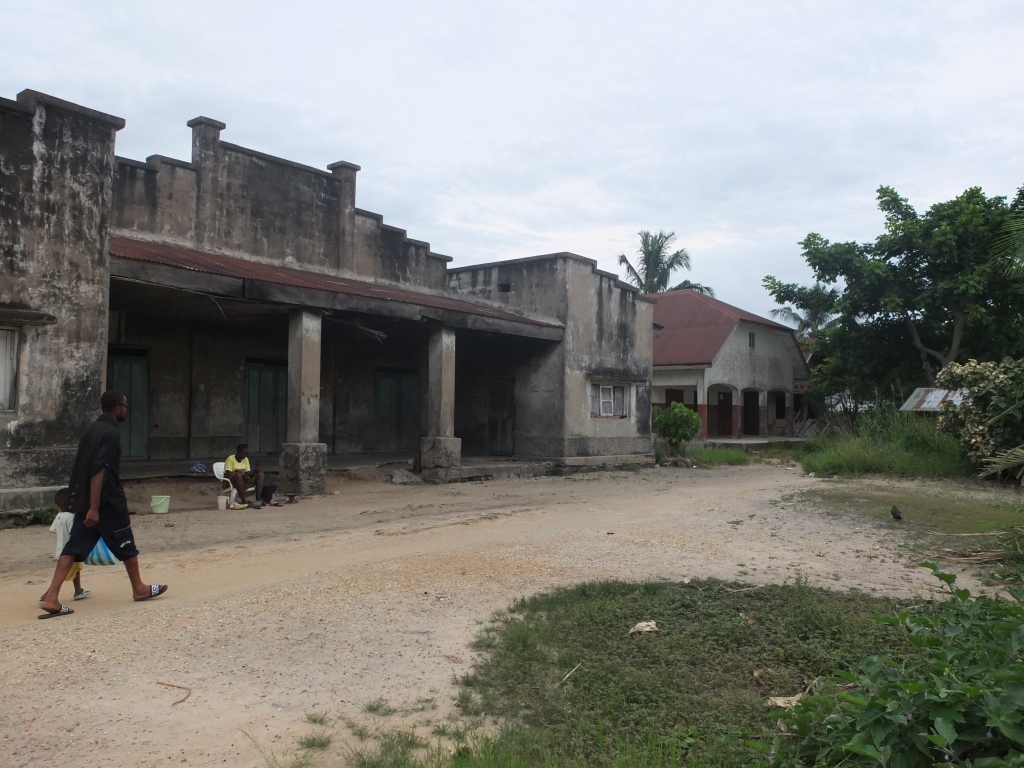
Yanonge — 50 kilometers downriver to Kisangani, we disembark in Yanonge, a small town built around a river dock and its market; a commercial gate to the river for the backland Opala territory and the Turumbu people. Up from the dock, over the steep river banks, I can read dates and names of European firms inscribed on the front of wharehouses now surrounded by the wooden stands of the weekly market. Along the riverfront, the traders’ villas and shops are almost untouched. Guélor, who shows me the place, lives in one of them with his family of five. The rest of the town is made of single-floor brick houses – the construction material coming from the local furnaces – and by simple clay, wood and straw houses. Outside the busy market area and the two main roads, people walk calmly in the shade of the many acacia and palm trees.
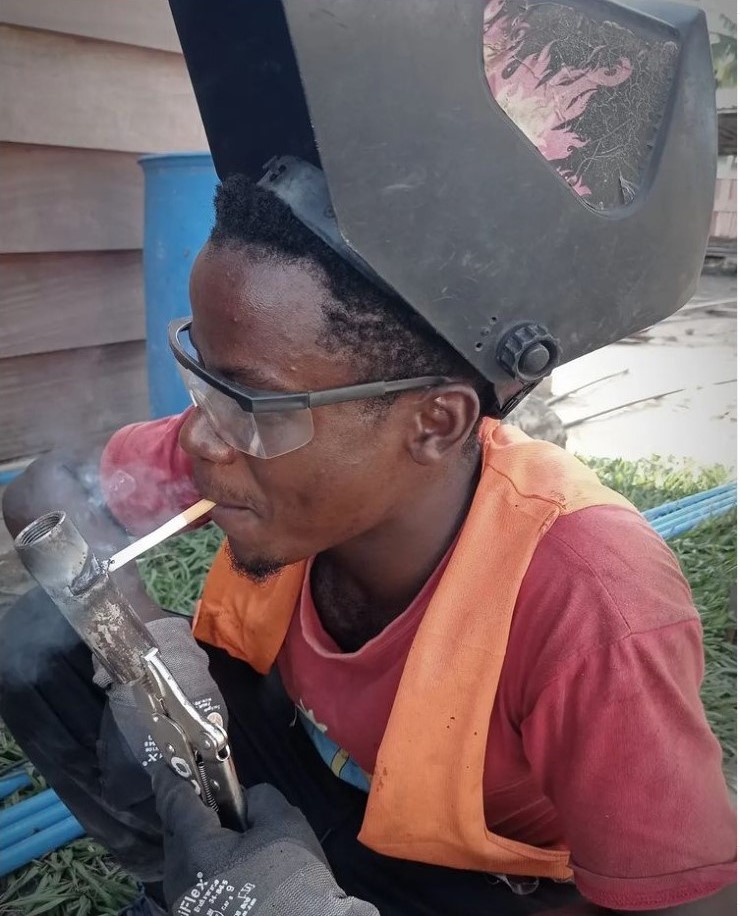
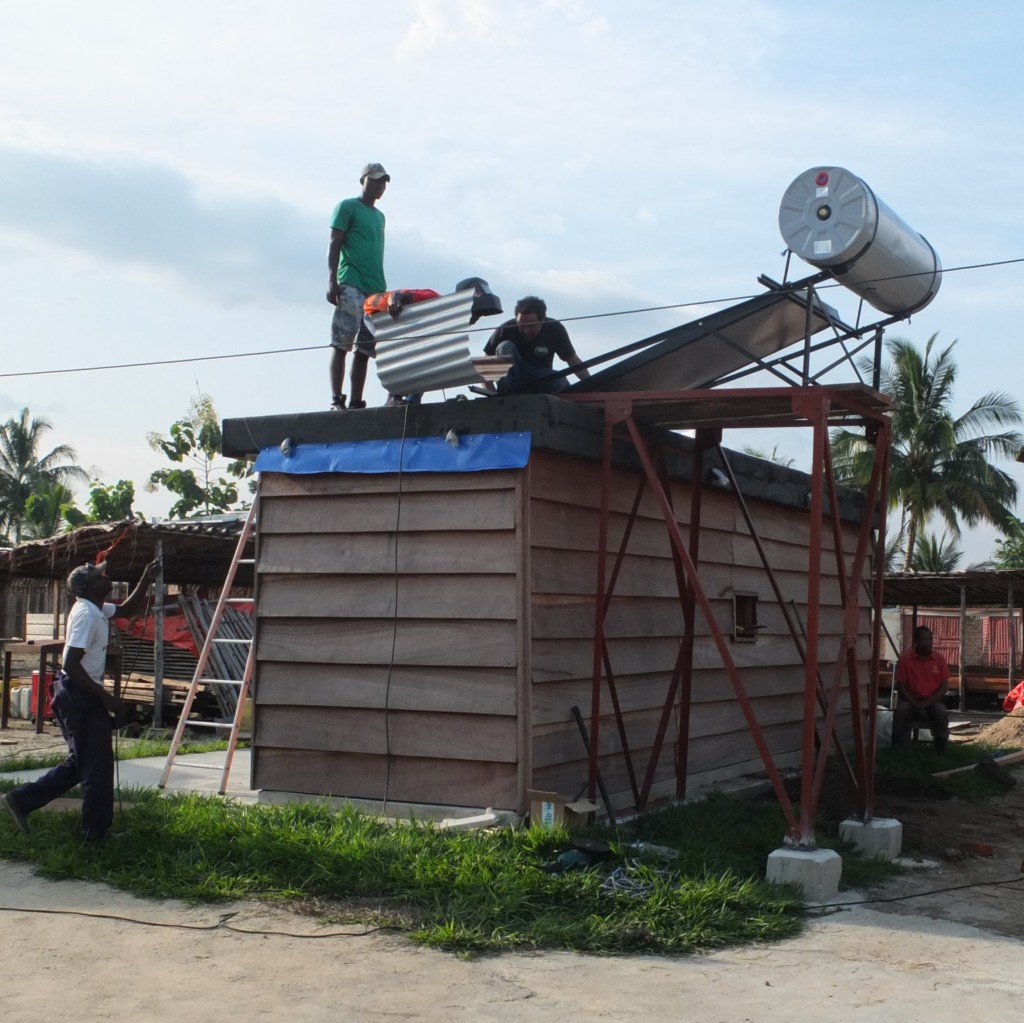
Since few years, Cifor established one of its bases in the town and carries our reforestation, agricultural and local development projects. Silvia, among the many other things, coordinates the construction of a small sawmill. A solar drying kiln is close to completion and an oddly sorted team of Congolese and Italians welds metal, cuts wood boards, make electrical and hydraulic connections, rushing to complete it before our departure. (My contribution to the works is barely symbolic). The aim is to prepare the way for a locally managed, and economically sustainable activity which, allowing to meet the quality standards required for exporting wood, would eventually offer a credible alternative to illegal logging [>>Forets]
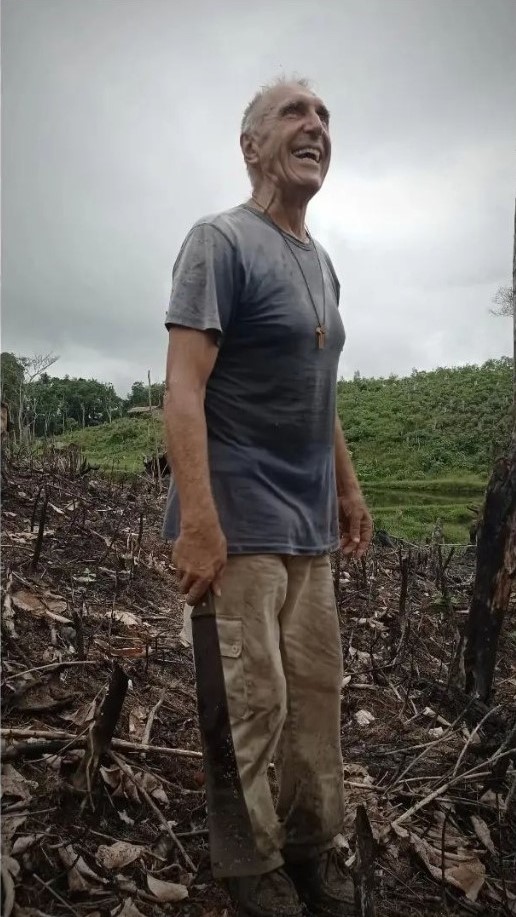
Fabrice lighting a cigarette with a welded piece / Vittorio at work: photos O.A.
During our days in Yanonge we stay at the local Catholic mission. Outside cities, missions often offers one of the few reasonably comfortable accommodations and in Yanonge, the Comboni community also gives the occasion for some peculiar encounters. Our early equatorial evenings are filled by the accounts of Father Vittorio, a truly remarkable character who spent 50 years in the Congolese rainforest, has unlimited energies, and a passion for >>improbable projects. When sitting in front of the usual plate of rice, pondu and tilapia, he starts talking and so I put my recorder on the table. I collect hours and hours of his improvised local history monologues in which he mixes personal memories with the accounts of the people among whom he have lived. “There weren’t many books in the places I have lived – he keeps saying, not without theatricality – but people love to talk to good listeners.”
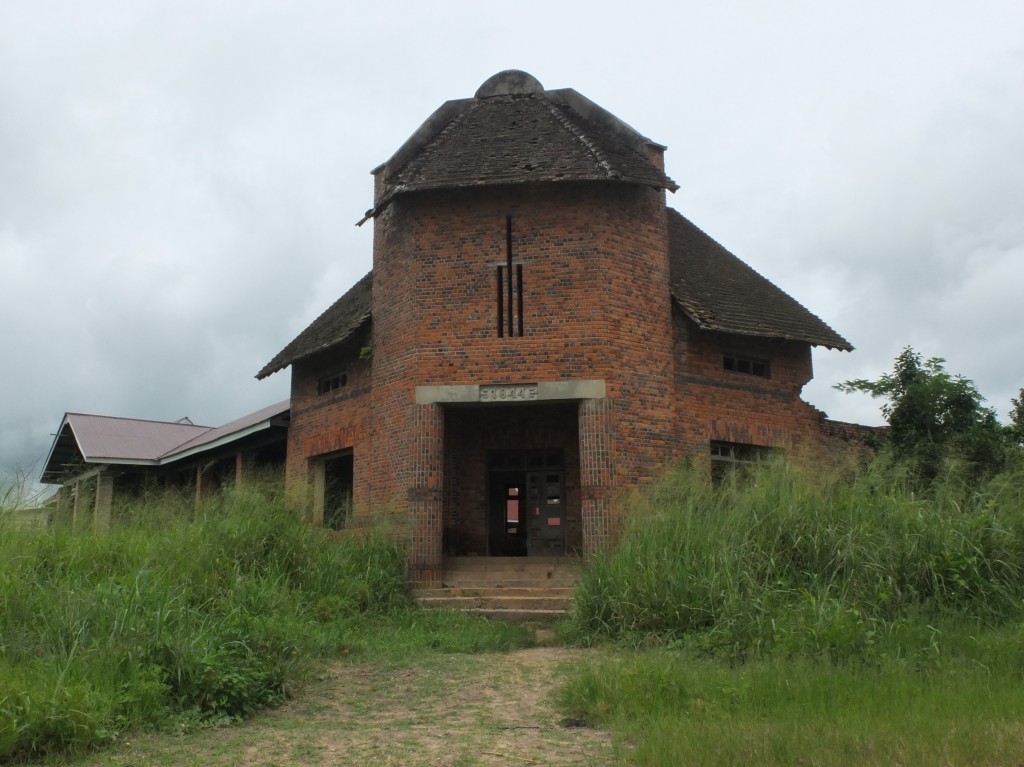
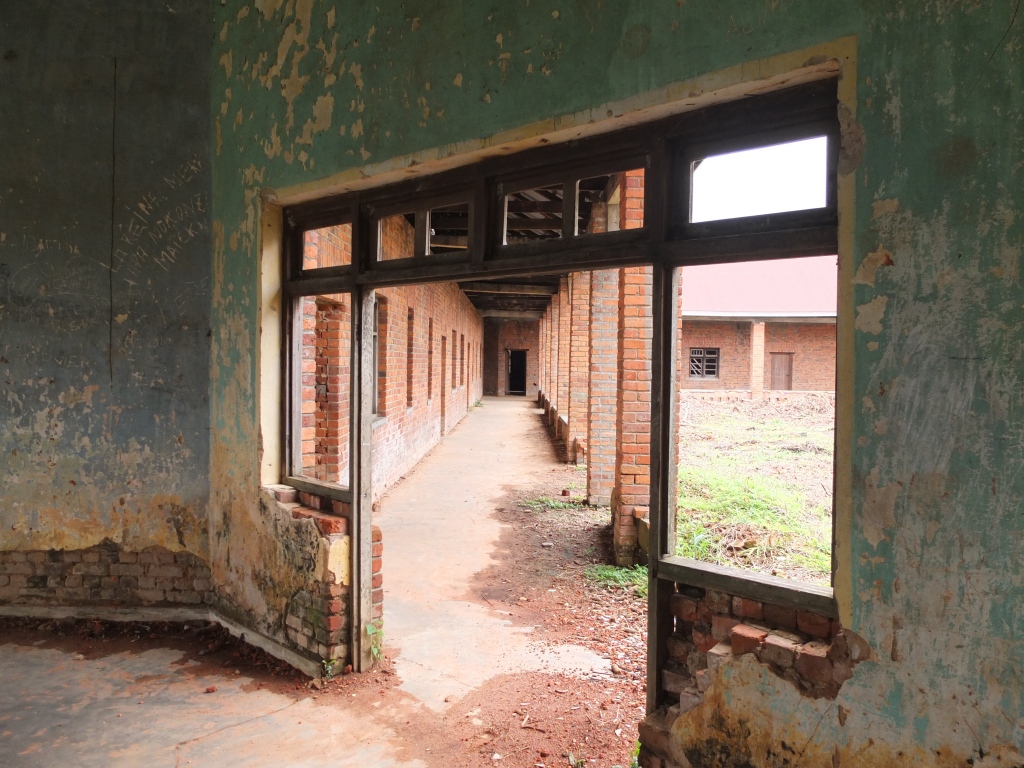
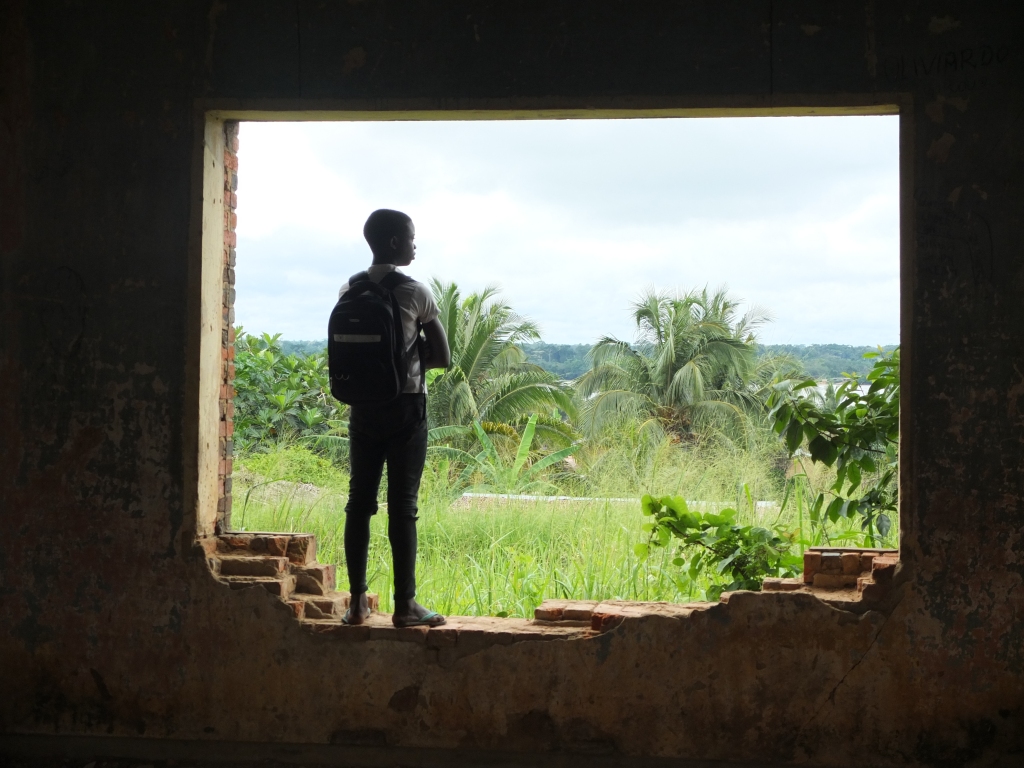
Here, the buildings have stories to tell too. The religious mission was established in the early days of the Belgian Congo and abandoned for decades after the brutal incursion in the convent by the Simba rebels in 1964. The concrete lintel mounted on rounded jambs – a motive that many times I saw in Brussels – at the entrance of what was the mission’s carpentry school is marked with the date ‘1944’. Behind the art-deco facade, a large room covered with an overly complex wooden trusses system. The three wings with porches on both sides form a courtyard and are in ruin. Part of the high-pitched roofs – a large ventilated chamber was originally left on top of classrooms to protect them from the heat – had been replaced; the rest had crumbled. Kids are everywhere, playing among the teetering walls. Our not so credible recommendations to stay away from the crumbling structures are (quite understandably) ignored. The mostly disappeared wood worshop is now a favourite spot for discreet nocturnal encounters and Paolo says that the large wood cutting machine built in Belgium in the 1940s was still bolted to the floor until not so long ago.
Private archive Vittorio Farronato
Next to this complex, the church and the old convent – now used as a school. The convent has a familiar shape that I had never had the chance to look closely before. A single-floor building – despite what the view from the outside may suggest – with a central corridor cutting longitudinally, facade-to-facade, through the building and rooms on both sides. Seen in cross-section, the corridor with openings placed at the ceiling level was meant to extract the hot air through natural ventilation. Next to this group of buildings and most probably coeval, a structure carrying a sign MATERNITE’ and two groups of identical brick houses which once hosted the school’s teachers.
The few days I planned on staying in this small town became more than a week as I’m stuck in bed, ill. “The full tropical experience” Iain writes me from Liverpool. I missed the boat for my next destination and I look for an alternative.
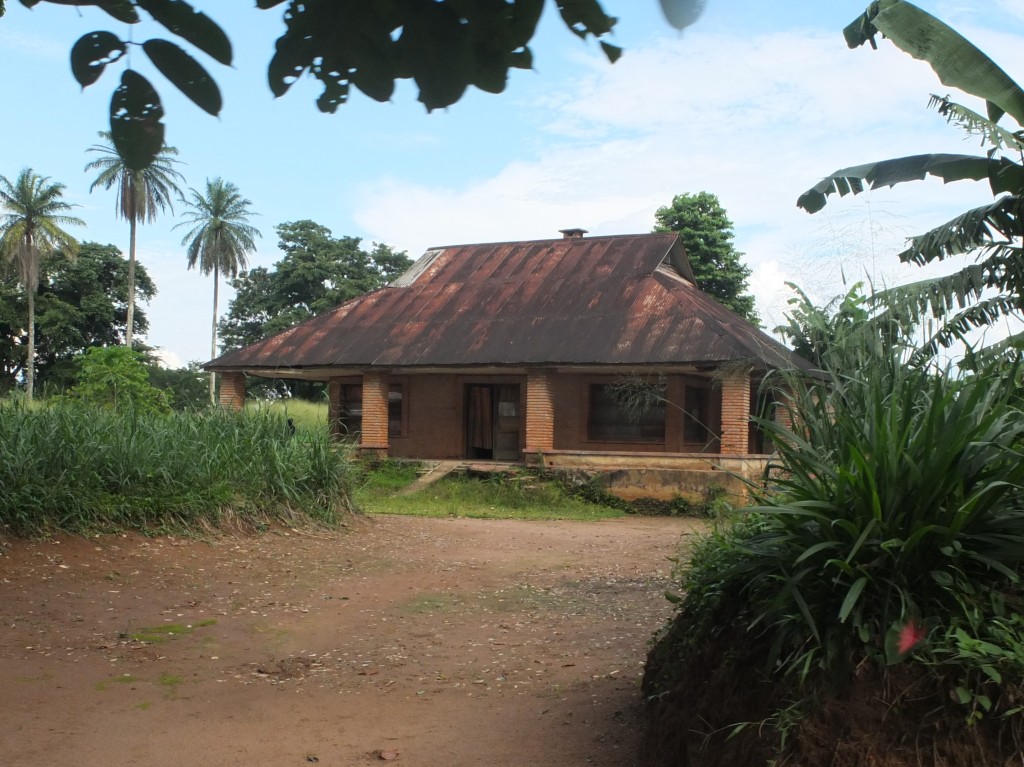
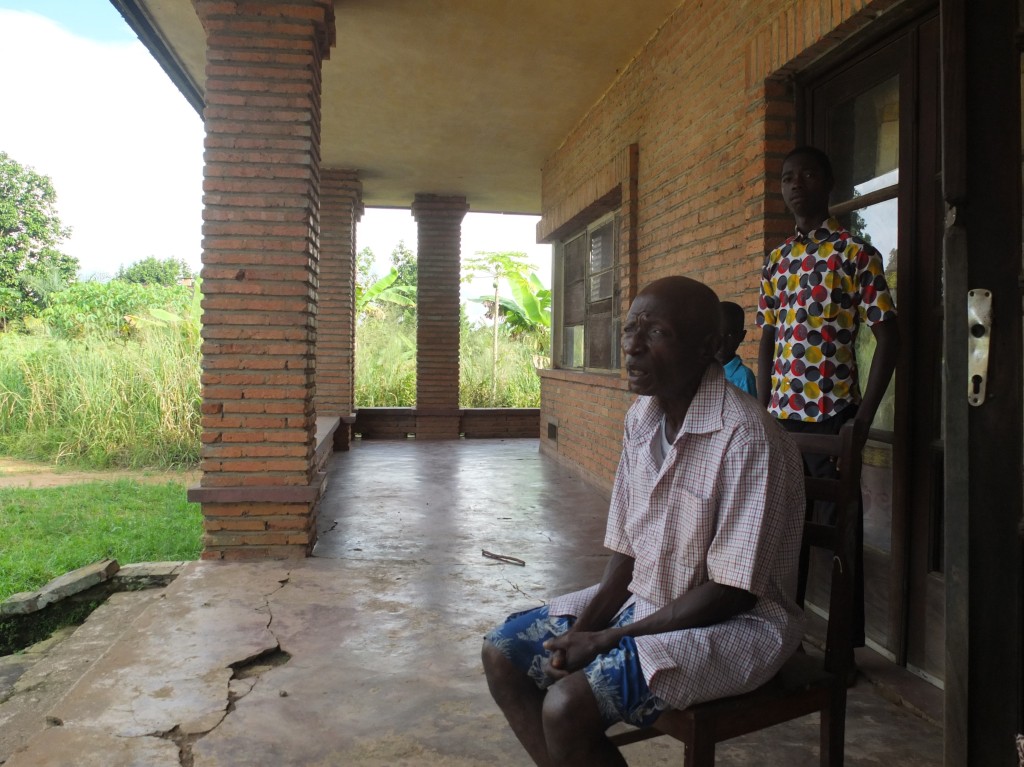
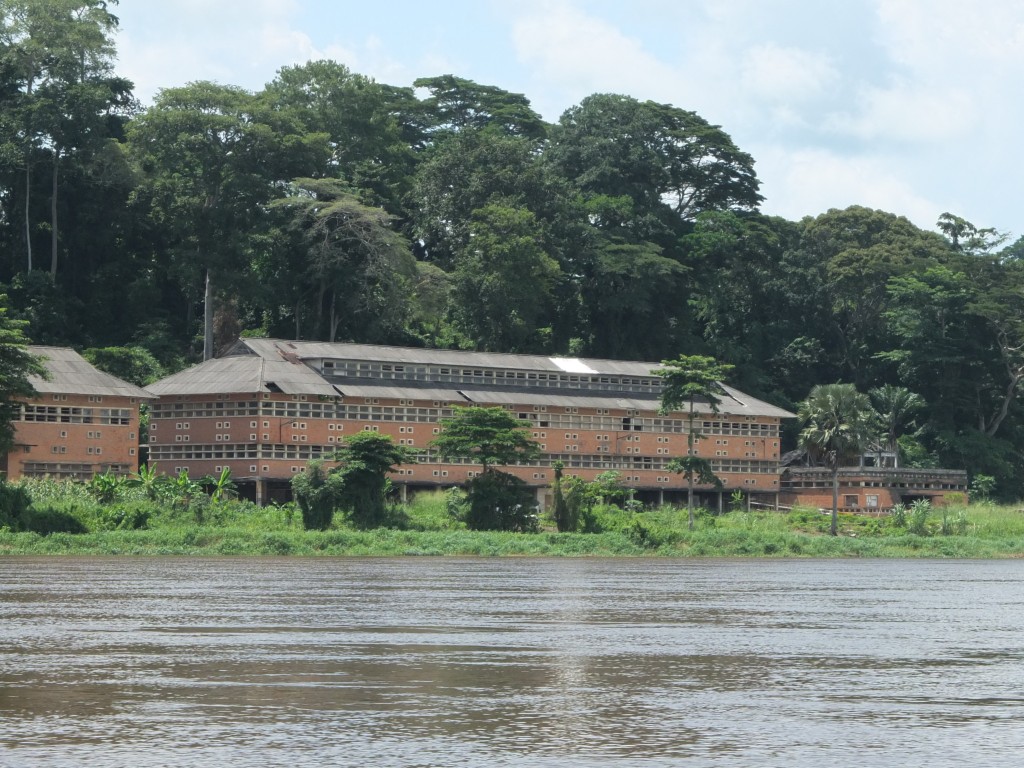
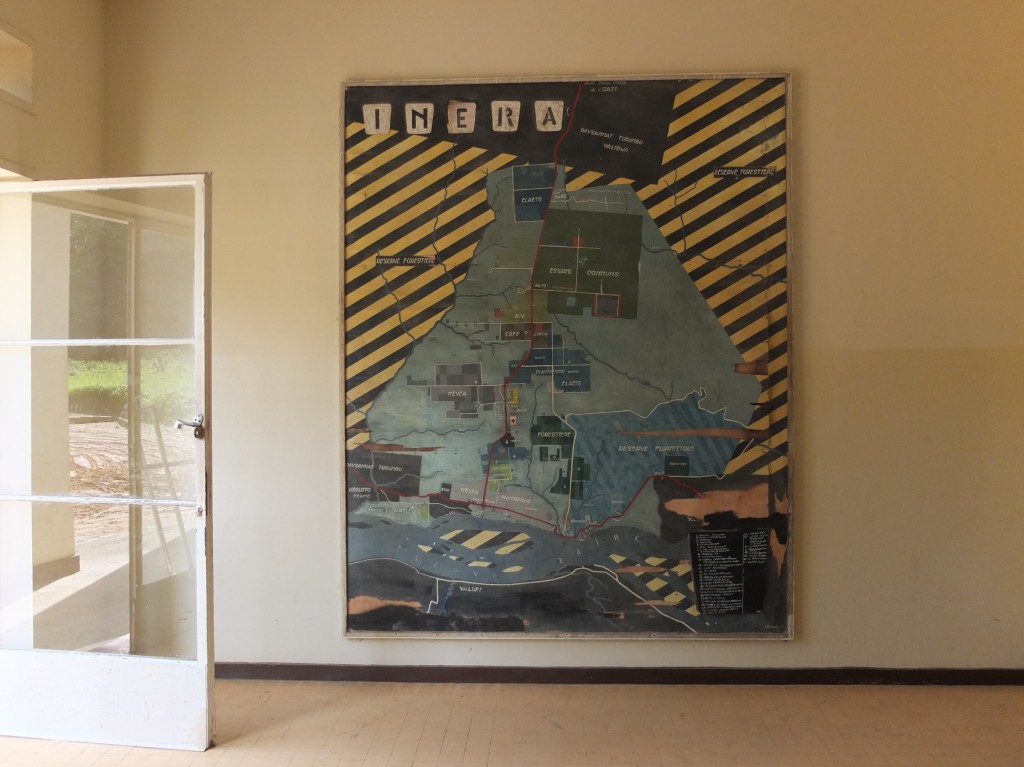
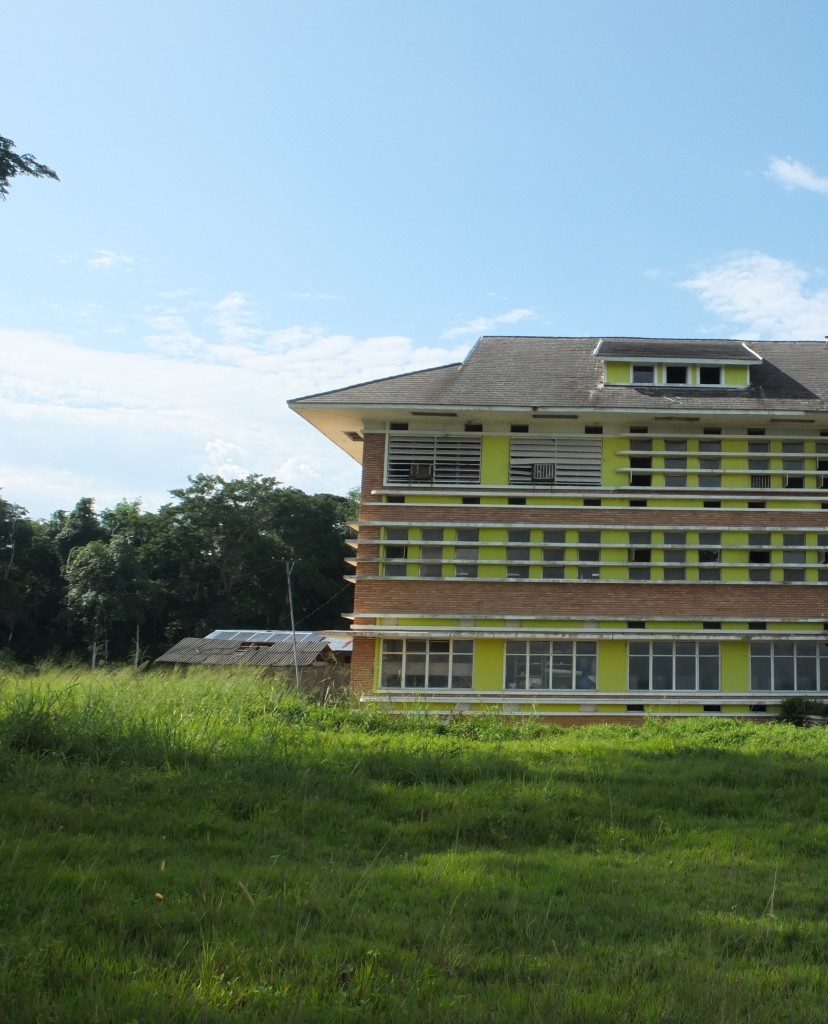
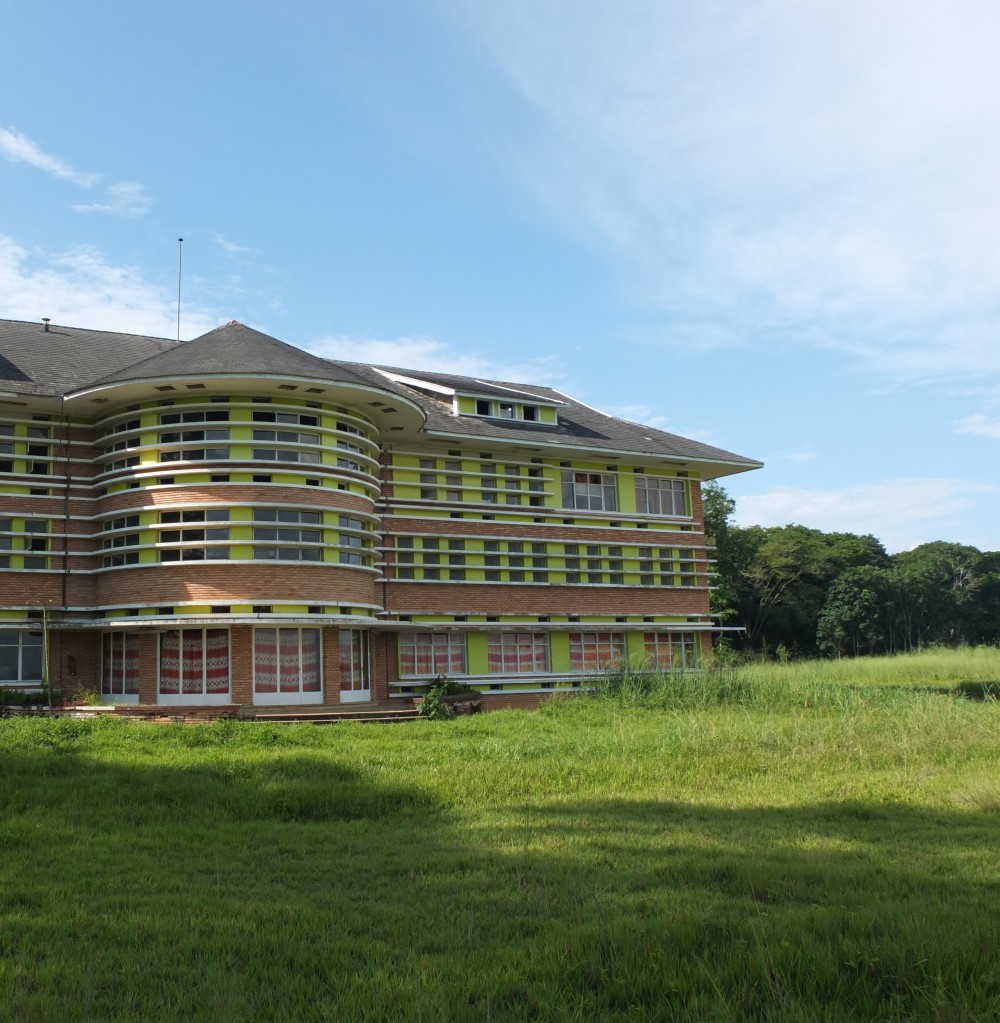
Yangambi — Sitting on the backseat of a motorbike running on a rutted dirt road, the lacking comfort is compensated by the view of riverine villages plunged in the luxuriant vegetation and by the glimpses of open horizon on the Congo river. When approaching the Yangambi reserve, the red brick walls of large villas appears on the side of the road, half concealed by the foliage of large ferns. The 250 villas built between 1933 and 1960 scattered across the reserve once housed the scientists and technicians of what was one of the largest ecological, biological, and agricultural research hubs in Africa, the >>Institut National pour les Etudes Agronomiques du Congo Belge – INEAC, later renamed INERA. The derelict storage tanks and the broken windows of the two large buildings facing the river port are the first visible signs of the now partly lost thriving life of this centre. But some sections of the research hub are >>still active.
During the few days I spend in Yangambi, Dorcas drive me from one section to the other of the reserve The library, inside the recently restored administrative building, has a large collection of magazines and publications dating back both to the colonial and Mobuto’s regimes as well as reports and correspondence documenting the exchanges that the institution had established with private companies such as the Huileries du Congo Belge and Lever Brothers. Even today, the centre carries out agronomic research and provide the germinated seeds of oil palm trees to smaller and larger >> Elaeis plantations in the country. The number of houses, communal facilites, and buildings dedicated to the different research sectors that I could brielfy see from the car or from the photographic albums stored in the library would definetely deserve to be explored with more attention but I’ve run out of time. The boat is waiting.
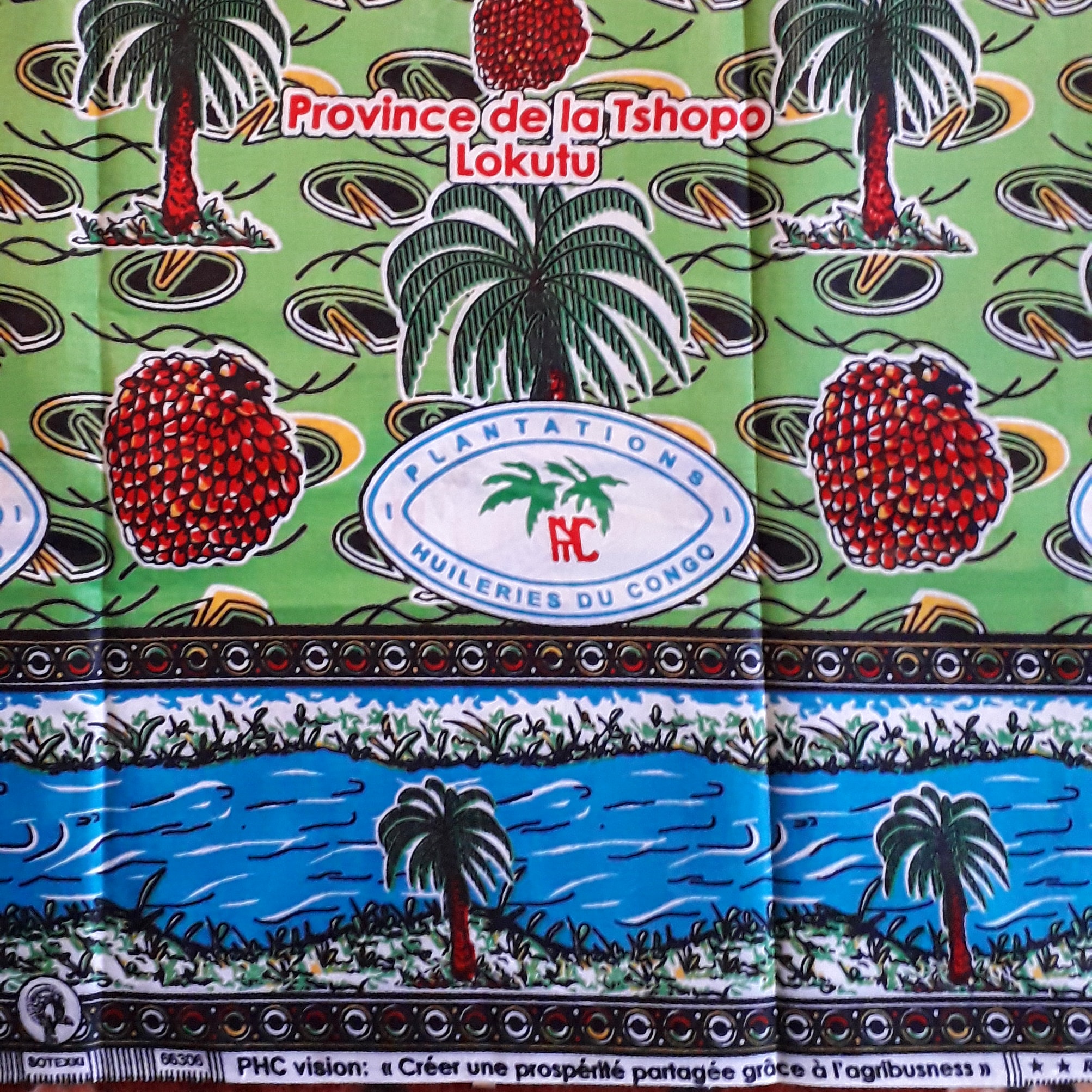
Kisangani — I’m already on the way back to Kinshasa when, during a two days stop in Kisangani that allows for a quick visit to the city, I find a piece of wax print fabric depicting the destination of my next trip to the DRC. In a small shop, one of the last selling locally produced Congolese wax fabric, among the most bizarelly decorated pieces of cloths, one is dedicated to the >>Plantation et Huileries du Congo, the company owning three of the former HCB plantation. Over a green background, the same palm tree and red oil palm bunch is repeated over and over. At the bottom, a sketched and colourful representation of the Congo River and its green banks along with some particularly >>optimistic mottoes of the company.
I greet the country carrying with me this small trace of the persisting signs of British-Belgian colonial capitalism in Congo. Lokutu (Elisabetha), Bumba (Alberta), and Lusanga (Leverville), three of the five company towns built by the Huileries du Congo Belge will be the subject of my next fieldwork in the coming months.
During this international conference, a series of scholars from different disciplines (history, anthropology, political science, architecture,..) and backgrounds will present their (ongoing) research on railways in Africa and engage in a conversation with Anne Wetsi Mpoma and two artists currently in residence in the context of Europalia Arts Festival, Alexandre Kyungu Mwilambwe and Arnaud Makalou. Aymar Nyenyezi Bisoka will start the day with a keynote lecture. Please note that interventions will be in French and/or English, with no simultaneous translation.
We will open a work-in-progress exhibition of work produced by students and staff of the Department of Architecture and Planning of Ghent University on the theme of the railway in Africa, conducted over the last couple of years. Two keynote lectures, one by historian Geert Castryck (University of Leipzig, Germany) and one by digital humanities scholar Chao Tayiana Maina (African Digital Heritage, Kenya) will provide a broader context on the theme. The interventions will be in English.
Eager to secure the provision of raw materials at low cost to its flourishing soap factories in Liverpool, Lever Brothers and the United Africa Company (UAC) acquired land concessions from colonial states across the oil palm belt in West Africa. Beginning from the early 1910s, subsidiaries such as the Huilieries du Congo Belge (HCB, later Huilever and Plantations du Congo), and Pamol, established oil palm plantations in today’s DR Congo, Congo-Brazzaville, Nigeria, Ghana and Sierra Leone.
Plantation workers holding a bunch of fruit of Elaeis Guineensis (African oil palm). Oil is derived from fruit’s outer layer and cracked kernel. The photo was taken near the Alberta plantation in the Belgian Congo, probably in the 1930s or 1940s.Agronomists selected oil palm varieties to maximise the quantity of oil and facilitate the cracking of the kernels.Plan of a plantation on the Benin river in Nigeria showing the subdivision of the planted area in square sectors; the location of the oil mill and wharfs where palm oil was extracted and loaded on boats; and the area where worker houses were built.
Historians such as Jules Marchal lengthily detailed the brutality of Lever Brother’s exploitation especially in the Belgian Congo, the forced resettlement of local population, and the violent repression of “uncooperative workers”. However, this attitude uneasily coexisted with a paternalistic, but probably genuine, hope that plantations would bring “progress and civilisation”. Such hope – Benoit Henriet argues – was compromised by the overriding need to turn a profit but it requires to be analysed beyond oversimplifying narratives of predatory capitalism.
Our initial exploration of the rich UAC archival collection revealed that plantations had been the locus of a wide array of experiments combining agronomic knowledge with political, economic, social, and cultural tools. The plans and photos of worker houses and communal facilities, and the numerous written exchanges on the social aspects of work organisation and the daily life of workers in the plantation shows that architecture played a relevant role in giving tangible form to the company’s largely unfulfilled ambitions to widespread social development.
Diorama showing two HCB oil palm plantations presented at the Ghent Universal and International Exhibition in 1913.“Model houses” for workers in the Brabanta plantation, Belgian Congo.Native dwelling quarters in an unidentified Huilever plantation.Views of worker houses and public facilities in Leverville, Belgian Congo.
While the construction of villages for plantation workers such as Leverville offers the occasion for a critical reflection on the role of architecture in private colonial exploitation, other documents from the UAC archives suggest that plantations had been the testing ground for innovative spatial planning models. Indeed, over the course of the 20th century, changes in plantation management and spatial structure overlapped with the evolution of ideas on social engineering and rural development.
In the 1930s and 1940s for example – as Jonathan Robins highlights – in response to the well grounded critiques on the social and environmental sustainability of plantations in West Africa, UAC proposed plans for a reformulation of plantation organisational system. The model they proposed would later influence policy recommendations given by international organisations such as the World Bank to developing countries across the globe. The experimental plantation model, the Nucleus Estate-Smallholder (NES) model, claimed to combine the virtues of the plantation system of management with the “social attractions” of peasant agriculture. This farming system entailed a spatial structure in which a nucleus, composed of a plantation established on a land concession and managed by UAC, is surrounded by further plantation sectors operated by smallholders.
The extent to which this and other models were successful in improving the living condition of local farmers or rather were functional smokescreens for the perpetuation of colonial or neo-colonial extractivism remains an highly debated topic. Certainly, plantations remains, both at the architectural and territorial scale, a fascinating subject which we will continue to explore in the following months and an opportunity to explore the multiple intersections between development ideologies, colonial and post colonial histories, and architectural and planning knowledges.
–
Henriet, B. (2021) Colonial impotence: virtue and violence in a Congolese Concession (1911-1940), De Gruyter Oldenburg.
Robins, J.E. (2021) Oil palm: a global history, University of North Carolina Press.
Marchal, J. (2008) Lord Leverhulme’s ghosts, Verso. First published in French as (2001) Travail force’ pour l’huile de palme de Lord Leverhulme: l’histoire du Congo 1910-1945, vol.3, Paula Bellings.
For the past months, we have been exploring the vast United Africa Company (UAC) archive held at Unilever in Port Sunlight. The archive documents decades of commercial activity in West Africa, which left a significant imprint on the built and natural environment. The UAC extracted raw materials such as palm oil and timber, but also exported finished goods such as cars, building materials, and refrigerators. The UAC also sold British products in its department stores across Ghana, Nigeria, and Sierra Leone. Meanwhile, it operated its own shipping line, named Palm Line, that ferried goods between the UK and West Africa. We have come across a variety of different materials, ranging from maps documenting the company’s palm oil plantations in the Congo and architectural drawings showing the modern Kingsway stores in Lagos and Freetown, to detailed notes related to the design of the UAC’s port, Burutu, in the Niger Delta.
Tropical hardwood at Sapele, NigeriaAfrican Timber and Plywood Concessions in Ghana, ca. 1955
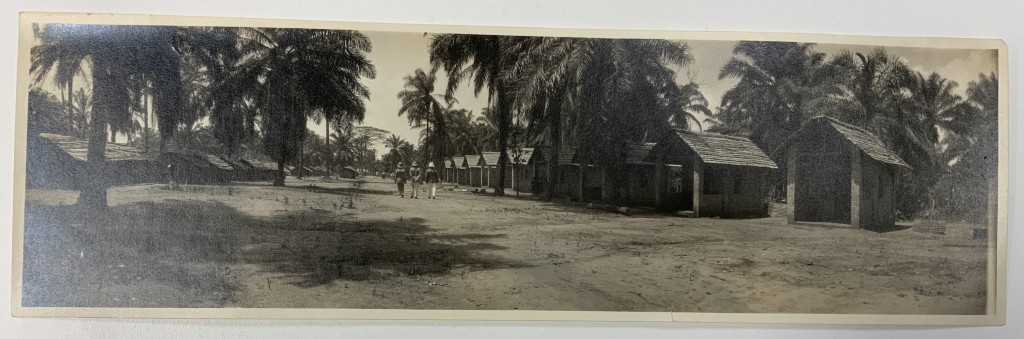
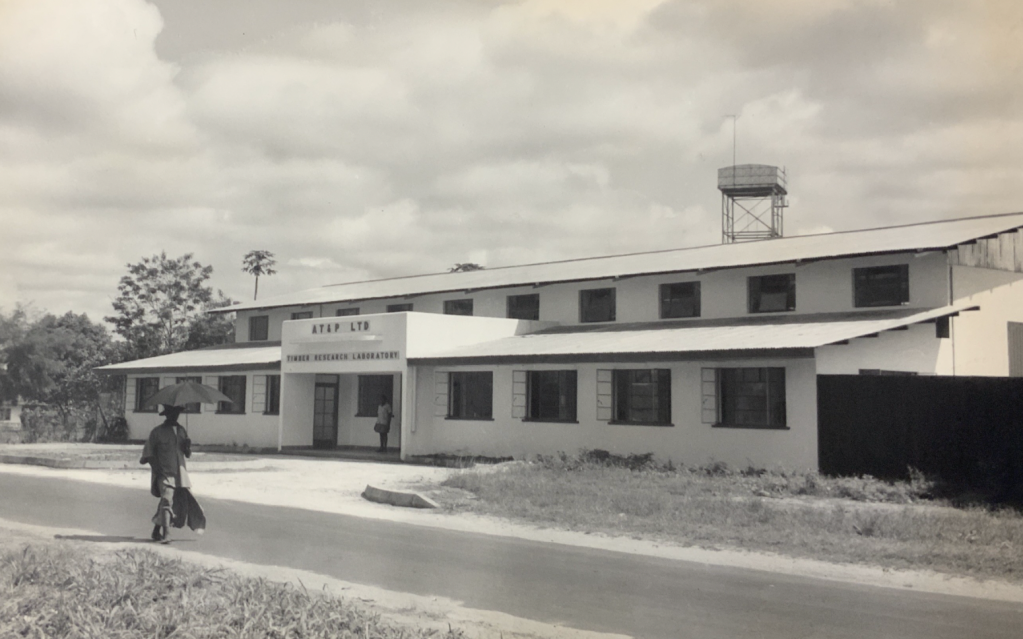
One aspect of the UAC I have been focusing on these past months is the company’s timber operations in Ghana and Nigeria. In the early twentieth century, the UAC founded the African Timber Company (later the African Timber and Plywood Company), located in Sapele, Nigeria. Through a range of concession agreements with local chiefs, they managed to consolidate vast areas of territory around Sapele from which they extracted a wide range of different tropical hardwoods for export to the UK. At the same time, the company began operating in Ghana (then still the Gold Coast), in Samreboi, a hundred miles inland from the port of Takoradi. After World War II, they also built a plywood factory in Sapele—the first of its kind in this area and described as ‘the largest industrial plant in West Africa’—and began producing plywood at a large scale. Using photographs and written documentation, I have begun to explore the construction of these two company towns and their wider infrastructure. While the factories and processing plants were built using prefabricated steel sheds made by Arcon (also responsible for prefabricated houses in the UK during the postwar period), the bungalows for the company’s British employees can be described as traditional. Later, a Timber Research Laboratory was added, as well as showrooms, and several local facilities such as a (plywood) cinema and clubhouse. Through felling hundreds of thousands of logs every year, the company irrevocably left an imprint on these two areas in Ghana and Nigeria and had a devastating impact on the natural environment.
The plywood factory in Sapele, NigeriaSapele, Nigeria, in the 1950sThe Timber Research Laboratory at Sapele, Nigeria
What is interesting is how the work of the African Timber and Plywood Company aligns with the British government’s focus on ‘empire timber’, or the push to use timber in Britain from different parts of the empire for furniture as well as architecture and interior design. While the government attempted to promote empire timber through a variety of exhibitions in the first decades of the twentieth century, the UAC archive reveals how widespread the use of tropical hardwood and plywood produced in Sapele and Samreboi was during the postwar period. Often marketed as giving ‘a feeling of warmth’, it was used for modern furniture made by the Conran Design Group, doors, window frames, and outside paneling for a variety of council housing, but also as interior decoration and flooring in buildings such as the Commonwealth Institute in London and the Commonwealth Royal Pool in Edinburgh. The former headquarters of the UAC in London, United Africa House at Blackfriars, is another case in point: the building’s interior functioned as a display of tropical timber, ranging from mahogany to African walnut and Sapele hardwood—all produced by the company.
Modular furniture designed by the Conran Design Group, made of African walnutDifferent types of tropical hardwood used for the interior of United Africa House, London, 1960s
Another fascinating aspect is the shift to production for the local, West African market in the 1960s and ‘70s, after Independence. Aside from furniture, one innovation was ATP Systems Building, a prefabricated building system using tropical hardwood and plywood. The company promoted this as an affordable, quick, and flexible way to build without requiring much technical knowledge. Documents I found in the archive point out that ATP Systems Building was widely deployed in, for example, Warri, a rapidly growing oil town in Nigeria, to build houses, offices, and schools.
The ATP Showroom in Benin City, Nigeria (originally built for the Lagos Trade Fair of 1962)An ATP employee selling an ATP Systems Building bungalow in Nigeria, ca. 1970
Overall, the archive of the African Timber and Plywood company demonstrates, once again, how (modern) architectural construction in Britain was shaped by colonialism and, conversely, how British companies continued to impact design in the former colonies after independence. Many questions, however, are still unanswered. How, for example, was the work of the timber companies related to the colonial government’s efforts to promote empire timber from Nigeria? How should we understand the widespread use of (colonial) timber in postwar Britain? What prompted the shift to focus on the Nigerian market after Independence? How successful was ATP Systems Building? Over the coming months, we will continue to explore these issues.
From the 1950s to the late 1980s, the politics and economies of foreign aid — instigated by both the ‘capitalist West’ as well as the ‘communist East’ — gave rise to a whole infrastructure destined to assist the progress of ‘developing countries’ on their ‘path to development’. The various North-South exchanges that took place in the name of ‘development’ have left a deep imprint on the geopolitical landscape of postcolonial Africa, Asia, and Latin America.
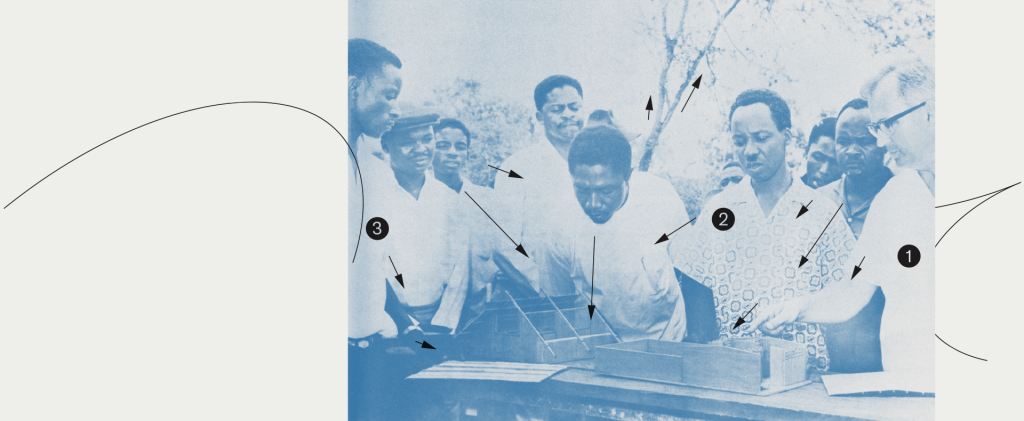
(1) Bertil Melin, the Swedish director of the Nordic Tanganyika Project in Kibaha, showing a model of low-cost housing to (2) President Julius Nyerere, c. 1963-64. To the far left, (3) Mr. Dennis, the carpenter who made the models, co-designed the housing project, and “test-lived“ in the first constructed house with his family. From Torvald Åkesson, ‘Education – In Marble Halls or Under Trees. Low-Cost Houses in East Africa, Especially Ethiopia and Tanzania’, compiled self-published report, c. 1965, Stockholm. Collection KTH Library.
Largely instituted through bilateral relations between individual states, these ‘aid’ initiatives involved not only financial and material resources but also various forms of knowledge and expertise; as such, the modalities of this global, foreign aid-funded infrastructure boosted the creation and reinforcement of all sorts of institutional actors to efficiently exchange knowledge — largely through training courses, educational programs and/or research projects. In the light of widespread rural migration and intensive, rapid urbanization processes, expertise on the built environment was a particularly salient form of knowledge to the aims of foreign aid. Hence, architecture, urbanism and planning were no strangers to an emerging foreign aid-funded knowledge economy — a context in which the production and circulation of knowledge were intimately tied to the political-economic value attributed to them by foreign aid diplomacy.
How did architectural knowledge figure in foreign aid-sourced international relations, and what frameworks were set in place to efficiently exchange that knowledge?
For this two-day symposium, we seek scholarly work that critically analyzes, contextualizes, or theorizes the establishment and functioning of such institutional actors, training courses, educational programs, research centers, and other infrastructures for knowledge exchange that emerged under the aegis of development and targeted ‘Third World’ clients. We welcome a wide range of methodological and creative perspectives as well as less empirical (but well-informed) theoretical approaches that interpret this phenomenon from a postcolonial or decolonizing perspective. We also encourage contributions that scrutinize the intersections of these histories with discussions of gender, race, religion and nationalism.
Tania Sengupta, “Papered spaces: clerical practices, materialities, and spatial cultures of provincial governance in Bengal, Colonial India, 1820s–1860s”, Journal of Architecture, vol 25, issue 2, 2020
British colonial governance in India was built upon global technologies of writing produced through European mercantile colonialism; the extraction of the embodied Mughal administrative knowledge from a Persianette (or Tamil-proficient, as in Southern India) Indian clerical class, and its materialisation into official paper-based forms, as shown by Christopher Bayly; and a scribal-clerical ‘habitus’ as described by Bhavani Raman. This research focuses on the architecture, spaces and material culture associated with the paper-bureaucracy of the colonial government of Bengal that Jon Wilson calls one of the world’s earliest modern states.
It argues that this paper-/ writing-oriented habitus also mandated a chain of materialities and spatialities (paper-records, furniture, spaces, and architectures of colonial governance). Focusing on the colonial cutcherry(office), the nerve-centre of Bengal’s zilla sadar (provincial administrative) towns, I analyse such ‘papered spaces’ as record rooms and clerical offices. The work is conceptualised around paper as a key agent of colonial governance, including the expanding spheres of its logic, which profoundly permeated the cutcherry’s material-spatial culture and experiential ‘lifeworld’. I also reflect on how colonial paper-practices intersected with other more immaterial and mobile circuits of knowledge and information spread over the town and country, and how such paper-governance was fed, for example, by spatial geographies of paper supply and printing. For the research, I combined extensive on-ground documentations of the material fabric of the buildings with archival research (governmental papers, period literature and art) in India, Bangladesh and Britain.
The Coloniality of Infrastructure: Eurafrican Legacies:
Call for Papers – Conference at the University of Basel, 24-26 June 2020
When Eurafrica emerged in the 1920s as an intellectual and political project to connect Europe with Africa, its goal was to ensure European colonial dominance in a changing world. Key to the proposed continental merger was infrastructure—not surprising at a time when railways, ports, camps, and other large-scale building projects were facilitating the extraction and movement of things for Europe while curtailing the freedom and mobility of Africans on an unprecedented scale. Recent scholarship has emphasized the centrality of Eurafrica and the type of colonialism it mustered in the history of European integration, from the EU’s founding intellectuals to its Cold-War-era realization. But continental infrastructure also played a role in African struggles for independence. Highways, ports, and dams became tools of state-building and even mobilized hopes of Panafrican integration and international solidarity. In practice, however, large-scale infrastructure required technical and financial aid which further entrenched Africa’s asymmetrical relationship to the Global North.
Today, as Africa enters a new age of development increasingly dominated by China, and the EU is in fundamental crisis, is it still possible to speak of a Eurafrican present? From the physical imprint of cities and the configuration of intercontinental airline routes, infrastructure testifies to the enduring legacies of Eurafrica. Infrastructure shapes territories and governs the mobilities within and across them, but also serves to immobilize and externalize bodies and things. The European infrastructure of the Mediterranean border regime, in which African migrants are systematically being detained or left to die, recalls colonial-era policies that valued life and dictated death along racial lines. At the same time, European aid focused on infrastructural development in Africa is increasingly targeted to counter such unwanted migration—without touching the global extraction economies that have roots in European colonial rule and continue to shape African cities and territories today. Because of these specters of Eurafrica, the EU seems structurally incapable to come to terms with its colonial past.
This conference proposes to explore historical continuities in Africa’s relationship with Europe through the lens of infrastructure. What are the infrastructural histories that bind the unequal destinies of people together across continents, and how do these legacies shape contemporary lifeworlds and international relations? How does infrastructural violence shape international relations between Africa and Europe, and how is the legacy of Eurafrica manifested in the spaces of everyday life? To answer these questions, the conference invites scholars from urban studies, history, political science, postcolonial theory, architecture, border and migration studies, and allied fields. We invite contributions that develop new perspectives of our geopolitical and interconnected urban present through its infrastructural pasts. Such studies of material and aesthetics relationships between Africa and Europe can focus on questions of lifeworlds, urban transformation, migration, territory, citizenship, development, or related themes. We are particularly interested in studies that can reveal the differential entanglements between people and places, and locate alternative forms of infrastructure, imaginaries of belonging, ongoing struggles for decolonization, and practices of world-making that decenter colonial ways of seeing, feeling, and knowing.
Confirmed Keynote Speakers:
Elizabeth Povinelli (Columbia University)
Siba N’Zatioula Grovogui (Cornell University)
Scientific Committee:
Peo Hansen (Linköping University, Sweden)
Edgar Pieterse (University of Cape Town)
Muriam Haleh Davis (University of California Santa Cruz)
Samia Henni (Cornell University)
Charles Heller (Forensic Oceanography, Geneva)
Anne-Isabelle Richard (University of Leiden)
Bilgin Ayata (University of Basel, Sociology)
Julia Tischler (University of Basel, Centre for African Studies)
Lorena Rizzo (University of Basel, Centre for African Studies)
Madeleine Herren-Oesch (University of Basel, European Global Studies)
Selection of Speakers:
Please submit an abstract of no more than 300 words and a short C.V. by 10 December 2019 to Michelle Killenberger (michelle.killenberger@unibas.ch). Applicants will be notified of acceptance in February 2020. We will cover travel and accommodation expenses for speakers in need of financial assistance.
Conference Organization:
The conference is organized by Kenny Cupers, Urban Studies, Department of Social Science at the University of Basel, in collaboration with Sociology, the Centre for African Studies, and the Institute for European Global Studies, as well as the African Centre for Cities at the University of Cape Town.
Follow-up Conference:
A follow-up conference will take place in collaboration with Prof. Edgar Pieterse at the African Centre for Cities at the University of Cape Town in June 2021. Entitled “Emerging Infrastructural Worlds: Mapping Urban Research in Africa,” this conference will map research approaches to transnational infrastructure projects across Africa and their consequences on the ground.
More information:
This conference is funded by the Swiss National Science Foundation. For more information about the conference and associated research projects, please visit:













 Transnational Architecture Group