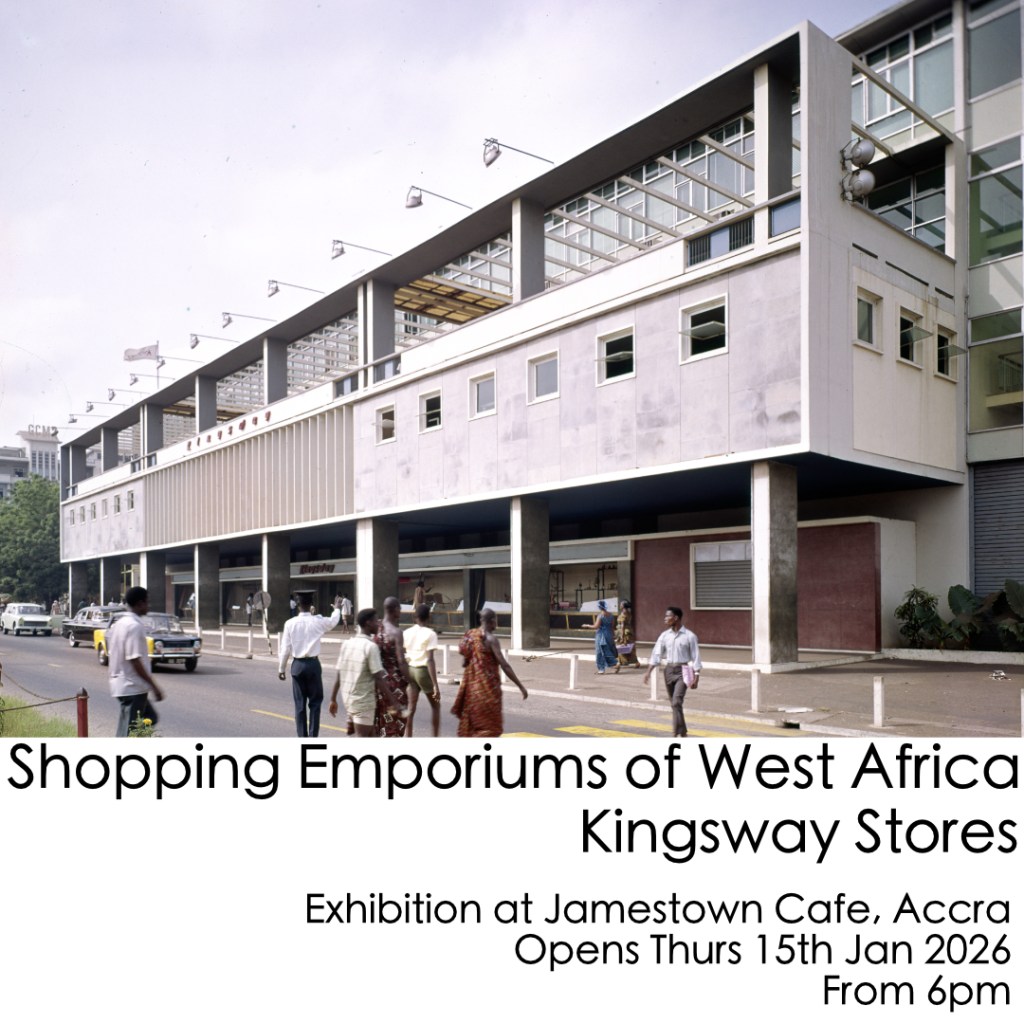
We’ll be setting up the Kingsway Stores exhibition at Jamestown Cafe and Gallery, Accra, this week. The two pavilions have made their way from Liverpool to Ghana and are ready for installation. The opening is on Thursday 15th January from 6pm – all very welcome. We’ll be based at the cafe from Friday 9th – so if you’re in the vicinity please call in. The exhibition will run until Easter and then we’ll tour it to other venues, with details to be confirmed.
During the 1960s, Accra stood at the center of the anticolonial world. As the capital of Ghana—the first independent country in sub-Saharan Africa following European colonization—the city drew revolutionaries, intellectuals, and artists from across the continent and the Cold War divides. Ghana’s first leader, Kwame Nkrumah, envisioned Accra as a showcase of African statehood and invited architects to help shape its future.
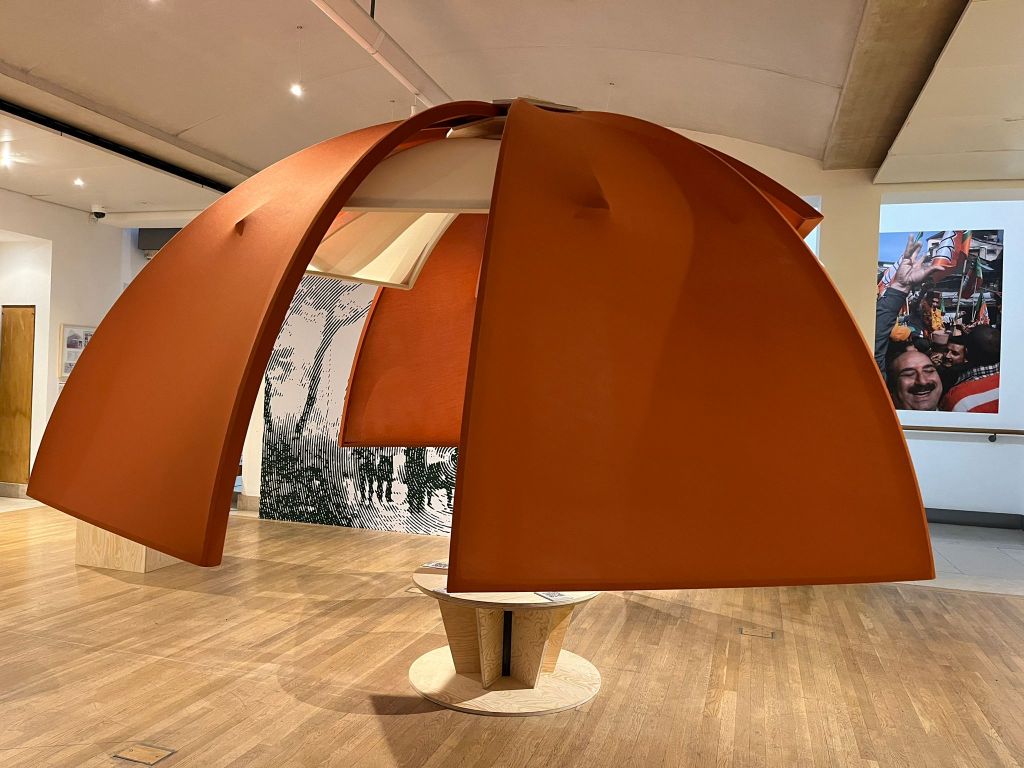
Exhibition Photograph, courtesy of Łukasz Stanek, 2025.
Intersections traces the collaboration of two architects who responded to that call: Ghanaian Victor Adegbite (1925–2014) and Hungarian Charles Polónyi (1928–2002). Polónyi arrived in Accra as part of Eastern European technical assistance programs supporting Ghana’s transition to socialism. He worked for the Ghana National Construction Corporation (GNCC), where Adegbite—a Howard University graduate—served as chief architect. In their work at the GNCC they mobilized architectural resources from the socialist, capitalist, and non-aligned countries and designed buildings that responded to Ghana’s needs, means, and aspirations.
The exhibition centers on the housing projects designed by Adegbite and Polónyi, which embodied the many dimensions of independence—from representing a new elite to the state’s provision of housing for all social groups. By juxtaposing family archives from the United States and Hungary—preserved by the architects’ daughters—the exhibition both reconstructs and reenacts an encounter from sixty years ago. By recording how the buildings designed by Adegbite and Polónyi have been appropriated by their inhabitants, it shows how the architects’ work continues to impact Accra’s urban landscapes.
Curators: Michael Dziwornu and Łukasz Stanek, in collaboration with Dana Salama.
We went to the Exhibition Preview at the V&A on Wednesday 20th February to see the opening of the Tropical Modernism exhibition – a full review is being prepared and we’ll share it shortly (currently under review elsewhere first…) – here’s just a few snaps from the evening…
It was an intriguing exhibition for TAG to visit – not least because most of the exhibits have already featured on this blog over the years. Perhaps the biggest privilege besides viewing all of the material was talking to Michael Hirst and discussing his work at Tema again. Some of Michael’s photographs are in the exhibition too. The first thing that stood out however, was the large queue to get in – it’s not often a private view has a long line outside…
Michael Hirst and his photographs of Tema from the late 1950s
Some of the other highlights include seeing the Buckminster Fuller geodesic dome restored and delicately hung from the ceiling. The last time we saw it was abandoned in the loft of a workshop at KNUST.
Buckminster Fuller Dome: in storage, KumasiDome restored and suspended from ceiling
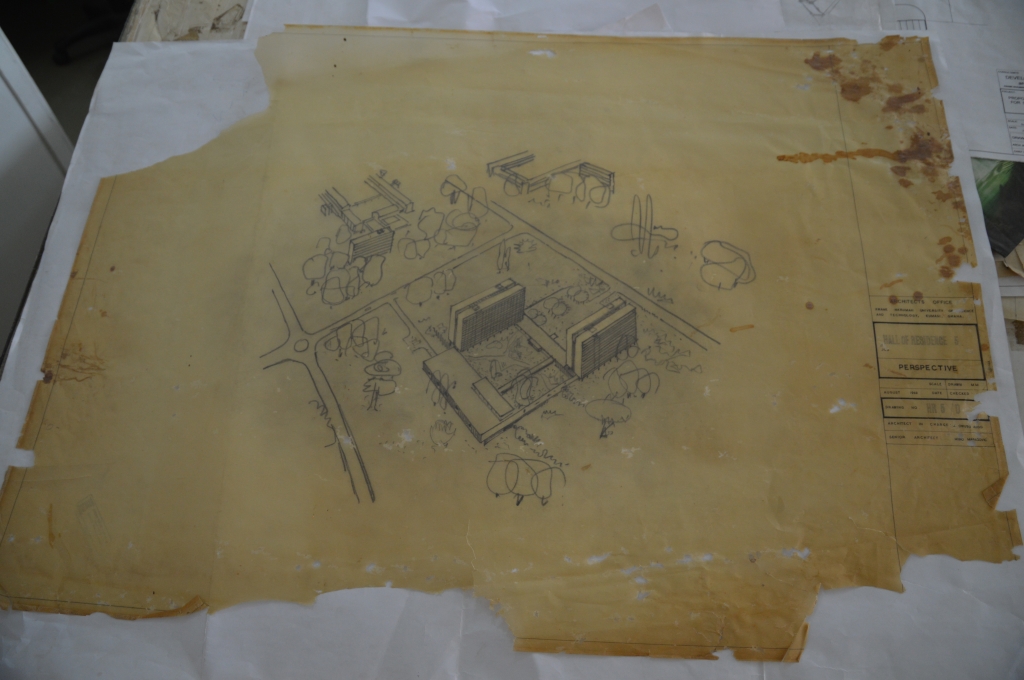
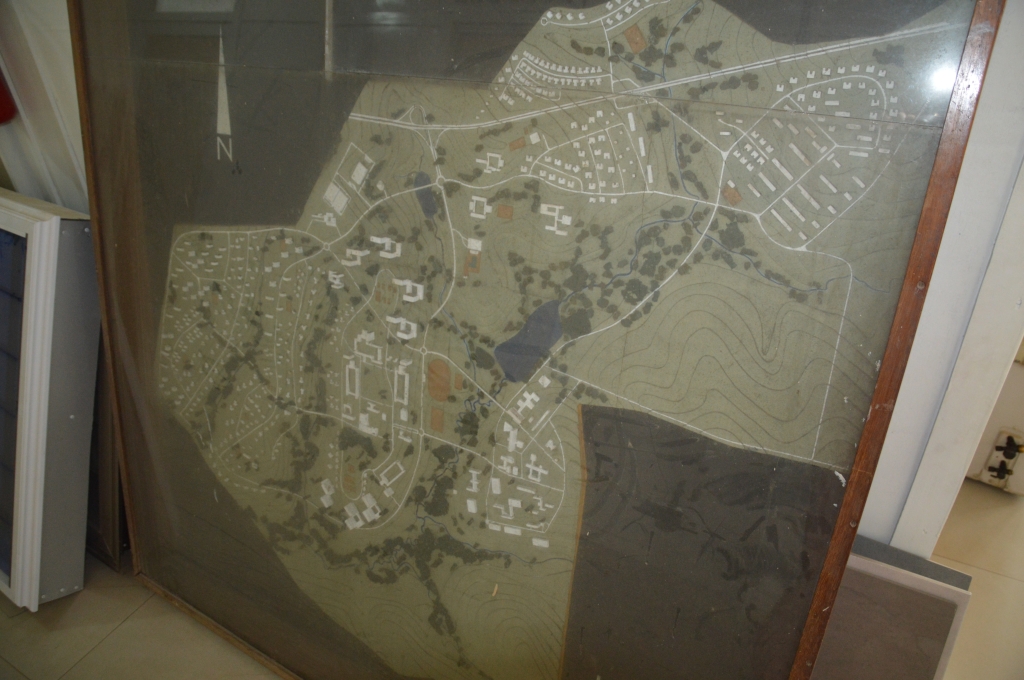
There’s also some delightful perspective drawings by John Owusu Addo in the exhibition and a model of KNUST campus too. It was such a relief to see that these drawings are now being cared for. We produced some digital copies in 2016 and 2018 and hoping the share the full set of the precious drawings here soon.
drawings in the archive at KNUSTModel of the KNUST campusJohn Owusu Addo drawing at the exhibitionRestored model exhibited at the V&A
About TAGOur model of the Accra Community Centre was included alongside several other models, including Giani Rattan Singh’s timber model of Corbusier’s Assembly Building in Chandigarh, and an outstanding model of the Pragati Maidan in Delhi, by architect Raj Rewal (and foolishly demolished in 2017).
Accra Community Centre model, by David Grant and Iain JacksonRattan Singh’s timber model of Corbusier’s Assembly Buildingmodel of the Pragati Maidan in Delhi
It was great to see some of Pierre Jeanneret‘s furniture on display alongside the unexpected inclusion of Nek Chand‘s sculptures. It’s a curious exhibition pulling together a range of projects around Ghana and India, with snippets from Nigeria and elsewhere.
Jeanneret Furniture and Chandigarh sectionSculptures from Nek Chand’s Rock Garden, Chandigarh
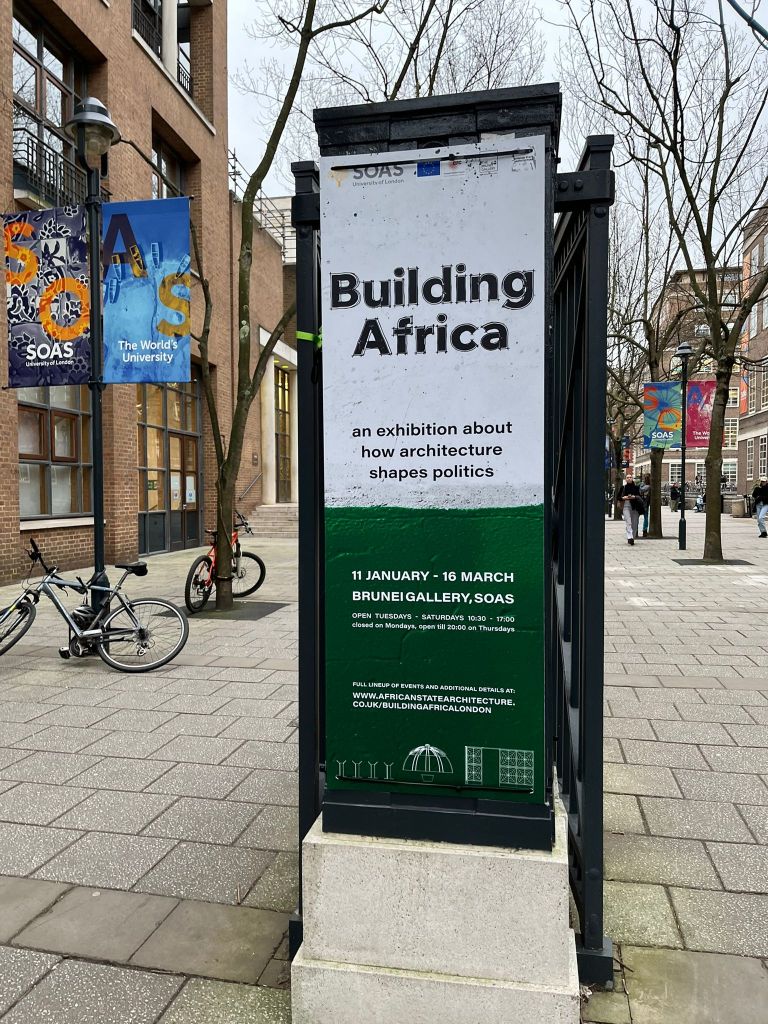
The Building Africa Exhibition curated by Julia Gallagher and Kuukuwa Manful is currently showing at the Brunei Gallery SOAS until 16 March 2024. This is a smaller version of the exhibition which was first shown in Ethiopia as part of the State Architecture Research project at SOAS with Prof Gallagher as its director.
The SOAS exhibition is full of colour featuring, film, photography, a large-scale physical model-installation, publications and school uniforms and memorabilia. Located in the main gallery space, sections deal with the school history of Ghana, ‘state-built architecture in several African countries, highlighted in the exhibition by images of Ghana’s alternating seats of power, (Osu Castle and State House), and the African Unity building constructed in Addis Ababa. A conceptual installation structure evoking African unity has also been produced by the work of a young Ethiopian architect , Nahom Teklu whose umbrella structure enables exhibition visitors view in VR the ‘state’ architecture of different parts of Africa, it also harks back to the idea of pan-African unity where the umbrella unites all states on the continent.
The exhibition’s thesis that buildings shape us, is made clear to viewer and particularly how the state’s involvement is central to this process of power, positioning, and identity, particularly in Africa, from its colonial past to the now post-colonial contemporary situated-ness in Africa’s modern cities to secondary schools in Ghana in which the schools shaped would be future leaders. This was both by the design of the schools within a colonial frame but also school uniforms, motos and other paraphernalia of educational engagement.
State built institutions such as seats of government (state house in the case of Ghana) or stadia (exemplified in the exhibition by the main stadium in Kinshasa) have a more mixed relationship where they both are sites of power, and international events (the Muhammed Ali – Frazier rumble in the jungle, Kinshasa stadium film footage is on show) or symbols of African Unity (shown through AU building in Addis Abeba, which often results in tensions of perceptions and strategic plans for future use as regimes and state actors change.
The exhibition also connects the viewer to the research which has underpinned it. This includes the 2023 book Building African Futures edited by Gallagher and Emmanuel Ofori-Sarpong, and Manful; and Manful’s thesis – and a number of papers members of the State Architecture project have published as reports and in peer reviewed journals.
Building Africa packs a dense amount of African state-built architectural history into a a viewable gallery which audiences are invited to view, engage with and critique, helpful post-it notes are provided for this process. The curators explain that this is an adjusted version of the larger 7 panel exhibition and of the conceptual architectural installation has had to be cut short to fit the gallery space. This does not detract from this well-planned and already publicly pleasing and well- received exhibition.
Thank you to Prof. Ola Uduku of Manchester School of Architecture for reviewing the ‘Sharing Stories from Jamestown’ exhibition. The exhibition has been extended to run until the end of June 2019. Below I’ve uploaded a 360 degree panoramic view – you can ‘click and drag’ the film to have a look around….
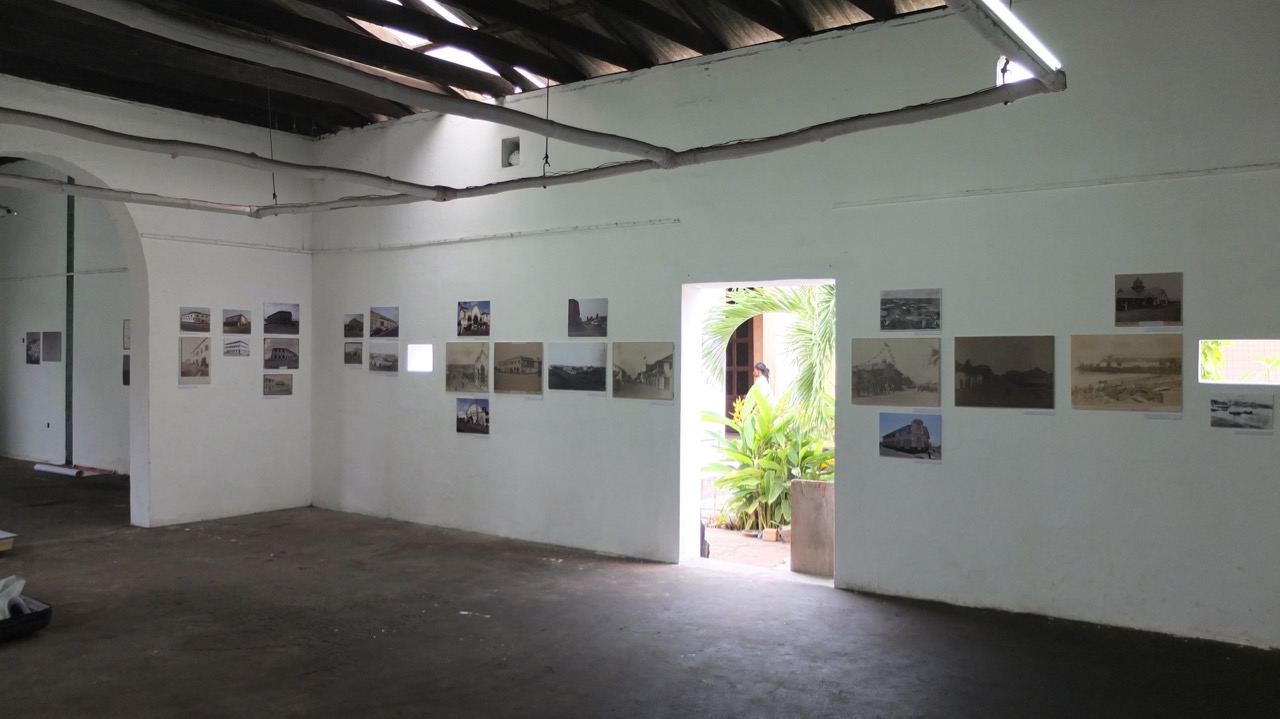
Iain Jackson’s exhibition co-curated by Allotey Konuah-Bruce and Joe Addo opened to great acclaim on Saturday evening at the Jamestown Café, venue, near Ussher Fort. Curiously the café it was confirmed by local elders who attended the opening is accurately in Usshertown; the exhibition launch providing a great forum for these questions to be aired and for detailed discussions to be had.
Historic photographs and maps of ‘old’
Jamestown buildings have been placed next to those which show their age,
condition and use, in ‘contemporary’ Jamestown have been displayed in the lower
gallery of the Jamestown Café, which itself features in the exhibition as Tarquah
house, the dwelling and warehouse of one of Jamestown’s wealthy local
merchants, who had originally had it built. The exhibition represents a true
joint collaboration between Iain Jackson and Allotey Konuah-Bruce who have formed a close and productive working relationship as they have spent the…
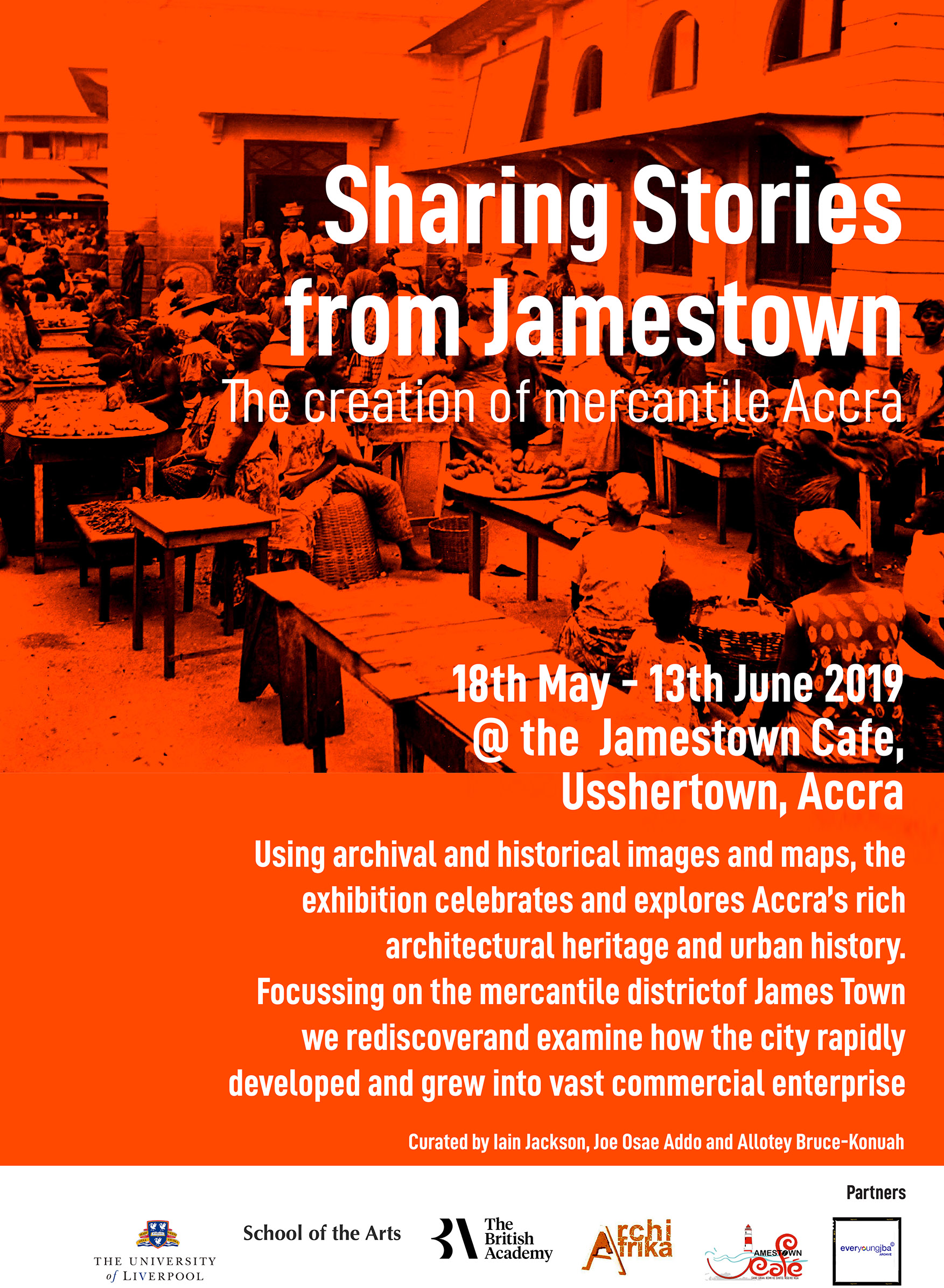
You are invited to our Exhibition, ‘Sharing Stories from Jamestown’, opening on the evening of Friday 17th May 2019 at Jamestown Cafe, High Street, Accra. All very Welcome! The exhibition will run until 13th June.
We’ll be exhibiting vintage photographs, plans and drawings from over ten archives and private collections that have been gathered together here for the first time. To accompany the exhibition we’ve also produced a catalogue that attempts to explain and contextualise the images, and to tell the history of Accra’s development, planning and architecture. You can read the digital version below. We’re indebted to Allotey Bruce-Konuah for expertly setting out the catalogue.
Sharing Stories from James Town and the Creation of Mercantile Accra
Forthcoming Exhibition at James Town Cafe, 17th May 2019
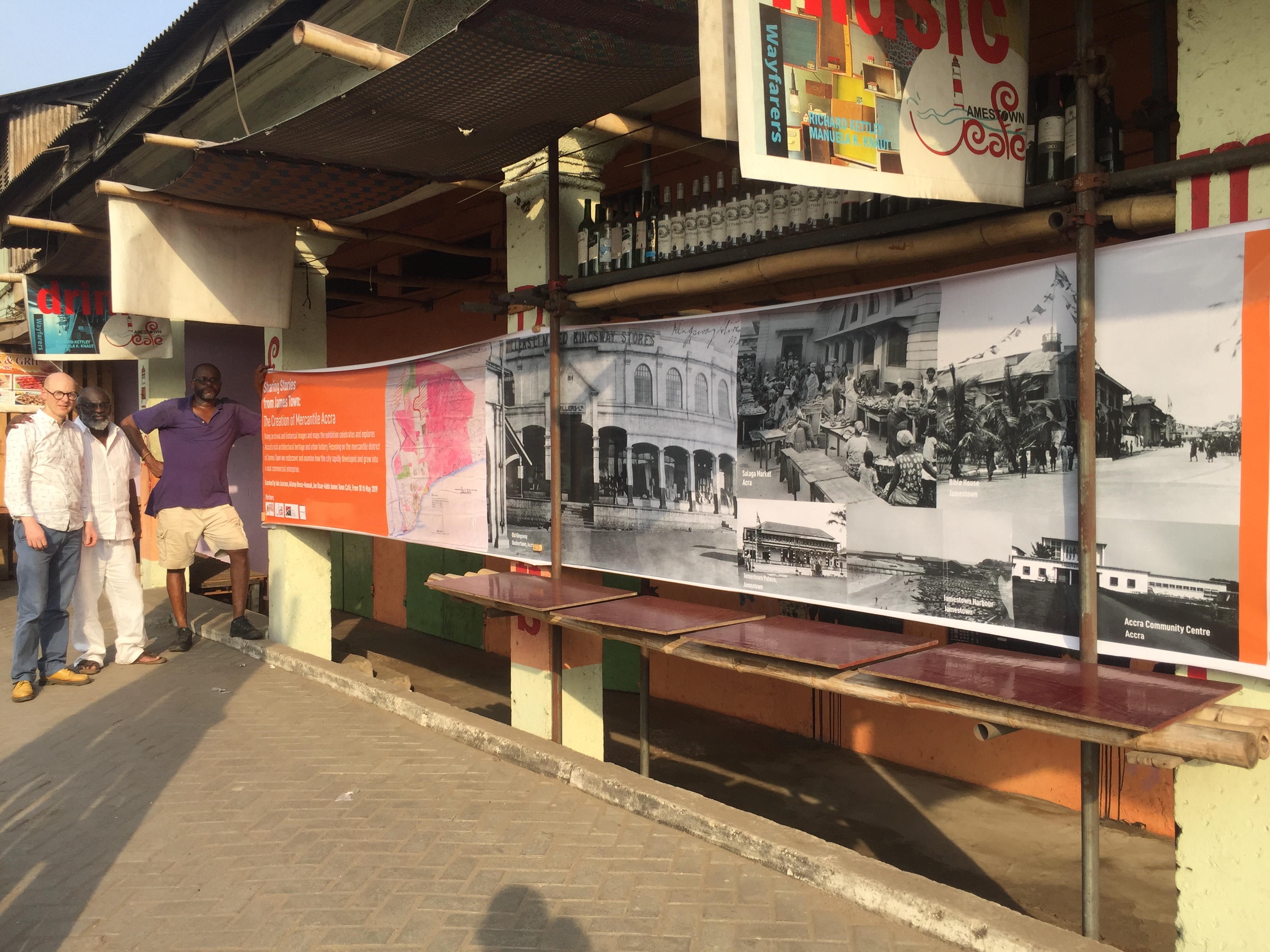
I’ve been working in Jamestown, Accra to start planning an exhibition on the colonial and mercantile architecture of the district. Using archival and historical images and maps the exhibition will celebrate and explore Accra’s rich architectural heritage and urban history. The exhibition will focus on the warehouses, stores, factories and offices of James Town and examine how the city rapidly developed into a vast commercial enterprise.
The images for the exhibition have been generously provided by Unilever, Barclays, UK National Archives, The British Museum and private collections. Most of these images have not been exhibited before and we’re delighted that they will be shown in Accra, and in very close proximity to where they were originally taken.
Exhibition Promotional Banner outside James Town Cafe with Iain Jackson [L], Joe Osae-Addo [C] and Allotey Bruce-Konuah [R]
There will be a printed/PDF catalogue to accompany the exhibition showing both archival and modern photographs of the buildings, along with historical maps, and we will hang large photographic banners of the archival images directly onto the historic buildings in James Town.
Kingsway Store, 1914
Kingsway Store 2018
The main exhibition (co-designed with architect Joe Osae-Addo and designer Allotey Bruce-Konuah) will be hosted by ArchiAfrika at the James Town Café, from 17th May 2019. We’re also hoping that it will go on tour to University of Ghana (details to be announced). In June there will be an additional exhibition hosted at the James Town Café curated by Lukasz Stanek and Ola Uduku of Manchester School of Architecture – and we’ll include more on both exhibitions here.
We’ve also started a new project to produce 360 degree panoramic photographs (and films) of some of the key sites and streets in James Town (and its environs). The images have been captured with a Ricoh Theta camera and we’ve taken over 200 photographs/ short films to date. The clips will be pieced together as a series of films and overdubbed with a commentary on the history and significance of the buildings in view. The films may be viewed with a VR headset for a more immersive experience. Allotey Bruce-Konuah already gives tours of James Town, and these films will enable his expertise to reach a wider audience, as well as encouraging new visitors to make the trip to this unique and highly important portion of Accra.
Exhibition: Nek Chand at Pallant House Gallery, Chelmsford, until 25th October
This is a rare chance to see Nek Chand’s work in the UK, and in an external setting which is how the sculptures should be seen. Pallant House Gallery has a large group of sculptures on show courtesy of the Nek Chand Foundation.
I re-visited Nek Chand’s Rock Garden, Chandigarh in August, eager to see how it was being treated and maintained following Nek Chand’s passing in June. I was very concerned that at best it would not be managed properly, and my worst fears were theft and destruction of this unique creation. It was such a relief to see it all looking better than ever. The walkways were clean, litter free and everything was running smoothly. Whilst work seems to have ground to a halt in ‘phase 3’ this may not be a bad thing. Perhaps we now need to think of the garden as being complete and any further changes to be made with utmost care and restraint.
Exhibition: Tropicality Revisited: Recent Approaches by Indonesian Architects is currently on show at the Deutsches Architekturmuseum , Frankfurt, Germany.
29 August 2015 – 3 January 2016, 3rd floor
GUIDED TOURS: Saturday and Sunday, 14:00
Architecture in the Tropics was never just about offering shelter from rain and sun. “Tropical architecture” suddenly gained global relevance with the emergence of Modernist Architecture and was adapted to suit all climates and cultures. During the post-War period the science of climatic architectural design became an international success. For many generations of Indonesian architects, the tropics has never been a romantic colony, but a harsh reality with its torrential rains, heat, and high humidity. Today, “tropical architecture” is often easily forgotten by the critics, lost behind the glazed and airconditioned skyscrapers or the celebrated designs for tropical tourist resorts. At times, it seems to be taken for granted – pitched roof and overhangs are the ready-to-use answers – but it is also a challenge for architects to find new solutions. In the days of climate change and energy crises, architecture adapted to the climate is making a triumphal comeback.
12 ARCHITECTS \ 12 PROJECTS
Achmad Tardiyana, Jakarta – Rumah Baca, Bandung
Adi Purnomo \ mamostudio, Ciputat – Studi-O Cahaya, West Jakarta











 Transnational Architecture Group