Archive

Author Archives: jacksoniain

In the UAC archive amongst the Public Relations files is ‘Nigeria Magazine‘. From within the mat brown cardboard of the archive box springs a collection of beautifully designed and printed set of publications. The magazine was a Government sponsored venture, published by the Cultural Division of the Ministry of Information in Lagos. It was issued quarterly from around 1937 until the mid-1980s “for everyone interested in the country and its peoples”. The focus of the editorial was varied and wide ranging, covering topics across the arts, history, architecture, literature, and culture in Nigeria. There was a strong commitment and celebration of ‘local’ art, as well as extensive articles on planning, housing, and architecture from across the ages. The contributing authors were often experts and highly regarded scholars. Ulli Beier was a frequent writer, and the quality and tone of the editorial was consciously accomplished, supplemented by some striking images and high quality graphics.

Covers of Nigeria Magazine from the 1960s, held in UAC archive

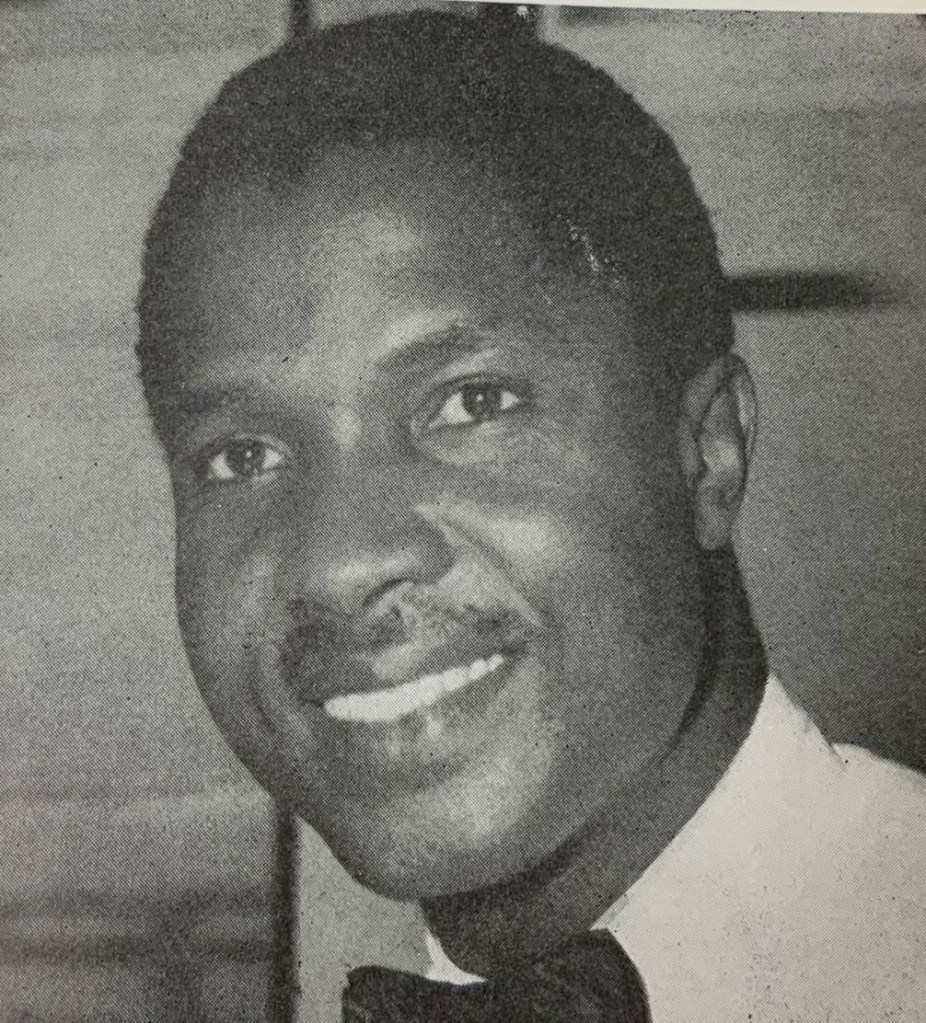
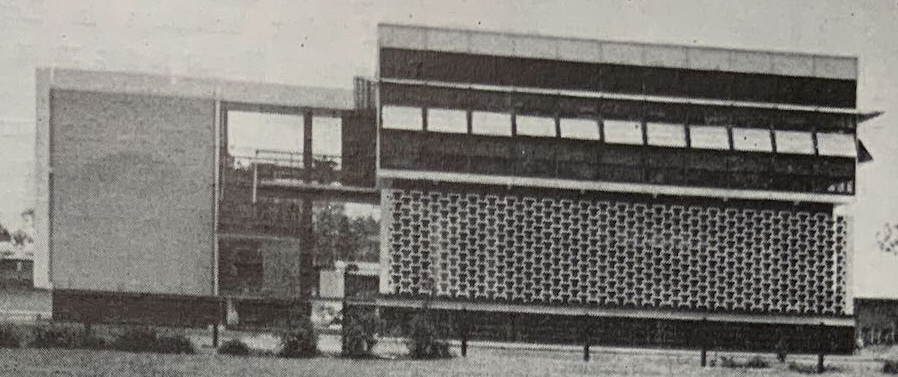
Articles were published on the history of cities, including “Ibadan, Black Metropolis” in 1961, relishing in the city’s longevity and traditions, as well as welcoming its position as a new centre for finance and media (see Design Group’s Finance building below). Other sections included biographies on key personalities, such as June 1966 with its feature on architect Alex Ifeanyichikwu Ekwueme (1932-2017).

Ekwueme studied at Washington University on a Fullbright Scholarship in 1952, and went onto to work at Nickson and Partners in London (is this Nickson and Boris?) before setting up a firm in Nigeria that grew to 16 offices. He designed the United Christian College at Apapa, Universal Insurance Building Enugu, and the Administration Building for the Nigerian Petroleum Refinery Company, amongst others. Ekwueme’s architectural career ended when he was elected Vice-President of Nigeria in 1979.

Architect and Vice-President of Nigeria, Alex Ifeanyichikwu Ekwueme (1932-2017), from Nigeria Magazine, June 1966.

Whilst there was a lofty desire to promote local art, culture, and history, other articles appear to focus on trade and industry, presenting what are effectively op-eds or public relations pieces as historical accounts. In 1960 there was a special report on The Niger River Transport Company and Burutu, “Nigeria’s Timber Industry” featured in December 1962, focusing on the work and settlements of the African Timber and Plywood company – both subsidiary companies of of United Africa Company (UAC). Again, the Company features in various other articles, such as “The UAC in Nigeria’s economic growth” in December 1965. It’s a thorough and detailed account, going to some length to stress how the company is ‘inseparable’ from Nigeria’s economic growth. The article was also eager to stress the restructuring of the company and how it now operated as a series of smaller locally managed entities ‘to encourage the growth of industry and trade in local Nigerian hands’.

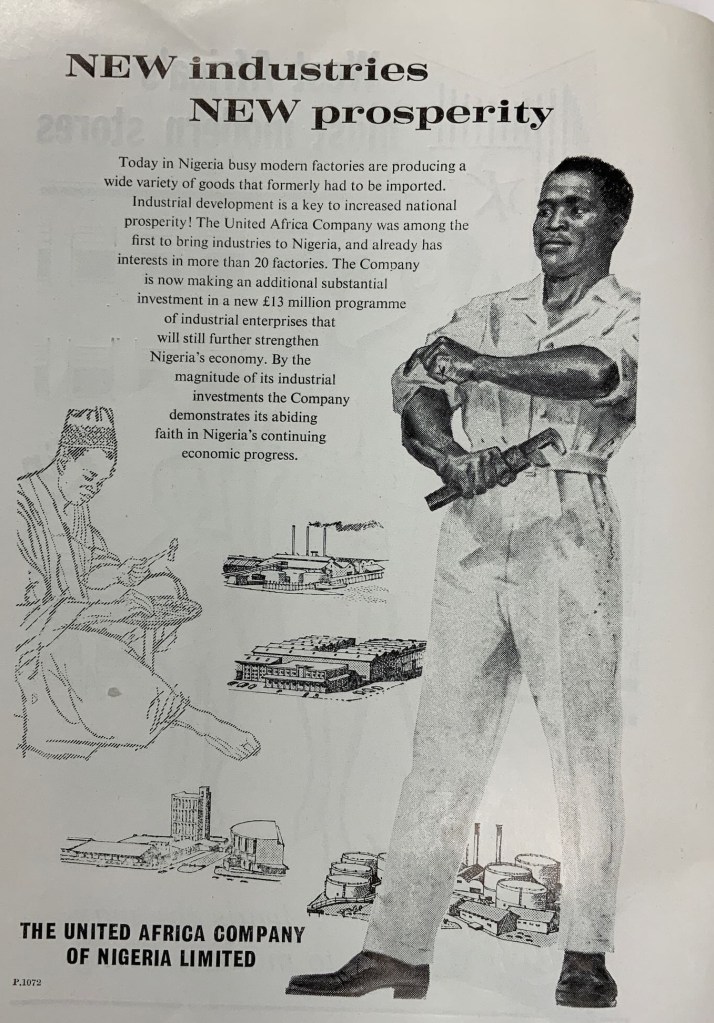
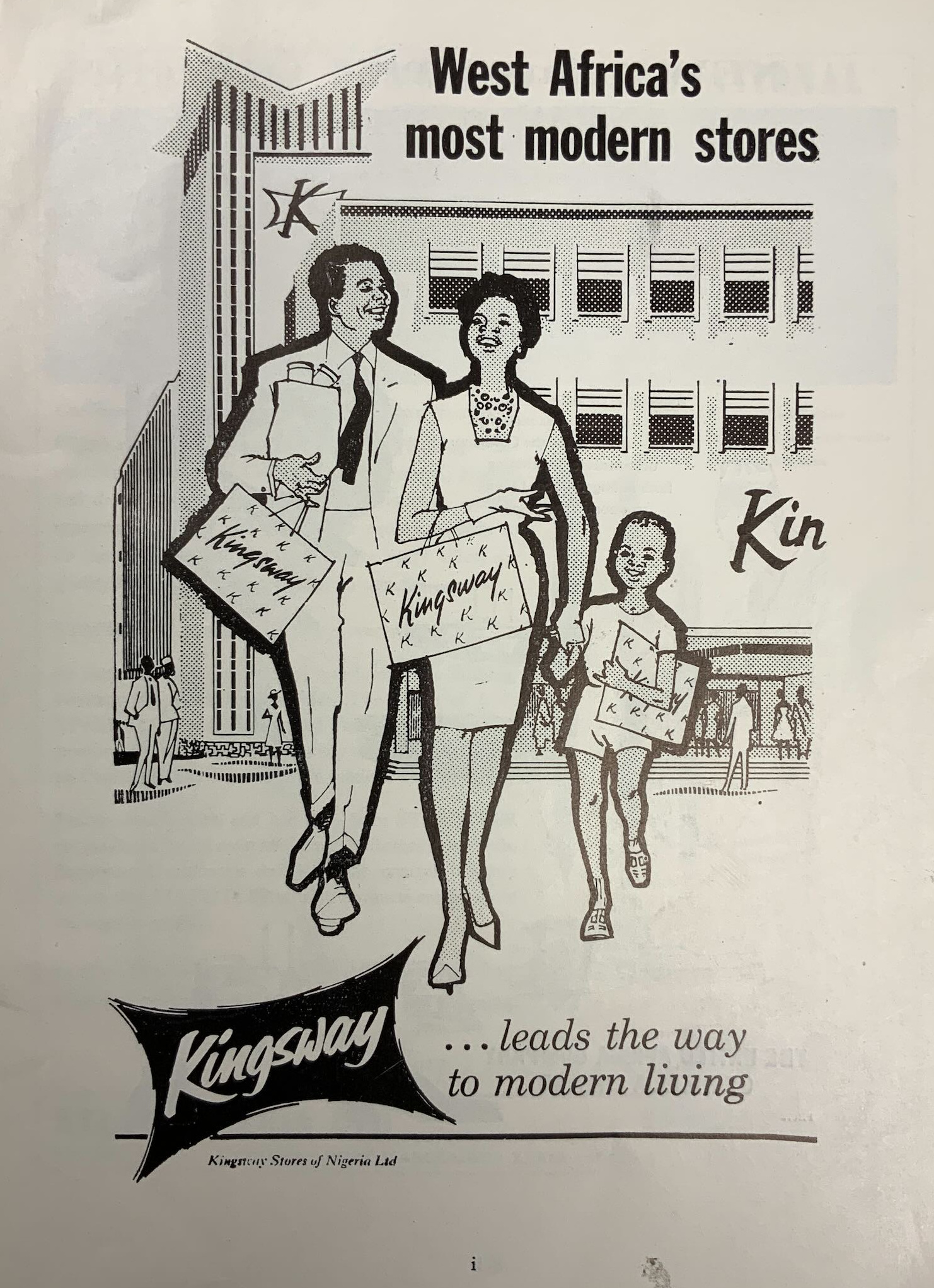
It seems that the magazine had a mandate beyond art and culture, and sought to shape opinion (particularly in the emerging and educated middle classes) on business and trade matters. The seductive and authoritative format of the journal gave these opinions validity, and allowed a particular and curated message to be carefully presented. The advertisements within the journal also reinforced these messages and narratives of progress through industry.

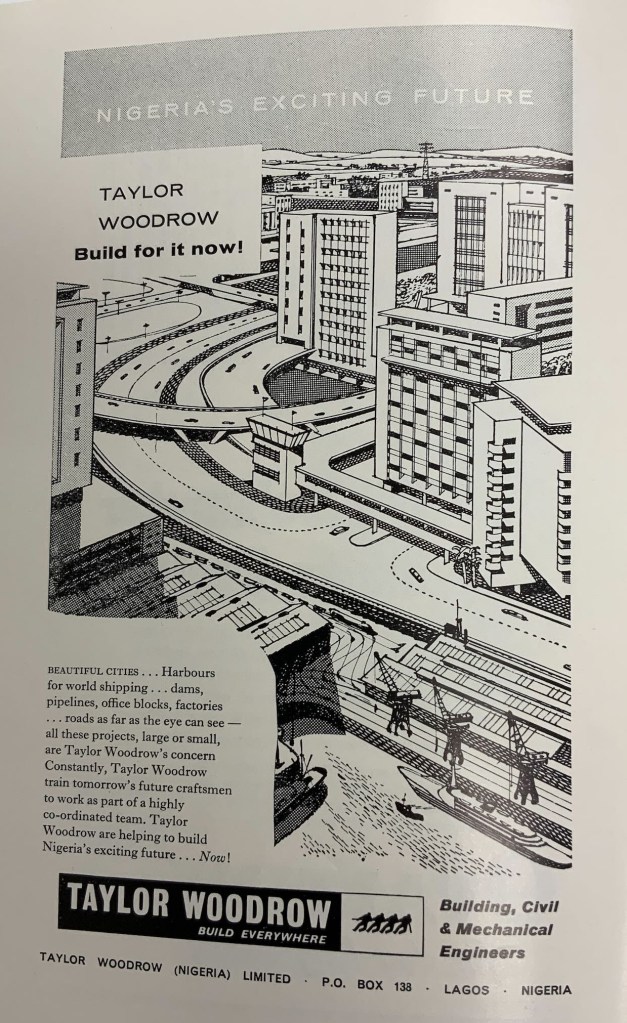
At the same time, ‘traditional’ and ‘local’ practices were celebrated and discussed. There is something disarming in this technique. An ahistorical image was usually shown on the front cover, often a decontextualised figure in traditional dress sometimes playing an instrument – followed on the inner leaf by an advertisement for the latest fashions from Kingsway department store. The advertisers tended to belong to, or were in partnership with, the UAC group (e.g. Taylor Woodrow, Guinness, Kingsway Stores), and it seems likely their extensive patronage held some sway over the editorial content. The adverts were not geared towards selling specific products, but were there simply to bolster public opinion and shift attitudes towards modernity, progress, and societal advancement alongside a romanticised nationalist sense of history and culture.

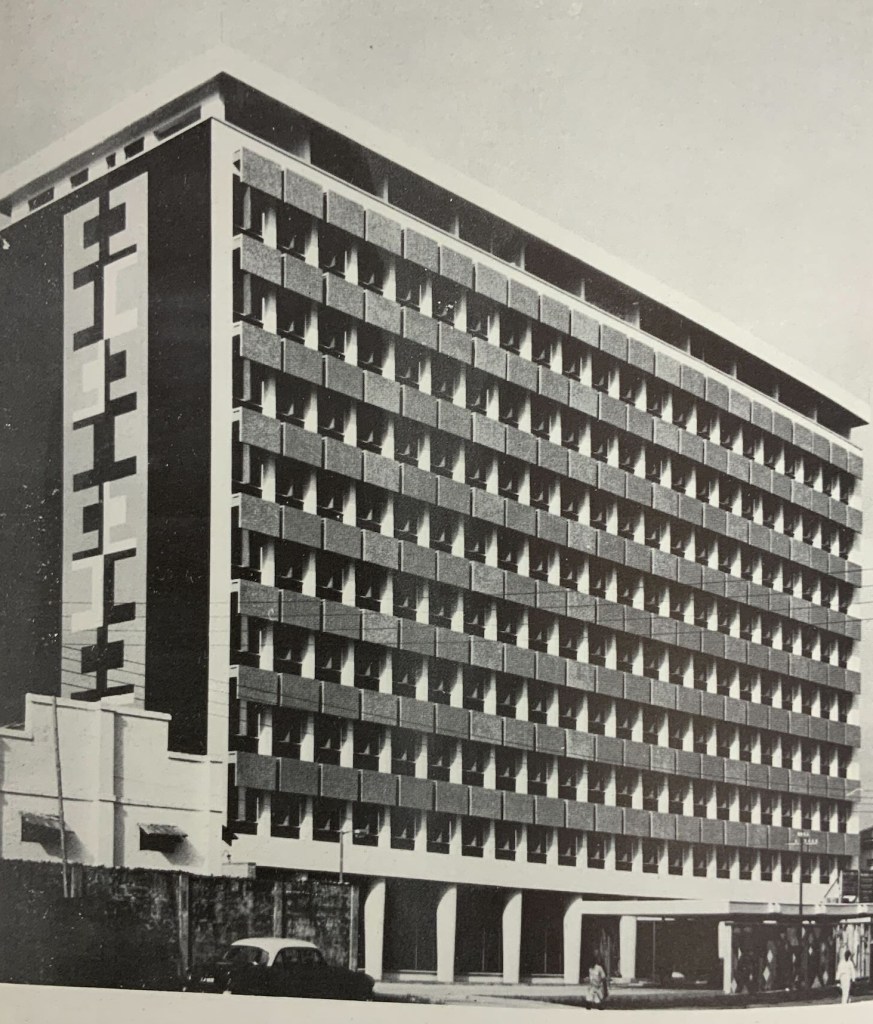
The articles on architecture were also propagandist and concerned with presenting Nigeria as a place of rapid progress and impatient ambition. Again, the UAC story is followed with interest, and their newly proposed offices in Lagos (by Watkins and Gray) demonstrates the Company’s commitment to ongoing business in the newly independent country, and also the shift in its focus from import/export to real estate and property development.

Artist impression of the UAC’s Niger House in Lagos. Designed by Watkins Gray and Partners.

John Godwin, wrote an article entitled, “Architecture in Nigeria” in December 1966. It’s a potted history that starts with the regional building types, local materials, and climatic responses before moving onto the impact of corrugated iron sheeting (pan) and its limitations. Godwin sets out this story to demonstrate the sudden change in scale, building types, and growth of the construction industry in West Africa post-1945,

“Tower cranes were on the scene in 1955 and by 1961 two twenty-five-storey buildings had been completed in Ibadan and Lagos built by Italian firms who thirty years earlier were struggling with their labour force to build small houses”

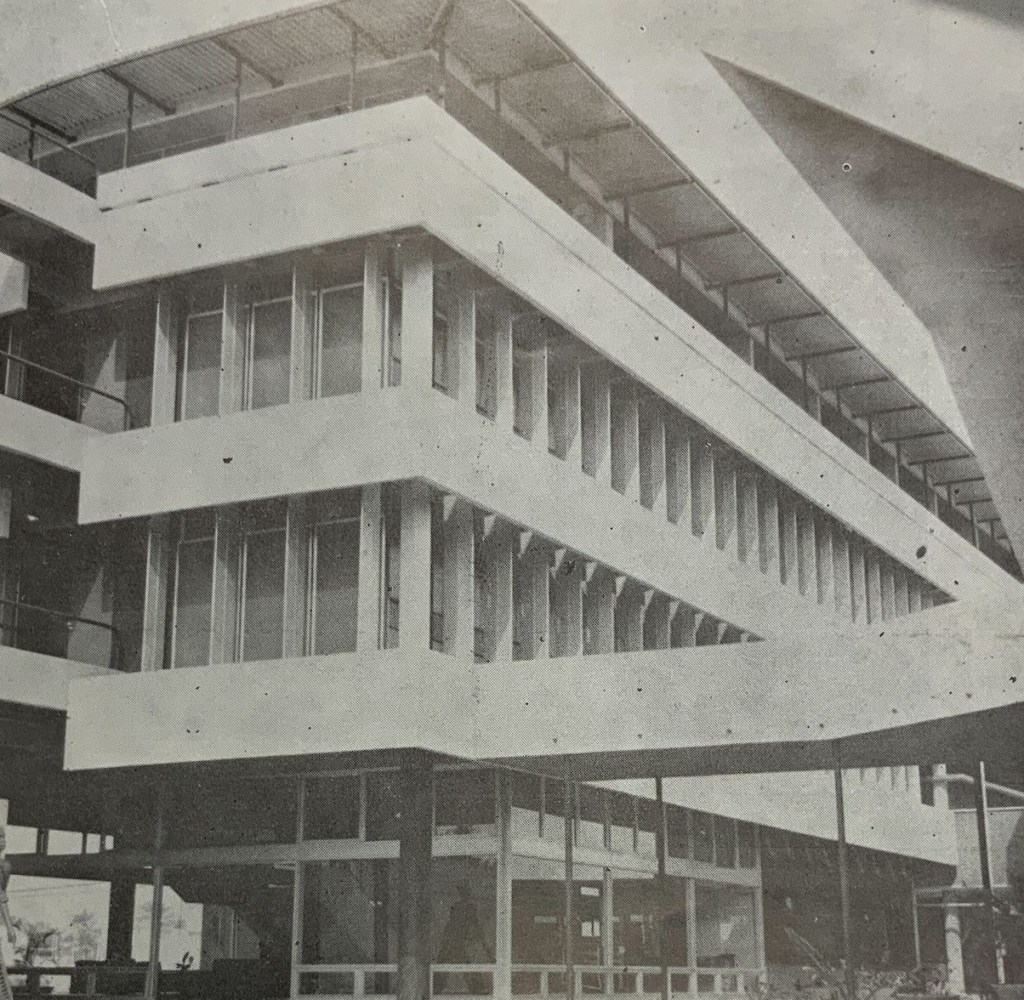
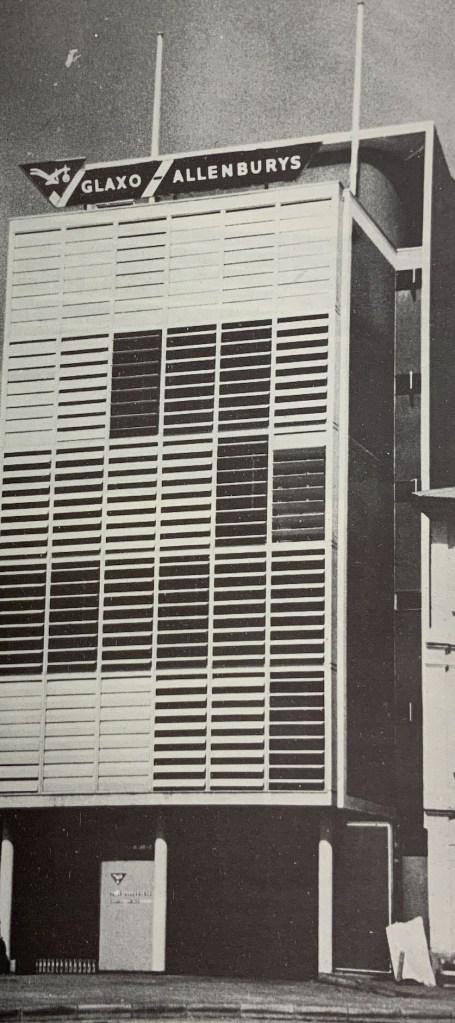
Whilst acknowledging this rapid growth and exciting possibilities, he also goes on to caution that more ‘research’ is required, greater collaboration should exist between architects, and that building components and materials were still being imported at prohibitive costs. Overly extravagant “prestige building” was also targeted whilst low-cost housing problems remained unresolved. Whilst the claims and hopes for air-conditioning now seem somewhat out-dated, his desire for a civic pride and community spirit, tree planting, and care of the environment is pertinent and all the more urgent. Godwin’s approach was to propose an “architecture of ventilators and sun breakers”, a lexicon that he viewed as, “increasingly identifiable as West African.”

Offices and Flats in Kaduna, designed by Godwin and Hopwood, 1964

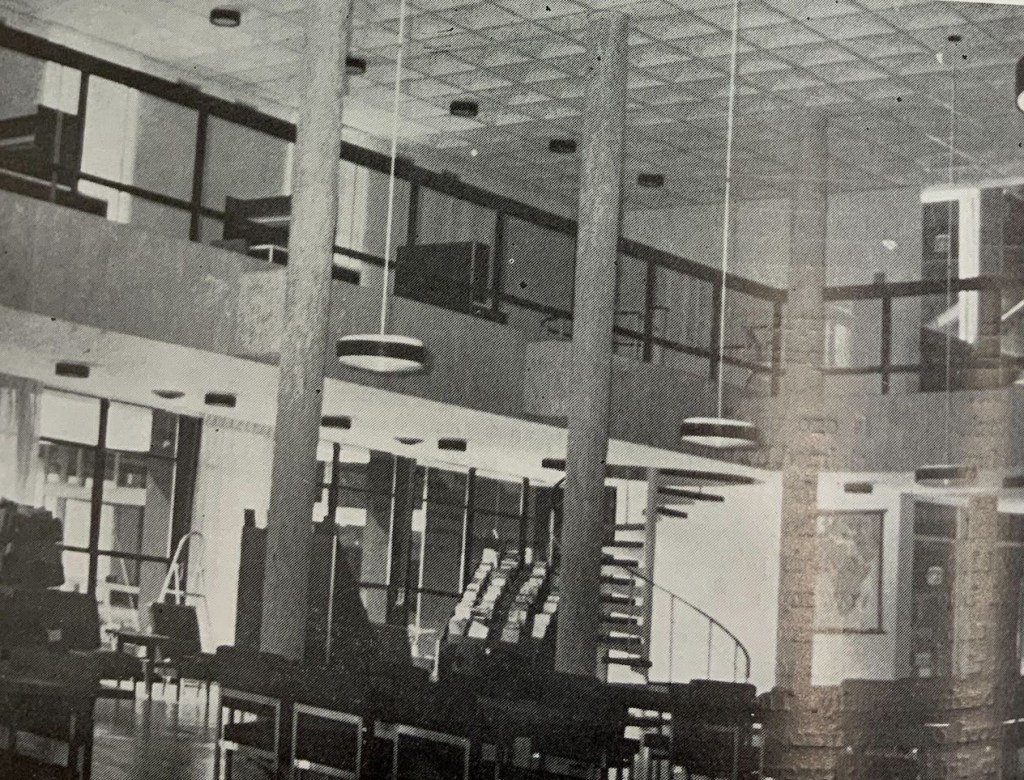
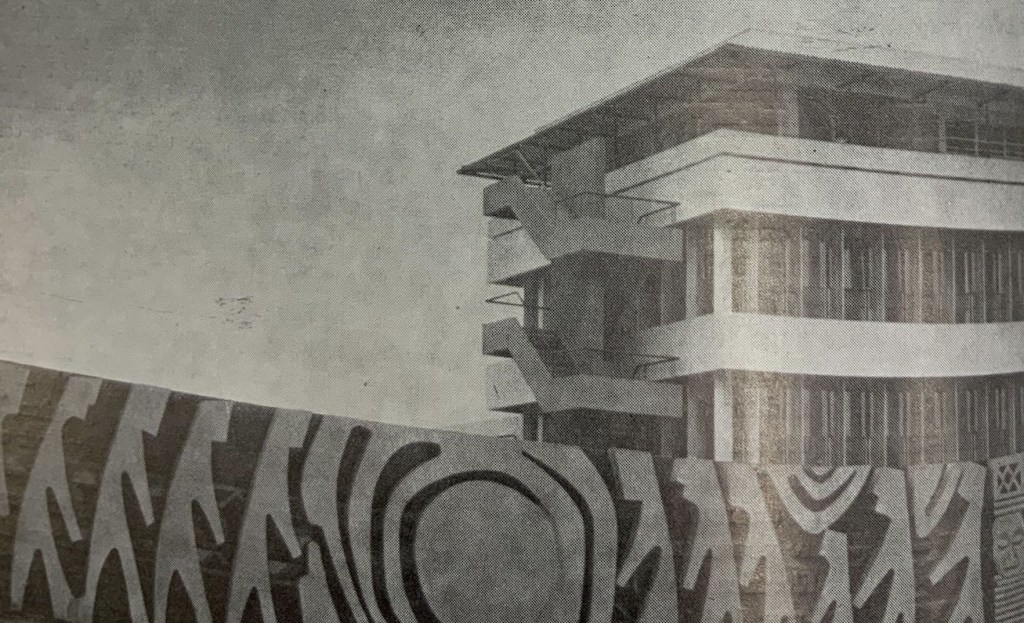
Contributing to this West African style was the Design Group’s “Nigerian Institute of International Affairs” (located on Lagos’s Kofo Abayomi Street). It was discussed at length by Alan Vaughan-Richards in the March/May 1968 edition of the magazine, where he particularly admired the sculptural mural, ‘The Art of Understanding” by Erhabor Emokpae in tooled concrete that revealed the granite aggregate. Inside the Institute are further sculptural elements, including a bronze figure representing Knowledge by Ben Enwonwu and positioned hovering above an evaporation pool. The interior includes some grand double-height spaces, dramatic cantilevered spiral staircases and travertine marble cladding (donated by the Italian contractor). At the rear of the plot there is an octagonal conference room with a dramatic star-shaped roof (still visible on Google maps).

The Institute was to promote peace and progress (the internal conflict taking place in Nigeria at that time was not mentioned), and was to operate as a centre for learning, research, and debate on global affairs.

June 1962 edition included an article on “Contemporary Nigerian Architecture” by D. J. Vickery, the former Head of Department at Singapore Polytechnic (did he then go on to work in Nigeria?). This is an exceptional article covering some of the latest construction in Nigeria, and Lagos in particular. As a gazetteer of the latest building work – including the work from recently qualified Nigerian architects – it formed one of the most detailed architectural surveys of the country. Although the crude categorisation of the works under three types; ‘Climate’, ‘Traditional Spirit’, and ‘Skyline’ is somewhat limited, it gets the message across, and more importantly illustrates what the Independence Boom meant to the towns and cities across Nigeria.

In addition to the speculative offices, headquarters and banking halls there was an impressive array of schools and libraries (many designed by James Cubitt who had also designed similar works in Sekondi and Koforidua, Ghana), but the focus here was undoubtedly on real estate and speculative construction.

Nigeria magazine illustrates how UAC and other global companies shifted their approach and emphasis during the early Independence period. UAC was presenting its suite of businesses as nationalist, pro-development, and key partners in the country’s future. They rapidly placed an emphasis on real estate, finance, and industrial development, whilst curating a sophisticated advertisement and public relations campaign, through an arts and culture journal, to bolster their local credentials and legitimacy in the history of Nigeria.


“Diaspora Remittance Flows: Restitution, Culture and Capital – ASAUK Biennial Conference 2022” 

We are pleased to announce the launch of the 2022 ASAUK biennial conference titled: “Diaspora Remittance Flows: Restitution, Culture and Capital”. This is an innovative conference which seeks to harness the global two-year involvement with online communications with our physical engagement with conferencing which we hope will return in 2022. This conference is conceived to enable our research colleagues in Africa (Ibadan, Nigeria and Nairobi, Kenya) to be part of the research conversation at the 29th ASAUK biennial conference, via the zoom media platform. We also will be running a smaller traditional in-person conference in Liverpool addressing this and other ASAUK member-determined themes. 

Running from August 31st – September 4th, 2022, the ASAUK Biennial conference will be a unique two-part conference. With British Academy funding, the first part will take place entirely online and involve ASAUK research colleagues based in Ibadan and Nairobi engaging in the conference themes from Africa based platforms shared across Africa and Liverpool in the UK. This will be followed by a smaller, traditional in-person conference, hosted by the ASAUK at the University of Liverpool. 

We invite you to attend the online conference, which is entirely free, and also to come to Liverpool for the ‘in-person’ conference, taking place from Friday 2nd – Sunday 4th September. The Liverpool conference will have a smaller audience, and conference panel requirements planned to pre-empt possible ongoing Covid health advice on conference size and appropriately spaced and ventilated conference facilities. Taking this into account, there will be online access to the physical Liverpool conference for a reduced fee. 

THE ONLINE CONFERENCE  31st August – 2nd September 

IBADAN-NAIROBI-LIVERPOOL  

Restitution, Culture and Capital

This is an entirely free to attend conference (with registration required).

Hosted by ASAUK colleagues at the IFRA Institute, at the University of Ibadan and the BIEA, Nairobi, the online conference has been directly funded by the British Academy, with generous supplementary funding from the BIEA. It will be delivered entirely online from both Ibadan and Nairobi, using the Zoom platform. Working closely with the Institutes in Ibadan and Nairobi, these interactive conferences will be broadcast on two consecutive days, from Ibadan on Wednesday 31st August and Nairobi on Thursday, 1st September. The final part of the online conference will be broadcast from Liverpool on Friday 2nd September, jointly chaired by the ASAUK and RAS presidents. 

We expect to curate and edit the key papers, from Ibadan, Nairobi and Liverpool that will be discussed at this unique online conference series. These with support from the British Academy will form the basis of the ASAUK publication Restitution Culture and Capital in Africa and the Diaspora, a trans-national conversation which will elaborate on the themes of the conference through the publication of the keynote papers and also the responses as recorded by participants at the three conference platforms.  

The panel session themes and keynotes for the three day online conference are as follows:

HOSTED ONLINE FROM IFRA, UNIVERSITY OF IBADAN

Curated by Vincent Hiribarren, Director IFRA Ibadan

Ibadan Session 1. DIASPORA FLOWS OF CULTURAL ARTEFACTS TO AND FROM AFRICA

Confirmed Keynote Speakers: Zachary Kingdon, Shadreck Chirikure

TBC David Adjaye

Ibadan Session 2 DIASPORA FLOWS OF PEOPLES AND CULTURES TO AND FROM AFRICA

Confirmed Keynote Speakers: Saheed Aderinto, Peju Layiwola  

TBC David Olusoga, Akosua Adomako Ampofo

HOSTED ONLINE FROM BIEA NAIROBI

Curated by Ambreena Manji + Freda Nkirote, Director of BIEA Nairobi

Nairobi Session 1 RESTITUTIONARY FUTURES: LAND JUSTICE

Confirmed Keynote Speaker: Parselelo Kantai

Nairobi Session 2 RESTITUTIONARY FUTURES: A JUST HOME

Confirmed Keynote Speakers: Prabha Kotiswaran 

LIVERPOOL HOSTED CONCLUDING SESSION

Curated by Ola Uduku and Arunma Oteh

African Diasporas, remittances and capital in a post-Covid era and Viewing the European Black Diaspora in the 2020s 

Confirmed Liverpool Keynote Speakers

Onyekachi Wambu Afford UK, Tunde Zack-Williams ASAUK

TBC Miatta Fahnbulleh, New Economics Foundation,

Prior to the online sessions keynote speakers will discuss their papers with Africa-based ECRs in workshop format.

THE LIVERPOOL ASAUK 29th BIENNIAL CONFERENCE

FRIDAY 2ND – SUNDAY 4TH September 2022

The ‘in-person’ Liverpool Conference follows the traditional panel theme format. Whilst the panel theme titled: Diaspora: Restitution, Culture and Capital, follows on directly from the online conference, we invite proposals for other panel themes.

As this is planned to be a smaller conference we call on panel proposers to ensure all panel proposals are sent in to the ASAUK conference team by 31st March, 2022. All proposals need to have the names of the 3 – 4 paper givers, and their abstracts submitted by the 31st March deadline. This will enable us to plan the conference space and facilities required. It will also mean that we can work to ensure that any documentation required for proposed international participants who might need this will get processed on time. We realise that this is different from the traditional conference format but hope you will join us for this unique, innovative conference in 2022. The 30th April is the later deadline for individual paper proposals. Due to the smaller conference format, space for individual papers will be limited and we encourage paper givers to consider working with emerging panel themes which will announce from February onwards.   

The 29th ASAUK biennial conference dinner will be held at Liverpool University’s Victoria Gallery and Museum on Saturday 3rd September. This will also be the venue for announcement and awards ceremony for the Audrey Richards prize, the Fage and Oliver prize and the distinguished Africanist awards ceremony. 

For more information about the 29th ASAUK conferencePlease contact the conference organisation team via the email address: asaukconference22@gmail.comPanel proposals, comprising the 3 – 4 papers with abstracts, can also now be sent to this address.   

We will be providing further information as the conference details develop on our website and via social media.

Thank you 

Ola Uduku ASAUK President

Shared Heritage Africa: Call for Applications: Digital Fellowships March-September 2022: https://sha.architectuul.com

We are pleased to announce an open call for 6 Digital Fellowships, to be awarded to students and young professionals in architecture related fields or with demonstrable interest in architecture, who are based in Ghana, Uganda or Nigeria.

Shared Heritage Africa: Rediscovering Masterpieces

The documentation and investigation of buildings can tell us a lot about how politics works, and a lot about the nature of the relationship between state and society – a concern of all partner organisations. The project focuses on the rediscovery of post-war modern buildings from the 1950-1970s. These fall in the period of independence from colonial rule, here from the United Kingdom (Ghana 1957, Nigeria 1960 and Uganda 1962), and have a great educational and socio-political significance. One focus of our discussions with the respective universities, which were founded by the majority during this period of independence and for which new campuses were usually built, among others:

  • Kwame Nkrumah University of Science and Technology (KNUST), Kumasi, Ghana (1952/1961),
  • University of Lagos (UNILAG), Lagos, Nigeria (1962),
  • University of Nigeria (UNN) (formerly Nigeria College of Arts Science and Technology), Nsukka, Nigeria,(1950s),
  • Busitema University (formerly National College of Agricultural Mechanisation), Busitema, Uganda (1968),
  • Kyambogo University (formerly Uganda Polytechnic), Kampala, Uganda (1958).Digital Fellowship ProgramThe 6 month long digital fellowship program involves participants working on documentation, investigation and representation of those post-war modernist buildings from the 1950-1970s in Ghana, Nigeria and Uganda. The fellowship program focuses on development of written and visual material on those buildings through scientific writing, photography and digital publishing using different media (text, photo, film and internet).The fellows will be involved in online tutoring and in-person activities undertaken over the period. They will contribute to the online platform Architectuul and the new digest/Blog “Shared Heritage Africa”, allowing for exchange with the professional actors and society, locally and globally. The results shall be presented and discussed at the 17th International DOCOMOMO Conference (IDC) in Valencia (Spain) in September 2022. Each fellow will receive a travel grant for joining the conference.

  • EligibilityPlease note the following conditions for participation:
    • –  Students and young professionals in architecture related fields or with demonstrable interest inarchitecture and other related disciplines, such as: Architecture, Urban Design, History, Social Science,Journalism, Urban Studies, Creative Writing, are eligible to participate.
    • –  If they are based in Ghana, Uganda or Nigeria.
    • –  Strong written communication skills and/or photography and/or digital publishing skills are required.
    • –  Previous experience conducting and communicating ideas or research publicly (blogs, articles,dissertations) is desirable.

Full Details and Application Form: https://sha.architectuul.com

During the past month we’ve continued our exploratory work in the Unilever archive pursuing a broad scoping exercise to determine and survey what is contained within Storeroom Number 4. The archive catalogue is extensive, detailed, and provides incredibly useful descriptions of what lies within – but inevitably there are unexpected items and fine details that remain beyond the limits of the usual cataloguing descriptions. 

East Street, Freetown, 1905

Our sampling has examined a wide range of materials, including the large photographic albums from the late 19th and early 20thC. These carefully preserved documents reveal the early ventures in the Oil Rivers, the exploits of the Niger Company, the development of Freetown, and new buildings in Ghana. The albums have provided important details of the early trading stations that transitioned from boat hulks to riverbank factories and stores of the Niger Delta, Burutu, and beyond. The collection includes photographs of everyday street scenes, new stores, and wharf extensions, we well as major political events. The images from Freetown, Sierra Leone, by photographer Alphonso Sylvester Lisk-Carew (1887–1969) taken in 1905, reveal a systematic street-by-street catalogue of the burgeoning town, and details of new store being built for Peter Ratcliffe Ltd. Most of the various trading companies produced and retained extensive photographic records, including, for example G. B. Ollivant with its Manchester warehouses filled with calico and wax prints ready for export to the coast.  Palm oil was the main export commodity being shipped from West Africa, and William Hesketh Lever’s plantations in Congo are an essential part of this story. We’ve uncovered some early photos of the plantations and worker housing at ‘Leverville’ (now Lusanga). 

Housing at Samreboi

We’ve began to review the timber processing factories and associated settlements of Sapele and Samreboi. Trading as the African Timber and Plywood Company the archive includes an important set of material on the creation of these sawmills, processing plants, and associated staff housing and facilities. The Company was also involved in developing a series of experimental prefabricated and kit housing. We’re especially interested in the relationship the UAC had with construction and building materials companies/contractors, and we’ve reviewed the archival files connected to Taylor Woodrow. The UAC was a shareholder in this major construction company, and we’d like to examine how the two enterprises collaborated to deliver their building programmes and wider ambitions. The complex web of UAC businesses and shareholding arrangements becomes ever more complex and entangled. 

Management Housing at Samreboi

A significant portion of the UAC archive is devoted to brewing and breweries. The UAC established collaborative ventures with Heineken and Guinness to produce the famous Star beer and a range of malt-flavoured beverages. We’ve found some extraordinary designs for worker welfare facilities designed by Godwin and Hopwood at the Lagos brewery, as well as factory layouts and extensive promotional material. This is another example of the UAC working with specialist producers, spreading its risk, and also creating new business for its various subsidiaries. A similar model was deployed with UAC Motors that imported various vehicles and acted as agents, spare suppliers, and repair garages for the manufacturers in Europe and US. 

Godwin and Hopwood Lagos Brewery Welfare Block

Retail and Wholesale business remained a core part of the UAC enterprise with the Kingsway Department stores being the most prominent and well-known retailer. Some excellent work has already been done on Kingsway, but the extensive archival material reveals a lot more to examine.  Major photographic collections and architectural drawings devoted this array of shops and their lavish interior displays have been carefully preserved. The largest and most famous branches were at Accra and Lagos, but other lesser-known stores at, for example, Apapa (designed by T P Bennett, 1960) and Jos, clearly warrant further research and investigation. 

Sketch for Apapa Kingsway Store, by TP Bennett
Kingsway Stores at Jos, Nigeria

Our archival trawling exercise will continue until Christmas 2021 and we’re hoping that by that time we’ll have a clearer picture of the overall collection and the areas/themes we’ll continue to investigate to much greater depths. 

Research Title and Summary: From One Slum to Another : A Journey of Understanding and Redefining Informal Districts in Jeddah, Saudi Arabia

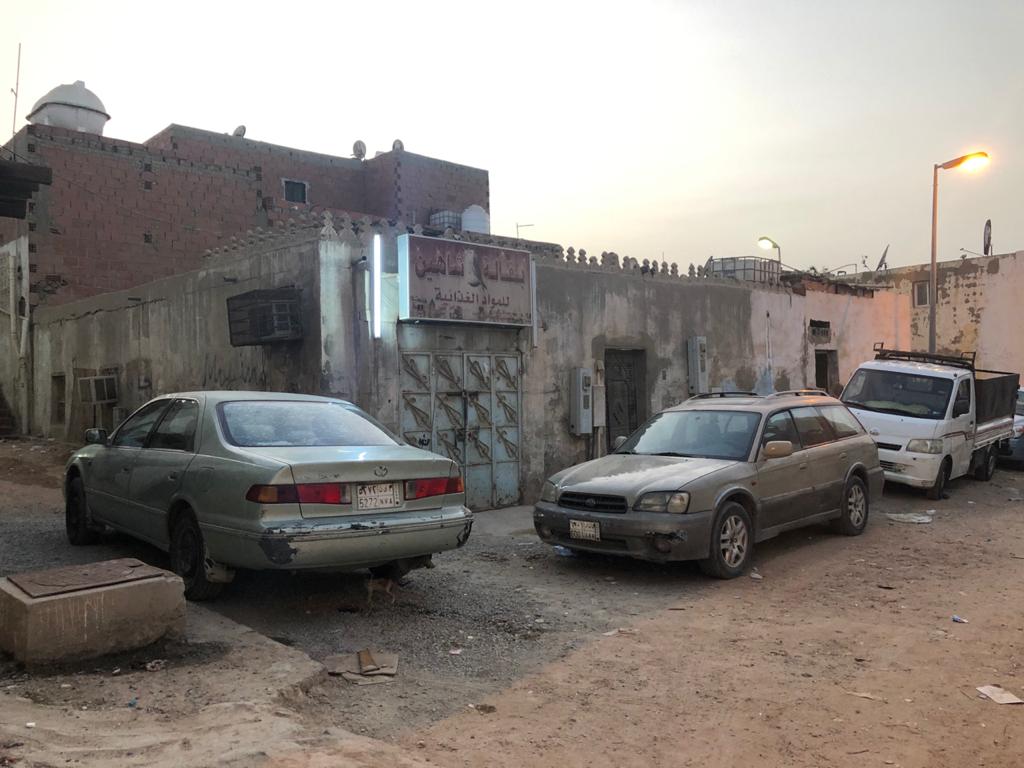
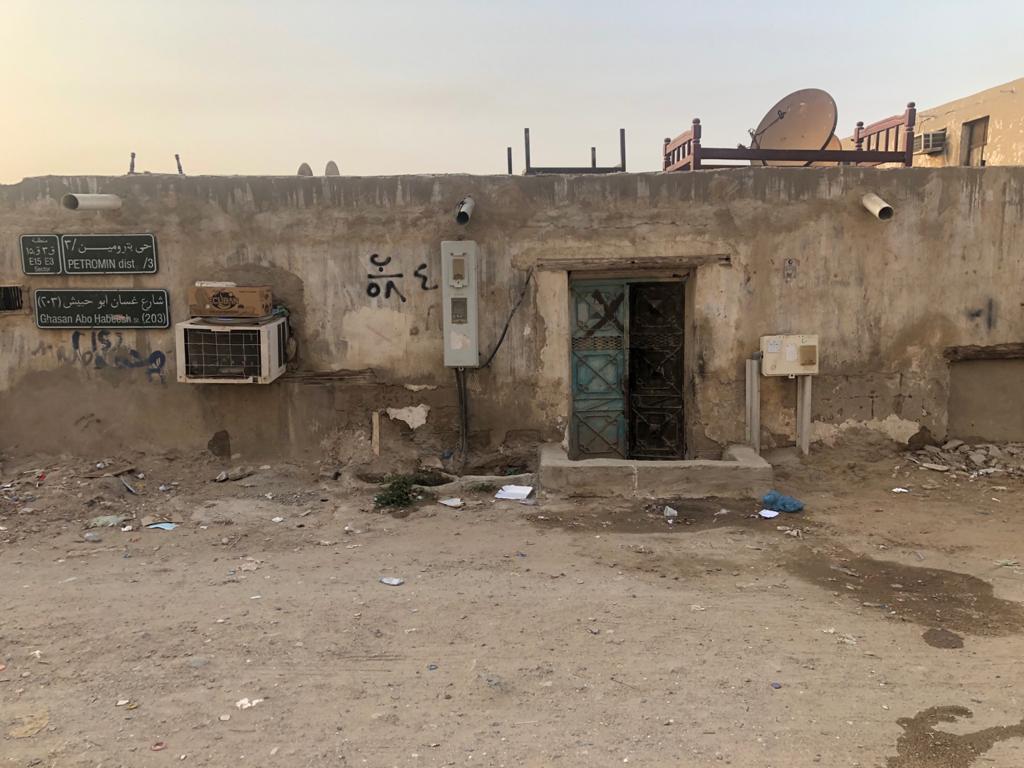
At a time where Saudi Arabia undergoes many mega development plans, Jeddah, located in the western region of Saudi Arabia, continuously aims to adjust the urban development strategies in an attempt to accommodate the future vision of the country. However, it suffers from the increasing numbers of informal districts where it currently adds up to sixty-six documented informal districts. This built environment has been vulnerable to socio-cultural implications and considerable complications. The community in these areas suffer from lack of proper housing, amenities, water supply, safety, and basic accessible healthcare. Living in closed clusters depending on and not limited to ethnicity and affordability. Saudi and non-Saudi people have inhabited informal districts for generations. For many years, policy makers along with governmental officials have put in action strategies to infiltrate these zones and prevent the spread of this architecture scar. Consequently, a bird eye view of the situation with no consideration to the communities needs and struggles have led to two types of people: landowners who refused to move and low-income communities who relocated to other informal low-income areas. 

Previous research investigated the informal districts crises, the root cause, the history and possible solutions. However, this historical crisis still reoccurs today. The oil boom, the mega projects, the rise in population and cost of living all have aided in the process of replacing, reproducing these slums. This research will shed the light on previous reasons of the crisis, However, it aims to investigate the mechanism of the informal districts and characteristics influenced by the behavior of different sociocultural aspects and to identify the variables that define these areas in Jeddah. 

Aims and Objectives:

This research aims to reveal the actual characteristics of Jeddah’s informal districts highlighting the different building and spatial dimensions. It aims to layer the social, economic and space relations to highlight the consistent power of such districts and the growth of this particular economy and space. 

The architecture of these zones in Jeddah can be abstracted into many indicators that differ from one district to another despite the close distance they are from each other. Considerably, the urban fabric and socio-cultural characteristics also differ from one zone to another. This is an understanding on how housing conditions and living challenges implicate the socio-culture nature of inhabitants. The research is an empirical analysis of the factors influencing the social and cultural patterns affected by the built environment that aid in the occurrence and recurrence of informal districts. 

Many descriptions have been mentioned in research and media talking about the problem of slums. The root cause, the history and possible solutions. However, a historical issue still reoccurs today. The oil boom, the mega projects, the rise in population and cost of living all have aided in the process of replacing and reproducing these slums. This research does aim to extensively explore previous reasons of the crisis. It aims to investigate the mechanism of the informal districts and characteristics. The aims are as following: 

  • To research the history of the urban fabric and the development of the built environment of Jeddah.  
  • To research the history of the existence and recurrence of informal districts in Jeddah. 
  • To investigate the different types of informal districts in Jeddah. 
  • To examine the current situation and analyze the relationship between the city and informal districts.
  • To examine the inhibitors socio-cultural background and economic status. 
  • To define the characteristics of the informal districts’ built environment where they differ in terms of culture, architecture, and economy. 
  • To set new indicators that categorizes the districts based on physical and social differences according to the previous definition. 
  • To propose recommendations for new strategies to enhance the built environment to accommodate inhabitants needs 

Why did you pursue a PhD, and what made you choose University of Liverpool?

Honestly, I have never thought I would. In 2013 I finished my master’s degree in Sustainable Architecture from the Catholic University of America. I was very eager to start working in the field. I went back to Jeddah, Saudi Arabia and worked at Dar Al-Hekma University as a lecturer, alongside I founded with my husband Vertix Design Studio where I worked as an Architect and Interior Designer. In 2017 I moved to teach at Jeddah University. I taught various subjects during my years at both universities such as design studios, sustainability, and computer aided design. Teaching was a very enriching experience and as a result I have been very enthusiastic about research and exploring new methods of developing the built environment. During COVID-19 lockdown, a worldwide crisis affecting humanity, I realized that the aftermath of this would lay within us for a very long periods of time. I started to research with my colleague Dr. Sherin Sameh, a former chair of the School of Architecture at Dar Al-Hekma University, about pandemic lockdowns and space layout in houses in Jeddah according to new resident’s needs. Research revealed how this pandemic affected the more vulnerable low-income society and how houses and neighborhoods were not equipped to deal with such events.

After exploring many prominent universities, I have chosen University of Liverpool because the School of Architecture is one of the excellent schools across the United Kingdom, and the areas of research I am interested in are compatible with the vision of the wonderful staff. Liverpool is one of the most beautiful cities I have visited in the UK, the very welcoming atmosphere and the beautiful architecture has made the decision much easier. 

What have you found the most fun part of the PhD, and the most challenging?

Exploring my city and meeting people from different backgrounds has been the most rewarding part of the PhD so far. Although I have lived most of my life in Jeddah, I had the chance of visiting areas for the first time. Seeing the city from a different point of view has been an eye-opening experience. 

The most challenging part has been starting my PhD online during the COVID-19 lockdown. Although e-learning has proved to be a revolutionary mechanism managing to bring people together in one room despite the physical distance, it has been challenging to build actual work/study relationships. As a new student, it takes time to be familiar with the new system and new instructors, nevertheless having to do it online made it challenging as there is limited time during online meetings and the importance of using that limited time effectively. However, I have been very fortunate that my supervisors have been very encouraging and supporting throughout time and I have been very motivated to work hard after each online meeting. 

Post-Phd? Any ideas of what you’d like to do next?

Although teaching has been a huge part of my career, I look forward to research further solutions for the constant rise in informal settlements in Saudi Arabia. I would like to effectively implement strategies that deal with such zones with consideration of the society living there. Finding sustainable solutions to eliminate such occurrences in the future for a more resilient country. I aim to influence and implement polices that would help mitigate this situation. 

Any advice for others interested in doing a PhD?

The dilemma I had in the past was constantly asking myself why do I want to do a PhD? Every time I thought about applying, I asked myself that, and only when I was able to answer I knew I was ready with a purpose. Don’t be afraid to be curious – the more you are – the better researcher you become. I have always seen myself since I started as more of an investigator researching for answers in the field. Choose a topic that you feel passionate about and do not be discouraged when you reach dead end, it just means there is an alternative road you need to take. Enjoy the journey. 

We’ve been making good progress on our latest research on the UAC architecture. Here’s a quick selection of material from our recent twitter feeds. Next week we’ll be joined by Dr. Michele Tenzon which will finally bring the entire research team together in one place. You can expect to see some of Michele’s maps and visual representations of the UAC activity here very soon.

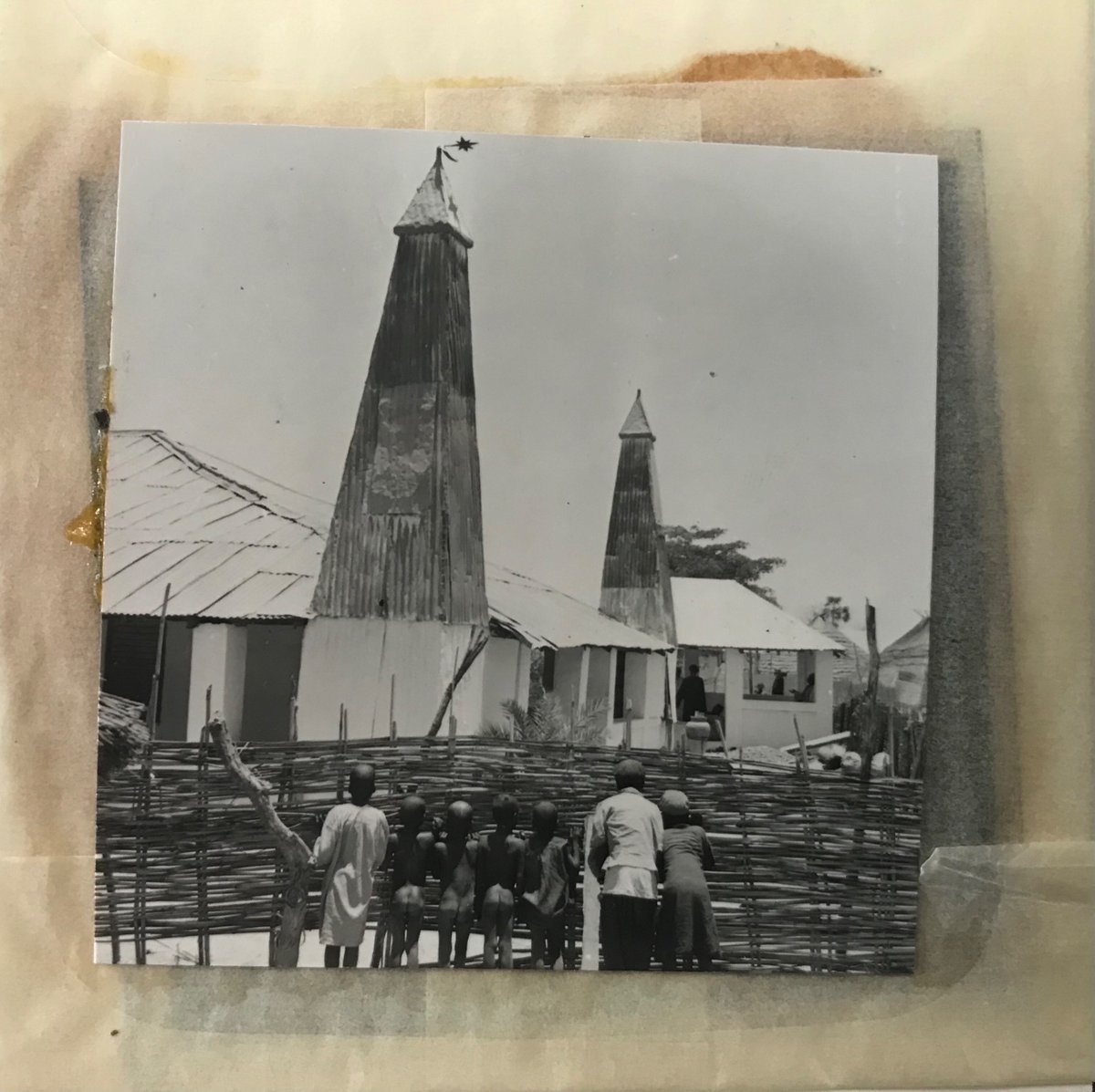
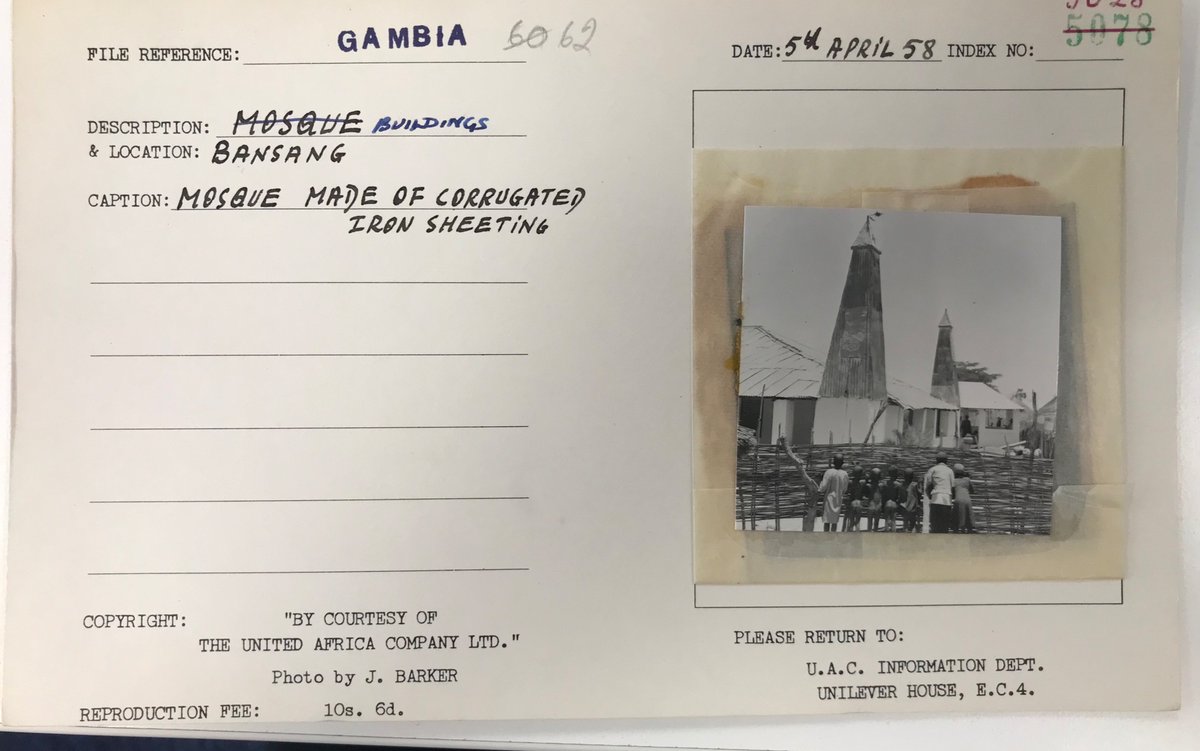
Corrugated iron mosque, Bansang Gambia. C1958.

From a collection of photographs taken by the United Africa Company @LivUniArch @iaindjackson @RixtWoudstra

Originally tweeted by Ewan Harrison (@EwanMHarrison) on September 22, 2021.

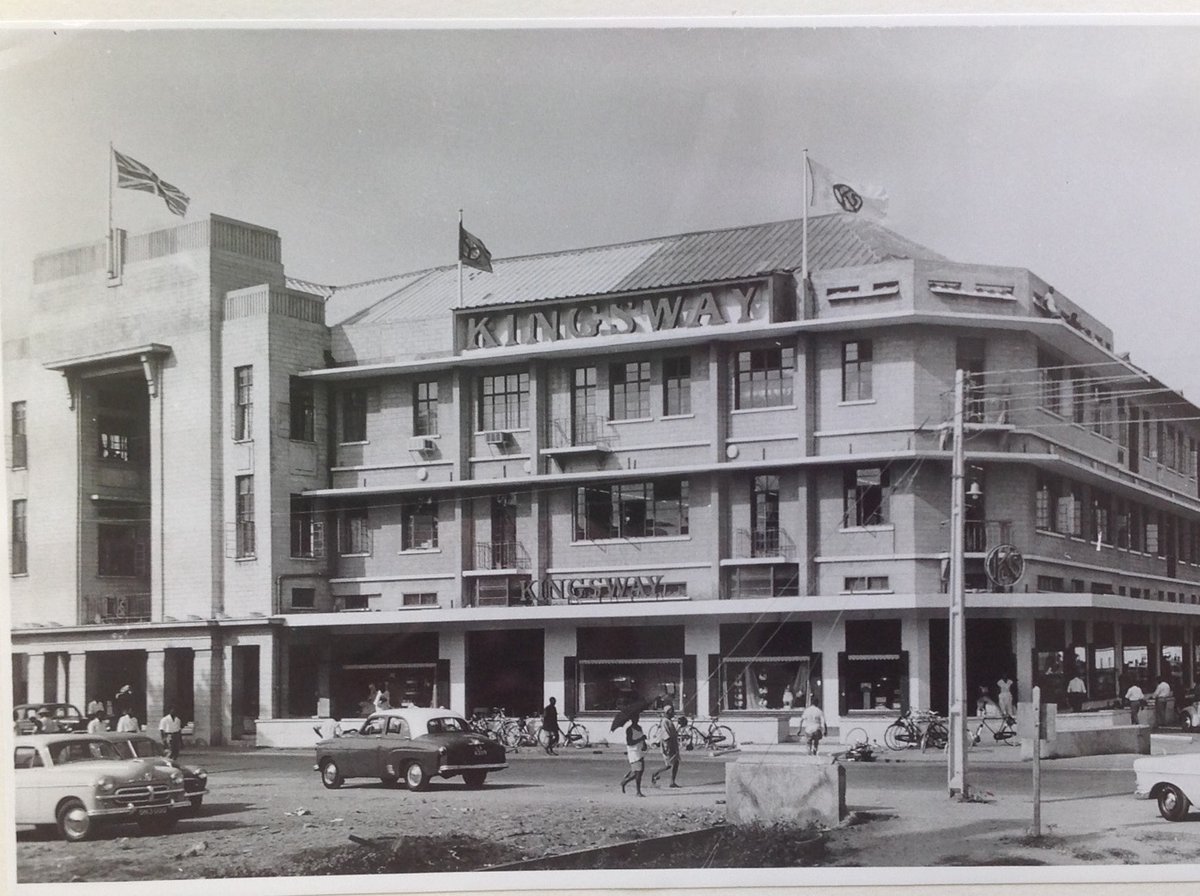
It’s a major design departure from the old Kingsway on Lagos Marina. Any ideas who designed this building? #UacArchive #Lagos #Kingsway

Originally tweeted by iainjackson (@iaindjackson) on September 30, 2021.

From the 1950s to the late 1980s, the politics and economies of foreign aid — instigated by both the ‘capitalist West’ as well as the ‘communist East’ — gave rise to a whole infrastructure destined to assist the progress of ‘developing countries’ on their ‘path to development’. The various North-South exchanges that took place in the name of ‘development’ have left a deep imprint on the geopolitical landscape of postcolonial Africa, Asia, and Latin America.

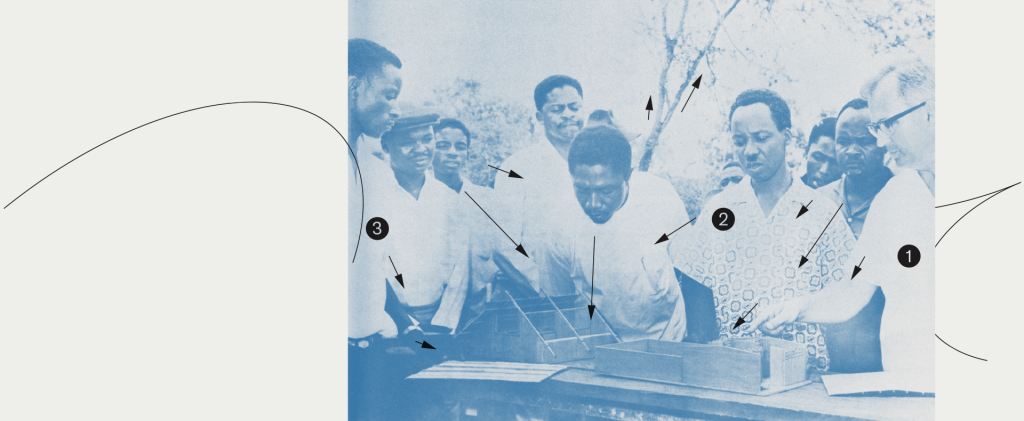
(1) Bertil Melin, the Swedish director of the Nordic Tanganyika Project in Kibaha, showing a model of low-cost housing to (2) President Julius Nyerere, c. 1963-64. To the far left, (3) Mr. Dennis, the carpenter who made the models, co-designed the housing project, and “test-lived“ in the first constructed house with his family. From Torvald Åkesson, ‘Education – In Marble Halls or Under Trees. Low-Cost Houses in East Africa, Especially Ethiopia and Tanzania’, compiled self-published report, c. 1965, Stockholm. Collection KTH Library.

Largely instituted through bilateral relations between individual states, these ‘aid’ initiatives involved not only financial and material resources but also various forms of knowledge and expertise; as such, the modalities of this global, foreign aid-funded infrastructure boosted the creation and reinforcement of all sorts of institutional actors to efficiently exchange knowledge — largely through training courses, educational programs and/or research projects. In the light of widespread rural migration and intensive, rapid urbanization processes, expertise on the built environment was a particularly salient form of knowledge to the aims of foreign aid. Hence, architecture, urbanism and planning were no strangers to an emerging foreign aid-funded knowledge economy — a context in which the production and circulation of knowledge were intimately tied to the political-economic value attributed to them by foreign aid diplomacy.

How did architectural knowledge figure in foreign aid-sourced international relations, and what frameworks were set in place to efficiently exchange that knowledge?

For this two-day symposium, we seek scholarly work that critically analyzes, contextualizes, or theorizes the establishment and functioning of such institutional actors, training courses, educational programs, research centers, and other infrastructures for knowledge exchange that emerged under the aegis of development and targeted ‘Third World’ clients. We welcome a wide range of methodological and creative perspectives as well as less empirical (but well-informed) theoretical approaches that interpret this phenomenon from a postcolonial or decolonizing perspective. We also encourage contributions that scrutinize the intersections of these histories with discussions of gender, race, religion and nationalism.

More information and Register here: https://www.architectureforeignaid.arch.kth.se

Name: Heather Lynn McGrath Alcock 
PhD Research Title: Beyond the Village: The Global Value of Port Sunlight 

Dissertation Supervisors: Professor Iain Jackson, Dr Ataa Alsalloum and Dr Cheryl Hudson 

Research Question: Does Port Sunlight village express Outstanding Universal Value and if so, what material and intangible aspects of the site express its influential, unique, and exemplary character? 

Aim: The aim of my research is to define the heritage values of Port Sunlight village in a comparative global context.


Figure 1: Mapping global planned worker villages. Sites are mapped by latitude and longitude and key characteristics are recorded for each site, including dates for development, designer, industry, and heritage site management indicators such as statutory protections.  

Objectives: 

  • Identify, map, and analyse the transmission of ideas and images for Port Sunlight village and two similar sites Bournville and New Earswick from 1889-1939. 
  • Complete desk-based research to identify, map and briefly describe global planned worker settlements, garden suburbs, and Garden Cities. 
  • Compare transmission of ideas and images research against the development of planned worker settlements, garden suburbs and Garden Cities research to identify and describe possible connections and influences. 
  • Undertake case studies for more in-depth comparative analysis, including archival research, field work and interviews with stakeholders.  
  • Analyse findings to determine if there is a correlation between the transmission of images and ideas and the development of planned worker villages. If so, would it be possible to identify the primary influence? Were direct or indirect forms of transmission most prevalent? What methods were most effective or enduring? Lastly, is it possible to directly trace Port Sunlight’s influence? 
  • Define Port Sunlight’s heritage values within UNESCO’s framework for world heritage site inscription.  

Figure 2: The model worker village at Port Sunlight was both a highly local and ‘tied’ manufacturing community and a global phenomenon. Foreign visitors toured the site regularly and Lever Brothers had a global business operation by 1900. This 1901 quote from the Crown Prince of Siam featured in the opening pages of the 1905 “Souvenir of Port Sunlight” by Lever Brothers Limited. (Held by Port Sunlight Museum, Collection Reference S13 1905) 

Background to Port Sunlight 

Port Sunlight is a planned worker village created by industrialist William Lever (1851-1925) for the workers in his soap manufacturing company Lever Brothers, which later became global manufacturing corporation Unilever, plc. Port Sunlight holds a unique place in the history of British town and country planning, where two significant traditions meet: picturesque town and country planning and improved housing and amenities for working class people”.1  

​​Construction of the Lever Brothers’ works started in 1888 and the first houses were occupied by 1889. By 1891, Lever Brothers had built their first community facility, Gladstone Hall and they were publishing visitor ‘guidebooks’ to promote the works and village. 

By the start of the first world war, the village had a wide range of facilities, including two schools, cottage hospital, an open-air swimming bath, 3000-seat auditorium, gymnasium, library, savings bank, social clubs, shops, church, tennis and bowling lawns, football pitch and pub.​ The houses and facilities were set in a generous landscape with passive green spaces, designed landscapes and allotments. ​ 

Figure 3: Plan of Port Sunlight as it was in 1938 by historian Michael Shippobottom in consultation with Edward Hubbard. The plan, reproduced in Hubbard and Shippobottom’s A Guide to Port Sunlight Village (3rd Edition, Page 34, Figure 32) illustrates the village at its first Jubilee.  

Port Sunlight village became a conservation area in 1978 and includes over 900 Grade II-listed buildings within 130 acres of parkland and gardens.  

Research Justification 

Port Sunlight faces many challenges, articulated in a suite of evidence-based strategic documents developed from 2018-2021 by Port Sunlight Village Trust (PSVT), the independent charity charged with the care and promotion of the village.2 PSVT, working in partnership with key stakeholders, plans to undertake significant projects and to advance key business objectives to address these challenges and to ensure the long-term sustainability, accessibility and inclusivity of the site.3 The research will support PSVT, village stakeholders, academics and practitioners to better understand the global value and significance of the site and to make more informed decisions about its future.  

Research Methodology 

My work will be informed by extensive archival research, case studies and oral histories, and my professional experience and understanding of heritage values (including current dialogue challenging the processes for identification and management of heritage sites), but it will also engage with the theoretical, contextual and historiographic approaches of others who have studied the design, development, transformation and impact of planned worker villages from multiple disciplines.  

Figure 4: Bridge Street and Park Road terraces houses in Port Sunlight by Douglas and Fordham, 1893. Digital version from the Drawn Together collection under Creative Commons CC-BY-NC-ND. Original drawing held by Unilever, plc.  

What did I do before the PhD Research? 

As a British-American citizen and a mature student, I enjoyed twenty years in built heritage practice in the USA and UK. My academic degrees in Cultural Anthropology and Historic Preservation from the University of Pennsylvania led to private heritage consultancy in New York City. There I worked for Building Conservation Associates, Inc. on many aspects of built heritage practice across the country. In New York, I developed a practical approach for the creative adaptation and conservation of listed buildings for tax credit projects, which resulted in the regeneration of at-risk heritage sites. Research underpinned my practice, including heritage policies for the United Nations Headquarters in New York and a serial listing for the New Canaan Moderns.   

Before starting my PhD at Liverpool, I served as the Heritage Conservation Officer for PSVT, where I had the opportunity to draft one of England’s first Local Listed Building Consent Orders, to design and implement a conditions and integrity survey of the 923 listed houses in the village, co-authored the Conservation Management Plan (2018) and managed Drawn Together, a Lottery-funded partnership project to digitise original drawings for Port Sunlight. It was through my work for PSVT and direct engagement with village residents that I developed an appreciation for my research site and its stakeholders.  

Why did you pursue a PhD and what made you choose the University of Liverpool? 

Since immigrating to the UK in 2009, I had felt the pull towards further education, particularly in a British context. I found time during the disrupted life of the pandemic to apply for both a PhD and research funding. The Society of Architectural Historians of Great Britain (SAHGB) awarded me their Graham Child Scholarship, so the question of funding was very happily and gratefully resolved. My choice of university was straight forward. I was well-acquainted with the School of Architecture, the excellent reputation of its researchers, its facilities, and resources. Both the Architecture and Planning departments had ties to Port Sunlight and the archives hold significant collections for the transmission of ideas research. I had met both Ataa and Iain through my work at Port Sunlight and felt they would make an ideal team to supervise my cross-disciplinary dissertation. Everything fell into place! 

What are your first impressions of life as a PhD researcher and what do you think you will do after you have finished? 

I am perhaps one of the most grateful and fortunate people in Wirral as I am being paid to learn, think, and write about Port Sunlight. Working with Ataa and Iain has been incredibly rewarding as their global expertise and experiences in architecture, history and heritage connect and complement my own experiences and practice. Our differences make for lively and enjoyable discussions, and I always go away feeling a bit daunted but inspired. 

However, there is no denying the dramatic change of pace and the different daily rhythms I experienced when I became a PhD researcher. In my professional life, there were meetings, colleagues, volunteers, emails, public engagement, and strategic considerations. In short, there were people. Now, my world is quiet and contemplative (when my children are at school). My ‘to do’ list is long and exciting, but undeniably solo. I rather like working with a team and know that once my dissertation is finished, I will welcome back the noisy collaborative world of heritage practice and possibly the even noisier world of teaching.