Archive

Author Archives: jacksoniain

An Update from Takoradi, Ghana Part 2

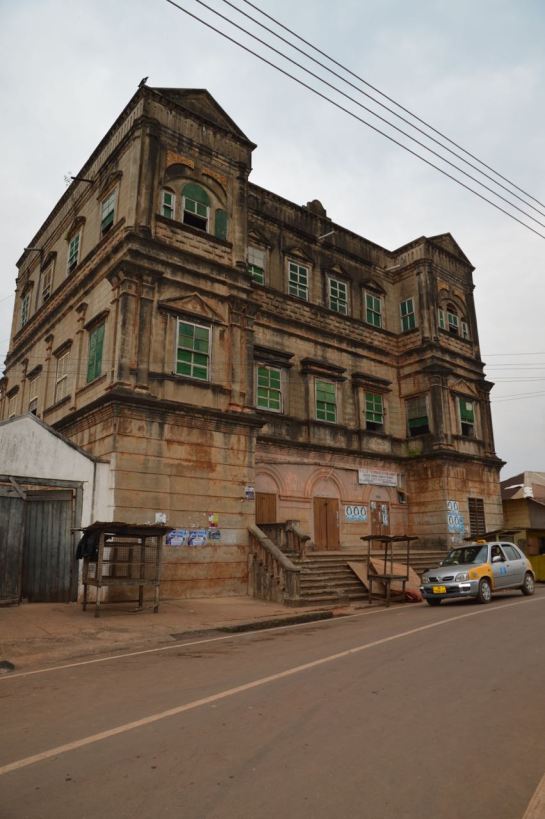
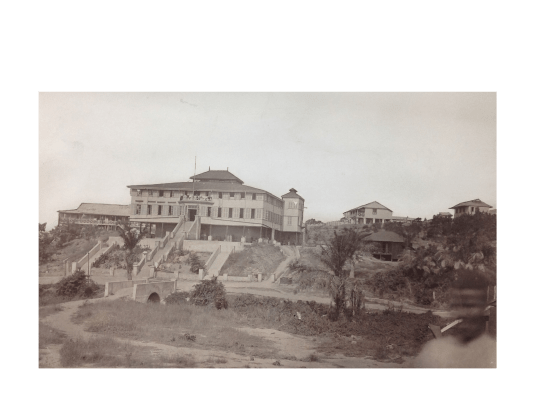
The docks and rail infrastructure of Takoradi was the impetus behind its rapid expansion from a small village to a major town. Construction commenced after WW1, but before this took place, it was neighbouring Sekondi that dominated the area with its grand houses, trading offices and the plush Metropole Hotel. The Dutch established Fort Orange there from 1670 and the natural harbour provided a suitable place for light vessels to shelter whilst the surf boats manned by the Kru people brought goods and people ashore.

evernote-snapshot-20160720-121210-copy

The Metropole Hotel, Sekondi

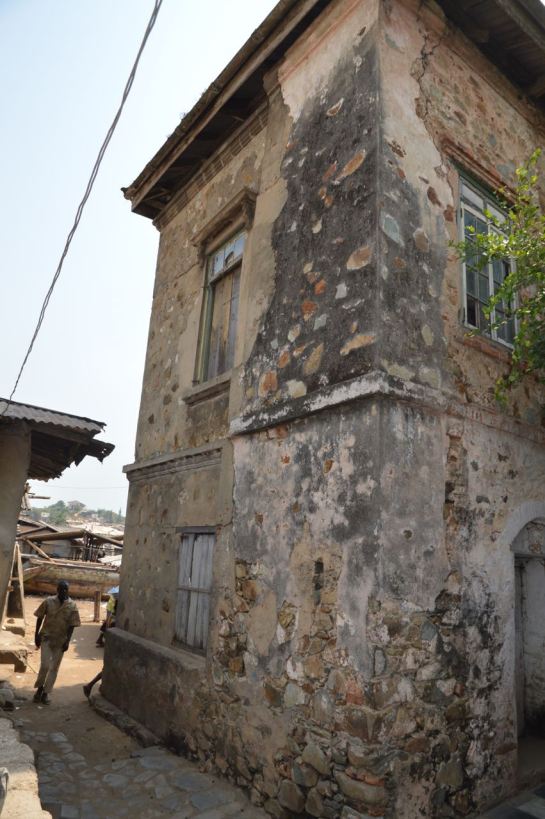
There is some rich architectural heritage in this town, and clear evidence of a once prospering settlement full of traders and merchants. Those days are clearly gone.

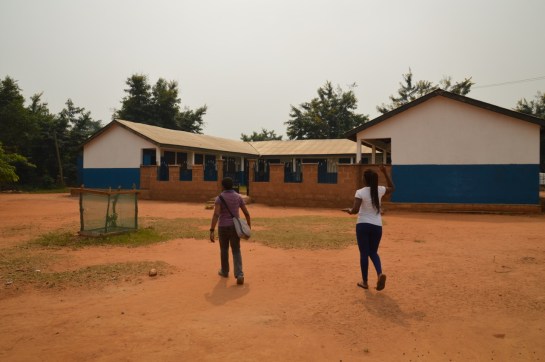
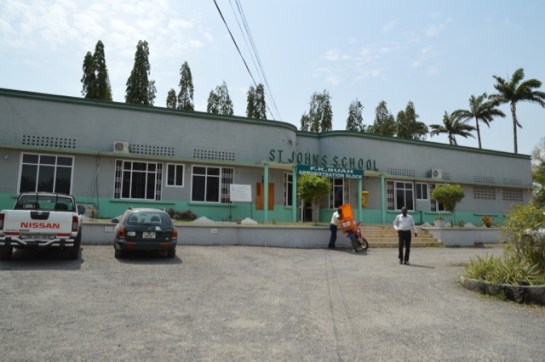
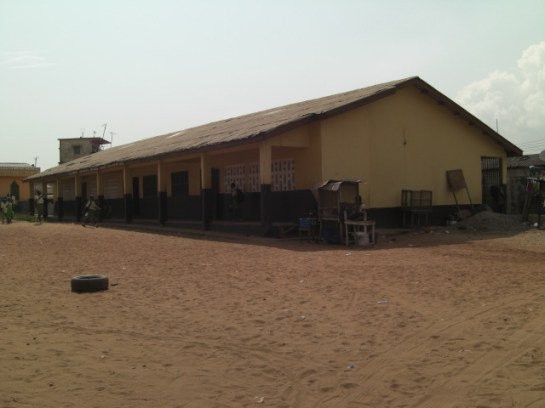
We started with two schools, the first called Fijai, captured here by the UK National Archives Africa through a lens. Then onto St. John’s, again the vintage photo below shows the clean lines of the school, when constructed c. 1955.


dsc_0383

St. John’s School, Sekondi

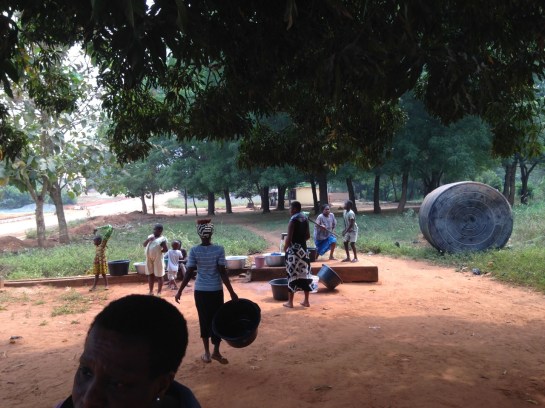
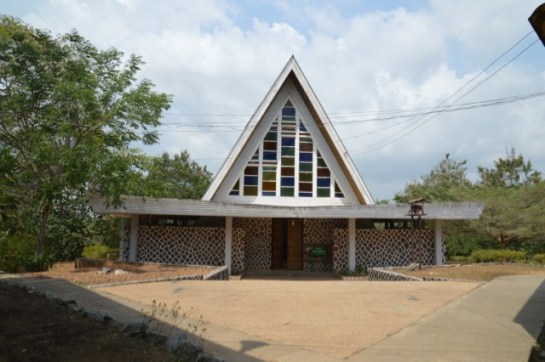
There have been further additions to the school including the striking church, donated by a Wisconsin family , with its large A-line structural frame,  finely detailed concrete casting, wooden ceiling and pre-cast screening. Next to St. John’s is Adiembra housing estate. There were revisions proposed for Adiembra in the 1944 Town Planning report made by Maxwell Fry and Jane Drew, but it is difficult to ascertain what impact this report made on the area, if any. However, we did spot some standpipes and washing stations that resemble those proposed by Fry and Drew in their manual, Village Housing in the Tropics, so perhaps this is evidence of their involvement.

dsc_0376

The Church at St. John’s School

We went onto the main street of Sekondi where the Post Office is located. We discussed this building in our chapter in Bremner’s Architecture and Urbanism in the British Empire, but were now shocked to see how the exquisite timber counter had been painted in bright blue gloss – destroying the previous display of tropical hardwoods. The rest of the street has only gotten worse since our last visit, with many of the former colonial buildings on the brink of collapse. Absent landlords coupled with a shrinking economy has left these structures vulnerable and economically unviable. Further sad news must be reported, as the modernist Sekondi Regional Library has recently been demolished and replaced with a new library.

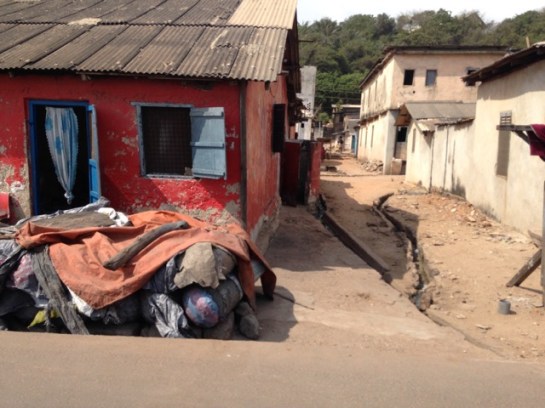
Our final visit in Sekondi was to the coastal-road village of Ekuasie, laid out in 1912. This was an early attempt at providing worker housing and adopts the familiar grid iron street format, although far more loosely imposed than similar schemes elsewhere (such as Korle Gono). There are some later and grander additions to this village, including a set of houses from the mid 1950s.

img_0663

Ekuasie Housing Estate

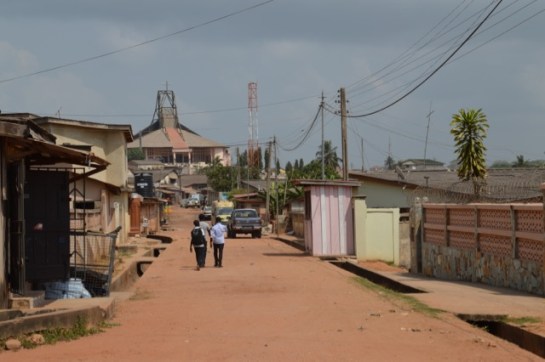
We returned to Takoradi and explored the workers’ estate, mentioned in the PRAAD archives as the ‘labourers housing and school’ at the Zongo area. This is still a thriving area, Hausa was heard being spoken and the tiny streets eventually lead to a playground-cum-village square, overlooked by the Islamic school and Mosque.

cimg5294

Takoradi Zongo School

An Update from Takoradi, Ghana

We started at the Takoradi Train Station, completed by 1928 as part of the coastal rail and docklands development. The train lines were initially constructed to transport cash crops, minerals and metals from the northern agricultural and mining districts to the awaiting ships, sheltered in the newly constructed breakwater and deep water harbour. When we visited in 2012 the train station was completely derelict and not in use. Today we found it carefully restored and new tracks laid. The plan is to reuse it for a local transport network. We walked up the hill to the small commercial district made up of international banks and a post and telegrams office. The mishmash of styles reveals the incremental development, as well as the fierce competition between the banks eager to differentiate themselves from the competition.

The former European hospital clock tower up on the hill overlooks the banks and docklands, as well as benefiting from the cooling sea breeze.

We drove to the 1920s part of Takoradi, a major new town extension that was built to accompany the docks development of that time. This portion of the town was primarily for the African population, although it also contains the Lasdun designed Bank of Ghana [built 1957]. Lasdun was also the architect of the National Museum in Accra. The bank was vacant when we visited in 2012, but now it stands in a state of complete dereliction, its fine materials and fixings being stripped from the building. This is a real tragedy. It was once an outstanding building, recorded in the Architecture journals of the day and surely one of Lasdun’s greatest works from this period.

img_0633

Somewhat downbeat, we bid farewell to the bank, and made our way to the rond-point in the middle of the town. The map was deceiving, as this was built as a major market place – our driver told us it was one of the largest markets in West Africa. It had the feel of Kariakoo market  in Dar es Salaam, and also contains a delightful little PWD post office with its signage graphics still intact.

Adjacent to the market is Amanful Village. Laid out in 1922-3 it is a mixed use area of housing and commercial properties. The basic PWD-type houses and layout remained in place, but more wealthy owners had transformed much of the upper part of the estate to suburban housing.

We then went to the Takoradi Technical Institute, shown above (Left, b+w) in the Africa Through a Lens Collection at the UK National Archives. There is a forcefulness to this scheme that takes the familiar two storey gallery access format, and emboldens into more ‘clunky’ yet determined architectural-structural forms.

dsc_0363

Nearby is the Effiekuma housing and the Effia Nkwanta hospital. The hospital has evolved overtime from a European hospital-cum-sanatorium in the colonial period, to a major health provider today. The careful layering and response to the site contours offers delightful views as well as a most welcome breeze to all the small structures that each have a view of the docks. At the top of the hill is a large brutalist extension that dates from c. late 1960s early 1970s. But who designed it?

24 hours in ‘downtown’ Nairobi

Dr. Ola Uduku, Dean of Africa, University of Edinburgh

Nairobi definitely has its charm. Unlike West Africa’s capital cities with their myriad of pot-holed or dirt tracks for roads, Nairobi’s roads at first glance seem akin to being in South or North Africa if not the West. The motorways seem to thrust the driver into the superhighways and traffic freedom that most of Africa can only dream of. Even the traffic lights work – in a peculiar manner we found out.

Image set 1: Downtown Nairobi

A trip from the airport to the city centre however can take 2 hours at peak traffic congestion periods or if it rains, so the absence of potholes does not equal speed of arrival. As one nears the city various parts of the skyline become more visible. An abstraction of the empire state building, followed by a squat version of Big Ben, signifying the parliament buildings, then the thrust of downtown Nairobi. The informal city seems well removed from view as the planned city is viewed before one’s eyes. Conference over, on day three a motley group of presentation weary conference attenders take a walk through central Nairobi – this is what we saw.

Starting out a vantage point on Kimathi Street we walked past the ‘hip’ Java Café to a bookshop in search of Iwateni and Wanjiku’s A Brief Tour of the Buildings of Nairobi, five-star recommendation if you can find it. I wanted to find Dorothy Hughes’ cathedral, which seemed absent from our Guidebook, we finally found a very short paragraph about it – clearly not significant to our guidebook writers. We nearly walked past its unimposing exterior façade.

Image set 2: Cathedral designed by Dorothy Hughes

Security in Nairobi has heightened since Westgate, so getting in to the building required bag searches and photography was not allowed. A discussion with the priest in charge gave us the permission we craved. Hughes’ oeuvre is definitely worth viewing. The play of light and the scale of the glazing enraptured us for the better part of half an hour. Its expressed structure also mimics well the stonework of the traditional European church in cast concrete ribs with occasional delicate details. Presumably planned to respond to the post Vatican Council 2 church layout, it has the alter moved from the apse to engage more with the congregation. This works well in relation to the cruciform structure of the layout.

Enroute we came across the memorial to Lionel Douglas Galton-Fenzi who was involved in an early car rally, which established road routes from Nairobi to various parts of East Africa and founded the East African Automobile Association. The monument also marks the historic central milestone for Nairobi Kenya, and gives distances to various faraway destinations. Not in terribly good shape but gives a sense of Nairobi in relation to the rest of the African continent.

Next stop KICC Centre. More security checks to get in to what, at first glance seemed, an inauspicious entrance to a rather large structure. As we make our way to the entrance however the structure begins to emerge. A very Scandinavian group of offices in a watered green setting soften’s the structure a brutalist concrete façade from ground level upwards to the scaling of a group of Swedish chalets. The entrance podium level is dark wood and retains its seventies interior design. The trace of a once clock strikes the right spot for the pre tower climb. The lift to the 27th floor works, and we get out before realising there is still some climbing to do. The top of the tower gives an amazing vantage point. A few other intrepid visitors share our view, Nairobi revealed, is a very green city but noisy too we can hear the soundspots and see the transport chaos from afar. Fast trip down and a coffee stop with a great view of the building – we didn’t make it into the conference centre but viewing the interior setting compensated for this. The detailing cries back to the Barbican Centre in London, apparently Norsvikk worked with the architects dept of Kenya city council – might there have been an exchange of ideas?

Image set 3: KICC Centre

Could we take in a few more buildings before dusk? The central mosque, next and across the road from Hughes and Polkingham’s Pensions building. A wall of high-rise architecture with a podium shopping façade. We split ways at the mosque as I wasn’t allowed to visit the male areas. The mosque occupies a large expanse of land in the CBD. Its been constructed around a much older mosque and now has a number of ancillary facilties. Part of its original site is occupied by a bank building which we found out later was one of Kenya’s first local savings banks.

img_1611

Image 4: Mosque and Bank 

We trudged out of the CBD on surely one of the best-designed footbridges in Nairobi to the campus site of the University of Nairobi, separated from the CBD by a busy motorway. An oasis of calm set around a quad, this did seem like the quintessential tropical university college campus. A few somewhat newer large additions including a school of Architecture and planning did not detract from the original quad buildings. To one side was the Nairobi Synagogue another visit for another day. Finally we made our way to Kenya’s National Theatre situated opposite its five-star Fairmont Hotel, used for the filming of “Out of Africa”, once owned by Tiny Rowland, and survivor of a 2010 terrorist bomb attack. We walked in on a major event for Kenya’s elite and had our beers and dinner whilst we ‘people-watched’ and were offered canapés on the balcony.

If you have the morning to spare, (we did it the next morning), a visit to the National Museum at the aptly named museum hill would be a great way to end the tour. Be careful of traffic lights where the ‘green person’ does not necessarily grant you right of way. When you do get through the doors bite your lips and pay the hefty foreigners fee, it will be worth it. It’s a series of buildings knitted to gether with good architectural nouse. The original building is a colonial affair, added to this is the Aga Khan wing, and its most recent addition formalises the setting into a court yard with the obligatory entrance, museum shop and café all being part of the project. At a location somewhat further downhill on the site is a snake sanctuary, which we decided to give a miss to. We were treated to an installation display showing the Scandinavian contribution to architecture and development in East Africa with Norvikk starring with the KICC tower and others who had contributed less show piece buildings but more development focused infrastructure to East Africa in the 1960s and 70s. Various parts of Kenya’s history from early skulls of pre neandrathel man, to the legacy of the Leakey family and banking, which brings the viewer back to the 20th century with the m-pesa exhibit. The museum café should round up your 24 hours in Nairobi city perfectly with locally brewed Kenyan coffee on tap.


Congratulations to Roy Khatchadourian, University of Liverpool [M.Arch 2016], on winning the 2016 RIBA Dissertation Medal for his thesis, A Juxtaposition of Ideological Expressions: Evaluating the urban transformations of Yerevan (Armenia) during 1915-2015. 

img_0528

Roy Khatchadourian being awarded the Medal by Alan Jones and RIBA President Jane Duncan

The dissertation discusses the contribution of Armenian-Russian architect Alexander Tamanyan (1878 – 1936) and his substantial work in Yerevan during the 1920s. The research investigates his attempts to create a ‘National architectural style’ and rejuvenate the country.

Following the Soviet occupation in 1920, a recently formed independent state was forcefully ended. However, its nationalistic ambitions were not completely inactive throughout the foreign rule; Tamanyan’s 1924 masterplan for the city was deeply rooted within the nationalistic rhetoric. Over time, it was widely used as an emblem to the city, presumably due to its rich political allegories and nationalistic ‘drive’. Through it, efforts were made to overcome a difficult past, by erasing specific histories from the city and replacing them by the enhancement of other selected memories.

After being forgotten for some years, Tamanyan’s efforts were revived after Armenia broke free from the Soviet Union. This was made evident in large developments within central Yerevan, acting as the ‘completion’ of Tamanyan’s vision. The Armenian diaspora, particularly from Russia and USA played an important role in these works, importing with them ideologies from abroad. Therefore, this dissertation discusses 3 phases within the recent urban transformations of Yerevan: Pre-soviet (1915-1920), Soviet (1920-1991) and Post-Soviet (1991-2015).

Architects Journal article with further details.

Call for Papers Architecture & Culture: Behind the Scenes: Anonymity and the Hidden Mechanisms of Design and Architecture

Vol. 6, Issue no. 1, March 2018

Jessica Kelly, Editor.

rfac_cfp_325_500

Rudolph, Paul, Architect. [Paul Rudolph’s architectural office in Manhattan. Man stepping across file cabinet tops among elevated drafting stations]. [Ca, 1965] Image. Retrieved from the Library of Congress, https://www.loc.gov/item/2010649573. (Accessed May 23, 2016.)

We tend to think about architects and designers as ’names’, creative individuals who have become branded personalities, bringing with them a particular look or attitude.  Yet as long ago as 1937, the journalist J.M. Richards declared that the personalities of architects and designers should become ‘culturally irrelevant’. Richards’ perspective emphasized the role of collective processes and anonymity in design and architecture. This Issue of Architecture and Culture seeks to look beyond the named individual or brand and explore the invisible, the overlooked and the ignored in design and architectural practice.

Focusing on the people, places and practices that are outside of or peripheral to conventional discussions, we ask in what ways personality remains relevant in design and architecture. This could include questioning the role of biography and autobiography in design discourses, exploring collaborative practices and globalised perspectives. The aim is not to propose new centres or canons but instead to de-centre discussions; to embrace the complexity and multiplicity of characters and narratives in design practice and history.

Coupled with this issue of personality, is the theme of ‘hidden mechanisms’ in design and architectural practice. Responding to Igea Troiani and Suzanne Ewing’s exploration of the ‘Inter, Multi and Trans-Disciplinary’ character of design practice, this Issue will consider the complex fields of activities involved in design and architecture. Emphasizing process rather than products or outputs, contributions might consider the role of administration, documentation, mediation and commentary in design practice. It will focus on the theme of networks (formal and informal, professional and personal) and will interrogate themes such as authorship, collaboration, creativity and the definitions of ‘ordinary’ in terms of practice, people and style.

Call for papers for this issue

We seek contributions from a wide range of practices and disciplines to interrogate the hidden, the intangible and the anonymous in design and architecture. We welcome contributions that consider alternative forms to the conventional academic essay, including the visual and verbal.

Contributions might address, but are not limited to, the following themes:

–    Design and anonymity in various contexts such as production, patent and copyright
–    Collective Practices and collaborative dynamics: Design teams, creativity and authorship
–    Networks – public and private, personal and professional
–    Non-masculinist/Feminist perspectives on design production
–    Spaces of production
–    Non-expert producers
–    Inter-disciplinary practices
–    Alternative modes of discourse: orality, non-verbal communication
–    Global perspectives on design practices and discourses

Contributions can range from short observations or manifestos, creative pieces, or visual essays, to longer academic articles. Architecture and Culture is published in both on-line and hard-copy formats: there is capacity to host on-line contributions that operate in a different way to paper-based work.

Production schedule

Response: 1 January 2017
Editors selection: February 2017
Peer Reviewing: March-June 2017
Authors Revisions: July-September 2017
Editorial checking: October-November 2017
Copy to publisher: 1 December 2017
Issue publication: March 2018

For author instructions, please go to ‘Instructions for Authors

Upload submissions at: http://www.editorialmanager.com/archcult/
Or via ‘submit online’ at http://www.tandfonline.com/loi/rfac

If you have any queries or require further information, please contact:
Jessica Kelly: ‪jkelly1@ucreative.ac.uk‬‬‬‪‬‬‬

Report from Chulalongkorn University, Bangkok, Thailand

Chulalongkorn University occupies an enviable site in Bangkok, spacious tree-lined avenues lead to large parks providing some tranquillity from the city beyond. The University was established in 1917 and the earliest buildings were designed by British architect, Edward Healey in a fusion of Beaux-Arts with Siamese decoration.

Nat Phothiprasat (alumni of Liverpool School of Architecture, BArch in 1929), established the Architecture Faculty in 1930. It relocated to its current location in 1940 and was designed by Lucien Coppé and Siwawong Kunchon na Ayudhya in 1940. Next door to the School of Architecture is the Chemistry Building (now Arts and Cultural Centre), designed c. late 1930s. The architect, Saroj Sukkhayang, (also studied at Liverpool, Dip. Architecture and Civic Design, 1920) had recently returned from a trip to Europe and was eager to implement in Thailand some of the designs he had experienced. Solar shades project above window openings, geometric symmetrical arrangements and the recessed curved entrance void give the building its distinctive character. It is astonishing to see another building designed by the same architect at exactly the same time – but in a completely contrasting style. The Arts Auditorium was an attempt to re-invent Thai architecture using modern materials and techniques, taking familiar motifs and ornamental designs but casting them in concrete rather than carving them in wood. It was also a collaborative design undertaken with master-builder U Laphanon. The rationale for using the concrete ornamentation was to create a more durable building that wouldn’t require the continuous renewal demanded by timber structures. The process of casting however demands that the formwork can be released from the cast and subsequently the ornament appears somewhat flat, and lacking the intricacy associated with timber carving. Concrete also permits longer spans than timber and the result is a larger single form, appearing as if extruded from the gable rather than as a series of hipped roofs and interlocking forms associated with more traditional forms of construction.

The student club house was also designed by Saroj Sukkhayang and Chuea Patthamachinda. Recently renovated and losing its shutters in the process, the building is now sealed and air-conditioned.

A more recent addition to the campus is the Student Union Building designed by Vodhyakarn Varavan and Lert Urasayananda in 1966. A large assembly space with smaller recessed annexes is formed by the spikey louvred gables. Robin Ward describes it unfairly as an ‘Elvis-era resort in Hawaii’ style building – but it is surely more than this. It is a response to the Wat structures coupled with innovative structural and climatic devices, as well as attempting to find a new lexicon for an optimistic university campus.

Close by to the campus at Siam Square is the exquisite Scala Cinema (1967) and well worth visiting, as is the former British Council Building.

Leaving the campus, heading through China Town and over the River we visited the Phra Borommathat Maha Chedi stupa. Built from 1828AD there is a blend of Palladian and local motifs. The temple has been sensitively repaired following a major structural failure and collapse. Just a short walk away is the Santa Cruz church and a small Catholic community that resides in the area. The narrow lanes prevent any motor traffic and the shading of the trees shelter the calm labyrinthine streets below. The community can trace its origins to Portuguese traders and they still bake Portuguese style cakes today. A wonderful museum [Bahn Kudichin Museum] is being created to celebrate this heritage. There are some excellent pencil-rendered measured drawings on display depicting the timber houses from the area (produced by students on the Thai Architecture Programme at Chulalongkorn University). The narrow streets betray the open spaces and gardens that lie within this exciting complex.

This side of the river contains the factories, go-downs and sheds associated with a burgeoning city – and like in many other cities, these frequently dilapidated yet enticing structures attract artists, architects and ‘creatives’. One such development is particularly of note – the Jam Factory. Designed and developed by architect Duangrit Bunnag. Duangrit was kind enough to give us a tour around the Factory which houses two of his restaurants, café, book shop, gallery and design studios.

I made a quick visit to Mahidol University campus too, to see the former Students Union Building and the cosmic brutalist lecture hall designed by Amon Sriwong in 1965.

A few other of my highlights include the Brutalist buildings along the Suriwongse Road, as well as the Neilson Hays Library designed by Mario Tamagno in 1921 and the Sri Maha Mariamman Temple, a Dravidian temple used by the south Indian residents of Bangkok from the 19thC onwards.

Many thanks to Professors Pinraj Khanjanusthiti, Saranya Siangarom and Chomchon Fusinpaiboon of Chulalongkorn University for all their generosity and help during my stay in Bangkok.

image2

Chomchon Fusinpaiboon giving a pre-tour briefing at Chulalongkorn University Faculty of Architecture Library.

As part of our British Academy Internationalisation and Mobility grant Iain Jackson and Ola Uduku visited Rexford Opong at KNUST in March (we included some brief updates here: Notes from Kumasi and Notes from Kumasi: part 2 and also Notes from Kumasi Part 3). We were fortunate enough to visit the Estate Planning Department and drawing offices and photographed some of the original drawings made of the university estate and buildings. Whilst every effort is being made to carefully preserve these drawings they have been subject to the ravages of time, humidity and vermin attack and many are in a poor state of repair. They are unlikely to survive for much longer.

dsc_0170

Drawing of the First Floor Senior Staff Club House, KNUST

In an attempt to remedy and counter this we are putting together an ‘Archives in Danger’ grant that, if successful, will enable these important artefacts to be digitally scanned/carefully photographed and then carefully preserved and archived for future scholarship.

In the meantime we’ve used the photographed drawings to produce a series of new CAD files. Pedro Bittencourt, a student based at Liverpool School of Architecture, has worked dilligently on translating the imperial scales into a metric format and has produced all of the new drawings. He has then used these drawings to construct a beautiful scale model of the Club House, utilising a laser cutter as to form the delicate components.

pedro

Pedro with the completed scale model

We’re hoping to produce additional models of other buildings on campus that can be used in exhibitions and as part of our lecture series.

img_0125img_0126

CALL for PAPERS

II International Conference on ‘African Urban Planning’

Date:

7 – 8 September 2017

Location:

University of Lisbon, Portugal

african-urban-planning

Organization:

Institute of Geography and Spatial Planning, University of Lisbon & International Planning History Society (IPHS)

Conference Website:

https://sites.google.com/site/cpcup2017conference/

Conference e-mail:

urbanplanningafrica2017@gmail.com

Important dates:

– Submission deadline for abstracts: 31 January 2017

– Notification of abstract acceptance: 15 March 2017

– Registration and payment: 1 – 15 April 2017

Flyer: aup-2017-lisbon_conference-flyer