Archive

Global Architecture

Paul Oliver Obituary by Elain Harwood

Only 1% of houses around the world were designed by architects. Paul Oliver, who has died aged 90, devoted himself to studying the remainder, architecture that was of the people rather than built for them. His books on vernacular architecture ranged from Dunroamin: The Suburban Semi and Its Enemies (1981, with Ian Davis and Ian Bentley) to a three-volume Encyclopedia of Vernacular Architecture of the World (1997), produced with 780 contributors from 80 countries.

An artist by training who became a distinctive commentator on both architectural history and music, especially the blues, he considered himself a generalist, though writing from an architectural background; when pressed, in 1998, he accepted the term “architectural anthropologist”.

His opportunity to develop this perspective came from taking a part-time job as drawing master at the Architectural Association (AA) in London in 1960. When the leading academics Robert Furneaux Jordanand Sir John Summerson both quit, he was left as the principal lecturer in architectural history.

Oliver’s inspiring teaching took two strands. One was the study of modernism, with its emphasis on simplicity, quality and economy. The other was vernacular architecture.

His interest had been aroused when his parents moved to Symondsbury, near Bridport in Dorset, a village with a strong music tradition, a mummer’s play and a close-knit cottage community. Then six articles in the Architectural Review by EA Gutkind, a planner, in 1953 revealed the diversity of traditional building around the world.

The study of vernacular traditions offered ideas on honest construction and functionalism attractive to modern architects, while also contributing to Britain’s emerging conservation movement. An international dimension took hold when in 1964 Oliver was invited to teach at the School of Architecture in Kumasi, Ghana, where his AA colleague John Lloyd was principal. Oliver and his students studied the ways of managing a humid climate and restricted resources, patterns of use and the buildings’ cultural values. His eyes were opened by the housing of the Gurunsi people, compounds with “the formal beauty and logic of pottery”, as he later wrote, which were being swept away for a reservoir and replaced by rows of prefab dwellings that paid no respect to Gurunsi traditions.

Paul Oliver had a lifelong interest in African-American music

The Ghana trip coincided with Bernard Rudofsky’s exhibition Architecture Without Architects at the Museum of Modern Art, New York. Although it was important in popularising vernacular architecture as a subject, Oliver was enraged by its emphasis on the buildings as art objects, which he considered patronising. Working with colleagues from the AA, including students from its small department of tropical architecture, he offered a broader cultural perspective in his book Shelter and Society (1969). Further books on Africa, Greece and symbolism in buildings followed.

His greatest love was perhaps sub-Saharan Africa where, under Islamic and Christian influences, architecture predominates among the visual arts. His contributors were architects and anthropologists, but the disciplines seemed entirely separate; only archaeologists took a holistic view, and Oliver considered their approach to be as valid for the present as the past.

He advised on conservation issues in French towns and villages for the Patrimoine Historique et Artistique de la France. The British Council supported research and teaching in East Africa and India, and he worked for the Overseas Development Administration in Turkey, the Balkans, Central America and Mexico. Some projects focused on the vulnerability of vernacular buildings to earthquakes and floods, and the failures of post-disaster housing that had not taken account of the lessons of older cultures.

Oliver became head of the AA’s graduate school in 1971, but left two years later to lead the art and design department at Dartington College of Arts, at Dartington Hall, Devon. He became an associate head of the architecture school at Oxford Polytechnic (now Oxford Brookes University) in 1978 and founder of the Shelter and Settlements Unit there. His greatest concern was to safeguard traditions in the face of technological change. He believed that the wisdom, skills and satisfaction of human needs embodied in traditional buildings were fundamental to the housing of millions in the 21st century.

In 1987 Oliver took early retirement, though he continued as a visiting professor, so he could devote himself to his research, stimulated by the suggestion of Alyn Shipton, reference editor at the publisher Blackwell, that he produce an encyclopedia of world architecture. His three-volume study was organised by cultures rather than countries, with the first volume explaining general traits, environments, materials and services. Oliver was particularly proud of sections like that for Ethiopia, which was entirely written by local scholars, while gamely taking on himself areas in which no research existed.

A forked post used in vernacular architectural style to support a beam in Taos, New Mexico

Born in Nottingham, Paul grew up in Pinner, north-west London, the son of W Norman Oliver, an architect, and his wife, the former Dorothy Edmunds. His father was keen that Paul should follow him into the profession, but he lacked any talent for mathematics and turned instead to painting.

At the age of 16, Paul entered Harrow Art School, where he met his future wife, Valerie Coxon (they married in 1950), and began a lifelong interest in African-American music. He trained as an art teacher at Goldsmith’s College, London, and in 1949 returned to his old school, the Harrow county school for boys, as art master. There he established a department teaching crafts as well as art, acted as client for a new building, and introduced an African-American music society after the headmaster refused to allow a jazz club. When he left this post for the AA, the drop in his income forced him to write more music reviews.

In 2003 Oliver was appointed MBE. His archive and photographs of vernacular architecture from around the world are held by Oxford Brookes University. In 2015, photographs demonstrating the inclusive and cross-cultural approach that he championed were exhibited in Oxford as Architecture for All.

Valerie died in 2002.
Elain Harwood

originally published in The Guardian: https://www.theguardian.com/artanddesign/2017/aug/31/paul-oliver-obituary

As a factor of globalization that accompanied the modern colonial and postcolonial period, transnationalism and an emerging landscape of cosmopolitan sites offered women new proving ground outside established social, cultural, and commercial spheres of architecture and planning. In this session, we investigate the significance of transnational mobility, over an open time period, for women as architects, planners, patrons, builders, curators, historians, or other users of the built environment. Whether their movement was based on privileged access to international networks or resulted from forced migration, we find repeated instances of an engagement in debates on regionalism, the vernacular, the everyday, the folkloric, and the anonymous, as expressions in architecture and planning. Seeing these debates as deeply contingent on the subject’s position, this session seeks precision on a problem that has inhabited the fringes of architectural and planning history: the gendered connections between an extreme mobility (understood as conditioned by specific historical contexts) and a theory of the situated. Thinking with Donna Haraway—in particular, her concern with ‘situated knowledge’ as that which is informed by the subject’s position and does not attempt the abstraction of universalism—this session attempts to map mobility and gender onto one another within a set of practices and visions that focused on structuring, building, historicizing, or thinking the undesigned, the unplanned. We see this in part as stemming from the vision of a stranger, a function of vision from a periphery or a territorially interior margin. As Hilde Heynen has discussed in relation to Sybil Moholy-Nagy, the turn to architecture without architects also shifted claims upon expertise, opening the position of expert to a wider pool. This session takes the epistemological question of what knowledge is produced by transnational mobility, and attempts to move beyond the frequent challenges of the archive and historiography, to suggest certain sites of resistance to a ‘canon’ from which many women have been excluded, as well as to the various borders which define architectural expression, authors, and publics. Bringing the work of women architects and non-architects alike into conversation, we invite papers that consider understudied professional figures such as Sybil Moholy-Nagy, Jaqueline Tyrwhitt, Charlotte Perriand, Erica Mann, Jane Drew, Lina Bo Bardi, Minnette de Silva, Hannah Schreckenbach, Dorothy Hughes, Gillian Hopwood, Ursula Olsner, and Denise Scott Brown, or a variety of named and unnamed groups of women—clients, laborers, refugees—whose transnational travels affected the built environment or its history.

Co-chairs: Anooradha Iyer Siddiqi and Rachel Lee

Submissions: Please submit max. 300-word abstracts to iyersiddiqi@gmail.com or rachel.lee@gmx.net

Deadline: 30 September 2017

http://eahn2018conference.ee/

**Deadline 19 May!**

reposted from http://design.britishcouncil.org/blog/2017/apr/12/open-call-rogelio-salmona-fellowship/?platform=hootsuite

OPEN CALL: Rogelio Salmona Fellowship Torres del Parque / photo by Enrique Guzmán © Fundación Rogelio Salmona

Torres del Parque / Photo by Enrique Guzman / copyright Rogelio Salmona

The British Council is seeking applications from architects and designers who have an interest in exploring the work of Rogelio Salmona and other architects and designers in Colombia for the Rogelio Salmona Fellowship.

Applications from practitioners in fields other than architecture and design are also welcome to apply (e.g. art; curatorial studies; history; social sciences or philosophy as well as architectural conservation and restoration; urban planning, architecture or design history or criticism).

The Rogelio Salmona Fellowship, alongside the Julio Vilamajó Residency in Uruguay, follows the success of the Lina Bo Bardi Fellowship in Brazil.

The Fellowship seeks to raise awareness and understanding of the important contribution of Salmona to architecture, culture and society in Colombia and across the region; to widen and deepen the understanding of his work internationally, to create long-term connections between the UK and Colombia, and between British and Colombian designers and architects, providing a development opportunity for talented British practitioners.

The Rogelio Salmona Fellowship is organised by the British Council and coordinated by Más Arte Más Acción, in partnership with Fundación Rogelio Salmona, Museo de Arte Moderno de Bogotá and Centro Cultural Universitario Rogelio Salmona – Universidad de Caldas.

 The Residency

While in Colombia, the designer in residence will be offered accommodation and access to a network of key contacts. They will be encouraged to visit all of Salmona’s built projects, to study the archive of his work, and to speak with people who have studied his life. A study of the work of other architects and designers, as well as Colombian culture as a whole, is also encouraged. The residency will be split between Bogotá and the Colombian Pacific Coast, and may include other cities in Colombia according to the proposed itinerary by the selected Fellow.

In addition to any specific areas that applicants would like to research, possible lines of enquiry in Rogelio Salmona’s work include:

  • Architecture and citizenship;
  • History and memory;
  • Environment and nature;
  • Craft and materials;
  • Public realm.

Applicants must be able to travel to Colombia for a period of 5-6 weeks between 15 July and 15 September 2017 (arriving in Bogotá before 15 August 2017).

How to Apply

Further information on the Fellowship and on how to apply detailed on the Open Call document.

The deadline for submissions is 16:00 (GMT) on Friday 19 May 2017.

Call for Papers: The 6th International Congress on Construction History

The 6th International Congress on Construction History (http://6icch.org) will take place in Brussels, from July 9 to July 13, 2018. 

The following thematic sessions look very interesting:

  • Modern ‘comfort’ in colonial/postcolonial settings beyond the‘centre/periphery’-framework. Johan Lagae, Jiat-Hwee Chang

  • Exchange in the construction worlds of 19th and 20th century Asia: the diffusion of materials and processes in the Global South. Srivastava Amit, Peter Scriver

  • Little planet. New approaches to a big picture in construction histories. East Asia and Europe in the 19tand 20th centuries. Changxue Shu, Thomas Coomans

The call for abstracts is now open: deadline June 15, 2017. 

Full brochure here: 6ICCH 2018 Brussels Call for abstracts

The 6th Conference on Infrastructure Development in Africa, has just concluded with a particular focus this year on ‘Building Resilience through African Urban Culture’. Held at KNUST in Kumasi, Ghana the conference welcomed speakers from Nigeria, South Africa and UK, as well as a host of research papers presented from scholars based in Ghana.

Key note speakers (including Prof. Chike Oduoza, Dr Obuks Ejohwomu and Prof. Mugendi M’Rithaa) lucidly presented the varied and many challenges facing African cities today – with particular focus on energy use, digital infrastructure and the internet of every/things.

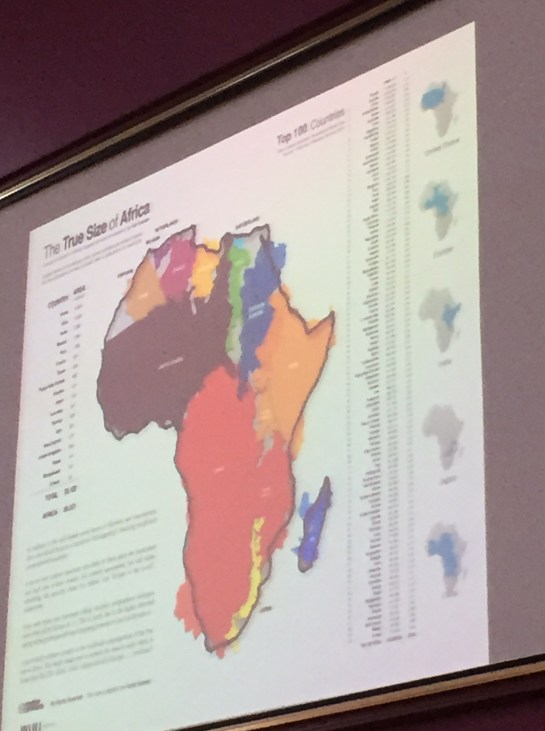
Prof. M’Rithaa’s presentation included some very striking map visuals, including the image below that shows the true size of Africa relative to other countries – something that Mercator projection of the world fails to reveal. You can just make out on the poor quality photo below the outlines of USA and India. He also spoke very eloquently on how our solutions must be people centred, rather than imposed solutions. Dr Ejohwomu also challenged us with many provocative questions and themes – including a cartoon showing an emaciated cow and a worker abandoning it in pursuit of an obese cattle. His challenge was that we can’t simply walk away from the problem and that Africa needs us to focus on its problems rather than attempting to flee them in the ‘global north’. This message also reinforced by Prof. David Edwards and Dr. Erica Parn in their presentation.

IMG_1313

IMG_1322

I gave a presentation on the rich modern architectural history of Ghana, and the infrastructure of culture that exists here. I focused on a series of building types including education, community centres, and libraries, as well as the town planning and historical development of Kumasi.

IMG_1309

Nearly 50 papers followed on a vast array of topics as well as a striking art installation on the plight of the African Giant Snail’s ecosystem. A new journal was launched ‘Journal of Built Environment (ISSN: 2026-5409) and next year the conference will migrate to Lagos – we look forward to hearing more from this important gathering.

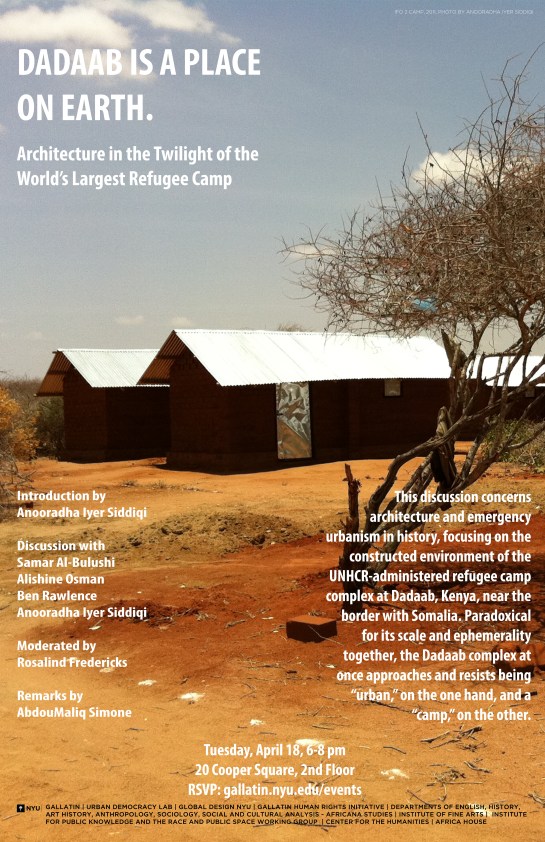
DADAAB IS A PLACE ON EARTH

Architecture in the Twilight of the World’s Largest Refugee Camp

April 18, 2017, 6:00-8:00 P.M., 20 Cooper Square, 2nd Floor, New York University

http://gallatin.nyu.edu/utilities/events/2017/04/DadaabIsAPlaceOnEarth.html

African Cities Week

This moderated discussion concerns architecture and emergency urbanism in history, focusing on the constructed environment of the UNHCR-administered refugee camp complex at Dadaab, Kenya, near the border with Somalia. Paradoxical for its scale and ephemerality together, the Dadaab complex at once approaches and resists being “urban,” on the one hand, and a “camp,” on the other. Established in 1991 to shelter thirty thousand refugees, the Dadaab complex expanded over the course of a quarter century to five settlements with a compound headquartering a centralized structure of humanitarian agencies. According to unofficial counts, it currently houses one half million refugees and asylum seekers, along with humanitarian aid workers in residence. In early 2016, citing security threats, the government of Kenya announced that it would close the complex prior to the next general election, and dismantled the Department of Refugee Affairs as a decisive measure. Through a detailed discussion on design, use, aesthetics, and affect at the Dadaab site, we hope to study the social and political lived realities of an environment constructed to be liminal.

Dadaab-1

Introduction by Anooradha Iyer Siddiqi

Discussion with Samar Al-Bulushi, Alishine Osman, Ben Rawlence, Anooradha Iyer Siddiqi

Moderated by Rosalind Fredericks

Remarks by AbdouMaliq Simone

Organized by Anooradha Iyer Siddiqi, with Rachel Stern. For more information and teaching materials related to this event, please see: http://gallatin.nyu.edu/utilities/events/2017/04/DadaabIsAPlaceOnEarth.html

Call for Sessions: 6th International Congress on Construction History

The 6th International Congress on Construction History (6ICCH) will be organised in Brussels, from July 9 to July 13, 2018. For the first time, thematic sessions as well as the usual open sessions will be organised. Therefore, a two-step procedure is adopted: the call for thematic sessions is launched first, followed by the general call for abstracts. The general call for abstracts will invite contributions for the special thematic sessions as well
as contributions dealing with a broad range of construction history topics (typology, the action of building, knowledge transfer, process and actors, materials, services, etc.). With this combination, the organisers aim at both a broad and an in-depth assessment of new research in construction history. The present call invites prospective session chairs to suggest topics for the thematic sessions. Their aim is to highlight explicitly the latest themes, approaches and directions in construction history research, and to foster
transnational and interdisciplinary collaboration and discussion on burning issues. Proposals should include a description of the theme (max. 400 words), a motivation of the relevance of the theme (max. 400 words) and a CV of the applicant chair demonstrating his/her relevant expertise. The organising committee will select up to 12 thematic sessions, limited to one per applicant.
Chairs of the thematic sessions are expected to be present at the 6ICCH and give a short introduction to their session. They are, in collaboration with the scientific committee, responsible for the selection process of the submitted abstracts and for the editing process of the submitted papers. For each session 4 to 5 papers will be selected. No more than one paper of the chair’s research team can be selected. The scientific committee reserves for itself the right to redirect papers towards other thematic or open sessions.

Proposals should be sent to info@6icch.org by April 1 2017. Session chairs will be informed about the selection of their proposal by the organising committee by May 1 2017.

important deadlines
Call for sessions: March 1, 2017
Submit sessions: April 1, 2017
Call for abstracts: May 1, 2017
Submit abstracts: June 15, 2017
Submit papers: December 1, 2017

organising committee
KU Leuven (Krista De Jonge)
Universiteit Antwerpen (Michael de Bouw)
Université Catholique de Louvain (Patricia Radelet-de Grave, Denis Zastavni)
Université Libre de Bruxelles (Rika Devos, Bernard Espion)
Vrije Universiteit Brussel (Inge Bertels, Stephanie Van de Voorde, Ine Wouters)

See the PDF here for more info: 6icch-2018-call-for-sessions

Los Angeles_LA River (2003) (002) (002).jpg

The modern usage of the term infrastructure has gone through a series of permutations from early emphasis on logistics, organisation, and the expanding scope of technological networks to more recent interest in the intersections with landscape, ecology, and alternative theorisations of urban materiality. In this event we will explore questions relating to the meaning and conceptualisation of urban infrastructures. The question of infrastructure will serve as an entry point for wider reflections on the changing experience of nature, modernity, and urban space.

This event is part of the Urban Salon – a London-based seminar series exploring urban experiences within an international and comparative frame.

Speakers:
Dr Jiat-Hwee Chang, Assistant Professor, Department of Architecture, National University of Singapore
Professor Dr Jochen Monstadt, Chair for Governance of Urban Transitions and Dynamics, Department of Human Geography and Spatial Planning, Utrecht University
Dr Manuel Tironi, Assistant Professor, Department of Sociology, P. Universidad Católica de Chile
Professor Jane Wolff, Associate Professor, Daniels Faculty of Architecture, Landscape, and Design, University of Toronto

Chair:
Professor Matthew Gandy FBA, Professor of Cultural and Historical Geography, University of Cambridge

To book see: http://www.britac.ac.uk/events/imagining-infrastructures

Congratulations to Roy Khatchadourian, University of Liverpool [M.Arch 2016], on winning the 2016 RIBA Dissertation Medal for his thesis, A Juxtaposition of Ideological Expressions: Evaluating the urban transformations of Yerevan (Armenia) during 1915-2015. 

img_0528

Roy Khatchadourian being awarded the Medal by Alan Jones and RIBA President Jane Duncan

The dissertation discusses the contribution of Armenian-Russian architect Alexander Tamanyan (1878 – 1936) and his substantial work in Yerevan during the 1920s. The research investigates his attempts to create a ‘National architectural style’ and rejuvenate the country.

Following the Soviet occupation in 1920, a recently formed independent state was forcefully ended. However, its nationalistic ambitions were not completely inactive throughout the foreign rule; Tamanyan’s 1924 masterplan for the city was deeply rooted within the nationalistic rhetoric. Over time, it was widely used as an emblem to the city, presumably due to its rich political allegories and nationalistic ‘drive’. Through it, efforts were made to overcome a difficult past, by erasing specific histories from the city and replacing them by the enhancement of other selected memories.

After being forgotten for some years, Tamanyan’s efforts were revived after Armenia broke free from the Soviet Union. This was made evident in large developments within central Yerevan, acting as the ‘completion’ of Tamanyan’s vision. The Armenian diaspora, particularly from Russia and USA played an important role in these works, importing with them ideologies from abroad. Therefore, this dissertation discusses 3 phases within the recent urban transformations of Yerevan: Pre-soviet (1915-1920), Soviet (1920-1991) and Post-Soviet (1991-2015).

Architects Journal article with further details.

Call for Papers Architecture & Culture: Behind the Scenes: Anonymity and the Hidden Mechanisms of Design and Architecture

Vol. 6, Issue no. 1, March 2018

Jessica Kelly, Editor.

rfac_cfp_325_500

Rudolph, Paul, Architect. [Paul Rudolph’s architectural office in Manhattan. Man stepping across file cabinet tops among elevated drafting stations]. [Ca, 1965] Image. Retrieved from the Library of Congress, https://www.loc.gov/item/2010649573. (Accessed May 23, 2016.)

We tend to think about architects and designers as ’names’, creative individuals who have become branded personalities, bringing with them a particular look or attitude.  Yet as long ago as 1937, the journalist J.M. Richards declared that the personalities of architects and designers should become ‘culturally irrelevant’. Richards’ perspective emphasized the role of collective processes and anonymity in design and architecture. This Issue of Architecture and Culture seeks to look beyond the named individual or brand and explore the invisible, the overlooked and the ignored in design and architectural practice.

Focusing on the people, places and practices that are outside of or peripheral to conventional discussions, we ask in what ways personality remains relevant in design and architecture. This could include questioning the role of biography and autobiography in design discourses, exploring collaborative practices and globalised perspectives. The aim is not to propose new centres or canons but instead to de-centre discussions; to embrace the complexity and multiplicity of characters and narratives in design practice and history.

Coupled with this issue of personality, is the theme of ‘hidden mechanisms’ in design and architectural practice. Responding to Igea Troiani and Suzanne Ewing’s exploration of the ‘Inter, Multi and Trans-Disciplinary’ character of design practice, this Issue will consider the complex fields of activities involved in design and architecture. Emphasizing process rather than products or outputs, contributions might consider the role of administration, documentation, mediation and commentary in design practice. It will focus on the theme of networks (formal and informal, professional and personal) and will interrogate themes such as authorship, collaboration, creativity and the definitions of ‘ordinary’ in terms of practice, people and style.

Call for papers for this issue

We seek contributions from a wide range of practices and disciplines to interrogate the hidden, the intangible and the anonymous in design and architecture. We welcome contributions that consider alternative forms to the conventional academic essay, including the visual and verbal.

Contributions might address, but are not limited to, the following themes:

–    Design and anonymity in various contexts such as production, patent and copyright
–    Collective Practices and collaborative dynamics: Design teams, creativity and authorship
–    Networks – public and private, personal and professional
–    Non-masculinist/Feminist perspectives on design production
–    Spaces of production
–    Non-expert producers
–    Inter-disciplinary practices
–    Alternative modes of discourse: orality, non-verbal communication
–    Global perspectives on design practices and discourses

Contributions can range from short observations or manifestos, creative pieces, or visual essays, to longer academic articles. Architecture and Culture is published in both on-line and hard-copy formats: there is capacity to host on-line contributions that operate in a different way to paper-based work.

Production schedule

Response: 1 January 2017
Editors selection: February 2017
Peer Reviewing: March-June 2017
Authors Revisions: July-September 2017
Editorial checking: October-November 2017
Copy to publisher: 1 December 2017
Issue publication: March 2018

For author instructions, please go to ‘Instructions for Authors

Upload submissions at: http://www.editorialmanager.com/archcult/
Or via ‘submit online’ at http://www.tandfonline.com/loi/rfac

If you have any queries or require further information, please contact:
Jessica Kelly: ‪jkelly1@ucreative.ac.uk‬‬‬‪‬‬‬