Central Lagos- quick picture show before (Nigeria Magazine 1962) and after (Jan 2024):

Western House by Nickson and Borys

Niger House for UAC by Watkins Grey

Book shop House Godwin Hopwood

Elder Dempster by James Cubitt – heavily modified with the new glazed facade.

Bristol Hotel by Godwin and Hopwood

Godwin and Hopwood Residence, Godwin and Hopwood

YMCA – slender single room deep plan, exposed staircase at the gable with concrete wrapping around. Commercial retail units at the base, pavilion and garden at the roof. Cracking scheme – but who is the architect?

Alan Vaughan-Richards House

Alan Vaughan-Richards (1925–1989) studied at the AA and worked for Architects Co-Partnership in Nigeria before establishing his own practice in Lagos.  His house and studio in Ikoyi, Lagos has featured on the TAG blog before as part of the archiving and digitisation of Vaughan-Richards’ drawings undertaken by Ola Uduku, and further published here: https://www.taylorfrancis.com/chapters/edit/10.4324/9780429506765-16/alan-vaughan-richards-archive-ola-uduku .

The house was originally planned as five interlocking circular rooms – responding to Yoruba housing forms. It contained a water feature, disco-lights, and a hardwood bar too. Set within the sweeping walls are built-in furniture, seating, storage and carefully curated spaces for art and sculpture. In section the light flows in from the roofscape, whilst also ventilating the passively cooled space. Vaughan-Richards collaborated with various artists and sculptors to produce door screens (one includes a carving of the house), furniture, and panels that feature in almost every space. A seating area cantilevers over the garden and once offered views over the lagoon beyond (now reclaimed land and gradually being built upon). The materials, natural ventilation, and careful positioning of the windows create delightful interiors with views out over the landscape and the giant trees that are home to African Greys. The house is a compact and modest scale with a refreshing lack of pretensions.  It was gradually extended by Vaughan-Richards to accommodate his growing family and a new floor was added above.

Outside the main property is a geodesic domed room providing additional visitor space and also used for exhibitions and events.

Vaughan-Richards designed many buildings across Nigeria. He really deserves a monograph dedicated to his important work. We also visited King JaJa hall at Unilag that was designed by Vaughan-Richards.

Thank you to Remi Vaughan-Richards for allowing us to visit the house and to Oluwaseyi Akerele for showing us JaJa and the campus.

UNILAG – The Central Core

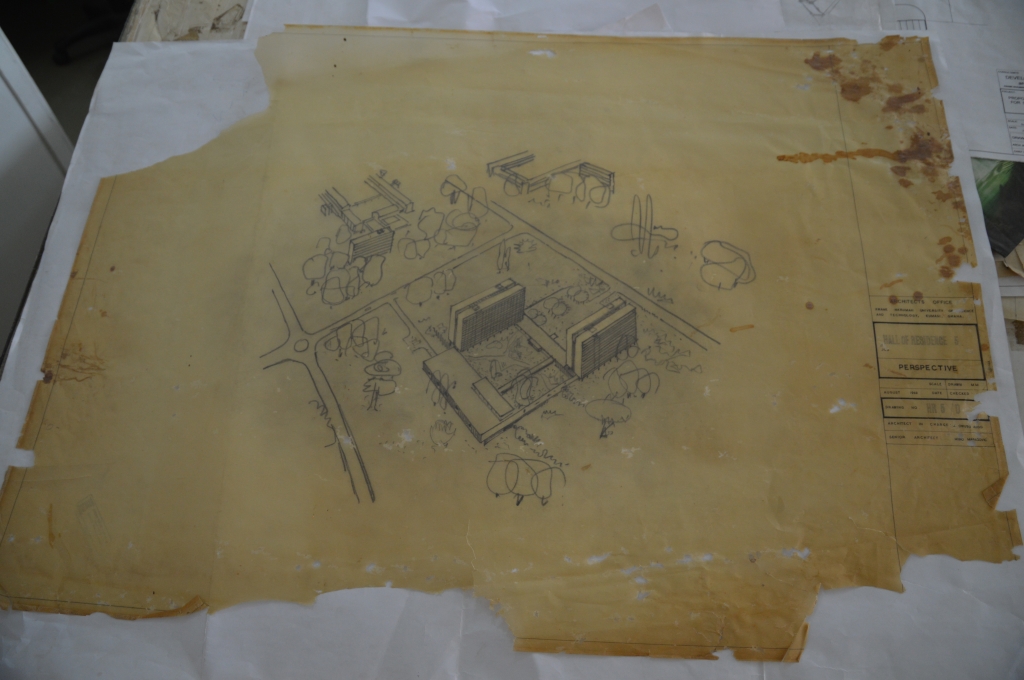
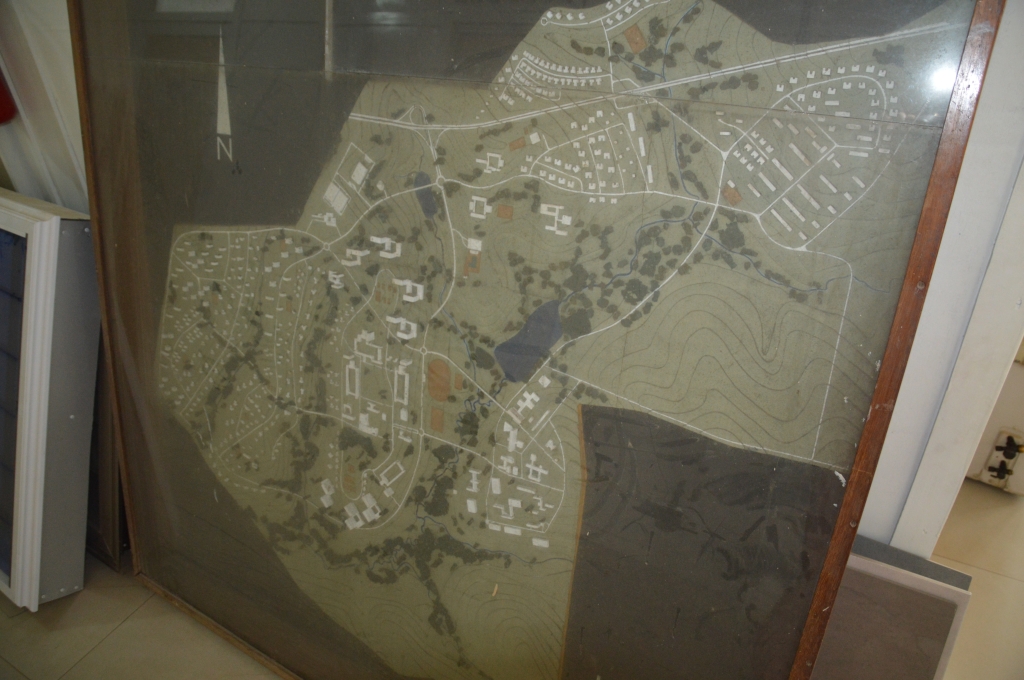
The University of Lagos, located in Akoka district of the city, was established in the early 1960s to provide a new centre of learning for the city. The campus and its significance is currently being researched  by Adefola Toye as part of her PhD investigation, and she’s recently published an introductory article in the latest Docomomo special edition too).

We spent the morning walking around the campus, and this was the first quality that resonated – it is walkable. It’s also more integrated into its urban context – rather than isolated on a remote hilltop like so many other universities in the region. Equally, there are tranquil elements and solitude, especially along the waterfront overlooking the lagoon. 

The central core is overlooked by Senate House tower and podiums designed by James Cubitt architects in the 1980s – all of the familiar brise soleil and double-skin façade motifs but extruded, layered, and clad in mosaic tiles. The brise soleil are actually hollow forms with a thin layer of cement and mosaic. There’s the classic Cubitt curved concrete motif (as seen on the Elder Dempster buildings in Lagos and Freetown).

Senate House faces into the plaza-precinct of the university, and here the campus responds to the landscape – both reacting the gradient that leads to the lagoon beyond, and as a man-made series of platforms, routes, and under crofts. It’s a space that has been crafted to catch the lagoon breeze and designed for gatherings, ceremonies, performances, and spending time with friends. The core campus buildings, designed by American practice Robert S. McMillan Associates in the early 1960s, overlook and enclose the space, including the university library and council chamber drum. They’re not forming a street but more of a town square. The administrative buildings are also here, located within a protective shaded courtyard and solitary palm tree. The scale shifts from the large public space into a much more intimate enclosure. The concrete former is expressed on all these buildings to reveal the timber grain, expertly cast into projecting scooped forms, parapets, and balustrades. There’s a heavy, confident, solidity to the composition of the facades. The horizontal soffits of the roofscape frames the visas, respond to the multi-level precinct feel, and are adequately matched with the vertical window bays and concrete fins. The sombre materiality of the ubiquitous concrete is relieved with unexpected blasts of colour, such as the gold mosaic on the J F Ade Ajayi Auditorium.

Erhabor Ogieva Emokpae (1934-1984) and the timber carving at Unilever

The largest item in the Unilever archive at Port Sunlight is a carved timber mural by the Nigerian artist Emokpae. Stretching to over 4m x4.5m and made up of 35 individual panels, it depicts the story of palm oil harvesting and the production of palm oil.

The panels also show William Lever visiting Africa and his famous Sunlight soap brand. It’s a vast piece of history and story telling revealing that behind ever bar of Sunlight soap was a vast system of extraction, production, logistics, and international trade stemming from Western Africa. The work was commissioned for the refurbishment of Unilever House in London in 1979. As well as being an influential and important artist Emokpae was a Creative Design Director for the design agency Lintas (also one of Unilever’s subsidiary companies).

I produced a measured drawing of the carving to help me to study it more carefully and because it’s almost impossible to photograph the original work in a single frame whilst capturing the detail. Together with Unilever’s Global Head of Art, Archives, and Records Management Claire Tunstall, we began discussing using the drawing to produce an animation that would help to explain part of the work and also make it more accessible. We shared our ideas with the agency Stone and Glow and commissioned them to develop an animation based on our text, keyframes, and artistic direction. We’re delighted to be able to share this with you here and hope you enjoy it:

Have a look here for Claire’s article : https://www.archives-unilever.com/discover/stories/bringing-our-collections-to-life .

I wanted to know more about Emokpae’s work and found some fascinating material in the Nigeria Magazines. Emokpae had worked on some major projects in Lagos and I’ve been eager to view them ever since. At the National Theatre (designed and constructed by the Bulgarian Techno Exporstroy in 1976) Emokpae was commissioned to produce the friezes that wrap around the lower parapet of the theatre as well as a series of mosaic murals at the entrances.

He also won a competition to design a concrete installation at the Nigerian Institute of International Affairs – a significant building designed by Design Group. Here Emokpae’s ‘The Art of Understanding’ is composed of a large concrete mural with mosaic backing. The project also featured in Nigeria Magazine no.96 1968 with an extended article written by Alan Vaughan-Richards.

We’ve written a short article on Emokpae too that will feature in the forthcoming https://www.aaschool.ac.uk/publicprogramme/whatson/as-hardly-found-in-the-art-of-tropical-architecture publication in 2024.

Venice Biennale and the IUAV August 2023

Venice 2023…

A visit to Venice to attend the inaugural AFRAHUAN session at the Teatro Piccolo at the Arsenale as part of the Carnivale Proceedings of the Venice Biennale proved an apt occasion to visit and view Venice in full exhibition and tourist mode.

Venice is indeed a city like no other. No cars, no bicycles, lots of passageways, canals, and tourists. One adjusts to this city of walkers, traders and tourists all jostling for space in alleyways that are literally not wide enough to swing a cat. The green canal water both enticing and goading the unwary walker to come to its banks.

A walk to the Arsenale gave a better viewpoint of the wide vista of Venice as a series of islands with canals as fingers out to the grand canal. The adaptive reuse of various parts of this still living city is clear. The Arsenale itself remains the home of the Italian navy and a museum dedicated to the armed force still exists with the occasional boat dropping by.

The main part of the old Arsenale building however now has been occupied by the architecture biennale, this year curated by Lesley Lokko and involving your writer and a wide set of architects, writers and artistes with Africa focused research. The ‘carnivale’ exhibition is no mean feat, a work of immense dedication, creativity and focus. The curation is superb and content more than can be taken in at one go. One easily gets immersed in what it offers up with names one knows and has heard of contributing to this rich tapestry of art. Fortunately the accompanying catalogue means one can refer back to installations and events missed or glossed over in the viewing of the exhibition.

AFRAUHN AT THE CARNIVALE…

The African Architectural and Urban History Network (AFRAUHN) had its debut at a session at the Carnivale at the Biennale. Curator Lesley Lokko introduced our session which had two parts, the first involved speakers Ikem Okoye (Delaware, USA),  Kuukuwa Manful (Michigan University, USA) and Neal Shasore (London School of Architecture), with Ola Uduku (Liverpool University) chairing, where the session focused on a discussion on the remit of AFRAUHN which is to help encourage and advocate for Architectural Research in Africa, and support new generations of indigenous historians and researchers in Architectural History and urbanism. After Ikem Okoye’s introduction both Kuukuwa and Neal were able to discuss their different approaches to, and hopes for Africa-related Architectural Research.

The second session chaired by Huda Tayob (Unversity of Manchester) involved all speakers from the earlier session and also Murray Fraser (University College London). This session was a roundtable where the speakers responded to Huda Tayob’s questions which considered specific issues and challenges to scholarship in African Architectural History and its situatedness within the wider context of global research and challenging normative notions of historical research and scholarship.

The entire session was recorded and will be published by the Venice Architecture Biennale before the end of September 2023. Due to the events related to air traffic control problems in the UK unfortunately several of the invited AFRAUHN team were unable to attend the session, and others arrived late due to flight delays. It is hoped we will be able to include their recorded contributions to the final video output from the session.

IUAV (University of Venice)

On Wednesday, the day after the Carnivale discussion we were fortunate to reconvene at a meeting room at the IUAV (University of Venice), thanks to Dr Jacopo Galli, who has researched into African modernism and was involved in the curation of the exhibition Africa Big Change, in Milan and has worked with Manchester School of Architecture on the analysis of schools in West Africa. IUAV has sites across Venice, and we met at the C’a Tron campus, a Venetian villa owned by the wealthy Tron Family before being gifted to the State.  Post meeting tours took us to the Carlo Scarpa-influenced main campus of the IUAV, a repurposed convent which still has parts which are owned by the church. The campus also has a significant architectural library including book volumes and periodicals accessible and in regular use by its students.  

Unlike the exclusive arrival to the watery city a few days earlier, the trip back to the airport was by airport water taxi, which proved to be a bus trip stopping at many of the archipelago of islands which constitute Venice, including Murano, famous for its glass works and San Michael. Approaching Marco Polo Airport Venice by water seemed a very apt way to leave the city.

A few years ago we reported on our Keeping Cool project and included a photograph of the Standard Chartered Bank on Accra’s High Street. The bank had been refurbished, radically changing its passively cooled perforated facade to a sealed glass envelope relying on air-conditioning.

We’ve just received updates from Accra that the bank has now been demolished. No details have been released on what is to replace the bank.

The same site has been used as a banking hall since the late 19th Century. Below are some of the photographs of the site revealing the continuity and change over the last century and the variety of architectural solutions deployed. Joe Addo kindly sent over some photographs of the shock demolition taking place earlier this month.

Accra High Street: Bank of British West Africa shown on the right hand side with the arched loggia
Postcard showing the Bank of British West Africa on the same site of Accra’s High Street, c1900
Standard Chartered Bank with passively cooled facade. Architect? unknown, c.late 1950s
Standard Chartered with new blue glass facade. Glimpse of Barclays bank on far left.
July 2023: Standard Chartered bank being demolished [Courtesy of Joe Addo]

We’ll post updates on what follows.

Call for participation
Journée d’étude sur l’architecture et l’urbanisme au Maroc après l’indépendance (1956-1986)
20th February 2024, Centre Jacques Berque, Rabat
Deadline (french or english): 30th September 2023

The newly established Réseau de recherche sur l’histoire de l’architecture au Maroc – RHAM (rham.hypotheses.org) launches a call for participation to the Symposium: ‘L’architecture et l’urbanisme au Maroc après l’indépendance (1956-1986). Trajectoires d’acteurs et circulations de savoirs’.

Cette journée d’étude se concentre sur une période spécifique de l’histoire du Maroc : les trois décennies qui ont suivi l’indépendance du Maroc, de 1956 à 1986. Cette période, qui demeure encore largement sous-explorée au regard de la littérature produite sur la période coloniale, suscite désormais un intérêt croissant. Fort de ce constat, la première journée d’étude du RHAM vise à faire se croiser et se rencontrer ces différentes manières d’aborder l’histoire de l’architecture, du paysage, de l’urbanisme et de l’aménagement du territoire au lendemain de l’indépendance, en mettant en évidence des matériaux de recherche inédits

For more info, see the call for participation here.

The AHUWA-Unilever Sponsored African Archives Collaborative Research Project 

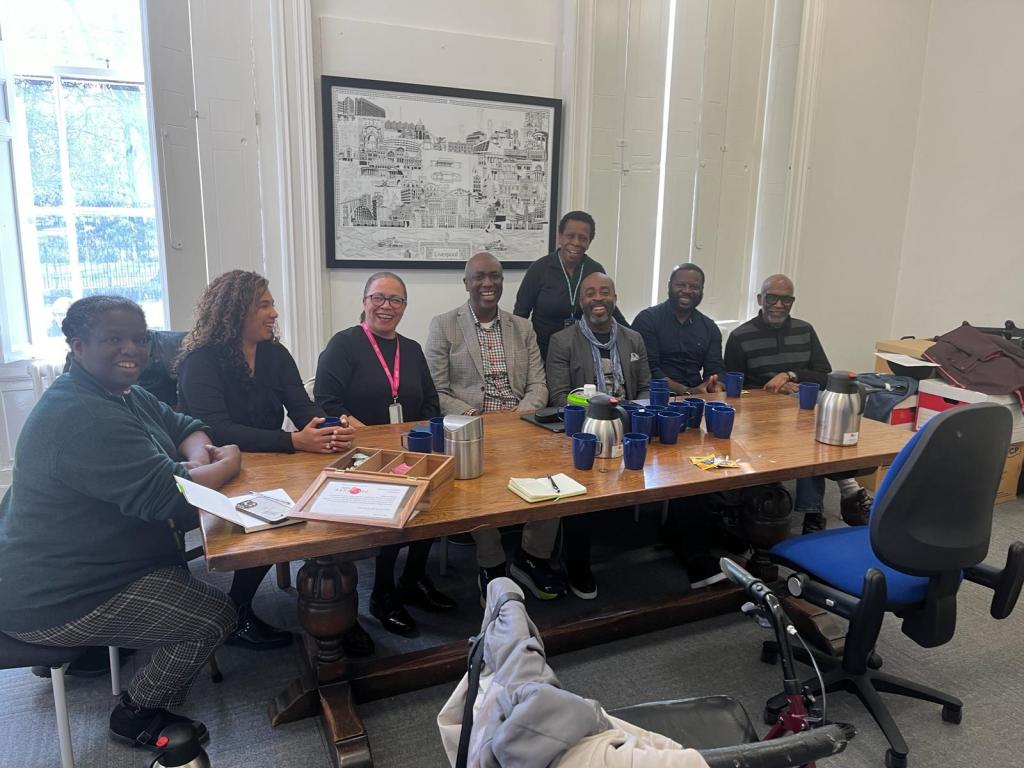
Two days were spent on Merseyside at the Unilever Archive and then at the University of Liverpool with senior research historian colleagues from the Universities of Ghana and Lagos in Western Africa. Professor Sam Ntewusu, head of the Institute of African Studies at the University of Ghana, and Professor Ayo Olukoju, of the Institute of African and Diaspora Studies at the University of Lagos.

Iain Jackson, Ola Uduku, Ayo Olukoju, Claire Tunstall, Sam Ntewusu at Unilever, Port Sunlight

The objective of the visit was to visit and introduce Profs Olukoju and Ntewusu to the Unilever archive collection at Port Sunlight, particularly its subsidiary the United Africa Company’ (UAC)’s extensive holdings on Western Africa covering its various business interests in the region. The symposium which took place the next day involved presentations by Profs Olukoju and Ntewusu on the state of archives and archival research in West Africa, which was attended by Merseyside researchers and PhD students.


Professors Olukoju and Ntewusu at Unilever, Port Sunlight with bust of William Lever

The two-day visit also enabled discussions to be had about future collaborations at various levels, research, knowledge exchange capacity building at Masters degree level, and forms of impact for institutions in Western Africa and also the the UK and NW England in particular. Our thanks to all who contributed to the symposium. Particularly Claire Tunstall, and her team at the Unilever Archives, Dr Abraham Ng’an’ga of the Andrew Walls Centre, Liverpool Hope University, Alex Buchanan, Archival Studies, University of Liverpool History Department, Suzie Goligher, Afrograph Ltd, and all other individual and institutional contributors to the symposium. 

MoU signed by the University of Liverpool’s APVC for the Faculty of Humanities Professor Fiona Beveridge, and received by Professor Olukoju, on behalf of the University of Lagos

The visit also coincided with the finalised signing off of the Memorandum of Understanding which has now been established between the University of Liverpool and the University of Lagos. The formal MoU, was signed by the University of Liverpool’s APVC for the Faculty of Humanities Professor Fiona Beveridge, and received by Professor Olukoju, on behalf of the University of Lagos

Ola Uduku

Adefola Toye writes:

Referentially: Towards a Decentred Future (https://mohoa.org/events/referentiality-towards-a-decentred-future/ ) was a one-day public event at the Bartlett School of Architecture organized by MoHoA (The Modern Heritage of Anthropocene- (https://mohoa.org/ ) and sponsored by the AHRC.

The event interrogated approaches that challenged the mainstream colonial, nationalist and social-cultural frameworks in architecture, art and heritage management scholarship and practice. It included discussions, talks and activities with a diverse range of speakers whose creative production explore approaches free from referential relationship with inequitable power structures.

A research conversation moderated by Edward Denison, Ievgenia Gubkina, Emily Mann and Shahid Vawda comprised speakers from multidisciplinary fields of research and practice with case studies from Africa, Asia and Europe. The speakers included Leverhulme Early Career Research Fellow, Dr. Alistair Cartwright and PhD researcher, Adefola Toye – both from Liverpool School of Architecture. Each speaker discussed the limitations they encounter when engaging mainstream sources for scholarship and research-in-practice which erases the agency of populations under study. Furthermore, they shared how they addressed this using participatory action research, public engagement, multidisciplinary methods and utilising crowdsourced open-access archives.

1. Image 1 by Edward Denison

2. Alistair Cartwright Presenting, by Edward Denison

The session concluded with talks from African heritage organizations, including the Direction du Patrimoine Culturel du Sénégal, Swahilipot Hub, and the University of Cape Town. They discussed existing and future initiatives for sustainable and inclusive heritage management on the continent. These included exhibitions, training workshops, public engagement tailored to different age groups and professions, and collaboration with local and global heritage partners.

Afterwards, a student-centered lunchtime activity with architect Sumayya Vally and BSA design tutor Jhono Bennett, explored referentiality in architectural research and practice through co-production and drawings based on the participants insights and experiences.

Image 3 by Adefola Toye

The remainder of the event was spent in conversations with notable speakers in the fields of architecture, art and curatorial practice.

Nana Ocran, founder and Editor of the People’s Stories Project, hosted discussions with multidisciplinary artists Christopher Samuel and Valerie Asiimwe Amani. They explained how their creative works use archives materials to create awareness about the underrepresentation of people with disabilities and colonial subjects.

Performers Peter Brathwaite and Kenneth Olumuyiwa Tharp examine ‘Rediscovering Black Portraiture’s use of domestic material culture to reimagine the historical image of black subjects as well as professional engagement with diverse art and culture foundations in the UK.

Image 4 by Adefola Toye

Architect, Sumayya Vally, and curator, Ekow Eshun also discussed the event’s theme in relation to their recent works: Asiat-Darse Project (Belgium) & the Islamic Arts Biennale (Saudi Arabia), and In the Black Fantastic (UK) & The Time is Always Now: Artists Reframe the Black Figure respectively.

Tofa Jaxx and guitarist Leon King closed the evening with a musical performance.

Adefolatomiwa.Toye@liverpool.ac.uk

THE AFRICAN ARCHIVAL EXPERIENCE 

CHALLENGES IN ARCHIVAL CURATION AND ARCHIVAL-BASED RESEARCH WORK IN WEST AFRICA 

12.30pm Tuesday 11th July 2023

Room G.04 Liverpool School of Architecture Building, Abercromby Square, Liverpool

Zoom Link: Contact ijackson@liverpool.ac.uk for the link

Abstract:

We are delighted to be able to host Professor Ayo Olukoju (Institute of African and Diaspora studies, University of Lagos) and Professor Sam Ntewusu (Institute of African Studies University of Ghana) who are visiting the University of Liverpool and also the Unilever Archives to explore the possibilities of future collaborative research and teaching activities across our institutions and others in NW England.

Both Professors are historians who have worked with archival sources in their research in West Africa. They have generously agreed to share, through this seminar, the challenges and issues with working with archival material and sources from a West African perspective and also some of the hopes they have for future collaborations.

Do join us to hear their views and also join the conversation – how do we make the most of archives in the 21st century in different locations and places? Importantly do we need to decolonise the archive, and if so how?  

All Welcome: 

A sandwich lunch will be provided at Room G.04

Professor Ola Uduku

Co-director AHUWA Research Centre 

Hosted by the AHUWA Research centre  in association with Unilever Archives, School of History and Institutes of African Studies and African Diaspora Studies  at the University of Ghana, and the University of Lagos