Archive

Author Archives: jacksoniain

New Research: Prof. Robert Home, ‘From cantonments to townships: Lugard’s influence upon British colonial urban governance in Africa’ in Planning Perspectives, Pages 1-22 | Published online: 20 Aug 2017

http://www.tandfonline.com/doi/full/10.1080/02665433.2017.1359103

Abstract: The cantonment has been a neglected topic of planning history, yet is significant for urban landscapes and governance in both India and Africa. Drawing upon scholarship in critical comparative legal geography, path dependency and Foucault’s genealogical method, the article explores the transfer of laws and regulations for urban governance by networks of knowledge and actors, tracing a line of descent from rules for cantonments in British India, through Lugard’s Nigerian period, and his indirect rule policy to townships and local government ordinances. The influence of Lugard’s Political Memoranda and Dual Mandate books is evidenced through the work of various senior officials moving between colonies, specifically South Africa, Kenya, and Northern Rhodesia.

Paul Oliver Obituary by Elain Harwood

Only 1% of houses around the world were designed by architects. Paul Oliver, who has died aged 90, devoted himself to studying the remainder, architecture that was of the people rather than built for them. His books on vernacular architecture ranged from Dunroamin: The Suburban Semi and Its Enemies (1981, with Ian Davis and Ian Bentley) to a three-volume Encyclopedia of Vernacular Architecture of the World (1997), produced with 780 contributors from 80 countries.

An artist by training who became a distinctive commentator on both architectural history and music, especially the blues, he considered himself a generalist, though writing from an architectural background; when pressed, in 1998, he accepted the term “architectural anthropologist”.

His opportunity to develop this perspective came from taking a part-time job as drawing master at the Architectural Association (AA) in London in 1960. When the leading academics Robert Furneaux Jordanand Sir John Summerson both quit, he was left as the principal lecturer in architectural history.

Oliver’s inspiring teaching took two strands. One was the study of modernism, with its emphasis on simplicity, quality and economy. The other was vernacular architecture.

His interest had been aroused when his parents moved to Symondsbury, near Bridport in Dorset, a village with a strong music tradition, a mummer’s play and a close-knit cottage community. Then six articles in the Architectural Review by EA Gutkind, a planner, in 1953 revealed the diversity of traditional building around the world.

The study of vernacular traditions offered ideas on honest construction and functionalism attractive to modern architects, while also contributing to Britain’s emerging conservation movement. An international dimension took hold when in 1964 Oliver was invited to teach at the School of Architecture in Kumasi, Ghana, where his AA colleague John Lloyd was principal. Oliver and his students studied the ways of managing a humid climate and restricted resources, patterns of use and the buildings’ cultural values. His eyes were opened by the housing of the Gurunsi people, compounds with “the formal beauty and logic of pottery”, as he later wrote, which were being swept away for a reservoir and replaced by rows of prefab dwellings that paid no respect to Gurunsi traditions.

Paul Oliver had a lifelong interest in African-American music

The Ghana trip coincided with Bernard Rudofsky’s exhibition Architecture Without Architects at the Museum of Modern Art, New York. Although it was important in popularising vernacular architecture as a subject, Oliver was enraged by its emphasis on the buildings as art objects, which he considered patronising. Working with colleagues from the AA, including students from its small department of tropical architecture, he offered a broader cultural perspective in his book Shelter and Society (1969). Further books on Africa, Greece and symbolism in buildings followed.

His greatest love was perhaps sub-Saharan Africa where, under Islamic and Christian influences, architecture predominates among the visual arts. His contributors were architects and anthropologists, but the disciplines seemed entirely separate; only archaeologists took a holistic view, and Oliver considered their approach to be as valid for the present as the past.

He advised on conservation issues in French towns and villages for the Patrimoine Historique et Artistique de la France. The British Council supported research and teaching in East Africa and India, and he worked for the Overseas Development Administration in Turkey, the Balkans, Central America and Mexico. Some projects focused on the vulnerability of vernacular buildings to earthquakes and floods, and the failures of post-disaster housing that had not taken account of the lessons of older cultures.

Oliver became head of the AA’s graduate school in 1971, but left two years later to lead the art and design department at Dartington College of Arts, at Dartington Hall, Devon. He became an associate head of the architecture school at Oxford Polytechnic (now Oxford Brookes University) in 1978 and founder of the Shelter and Settlements Unit there. His greatest concern was to safeguard traditions in the face of technological change. He believed that the wisdom, skills and satisfaction of human needs embodied in traditional buildings were fundamental to the housing of millions in the 21st century.

In 1987 Oliver took early retirement, though he continued as a visiting professor, so he could devote himself to his research, stimulated by the suggestion of Alyn Shipton, reference editor at the publisher Blackwell, that he produce an encyclopedia of world architecture. His three-volume study was organised by cultures rather than countries, with the first volume explaining general traits, environments, materials and services. Oliver was particularly proud of sections like that for Ethiopia, which was entirely written by local scholars, while gamely taking on himself areas in which no research existed.

A forked post used in vernacular architectural style to support a beam in Taos, New Mexico

Born in Nottingham, Paul grew up in Pinner, north-west London, the son of W Norman Oliver, an architect, and his wife, the former Dorothy Edmunds. His father was keen that Paul should follow him into the profession, but he lacked any talent for mathematics and turned instead to painting.

At the age of 16, Paul entered Harrow Art School, where he met his future wife, Valerie Coxon (they married in 1950), and began a lifelong interest in African-American music. He trained as an art teacher at Goldsmith’s College, London, and in 1949 returned to his old school, the Harrow county school for boys, as art master. There he established a department teaching crafts as well as art, acted as client for a new building, and introduced an African-American music society after the headmaster refused to allow a jazz club. When he left this post for the AA, the drop in his income forced him to write more music reviews.

In 2003 Oliver was appointed MBE. His archive and photographs of vernacular architecture from around the world are held by Oxford Brookes University. In 2015, photographs demonstrating the inclusive and cross-cultural approach that he championed were exhibited in Oxford as Architecture for All.

Valerie died in 2002.
Elain Harwood

originally published in The Guardian: https://www.theguardian.com/artanddesign/2017/aug/31/paul-oliver-obituary

An interesting book and reappraisal of 20thC Modernist architecture by Freddy Gibberd’s grandson has been published by Phaidon http://uk.phaidon.com/store/architecture/ornament-is-crime-9780714874166/  

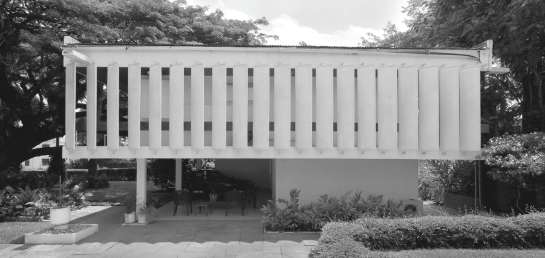
I was especially pleased to see Kenneth “Winky” Scott’s house in Accra included:

3952

More here: https://www.theguardian.com/artanddesign/gallery/2017/jul/19/modernist-architecture-photography-corbusier-concrete-gibberd-hill

Ola Uduku and colleagues at Edinburgh University hosted an excellent workshop this week on West African Modernism, combining some of the sessions with Docomomo Africa. The result was a very rich series of encounters, exchanges and discussions.

IMG_1676

Ilze Wolff presenting Rex Truform’s factory in Cape Town

Ilze Wolff gave a very poignant paper on Rex Truform, the clothing factory in Cape Town designed by Max Policansky in 1937. Ilze’s investigation goes beyond the built fabric and stylistic qualities of the structure – it considers the workers’ stories and what it was like to be a part of the everyday life of this significant building in the city. Ilze is also publishing her findings and interventions through a series of booklets: see Open House Architecture for more details.

IMG_1674

Shantanu Subramaniam’s presentation on Community Centres and Libraries in Ghana

Shantanu Subramaniam presented his recent fieldwork on the community centres and libraries of Ghana. In addition to architectural surveying and cataloguing Shantanu is also considering the environment performance of these structures and testing their ability to modify climate and interior temperatures.

IMG_1675

Joe Addo’s skype presentation on modern architecture in Accra

Joe Osae-Addo joined us via Skype and shared his film on modern architecture in Accra. The film presented an autobiographical account of Accra and its modern architecture, as seen and experienced by Joe from his childhood onwards. It is a compelling piece that will deliver far more impact in changing ‘hearts and minds’ than reports and conservation legislation.

You can watch the film here: https://stream.liv.ac.uk/s/hav96uun

We also discussed the DOCOMOMO presence in Africa and whether there should be regional groups [such as West Africa, Southern Africa and so on], to generate a more critical mass and greater influence. The reliance on the fiche methodology was also questioned – or at least its limits acknowledged – and we considered the use of ‘narrative’ and social history as a means of generating meaning, significance and connection to these structures beyond the fetishisation of the physical attributes, and tangible qualities.

IMG_1697

Cumbernauld townscape

On the final day we were treated to a site visit to the new town of Cumbernauld, and Stirling University.

Call for Papers: The 6th International Congress on Construction History

The 6th International Congress on Construction History (http://6icch.org) will take place in Brussels, from July 9 to July 13, 2018. 

The following thematic sessions look very interesting:

  • Modern ‘comfort’ in colonial/postcolonial settings beyond the‘centre/periphery’-framework. Johan Lagae, Jiat-Hwee Chang

  • Exchange in the construction worlds of 19th and 20th century Asia: the diffusion of materials and processes in the Global South. Srivastava Amit, Peter Scriver

  • Little planet. New approaches to a big picture in construction histories. East Asia and Europe in the 19tand 20th centuries. Changxue Shu, Thomas Coomans

The call for abstracts is now open: deadline June 15, 2017. 

Full brochure here: 6ICCH 2018 Brussels Call for abstracts

Architectural Review: May 2017 on Africa

AfricaShopify_large

‘Africa’ has become a lazy substitute for any number of ideas from the political to the social, cultural, historical and economic. In this issue, we reject the stereotypes and, from refugee camps to Art Deco housing; starchitects to wooden skyscrapers, counter the notion of Africa as a place to be influenced.

Lesley Lokko challenges the development-aid-charity paradigm that confines Africa, treating it as separate from the forces shaping architectural culture globally, while Tomá Berlanda looks at the challenge of reversing the social engineering engrained in the architecture and urban design of Apartheid towns.

In a new Notopia Edition, Manuel Herz challenges established ideas of permanent and temporary in his study of the refugee camps in the Western Sahara, presenting them as newly found cities with the ability to question the notion of the nation state and the citizen.

We look at projects from Djibouti to Joburg, including designworkshop:sa’s renovation of an Art Deco apartment block, an extension to a piecemeal 1950’s hospital in Vredenburg by Wolff Architects and Urko Sanchez’s SOS Children’s Village.

Typology asks whether the skyscraper is a logical extrusion of land values or an anti-urban monster, while Outrage bemoans the lack of coordinated policy required for housing reform in many burgeoning African cities, the diversity of which is explored by David Adjaye in a presentation of his personal research.

Finally, in the wake of Francis Kéré’s winning design for the 2017 Serpentine pavilion, Andres Lepik looks back on the German-trained African architect’s works and the dialogue they have generated between the global North and South.

See more at: https://www.architectural-review.com/magazine-shop/latest-issue-may-2017-on-africa/10019285.article and David Adjaye’s article at: https://www.architectural-review.com/rethink/david-adjaye-urban-africa/10019650.article?blocktitle=Adjaye-Urban-Africa&contentID=18684

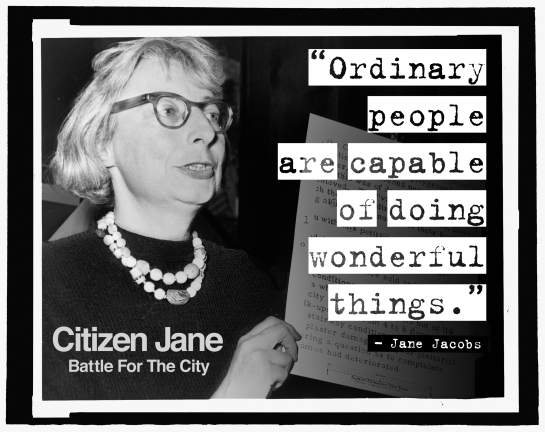
New Film: Citizen Jane: Battle for the City

CJ-Jane2-Quotes.png

In 1960 Jane Jacobs’ book The Death and Life of Great American Cities sent shockwaves through the architecture and planning worlds, with its exploration of the consequences of modern planners’ and architects’ reconfiguration of cities. Jacobs was also an activist, who was involved in fights in mid-century New York to stop ‘master builder’ Robert Moses from running roughshod over the city. This film retraces the battles for the city as personified by Jacobs and Moses, as urbanization moves to the very front of the global agenda. Many of the clues for formulating solutions to the dizzying array of urban issues can be found in Jacobs’ prescient text, and a close second look at her thinking and writing about cities is very much in order. This film sets out to examine the city of today though the lens of one of its greatest champions.

DIRECTOR’S STATEMENT

In the face of developers and the overzealous parks commissioner Robert Moses, who, in
the 1950s, wanted to run a four-lane highway through the middle of the park, Jacobs and
other Greenwich Village residents and activists organized a formal opposition to the city’s plans.
Through community-driven support, a large neighborhood coalition, a series of public protests, and a years-long letter-writing campaign to officials at every level of city government, Jacobs and her compatriots eventually triumphed and Moses’s park-destroying plan was shelved.
It was a battle much like the one Sanders’s campaign has framed today: a grassroots coalition of regular people fed up with the top-down impositions of the powers that be running roughshod over regular citizens.

Jacobs, whose centenary will be celebrated on May 4, is something of a spiritual soul mate to Sanders. The parallels between their underlying ideologies are striking. And as
Sanders’s popularity and fame continues to skyrocket, it’s time to give his fellow New
Yorker, Jacobs, her due. Jacobs’s fight for Washington Square Park—and for the people’s right to the city—is a story I tell in Citizen Jane (which is produced by one of New
York’s newer grassroots activists, High Line co-founder Robert Hammond).

Like the modern-day opposition to the role of big banks and the political influence of the wealthiest one percent, Jane Jacobs and the Greenwich Village community members were fighting against a power structure that valued its own perseverance over the public it was ostensibly serving. She, more than anyone else of her era, deserves credit for unmasking this unseemly cabal.

A BATTLE FOUGHT IN THE STREETS 

Citizen Jane: Battle for the City is a story about our global urban future, in which nearly three-fourths of the world’s population will live in cities by the end of this century. It’s also a story about America’s recent urban past, in which bureaucratic, “top down” approaches to building cities have dramatically clashed with grassroots, “bottom up” approaches. The film brings us back mid-century, on the eve of the battles for the heart and soul of American cities, about to be routed by cataclysmically destructive Urban Renewal and highway projects.

The film details the revolutionary thinking of Jane Jacobs, and the origins of her magisterial 1961 treatise The Death and Life of Great American Cities, in which she single-handedly undercuts her era’s orthodox model of city planning, exemplified by the massive Urban Renewal projects of New York’s “Master Builder,” Robert Moses. Jacobs and Moses figure centrally in our story as archetypes of the “bottom up” and the “top down” vision for cities. They also figure as two larger-than-life personalities: Jacobs—a journalist with provincial origins, no formal training in city planning, and scarce institutional authority—seems at first glance to share little in common with Robert Moses, the upper class, high prince of government and urban theory fully ensconced in New York’s halls of power and privilege.

Yet both reveal themselves to be master tacticians who, in the middle of the 20th century, became locked in an epic struggle over the fate of the city. In three suspenseful acts,

Citizen Jane: Battle for the City gives audiences a front row seat to this battle, and shows how two opposing visions of urban greatness continue to ripple across the world stage, with unexpectedly high stakes, made even higher and more unexpectedly urgent in the suddenly shifting national political landscape of 2017, in which the newly inaugurated U.S. President is a real estate developer, who is calling for a new era Urban Renewal, echoing the traumatic period in which this film takes place. In perilous times for the city and for civil rights, Citizen Jane offers a playbook, courtesy of Jane Jacobs, for organizing communities and speaking the truth to entrenched and seemingly insurmountable powers.

https://dogwoof.com/citizenjane#screenings

Conference Call for Papers: The Design, Planning and Politics of How and Where we Live

ab0a4cd7-3ec5-4f67-9662-3ddd2272aa94
Place: University of the West of England (UWE), Bristol, UK
Dates: 25-26 January 2018
Organisers: Department of Architecture, UWE, with AMPS. In collaboration with the Public Health Film Society and World Health Organisation Collaborating Centre at UWE.

Abstract Submission (Round 1): 01 June 2017   

http://architecturemps.com/bristol-2018/

The conference welcomes delegates to present in-person, via Skype or pre-recorded video which will be uploaded to the AMPS YouTube channel.

This major international conference considers the sustainability and healthiness of the places we live in – from our houses to our cities. Inspired by the origin of the public health movement in the issues of urban housing, it seeks an interdisciplinary debate on the quality of life in the built environment. It welcomes health professionals, sociologists, community activists, architects, planners, urban designers, and more.

From a health perspective, it continues the work of AMPS over the past three years on public health. From a housing perspective it continues AMPS engagement with the Housing – Critical Futures research programme. In its concern with the ‘politics of housing and health’ it continues collaborations with sociologists and community researchers. From a design point of view, it brings together the work of architects and spatial designers from various disciplines concerned with a better quality living environment affecting wellbeing, health and social sustainability.

Publications:
There will be a conference proceedings publication with its own ISSN.
There are several other publications:
1. A Special Issues of the Architecture_MPS journal
2.  Amps Book Series with UCL Press
3. Amps Book Series with Libri Publishing
4. Amps Book Series with Vernon Press

Other Partners:
The event is coordinated by the UK non-profit research organisation AMPS as part of its engagement with the UN Habitat University Initiative. It is part of a series being organised by an international consortium of universities and publishers including: The University of Derby, La Universidad de Sevilla, University of Cyprus, Swinburne University Australia, London South Bank University Liverpool and John Moores University, UCL Press and Libri Publishing.

This particular event is organised by the University of the West of England, Bristol, UK.
http://architecturemps.com/bristol-2018/

Image: Guy Freeman

hall-of-nations-demolished_a3308b4a-2908-11e7-bd89-19cc2c5d765e.jpg

We included an article on these structures exactly one year ago today – and were still hopeful that the Indian Government would see sense and agree to retain these important pieces of architecture. Alas, they made a terrible decision and sent in the wrecking ball.

There was no real justification for this act of cultural vandalism. It is a disgraceful destruction of modern heritage, not to mention the environmental waste.

Next month the AHRC and Indian Council for Historical Research will be sponsoring a workshop on ‘Cultural Heritage and Rapid Urbanisation in India‘ in Delhi. Its too late for the Maidan but let’s hope the workshop can provoke some much needed change.

asia-72-exhibition_0f931730-290e-11e7-bd89-19cc2c5d765e

Read and see more at the Hindustan Times.