Archive

Conferences

Call for Papers: Architectures of Power: buildings of politics and governance, 1750-2000. Girton College, University of Cambridge 27-28 June 2020

This conference looks very interesting….

https://www.hist.cam.ac.uk/research/conferences/forthcoming-conferences/architectures-of-power-cfp

When: 27-28 June 2020
Where: Girton College, University of Cambridge
Submit abstracts of 250 words to architecturesofpower@hist.cam.ac.uk by 21 October 2019.

Historians have long recognised the importance of architecture within the exercising of political power. Yet the interaction between power and place, between human actor and physical location, is a difficult one to quantify. This conference brings together political, social, cultural, and architectural historians to explore this relationship. Architecture could be mobilised to exhibit and to legitimise political power, but it could also have a profound influence on decision-makers at crucial moments of governance. Architecture has played a fundamental role in performances of statecraft. Accounting for this architectural agency, without resulting to crude spatial determinism, is one of the great methodological challenges that this conference will discuss. As architectural historians have established, the meaning of buildings vary from user to user. Often these reflected hierarchies operating within the building: experiences of the Foreign Office, for instance, differed from a Permanent Under-Secretary to a newly arrived clerk. It is this question of the subjective nature of architectural experience that we are particularly interested in exploring.

Taking broad definitions of political power and the state, we will not only consider the architecture of palaces, parliaments, and administration, but also of commercial, financial, legal, and religious sources of political authority. This conference is interested in the physical seats of power from the private residences of statesmen and women, to legislatures, embassies, and banking houses. Importantly, this conference considers how the architecture of political power evolved over time, reflecting changes in structures of government. In the late eighteenth-century, the majority of states were absolute monarchies or governed by elite oligarchs, but by the mid twentieth-century the rise of popular representation entailed very different types of architecture. Where once palaces like Versailles and Blenheim embodied the authority of ruling elites, parliaments and administrative offices soon reflected accountable styles of government.

We welcome papers on any geographical case study from the mid eighteenth-century until the twentieth. We are particularly interested in proposals that consider the role of gender, race, and class as well as questions of architectural science and technology. We are also interested in the role of architecture in the operation of imperial, economic, and religious political power. Please submit abstracts of 250 words to architecturesofpower@hist.cam.ac.uk by 21 October 2019.

Article by Prof Stephanie Decker, Professor at Aston Business School specializing in organizational history and international strategy. Originally published here: https://orghist.com/2019/06/21/unlocking-archives-unilever-historical-archives/

On 20th June 2019 Unilever kindly hosted (with additional support from the University of Liverpool) a workshop showcasing the amazing material that can be found within business archives. It was a really great day to learn more about how different researchers are using the collections and the great work by archivist who make all of this accessible to the public.

Keynote by Valerie Johnson, Director of Research, The National Archives

Business archives – a bit of a passion killer?

Valerie Johnson opened her keynote by highlighting that business archives are often seen as dull and uninteresting – to the point she was once told by a conference organizers that he had not expected her research talk about business archives to be so interesting. Nothing could not be further from the truth. For almost any subject of interest to researchers, business archives have materials, as companies were often spearheading new developments (e.g. technology), were embedded in social and cultural trends of the day (e.g. the culture of imperialism), design history (e.g. in the Board of Trade archives) to name but a few.

In a whistle stop tour through a wide range of archives, Johnson illustrated the history of women at work through an architectural map in the ING Barings Archive, and the representations of empire in the textiles archive of John Lewis, and the United Africa Company trademarks at Unilever Historical Archives.

To get a better sense of what Unilever Historical Archives do, see their
Instagram site: https://www.instagram.com/unileverarchives/

Johnson closed by reiterating that business records offer magnificent materials and insights into society, technology and attitudes of the past, not just the records of business operations in the narrow sense. So she closed with highlighting the importance of:

Putting the passion back into business archives!

Snippets from archival research

The day continued with wide-ranging research presentations. The morning opened with Jeanette Strickland introducing the audience to William Lever, the founder of Lever Brothers (one half of the original Unilever), a formidable businessmen and somewhat of a micro-manager.

This was followed by Frank Thorpe, University of Liverpool, talking about advertising and beyond. His presentation is based on his doctoral thesis that investigates the changing attitudes towards personal hygiene, or “BO”, and how
products like deodorant were gendered and stigmatized at times. At Unilever, he
has researched uncatalogued material, but also used a range of online newspaper
archives to understand the context within which these adverts appeared.

Ronnie Hughes offered a different view on Port Sunlight, the location of the Unilever factory and archives, where the workshop took place, by asking a key question:

What must it have been like to live in someone else’s utopia 100 years after they died?

Walking through Port Sunlight village in the morning before the workshop, this is not unlike the question we asked ourselves – would we actually like to live here,
as beautiful as it is? As a heritage site, it has a very distinct and unique
feel, which is unlike other neighbourhoods. Hughes highlights that he has asked
communities questions about what their perfect place would look like before
starting this research project. He blogs at A Sense of Place.

Prof Matt Reed finished the morning session by outlining his search for the ‘origin story’ of the collaboration between Unilever and the University of Liverpool, which dates back to 1906, which was “multi-faceted and sporadic.”
Lever donated money to a number of departments, including Civic Design and town planning. The Department of Industrial Chemistry was particularly well aligned with Lever’s business interests. Reed finished with a reflection of the value
of searching archives versus the self-taught googling that passes for research
outside of archives.

A fascinating tour of the archives at lunchtime that featured highlights such as Marmite pants.

The afternoon sessions kicked off with Dr Rory Miller’s exploration of why David Fieldhouse’s Unilever Overseas is missing a chapter on Latin America – apparently he fell out with his research assistant. 25 years ago, Miller first visited the Unilever archives to find out what was actually available on Unilever’s business in Argentina and beyond. Perusing the directors’ visiting reports, he outlined how Argentinians rarely bought Lifebuoy soap other than to wash their dogs.

In her talk about the design process, Dr Lee Wright highlighted the potential importance of archives for the design practice and the sourcing of design ideas. In her teaching, students reference the past through images they source from Pinterest, highlighting the significance of social media sites in mediating our visual understanding of the past.

The day closed with two fascinating talks, the first by Prof Iain Jackson about the development of urban architecture in Accra, Ghana in the mid-twentieth century. While the National Archives had more material on the European settlements of Accra, within other archives, such as the United Africa Company collection at Unilever, mercantile areas such as Jamestown are much better documented. Some of his collected images are available in an online book available via issuu.com (search “Accra”) here.

The workshop closed with Claire Tunstall describing their mission and how the archives has to serve many different stakeholders: internal divisions, brands and communications, outreach with schools, partnership with museums and universities and, of course, the Port Sunlight Village Trust, as well as researchers.

Hopefully, more such events, at Unilever or other major archives, will take place in the future. The workshop did not just have great presentations but also offered great opportunities to meet a wide variety of people interested in using and promoting archives.

Conference programme

10 am Registration Tea & coffee
10.20 Welcome, introductory remarks and housekeeping
– Claire Tunstall and Jeannette Strickland
10.30 Keynote Dr Valerie Johnson, Director of Research & Collections, The National Archives “What’s the use? Your research and business archives”
10.50 Q&A
11.00 Refreshments
11.15-12.30 Session 1 Chair: Prof Stephanie Decker, Aston University
11.15 Jeannette Strickland, Department of History, University of Liverpool, “Finding William Lever, the man behind the myth”
11.30 Frank Thorpe, Department of History, University of Liverpool, “Beyond the ad: filling gaps and finding new gaps”
11.45 Ronnie Hughes, Department of Sociology, Social Policy & Criminology, University of Liverpool, “Looking for Utopia”
12.00 Dr Matt Reed, Strategy Director, Materials Innovation Factory, University of Liverpool, “Turn every page”
12.15 Q&A
12.30-2.00 Lunch
Tours of Unilever Archives available at 12.45 and 1.10
2.00-3.00 Session 2 – Chair: Dr Valerie Johnson, The National Archives
2.10 Dr Rory Miller, formerly Reader in the Management School, University of Liverpool, “The Missing Chapter in David Fieldhouse’s Unilever Overseas: Unilever’s Expansion in Latin America in the Mid-Twentieth Century”
2.30 Dr Lee Wright, Senior Lecturer in the History and Theory of Design, Liverpool School of Art and Design, Liverpool John Moores University, “The value of archives and their potential to impact current design practice”
2.50 Q&A
3.05 Refreshments
3.20-4.20 Session 3 – Chair: Jeannette Strickland, University of Liverpool
3.20 Prof Iain Jackson, School of Architecture, University of Liverpool, “Traders, speculators, taste makers: the United Africa Company in Ghana”
3.40 Claire Tunstall, Head of Art, Archives & Records Management, Unilever plc, “The research potential of Unilever Archives”
4.00 Q&A
4.20 Summing up and closing remarks
4.30 Optional post-workshop drink at the Bridge Inn in Port Sunlight


 (sub) URBAN TROPICALITY: Urban challenges in the tropical zone

International Network of Tropical Architecture (iNTA) Conference at The University of Queensland, Brisbane, Australia,  5 – 8 December 2019

The cities and urban centres of the (sub) tropics are where the greatest challenges facing our collective future can be found. They are where the challenges of global warming, inequality and the migration of people fleeing political unrest or climate change are at their most extreme. The 2019 International Network of Tropical Architecture (iNTA) conference provides a forum to discuss architectural and design solutions for a resilient, smart and just future for urban centres in the tropics.

Founded in Singapore in 2004, the International Network for Tropical Architecture (iNTA) is a networking platform for international researchers and practitioners to collaborate and learn from each other about problems and solutions pertaining to architecture and urban design in the tropical (and sub-tropical) regions and brought together by the shared climatic imperatives and opportunities of these regions. The iNTA permanent secretariat is located at the Department of Architecture, School of Design and Environment at the National University Singapore.

The 2019 iNTA conference is hosted by the School of Architecture at The University of Queensland, located in Brisbane, capital city of the state of Queensland, Australia. Brisbane is proximate to both the fastest growing urban centres in Asia and many Small Island Developing States (SIDS) most at risk from climate change, including Kiribati, Marshall Islands, Federal States of Micronesia, Marshall Islands, Niue and Tuvalu amongst others. Queensland’s most northern extremity, Cape York, sits at the confluence of the Indian and Pacific Oceans, those very same oceans that generate the weather systems that circle the globe and affect the destiny of millions of people.

For those who live in the so-called “global south,” there is a sense of urgency about the challenges arising from rapidly changing climate conditions. Matters are not merely academic, but dynamic and concrete. Before the launch of iNTA, discourse around architecture and urbanism in the tropics was framed by centres of scholarship in Europe and North America. The malingering aftermath of devastating tropical storms such as Maria and Irma (2017) in the Caribbean and Typhoon Haima (2016) in the Philippines challenges such ascendancy. The 2019 iNTA conference in Brisbane brings discourse to a subtropical city at the crossroads of cultures, regions and climate zones. At a time when Australia’s role in the region continues to be questioned, it provides an opportunity to enhance north-south dialogue. 

Submission Information & Instructions

Submit abstracts of no more than 300 words in length by email as Word documents to:  https://easychair.org/conferences/?conf=inta2019.  Please name the email subject ABSTRACT-SURNAME and use this name for your submission file as well.

  • Abstract deadline: 26 April 2019
  • Submission of full papers for review: 26 July 2019
  • Submission of final papers for publication: 18 October 2019

 All abstracts will be considered by the conference academic committee; authors will be invited to prepare a full paper (no longer than 4,500 words); authors wishing their papers to be published in conference proceedings should submit their final papers for peer review on or before 26 July 2019. The date for submission of final papers is 18 October 2019. Authors may opt out of publication.

Conference Streams 

Tropical Architecture refers to constructed architectural and urban environments relating the climatic and natural conditions of the tropical (and sub- tropical) regions, and interacting with various local specifics of culture, urban fabric and technology. Contributions to the following conference streams are sought. 

1.            Tropical Urbanism  

Stream focussing on challenges to and solutions for enhanced liveability in urban centres of the tropics. Papers might address:

  • projects or propositions for reversing or healing the degradation and collapse of urban centres under rapid growth; 
  • urban infrastructures at risk: rising sea-levels, increasing storm intensity, expanding torridity and aridity.
  • urban adaptation responses : design planning policy, governance and codes
  • urban forms shaped by determinants other than climate alone, such as topography, nature, cultural life. 
  • vegetation in (sub) tropical cities: cultivation in gardens and the peri-urban or neglect in terrain vague. 

2.             Tropical Architecture :: Contemporary Tropical-isms

Stream focussing on individual designs/ architectural, infrastructure, adaptation projects.  What is it that makes the contemporary architectural project tropical? Or the tropical project contemporary? Papers might illuminate projects that demonstrate instances of : 

  • building technologies: tropical and subtropical applications including 
  • passive low energy and carbon neutral architecture
  • climate mitigation strategies
  • equity in the tropical city
  • the (sub)tropical tower
  • contemporary architecture (still) learning from vernacular traditions
  • reciprocities/dialogue between architecture and tropical environments: between the zeitgeist of a globalized culture and a project’s specific circumstance. 

3.            Narratives of Disease, Discomfort, Development and Disaster ::  Reconsidering Tropical Architecture and Urbanism  

The idea of tropical architecture and urbanism initially developed through a particular connection between discourses on disease, spatial practices and optimum architectural typologies, which were believed to circumvent the spread of tropical diseases and to maintain the comfort of the white settler. After the Second World War, the focus shifted from the European settlement of the colonial tropics to the self-development and governance of the world’s tropical regions; a phenomenon necessitated and propelled by post-war decolonization and global regimes of development aid. Accompanying this change was a shift away from the physiological comfort of the colonial settler to a new focus on indigenous cultures, vernacular building traditions, use of local materials, and increasing appreciation for the psychological value of cultural conventions, including superstition and taboo. The aim of this stream is to examine how “triumph” in the tropics was imagined across multiple geographies, by various subjects, through diverse discourses, and at different times and to critically investigate the roles architecture and urban planning played in this process. We particularly welcome papers that offer historical case studies of tropical and subtropical architecture and urbanism examined through one of four lenses: 

  • disease 
  • discomfort
  • development or disaster.

This stream will be convened by Dr Deborah van der Plaat (The Univerity of Queensland), Dr Vandana Baweja (University of Florida) and Professor Tom Avermaete (ETH Zurich).

4.             Historic Urban Landscapes and Tropicality 

The Historic Urban Landscape is a new approach recommended by UNESCO that recognises and positions the historic city and its core as a resource for the future and the centre for the urban development process. Papers might address:

  • operational principles for urban conservation models: respecting values, traditions and environments of different cultural contexts.
  • historic urban centres and tropical vulnerability 
  • mapping urban heritage values and attributes
  • planning, design and implementation of development projects in historic urban centres
  • adaptive use and re-use impacting authenticity and integrity of physical and social fabric in historic urban centres
  • Small Island Developing States (SIDS) of the Pacific and Caribbean: their vulnerability and resilience

Conference Report: Colonial and Postcolonial Landscapes: Architecture Cities Infrastructure 16th– 18thJanuary, Calouste Gulbenkian Foundation, Lisbon

Text and Photographs by Ola Uduku, Manchester School of Architecture.

This conference took place at the Gulbenkian institute from Wednesday 16th– Friday 18thJanuary. Its central focus was on having its audience explore research findings and aspects of post-colonial architecture and landscapes specifically from an infrastructure perspective in Africa with a primary focus on the Lusaphone African countries of Mozambique and Angola. Sessions however covered a wide range of topics such as the Chinese involvement in building projects in Africa and how to engage in transnational projects from a postcolonial perspective.

The Gulbenkian Institute, Lisbon

The Gulbenkian Institute, Lisbon

The Gulbenkian Institute was a good setting for the event as Lisbon in winter was best encountered from the urban oasis of the institute in its urban landscape setting. The plenary session on the Wednesday afternoon introduced delegates to the themes of the conference and ended with a lecture given by Helder Pereira, a young Angolan architect who was able to give his perspective on Angolan architectural history and the challenges of architectural practice in contemporary Luanda. He felt particularly exercised with the building industry and landscape in Angola today, but was clear that he was happy to work and contribute his skills to the new Angola in his capacity as a private individual with his own practice.

Helder Pereira at plenary session

Helder Pereira at plenary session

On the first full conference day the opening keynote session was given by Johan Lagae,  (University of Ghent)  who emphasised the need to join up and contextualise the research being done into the PWD archives of Angola, Mozambique and a few other former Portuguese possessions or territories. He focused on the non-completed railway network that would have connected Luanda with Lorenco Marques (now Maputo) and the evolution and execution – successfully or otherwise of other communication projects, and the need to collaboratively examine the histories. A honorary award was also given to the architect Fernao Simoes de Carvalho who had been instrumental to designing a number of buildings and plans in Maputo and across Mozambique.

The parallel sessions which followed covered a number of themes. The author contributed to the session titled “The Transnational Live Project: Critical Reflections on the ethics, politics and pedagogies of collaboration between the global North and the global South”, with Baerbel Muller, (University of Vienna)  the Architects Sans Frontiers representative for Portugal, and one other contributor.

The panel was chaired by John Bennett and Peter Russell, and we concluded that it was possible but difficult to challenge the stereotypical student and institutional engagement and view of the Live project, and that this was an area which needed further exploration but that a radical change to the site project was required. The titles of other parallel sessions in the 1400 – 1600 time slot on day 1 included; Colonial Spatiality in African Sahara Regions, chaired by Samia Henni, and DeConstructing the Right to the City: focusing on Portuguese speaking countries.

In the second parallel session, themes included, Interrupted Utopia: Landscapes of Modern Collective Housing in former European (Socialist) Countries, Spaces in America Current efforts towards a non-Eurocentric theory, projecting Power and further sessions on Planned Violence and Deconstructing the Right to the City. The collective Housing session involved papers describing housing in Yugoslavia and how some of the precast design systems were adapted and designed for socialist countries including Angola due to the cold war connection with the post-colonial political party UNITA, the ensuing independence war meant that only two of these projects were built although countries such as Cuba had more connections to these systems.

We then were taken that to view the colonial archives and an exhibition of the infrastructure in the Belem district of the city, titled “Colonizing Africa”, were we had a drinks reception. Amongst the exhibited PWD photographs of bridges and public housing projects were also busts of Portugal’s unreconstructed neo colonial past.

Paul Jenkins Presentation

The second full day of the conference began with a plenary session, where Paul Jenkins, (Wits University) gave an illuminating lecture on hard and soft infrastructure development focusing in Mozambique. He was able to trace the development of hard infrastructure projects from power supply to railway lines and then focused on road networks. He posited that the hard physical infrastructure need a soft (maintenance, services and planning) infrastructure approach to be successful. By taking a contemporary viewpoint he was able to demonstrate that new development partners, in this case the Chinese, and post revolutionary governments are yet to address the problem of having soft infrastructure packages in pace, to the detriment of current infrastructure being built in postcolonial cities like Maputo, with the Matende bridge and new ring road being case studies to support this theory. Paul pointed out that these projects as in the colonial times benefit investors and middle classes and rarely the masses who often have to ‘pay’ for development.

Tribute Lecture and award made to architect Jose Forjaz

Tribute Lecture and award made to architect Jose Forjaz

The session ended with further summaries of research projects being carried out using the newly catalogued archive sources, and then an honorary citation and award was given to the architect Jose Forjaz for the work he had done for Mozambique from the early revolutionary period to the present day.

The final parallel sessions in the afternoon focused again on a range of themes, including Single and collective housing in a modern laboratory in colonial territories, Infrastructural development in European Portuguese territories in the late colonial period, peripheral infrastructure in late colonial cities, and materiality and mobility in colonial landscapes. I attended the China in African, Latin American and Caribbean territories: examining spatial transformations around diplomacy and economic aid panel. Two papers gave illuminating accounts of the history of Chinese building aid in Africa from the 1960s to the present day. They both concluded that this involvement has now been historic, and despite having its tensions they are set to continue as China’s political relations and economic influence on the continent continues.

The last parallel session had a second panel on materiality and mobility, urban legacies, globalised regionalism, population spatialisation and control, and the panel I attended titled Beyond Colonialism: Afro-Modernist Agents and Tectonics as an expression Cultural Independence. The panel was set up to have younger conference delegates discuss their encounters with post-modern architectural images and landscapes in Europe (Belgium) and in Africa (Mozambique) and how todays tensions of identity and race are encountered by the public. The panel paper givers consensus was that this was still a problem in many European cities, whilst in Africa, the post-colonial city has not changed or adequately dealt with post colonial monuments of the past. Unfortunately there was no time to have the proposed debate about this.

The final panel session was in Portuguese and was unfortunately not translated so only a few of the conference delegates were able to participate in the session. We were told by those who were Portuguese-speaking, that some divisive views were aired relating to whether colonialization in Lusaphone Africa was a success. We did have a successful dinner to conclude the conference.

The conference was very focused, as was to be expected on issues related to Lusaphone Africa, but it did attract a wide range of delegates from as far afield as Brazil, China and Serbia. Its pre-occupation with discussing the material now available from its African colonial archives was welcome although most delegates, as international contributors to panel discussions encouraged the organisers to engage more with universities and researchers in Lusaphone Africa to “make sense” of the archival material now available and also to set up collaborative research projects in the same vein.

The exhibition Lisbon-Baghdad, co-curated by Ricardo Agarez, a conference delegate was also on show at the Gulbenkian Art Gallery during the conference. This showed the Gulbenkian links with modernist architecture and planning in Iraq from the late 1950s to 1960s.


A World of Architectural History is the 4th annual conference of the Architectural Research in Europe Network Association (ARENA).

mf_conference_image_1_web

The conference aims to critique and celebrate the latest global advances within architectural history over the last few decades, by focusing upon the word ‘global’ in two senses: 

  • Geographically – referring to the increasing inclusion of all parts of the world in more complex and multiple discourses of architectural history
  • Intellectually – the ongoing expansion of architectural history into other academic subjects, plus the reception of ideas/themes from those subjects

Recognition will be given to a more inclusive approach to architectural history that seeks to incorporate the histories of all countries/regions, and to the significant contributions now being made through interdisciplinary links with other subjects. As such, the conference will represent the forefront of the field internationally and discuss where architectural history ought to head in the future.

Conference presenters will include those from a wide range of subject areas within The Bartlett Faculty of the Built Environment and leading figures in architectural history across the world. Both invited speakers and those selected via an open call will contribute their papers.

Conference themes

Eight thematic areas will be presented over the two days of the conference, with these themes also framing the call for papers:

  • Culture and Architectural History
  • Architectural History and Design Research
  • The Expanded Field
  • Colonialism, Post-Colonialism and Beyond
  • History, Environment and Technology
  • Architectural History as Pedagogy
  • Global Domesticity
  • Informalities, Identities and Subjectivities

https://www.ucl.ac.uk/bartlett/architecture/events/2018/nov/world-architectural-history-conference


Call for Papers: COLONIAL AND POSTCOLONIAL LANDSCAPES: Architecture, Cities, Infrastructures

16th – 18th January 2019  |   Lisbon | Calouste Gulbenkian Foundation
DSC_0412

The infrastructure of the colonial territories obeyed the logic of economic exploitation, territorial domain and commercial dynamics among others that left deep marks in the constructed landscape. The rationales applied to the decisions behind the construction of infrastructures varied according to the historical period, the political model of colonial administration and the international conjuncture.

​This congress seeks to bring to the knowledge of the scientific community the dynamics of occupation of colonial territory, especially those involving agents related to architecture and urbanism and its repercussions in the same territories as independent countries.

It is hoped to address issues such as how colonial infrastructure has conditioned the current development models of the new countries or what options taken by colonial administrations have been abandoned or otherwise strengthened after independence.

The congress is part of the ongoing research project entitled “Coast to Coast – Late Portuguese Infrastructural Development in Continental Africa (Angola and Mozambique): Critical and Historical Analysis and Postcolonial Assessment” funded by ‘Fundação para a Ciência e Tecnologia’ (FCT – Foundation for Science and Technology), which has as partner the Calouste Gulbenkian Foundation (FCG).

The aim of this congress is to extend the debate on the repercussions of the decisions taken by the colonial states in the area of ​​territorial infrastructures – in particular through the disciplines of architecture and urbanism – in post-independence development models and the formation of new countries with colonial past


1. Projecting Power in Colonial and Post-Colonial Angola and Mozambique: Architecture, Urban Design, Public Art and Monuments (Jeremy Ball, Gerbert Verheij)

2. China in African, Latin American and Caribbean territories: Examining spatial transformations around diplomacy and economic aid (Valeria Guzmán Verri, Natalia Solano Meza)

3. Spaces in the Americas: current efforts towards a non-Eurocentric theory (Fernando Luiz Lara, Marcio Cotrim Cunha)

4. Planned Violence: Post/Colonial Urban Infrastructures, Literature and Culture (Dominic Davies, Elleke Boehmer)

5. Infrastructural development in the European Portuguese territory in the late colonial period (Paulo Tormenta Pinto, João Paulo Delgado)

6. Peripheral infrastructures in late colonial cities (Tiago Castela)

7. Single and collective housing as a modern laboratory in colonial territories: from public order to private initiative (Ana Magalhães)

8. Beyond Colonialism: Afro-Modernist Agents and Tectonics as Expression of Cultural Independence  (Milia Lorraine Khoury, Diogo Pereira Henriques)

9. (De)constructing the Right to the City: Infrastructural policies and practices in Portuguese-speaking African countries (Sílvia Viegas, Sílvia Jorge)

10. The interrupted utopia. Landscapes of modern collective housing in Former European Colonies  (Roberto Goycoolea, Inês Lima Rodrigues)

11. Globalized Regionalism: the inheritance of colonial infrastructure (Eliana Sousa Santos, Susanne Bauer)

12. Materiality & Mobility in the construction of Colonial Landscapes (Alice Santiago Faria)

​13. The transnational live project: critical reflections on the ethics, politics and pedagogies of collaborations between the global north and global south (Jhono Bennett, James Benedict Brown, Peter Russell)

​14. Colonial Spatiality in African Sahara Regions (Samia Henni)

​15. Urban Legacies: linking enclaving and social identities (Anna Mazzolini, Morten Nielsen)

​16. The spatialization of population control in late colonialism: contexts, modalities, dynamics (Miguel Bandeira Jerónimo)

​

Biennial Conference, Centre for European Architecture, Kent School of Architecture (UK)

From Building to Continent: How Architecture makes Territories

Cultural landscape refers to landscapes shaped by humans through habitation, cultivation, exploitation and stewardship, and has influenced thinking in other fields, such as architecture. Generally, architecture has been subsumed within cultural landscape itself as a comprehensive spatial continuum. Yet standard architectural histories often analyse buildings as isolated objects, sometimes within the immediate context, but typically with minimal acknowledgement of wider spatial ramifications. However, buildings may become spatial generators, not only in the immediate vicinity, but also at larger geographic scales. ‘Buildings’ in this case include architectural works in the traditional sense, as well as roads, bridges, dams, industrial works, military installations, etc. Such structures have been grouped collectively to represent territories at varying scales.

In the context of this conference, the term ‘territories’ is appealed to rather than ‘landscape’, for the latter is associated with a given area of the earth’s surface, often aestheticized as a type of giant artefact. Territories by contrast are more abstract, and may even overlap. Discussions in this conference may consider varying territorial scale relationships, beginning with the building, moving to the regional, and even to the global. For example, at the level of architectural detailing, buildings may represent large-scale territories, or obscure others, themselves acting as media conveying messages. How tectonic-geographic relationships are represented may also be considered. Various media, primarily maps but also film and digital technologies have created mental images of territories established by buildings, and are all relevant to these discussions. Geopolitical analysis may provide another means towards understanding how architecture makes territories. Governments are often the primary agents, but not always, for religious and special interest groups have played central roles. Mass tourism and heritage management at national and international levels have reinforced, or contradicted, official government messages. Organisations dedicated to international building heritage, such as UNESCO (United Nations Educational, Scientific and Cultural Organization) also are implicated in such processes.

Paper proposals may cover anytime period, continuing into the present. Relevant proposals from all disciplines are welcomed.

Logistics

Conference organisers: Dr. David H. Haney, and Dr. Luciano Cardellichio.

Conference webpage address: Research.kent.ac.uk/frombuildingtocontinent


Paper abstracts: 150-200 words in length.

Paper abstract submission due date: 5th February, 2018.

Paper selection announcement date: 31st of March, 2018.

Please send paper abstracts as a Word doc (without images): frombuildingtocontinent@kent.ac.uk


Conference dates: 28th and 29th of June, 2018

Location: Canterbury, Kent, UK

Venue: The Cathedral Lodge: https://www.canterburycathedrallodge.org/meeting-and-conference-facilities-in-canterbury/

Daily Schedule: to be published

Conference Fee: £140 per person. Includes coffee/tea and refreshments, and buffet lunches on both days.

To pay the registration fee online, please click here: http://store.kent.ac.uk/product-catalogue/faculty-of-humanities/school-of-architecture/events/conference-from-building-to-continent-how-architecture-makes-territories

A conference publication containing selected essays is planned.

Keynote Speaker Lectures:

Professor Lucia Allais, Princeton University (US): ‘Maps of monuments and scales of design: Strategic bombing and the postwar international order’.

Professor Mark Bassin, Södertörn University (Stockholm): ‘Nature as State: Geopolitics and Landscape Monuments’.

Professor Kenny Cupers, University of Basel: ‘The Earth that Modernism Built’.

Professor Tullia Iori, The University of Rome Tor Vergata: ‘Engineering the Italian Landscape: the Autostrada del Sole as Territorial Construct for a New Post-War National Identity’.

Call for Papers MoMoWo Symposium 2018 International Conference | Women’s Creativity since the Modern Movement (1918-2108): Toward a New Perception and Reception Women’s Creativity since the Modern Movement – MoMoWo is a large-scale cooperation cultural project co-funded by the Creative Culture Programme of the European Union and coordinated by the Polytechnic of Turin launched in 2014. MoMoWo considers an issue of contemporary cultural, social and economic importance, from both a European and an interdisciplinary perspective, women’s achievements in the design professions. After almost four years of successful project activities, and in accordance with the MoMoWo mission, the International Conference | Women’s Creativity since the Modern Movement (1918-2018): Toward a New Perception and Reception continues to increase the visibility of creative women, to foster in Europe and beyond interdisciplinary and multicultural approaches to the study of the built environment “from the spoon to the city”, and to facilitate the exchange of research results and professional practices in the fields of architecture, civil engineering and design.

Topics:

A. Women’s education and training. National and international mappings

B. Women’s legacy and heritage. Protection, restoration and enhancement

C. Women in communication and professional networks

D. Women and cultural tourism

E. Women’s achievements and professional attainments. Moving boundaries

F. Women and sustainability

G. Women ”as subjects”. Documentation, methodology, interpretation and enhancement G.1. Design drawings

Deadline for Abstracts submission is 31st October 2017. Lots more info here: http://www.momowo.eu/symposium/

From Sheboygan to Los Angeles: Conference Updates

I was fortunate to attend two conferences this week that traced the research topics I’ve been investigating during the last 20 years. The first was at the John Michael Kolher Arts Centre and focused on ‘Visionary Environments’ [that is, places and objects built by self-taught and ‘outsider’ artists/builders/architects] and the second was the GAHTC investigating how we might teach a Global Architectural History.
‘The Road Less Travelled’ conference/exhibition at JMKAC celebrated the centre’s 50th Anniversary and brought together many of the contributors, responders, artists and scholars associated with this extraordinary set of 17 exhibitions. It forms a radical set of artwork with equally provocative and experimental curating. I’ve previously reviewed some of their earlier displays in Raw Vision Magazine and on this blog here. Three highlights from the current set of exhibitions include the works of Dr Charles Smith, Eugene von Bruenchenhein and Stella Waitzkin.

It was an engaging line-up and full of challenges ranging from conservation, community use, cultural concerns, research methods, and lots on Pasaquan.  Prof. Jo Farb Hernandez’s documentation work in Spain really resonated and she’s gathering more material for a follow-up book. I also enjoyed the podcast/lecture on the Forevertron by Benjamin Walker and The Theory of Everything.
There was a strong connection between these two conferences – both held a desire to reexamine and question the way we think about architecture and art, both in terms of its production as well as in its dissemination and history. GAHTC is working from within the canon [with a desire to change it], whereas JMKAC perhaps doesn’t view its collection as architectural, or as something architectural historians might be concerned with.  Its collection certainly falls within the ‘architecture without architects’ bracket but not in the way that Bernard Rudofsky presented it. Perhaps the common denominator between these conferences is the visionary environment in LA built by Italian migrant Simon Rodia, and now known as Watts Towers. I paid homage to this staggering creation and highly recommend it.

JMKAC has recently become the new home for SPACES archive [previously held in California] that contains some wonderful survey drawings, model and photographic documentation of the Towers, currently on display at JMKAC.

The SPACES methodology and detailed survey work sets the standard in this area, and their collection is being digitised. In many ways GAHTC is attempting to build up an equivalent archive of teaching material. To date, there are over 200 lectures held in its repository, and the ambition is for another 200+ lectures. They are also issuing a number of grants for scholars to develop new teaching resources and material. The three plenary speakers, Philip J Ethington, Stella Nair and Greg Castillo stoked considerable debate on cultural appropriation, settlements that existed on the site now occupied by Los Angeles, and the power of mapping this data. I also enjoyed the module proposed by Alicia Imperiale with its three lectures considering various aspects of mobile architecture, (including one by TAG friend Anoo Siddiqi).

Ola Uduku and colleagues at Edinburgh University hosted an excellent workshop this week on West African Modernism, combining some of the sessions with Docomomo Africa. The result was a very rich series of encounters, exchanges and discussions.

IMG_1676

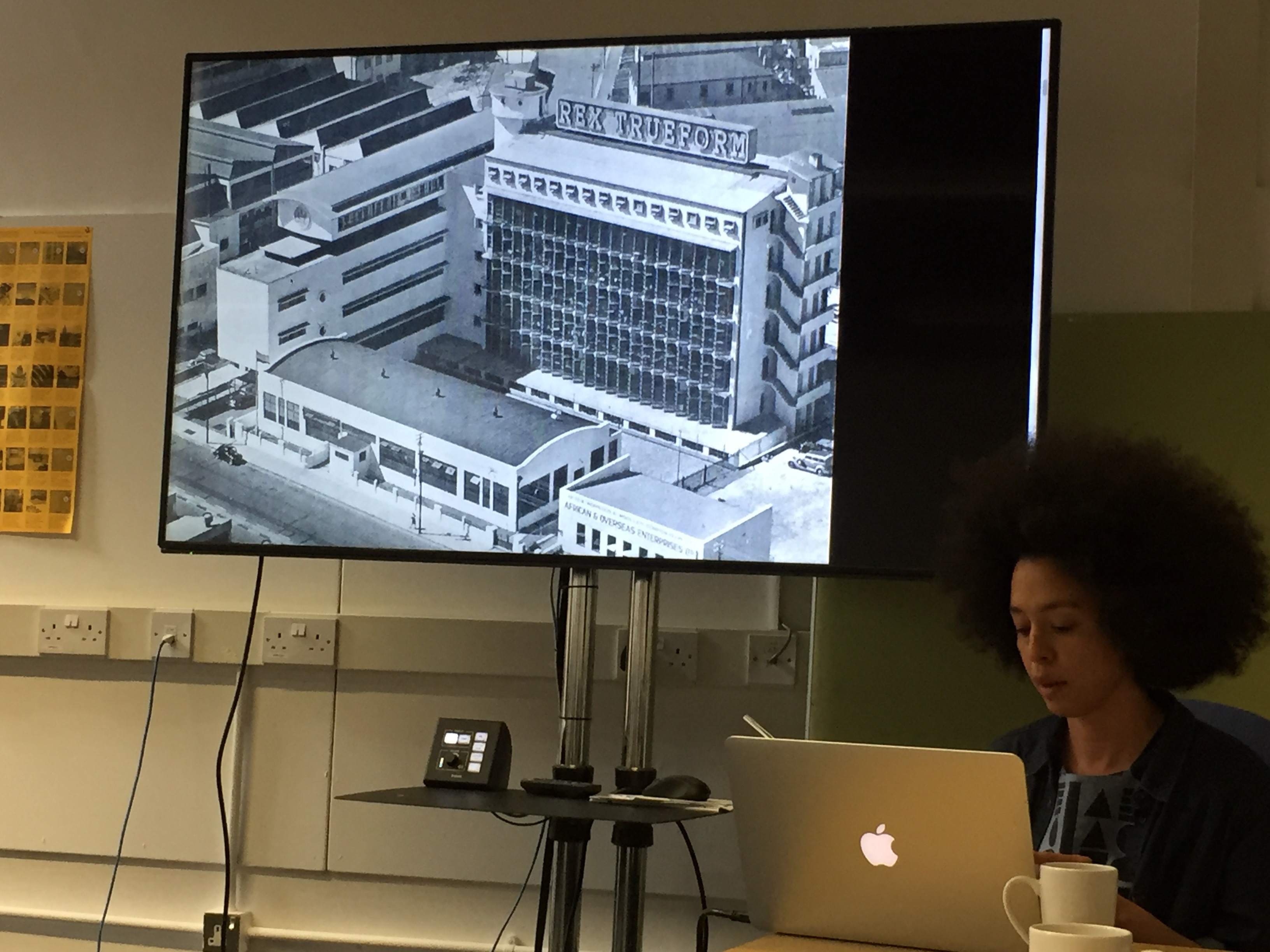
Ilze Wolff presenting Rex Truform’s factory in Cape Town

Ilze Wolff gave a very poignant paper on Rex Truform, the clothing factory in Cape Town designed by Max Policansky in 1937. Ilze’s investigation goes beyond the built fabric and stylistic qualities of the structure – it considers the workers’ stories and what it was like to be a part of the everyday life of this significant building in the city. Ilze is also publishing her findings and interventions through a series of booklets: see Open House Architecture for more details.

IMG_1674

Shantanu Subramaniam’s presentation on Community Centres and Libraries in Ghana

Shantanu Subramaniam presented his recent fieldwork on the community centres and libraries of Ghana. In addition to architectural surveying and cataloguing Shantanu is also considering the environment performance of these structures and testing their ability to modify climate and interior temperatures.

IMG_1675

Joe Addo’s skype presentation on modern architecture in Accra

Joe Osae-Addo joined us via Skype and shared his film on modern architecture in Accra. The film presented an autobiographical account of Accra and its modern architecture, as seen and experienced by Joe from his childhood onwards. It is a compelling piece that will deliver far more impact in changing ‘hearts and minds’ than reports and conservation legislation.

You can watch the film here: https://stream.liv.ac.uk/s/hav96uun

We also discussed the DOCOMOMO presence in Africa and whether there should be regional groups [such as West Africa, Southern Africa and so on], to generate a more critical mass and greater influence. The reliance on the fiche methodology was also questioned – or at least its limits acknowledged – and we considered the use of ‘narrative’ and social history as a means of generating meaning, significance and connection to these structures beyond the fetishisation of the physical attributes, and tangible qualities.

IMG_1697

Cumbernauld townscape

On the final day we were treated to a site visit to the new town of Cumbernauld, and Stirling University.