During this international conference, a series of scholars from different disciplines (history, anthropology, political science, architecture,..) and backgrounds will present their (ongoing) research on railways in Africa and engage in a conversation with Anne Wetsi Mpoma and two artists currently in residence in the context of Europalia Arts Festival, Alexandre Kyungu Mwilambwe and Arnaud Makalou. Aymar Nyenyezi Bisoka will start the day with a keynote lecture. Please note that interventions will be in French and/or English, with no simultaneous translation.
We will open a work-in-progress exhibition of work produced by students and staff of the Department of Architecture and Planning of Ghent University on the theme of the railway in Africa, conducted over the last couple of years. Two keynote lectures, one by historian Geert Castryck (University of Leipzig, Germany) and one by digital humanities scholar Chao Tayiana Maina (African Digital Heritage, Kenya) will provide a broader context on the theme. The interventions will be in English.
Document Fever: Encounters with the architecture of the *colonial architecture archive: Organised by the Architectural Association in collaboration with the Architecture Space & Society Centre, Birkbeck School of Arts
Date: Friday 25 February 2022 Time:10:00 – 17:00
Fever: An intense enthusiasm for or interest in a person, pastime, event, etc., typically widespread but short-lived; an obsession, a craze / A state of intense nervous excitement or agitation / to elevate in intensity, temperature, etc., to heighten emotionally. OED
An architectural archive is expected to contain drawings, plans, maps, photographs, models, and sample materials. However, the archives of post-war architects working for the United Nations — Jacky Tyrwhitt, Charles Abrams, or Otto Koenigsberger, to name a few — contain letters, invoices, book drafts, repetitive lecture notes, photographs, press cuttings, and, mostly, reports, piles of them. Reports consist of from two to dozens of typed pages with advice on the development of the environment as a whole, spanning issues such as landscape, ecology, economy, housing, migration, labour, water management, and others. These reports are mostly addressed at regions in Africa, Latin America, and South and Southeast Asia that were colonised at the time or had recently gained independence.
It is common to find report-based archives in Western departments of architecture and architectural institutions. Both the architectural category and the Western homes of these archives could be questioned for their interdisciplinary content and their embodiment of neo/post/post-/re/trans/inter/—/*colonial relations. These probably get complicated by other questions: the exiled condition of some of its authors, the aspirations of the UN and of the recipients of these reports, or the political and economic international dynamics behind these reports. Maybe one first question is about what these archives represent: is it their authors, their ideas and practices, their network, the lands and peoples reported, or something other?
This symposium adds to the work on *colonial networks of planning consultants since the 2000s and specifically to the work from critical studies and the social sciences developed in the 2010s on *colonial exchanges between Argentina, Brazil, Mexico, US, UK, Nigeria, South Africa, Singapore, The Philippines, Indonesia, India, Pakistan, Kuwait, Iran, Iraq, Ghana, Germany, Poland, Romania, and Belgium. This work has until now scrutinised these archives through theses on climate and race, capitalism and extraction, green infrastructure, socialist worldmaking, and misogynist endurances, amongst others. None of these topics were explicit in the archives which are partial, unclassified, and under rigorous custodianship most of the times. This symposium focusses on the feverish encounter with the architecture of the archive that made possible these forms of research and asks how to make ‘privilegings, elisions, and silencing’ of the ‘work of the archive’ present, accessible, and suggestive, if at all appropriate, in the architectural *colonial archive?
The symposium will explore the following themes:
space, geoposition, and structure of the archive;
property, representation, and audience;
socio-cultural pressures;
fantasies of the writer of the document;
encounters with the document;
critical approaches to the architectural category of these papers;
intellectual frameworks to approach these archives;
evidence finding and the power of “critical fabulations”;
emotional fever in the archive;
connection to the material and personal qualities of the archive;
and the way one would have liked that the encounter with the archive could be framed for future researchers.
CONFIRMED PARTICIPANTS:
Keynote: Sabelo J. Ndlovu-Gatsheni (Professor and Chair of Epistemologies of the Global South with Emphasis on Africa at the University of Bayreuth in Germany)
Irene Appeaning Addo (Senior Research Fellow, Institute of African Studies, University of Ghana)
Ed Bottoms (Archivist, Architectural Association)
Albert Brenchat-Aguilar (PhD student Art History, Architectural Association and Birkbeck; curator, IAS, UCL)
Mark Crinson (Professor of Architectural History, Birkbeck)
Ayala Levin (Associate Professor of Architecture and Urban Design, UCLA)
We are pleased to announce the launch of the 2022 ASAUK biennial conference titled: “Diaspora Remittance Flows: Restitution, Culture and Capital”. This is an innovative conference which seeks to harness the global two-year involvement with online communications with our physical engagement with conferencing which we hope will return in 2022. This conference is conceived to enable our research colleagues in Africa (Ibadan, Nigeria and Nairobi, Kenya) to be part of the research conversation at the 29th ASAUK biennial conference, via the zoom media platform. We also will be running a smaller traditional in-person conference in Liverpool addressing this and other ASAUK member-determined themes.
Running from August 31st – September 4th, 2022, the ASAUK Biennial conference will be a unique two-part conference. With British Academy funding, the first part will take place entirely online and involve ASAUK research colleagues based in Ibadan and Nairobi engaging in the conference themes from Africa based platforms shared across Africa and Liverpool in the UK. This will be followed by a smaller, traditional in-person conference, hosted by the ASAUK at the University of Liverpool.
We invite you to attend the online conference, which is entirely free, and also to come to Liverpool for the ‘in-person’ conference, taking place from Friday 2nd – Sunday 4th September. The Liverpool conference will have a smaller audience, and conference panel requirements planned to pre-empt possible ongoing Covid health advice on conference size and appropriately spaced and ventilated conference facilities. Taking this into account, there will be online access to the physical Liverpool conference for a reduced fee.
THE ONLINE CONFERENCE 31st August – 2nd September
IBADAN-NAIROBI-LIVERPOOL
Restitution, Culture and Capital
This is an entirely free to attend conference (with registration required).
Hosted by ASAUK colleagues at the IFRA Institute, at the University of Ibadan and the BIEA, Nairobi, the online conference has been directly funded by the British Academy, with generous supplementary funding from the BIEA. It will be delivered entirely online from both Ibadan and Nairobi, using the Zoom platform. Working closely with the Institutes in Ibadan and Nairobi, these interactive conferences will be broadcast on two consecutive days, from Ibadan on Wednesday 31st August and Nairobi on Thursday, 1st September. The final part of the online conference will be broadcast from Liverpool on Friday 2nd September, jointly chaired by the ASAUK and RAS presidents.
We expect to curate and edit the key papers, from Ibadan, Nairobi and Liverpool that will be discussed at this unique online conference series. These with support from the British Academy will form the basis of the ASAUK publication Restitution Culture and Capital in Africa and the Diaspora, a trans-national conversation which will elaborate on the themes of the conference through the publication of the keynote papers and also the responses as recorded by participants at the three conference platforms.
The panel session themes and keynotes for the three day online conference are as follows:
HOSTED ONLINE FROM IFRA, UNIVERSITY OF IBADAN
Curated by Vincent Hiribarren, Director IFRA Ibadan
Ibadan Session 1. DIASPORA FLOWS OF CULTURAL ARTEFACTS TO AND FROM AFRICA
Prior to the online sessions keynote speakers will discuss their papers with Africa-based ECRs in workshop format.
THE LIVERPOOL ASAUK 29th BIENNIAL CONFERENCE
FRIDAY 2ND – SUNDAY 4TH September 2022
The ‘in-person’ Liverpool Conference follows the traditional panel theme format. Whilst the panel theme titled: “Diaspora: Restitution, Culture and Capital“, follows on directly from the online conference, we invite proposals for other panel themes.
As this is planned to be a smaller conference we call on panel proposers to ensure all panel proposals are sent in to the ASAUK conference team by 31st March, 2022. All proposals need to have the names of the 3 – 4 paper givers, and their abstracts submitted by the 31st March deadline. This will enable us to plan the conference space and facilities required. It will also mean that we can work to ensure that any documentation required for proposed international participants who might need this will get processed on time. We realise that this is different from the traditional conference format but hope you will join us for this unique, innovative conference in 2022. The 30th April is the later deadline for individual paper proposals. Due to the smaller conference format, space for individual papers will be limited and we encourage paper givers to consider working with emerging panel themes which will announce from February onwards.
The 29th ASAUK biennial conference dinner will be held at Liverpool University’s Victoria Gallery and Museum on Saturday 3rd September. This will also be the venue for announcement and awards ceremony for the Audrey Richards prize, the Fage and Oliver prize and the distinguished Africanist awards ceremony.
For more information about the 29th ASAUK conference. Please contact the conference organisation team via the email address: asaukconference22@gmail.com. Panel proposals, comprising the 3 – 4 papers with abstracts, can also now be sent to this address.
We will be providing further information as the conference details develop on our website and via social media.
From the 1950s to the late 1980s, the politics and economies of foreign aid — instigated by both the ‘capitalist West’ as well as the ‘communist East’ — gave rise to a whole infrastructure destined to assist the progress of ‘developing countries’ on their ‘path to development’. The various North-South exchanges that took place in the name of ‘development’ have left a deep imprint on the geopolitical landscape of postcolonial Africa, Asia, and Latin America.
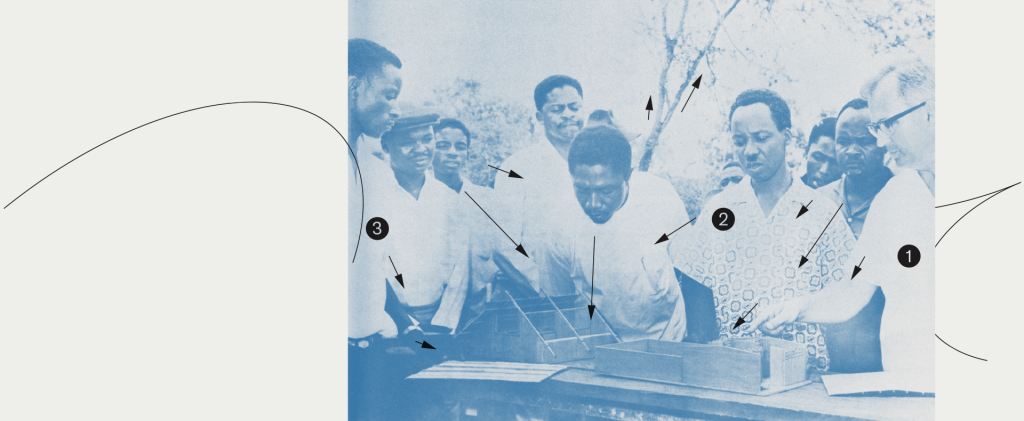
(1) Bertil Melin, the Swedish director of the Nordic Tanganyika Project in Kibaha, showing a model of low-cost housing to (2) President Julius Nyerere, c. 1963-64. To the far left, (3) Mr. Dennis, the carpenter who made the models, co-designed the housing project, and “test-lived“ in the first constructed house with his family. From Torvald Åkesson, ‘Education – In Marble Halls or Under Trees. Low-Cost Houses in East Africa, Especially Ethiopia and Tanzania’, compiled self-published report, c. 1965, Stockholm. Collection KTH Library.
Largely instituted through bilateral relations between individual states, these ‘aid’ initiatives involved not only financial and material resources but also various forms of knowledge and expertise; as such, the modalities of this global, foreign aid-funded infrastructure boosted the creation and reinforcement of all sorts of institutional actors to efficiently exchange knowledge — largely through training courses, educational programs and/or research projects. In the light of widespread rural migration and intensive, rapid urbanization processes, expertise on the built environment was a particularly salient form of knowledge to the aims of foreign aid. Hence, architecture, urbanism and planning were no strangers to an emerging foreign aid-funded knowledge economy — a context in which the production and circulation of knowledge were intimately tied to the political-economic value attributed to them by foreign aid diplomacy.
How did architectural knowledge figure in foreign aid-sourced international relations, and what frameworks were set in place to efficiently exchange that knowledge?
For this two-day symposium, we seek scholarly work that critically analyzes, contextualizes, or theorizes the establishment and functioning of such institutional actors, training courses, educational programs, research centers, and other infrastructures for knowledge exchange that emerged under the aegis of development and targeted ‘Third World’ clients. We welcome a wide range of methodological and creative perspectives as well as less empirical (but well-informed) theoretical approaches that interpret this phenomenon from a postcolonial or decolonizing perspective. We also encourage contributions that scrutinize the intersections of these histories with discussions of gender, race, religion and nationalism.
Online Modernist University Campus Architecture Writing Workshop: A Ghana-Nigeria-UK collaboration
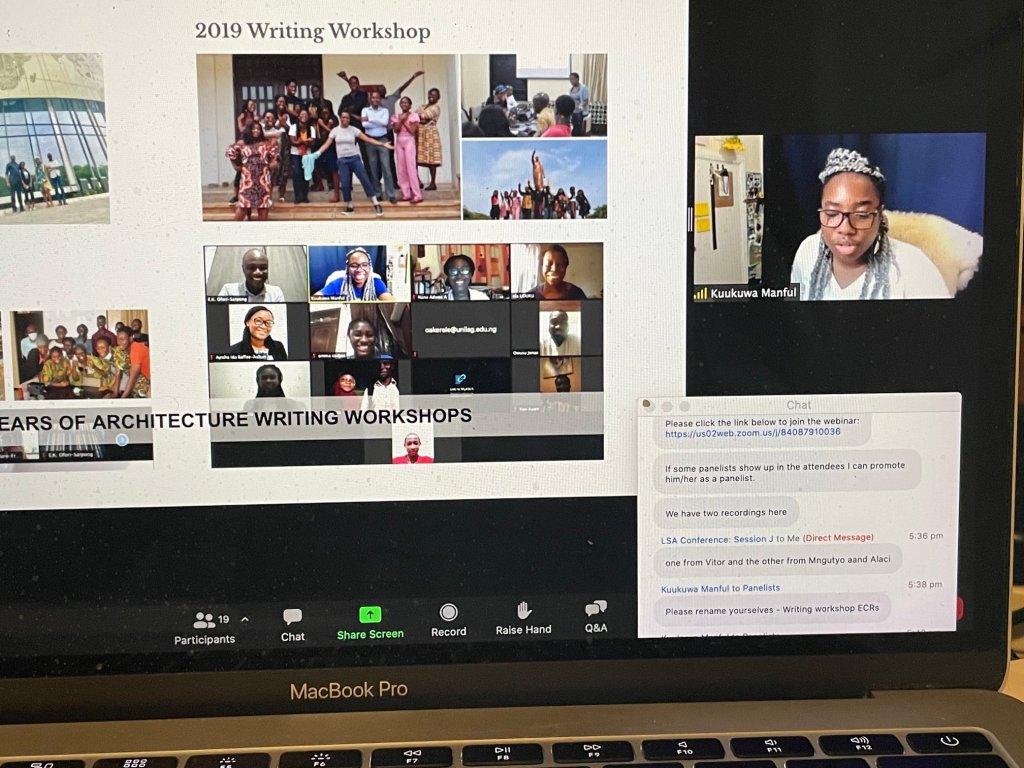
The third iteration of the African Architecture Writing Workshop has involved multi-disciplinary teams of young students and Early Career Researchers (ECRs) from Universities in both Ghana and Nigeria in developing a series short written articles focused on personal views of university campus buildings in Ghana and Nigeria. The ECRs worked directly with the young students as mentors to encourage and develop their writing style.
The ECRs have also been tasked with compiling and editing student work to create a series of gazette entries for the Modernist University Campus Buildings in West Africa project. Aside from the written component the ECRs and students have also taken a set of photographs which will form the basis for a future planned photography workshop to be run in association with the International Documentation of Modern Buildings and Landscapes, (Docomomo) team Germany.
The British Academy-funded workshop took place over two weeks starting at the University of Ghana, Legon led by Co-I Dr Irene Appeaning Addo, with support from ECRs Kuukuwa Manful, Emmanuel Ofori-Sarpong, Dr Ayisha Baffoe-Eshun, and Yaw Asare; as well as guest mentor Dr Joseph Oduro-Frimpong. There was a guest lecture from Professor Lesley Lokko. Students from Kwame Nkrumah University of Science and Technology, University of Ghana, and Central University College took part in the workshop. Arc Ruth Anne Richardson, Arc Tony Asare, Dr Edem Adotey, and Professor Iain Jackson reviewed the students’ final written pieces that were focused on three buildings on the University of Ghana Campus; Commonwealth, Volta and Legon Halls.
After a hand over day the Nigeria team’s workshop was led by Co-I Dr Nnezi Uduma-Olugu, and involved three institutions, the University of Lagos, University of Jos and the University of Nigeria, Enugu Campus. Each institution had a number of ECRs who worked at mentoring the interdisciplinary group of students who had enrolled at each of the workshops. As with the Ghana workshop a number of guest speakers including Prof Bogdana Prucnal-Ogunsote, (University of Jos) Kofo Adeleke (Legacy-92 organisation Lagos) and Dr Onyekiekwe Ijeoma, Nigeria commission for Museums. For the Nigerian final critical reviews attended by Prof Lukasz Stanek (University of Manchester) and Dr Joseph Oduro-Frimpong (Asheshi University Ghana) the ECRs presented their edited summaries of the student-written work and views on campus buildings in the three cities.
ECRs then presented their workshop experience at the Lagos Studies Association International Online Conference at a roundtable panel on conservation challenges in Africa chaired by Profs Uduku and Lawanson, Manchester School of Architecture, Manchester Metropolitan University, and University of Lagos respectively.
Whilst students and ECRs met in covid secure ways at their respective campuses all lectures and reviews took place entirely online, with students and ECRs able to work from ethernet-wifi equipped room spaces at the University of Ghana, and all three Nigerian collaborating Universities.
Currently ECRs are working on the editing and production of the initial phase of the Modernist African University Campus Buildings Gazette, this will be critically reviewed by Prof Miles Glendinning, Docomomo Scotland and Director SCCS University of Edinburgh. Watch this space…
The 20th anniversary of the Modern Heritage Programme, jointly initiated by UNESCO, ICOMOS, and DOCOMOMO, in 2021 presents a timely and important opportunity to reflect on the transformative cultural experiences and global consequences of the recent past that heralded the dawn of the anthropocene and its many impacts on climate, society, and the planet. Despite these impacts, the ‘modern’ era and its legacies are comparatively undervalued and overlooked, and disproportionately concentrated and interpreted in ‘the west’. MoHoA contends that Africa’s experiences of plural modernities include the positive and negative, colonial and post-colonial, tangible and intangible, urban and rural, culture and nature. This will need greater scholarly attention and can be instructive and transformative in framing modernities and modern heritage globally, as well as addressing the challenges of sustainability continentally. On the one hand, Africa’s contemporary cities, many of which are products of modern encounters, face the highest rates of urbanisation in the world over the next half a century, straining populations and resources, urban landscapes and rural hinterlands, and placing modern heritage at serious risk of alteration or destruction. On the other hand, the unique human settlement patterns in Africa, provides a new dimension, reflected in the cultural landscapes, “combining works of nature and humankind, they express a long and intimate relationship between peoples and their natural environment”.
The African World Heritage Fund has identified modern heritage as amongst the most marginalised heritage categories on the continent, demanding investment in research and documentation to better protect, increase resilience and subsequently Africa’s representation on the UNESCO World Heritage List. Through improved methods of understanding and assessing significance, raising public awareness and promoting inscription on local or global registers, Africa’s modern heritage has a vital role in contributing to rural and urban sustainability in line with the UN’s Sustainable Development Goals (SDGs), the New Urban Agenda (NUA), the African Union’s Agenda 2063, and the Historic Urban Landscapes (HUL) Approach.
MoHoA plans two symposia over two years and a series of supporting thematic workshops. The first symposium, focusing on Africa, will be hosted by the University of Cape Town in September 2021 and titled ‘Modern Heritage of Africa’. The second will be global in scope and hosted by The Bartlett School of Architecture (UCL) in 2022 and titled ‘Modern Heritage in the Anthropocene’. The outcome UCT symposium will lead to proposing a ‘The Cape Town Document on Modern Heritage’ supporting efforts to modify international policy and guidance on modern heritage in line with present and future planetary challenges of ecological, social and economic equity. This will be presented to the World Heritage Committee as part of the reporting exercise and as a side event at the relevant Committee Session. The UCL symposium will discuss the wider implications of the MoHoA globally.
We invite submissions to the International Symposium on the Modern Heritage of Africa and welcome papers and other forms of communication including video, music, performance and literature accompanied with a commentary and interpretation focusing on any of the following themes evolving from the brain storming isivivana last August, highlighting both cultural and natural heritage, the tangible and intangible and their symbiotic relationships:
Considerations of modernities in Africa
Modern Heritage and Sustainable Development in Africa (SDGs)
Infrastructure development, particularly industrialization and transportation systems, as activators of modernism in Africa
Natural heritage and its role in society, linking culture and nature
Public spaces, memorialization and commemoration in postcolonial Africa
Modern Heritage of Africa and the World Heritage Convention
Any other theme not covered by the above
Abstracts: Contributions with African experiences of modernities and the sharing of heritage knowledge and we welcome abstracts of up to 300 words or equivalent format (e.g. film shorts, blog, Instagram story) for other types of digital submissions. For general reference in terms of format – see below. To submit an abstract, email: modernheritageofafrica@gmail.com
The abstracts: Date to be finalised
forming results: Date to be finalised
Publication: Selected papers or presentations will be published as part of the Modern Heritage of Africa Book Series to be published after the conference.
Audience: academia, heritage fields, professionals and practitioners from diverse disciplines addressing the tangible and intangible, culture and nature, documentation, archives and collections. We encourage participation from colleagues and institutions from Africa, particularly from youth and women.
Networking: Institutions of African Studies, Schools of Cultural Studies, Architecture and Planning – African Union and professional bodies.
Languages: Français and English
Dates:22 and 23 September and 24 September, South Africa Heritage Day 2021
Venue: University of Cape Town, South Africa
Participation: online registration will be required and is free; a $50 donation will be welcome.
Format: The MoHoA symposium will be a virtual, hybid, academic event, a dialogical field capable of moving beyond disciplinary boundaries with social and cultural exchanges. To ground its activities and foster dialogue, we invite proposals, ranging from operational practices to speculative and theoretical questionings. These can be presented in written, built, coded, drawn, figured, imagined, filmed, modelled or in any other format (do not hesitate to consult with us for any exotic format or idea!).
Contributions may take the following forms:
Paper presentations that will be shared and discussed through joint working sessions and panel discussions. These might include theoretical work, but also case studies and project reports. To submit your paper proposal, you must submit an abstract of up to 300 words.
Projects, models, images, devices, pieces of coding, hardware and all other kinds of contributions. These must be submitted by sending a 300-word optionally illustrated abstract in the form of a single PDF including text and images (max 5mb).
Contributions can be signed individually or collectively.
Contributors are welcome to submit more than one proposal in one or more formats. If selected, all contributors are responsible for covering the costs of sending their work in time for presentation. The conference is led by the University of Cape Town and planned virtually with a possible physical component on campus; please state if you would able to attend in person.
If selected, contributors might be assigned to a 15-min paper/project presentation session or a debate session to discuss their work. Or both. These might be done in person, by possibly attending one of the conference’s sites, or remotely. The final format and topics of the sessions will be configured once all submissions have been received, so it is possible and desirable that participants will be grouped in thematically coherent yet interdisciplinary sessions.
Here are the recordings from the Crucibles, Vectors, Catalysts: Envisioning The Modern City, event from 2nd and 9th March 2021. Thank you to all of our excellent speakers, and for the interesting questions and discussions.
PROGRAMME: Session 1: Crucibles, 15:00-16:30 (UTC) Building the Modern City: Expressions of Identity, Change and Power, Moderated by Iain Jackson
This panel will explore state-sponsored programmes, planned cities and masterplans in cities such as Lagos, Tehran and Baghdad. It will examine architecture as expressions of nationalism and nationalist political agendas as well as its relationship to big business, corporations and mercantile ventures.
Rupture, Transition and Continuity in Baghdad’s Master Plans: From Minoprio to Miastoprojekt
Session 2: Vectors, 17:00-18:30 (UTC) Connecting the Modern City: Networks, Alliances and Knowledge Production; Moderated by Clara Kim
This panel will explore the practice of modern architecture through colonial-postcolonial networks and geopolitical alliances. It will explore cities in Mozambique within the context of other Lusophone countries, post-Partition East & West Pakistan, as well as the dissemination of knowledge and technical expertise through pedagogy.
Correspondences, Transfers and Memory: Maputo’s “Age of Concrete”
Farhan Karim (University of Kansas)
Archaeology of the Future: Constantinos Doxiaidis in East and West Pakistan
Patrick Zamarian (University of Liverpool)
Global Perspectives and Private Concerns: The AA’s Department of Tropical Architecture
TUESDAY 9 MARCH Session 3: Catalysts, 15:00-16:30
Fragments of the Modern City: Memories, Echoes and Whispers Moderated by Osei Bonsu
This panel will explore the collaborations, connections and entanglements that developed between art and architecture during a dynamic period of building in Morocco, India and Iraq. It will examine the legacy and afterlives of these projects through the investigation of under-recognised figures and narratives in art and architecture.
Speakers:
Lahbib el Moumni & Imad Dahmani (founders of MAMMA, Mémoire des Architectes Modernes Marocain)
Initiatives toward saving modern heritage of Morocco
Ram Rahman (Photographer/Curator)
Building Modern Delhi, The Nehruvian Post-Independence Renaissance
Amin Alsaden (Independent Scholar)
Syntheses Across Disciplines: Rifat Chadirji and Art-Architecture Liaisons in Modern Baghdad
Explore modern cities and architectural production in the blurred era of the independence and postcolonial period
Join us for three sessions which will bring together scholars, researchers and curators to explore architectural production in the blurred era of independence to the post-colonial period of the mid-20th century, focussing on cities in Africa, Middle East and South Asia.
Whether driven by socialist agendas (Nehruvian in India and Nkrumah in Ghana), monarchies (Pahlavis in Iran and Hashemite in Iraq), quasi colonial protectorates, or pan-continental aspirations, architecture (and especially Modernism) was a key apparatus for nation-building, for re-imagining identities and a means to project and invent a new image of the future. The seminar seeks to explore the use of architecture as both physical infrastructure and symbolic expression, as well as its vulnerability to the vicissitudes of changing politics and policies of the times.
The role of cities as crucibles, vectors and catalysts for developing new expressions of identity, change and power is key. Cities in this period saw the emergence of schools of thought, dynasties and collaborations were formed, networks and ideas were shared and publications were disseminated. While the desire of a newly independent nation was often to consolidate a single national collective identity, it was through the urban centres that strands of coherent, yet often multiple identities were formed. The role of figures such as Rifat Chadirji, Mohamed Makiya, Jane Drew and Maxwell Fry were important as they often operated within multiple cities and cross-cultural contexts that spanned the colonial to postcolonial divide.
These urban centres were either newly built, or they were remade and reimagined through city infrastructure, government buildings, universities, cultural institutions and national monuments. Architecture schools, state sponsored projects and external agencies feed into the discussion and warrant further exploration. The seminar explores the transnational connections, diverse political agendas and complex allegiances which informed architectural development in this period.
Seminar convenors:
Iain Jackson, Professor of Architecture and Research Director, Liverpool School of Architecture
Clara Kim, The Daskalopoulos Senior Curator, International Art, Tate Modern
Nabila Abdel Nabi, Curator, International Art, Tate Modern
PROGRAMME TUESDAY 2 MARCH
Session 1: Crucibles, 15:00-16:30 (UTC)
Building the Modern City: Expressions of Identity, Change and Power
Moderated by Iain Jackson
This panel will explore state-sponsored programmes, planned cities and masterplans in cities such as Lagos, Tehran and Baghdad. It will examine architecture as expressions of nationalism and nationalist political agendas as well as its relationship to big business, corporations and mercantile ventures.
Rupture, Transition and Continuity in Baghdad’s Master Plans: From Minoprio to Miastoprojekt
Session 2: Vectors, 17:00-18:30 (UTC)
Connecting the Modern City: Networks, Alliances and Knowledge Production
Moderated by Clara Kim
This panel will explore the practice of modern architecture through colonial-postcolonial networks and geopolitical alliances. It will explore cities in Mozambique within the context of other Lusophone countries, post-Partition East & West Pakistan, as well as the dissemination of knowledge and technical expertise through pedagogy.
Correspondences, Transfers and Memory: Maputo’s “Age of Concrete”
Fahran Karim (University of Kansas)
Archaeology of the Future: Constantinos Doxiaidis in East and West Pakistan
Patrick Zamarian (University of Liverpool)
Global Perspectives and Private Concerns: The AA’s Department of Tropical Architecture
TUESDAY 9 MARCH
Session 3: Catalysts, 15:00-16:30 (UTC)
Fragments of the Modern City: Memories, Echoes and Whispers
Moderated by Nabila Abdel Nabi
This panel will explore the collaborations, connections and entanglements that developed between art and architecture during a dynamic period of building in Morocco, India and Iraq. It will examine the legacy and afterlives of these projects through the investigation of under-recognised figures and narratives in art and architecture.
Speakers:
Lahbib el Moumni & Imad Dahmani (founders of MAMMA, Mémoire des Architectes Modernes Marocain)
Initiatives toward saving modern heritage of Morocco
Ram Rahman (Photographer/Curator)
Building Modern Delhi, The Nehruvian Post-Independence Renaissance
Amin Alsaden (Independent Scholar)
Syntheses Across Disciplines: Rifat Chadirji and Art-Architecture Liaisons in Modern Baghdad
The 7th International Congress on Construction History (7ICCH) will be held in Lisbon, from 12 to 16 July, 2021. As in 6ICCH (Brussels, 2018), the 7ICCH event will adopt a two-step procedure for proposals evaluation:
– First call: a first call for proposals for thematic sessions will be open from 15 April 2020 to 9 May 2020; followed by a
– Second call: a general call for abstracts for the usual open sessions, from 18 May to 28 June 2020.
We are what we build and how we build; thus, the study of Construction History is now more than ever at the centre of current debates as to the shape of a sustainable future for humankind. With the main theme “History of Construction Cultures”, the Congress will provide an opportunity to celebrate and expand our understanding of the ways that everyday building activities have been perceived and experienced in different cultures, times and places.
The general call for abstracts will invite proposals for inclusion in thematic sessions as well as single contributions dealing with a broad range of construction history topics (construction determinants and their relation with design, extraction and processing of materials, site management, works execution processes, knowledge transfer, actors, machines, tools, building legislation, construction – politics, economy and society, etc.). The aim will be to achieve a broad and in-depth assessment of new research in construction history.
The present call, open until 9 May 2020 invites prospective session chairs to suggest topics for thematic sessions. The proposed subjects should contribute to the debate of the latest issues, approaches and questions of research in the field of construction history research, stimulating intercultural and interdisciplinary collaboration and discussion. Proposals should include a description of the theme (max. 400 words), an explanation of the relevance of the theme (max. 400 words) and the CV of the applicant chair demonstrating his/her relevant expertise.
With the support of the Scientific Committee, the Organizing Committee will select up to 12 thematic sessions, limited to one per applicant. Chairs of the thematic sessions are expected to be present at the 7ICCH and give a short introduction to their session. They are, in collaboration with the Scientific Committee, responsible for the selection process of the submitted abstracts and for the editing process of the submitted papers. Four or five papers will be selected for each session.
No more than one paper from the chair’s research team can be selected. The Scientific Committee reserves the right to redirect papers towards other thematic or general sessions. Proposals should be sent to 7icchlisbon@gmail.com until 4 May 2020. Prospective session chairs will be informed on the evaluation of their proposals by the Organizing Committee by 18 May 2020.
Organizing Committee:
Chair – João Mascarenhas Mateus (University of Lisbon) Treasurer – Ana Paula Pires (NOVA University of Lisbon) Sandra M. G. Pinto (NOVA University of Lisbon) Fernanda Rollo (NOVA University of Lisbon)
José Aguiar (University of Lisbon)
Ivo Veiga (University of Lisbon)
Milton Pacheco (Coimbra University)
Manuel Caiado (University of Lisbon)
The Coloniality of Infrastructure: Eurafrican Legacies:
Call for Papers – Conference at the University of Basel, 24-26 June 2020
When Eurafrica emerged in the 1920s as an intellectual and political project to connect Europe with Africa, its goal was to ensure European colonial dominance in a changing world. Key to the proposed continental merger was infrastructure—not surprising at a time when railways, ports, camps, and other large-scale building projects were facilitating the extraction and movement of things for Europe while curtailing the freedom and mobility of Africans on an unprecedented scale. Recent scholarship has emphasized the centrality of Eurafrica and the type of colonialism it mustered in the history of European integration, from the EU’s founding intellectuals to its Cold-War-era realization. But continental infrastructure also played a role in African struggles for independence. Highways, ports, and dams became tools of state-building and even mobilized hopes of Panafrican integration and international solidarity. In practice, however, large-scale infrastructure required technical and financial aid which further entrenched Africa’s asymmetrical relationship to the Global North.
Today, as Africa enters a new age of development increasingly dominated by China, and the EU is in fundamental crisis, is it still possible to speak of a Eurafrican present? From the physical imprint of cities and the configuration of intercontinental airline routes, infrastructure testifies to the enduring legacies of Eurafrica. Infrastructure shapes territories and governs the mobilities within and across them, but also serves to immobilize and externalize bodies and things. The European infrastructure of the Mediterranean border regime, in which African migrants are systematically being detained or left to die, recalls colonial-era policies that valued life and dictated death along racial lines. At the same time, European aid focused on infrastructural development in Africa is increasingly targeted to counter such unwanted migration—without touching the global extraction economies that have roots in European colonial rule and continue to shape African cities and territories today. Because of these specters of Eurafrica, the EU seems structurally incapable to come to terms with its colonial past.
This conference proposes to explore historical continuities in Africa’s relationship with Europe through the lens of infrastructure. What are the infrastructural histories that bind the unequal destinies of people together across continents, and how do these legacies shape contemporary lifeworlds and international relations? How does infrastructural violence shape international relations between Africa and Europe, and how is the legacy of Eurafrica manifested in the spaces of everyday life? To answer these questions, the conference invites scholars from urban studies, history, political science, postcolonial theory, architecture, border and migration studies, and allied fields. We invite contributions that develop new perspectives of our geopolitical and interconnected urban present through its infrastructural pasts. Such studies of material and aesthetics relationships between Africa and Europe can focus on questions of lifeworlds, urban transformation, migration, territory, citizenship, development, or related themes. We are particularly interested in studies that can reveal the differential entanglements between people and places, and locate alternative forms of infrastructure, imaginaries of belonging, ongoing struggles for decolonization, and practices of world-making that decenter colonial ways of seeing, feeling, and knowing.
Confirmed Keynote Speakers:
Elizabeth Povinelli (Columbia University)
Siba N’Zatioula Grovogui (Cornell University)
Scientific Committee:
Peo Hansen (Linköping University, Sweden)
Edgar Pieterse (University of Cape Town)
Muriam Haleh Davis (University of California Santa Cruz)
Samia Henni (Cornell University)
Charles Heller (Forensic Oceanography, Geneva)
Anne-Isabelle Richard (University of Leiden)
Bilgin Ayata (University of Basel, Sociology)
Julia Tischler (University of Basel, Centre for African Studies)
Lorena Rizzo (University of Basel, Centre for African Studies)
Madeleine Herren-Oesch (University of Basel, European Global Studies)
Selection of Speakers:
Please submit an abstract of no more than 300 words and a short C.V. by 10 December 2019 to Michelle Killenberger (michelle.killenberger@unibas.ch). Applicants will be notified of acceptance in February 2020. We will cover travel and accommodation expenses for speakers in need of financial assistance.
Conference Organization:
The conference is organized by Kenny Cupers, Urban Studies, Department of Social Science at the University of Basel, in collaboration with Sociology, the Centre for African Studies, and the Institute for European Global Studies, as well as the African Centre for Cities at the University of Cape Town.
Follow-up Conference:
A follow-up conference will take place in collaboration with Prof. Edgar Pieterse at the African Centre for Cities at the University of Cape Town in June 2021. Entitled “Emerging Infrastructural Worlds: Mapping Urban Research in Africa,” this conference will map research approaches to transnational infrastructure projects across Africa and their consequences on the ground.
More information:
This conference is funded by the Swiss National Science Foundation. For more information about the conference and associated research projects, please visit: