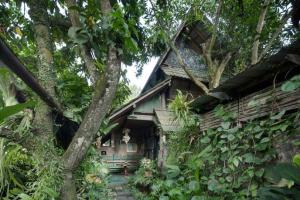
Exhibition: Tropicality Revisited: Recent Approaches by Indonesian Architects is currently on show at the Deutsches Architekturmuseum , Frankfurt, Germany.

ImageHandler.ashx-2

29 August 2015 – 3 January 2016, 3rd floor
GUIDED TOURS: Saturday and Sunday, 14:00

ImageHandler.ashx

Architecture in the Tropics was never just about offering shelter from rain and sun. “Tropical architecture” suddenly gained global relevance with the emergence of Modernist Architecture and was adapted to suit all climates and cultures. During the post-War period the science of climatic architectural design became an international success. For many generations of Indonesian architects, the tropics has never been a romantic colony, but a harsh reality with its torrential rains, heat, and high humidity. Today, “tropical architecture” is often easily forgotten by the critics, lost behind the glazed and airconditioned skyscrapers or the celebrated designs for tropical tourist resorts. At times, it seems to be taken for granted – pitched roof and overhangs are the ready-to-use answers – but it is also a challenge for architects to find new solutions. In the days of climate change and energy crises, architecture adapted to the climate is making a triumphal comeback.

ImageHandler.ashx-3
12 ARCHITECTS \ 12 PROJECTS

  • Achmad Tardiyana, Jakarta – Rumah Baca, Bandung
  • Adi Purnomo \ mamostudio, Ciputat – Studi-O Cahaya, West Jakarta
  • djuhara + djuhara, Ciputat – Wisnu Steel House, Bekasi
  • andramatin, Jakarta – Andra Matin House, Jakarta
  • Csutoras & Liando, Jakarta – Kineforum Misbar, Jakarta
  • d-associates, Bandung – Tamarind House, Jakarta
  • EFF Studio, Denpasar \ Bali – Almarik Restaurant, Gili Trawangan \ Lombok
  • Eko Prawoto Architecture Workshop, Yogyakarta – Eko Prawoto House, Yogyakarta
  • Studio Akanoma, Bandung – Ciledug Timber House, Ciledug \ Tangerang
  • LABO, Bandung – House #1 at Labo. the mori, Bandung
  • Studio TonTon, Jakarta – Ize Hotel, Seminyak \ Bali
  • Urbane Indonesia, Jakarta – Baiturrahman Mosque, Kopeng \ Yogyakarta

More information at: http://www.dam-online.de/ 

Congratulations to Zaha Hadid for winning the 2016 RIBA Gold Medal and for being the first women to do so in her own right.

zaha-hadid-interview-united-nude-re-inventing-shoes-milan-design-week-designboom-10-818x523

A very interesting radio interview is transcribed here about the fate of construction workers at the Qatar World Cup Stadium. Don’t call Zaha scary and then attempt a series of poor, under researched questions is the moral here.

Read the interview transcript at: http://www.theguardian.com/artanddesign/ng-interactive/2015/sep/24/zaha-hadid-radio-4-interview-sarah-montague-qatar 

Further info at the RIBA site here: https://www.architecture.com/Awards/RGM/RGM2016/ZahaHadid.aspx

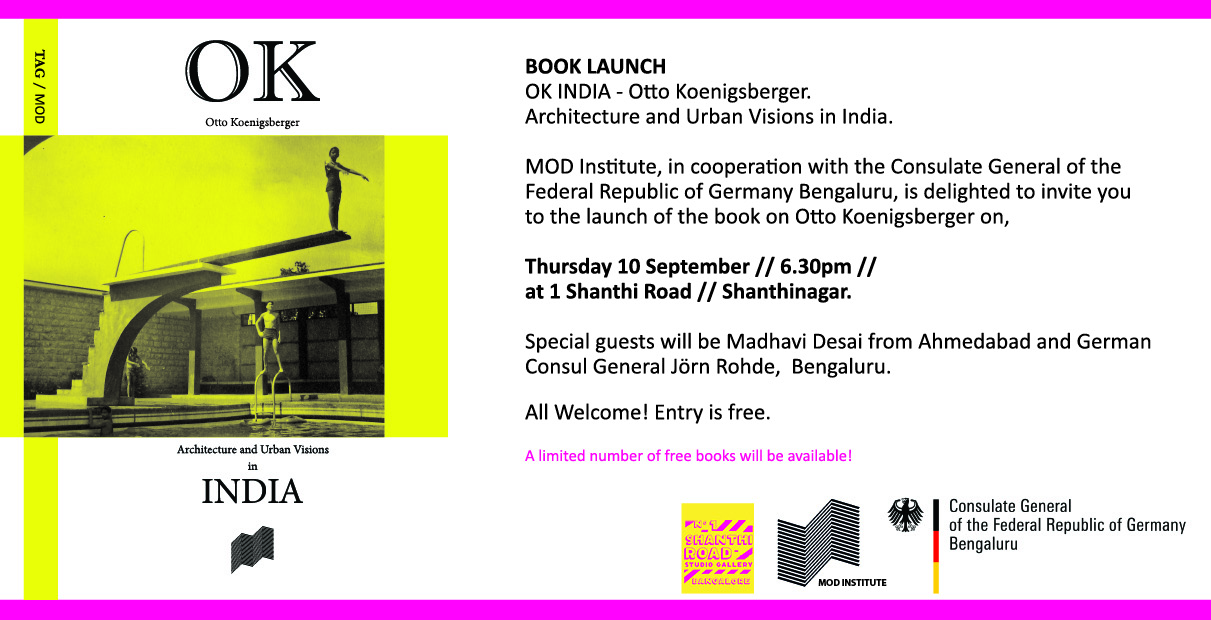
Book Launch OK India – Otto Koenigsberger. Architecture and Urban Visions in India, by Rachel Lee

The much awaited book by Rachel Lee on Otto Koenigsberger is finally with us, and there will be a book launch celebration on 10th September in Bengaluru, see the poster below for more details. We’re delighted that the book has been jointly published by TAG / MOD and we’ll post more details of how you can get a copy in due course…

Book Launch Otto Koenigsberger

Architecture Tour: Otto Koenigsberger: Building Bangalore in the 1940s

Dr Rachel Lee will be leading a tour of Otto Koenigsberger’s buildings in Bangalore on 3rd September – a rare treat to learn more about Koenigsberger’s work in Mysore state. Dr Lee’s PhD was dedicated to Koenigsberger’s work in India and she is about to publish a monograph on her findings very soon- which we are very much looking forward to and will announce further details here…..

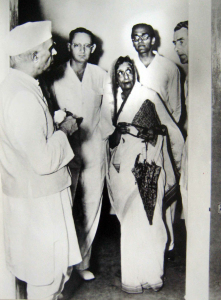
Otto Koenigsberger with Nehru, Amrit Kaur and Mountbatten

Thursday, 3 September 2015

Tour Start Point: 1:00 p.m. at the Pavilion in M. N. Krishna Rao Park

Tour End Point: 5:00 p.m. at IISc CCS

To register, contact: +919880347794 OR 080-49000812-ext 836  or email: cph@srishti.ac.in 

Last day for registration: 1 September 2015.

To view the poster and for more details see: Rachel Lee Walk

cleoroberts's avatarEnvisioning the Indian City

Tuesday 18th August 2015

The second day opened with two papers addressing the architectural development and planning of Chandigarh. Iain Jackson (Senior Lecturer, School of Architecture, University of Liverpool) explored the overlooked and quotidian portions of the city in his paper, ‘Chandigarh Dwellings: Ghastly Good Taste or Flamboyant Modernism’. Departing from the over-cited work on the city by Le Corbusier, Pierre Jeanneret, Maxwell Fry and Jane Drew, he detailed his early research into private developments which have avoided similar ossification. 

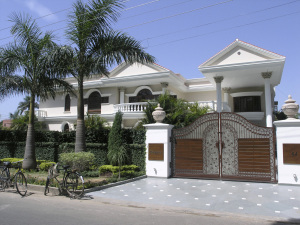
His documentation of these private dwellings showed idiosyncratic modification contra to the city’s founding vision. Discussing this independence from the Government’s arbitration of taste and aesthetic agenda, Jackson proposed a series of classifications including Punjabi Baroque. He stated that this peacock flamboyancy and non-utilitarian adaptation showed Chandigarh remained open, unresolved and signalled the failure of modernist notions of ‘home’. 

New Chandigarh villa New Chandigarh villa

Melissa Smith (Banduksmith Studio/Visiting Faculty, CEPT…

View original post 1,521 more words

cleoroberts's avatarEnvisioning the Indian City

ENVISIONING THE INDIAN CITY: PEOPLE, PLACES, PLANS

UGC-UKIERI INTERNATIONAL WORKSHOP

HL ROY MEMORIAL AUDITORIUM

MONDAY 17TH AUGUST 2015

The third ETIC international workshop was inaugurated by Professor Sukanta Chaudhuri, Emeritus Professor of English and well-known urban historian. Supriya Chaudhuri (ETIC project lead, Jadavpur) thanked the Centre of Advanced Study, Department of English, Jadavpur University, for hosting the two days and communicated apologies on behalf of Professor Nandini Das (ETIC project lead, University of Liverpool). 

Narayani Gupta (Formerly Professor, Department History and Culture, Jamia Millia Islamia)  opened the first panel. ‘The Denial of History’ discussed the lost traces of Delhi’s cross-cultural connect throughout its ‘planning’ historiography. Delhi was depicted as an open city, attracting cosmopolitan migration including Armenian and Afghani communities, but Gupta commented on the lack of social historical interest in this multi-layered past. As Delhi gets reported in political terms, using phrases such as Lodi Dehli…

View original post 1,688 more words

 Architectural Theory Review Special Issue Call for Papers: Africa Critical (Vol. 20, No. 3)

Unlike every other populated continent, Africa retains a monolithic description that flattens and abrogates the complexities inherent across its 54 countries. The connotations of the name bear witness to a phantasmatic mobility for which crises have opened various regions to reinvention via mediated spectacle, while also occluding the hegemonies of imperialism and its afterlives. Such transfers, intensified during the violent insurgencies of colonial possession and subsequent ethnic conflicts, has continued into the twenty-first century at an alarmingly rapid pace affecting how and why power is reified among urban centres. Competing ventures, including the fabrication of new infrastructures, unlimited mineral processing and the (de)mobilisation of humanitarian aid all can be read as dynamic indexes of those “networks of concrete becoming” (AbdouMaliq Simone) which quickly eschewed lingering colonial systems in favour of the global. We seek to interrogate how the mapping of environmental impacts and encoding of borders dismantle the “invisible” systems (Filip de Boeck) that once connoted security and development in the post-colony.

This issue invites essays that investigate how displacements such as the phenomena of sovereignty, citizenship, the deployment of health systems, the radicalisation of race and gender, and the manifestations of diaspora are registered in the built environment. More broadly, the issue seeks contributions that reflect on how architecture, art, and landscape confront such divisive forms on the African continent while ensnaring agendas of the everyday.

Africa Critical will attempt to recentre Africa as a source for and mirror of a spatial politics that is rendering a new map of global capital. How can humanistic inquiries begin to move away from the monumental to suggest a holistic yet critical mode to address these incursions? This issue commences with the unmitigated resourcing of Africa throughout history as a platform for staging an alternative reading of global modernity.

Architectural Theory Review, founded at the University of Sydney in 1996 and now in its twentieth year, is the pre-eminent journal of architectural theory in the Australasian region. Published by Taylor & Francis in print and online, the journal is an international forum for generating, exchanging, and reflecting on theory in and of architecture. All texts are subject to a rigorous process of blind peer review.

Enquiries about this special issue theme, and possible papers, are welcome, please email the editor, Sean Anderson: sean.anderson@sydney.edu.au
F
urther details are also posted on http://explore.tandfonline.com/cfp/pgas/ratr-cfp-africa-critical 

***The deadline is 26th August 2015 – but please do contact Sean Anderson if you need a short extension….***

French Books on India

Have you ever wanted a complete bibliography of books written in French on the topic of India from 1754-1954? If so, this resource is for you. Ian Magedera and team have painstakingly compiled the data and it is now available on-line, with regular updates as new volumes are discovered. Links are also provided to google books and other repositories to the texts making this a very useable and important collection.

The Bibliography is available here: https://frenchbooksonindia.wordpress.com

Conserving West African Modernism Workshop and Conference Report

KNUST Kumasi, 2 – 18th July 2015

From the 2nd to 18th July 2015 Ola Uduku spent time at the Kwame Nkrumah University of Science and Technology (KNUST), Kumasi Ghana, working with Dr Rexford Assasie Oppong, to set up and run the inaugural “Conserving West African Modernism” workshop culminating in an international conference held from the 13th – 14th July at KNUST.

There were a number of objectives for the project; firstly the visit provided an initial attempt to explore the possibilities of Edinburgh University’s Scottish Centre for Conservation Studies, (SCCS) and Architecture School becoming involved in research collaboration activities centred on the Modernist heritage of the KNUST campus both in terms of architectural history and also international- tropical conservation practice. Also included in this collaboration was the Liverpool University School of Architecture, (LSA) which has research expertise and archival material on the work of Maxwell Fry and Jane Drew who were involved in the development of Kumasi and Ghana’s post-WW2 architectural heritage.

DSC_0463

Second, the project sought to make an initial assessment of the modernist heritage site and buildings at KNUST with a view to using these as a basis for documentation, to support the application for Ghana to become a member of the international modernism conservation organisation Docomomo International. This also included a public outreach element in which the project engaged with local university school children in a campus buildings tour and questionnaire session to raise awareness and interest in the buildings on the KNUST campus.

Third, the project sought to explore the possibilities of having the SCCS at Edinburgh University support the development of an MSc. Course in conservation and also contributions to architectural history teaching, initially via online courses, using available media technology at both institutions. In connection with this, linkages to architectural history teaching at the Liverpool School of Architecture and its future research-links with Ghana were also examined.

PG_KNUST2

Also at public and international outreach level, work was undertaken with Junior high school students to raise awareness about the modernist architectural legacy on the Kumasi campus, via a series of tours, discussions and ‘snap-voting’ on buildings judged ‘best’ by the pupils. At the international level the project enlisted PG architecture students to work on listing key campus buildings, using the Docomomo, (the international organisation for conserving modernist buildings and landscapes), fiche listing template. This is with a view to working with KNUST staff and students towards compiling material required to apply for Ghana’s membership of Docomomo in the next biennial conference in 2016.

GROUP_UNITY

The project culminated with a well-attended two-day conference at KNUST, where keynote speeches were given by; KNUST Professor emeritus H. Wellington, and Professor Miles Glendinning, Director SCCS, University of Edinburgh. Teams of Junior High School and KNUST Architecture PG students also gave presentations, showing the work they had done during the preceding week’s ‘KNUST Modernism’ workshops.

miles_rex_me Prof_Wellington

Providently the conference also heard the views and reminiscences of Profs Wellington, Owuso Addo, and Arc. J Larbi, all eminent Ghanaian architects and educators, who had been historically involved with the development of the campus, since its inception in the mid 1950s to the 1990s, who attended the workshop. Representatives from the Ghana Institute of Architects, the Lands and Survey office at KNUST, associated faculty staff from the College of Architecture, Arts, and Planning, and from the ArchiAfrika organisation, were also in attendance.

The various workshops and final conference was made possible by funding and in–kind support received from a number of bodies including: The African Studies Association UK, ArchiAfrika, The University of Edinburgh, The University of Liverpool and KNUST.

The Communique below was issued at the conclusion of the conference:

Conserving West African Modernism and Urbanism Research Workshop and Conference Communiqué

 At the inaugural workshop / conference, ‘Conserving West African Modernism and Urbanism’, held at KNUST, Kumasi, Ghana on 13-14 July 2015 – an event which involved staff and student participants from the KNUST Junior High School, KNUST Architecture postgraduates, and which was attended by a range of national and international invitees including the Ghanaian architectural luminaries Prof. J. Owusu-Addo, Prof. H. N. A. Wellington, and Arc. S. O. Larbi, along with Prof. Miles Glendinning from the University of Edinburgh, Scotland – it was agreed to pursue the following specific objectives:

  • To continue with the primary objective of the project in supporting and developing an appreciation and culture of conservation in West Africa, in collaboration with DOCOMOMO International – commencing with the task of researching and conserving the heritage modernist movement campus layout and buildings at KNUST, Kumasi, and pursuing the establishment of a Ghanaian national chapter of DOCOMOMO;
  • To work to develop collaborative research links related to KNUST’s building history, with the Edinburgh School of Architecture and Landscape Architecture (University of Edinburgh) and the Liverpool School of Architecture (University of Liverpool), with expected joint academic research outputs.
  • To explore the possibilities of developing a Department of Architecture -KNUST Masters programme in history/ conservation studies with support and collaboration from the Scottish Centre for Conservation Studies (SCCS) at the University of Edinburgh, and the Liverpool School of Architecture (LSA);
  • To seek funding to develop a West African Modernism Archival Project, (WAMAP) which would have the Department of Architecture, KNUST as its centre. Its objective will be to create a digital archive of KNUST’s extant material records of its historical development, comprising plans, models, and oral histories contributed by surviving actors involved in the founding and development of the campus. This project would aim ultimately to evolve into an international centre and nexus for modernist building research in West Africa.

In this communiqué we also acknowledge the desirability of developing full links with cognate research and academic bodies within Ghana, including the Institute of African Studies and the Department of Archaeology and Heritage Studies, at the University of Ghana, Legon, together with other associated educational and professional institutions, including the Ghana Museums and Monuments Board, the Ghana National Archives, the Ghana Institute of Architects, and ArchiAfrika.

  15th July 2015
Dr Rexford Assasie Oppong Dr Ola Uduku
Department of Architecture,

Kwame Nkrumah University of Science and Technology, Kumasi, Ghana

Edinburgh School of Architecture and Landscape Architecture,

University of Edinburgh, Scotland

*** Further news, Iain Jackson, Rexford Assasie Oppong and Ola Uduku will be collaborating on a British Academy Funded International Partnership and Mobility Grant “Architecture and planning in the Tropics; from Imperial Gold Coast to Tropical Ghana“,  starting in November 2015. ***